
Research article · 2024 · Full text
International Journal of Research in AgronomyOptimizing pea yield and quality through integrated nutrient management strategy
Volume 7(3S) · Pages 84–88 · DOI: 10.33545/2618060x.2024.v7.i3sb.387 ↗
Research areasAgronomic Practices and Intercropping Systems
Abstract
Author-writtenAn experiment was conducted at student research farm, Department of Agronomy, Punjab Agricultural University, Ludhiana, Punjab (India) during 2018-19 and 2019-20 with four treatment combinations randomized in pea viz., 100% NPK to maize (previous season) + 100% NPK to pea, 100% NPK to maize + 100% NPK + FYM @ 20 t ha-1 to pea, 100% NPK+ FYM @ 15 t ha-1 to maize + 100% NPK to pea and 100% NPK + FYM @ 15 t ha-1 to maize + 100% NPK + FYM @ 20 t ha-1 to pea. The experiment was conducted in randomized complete block design with three replications. The results revealed that yield attributes viz., pods per plant, pod length, seed per pods and 100 seed weight recorded significantly higher with application of 100% NPK + FYM @ 15 t ha-1 to maize + 100% NPK + FYM @ 20 t ha-1 to pea during both the years. The pod yield (82.1 and 104.6 q ha-1) and stover yield (157.5 and 193.3 q ha-1) were recorded significantly higher where 100% NPK + FYM @ 15 t ha-1 and 100% NPK + FYM @ 20 t ha-1 applied to maize and pea during 2018-19 and 2019-20 respectively. Combined application of RDF and FYM to both maize and pea resulted with higher yield and attributes in pea during both the years.
Summary
Source-checkedPlain-language reading of the full paper, prepared with AI and checked against the text. Each point links to the authors' own words.
Why it matters
- Pea is a globally cultivated temperate grain legume valued for its high nutritional content, including protein (21-25%), essential vitamins, and specific amino acids. View evidence ↗
- Peas contribute to sustainable agriculture by maintaining soil fertility through biological nitrogen fixation via symbiotic Rhizobium in root nodules. View evidence ↗
- Integrating peas into nutrient management systems helps balance soil nutrient replenishment and reduces the risk of deficiencies. View evidence ↗
The question
- The study aimed to optimize the yield and quality of peas using an integrated nutrient management strategy. View evidence ↗
What they did
- The research was conducted over two years (2018-19 and 2019-20) at the Punjab Agricultural University research farm in Ludhiana, India. View evidence ↗
- The experiment tested four treatment combinations involving varying applications of NPK and Farm Yard Manure (FYM) applied to both the preceding maize crop and the subsequent pea crop. View evidence ↗
- The study utilized a randomized complete block design with three replications. View evidence ↗
- Researchers measured pods per plant, pod length, seeds per pod, 100-seed weight, pod yield (q ha-1), and stover yield (q ha-1). View evidence ↗
What they found
- The highest yield attributes, including pods per plant (23.2 and 22.7), pod length (11.2 and 11.4 cm), seeds per pod (9.4 and 9.6), and 100-seed weight (23.9 and 24.8 g), were achieved when 15 t ha-1 FYM was applied to maize and 20 t ha-1 FYM to pea. View evidence ↗
- The combination of 15 t ha-1 FYM for maize and 20 t ha-1 FYM for pea produced the highest pod yields of 82.1 q ha-1 in 2018-19 and 104.6 q ha-1 in 2019-20. View evidence ↗
- The lowest pod yields (68.6 q ha-1 in 2018-19 and 82.9 q ha-1 in 2019-20) occurred when only synthetic NPK fertilizers were used for both crops. View evidence ↗
- The lowest stover yields (114.0 and 145.0 q ha-1) were recorded under the sole application of 100% NPK to both maize and pea. View evidence ↗
What it means
- The authors conclude that integrating the recommended dose of synthetic fertilizer with farm yard manure significantly increases pea yield and yield attributes compared to using synthetic fertilizers alone. View evidence ↗
Visual summary
3 visualsIllustrations explain the paper; charts are replotted from the paper's own table values.
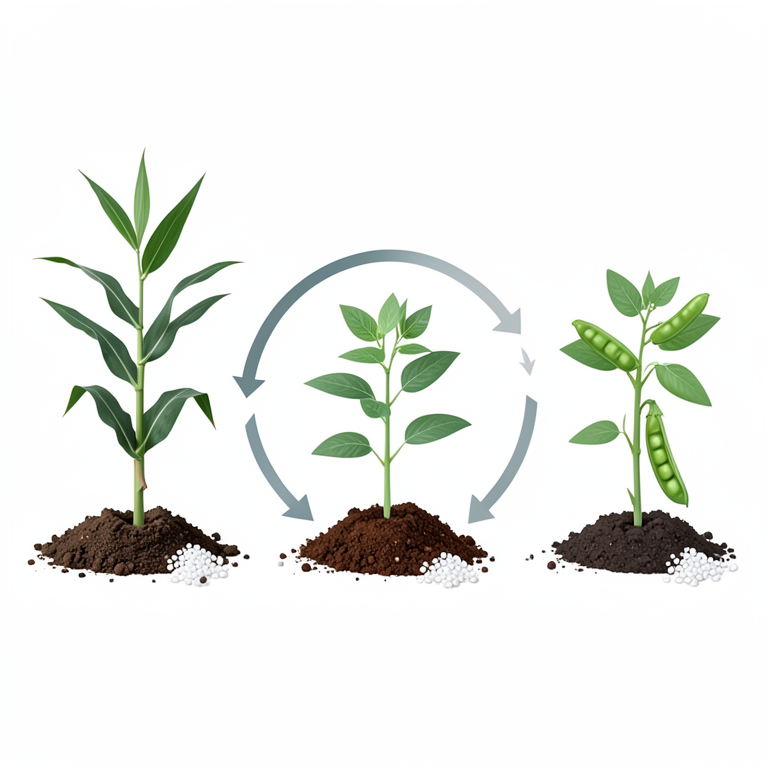
Integrated Nutrient Management Cycle
AI-generated conceptual illustration (field-grown maize and garden pea plants). It explains the idea and does not show study data.
View source evidence ↗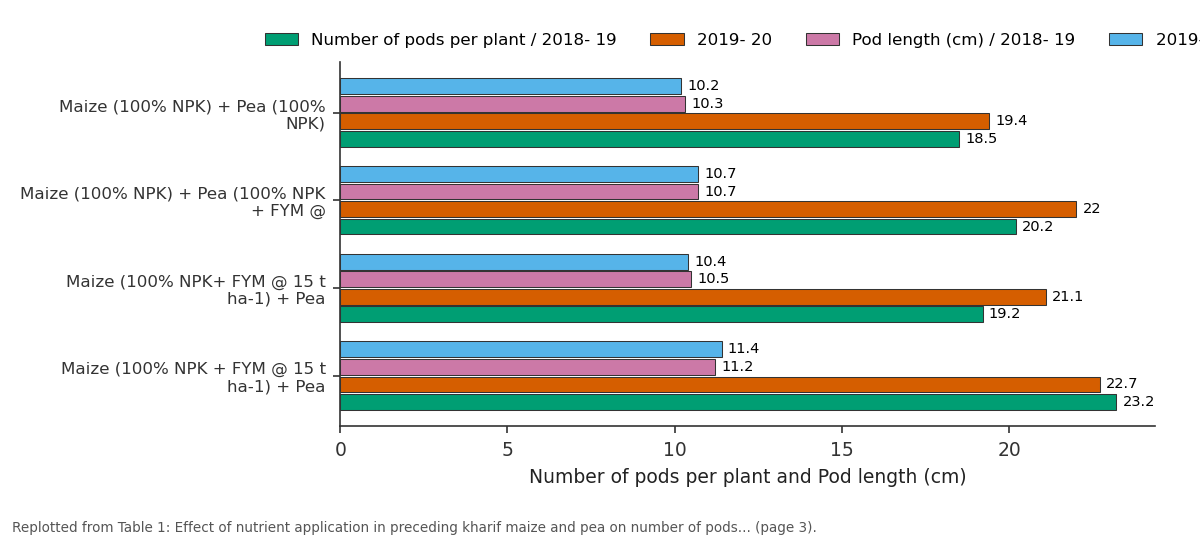
Number of pods per plant / 2018- 19 and 2019- 20 and more: Maize (100% NPK) + Pea... vs Maize (100% NPK) + Pea... vs Maize (100% NPK+ FYM @... vs Maize (100% NPK + FYM @...
Replotted from Table 1 (page 3) of the original paper. Every bar is the paper's own table value.
View source evidence ↗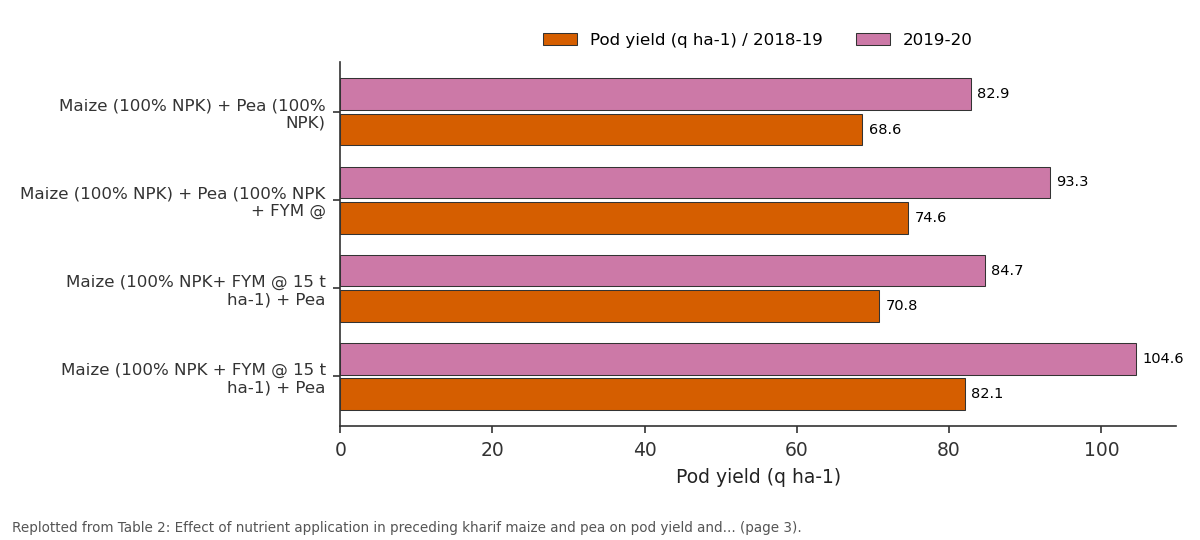
Pod yield (q ha-1) / 2018-19 and 2019-20: Maize (100% NPK) + Pea... vs Maize (100% NPK) + Pea... vs Maize (100% NPK+ FYM @... vs Maize (100% NPK + FYM @...
Replotted from Table 2 (page 3) of the original paper. Every bar is the paper's own table value.
View source evidence ↗Figures & tables
From the original paper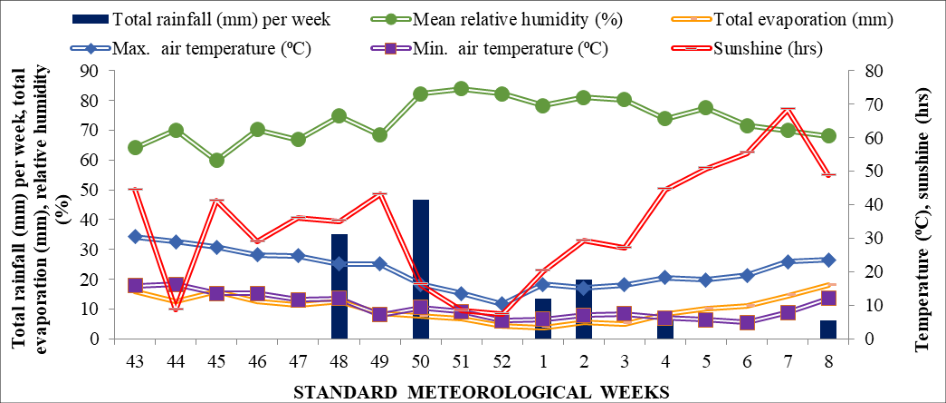 Figure 2
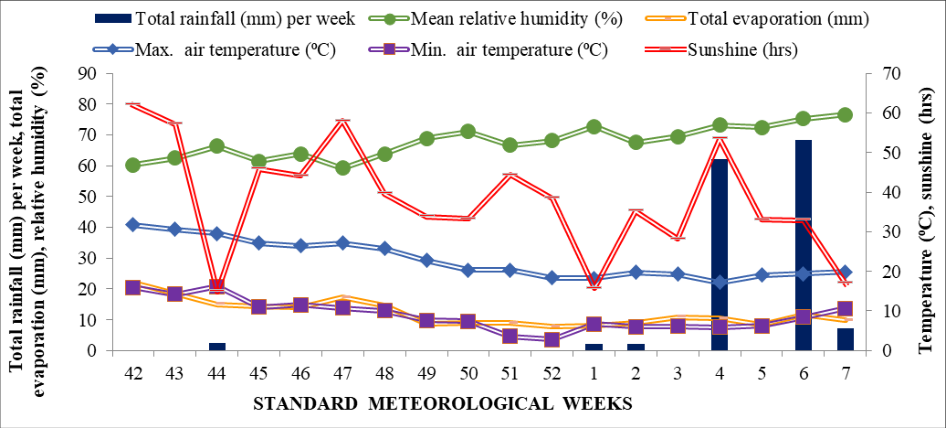 Figure 1
 Table 1
 Table 2
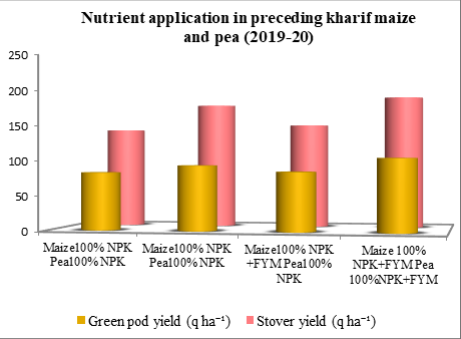 Figure 3
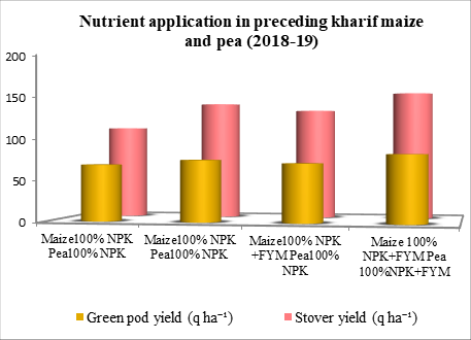 Figure 3
Introduction
Pea (Pisum sativum L.) is a major temperate grain legume widely cultivated worldwide. Pea is commonly used in human diet throughout the world and it is rich in protein (21-25%), carbohydrates, vitamin A and C, calcium, phosphorous and has high levels of amino acids "lysine" and "tryptophan" (Bhat et al 2013) [1] . Cultivation of green pea maintains soil fertility through biological nitrogen fixation while being in association with symbiotic Rhizobium which is present in its root nodules. Thus the crop plays a vital role in fostering sustainable agriculture (Fernandez et al 2021) [4] . Legumes are popular components in diversification strategies, as they provide ecological services to other crops, as well as to the environment. Inclusion of legume will promotes the interaction of soil microorganism for legumes to acquire and use efficiently nitrogen and phosphorus, which will reduce the use of mineral-based fertilizers and increase carbon-dioxide sequestration. Because of the high protein content of their seeds, legumes are used both for food and feed. Legumes fix atmospheric N into the soil and increase grain yield of subsequent crop and consequently total SOC in legumes-cereals rotations (Shah et al 2011) [13] . Pea plays a significant role in integrated nutrient management (INM) systems by contributing to nitrogen fixation, improving soil fertility and supporting sustainable agricultural practices. It is a leguminous crop capable of forming symbiotic relationships with nitrogen-fixing bacteria called rhizobia. These bacteria reside in nodules on pea roots and convert atmospheric nitrogen into a form that plants can utilize for growth (Siddique and Loss 1999) [14] . This process, known as biological nitrogen fixation, reduces the need for synthetic nitrogen fertilizers, thereby promoting sustainable agriculture practices (Herridge et al 1995) [6] . Pea residues, including roots, stems, and leaves, are rich in nitrogen and other nutrients. When these residues decompose, they release nutrients back into the soil, thereby improving soil fertility (Jensen et al 2012) [7] . Incorporating pea into INM systems helps balance nutrient uptake and replenishment in the soil, reducing the risk of nutrient imbalances and deficiencies. This balanced nutrient supply is essential for maintaining crop productivity and soil health INM practices that incorporate pea contribute to environmental sustainability by reducing nitrogen leaching, minimizing greenhouse gas emissions associated with fertilizer production and application and promoting soil health and biodiversity. pea contributes significantly to integrated nutrient management through nitrogen fixation, nutrient recycling, crop rotation, balanced nutrient supply, cost reduction, and environmental benefits. These contributions make pea a valuable component of sustainable agricultural systems.
Materials and Methods
The present investigation was conducted at student research farm, Department of Agronomy, Punjab Agricultural University, Ludhiana during rabi season of 2018-19 and 2019-20. The soil of the experimental site is loamy sand and low in available nitrogen, high in phosphorus and medium in potassium. The experiment conducted in randomized complete block design and replicated thrice. Before pea, kharif maize was sown with two treatment combinations and after harvesting of kharif maize, pea was sown with four treatment combinations randomized into it viz., 100% NPK to maize + 100% NPK to pea, 100% NPK to maize + 100% NPK + FYM @ 20 t ha -1 to pea, 100% NPK+ FYM @ 15 t ha -1 to maize + 100% NPK to pea and 100% NPK + FYM @ 15 t ha -1 to maize + 100% NPK + FYM @ 20 t ha -1 to pea. The recommended fertilizer dose applied to pea was 50:62.5:0 kg N:P2O5:K2O ha -1 . All the fertilizers were applied as basal dose during sowing. Weekly mean maximum air temperature during pea ranged between 17. Number of pods were picked and counted from tagged plants for each picking and at the end of season, the average was expressed as number of pods per plant. Ten pods from each plot were selected randomly during pickings and length of each pod was measured with measuring scale. The average pod length was worked out and expressed in centimeter. Total number of seeds of ten randomly selected pods from each plot was taken and average was expressed as number of seeds per pod. Seed taken for number of seeds per pod were used for 100 seed-weight on fresh weight basis and average 100-seed weight was worked out for each treatment by subtracting the moisture content. The pods per plot were harvested separately and after final picking pods yield per plot was worked out and total yield q ha -1 was calculated. Stover obtained from each plot after separating the pods was sun dried for a week and weight was recorded and expressed as q ha -1 . Analysis of variance was using procedure proposed by Cochran and Cox (1967) [3] . For analysis of data, statistical package CPCS-1, software was developed by department of Mathematics and Statistics, PAU, Ludhiana. Treatments comparison was made at 5 percent level of significance.
Results and Discussion
Results and Discussion
Yield attributes
Data in respect to yield attributes of pea viz., pods per plant, pod length, seeds per pod and 100 seed weight were presented in table 1. A scrutiny of the mean data indicated that application of inorganic fertilizers coupled with FYM had a profound effect on all the yield attributes of pea. Application of 100% NPK + FYM @ 15 t ha -1 to maize and 100% NPK + FYM @ 20 t ha -1 to pea resulted in maximum number of pods per plant (23.2 and 22.7), pod length (11.2 and 11.4 cm) seeds per pod (9.4 & 9.6) and 100 seed weight (23.9 & 24.8 gm) followed by 100% NPK to maize and 100% NPK + FYM @ 20 t ha -1 to pea, which was also statistically at par with 100% NPK + FYM @ 15 t ha -1 to maize and 100% NPK + FYM @ 20 t ha -1 to pea during both the year. Lowest number of pods per plant, pod length were recorded under treatment which involves 100% NPK application to both maize and pea during 2018-19 and 2019-20. The percent increase in number of pods per plant, pod length, seeds per pod and 100 seed weight under 100% NPK + FYM @ 15 t ha -1 to maize and 100% NPK + FYM @ 20 t ha -1 to pea was 25.4 & 17.0%, 8.7 & 11.7%, 10.7 & 17.7% and 22.6 & 18.7% over 100% NPK applied to both maize and pea during 2018-19 and 2019-20, respectively. Treatments having combined application of organic and inorganic nutrient resulted with maximum number of pods per plant as compared to sole application of synthetic fertilizer. This may be attributed to greater root extension under integrated nutrient management that might have helped in greater uptake of different macro and micronutrients and enhanced photosynthesis and photosynthates production and ultimately increased number of pods per plant. These results are in conformity with findings of Singh and Singh (2002) [15] , Meena et al (2007) [9] and Chattoo et al (2009) [2] who observed higher number of pods per plant under mixed application of poultry manure and synthetic fertilizers as compared to use of 100% RDF alone in garden pea. Pandey et al (2006) [10] and Gopinath and Mina (2011) [5] also reported that integrated nutrient management i.e. application of RDF + FYM recorded maximum pod length than use of RDF alone in garden pea. Pod yield: Yield is of paramount importance in the field of agriculture as it directly correlated with net returns and benefit cost ratio. A perusal of the data given in table 2 and fig. 3 showed that significantly higher pod yield was recorded (82.1 and 104.6 q ha -1 ) under treatment which consists application of 100% NPK + FYM @ 15 t ha -1 to maize and 100% NPK + FYM @ 20 t ha -1 to pea during 2018-19 and 2019-20, respectively and it was on par with the treatment involving application of 100% NPK to maize and 100% NPK + FYM @ 20 t ha -1 to pea. During 2018-19 and 2019-20, sole use of synthetic fertilizers i.e 100% NPK application to both maize and pea resulted in minimum pod yield (68.6 and 82.9 q ha -1 ). The increase in pod yield up to a margin of 19.7 and 26.1% was observed under application of 100% NPK + FYM @ 15 t ha -1 to maize and 100% NPK + FYM @ 20 t ha -1 to pea during 2018-19 and 2019-20, respectively, over 100% NPK applied to both maize and pea. This may be due to the fact that initially the chemical fertilizers provided rapidly better nutrition with all essential nutrients and their uptake by the plant which leads to better plant growth. In latter stages, the required plant nutrients are provided through decomposed organic manures for better development of the plants which in turn resulted into higher yield of the crop. These findings are in agreement with those of Kumari et al (2012) [8] , Sepehya et al (2012) [12] and Pawar et al (2017) [11] who reported higher pod yield under integrated application of organic manure and synthetic fertlizers in garden pea.
| Nutrient application to preceding maize and pea | Pod yield (q ha-1) | — | Stover yield (q ha-1) | — |
|---|---|---|---|---|
| 2018-19 | 2019-20 | 2018-19 | 2019-20 | |
| Maize (100% NPK) + Pea (100% NPK) | 68.6 | 82.9 | 114.0 | 145.0 |
| Maize (100% NPK) + Pea (100% NPK + FYM @ 20 t ha-1) | 74.6 | 93.3 | 144.8 | 182.3 |
| Maize (100% NPK+ FYM @ 15 t ha-1) + Pea (100% NPK) | 70.8 | 84.7 | 135.9 | 152.0 |
| Maize (100% NPK + FYM @ 15 t ha-1) + Pea (100% NPK + FYM @ 20 t ha-1) | 82.1 | 104.6 | 157.5 | 193.3 |
| CD (p=0.05) | 8.1 | 11.8 | 25.8 | 24.6 |
Table text extracted from the original PDF; superscript letters are shown inline. The original table image is below.
View original table image
| Nutrient application to preceding maize and pea | Number of pods per plant | — | Pod length (cm) | — | Number of seeds per pod | — | 100-seed weight (g) | — |
|---|---|---|---|---|---|---|---|---|
| 2018- 19 | 2019- 20 | 2018- 19 | 2019- 20 | 2018-19 | 2019- 20 | 2018-19 | 2019-20 | |
| Maize (100% NPK) + Pea (100% NPK) | 18.5 | 19.4 | 10.3 | 10.2 | 8.4 | 8.2 | 19.5 | 20.9 |
| Maize (100% NPK) + Pea (100% NPK + FYM @ 20 t ha-1) | 20.2 | 22.0 | 10.7 | 10.7 | 8.7 | 8.9 | 21.9 | 22.5 |
| Maize (100% NPK+ FYM @ 15 t ha-1) + Pea (100% NPK) | 19.2 | 21.1 | 10.5 | 10.4 | 8.5 | 8.7 | 20.6 | 21.7 |
| Maize (100% NPK + FYM @ 15 t ha-1) + Pea (100% NPK + FYM @ 20 t ha-1) | 23.2 | 22.7 | 11.2 | 11.4 | 9.3 | 9.6 | 23.9 | 24.8 |
| CD (p=0.05) | 3.0 | 2.2 | 0.4 | 0.6 | 0.7 | 0.7 | 2.9 | 2.6 |
Table text extracted from the original PDF; superscript letters are shown inline. The original table image is below.
View original table image
Stover yield
The data given in table 2 and fig. 3 revealed that integrated application of organic and inorganic nutrients significantly influence the stover yield of pea. Conjoint application of organic and synthetic fertilizer i.e. 100% NPK + FYM @ 15 t ha -1 to maize and 100% NPK + FYM @ 20 t ha -1 to pea resulted in significantly higher stover yield (157.5 and193.3 q ha -1 ) in comparison to 100% NPK application to both maize and pea, but it was statistically at par with 100% NPK application to maize and 100% NPK + FYM @ 20 t ha -1 to pea during both the years. With application of 100% NPK + FYM @ 15 t ha -1 to maize and 100% NPK + FYM @ 20 t ha -1 to pea, the increase in stover yield was 38.2 and 33.3% as compared to 100% NPK applied to both maize and pea during 2018-19 and 2019-20, respectively. During both years, 100% NPK application to both maize and pea resulted in the lowest stover yield (114.0 and 145.0 q ha -1 ). Higher stover yield in integrated nutrient management was due to better nutrient and water availability leads to better plant height, dry matter accumulation and leaf area of the plant which ultimately recorded higher stover yield. Pawar et al (2017) [11] also reported higher growth of the plant and stover yield with combined application of organic fertilizers along with chemical fertilizers as compared to sole use chemical fertilizers.
Conclusion
Based on the findings it can be concluded that integrated application of recommended dose of fertilizer and farm yard manure to the crops resulted with significant increase is yield and yield attributes of pea as compared to sole application of synthetic fertilizer.
Acknowledgement
AcknowledgementThe authors thankfully acknowledge the field and laboratory facilities provided by Department of Agronomy, PAU, Ludhiana during the experiment.
Figures and tables from the paper
References
13 in the original paper- Bhat TA, Gupta M, Ganai MA, Ahanger RA, Bhat HA. Yield, soil health, and nutrient utilization of field pea (Pisum sativum L.) as affected by phosphorus and biofertilizers under sub-tropical conditions of Jammu. International Journal of Modern Plant and Animal Sciences. 2013;1:1-8.
- Chattoo MA, Ahmad N, Khan SH, Sidique SH, Hussan K. Residual effect of organic manures and inorganic fertilizers on succeeding crop pea (Pisum sativum L.) cv. Bonneville. Asian Journal of Horticulture. 2009;4:299-304.
- Gopinath KA, Mina BL. Effect of organic manures on agronomic and economic performance of garden pea (Pisum sativum) and on soil properties. Indian Journal of Agricultural Sciences. 2011;81:236-39.
- Herridge DF, Marcellos H, Felton WL, Turner GL, Peoples MB. Chickpea increases soil-N fertility in cereal systems through nitrate sparing and N2 fixation. Soil Biology and Biochemistry. 1995;27:545-51.
- Jensen ES, Peoples MB, Boddey RM, Gresshoff PM, Hauggaard-Nielsen H, Alves BJR, Rahn CR. Legumes for mitigation of climate change and the provision of feedstock for biofuels and biorefineries. A review. Agronomy for Sustainable Development. 2012;32:329-64.
- Kumari A, Singh ON, Kumar R. Effect of integrated nutrient management on growth, seed yield and economics of pea (Pisum sativum) and fertility changes. Journal of Food Legumes. 2012;25:121-24.
- Meena O, Khafi HR, Shekh MA, Mehta AC, Davda BK. Effect of vermicompost and nitrogen on content, uptake and yield of rabi maize. Crop Research. 2007;33:53-54.
- Pandey AK, Gopinath KA, Bhattacharya R, Hooda KS, Sushil SN, Kundu S, Selvakumar G, Gupta HS. Effect of source and rate of organic manures on yield attributes, pod yield and economics of garden pea grown under organic farming system. Indian Journal of Agricultural Sciences. 2006;76:230-34.
- Pawar Y, Varma LR, Verma P, Joshi HN, More SG, Dabhi JS. Influences of integrated use of organic and inorganic sources of nutrients on growth, flowering and yield of garden pea (Pisum sativum L.) cv. Bonneville. Legume Research. 2017;40:117-24.
- Sepehya S, Bhardwaj SK, Dixit SP, Dhiman S. Effect of integrated nutrient management on yield attributes, yield and NPK uptake in garden pea (Pisum sativum L.) in acid Alfisol. Journal of Food Legumes. 2012;25:247-49.
- Shah Z, Ahmad SR, Rahman HU, Shah MZ. Sustaining rice-wheat system through management of legumes. Pakistan Journal of Botany. 2011;43:2093-97.
- Siddique KHM, Loss SP. Grain yield, harvest index, and water use of short-season grain legumes in low-rainfall Mediterranean-type environments. Australian Journal of Agricultural Research. 1999;50:671-684.
- Singh SP, Singh B. Effect of Rhizobium inoculation and phosphorus application on growth and yield of pea (Pisum sativum L.) cv. Bonneville. Bioved. 2002;13:69-72.
Cited by 1
From OpenAlex, OpenCitations and reference lists read by Scinovex
- Influence of integrated nutrient management and foliar NPK application on growth, yield attributes and productivity of garden pea (Pisum sativum L.)
Saloni Yadav, Ashesh N Dwivedi, Avnish Tripathi, Satya Dev Shakya, Anshika Singh Parihar · International Journal of Research in Agronomy · 2026
A field experiment was conducted during the Rabi season at Lalitpur, Uttar Pradesh, India, to assess the effect of inorganic nutrient management on growth and yield of garden pea (Pisum sativum L.). The study was laid out in a randomized block design with three replications and nine treatments comprising different levels of recommended dose of fertilizers (RDF) and foliar application of 1% NPK at flowering, pod formation, and both stages. Results revealed that nutrient management significantly influenced growth, yield attributes, and productivity, while initial plant population remained non-si