
Research article · 2024 · Full text
International Journal of Biology SciencesImpact of Enterobius vermicularis infection on IgE levels among patients in Kirkuk city
Volume 6(1) · Pages 129–131 · DOI: 10.33545/26649926.2024.v6.i1b.199 ↗
Research areasPancreatitis Pathology and Treatment
Abstract
Author-writtenEnterobius vermicularis is the most prevalent parasitic worm that causes Enterobiasis infections. The purpose of this study was to determine the concentration of IgE antibody in children infected with E. vermicularis by using miniVIDAS technique. Blood samples were collected from people infected with pinworms in primary health care centers in Kirkuk city (104 children and 66 adults), whose ages ranged from 1 - 65 years, for both genders, in addition to 50 samples as a control group. The results of the study showed a significant increase in IgE levels for children and adults at the probability level of 0.001 and 0.05 (330.76±72.07), (73.87±51.79) respectively compared with control group the mean serum total IgE was (34.43±26.79), (46.19±33.33) respectively, The aim of this study was to investigate aprobable correlation between the level of IgE and E. vermicularis infection, we compared patients who were positive or negative for enterobiasis regarding IgE levels and control group.
Summary
Source-checkedPlain-language reading of the full paper, prepared with AI and checked against the text. Each point links to the authors' own words.
Why it matters
- Intestinal parasitic infections from helminths are a major global health issue, with over 200 million people infected by Enterobius vermicularis. View evidence ↗
- The IgE antibody is involved in hypersensitivity reactions and is believed to help the body protect itself against parasites. View evidence ↗
- High levels of total serum IgE can indicate a chronic parasitic infection or a specific interaction between the parasite and the host's IgE levels. View evidence ↗
The question
- The study aimed to determine the concentration of IgE antibodies in children infected with E. vermicularis using the mini VIDAS technique. View evidence ↗
What they did
- The study was conducted in Kirkuk City between September 2022 and September 2023. View evidence ↗
- The study sample consisted of 104 infected children and 66 infected adults, with two separate control groups of 25 individuals each. View evidence ↗
- IgE levels were measured in the laboratory using a MiniVIDAS device and a kit from the French company VIDAS. View evidence ↗
- Data analysis was performed using SPSS version 28 and Microsoft Office Excel 2010, employing the Chi-square test for categorical variables. View evidence ↗
What they found
- In children, those infected with E. vermicularis had significantly higher IgE levels (330.76±72.07) compared to the control group (34.43±26.79), with a p-value ≤0.001. View evidence ↗
- In adults, infected individuals showed significantly higher IgE levels (73.87±51.79) than the control group (46.19±33.33), with a p-value ≤0.05. View evidence ↗
What it means
- The authors conclude that E. vermicularis infection leads to higher IgE levels and that age is a determining factor in the magnitude of this increase. View evidence ↗
- The authors state that long-term research is necessary to clearly establish the causal link between helminthic infections and IgE concentrations. View evidence ↗
Visual summary
1 visualsIllustrations explain the paper; they do not show study data.
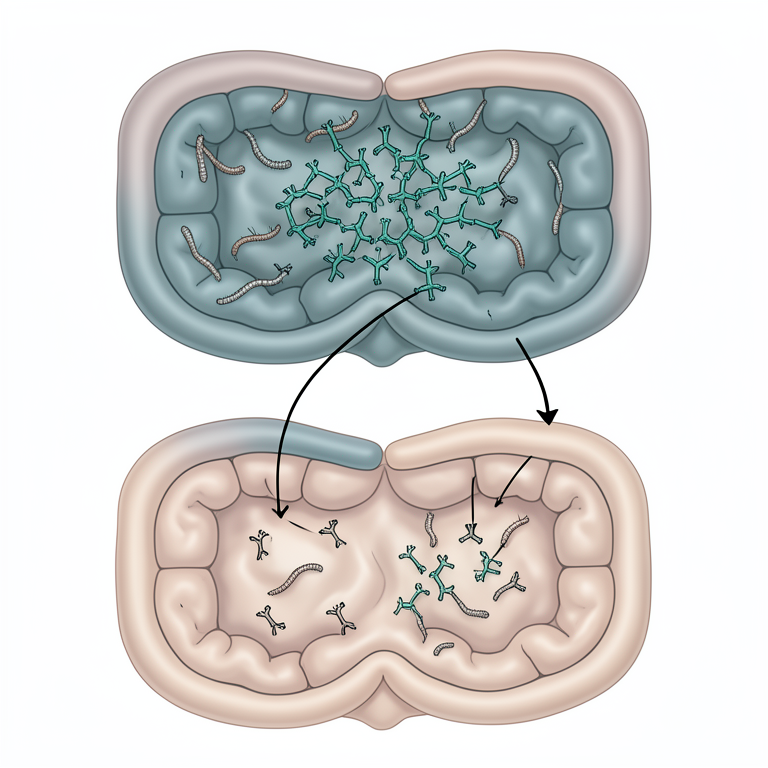
Comparison of IgE Levels
AI-generated conceptual illustration (human intestinal lining and Enterobius vermicularis pinworms). It explains the idea and does not show study data.
View source evidence ↗Figures & tables
From the original paper Table 1
 Table 2
Introduction
Intestinal parasitic infection caused by parasitic helminthes are one of main causes of health problems in worldwide, especially in tropic and sub tropic countries, over than 200 million individuals infected with Enterobius vermicularis (Guimaraes & Nutman, 2018) [14] , Parasitic infection has a significant impact on public health, especially on people living within low standard of living and low levels of awareness (Mutlag et al., 2019) [21] . Parasitic helminths in humans are characterized by their propensity to stay in the host for extended periods and their failure to trigger protective immunity until years or even decades after exposure (Ahmed & Jasim, 2023) [2] . Humans are the final host for E. vermicularis, and the life cycle takes place in all its stages in the digestive system because these worms live in the caecum, colon and rectum, but in general they roam along the alimentary canal from the stomach to the anus, attached to the mucous folds of their lips, and their life cycle simple and direct and does not need an intermediate host (Sharma et al., 2018) [23] , Routine examinations of a stool sample give a positive diagnosis in only 5-15% of infected subjects (Cook, 1994) [10] , The best way to diagnose these worms is to use the scotch tape test, which requires the eggs to be demonstrated. Unlike other intestinal nematodes, pinworms can only be diagnosed by this approach, which is best performed at night or early in the morning. (Al-Jaf et al., 2018) [7] , and another method, through PCR technology (Yahya et al., 2023) [25] . Autoinfection occurs when an individual spreads an infection to themselves, typically by scratching the anal region and then ingesting the contaminated material (fecal-oral transmission). Retroinfection, as described by Horne in 2002, is an uncommon method of infection when eggs near the anus hatch into larvae that go back to the rectum and then to the gut to develop into adult worms (Al-Daoody et al., 2020) [4] . Generally, Enterobiasis is considered as a symptomatic diseases, however, with heavy worm burdens, neurological symptoms such as restlessness, nervousness distraction and irritability, nocturnal enuresis and viginal pruritus and appendicitis (Abbas et al., 2021) [1] and another symptom of the infection is enuresis (Al-Daoody et al., 2020) [4] . The occurrence of intestinal parasites differs depending on geographical location and is influenced by variables such as climate, poverty, malnutrition, high population density, personal and communal cleanliness, and circumstances favorable for the development and transmission of intestinal parasites (Ahmed et al., 2018) [3] .
One of the most intricate systems in the body, the immune system exhibits several clues that Host species' immune responses differ from those of many other species depending on factors including the environment and stage of the life cycle (Al-Kabee, 2014) [8] . IgE antibody is a well-known antibody that is implicated in various hypersensitivity reactions and may also aid in parasite protection (Al-Hashemy, 2019) [6] . It is purported that IgE antibody is secreted from β and plasma cells (Mukai et al., 2016) [20] . IgE, which has a plasma half-life of less than a day, can persist for weeks or months. Its primary function is to protect against parasitic infections, such as those caused by helminths. This is achieved through the activation of Th2 assisted T cells, which generate antibodies to IgE (Fitzsimmons et al., 2014) [13] . Elevated levels of total IgE in the serum are indicative of either chronic parasitic infection or an interaction between IgE levels and parasitic infection; the nature of the helminths and the duration of the infection determine the interaction (Ripa et al., 2010) [22] . Research suggests that individuals with the highest total IgE levels are re-infected following helminth infections treatment in endemic locations (Solmaz et al., 2018) [24] .
Materials and Methods
Materials and Methods
Samples of study
The present study ran from September 2022 to September 2023 in Kirkuk City. The examination was conducted on a group of people infected with the pinworm parasite. Blood samples were collected from patient and control group after taking permission. All blood sample were measured for the amount of IgE. About 2 ml of venous blood was collected including children and adults and both genders. The number included 66 samples from adults, 25 samples used as a control group and 104 samples from children, with 25 samples from the control group. The examination was conducted in the laboratory using the MiniVIDAS device, and the kit was from a company VIDAS of French origin. The samples and kit were placed at room temperature, and after the device was calibrated, the test strips were placed inside the device, and 200 µl of serum were placed in them. The device began to perform the examination automatically, and after about 45 minutes, the test was completed. Get the result printed on the special papers attached to the device.
Statistical analysis
The data was gathered, summarized, analyzed, and presented using the statistical software SPSS version 28 and Microsoft Office Excel 2010. The Chi-square test was utilized to examine the relationship between two categorical variables.
Results and Discussion
The The results are higher and are consistent with the result of (Solmaz et al., 2018) [24] , that observed increase in IgE level 393.10±159.83 IU/ml in patient with E. vermicularis compared with control group (228.90±84.40) in Turkey. and agree with (Hadi & Al-Awadi, 2022) [15] in Kufa city, Iraq, who observed that the level of IgE increased significantly in patients with pin worm infection (120.25±8.7) compared with control group (96.22±11.9), and agree with (Al-Daoody & Al-Bazzaz, 2020) [4] , Erbil province, Iraq, who were found serum total IgE in comparison with the enterobiasis positive -negative group (170.26±216.28), (69.17±129.01) respectively The ability of helminthes to influence their host's immune system in order to secure their survival, and the host's tendency to mount an immunological defense against other infections (Filbey et al., 2019) [12] . IgE primarily functions in the immune response against parasites like helminths.
Elevated levels of IgE have been seen in individuals infected with helminths or parasites. Higher IgE levels were seen in worm infections compared to parasite infections (Bengul et al., 1996) [9] . A high level of IgE indicates that it plays an important role in the immune defense against most parasitic worms (ErbkJ, 2007) [11] . Immunoglobulin has a role in the host's defense against toxins, as tissue injury is the main trigger of immune responses in Th2 cells (Mukai et al., 2016; Kelly & Grayson, 2016) [20,18] . The duration of infection and the type of helminths affect the level of IgE in the blood and the number of eosinophils (Ripa et al., 2010) [22] . The helminths can induce suppressor T cells and lead to alow response against environment allergens. Interleukin -10 reduces Trans forming growth factor beta (TGF-B) (Kilon, 2004) [19] , production of polyclonal IgE against helminthes is common characteristic in atopic individuals (Hagel, 1993) [16] .
Conclusion
The immunological response resulting from a parasite infection is multifaceted and intricate. Antiparasitic stimuli cause a strong Th2 response in parasitic worms, particularly E. vermicularis, which results in the synthesis of IgE immunoglobulin through the production of interleukin-4 and interleukin-5. The study's findings indicate that individuals with the E. vermicularis parasite have greater antibody levels of IgE compared with control group and that age is the determining factor in its height. The findings documented in the literature raise concerns regarding the connection between allergy and parasite infection. To distinctly ascertain the causal link between helminthic infections and IgE concentration, long-term research must be carried out.
Figures and tables from the paper
| IgE | Children | — | — | — | — | — | t. test | P. value |
|---|---|---|---|---|---|---|---|---|
| Cases (No. 104) | Control (No. 25) | |||||||
| Mean ± SD | SE | Min-Max | Mean ± SD | SE | Min-Max | |||
| 330.76±72.07 | 7.07 | 216.80-468.87 | 34.43±26.79 | 5.36 | 2.55-96.04 | 20.176 | <0.001 |
Table text extracted from the original PDF; superscript letters are shown inline. The original table image is below.
View original table image
| IgE | Adult | — | — | — | — | — | t. test | P. value |
|---|---|---|---|---|---|---|---|---|
| Cases (No. 66) | Control (No. 25) | |||||||
| Mean± SD | SE | Min-Max | Mean± SD | SE | Min-Max | |||
| 73.87±51.79 | 6.37 | 12.87-189.56 | 46.19±33.33 | 6.67 | 3.39-109.98 | 2.480 | 0.015 |
Table text extracted from the original PDF; superscript letters are shown inline. The original table image is below.
View original table image
References
18 in the original paper- Ahmed NA, Jasim AH. Frequency of intestinal parasites among school children around Al Hawija, Kirkuk city. Biomedicine. 2023;43(3):988-991.
- Ahmed SA, Guerrero Flórez M, Karanis P. The impact of water crises and climate changes on the transmission of protozoan parasites in Africa. Pathogens and Global Health. 2018;112(6):281-293.
- Al-Daoody AAK, Al-Bazzaz ENH. Impact of Enterobius vermicularis infection on biochemical parameters in the blood of children in Erbil Province, Iraq. BMC infectious diseases. 2020;20:1-6.
- Al-Daoody AAK, Qadir FM, Tahir AA, Mahmood NH, Majeed AF. Risk factors of Enterobius vermicularis infection with symptoms among children in Erbil Governorate. Pak-Euro Journal of Medical and Life Sciences. 2020;3(2):50-58.
- Bengül D, Cengiz Y, Mehmet K, Mehmet R, Riza D, Sami Y, et al. Concentrations of Total Serum IgE in Parasitized Children and the Effects of the Antiparasitic Therapy on IgE Levels. Journal of Turgut & Oumlzal Medical Center 1996;3(4):332-335.
- Cook GC. Enterobius vermicularis infection. Gut. 1994;35(9):1159.
- Erb KJ. Helminths, allergic disorders and IgE-mediated immune responses: Where do we stand? European Journal of Immunology. 2007;37(5):1170-1173.
- Filbey KJ, Camberis M, Chandler J, Turner R, Kettle AJ, Eichenberger RM, et al. Intestinal helminth infection promotes IL-5-and CD4+ T cell-dependent immunity in the lung against migrating parasites. Department of Pathology & Biological Science, University of Otago, Christchurch, New Zealand and 3Australian Institute of Tropical Health and Medicine, James Cook University, Cairns, Australia. Mucosal Immunology. 2019;12(2):352-362.
- Fitzsimmons CM, Falcone FH, Dunne DW. Helminth allergens, parasite-specific IgE, and its protective role in human immunity. Frontiers in Immunology. 2014;5:61.
- Hagel I, Lynch NR, Pérez M, Prisco MCD, López R, Rojas E, et al. Modulation of the allergic reactivity of slum children by helminthic infection. Parasite Immunology. 1993;15(6):311-315.
- Kelly BT, Grayson MH. Immunoglobulin E, what is it good for? Annals of Allergy, Asthma & Immunology. 2016;116(3):183-187.
- Klion AD, Nutman TB. The role of eosinophils in host defense against helminth parasites. Journal of Allergy and Clinical Immunology. 2004;113(1):30-37.
- Mukai K, Tsai M, Starkl P, Marichal T, Galli SJ. IgE and mast cells in host defense against parasites and venoms. In Seminars in immunopathology. Springer Berlin Heidelberg. 2016;38(5):581-603.
- Mutlag SK, Ahmed NA, Abbas SK. Investigation the Role of Blastocystis hominis Effect on The Levels of Il10, Il-18 and Hematological Parameters. Biochemical and Cellular Archives. 2019;19(2):3887-3892.
- Rîpă C, Bahnea RG, Cojocaru I, Luca MC, Ivan A, Luca M, et al. Atopic diseases and intestinal helminth infections. Revista Medico-chirurgicala a Societatii de Medici is Naturalisti Din Iasi. 2010;114(4):1017-1021.
- Sharma M, Kaul R, Chander B. Enterobius vermicularis infestation leading to Meckel's diverticulitis in an adolescent boy: An extremely rare presentation. Journal of Laboratory Physicians. 2018;10(01):106-108.
- Solmaz F, Dikici O, Akduman D, Haksever M, Hakyemez İN, Yanılmaz M, et al. The effect of Enterobius vermicularis infection (Oxyuriasis) on eosinophil and IgE levels in allergic rhinitis. The European Research Journal. 2018;4(4):399-404.
- Yahya NA, Hamad SS, Muhammad DA. Isolation and Molecular Identification of Enterobius vermicularis from Patient in Emigrant Campus. HIV Nursing. 2023;23(1):779-782.