
Research article · 2024 · Full text
International Journal of Advanced Biochemistry ResearchPhysico-chemical characterization of coconut shell (Cocos nucifera)
Volume 8(3S) · Pages 118–122 · DOI: 10.33545/26174693.2024.v8.i3sb.703 ↗
Research areasCoconut Research and ApplicationsPlant-Derived Bioactive Compounds
Abstract
Author-writtenCoconut shell (Cocos nucifera) is a widely available agricultural waste. However, their disposal poses environmental challenges and economic burdens. The study assesses the physical characteristics, proximate analysis, ultimate analysis, and higher heating value of coconut shell (Cocos nucifera). Physical measurements of randomly selected 25 samples revealed average weight, height, and thickness. Proximate analysis of samples indicated low moisture content (7.67%), making it suitable for thermal application process. Calorific value was found to be 4339.85 kcal kg-1, indicating good combustion characteristics. Ultimate analysis using the multilinear regression technique (MLR model) equations showed high carbon content (56.43%), supporting its suitability as a combustion fuel. To explore their potential utilization, this study examines the physico-chemical properties of coconut shells, highlighting their suitability for various applications and underscoring the importance of implementing sustainable waste management approaches.
Summary
Source-checkedPlain-language reading of the full paper, prepared with AI and checked against the text. Each point links to the authors' own words.
Why it matters
- Coconut shells are a common agricultural waste product, but their disposal creates economic burdens and environmental problems. View evidence ↗
- Biomass is considered a vital renewable energy resource because it is carbon neutral, economical, and widely available. View evidence ↗
- Coconut shells are specifically valued as a cost-effective biomass source due to their high volatile and carbon content and low ash content. View evidence ↗
The question
- The study aims to evaluate the physical properties, heating value, and the proximate and ultimate chemical analyses of coconut shells. View evidence ↗
What they did
- The researchers used locally sourced coconut shells collected from locations such as temples and hotels. View evidence ↗
- Physical measurements of weight, height, and thickness were taken from 25 randomly selected half-shell samples. View evidence ↗
- Three samples from the original 25 were selected for the gross heating value and the proximate and ultimate chemical analyses. View evidence ↗
- A bomb calorimeter was used under 25 atmospheric pressure of oxygen to determine the gross heating value. View evidence ↗
- The ultimate analysis for carbon, hydrogen, oxygen, and nitrogen was estimated theoretically using a multilinear regression (MLR) model based on proximate analysis results. View evidence ↗
What they found
- The average physical measurements for the shells were 0.081 kg in weight, 0.065 m in height, and 0.0038 m in thickness. View evidence ↗
- The shells had a relatively low moisture content of 7.67% on a dry basis. View evidence ↗
- Proximate analysis showed the shells contained 66.1% volatile matter, 24.8% fixed carbon, and 1.4% ash. View evidence ↗
- The calorific value of the coconut shell was measured at 4339.85 kcal kg-1. View evidence ↗
- The ultimate analysis revealed an average composition of 56.43% carbon, 37.51% oxygen, 4.16% hydrogen, and 0.48% nitrogen. View evidence ↗
What it means
- The authors conclude that the low moisture content makes coconut shells a suitable fuel for combustion applications. View evidence ↗
- The authors recommend utilizing coconut shells to minimize environmental impact and reduce dependence on finite resources. View evidence ↗
Figures & tables
From the original paper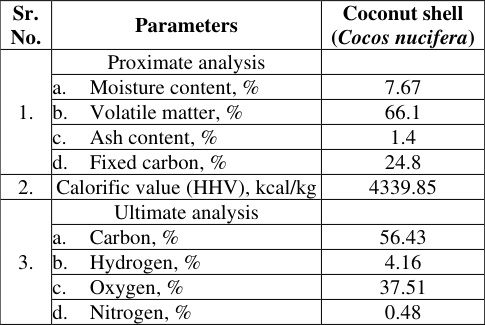 Table 1
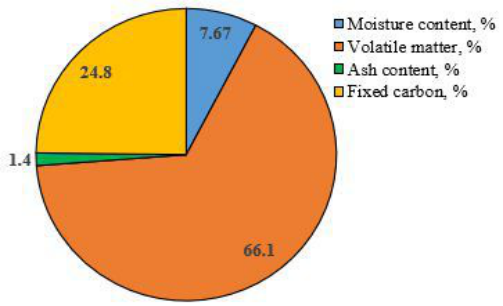 Figure 1
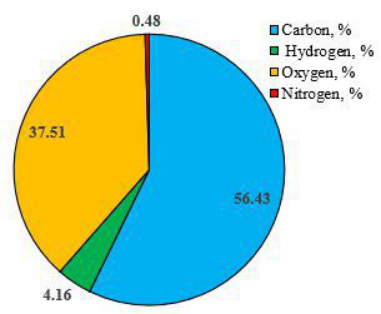 Figure 1
Introduction
Biomass is renewable in nature, plentily available, evenly distributed, carbon neutral and more economical than other renewable sources. It serves as a vital renewable energy resource that accounts for nearly 75 % of rural energy needs, and the rural population constitutes 70 % of the total population of India. Major agricultural crops of the Konkan region in Maharashtra are rice, millets, pulses, coconut, etc. Biomass can either be used directly or converted into other form of energy. The types of biomass usually the ones which are used for burning purposes viz: domestic cooking, heating in rural areas (Komala and Prasad, 2016) [10] . A few names are: Coconut shell, Rice husk, Maize stalks, Ground nut straw/shell, etc. are used for heating and cooking in rural areas. Coconut is cultivated in over 95 countries around the world, in the tropical belt of world over an area of about 12,196 million hectare with production of 69,836.36 million nuts and productivity is 49969 nuts per hectare (FAO, 2019) [6] . The coconut shell (Cocos nucifera) is a widely available agricultural waste renowned for its low ash content, high carbon, and volatiles, making it a cost-effective biomass source and and available in rural areas and during almost all seasons of the year. India, ranking third in coconut production globally, generates approximately 3.18-4.20 million tonnes of coconut shells annually. These shells, alongside fibrous husks, are byproducts of coconut processing, contributing significantly to agricultural waste (Gunasekaran et al. 2012; Prakash et al. 2018) [7,14] . On average each coconut tree yields 70-100 nuts per year which in turn will provide about 21-30 kg of coconut shells (Manjula et al. 1985) [12] . Konkan region of Maharashtra is a major coconut producing region in the Maharashtra. The average production of coconuts in the Konkan region is about 1,313.8 lakh nuts annually (Suhas et al. 2018) [16] . In Konkan region, the average production potential of coconut shell as a biomass is 17,737.64 tonnes annually. Coconut shells and husk are usually biomass or the waste products of coconut processing plants producing coconut oils and coconut flakes. The shell of the mature coconut is a uniformly dense material like hardwood that consists mainly of lignin and cellulose. The coconut shell stands as a significant contributor to global pollution issues, with approximately 3.19 million tonnes generated annually, representing over 60% of India's national waste volume (Ting et al. 2015) [17] . Originating largely from local coconut industries, it constitutes a readily available agricultural waste. With an energy content of 16.7 Giga Joules/ Tonne for husks and a calorific value of 20.81 MJ/kg for shells, they present substantial potential for various applications, including thermal processes (like heating, cooking, drying process), coconut shell powder production, handicrafts, and charcoal production (Dongardive et al. 2019; Raghavan, 2010) [5,15] . However, their disposal poses environmental challenges and economic burdens Keeping all these points in view, the physico-chemical properties of coconut shell (Cocos nucifera) was studied.
Materials and Methods
The research study was carried out by using locally available coconut shell (Cocos nucifera) and these were collected from hotels, temples etc. The physical characteristics of coconut shells were measured by random selection of 25 samples of available coconut shells (half shells) in terms of weight, thickness and height. The proximate analysis, ultimate analysis, and gross heating value of coconut shell (Cocos nucifera) was found by selecting three samples from 25.
Characterization of biomass as feedstock i. Physical characteristics of coconut shell
The physical characteristics of coconut shell were measured by random selection of 25 samples of available coconut shells (half shells) in terms of weight, thickness and height. The weight, thickness and height of 25 randomly selected coconut half shells were recorded by using electronic weighing balance, vernier caliper (L. C. 0.02 mm) and scale.
ii. Proximate analysis
The proximate analysis of sample was conducted using the analytical method ASTME-3173, 3174 and 3175. The analysis of moisture was determined as per ASTME-3173. The quantity of ash was determined according to ASTME-3174. The fraction of volatile was determined as per ASTME-3175 and the fixed carbon was determined by subtracting the summation of volatile matter, moisture content, and ash content from 100.
a. Moisture content
As per the ASTM D-3173, The moisture content of the raw biomass was assessed by measuring the weight loss of the material through the hot air oven drying method. Subsequently, the moisture content was computed by using formula:
d. Fixed carbon
The fixed carbon (FC) content in the sample gives a rough indication of the charcoal yield. The fixed carbon is estimated by using the following formula Fixed carbon (%) = 100 -% of (moisture content + volatile matter + ash)
iii. Heating value of coconut shell
The gross heating value of coconut shell (Cocos nucifera) was found using a bomb calorimeter (ASTME-711) under controlled conditions with 25 atmospheric pressure of oxygen to ensure complete combustion. The water equivalent of the apparatus was determined by burning a known weight (1.0 g) of pure and dry benzoic acid in powdered form in the bomb under identical conditions, with the rise in temperature noted for 5 minutes. The standard heating value of benzoic acid (6324 cal/g) was used to calculate the water equivalent. This allowed for the determination of the higher calorific value of coconut shell (Cocos nucifera) through the bomb calorimeter experiment was determined as
Where, W = Mass of water placed in the calorimeter, g w = Water equivalent of the apparatus, g T1 = Initial temperature of water in the calorimeter, °C T2 = Final temperature of water in the calorimeter, °C tC = Cooling correction tA = Acid correction tF = Fuse wire correction tT = Cotton thread correction m = Mass of fuel sample taken in the crucible, g
iv. Ultimate Analysis
The ultimate analysis includes determination of Carbon content, Hydrogen content, Oxygen content and Nitrogen content of the fuels. The ultimate analysis is helpful in calculating heat balances in any process in which biomass is used as fuel. Using the values of proximate analysis, ultimate analysis of the biomass was calculated by using the multilinear regression technique (MLR model) equations for predicting the elemental compositions of coconut shell (Cocos nucifera) (Lawal et al. 2021) [11] .
Carbon content (C) of the sample was calculated based on the following formula,
The hydrogen (H) content of the sample was calculated theoretically based on following formula, H = -6156.21 + 61.44348FC +61.66506VM + 61.74225A + 61.65247M (8) iii. Oxygen Content, (%)
The oxygen (O) content of the sample was calculated theoretically by using the following formula, O = 31071.47 -309.621FC -310.437VM -312.201A -310.789M
iv. Nitrogen content, (%) Nitrogen content (N) of the sample was theoretically calculated by difference using the following formula,
Where, FC = Fixed Carbon, % A = Ash content, % VM = Volatile matter, % M = Moisture content, %
Results and Discussion
The standard analytical procedures were used to determine the physical characteristics, proximate analysis, calorific value, and ultimate analysis of coconut shell (Cocos nucifera) as per methodology section. It was observed that, the average weight of individual coconut shell was found to be 0.081 kg with average height of 0.065 m and shell thickness was 0.0038 m.
The proximate analysis of coconut shell (Cocos nucifera) in terms of moisture content, volatile matter, fixed carbon content and ash content was determined as presented in Table 1 and Fig. 1 (a). The moisture content of coconut shell (Cocos nucifera) was found to be 7.67 % on dry basis, indicates that relatively low moisture content. The low moisture content of coconut shell makes suitable fuel for combustion applications, offering the potential for improved performance. The moisture content of coconut shell (Cocos nucifera) reported in the range of 7.40-11.00 % (dry basis) by various researches like Irawan et al. (2017) [9] ; Iloabachie et al. 2018 [8] . From experimental data, it was observed that the volatile matter, ash content and fixed carbon of coconut shell (Cocos nucifera) were found as 66.1, 1.4 and 24.8 % respectively. The results showed the feasibility of coconut shell (Cocos nucifera) as a fuel for combustion because of low ash content and higher fixed carbon content. The similar types of work were reported by Parikh et al. (2007) [13] ; Irawan et al. (2017) [9] ; Iloabachie et al. (2018) [8] .
| Sr. No. | Parameters | Coconut shell (Cocos nucifera) |
|---|---|---|
| 1. | Proximate analysis | |
| a. Moisture content, % | 7.67 | |
| b. Volatile matter, % | 66.1 | |
| c. Ash content, % | 1.4 | |
| d. Fixed carbon, % | 24.8 | |
| 2. | Calorific value (HHV), kcal/kg | 4339.85 |
| 3. | Ultimate analysis | |
| a. Carbon, % | 56.43 | |
| b. Hydrogen, % | 4.16 | |
| c. Oxygen, % | 37.51 | |
| d. Nitrogen, % | 0.48 |
Table text extracted from the original PDF; superscript letters are shown inline. The original table image is below.
View original table image
The calorific value of coconut shell (Cocos nucifera) was determined with the help of bomb calorimeter and calorific value of coconut shell (Cocos nucifera) was found to be 4339.85 kcal kg -1 . The coconut shell has higher calorific value indicating good characteristics for combustion because higher heat generated during combustion leads to high temperature in various thermal applications. The similar results of calorific value for coconut shell (Cocos nucifera) was reported by Irawan et al. (2017) [9] ; Iloabachie et al. (2018) [8] .
The ultimate analysis of coconut shell (Cocos nucifera) in terms of carbon (C), hydrogen (H), oxygen and nitrogen content was estimated theoretically from the results obtained in proximate analysis using the multilinear regression technique (MLR model) equations (Lawal et al. 2021) [11] . The ultimate analysis findings for coconut shell (Cocos nucifera) is presented in Table 1 [13] ; Irawan et al. (2017) [9] ; Iloabachie et al. (2018) [8] .
Conclusion
The coconut shell (Cocos nucifera) is recognized as agricultural residue, renowned for its low ash content, high carbon (C), and volatile content. It's readily available at lower costs in rural areas throughout almost every season of the year. The low moisture content (7.67 %) of coconut shell (Cocos nucifera) makes it a suitable fuel for combustion applications, offering the potential for improved performance. Furthermore, its higher calorific value indicates good characteristics for combustion, as higher heat generated during combustion leads to high temperatures in various thermal applications. The elemental composition of coconut shell (Cocos nucifera), as revealed in ultimate analysis using the multilinear regression technique (MLR model) equations, closely relates to the heat of combustion, containing high carbon (C) content which makes it suitable for combustion processes. This study investigates the physico-chemical characteristics of coconut shell (Cocos nucifera), shedding light on its potential as a sustainable and efficient biomass resource for various applications. Hence, the utilization of coconut shell (Cocos nucifera) presents a multitude of opportunities across various applications. Its renewability, environmental friendliness, and costeffectiveness make it a valuable resource in the realm of biomass. By harnessing the coconut shell, we can significantly reduce reliance on finite resources while minimizing environmental impact. From energy production to agricultural uses and beyond, the versatility of coconut shell (Cocos nucifera), as a sustainable material offers a promising avenue for innovation and resource optimization.
References
16 in the original paper- ASTM International. ASTM D3173-87: Standard Test Method for Moisture in the Analysis Sample of Coal and Coke. ASTM Journal of Testing and Evaluation. West Conshohocken, PA: ASTM International; 1987:315-316.
- ASTM International. ASTM D3174-98: Standard Test Method for Ash in the Analysis Sample of Coal and Coke from Coal. ASTM Journal of Testing and Evaluation. West Conshohocken, PA: ASTM International; 1998:1-6.
- ASTM International. ASTM D3175-73: Standard Test Method for Volatile Matter in the Analysis Sample of Coal and Coke. ASTM Journal of Testing and Evaluation. West Conshohocken, PA: ASTM International; 1973:1-5.
- ASTM International. ASTM E711-96: Standard Test Method for Gross Calorific Value of Refuse-Derived Fuel by the Bomb Calorimeter. ASTM Journal of Testing and Evaluation. West Conshohocken, PA: ASTM International; 1996:265-71.
- Dongardive S, Mohod A, Khandetod Y. Slow pyrolysis of coconut shell to produce crude oil. International Journal of Innovations in Engineering and Technology. 2019;12(3):94-97.
- Gunasekaran K, Annadurai R, Kumar PS. Long term study on compressive and bond strength of coconut shell aggregate concrete. Construction and Building Materials. 2012;28:208-215.
- Iloabachie IC, Okpe BO, Nnamani TO, Chime AC. The effect of carbonization temperatures on proximate analysis of coconut shell. Chemical Analysis. 2018;78(16.21):2-4.
- Irawan A, Latifah Upe S, Meity Dwi IP. Effect of torrefaction process on the coconut shell energy content for solid fuel. In AIP Conference Proceedings. 2017;1826(1):020010. AIP Publishing LLC.
- Komala HP, Devi Prasad AG. Biomass: A key source of energy in rural households of Chamarajanagar district. Pelagia Research Library Advances in Applied Science Research. 2016;7:85-89.
- Lawal AI, Aladejare AE, Onifade M, Bada S, Idris MA. Predictions of elemental composition of coal and biomass from their proximate analyses using ANFIS, ANN and MLR. International Journal of Coal Science & Technology. 2021;8:124-140.
- Manjula S, Sudha JD, Bera SC, Pillai CKS. Polymeric resin from renewable resources: studies on polymerization of the phenolic component of coconut shell tar. Journal of Applied Polymer Science. 1985;30:1767-1771.
- Parikh J, Channiwala SA, Ghosal GK. A correlation for calculating elemental composition from proximate analysis of biomass materials. Fuel. 2007;86(1213):1710-1719.
- Prakash A, Vadivel V, Banu SF, Nithyanand P, Lalitha C, Brindha P. Evaluation of antioxidant and antimicrobial properties of solvent extracts of agro-food by-products (cashew nut shell, coconut shell and groundnut hull). Agriculture and Natural Resources. 2018;52(5):451-459.
- Raghavan K. Biofuels from coconuts. Report published by FACT, Mozambique Energy Publication Database. 2010:01-107.
- Suhas JP, Anwarali KS, Mohod AG, Khandetod YP. Energy Balance Study of Combined Carbonization and Liquefaction of Coconut Shell. International Journal of Current Microbiology and Applied Sciences. 2018;7(9):2238-2247.
- Ting T, Jaya R, Hassan N, Jayanti D, Ariffin M. A review of chemical and physical properties of coconut shell in asphalt mixture. Journal Teknologi. 2015;78(4):85-89.
Cited by 7
From OpenAlex, OpenCitations and reference lists read by Scinovex
- Flexural Performance of Unsaturated Polyester Composites Reinforced with Coconut Shell Charcoal Powder for Lightweight Structural Applications ↗
Nusyirwan Nusyirwan, Rispandi, Hendra Hendra, Cheng-Shane Chu · Journal of Composites Science · 2026
Polymer-based composites have emerged as viable alternatives to metals for applications requiring reduced weight, corrosion resistance, and cost-effectiveness; however, their relatively low mechanical strength remains a significant limitation. This study evaluates the flexural performance of unsaturated polyester composites reinforced with coconut shell charcoal (CC) powder at filler contents of 0%, 10%, 20%, and 30% by weight, in accordance with ASTM…
❝ 5PDF - Thermochemical Characterization of Coconut Husk, Rice Husk, and Mineral Coal: A Comparative Assessment for Energy Applications ↗
Stiven J. Sofán-Germán, Fabio L. Acuña-Izquierdo, Jesús David Rhenals Julio, Karen Paola Cacua, Jorge Mario Mendoza Fandiño · Biomass · 2025
This study provides a comparative thermochemical analysis of coconut husk, rice husk and mineral coal, assessing their potential for use in sustainable energy applications. Standardised proximate and ultimate analyses, thermogravimetric (TGA/DTG) evaluations and combustibility index measurements were performed under identical laboratory conditions to ensure consistent comparisons could be made. Coconut husk exhibited the lowest ignition temperature (320.88 °C) and the…
❝ 4PDF - Circular valorization of Argemone ochroleuca seed meal: biomass fractionation, bioethanol production, and hydrothermal carbonization ↗
Tesfaye Kassaw Bedru, Beteley Tekola Meshesha, Shegaw Ahmed Mohammed, Abayneh Getachew Demesa, Samuel Bernardo Pérez Vega, Wondimu Kebede et al. · Bioresources and Bioprocessing · 2025
Abstract Valorization of waste from the agro-industry is important for the advancement of the circular bioeconomy framework and the establishment of integrated, sustainable biorefineries. This study demonstrates the valorization of Argemone ochroleuca seed meal, a hexane-defatted lignocellulosic biomass, for the simultaneous production of bioethanol, hydrochar, and biopolymer precursor. Compositional analysis shows that 30.2% cellulose, 19.7% hemicellulose, and 22.1% lignin, showing…
❝ 3PDF - A holistic review on the structural performance of concrete incorporating palm kernell and coconut shells: an approach to waste management and production of sustainable green composite ↗
Abiodun Joseph KILANI, Bolanle Deborah Ikotun, Rasheed Abdulwahab · Discover Applied Sciences · 2026
The wrong disposal of agricultural residues constitutes environmental pollution and climate challenges to the world. Amongst the consequences of environmental pollution is frequent emission of greenhouse gases (GHGs) from waste, most especially carbon dioxide (CO2) which usually affects the Ozone layer. One of the ways in managing these wastes is by incorporating them into cement composites thus contributing to the…
❝ 1PDF - Integrated valorization of mango kernel biomass for biodiesel and biosyngas production via optimized transesterification and gasification using response surface methodology ↗
JIBRIN MOHAMMED, Matthew Olaleke Aremu, Abdullahi Usman, Ernee Noryana Muhamad · Discover Industrial Chemistry and Materials · 2026
Mango kernel biomass is an abundant yet underutilized agro-industrial residue with considerable potential for sustainable renewable energy production. This study examines the integrated valorization of mango kernel oil and its solid residue for the concurrent production of biodiesel and biosyngas, employing Response Surface Methodology (RSM) to optimize key process variables. Oil was extracted from mango kernels using Soxhlet extraction and…
❝ 0PDF - Valorization of Coconut By-Products Using Eutectic Solvents: A Comprehensive Review on Green Extraction ↗
Lucas S Silva, Renan Paranhos, Márcio L.L. Paredes, Ivaldo Itabaiana, Bernardo Dias Ribeiro · Processes · 2026
Coconut (Cocos nucifera L.) is one of the most widely cultivated tropical crops, generating substantial by-products during industrial processing. Although rich in lignocellulosic components, phenolic compounds, lipids, and other bioactive molecules, they are often discarded or burned as low-grade fuel, causing environmental pollution and the proliferation of disease-carrying vectors. The sustainable valorization of these by-products is therefore essential to reduce…
❝ 0PDF - Enhancing bio-char calorific value through catalytic pyrolysis: The role of magnesium oxide-zeolite based catalysts ↗
Alien Abi Bianasari, Muhammad Saifullah Abu Bakar, Md. Sarowar Khaled, Saepurahman Saepurahman, Dieni Mansur, Абул Калам Азад · International Journal of Renewable Energy Development · 2025
The current research aims to improve the generation of bio-char with elevated higher heating values (HHVs) by utilizing magnesium oxide-zeolite-based catalysts across various temperature conditions. The exploration of biomass catalytic pyrolysis has intensified in the pursuit of sustainable energy solutions. Catalytic pyrolysis offers a technique to convert abundant and renewable biomass resources into valuable biofuels and bio-char, thereby improving energy…
❝ 0PDF