
Research article · 2024 · Full text
International Journal of Geography Geology and EnvironmentAgricultural programmes in socio-economic development of Jammu and Kashmir with special reference to district Anantnag
Volume 6(1) · Pages 251–257 · DOI: 10.22271/27067483.2024.v6.i1d.229 ↗
Research areasAgricultural Economics and PracticesLivestock Management and Performance ImprovementAgricultural risk and resilience
Abstract
Author-writtenAgriculture is the science and art of cultivation of the soil, rearing of livestock and raising of crops. Agricultural sector is considered as the most essential tool for the common masses to get their livelihood. It is estimated that about two-third of population is still dependent on agriculture in India. Throughout the world near about 50% persons are associated with agricultural activities and their production. Soils which are rich in mineral contents and adequate climatic conditions are the factors which are vital for agricultural activity. The contribution of agriculture at national level on Gross Domestic Product is dynamic in nature and has reduced from 30% in 1990-91 to about 14% in 2011-12, it then again increased and reached 17% in 2019-20 up to about 19.9% in 2020-21 but still it is considered as the backbone of Indian economy. Agriculture sector should be given priority in order to make adequate measures to reduce poverty and to provide food security to the common people. The growth of agriculture is vital for inclusive and sustainable development of the nation. The growth of agriculture in India, is facing the challenges of unemployment, rural poverty, underemployment and accessibility of natural resources. The aim of this paper is to highlight whether the Government Policies and Programmes related to agriculture has done well in improving the living standard of people. This paper will focus on whether the people of district Anantnag got benefited from agricultural schemes implemented by the ministry of agriculture.
Summary
Source-checkedPlain-language reading of the full paper, prepared with AI and checked against the text. Each point links to the authors' own words.
Why it matters
- Agriculture is a critical tool for livelihood in India, with approximately two-thirds of the population depending on the sector. View evidence ↗
- Agricultural growth in India is hindered by challenges including rural poverty, unemployment, and limited access to natural resources. View evidence ↗
- In the Union Territory of Jammu and Kashmir, agriculture is vital for inclusive growth as it supports the livelihoods of about 70% of the population. View evidence ↗
The question
- The study aims to evaluate if government agricultural policies and schemes have improved living standards, specifically focusing on beneficiaries in the Anantnag district. View evidence ↗
What they did
- The research utilized secondary data sourced from government records, economic surveys, statistical handbooks for Anantnag (2021-2022), and various academic and journalistic publications. View evidence ↗
- The study focused on the Anantnag district of Jammu and Kashmir, which spans approximately 3,574 square kilometers. View evidence ↗
What they found
- Paddy cultivation area in the district decreased from 28,332 hectares to 20,178 hectares over the study period. View evidence ↗
- Land dedicated to fruits and vegetables increased from 8,032 hectares to 14,976 hectares over a decade. View evidence ↗
- The number of farmers benefiting from agricultural schemes in Anantnag grew significantly from 180 in 2018-19 to 16,751 in 2021-22. View evidence ↗
- The state capex budget had the highest allocation at Rs. 113.09 lakhs, with an expenditure of Rs. 106.84 lakhs in 2021-22. View evidence ↗
What it means
- The authors conclude that both central and state-sponsored agricultural schemes have significantly contributed to the development of rural populations. View evidence ↗
- The authors state that the implementation of high-yielding seeds, training, irrigation schemes, and KCC loans served to reduce poverty and improve the quality of life for farmers. View evidence ↗
Visual summary
3 visualsIllustrations explain the paper; charts are replotted from the paper's own table values.
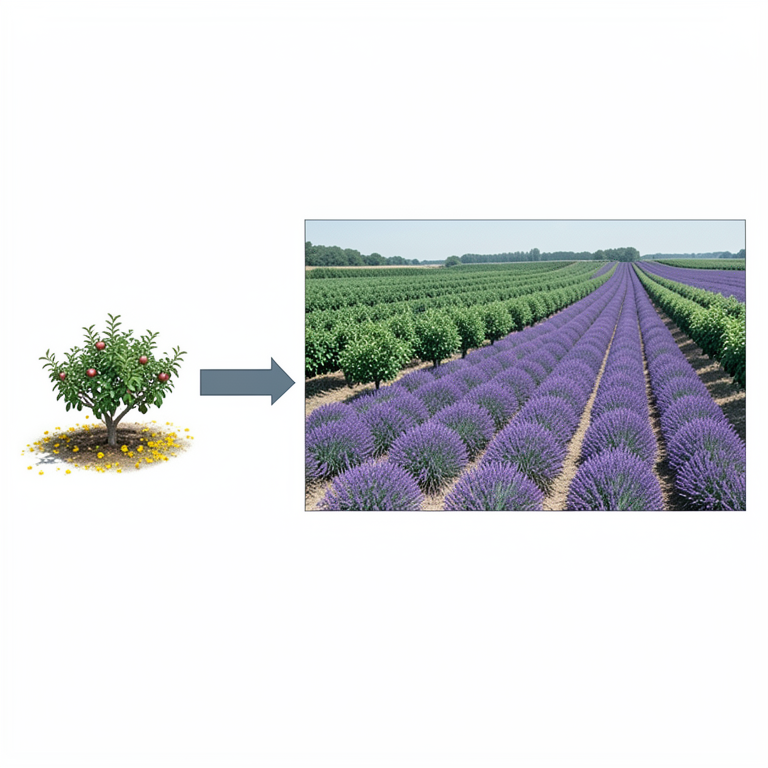
Growth of Scheme Beneficiaries
AI-generated conceptual illustration (Apple orchards and saffron fields in Anantnag, Jammu and Kashmir). It explains the idea and does not show study data.
View source evidence ↗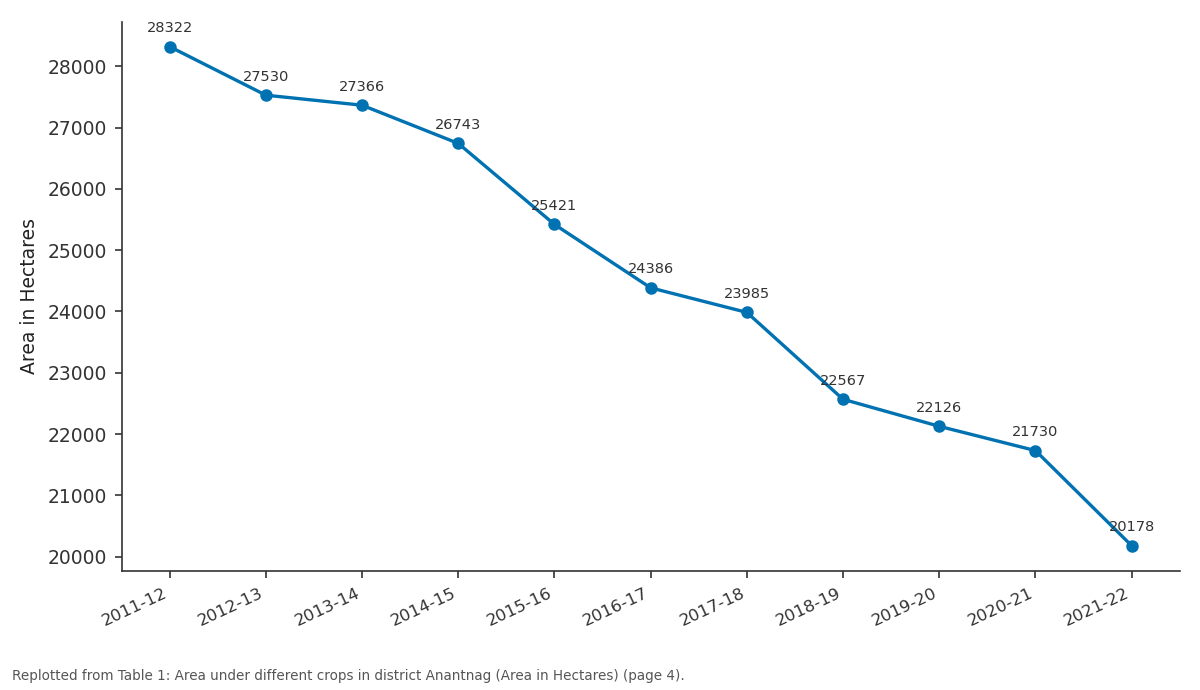
Paddy: 2011-12 vs 2012-13 vs 2013-14 vs 2014-15 vs 2015-16
Replotted from Table 1 (page 4) of the original paper. Every bar is the paper's own table value.
View source evidence ↗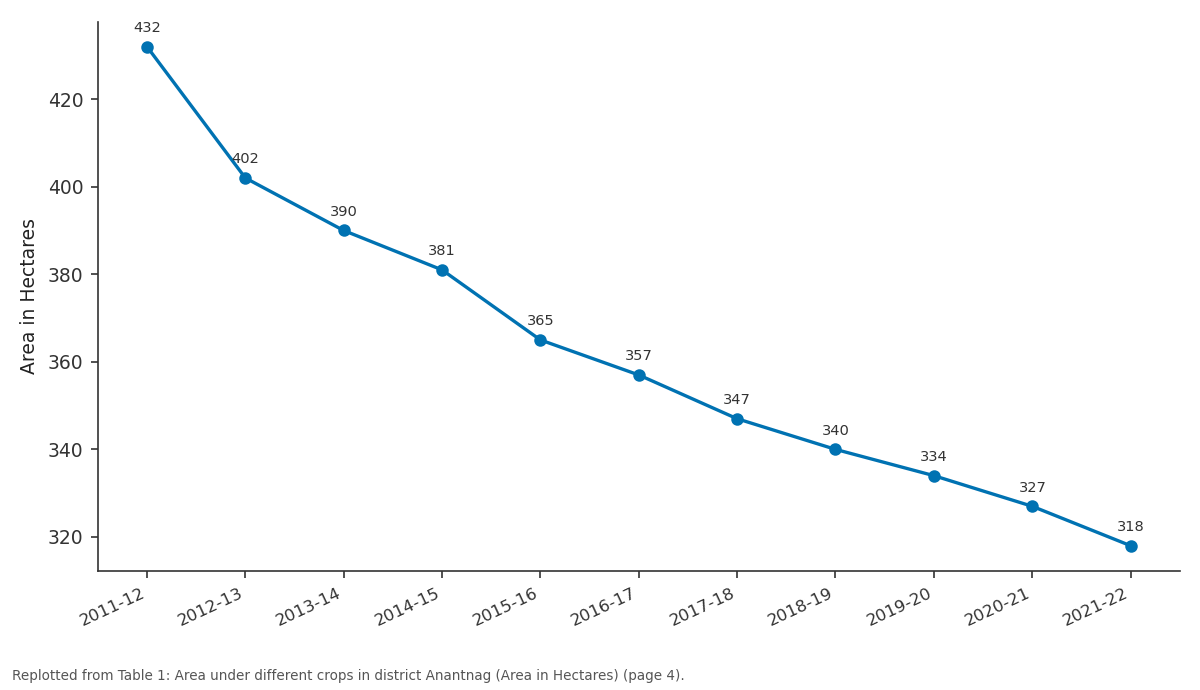
Pulses: 2011-12 vs 2012-13 vs 2013-14 vs 2014-15 vs 2015-16
Replotted from Table 1 (page 4) of the original paper. Every bar is the paper's own table value.
View source evidence ↗Figures & tables
From the original paper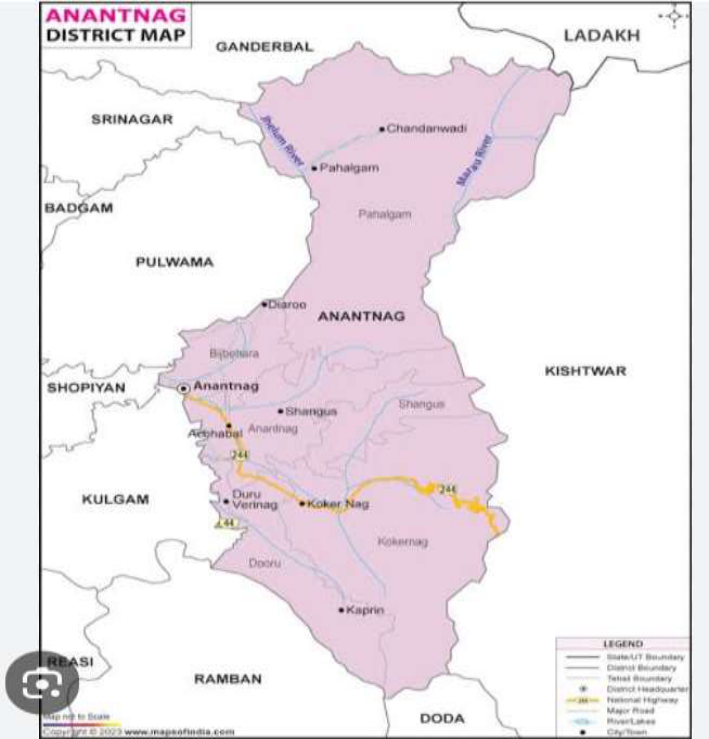 Figure 1
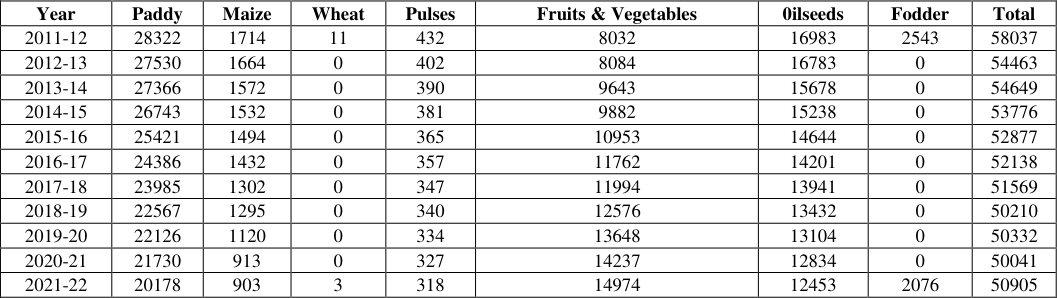 Table 1
 Table 2
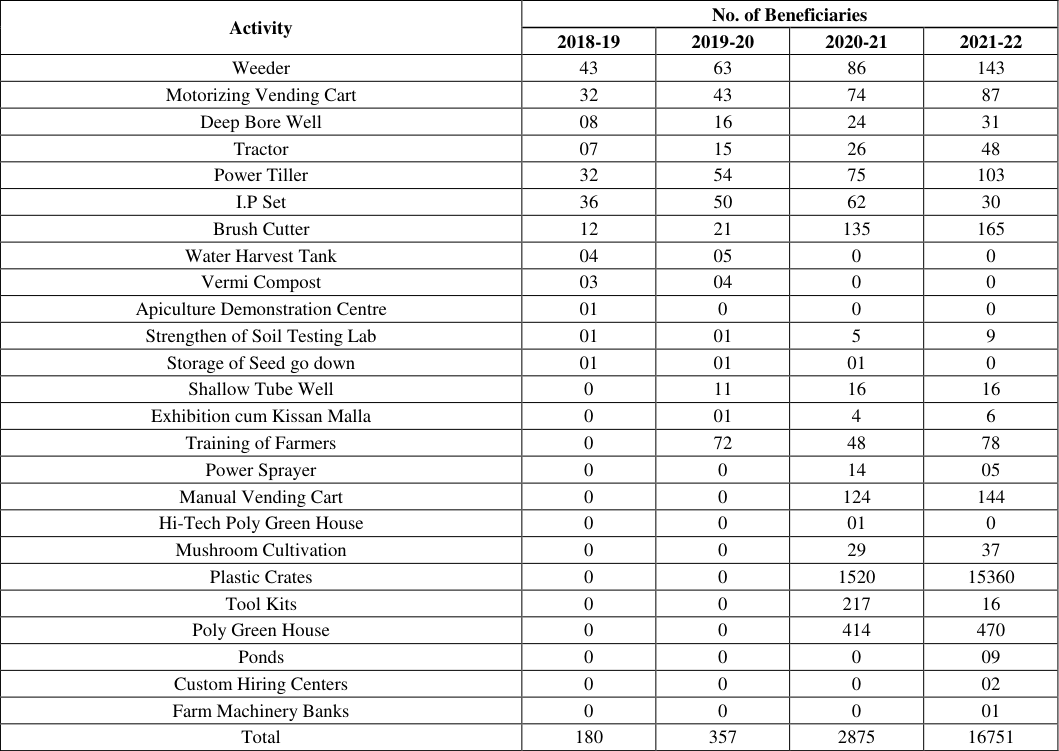 Table 3
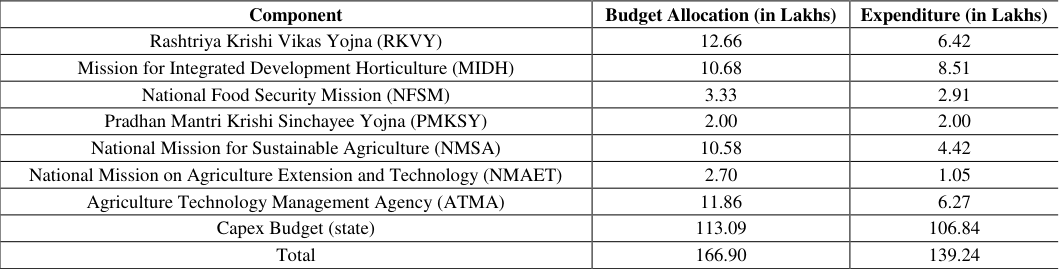 Table 4
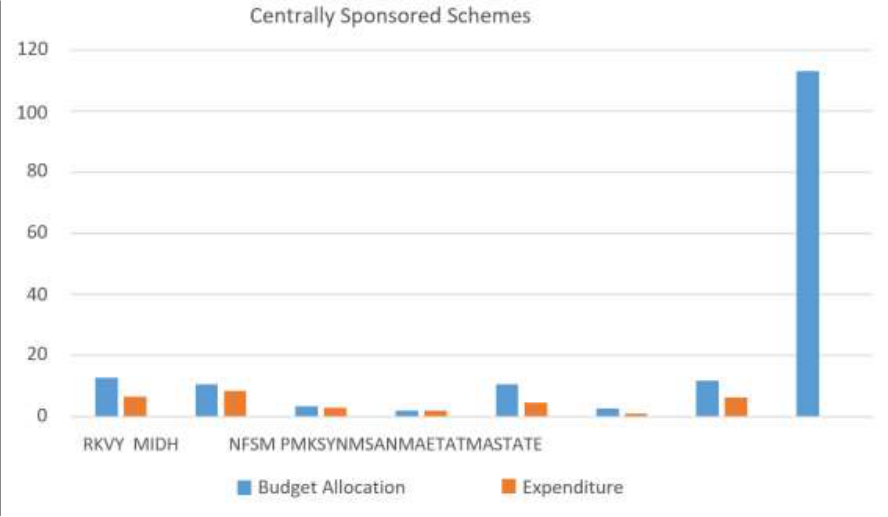 Figure 2
Introduction
The agricultural expansion is a significant challenge before the thinkers and policy makers. The agricultural development refers to increase the agricultural output to meet the growing demands of population by increasing the cropped area, improving the irrigation facilities, use of high yielding variety of seeds, increasing the number of crops grown and by use of fertilizers (Bhat et al., 2019) [3] . The vital goal of agricultural expansion is to increase the food grain production. Agricultural development is the backbone of rural development. The social, cultural and economic development of rural India largely depends on natural resources such as land, water, timber and minerals. India's 65.07% of population belongs to rural area living in more than five lakh villages. Agriculture is the main employment of rural people as the artisans, small farmers and agricultural labourers are engaged with this sector (Khan, 2019) [15] . A large population 812 million, about 60% of India's population is still living in below poverty line and is the main focus of poverty alleviation programmes. In rural India, the standard of living of people is very low as compared to those people living in Urban and sub urban areas because of limited resources that are available there. The villages have less facilities of essential services like drinking water, electricity, roads, schools, libraries, sewage, street lights, garbage collection and lack of transport as compared to cities and towns where every basic service of life is easily available to them. The concept of rural development aims to improve the wellbeing, life style and socio-economic conditions of the rural people (Acharya, 2006) [1] . The process of rural development is meant to bring a change in the socioeconomic development of people living in rural areas (John, 1982) [14] . The Central and State Governments applies different schemes and programmes to act as a stimulant to eradicate poverty to bring a change in rural community.
Agriculture in the Union Territory, Jammu and Kashmir
The Jammu and Kashmir, a newly created Union Territory of India (until October 31, 2019, a state), is located in the northern part of Indian determined by the plains around Jammu to the south and by the valley of Kashmir to the North. In August 2019, the legislation passed a bill through which demotion the Jammu and Kashmir from statehood to union territory and carved out a part of it, known as the Ladakh region, into a separate union territory. Jammu and Kashmir, which was previously one of the largest princely states of India, is restricted to the east by the Indian Union Territory of Ladakh, to the south by the Indian states of Himachal Pradesh and Punjab, to the southwest by Pakistan and to the northwest by the Pakistani-administered portion of Kashmir (https://www.britannica.com). The state forms part of western Himalayan Zone. It has a hilly terrain, mountainous and undulating topography with altitude ranging from 1,850 to 3,048 meters above sea level. Total geographical area of union territory Jammu and Kashmir is 42,241 sq.kms which is equal to 16,309 sq. miles (https://en.m.wikipedia.org). Its population, as per 2011 census, is 12,267,013 residing in 6,652 villages and 3,947 towns providing a density of 290 persons per sq. kms. Villages in the Union Territory are scattered and small. In the Union Territory, the Scheduled Tribe population constitute about 11.9 per cent and the Scheduled Caste population constitute 7.38 per cent of the total population of the Jammu and Kashmir. Scheduled Tribes are concentrated in tribal districts of Poonch and Rajouri, Reasi and Pir Panjal districts of Doda and Kishtwar. For administrative purposes and implementation of development programmes, Jammu and Kashmir is divided into 20 districts, 44 Community Development Blocks. In addition, 3,700 elected Gram Panchayats are taking active part in implementing rural development programmes. The prevalence of poverty in the Union Territory, Jammu and Kashmir is inferior to national average. Based on the latest estimates of percentage of people below the poverty line for 2011-2012, it was 10.35% as against the all-India average of 21.9%. In rural areas of Jammu and Kashmir, 11.54% persons were living below the poverty line against 25.7% for rural India. The incidence of poverty in urban areas of the Jammu and Kashmir was only 7.20% as against 13.7% urban population of India below the poverty line (https://www.tribuneindia.com). The Union Territory, Jammu and Kashmir lies spatially between the geocoordinates of 33 0 2304.62to 34 0 1227.18N latitude and 74 0 1543.32to 75 0 2901.32E longitude (Yadav et al., 2016) [19] with a total area of 42,241 sq. km. As the Union Territory, Jammu and Kashmir is the meeting point of some powers of the world and occupies a unique position in the political geography of India. The temperature of the Union Territory of Jammu and Kashmir varies from one season to another season throughout the year (Hussain, 2016) [11] . The Union Territory, Jammu and Kashmir has swelling topography with different practices and skills of the people to get their livelihood. Agriculture sector and other allied sectors plays a vital role for the socio-economic development of Union Territory, Jammu and Kashmir. In the Union Territory, Jammu and Kashmir around 70% population gets their occupation directly or indirectly from the agriculture and other allied sectors (Department of Agriculture and Cooperation, Annual report, 2016-2017).
The main growing crop of Kashmir valley is Paddy followed by maize, vegetables, fodder, wheat, oilseeds and pulses. The main growing crop of Jammu Division is wheat followed by maize, oilseeds, fodder, vegetables, pulses, oilseeds and other crops. The nature of Union Territory, Jammu and Kashmir is basically agrarian and is a mono cropped land area. Agriculture is the main source of economy. The contribution of agriculture sector in the Union Territory's GDP is gradually declining and is still considered a largest economic sector which acts a vital role in the overall socio-economic development of Jammu and Kashmir. Agriculture development is very essential for the inclusive growth because this sector alone sustains the livelihood of about 70% of population of the Union Territory, Jammu and Kashmir. Agriculture sector alone contributes about 14.85% to the GDP of Jammu and Kashmir. The low contribution of GDP is due to the reason that the production of our agricultural crops is very inefficient as against to other states and rest of the country (J&K, Economic survey, 2014-2015). The deficit of technology and modern machinery is another cause of low agricultural output of major crops of the Union Territory, Jammu and Kashmir (Rubeenah and Rekha, 2015) [17] . The Union Territory, Jammu and Kashmir has a diverse agro climatic circumstances which are adequate for growing horticultural and agricultural crops. Irrigation facilities and fertile soils are the vital input for the development of agricultural and horticultural sectors in the Union Territory, Jammu and Kashmir. The world's high quality saffron and black zeera are cultivated in the Kashmir province and has an international identity (Department of Horticulture. J&K, Srinagar, 2019-20) [6] .
Research Methodology
The present study is based on secondary data. The data is collected from text books, newspapers, articles, journals, periodicals, publications, web sites, Government official records, economic survey, statistical digest, statistical handbook district Anantnag 2021-2022 etc.
Study Area
The researcher selects district Anantnag as the study area in the Union Territory, Jammu and Kashmir. District Anantnag covers geographical area of about 3574 square kilometers with varied topographical features situated at a distance of 53 km from Srinagar. Geographically the district lies between 33 0 20to 34 15 North latitude and 74 30 to 75 35 East longitude and at an elevation of 1600 meters above sea level. The district is bordered by Kargil and Kishtiwar in the East, Doda and Ramban to the South, Srinagar, Pulwama, Kulgam and Shopian to the West and Ganderbal to the North. Anantnag features a modrate climate with average annual rainfall 916 mm. Summer is usually mild and with a little rain, but relative humidity is generally high and the nights are cool. The hottest month is July 6 °C to 32 °C and coldest are December -15 °C to 0 °C. The texture of soils found in Anantnag varies from silty clay loam (80%) to sandy clay loam (20%) with good production potential. Agriculture is an important occupation in the district, because population resides in rural areas and are involved directly or indirectly in cultivation. Agriculture is the main sources of income for thousands of families with 54986 hactares of cultivated land covering 14% of total net sown area of Kashmir division. The irrigated area is 28617 ha while unirrigated area comprises of 26369ha. The staple food of the district is Rice. The main food crops grown in the district are paddy followed by Maize and Pulses.
Location Map of District Anantnag
Anantnag district is in southern sector of Jehlum valley. Agricultural activities are the main features of district Anantnag. Agriculture plays an important role to provide food and livelihood to a large percentage of population involved in this sector directly or indirectly. The principal crop grown in the district Anantnag is Rice, followed by maize, pulses, vegetables and fodder, potato and oil seeds (Department of Agriculture and Farmers Welfare District Anantnag). Plantation of medicinal plants, willows, popular and keeker also contributes in the economic development. More than30% agricultural land in the district has been diverted to horticultural land leaving only about 60 to 70% land under agricultural purposes. The total cultivated area of district is 21597 hectares out of which 18392 hectares are under irrigated area and 19542 are under remaining sown area (Fig. 1).
[Source: www.mapsofindia.com) Similarly, area under pulses decreases from 432 hectares to 318 hectares. Area under fruits and vegetables also increases and reaches from 8032 hectares to 14976 hectares during a decade and area under fodder decreases from 2543 to 2076 hectares. While as the area under wheat cultivation shows a negative trend and reaches to three hectares from 11 hectares of land. The area under oilseeds shows also a slight negative trend and reaches 12453 hectares from16983 hectares of land. The Table 2 shows the food grain production in district Anantnag for the year 2021-22. The production of paddy 67557 quintals is the highest in the district. Followed by Maize 48267 quintals and the least production 3810 quintals is of pulses. The production of wheat and cereals are zero quintals for the year 2021-22. Thus paddy ranks first, Maize second and pulses third in terms of food grains production in the district. This scheme was launched by central government in order to increase the production of rice, wheat and pulses. The production of yield was increased by expanding area in a sustainable manner in a few identified districts of the country. The soil fertility and productivity were restoring at individual farm level by applying new methods and techniques to improve the income level of farmers which acts as a stimulant to create new job opportunities for rural people to enhance the living standard of people. The main objective of the scheme to increase the overall production would remain continue during12th plan which has target of additional production of 25 million tons of food grains comprising 10million tons of rice, 8 million tons of oil seeds, 4million tons of pulses and 3 million tons of coarse cereals.
National Mission for Sustainable Agriculture (NMSA):
The main purpose of this scheme is to make agriculture more sustainable, productive and climatic robust by developing composite and integrated agricultural farm systems. The natural resources are brought under sustainable control. The conservation of soil and efficient water management practices are the controlling factors that are helpful to boost the agricultural sector to stream line the living standard of people on modern style who are directly and indirectly involved with this sector. The soil test based on macro and micro nutrients, soil health management practices based on soil fertility and the judicious use of fertilizers are the other measures which are used to expand coverage area for achieving better yield production. The pilot models are used in the selected blocks to improve the agricultural production in the rain fed farming areas by rainfed technologies.
National Mission on Agricultural Extension and Technology (NMAET):
The main aim of this scheme is to strengthening the extension machinery and utilizing it for the improvement of agricultural outputs under the umbrella of Agriculture Technology Management Agency (ATMA). Agricultural technology includes the promotion of inputs and improved agronomic practices under the 17 different schemes of Department of Agriculture and Cooperation during the 11 th five-year plan to envisage the farmer's wellbeing through the amalgamation of these schemes. This scheme consists of four Sub Missions: i) Sub Mission on Agricultural Extension(SAME) ii) Sub Mission on Agricultural Mechanization (SMAM) iii) Sub Mission on Seed and Planting Material(SMSP) iv) Sub Mission on Plant Protection and Plant Quarantine.
Mission for Integrated Development of Horticulture (MIDH):
This scheme is implemented by central government in order to promote better growth of horticulture sector. The strategies that are used to develop the horticultural sector includes technology promotion, research and post-harvest management, processing and marketing with the diverse agro-climatic features. The development process usually takes place in fruits, mushrooms, vegetables, spices, tuber crops, aromatic plants, flowers and plantation crops like coconut, cashew nut, arecanut, bamboo and cocoa. This scheme enhance s horticulture production, increases income level of the farmers and strengthen nutritional security of the general masses. It improves horticultural productivity by use of quality germplasm and by the use of efficiency water through micro irrigation canals and pumps. The scheme contributes much to enhance skill development among youth and provide employment opportunities to rural youth in the horticulture sector.
Rashtriya Krishi Vikas Yojna (RKVY):
The purpose of this scheme is to achieve the sustaining annual growth rate of agricultural development and its allied sectors during the 12 th five year plan period. The objective of this scheme is to enhance the public investment in the agriculture and allied sectors. This scheme provides autonomy and flexibility for the development plan of agriculture and allied sectors. This scheme is implemented to reduce the yield gap among different crops and to minimize the returns of the farmers in the agricultural sector.
Pradhan Mantri Krishi Sinchayee Yojna (PMKSY):
This is a centrally sponsored scheme which is used to increase the agricultural production and productivity in order to increase the income level of farmers. The broad objectives of this scheme like social, technical and economic include the convergence of investments in irrigation at the field level to expand cultivable land area under the assured irrigation supply. The efficient use of water resource through appropriate technologies to reduce wastage and increase availability of food production to improve the living standard of life. The recharge of aquifers enhances the sustainable conservation to promote rain-fed development areas from groundwater which support extension of agriculture. The Table 3 depicts the number of beneficiaries under different agricultural sponsored schemes in district Anantnag. The Table 4 shows the number of beneficiaries under different centrally sponsored agricultural programmes to eradicate the poverty from the district. The agricultural farmers are provided tool kits, tractors, poly green houses and other facilities to increase the production of food grains. Training camps are conducted by the district administrative authority to train the farmers with modern techniques of farming. The table shows that 180 farmers were benefited during the year 2018-19. In the year 2019-20 the number rose to 357. Similarly, 2875 farmers were benefited in the year 2020-21 and 16751 farmers were benefited during the year 2021-22. The
| Component | Budget Allocation (in Lakhs) | Expenditure (in Lakhs) |
|---|---|---|
| Rashtriya Krishi Vikas Yojna (RKVY) | 12.66 | 6.42 |
| Mission for Integrated Development Horticulture (MIDH) | 10.68 | 8.51 |
| National Food Security Mission (NFSM) | 3.33 | 2.91 |
| Pradhan Mantri Krishi Sinchayee Yojna (PMKSY) | 2.00 | 2.00 |
| National Mission for Sustainable Agriculture (NMSA) | 10.58 | 4.42 |
| National Mission on Agriculture Extension and Technology (NMAET) | 2.70 | 1.05 |
| Agriculture Technology Management Agency (ATMA) | 11.86 | 6.27 |
| Capex Budget (state) | 113.09 | 106.84 |
| Total | 166.90 | 139.24 |
Table text extracted from the original PDF; superscript letters are shown inline. The original table image is below.
View original table image
| Activity | No. of Beneficiaries | — | — | — |
|---|---|---|---|---|
| 2018-19 | 2019-20 | 2020-21 | 2021-22 | |
| Weeder | 43 | 63 | 86 | 143 |
| Motorizing Vending Cart | 32 | 43 | 74 | 87 |
| Deep Bore Well | 08 | 16 | 24 | 31 |
| Tractor | 07 | 15 | 26 | 48 |
| Power Tiller | 32 | 54 | 75 | 103 |
| I.P Set | 36 | 50 | 62 | 30 |
| Brush Cutter | 12 | 21 | 135 | 165 |
| Water Harvest Tank | 04 | 05 | 0 | 0 |
| Vermi Compost | 03 | 04 | 0 | 0 |
| Apiculture Demonstration Centre | 01 | 0 | 0 | 0 |
| Strengthen of Soil Testing Lab | 01 | 01 | 5 | 9 |
| Storage of Seed go down | 01 | 01 | 01 | 0 |
| Shallow Tube Well | 0 | 11 | 16 | 16 |
| Exhibition cum Kissan Malla | 0 | 01 | 4 | 6 |
| Training of Farmers | 0 | 72 | 48 | 78 |
| Power Sprayer | 0 | 0 | 14 | 05 |
| Manual Vending Cart | 0 | 0 | 124 | 144 |
| Hi-Tech Poly Green House | 0 | 0 | 01 | 0 |
| Mushroom Cultivation | 0 | 0 | 29 | 37 |
| Plastic Crates | 0 | 0 | 1520 | 15360 |
| Tool Kits | 0 | 0 | 217 | 16 |
| Poly Green House | 0 | 0 | 414 | 470 |
| Ponds | 0 | 0 | 0 | 09 |
| Custom Hiring Centers | 0 | 0 | 0 | 02 |
| Farm Machinery Banks | 0 | 0 | 0 | 01 |
| Total | 180 | 357 | 2875 | 16751 |
Table text extracted from the original PDF; superscript letters are shown inline. The original table image is below.
View original table image
Conclusion
The Indian population mostly lived in rural areas. The 70% of Indian population is wholly and solly dependent on agriculture sector. In rural population almost 80% depends on agriculture sector being small and marginal farmers (Jalan, 1992) [13] . Thus, development of rural population mostly depends on agricultural sector. The Government of India, since independence focused on agricultural development which is prevalent by the fact that in the first five year plan (1951-1956) priority was given to agriculture sector. The central as well as the state Governments from time to time implemented many poverty all aviation programmes in order to improve the quality of life and socio-economic development of rural masses up to till date. The research highlighted various schemes and their role to improve the socio-economic conditions of rural people. High Yielding Variety of seeds, skill development programmes and training awareness programmes and new irrigational facility schemes were launched, even KCC loan were provided to farmers to eradicate their poverty level, to improve their socio-economic conditions and quality of life. The Department of Agriculture Kashmir, under the guidance of Director Agriculture Kashmir started to develop Kitchen Garden during the year 2019-2020 under the umbrella of Capex Budget, encouraged the rural women to form selfhelp groups to empower themselves to modify their socioeconomic conditions. The department of Agriculture District Anantnag also made self-help groups and imparting training to the rural women for their skill development. The Department of Agriculture and Farmers Welfare, Kashmir has developed the initiative to grow the packed mushroom sacks as their source of income. Sericulture, apiculture, horticulture and floriculture like practices were given keen attention to develop the minsucha way to act as a source of income to increase the income level of farmers and improve their socio-economic conditions. The central and the state sponsored schemes significantly helped in the development of rural people.
Figures and tables from the paper
| Year | Paddy | Maize | Wheat | Pulses | Fruits & Vegetables | 0ilseeds | Fodder | Total |
|---|---|---|---|---|---|---|---|---|
| 2011-12 | 28322 | 1714 | 11 | 432 | 8032 | 16983 | 2543 | 58037 |
| 2012-13 | 27530 | 1664 | 0 | 402 | 8084 | 16783 | 0 | 54463 |
| 2013-14 | 27366 | 1572 | 0 | 390 | 9643 | 15678 | 0 | 54649 |
| 2014-15 | 26743 | 1532 | 0 | 381 | 9882 | 15238 | 0 | 53776 |
| 2015-16 | 25421 | 1494 | 0 | 365 | 10953 | 14644 | 0 | 52877 |
| 2016-17 | 24386 | 1432 | 0 | 357 | 11762 | 14201 | 0 | 52138 |
| 2017-18 | 23985 | 1302 | 0 | 347 | 11994 | 13941 | 0 | 51569 |
| 2018-19 | 22567 | 1295 | 0 | 340 | 12576 | 13432 | 0 | 50210 |
| 2019-20 | 22126 | 1120 | 0 | 334 | 13648 | 13104 | 0 | 50332 |
| 2020-21 | 21730 | 913 | 0 | 327 | 14237 | 12834 | 0 | 50041 |
| 2021-22 | 20178 | 903 | 3 | 318 | 14974 | 12453 | 2076 | 50905 |
Table text extracted from the original PDF; superscript letters are shown inline. The original table image is below.
View original table image
References
5 in the original paper- Department of Agriculture and Cooperation, Ministry of Agriculture. Annual report. New Delhi: Department of Agriculture and Farmers Welfare, Govt. of India; District Anantnag; c2016-2017.
- Govt. of J&K. Economic survey. Directorate of Economics and Statistical Planning; c2014-2015.
- Irshad AW, Ahrar AH, Zuber SM. Revisiting Social Stratification in Indian Society: A Review and Analysis with Focus on Kashmiri Society. International Journal of Humanities and Social Science Invention. 2013;2(12):57-66.
- Rubeenah A, Rekha A. Changes in Cropping Pattern in Jammu and Kashmir. International Journal of Advanced Research in Education and Technology. 2015;2(4):8891.
- Wani MA, Mir MS. Agriculture and Socio-Economic Structure in Kashmir Valley (With Special Reference to Block Awantipora). International Journal of Engineering, Science, and Computer. 2019;9(2):1965719660.
Cited by 1
From OpenAlex, OpenCitations and reference lists read by Scinovex
- The Institutional Foundations of Behavioural Control: Extending Behavioural Control Theory in Agricultural Entrepreneurship ↗
Aiman Fayaz, Abid Sultan, Farhet Ahmad Shaheen · Research Square · 2026
❝ 0PDF