
Research article · 2024 · Full text
International Journal of Advanced Biochemistry ResearchStudy on the profile of beneficiaries of agriculture technology information centres
Volume 8(3S) · Pages 01–04 · DOI: 10.33545/26174693.2024.v8.i3sa.676 ↗
Research areasDiverse Educational Innovations Studies
Abstract
Author-writtenThe present investigation was undertaken in the Marathwada region of Maharashtra state during the years 2021–22. For the study, a sample of 180 ATIC beneficiaries was collected. The research design ex post facto were used. The analysis of profile of the ATIC beneficiaries indicates that majority of them belonged to middle age (45.55%), High school (8th to10th standard) (40.55%), Medium Family size (63.88%), Farming occupation (41.12%), land holding (43.88) medium annual income (76.67%), medium Farming experience (54.44%), medium Social participation (60.55%), medium Source of information (65.56%), medium Scientific orientation (80.00%), medium Economic motivation (78.89%), One training (33.34%).
Summary
Source-checkedPlain-language reading of the full paper, prepared with AI and checked against the text. Each point links to the authors' own words.
Why it matters
- The extension education system is designed to spread agricultural information and new research-based practices from academic and research institutions to the field. View evidence ↗
- Launched in 1999, Agricultural Technology Information Centres (ATIC) provide a 'single window' system for farmers to access advice, seeds, plant materials, and technological information. View evidence ↗
- ATICs are intended to act as a formal organizational bridge connecting scientists with farmers. View evidence ↗
The question
- The study aims to examine the profile of ATIC beneficiaries and assess the impact the centres have on them. View evidence ↗
What they did
- The research was conducted in the Parbhani and Hingoli districts of the Marathwada region in Maharashtra state. View evidence ↗
- A total of 180 beneficiaries were selected for the study, with 10 individuals randomly chosen from each selected village. View evidence ↗
- Data collection was performed using an interview schedule and an Impact Scale. View evidence ↗
- The study analyzed several independent variables, including age, education, family size, occupation, land holding, income, farming experience, social participation, information sources, scientific orientation, economic motivation, and training received. View evidence ↗
What they found
- The largest age group among beneficiaries was the middle-age category (36 to 50 years), representing 45.55% of the sample. View evidence ↗
- Regarding education, 40.55% of beneficiaries had reached a high school level (8th to 10th standard). View evidence ↗
- A majority of the beneficiaries (63.88%) had a medium family size consisting of 5 to 7 members. View evidence ↗
- The most common occupational profile was a combination of farming, service, and business, held by 41.12% of beneficiaries. View evidence ↗
- The most frequent land holding size was medium (2.01 to 4.00 ha), accounting for 43.88% of beneficiaries. View evidence ↗
- Over three-quarters (76.67%) of the beneficiaries reported a medium annual income between Rs. 76,626 and Rs. 4,51,557. View evidence ↗
- More than half of the beneficiaries (60.55%) exhibited a medium level of social participation. View evidence ↗
- A high proportion of beneficiaries (80.00%) possessed a medium level of scientific orientation. View evidence ↗
- The majority of beneficiaries (78.89%) reported a medium level of economic motivation. View evidence ↗
- The most common level of training received was a single training session, reported by 33.34% of beneficiaries. View evidence ↗
What it means
- The authors conclude that marginal agricultural segments need to be updated with the latest digital information and training skills in agriculture and related sectors. View evidence ↗
Visual summary
2 visualsIllustrations explain the paper; charts are replotted from the paper's own table values.
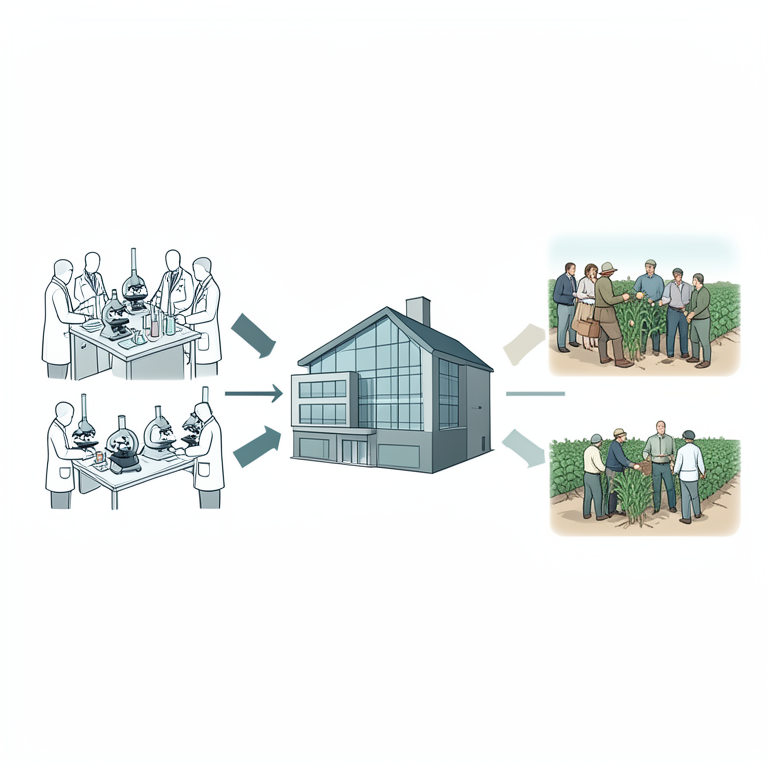
ATIC Structural Role
AI-generated conceptual illustration (Agricultural scientists and rural farmers). It explains the idea and does not show study data.
View source evidence ↗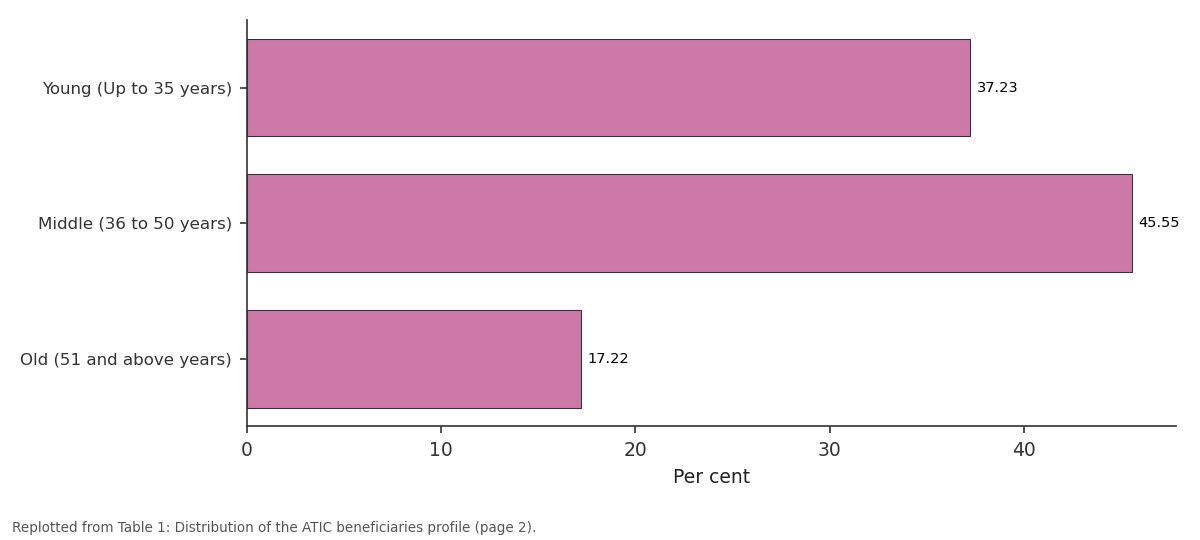
Per cent: Young (Up to 35 years) vs Middle (36 to 50 years) vs Old (51 and above years)
Replotted from Table 1 (page 2) of the original paper. Every bar is the paper's own table value.
View source evidence ↗Figures & tables
From the original paper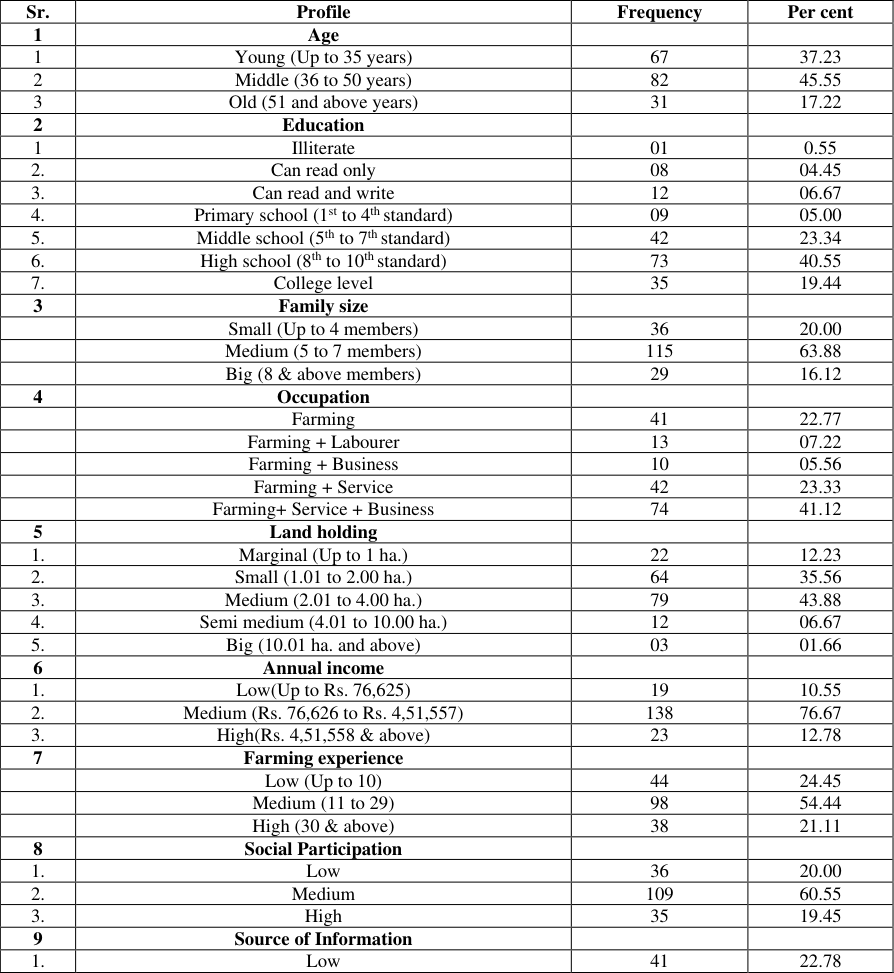 Table 1
Introduction
As the primary goal of the extension education system is to disseminate agriculture information and new practices developed through research at agricultural universities, colleges, and research centres across the country.The Research-Extension-Farmer (R-E-F) linkage is a crucial part of agricultural extension. Modern agriculture must implement new technology and eliminate outdated practices. The National Agriculture Technology Project (NATP) launched the Agricultural Technology Information Centre (ATIC) in 1999. The Centre offers advice services via a single window system, together with additional inputs including seeds, plant materials, and other information on agriculture technology. The purpose of the ATIC is to serve as a formal organizational structure between farmersand scientists. The Agricultural Technology Information Centre (ATIC) provides a single window systemfor decision-making and problem-solving help by linking the various research institution units with intermediary users and end users (farmers). Numerous institutes have generated significant agricultural advancements in the form of publications, seed, planting materials knowledge, and technological advances. These will only be useful if the end user brings them into practice and ATIC assists with fulfilling their requirements. This aims to promote the development of entrepreneurship in innovative technologies and also agricultural operations.
Mandate of ATIC
To act as a single window delivery system for information about agricultureas well as new products and innovative technologies developed by the Research Institute with a objective deliver quality services to farmers To strengthen the farm advisory services by implementing a multi dimensional approach to problem solving. To provide platform for feedback from the end beneficiaries to the research system. To function as a repository of agricultural information pertaining to farming skills and practices, farm inputs and agricultural education. To provide advisory services to the various state stakeholders. As part of the NABARD project, ATICofferdifferent skill training to unemployed youth to equip them to become job providers, rather than job seekers This study will besignificantly useful in the future for decidingplan and policies regardingagriculture development.
Objective
The current study aims to assess the impact of ATIC on its beneficiaries and also examine the profile of ATIC beneficiaries.
Materials and Methods
The objective of the present research aimed to determine the Agricultural Technology Information Center impacton its beneficiaries. The present investigation was conducted in purposively selected two districts viz., Parbhani and Hingoli district of Marathwada region in Maharashtra state as the highest number of ATIC beneficiaries among eight districts of marathwada region. From each selected district Three talukas were selected purposefully for this investigationon the basis of maximum number of ATIC beneficiaries. Parbhani, Purna and Manwat from Parbhani district and Hingoli, Basmat and Aundha from Hingoli district were selected for research study. From each selected taluka three villages were selected purposively for the study on the basis of highestnumber of ATIC beneficiaries for that purpose list was collectedfrom Agricultural Technology Information Centre, Vasantrao Naik. Ten (10) ATIC beneficiaries were selected randomly from each selected village. Thus total 180 beneficiaries were selected for research. The interview scheduleand Impact Scale was used as a tool for collection of data. The data were collected with the help of a interview schedule from the beneficiaries as per their convenience at home or on farms. The independent variables, namely, age, Education, Size of familyOccupation,Land holding,Annual income,Farmingexperience,Social participation,Source of information, Scientific orientation, Economic motivation,Training Receivedwere selected for this study. The impact of ATIC as a dependent variable has been selected for this study. The suitable statistical tools used were viz., The statistical methodsand tests such as correlation,frequency, percentage, standard deviation, mean, multiple regressions, path analysis and 'Z' test, was used for the analysis of the data Ex-post facto research design was usedin this research. The results of the study presented in Table no 1as follows. These findings were in agreement with the findings of Dhulgand (2020) [5] and Nair (2021) [8] .
Results and Discussion
Results and Discussion
Education
As per as Education concern the forty per cent (40.55%) of the ATIC beneficiaries were educated up to high school level, followed by 23.34 per cent of them were educated up to middle school, while 19.44 per cent of them graduate level, 6.67 per cent of them can read and write, five per cent (5.00%) of them were primary school, 4.45 per cent of them were can read only. Whereas 0.55 of them were illiterate. It was indicatedfromtable 1that, majoritythe ATIC beneficiaries were educated up to high school education i.e. (8 st to 10 th standard).
These findings are in line with the findings of Adsul (2016) [1] , Dhulgand (2020) [5] and Nair (2021) [8] .
Family Size
As per Family size majority (63.88%) of beneficiaries were belongs from medium family size i.e. (5 to 7 members), followed by 20.00 per cent small size i.e. (up to 4 members) and 16.12 per cent of them were with the and big size i.e. (more than 8 and above members) of family, respectively. It was reflectedfrom table1 that, majorityof the ATIC beneficiaries were having medium family size i.e. (5 to 7 members). These findings are in line with the findings of Dhulgand (2020) [5] .
| Sr. | Profile | Frequency | Per cent |
|---|---|---|---|
| 1 | Age | ||
| 1 | Young (Up to 35 years) | 67 | 37.23 |
| 2 | Middle (36 to 50 years) | 82 | 45.55 |
| 3 | Old (51 and above years) | 31 | 17.22 |
| 2 | Education | ||
| 1 | Illiterate | 01 | 0.55 |
| 2. | Can read only | 08 | 04.45 |
| 3. | Can read and write | 12 | 06.67 |
| 4. | Primary school (1st to 4th standard) | 09 | 05.00 |
| 5. | Middle school (5th to 7th standard) | 42 | 23.34 |
| 6. | High school (8th to 10th standard) | 73 | 40.55 |
| 7. | College level | 35 | 19.44 |
| 3 | Family size | ||
| Small (Up to 4 members) | 36 | 20.00 | |
| Medium (5 to 7 members) | 115 | 63.88 | |
| Big (8 & above members) | 29 | 16.12 | |
| 4 | Occupation | ||
| Farming | 41 | 22.77 | |
| Farming + Labourer | 13 | 07.22 | |
| Farming + Business | 10 | 05.56 | |
| Farming + Service | 42 | 23.33 | |
| Farming+ Service + Business | 74 | 41.12 | |
| 5 | Land holding | ||
| 1. | Marginal (Up to 1 ha.) | 22 | 12.23 |
| 2. | Small (1.01 to 2.00 ha.) | 64 | 35.56 |
| 3. | Medium (2.01 to 4.00 ha.) | 79 | 43.88 |
| 4. | Semi medium (4.01 to 10.00 ha.) | 12 | 06.67 |
| 5. | Big (10.01 ha. and above) | 03 | 01.66 |
| 6 | Annual income | ||
| 1. | Low(Up to Rs. 76,625) | 19 | 10.55 |
| 2. | Medium (Rs. 76,626 to Rs. 4,51,557) | 138 | 76.67 |
| 3. | High(Rs. 4,51,558 & above) | 23 | 12.78 |
| 7 | Farming experience | ||
| Low (Up to 10) | 44 | 24.45 | |
| Medium (11 to 29) | 98 | 54.44 | |
| High (30 & above) | 38 | 21.11 | |
| 8 | Social Participation | ||
| 1. | Low | 36 | 20.00 |
| 2. | Medium | 109 | 60.55 |
| 3. | High | 35 | 19.45 |
| 9 | Source of Information | ||
| 1. | Low | 41 | 22.78 |
Table text extracted from the original PDF; superscript letters are shown inline. The original table image is below.
View original table image
Occupation
Based on the data presented in Table 1, the majority (41.12%) of the ATIC beneficiaries had farming + service + business as their main occupation, followed by 23.33 per cent farming + service, 22.77 per cent farming, 7.22 per cent farming + labor, and 5.56 per cent of the beneficiaries belonged to farming + business. It was observed from Table 1 that most of the ATIC beneficiaries had having farming+ service + business as their main occupations. This finding was in agreement with the findings of Nair (2021) [8] .
Land Holding
Table 1 revealed that the majority (43.88%) of ATIC beneficiaries have a medium size of land holding (i.e., 2.01 to 4.00 ha), followed by 35.56 per cent of them having a small size of land holding (i.e. 1.01 to 2.00 ha). Whereas, 12.23 per cent and 6.67 per cent of them have marginal and semi medium size land holdings, respectively, and 1.66 per cent of ATIC beneficiaries belonged to big size of land holdings (i.e., 10.01 ha) and above. It was indicated from Table 1 that the majority of the ATIC beneficiaries have a medium size of land holding (i.e., 2.01 to 4.00 ha). These findings are in line with the findings of Adsul (2016) [1] , Dhulgand (2020) [5] and Nair (2021) [8] .
Annual Income
It was observed from Table 1 that, more than three fourth (76.67%) of the ATIC beneficiaries had medium annual income i.e. (Rs. 76,626 to Rs. 4,51,557), followed by 12.78 per cent of them were belonged from high annual income i.e. (4,51,558 and above) and 10.55 per cent of them were belonged from low annual income i.e. (Up to Rs. 76,625) category. It was observed from below table that, most of the ATIC beneficiaries were having medium annual income i.e. Rs. 76,626 to Rs. 4,51,557. These findings was further strengthened by the results reported by Adsul (2016) [1] , Dhulgand (2020) [5] and Nair (2021) [8] .
Farming Experience
Table 1 indicatedthat majorityper cent (54.44%) of the beneficiaries were having medium farming experience i.e. (11 to 29 years), while 24.45 per cent of them having low farming experience i.e. 10 years and 21.11 per cent of them having high farming experience above 30 years. This result was in agreement with the findings ofRaut (2018) [9] .
Economic Motivation
Table 1 indicates that the majority of ATIC beneficiaries (78.89%) had a medium level of economic motivation. While (9.44%) and (11.67%) of them, respectively, reported low and high economic motivation. The table 1 shows that the majority of ATIC beneficiaries had a medium level of economic motivation. This result is in conformity with the findingsAdsul (2016) [1] and Dhulgand (2020) [5] .
Training Received
It is revealed from Table 1 that, majority (33.34%) of the ATIC beneficiaries were having received one training. While, 23.88 per cent and 22.23 per cent of them had received more than two training and two training, respectively and 20.55 per cent beneficiaries training not received. It was observed from table 1that, most of the ATIC beneficiaries were having received one training. This result is in conformity with the findings ofNair (2021) [8] .
Conclusion
The demographic profile as an independent variables of the ATIC beneficiaries belongs to low and medium possession or categorization. Among the personal independent variables, 'Land holding' is crucial and maximum 50 percent beneficiaries belongs to marginal, small and agricultural labourers. The same statistics resembles at national level. To bring evolutionary charges and reforms and further declining of agricultural sector which is currently at crossroad rapid transformation stage, these marginal segments of agricultural societies need to abreast with latest digital information and training skill in agriculture and allied sectors.
Acknowledgement
AcknowledgementI express my deepest sense of gratitude towards my honorable research guide Dr. R. P. Kadamfor his learned council, intellectual inspiration, constructive criticism, valuable suggestions, constant guidance, cooperative attitude and willing help throughout the course of investigation and preparation of the manuscript.
Social Participation
Table 1 showed that, among the beneficiaries, more than fifty percent (60.55%) had medium participation followed by low social participation (20.00%) and high social participation (19.45%) respectively. The table below shows that a majority of ATIC beneficiaries had a low degree of participation This result is in conformity with the findings ofAdsul (2016) [1] , Dhulgand (2020) [5] and Nair (2021) [8] .
Source of Information: Table 1 revealed that approximately (65.56%) of the respondents had a medium source of information. However, of these, (22.78%) and (11.66%), respectively, belonged to the low-and high-level categories of sources of information. Table 1 shows that the majority of ATIC beneficiaries have a medium level source of information. The present findings supported by Adsul (2016) [1] , Dhulgand (2020) [5] and Nair (2021) [8] Scientific Orientation Table 1 showed that a medium levelof scientific inclination was possessed by more than two-thirds (80.00%) of ATIC beneficiaries. A low and high level of scientific orientation was shown by 10.56 per cent and 9.44 per cent of beneficiaries, respectively. The table1 shows that the majority of ATIC beneficiarieshad a medium level of Scientific orientation. These results derive support from the findings ofLade (2022) [7] .