
Research article · 2024 · Full text
International Journal of Agriculture Extension and Social DevelopmentDevelopment and standardization of a scale to measure impact of ATIC on its beneficiaries
Volume 7(3) · Pages 01–05 · DOI: 10.33545/26180723.2024.v7.i3a.387 ↗
Research areasICT Impact and PoliciesUniversity-Industry-Government Innovation ModelsInnovation Policy and R&D
Abstract
Author-writtenA method used for evaluating or ordering entities based on quantitative characteristics or attributes is known as scaling."Procedure for assigned numbers or other symbols to a property of objects in order to impart some of the characteristics of numbers to the properties in question" is the definition of scaling.The present investigation, was conducted in the region of Marathwada within 2021 and 2022, planned at developing and standardize a scale to measure the impact of Agricultural Technology Information Centres (ATIC) among the beneficiaries.The Agricultural Technology Information Center (ATIC) impact scale was developed and standardised according to the Likert (1932) summated rating method.65 statements, expressing the impact of Agricultural technology information centre by Vasantrao Nike Marathwada Krushi Vidyapeeth, Parbhani on farmers have been collected under four components.These statements were edited on the basis of criteria suggested by Thurstone (1946), Likert (1932) and Edward (1957).Total 42 statements were retained after editing and sent to 160 judges to determine the relevancy.Out of that 103judges responded.After calculation of relevancy score, t-value calculation.Test-retest method of reliability final scale contain 30 statements to measure the impact of ATIC Scheme.The scale contain three continuum i.e. 'Strongly Agree" to "Strongly Disagree".The scoring pattern adopted was 3 to 1, in which, 3 weighs to Strongly Agree response, 2 to Partially Agree response, 1 to strongly disagree response for positive statement and negative statement, the scorning pattern was reversed.
Summary
Source-checkedPlain-language reading of the full paper, prepared with AI and checked against the text. Each point links to the authors' own words.
Why it matters
- Agricultural extension education is critical for communicating new agricultural technologies from research stations and universities to farmers. View evidence ↗
- The Agricultural Technology Information Center (ATIC) was established to provide farmers with a single-window system for efficient information dissemination. View evidence ↗
The question
- The study aimed to develop and standardize a scale to measure the impact of ATIC on its beneficiaries in the Marathwada region between 2021 and 2022. View evidence ↗
What they did
- The researchers used the Likert summated rating method to develop and standardize the impact scale. View evidence ↗
- The initial pool of 65 statements regarding ATIC impact was collected across four different components. View evidence ↗
- To determine relevancy, 103 judges responded to the evaluation of the initial statements. View evidence ↗
- Statements were included in the item analysis only if they had a relevancy weightage > 0.66, a relevancy percentage > 66.00%, and a mean relevancy score > 2. View evidence ↗
What they found
- After applying relevancy criteria, the number of statements was reduced from 65 to 30. View evidence ↗
- Statements with a 't' value greater than 1.75 were selected for the final scale to ensure they could differentiate between high and low impact groups. View evidence ↗
- The authors concluded the scale satisfied content validity because it covered the entire field of ATIC impact based on expert opinion and literature. View evidence ↗
What it means
- The authors conclude that ATIC effectively connects research stations and line departments with the users of new technology. View evidence ↗
- The authors recommend the developed scale for use by future researchers conducting similar impact studies. View evidence ↗
Visual summary
1 visualsIllustrations explain the paper; they do not show study data.
Scale Development Workflow
AI-generated conceptual illustration (A conceptual workflow of a scientific measurement scale). It explains the idea and does not show study data.
View source evidence ↗Figures & tables
From the original paper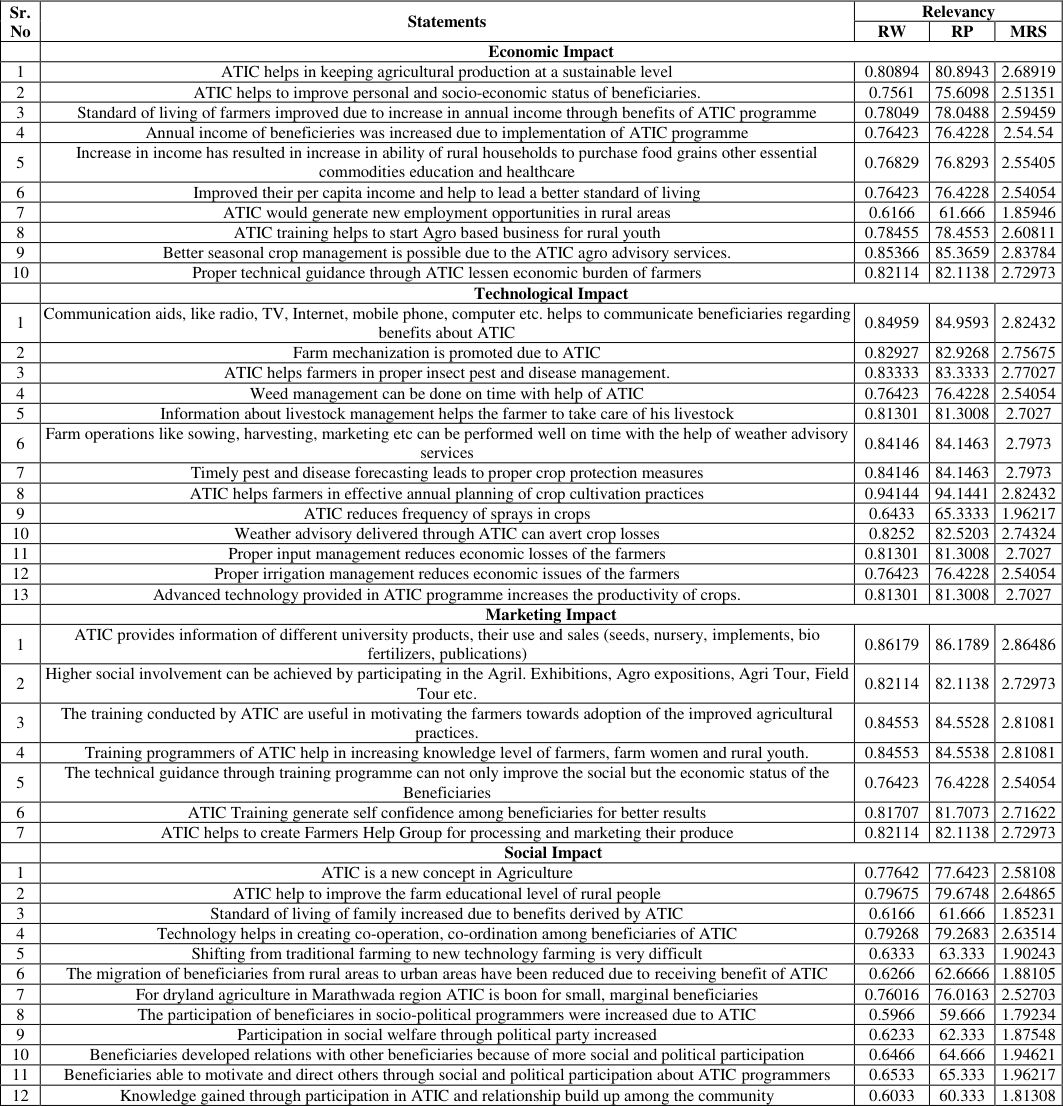 Table 1
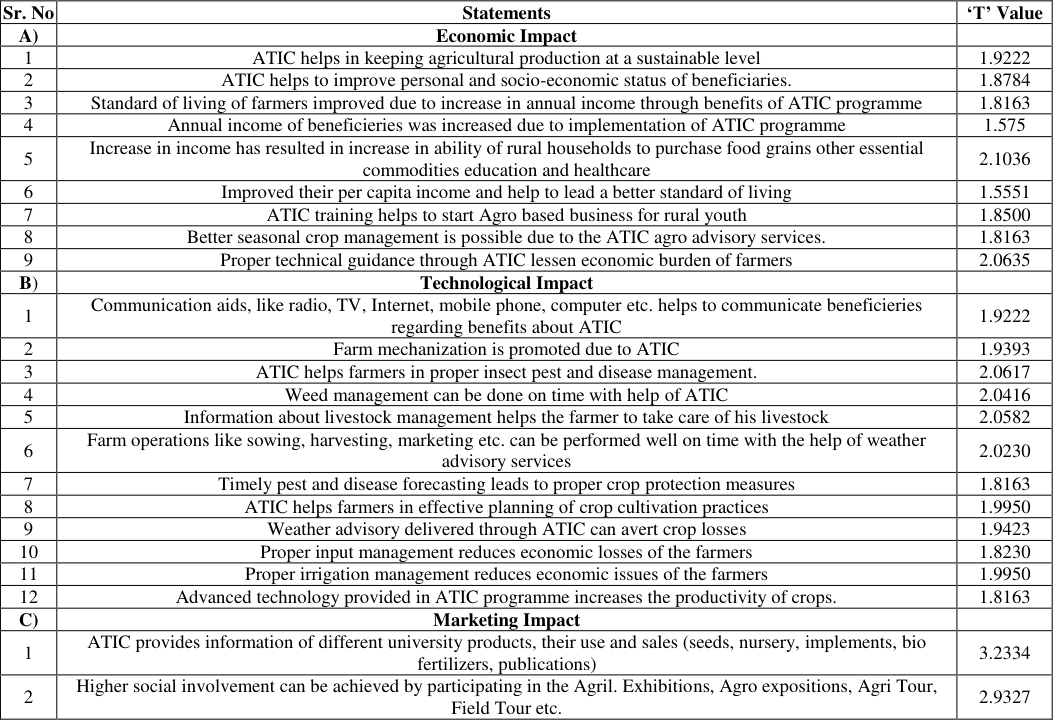 Table 2
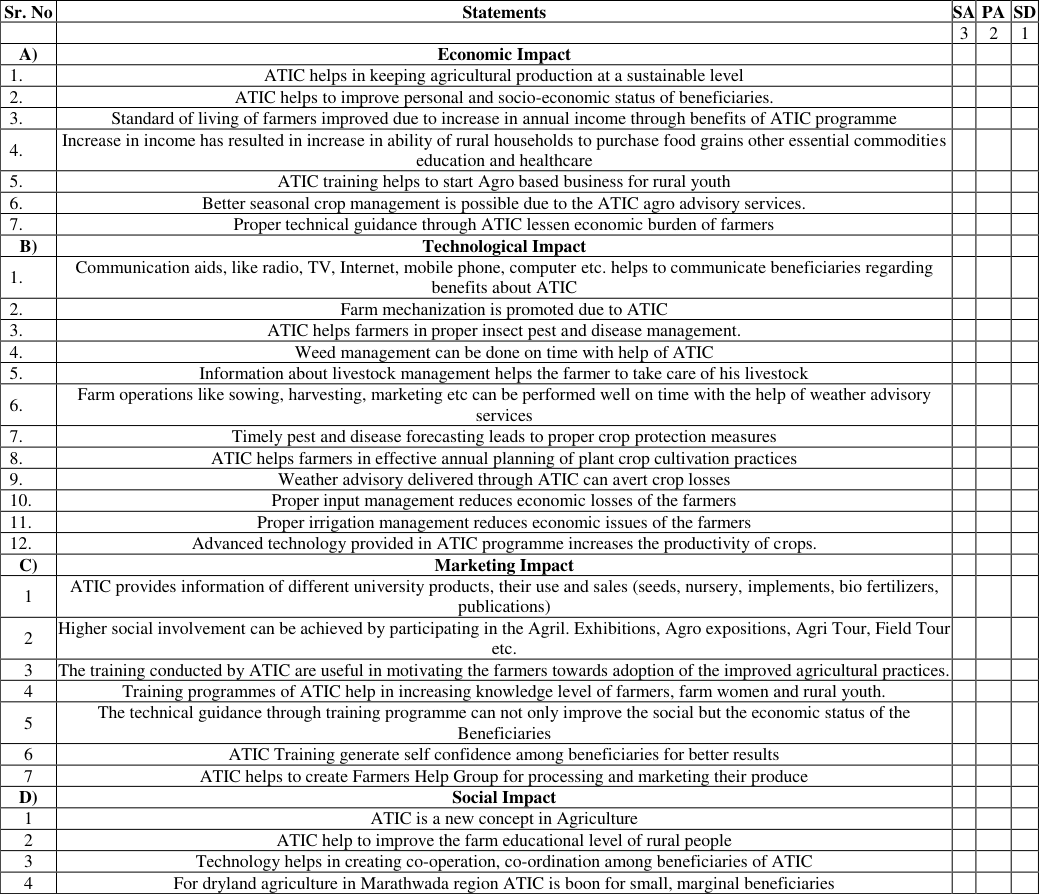 Table 3
Introduction Agricultural Technology Information Centre (ATIC)
The main role of agricultural extension education is to communicate the latest agricultural technology generated from state, central Agriculture Universities and research station to the farmers. Hence, research-extension-farmers (R-E-F) linkage is the essential element of agricultural extension. Indian farmers need to be well informed and well trained in the field of management therefore now the farmers are needed to replace traditional practices by using modern information technologies with the help of agricultural technology information centre. For effective Dissemination of Latest agriculture information National Agriculture Technology Project (NATP) under the financial assistance of the World Bank was launched by Indian council of Agricultural Research (ICAR), New Delhi. Establishment of Agricultural Technology Information Center (ATIC) under NATP has provided an efficient mechanism for information dissemination. ATIC acts as a single window system for farmers.
Objective
This research was conducted to measure Impact of ATIC, VNMKV on its beneficiary. A scale has been developed to measure the Impact of ATIC on its beneficiaries.
Materials and Methods
The present investigation was conducted to measure the impact of ATIC among its beneficiaries. In order to measure the Impact of ATIC an impact scale was developed by adopting method of summated rating suggested by Likert (1932) [4] . The details of the steps which followed during developing and standardization of the scale are mentioned as below.
Identification of dimension
ATIC is the dimension related to impact of Agricultural Technology Information Centre on its beneficiaries, in this research which is identified on the basis of review of literature and discussion with the experts who is specialist in extension education.
Collection of items and editing
There are total 65 statements, expressing the impact of Agricultural technology information centre by Vasantrao Nike Marathwada Krushi Vidyapeeth, Parbhani on its beneficiaries have been gathered from available literature, websites and in dissuasion with the specialists in the area of extension education and they were edited on the basis of www.extensionjournal.com criteria suggested by Thurstone (1946) [3] , Likert (1932) [4] and Edward (1957) [1] . Out of 65 statements, 42 statements were remained after editing. These statements were found to be non-ambiguous and non-factual.
Relevancy test
The collected 42 statements, were sent to the 160 judges which are Expert, Specialist in the disciplines of Agricultural Extension which are senior faculty members from the State and Central Agricultural Universities, Research stations and Subject Matter Specialists of the Krishi Vigyan Kendras, Extension Scientists from the ICAR. They were requested to show their responses regarding each of the statements on a three point continuum namely, 'most relevant' 'relevant' and 'not relevant' with the score of 3, 2, and 1, respectively. Also request to give their opinion. A total of 103 judges responded to the appeal and returned the duly filled in schedules. On the basis of the responses received, the relevancy weight age, relevancy percentage and mean relevancy score for each statement were calculated through following formulae these value presented in Table 1.
| Sr. No | Statements | Relevancy | — | — |
|---|---|---|---|---|
| RW | RP | MRS | ||
| Economic Impact | ||||
| 1 | ATIC helps in keeping agricultural production at a sustainable level | 0.80894 | 80.8943 | 2.68919 |
| 2 | ATIC helps to improve personal and socio-economic status of beneficiaries. | 0.7561 | 75.6098 | 2.51351 |
| 3 | Standard of living of farmers improved due to increase in annual income through benefits of ATIC programme | 0.78049 | 78.0488 | 2.59459 |
| 4 | Annual income of beneficieries was increased due to implementation of ATIC programme | 0.76423 | 76.4228 | 2.54.54 |
| 5 | Increase in income has resulted in increase in ability of rural households to purchase food grains other essential commodities education and healthcare | 0.76829 | 76.8293 | 2.55405 |
| 6 | Improved their per capita income and help to lead a better standard of living | 0.76423 | 76.4228 | 2.54054 |
| 7 | ATIC would generate new employment opportunities in rural areas | 0.6166 | 61.666 | 1.85946 |
| 8 | ATIC training helps to start Agro based business for rural youth | 0.78455 | 78.4553 | 2.60811 |
| 9 | Better seasonal crop management is possible due to the ATIC agro advisory services. | 0.85366 | 85.3659 | 2.83784 |
| 10 | Proper technical guidance through ATIC lessen economic burden of farmers | 0.82114 | 82.1138 | 2.72973 |
| Technological Impact | ||||
| 1 | Communication aids, like radio, TV, Internet, mobile phone, computer etc. helps to communicate beneficiaries regarding benefits about ATIC | 0.84959 | 84.9593 | 2.82432 |
| 2 | Farm mechanization is promoted due to ATIC | 0.82927 | 82.9268 | 2.75675 |
| 3 | ATIC helps farmers in proper insect pest and disease management. | 0.83333 | 83.3333 | 2.77027 |
| 4 | Weed management can be done on time with help of ATIC | 0.76423 | 76.4228 | 2.54054 |
| 5 | Information about livestock management helps the farmer to take care of his livestock | 0.81301 | 81.3008 | 2.7027 |
| 6 | Farm operations like sowing, harvesting, marketing etc can be performed well on time with the help of weather advisory services | 0.84146 | 84.1463 | 2.7973 |
| 7 | Timely pest and disease forecasting leads to proper crop protection measures | 0.84146 | 84.1463 | 2.7973 |
| 8 | ATIC helps farmers in effective annual planning of crop cultivation practices | 0.94144 | 94.1441 | 2.82432 |
| 9 | ATIC reduces frequency of sprays in crops | 0.6433 | 65.3333 | 1.96217 |
| 10 | Weather advisory delivered through ATIC can avert crop losses | 0.8252 | 82.5203 | 2.74324 |
| 11 | Proper input management reduces economic losses of the farmers | 0.81301 | 81.3008 | 2.7027 |
| 12 | Proper irrigation management reduces economic issues of the farmers | 0.76423 | 76.4228 | 2.54054 |
| 13 | Advanced technology provided in ATIC programme increases the productivity of crops. | 0.81301 | 81.3008 | 2.7027 |
| Marketing Impact | ||||
| 1 | ATIC provides information of different university products, their use and sales (seeds, nursery, implements, bio fertilizers, publications) | 0.86179 | 86.1789 | 2.86486 |
| 2 | Higher social involvement can be achieved by participating in the Agril. Exhibitions, Agro expositions, Agri Tour, Field Tour etc. | 0.82114 | 82.1138 | 2.72973 |
| 3 | The training conducted by ATIC are useful in motivating the farmers towards adoption of the improved agricultural practices. | 0.84553 | 84.5528 | 2.81081 |
| 4 | Training programmers of ATIC help in increasing knowledge level of farmers, farm women and rural youth. | 0.84553 | 84.5538 | 2.81081 |
| 5 | The technical guidance through training programme can not only improve the social but the economic status of the Beneficiaries | 0.76423 | 76.4228 | 2.54054 |
| 6 | ATIC Training generate self confidence among beneficiaries for better results | 0.81707 | 81.7073 | 2.71622 |
| 7 | ATIC helps to create Farmers Help Group for processing and marketing their produce | 0.82114 | 82.1138 | 2.72973 |
| Social Impact | ||||
| 1 | ATIC is a new concept in Agriculture | 0.77642 | 77.6423 | 2.58108 |
| 2 | ATIC help to improve the farm educational level of rural people | 0.79675 | 79.6748 | 2.64865 |
| 3 | Standard of living of family increased due to benefits derived by ATIC | 0.6166 | 61.666 | 1.85231 |
| 4 | Technology helps in creating co-operation, co-ordination among beneficiaries of ATIC | 0.79268 | 79.2683 | 2.63514 |
| 5 | Shifting from traditional farming to new technology farming is very difficult | 0.6333 | 63.333 | 1.90243 |
| 6 | The migration of beneficiaries from rural areas to urban areas have been reduced due to receiving benefit of ATIC | 0.6266 | 62.6666 | 1.88105 |
| 7 | For dryland agriculture in Marathwada region ATIC is boon for small, marginal beneficiaries | 0.76016 | 76.0163 | 2.52703 |
| 8 | The participation of beneficiares in socio-political programmers were increased due to ATIC | 0.5966 | 59.666 | 1.79234 |
| 9 | Participation in social welfare through political party increased | 0.6233 | 62.333 | 1.87548 |
| 10 | Beneficiaries developed relations with other beneficiaries because of more social and political participation | 0.6466 | 64.666 | 1.94621 |
| 11 | Beneficiaries able to motivate and direct others through social and political participation about ATIC programmers | 0.6533 | 65.333 | 1.96217 |
| 12 | Knowledge gained through participation in ATIC and relationship build up among the community | 0.6033 | 60.333 | 1.81308 |
Table text extracted from the original PDF; superscript letters are shown inline. The original table image is below.
View original table image
II. Relevancy percentage
Relevancy percentage of each statement was computed by using the following formula.
Where, RP = Relevancy Percentage OS = Obtained Score MOS = Maximum Obtainable Score.
III. Mean relevancy score
For calculating the mean relevancy score of each item, following formula was used.
Where, MRS = Mean Relevancy Score MRR = Most Relevant Response RR = Relevant Response NRR = Not Relevant Response Using these three criteria, the items were screened for their relevancy. Finally, the statements having, more than 0.66 relevancy weightage, more than 66.00 per cent relevancy percentage and more than 2 mean relevancy score were considered for the inclusion in item analysis. Thus, 30 statement were retained out of 65 statements.
Calculation of 't' value (item analysis)
The 't' value which is a measure of the extent to which a given statement differentiates between the high and low groups of the ATIC beneficiaries for each statements was analyzed through the formula suggested by Edward (1957) [1] . After calculating the 't' value for all the 32 statements, statements with greater than 1.75 and highest 't' value were finally selected for the scale. The lists of statement and their 't' values are expressed in Table 2. These 32 statements undergo item analysis in the items based on the extent to which they can differentiate the beneficiaries with high impact than the beneficiaries with low impact of ATIC on beneficiaries in Marathwada region.
| Sr. No | Statements | ‘T’ Value |
|---|---|---|
| A) | Economic Impact | |
| 1 | ATIC helps in keeping agricultural production at a sustainable level | 1.9222 |
| 2 | ATIC helps to improve personal and socio-economic status of beneficiaries. | 1.8784 |
| 3 | Standard of living of farmers improved due to increase in annual income through benefits of ATIC programme | 1.8163 |
| 4 | Annual income of beneficieries was increased due to implementation of ATIC programme | 1.575 |
| 5 | Increase in income has resulted in increase in ability of rural households to purchase food grains other essential commodities education and healthcare | 2.1036 |
| 6 | Improved their per capita income and help to lead a better standard of living | 1.5551 |
| 7 | ATIC training helps to start Agro based business for rural youth | 1.8500 |
| 8 | Better seasonal crop management is possible due to the ATIC agro advisory services. | 1.8163 |
| 9 | Proper technical guidance through ATIC lessen economic burden of farmers | 2.0635 |
| B) | Technological Impact | |
| 1 | Communication aids, like radio, TV, Internet, mobile phone, computer etc. helps to communicate beneficieries regarding benefits about ATIC | 1.9222 |
| 2 | Farm mechanization is promoted due to ATIC | 1.9393 |
| 3 | ATIC helps farmers in proper insect pest and disease management. | 2.0617 |
| 4 | Weed management can be done on time with help of ATIC | 2.0416 |
| 5 | Information about livestock management helps the farmer to take care of his livestock | 2.0582 |
| 6 | Farm operations like sowing, harvesting, marketing etc. can be performed well on time with the help of weather advisory services | 2.0230 |
| 7 | Timely pest and disease forecasting leads to proper crop protection measures | 1.8163 |
| 8 | ATIC helps farmers in effective planning of crop cultivation practices | 1.9950 |
| 9 | Weather advisory delivered through ATIC can avert crop losses | 1.9423 |
| 10 | Proper input management reduces economic losses of the farmers | 1.8230 |
| 11 | Proper irrigation management reduces economic issues of the farmers | 1.9950 |
| 12 | Advanced technology provided in ATIC programme increases the productivity of crops. | 1.8163 |
| C) | Marketing Impact | |
| 1 | ATIC provides information of different university products, their use and sales (seeds, nursery, implements, bio fertilizers, publications) | 3.2334 |
| 2 | Higher social involvement can be achieved by participating in the Agril. Exhibitions, Agro expositions, Agri Tour, Field Tour etc. | 2.9327 |
Table text extracted from the original PDF; superscript letters are shown inline. The original table image is below.
View original table image
From non-sample areas, 60 farmers had been selected for this. On a three-point continuum which range from "Strongly Agree" to "Strongly Disagree", those who responded were requested to state the extent to which they agreed or disagreed with each item. The chosen scoring scheme was 3 to 1, with 3 weights indicating a "Strongly Agree" response, 2 expressing a partially agree response, and 1 expressing a "Strongly Disagree". Reaction for both positive and negative statements. The scorning pattern was reversed. The respondents have been arranged in descending order according to their overall scores. Because both of these categories act as criteria groups to evaluate each of the respondents, the top 25% of respondents with their total score were considered to have in the high group and the bottom 25% as the low group. Provide criterion groups in terms of evaluating the individual statements as suggested by Edwards (1957) [1] . Thus out of 60 beneficiaries to whom the items were administered for the item analysis, 15 beneficiaries with lowest, 15 with highest scores were used as criterion groups to evaluate individual items.
Reliability test-retest method
Test-retest was used to determine the scale's reliability. The final 30 statements, which define the impact of the agricultural technology information centre on beneficiaries, were presented with to a three-point continuum to a fresh group of sixty beneficiaries who which were not included in the actual sample. After 15 days interval the scale was again administered to the same respondents and thus two sets of scores were obtained. For both sets, the correlation coefficient was calculated. The impact scale was suitable for administering to extension staff due to its stable and reliable measurement, as indicated by the significant "r" value (0.742) at the 0.01 level of probability.
Content validity
The scale's content validity was tested. The content validity is the sampling or representative adequacy of the content, the matter and the topics of a measuring instrument. This method was used in the present scale to evaluate the content validity of the scale. As the content of the impact was thoroughly covered the entire field of agricultural technology information centre on beneficiaries through literature and expert opinion, it was assumed that present scale satisfied the content validity. As the scale value difference for almost all the statements included had a very high discriminating value, it seemed reasonable to accept the scale as a valid measure of the impact. Thus, ensuring a fair degree of content validity.
Administration of scale
The three-point continuum, which ranges from "Strongly Agree" to "Strongly Disagree," was used for administering the scale. It measures the degree of relevancy or not relevant. Three points were allocated for an "Strongly Agree" answer, two for a Partially Agree response, and one for a strong "Strongly Disagree," response for both positive and negative statements. The scoring scheme used was three to one. www.extensionjournal.com ATIC helps in keeping agricultural production at a sustainable level 2.
ATIC helps to improve personal and socio-economic status of beneficiaries.
3.
Standard of living of farmers improved due to increase in annual income through benefits of ATIC programme 4.
Increase in income has resulted in increase in ability of rural households to purchase food grains other essential commodities education and healthcare 5.
ATIC training helps to start Agro based business for rural youth 6.
Better seasonal crop management is possible due to the ATIC agro advisory services. 7.
Proper technical guidance through ATIC lessen economic burden of farmers B) Technological Impact
1.
Communication aids, like radio, TV, Internet, mobile phone, computer etc. helps to communicate beneficiaries regarding benefits about ATIC 2.
Farm mechanization is promoted due to ATIC 3.
ATIC helps farmers in proper insect pest and disease management. 4.
Weed management can be done on time with help of ATIC 5.
Information about livestock management helps the farmer to take care of his livestock 6. Farm operations like sowing, harvesting, marketing etc can be performed well on time with the help of weather advisory services 7.
Timely pest and disease forecasting leads to proper crop protection measures 8.
ATIC helps farmers in effective annual planning of plant crop cultivation practices 9.
Weather advisory delivered through ATIC can avert crop losses 10.
Proper input management reduces economic losses of the farmers 11.
Proper irrigation management reduces economic issues of the farmers 12.
Advanced technology provided in ATIC programme increases the productivity of crops.
C)
1 ATIC provides information of different university products, their use and sales (seeds, nursery, implements, bio fertilizers, publications) 2 Higher social involvement can be achieved by participating in the Agril. Exhibitions, Agro expositions, Agri Tour, Field Tour etc. 3 The training conducted by ATIC are useful in motivating the farmers towards adoption of the improved agricultural practices. 4 Training programmes of ATIC help in increasing knowledge level of farmers, farm women and rural youth. For dryland agriculture in Marathwada region ATIC is boon for small, marginal beneficiaries SA: Strongly Agree, PA: Partially Agree, SD: SD is agree
Conclusion
The Agricultural Technology Information Center helps to establish strong connections between various research stations, line departments, and users of new technology. It also provides a "Single Window Delivery System" for seed, planting material, processed products, biofertilizers, biopesticides, equipment, and literature. Therefore, policy makers are able to benefit from this scale. The validity and reliability of the scale indicates how consistently the results are attained.
Recommendation:
The scale developed in the present study to assess the impact of ATIC will be useful to researchers interested in similar types of studies in the future.
Acknowledgement
AcknowledgementI express my deepest sense of gratitude towards my honorable research guide Dr. RP Kadam for his learned council, intellectual inspiration, constructive criticism, valuable suggestions, constant guidance, cooperative attitude and willing help throughout the course of investigation and preparation of the manuscript.
Figures and tables from the paper
References
3 in the original paper- Thurstone. Comment, American J Sociology. 1946;52:39-50.
- Likert R. A technique for the measurement of attitudes, Archology Psychology, No 140. Lodhal TM and Kejner M, 1965, J Appl. Psy. 1932;49:24-33.
- Uma, Prasher. Mahatma Gandhi National Employment guarantee act and its impact on the beneficiaries. Asian Journal of Research in Social Sciences and Humanities. 2014;4(4)50-60.