
Research article · 2024 · Full text
International Journal of Veterinary Sciences and Animal HusbandryMilk production constraints in Marathwada region of Maharashtra: A case study
Volume 9(1S) · Pages 712–715 · DOI: 10.22271/veterinary.2024.v9.i1sj.1171 ↗
Research areasLivestock Management and Performance ImprovementAgricultural Economics and PracticesAnimal Diversity and Health Studies
Abstract
Author-writtenThis study focuses on research conducted in the Marathwada region of Maharashtra State during the year 2022-23. It specifically outlines the issues that farmers encounter in operating and managing dairy activities related to milk production. The Marathwada region of Maharashtra State was chosen intentionally because to its low milk production as well as productivity. A random study was conducted on 195 milk farmers in Nanded and Latur districts of the Marathwada region in Maharashtra State. Garret's ranking technique was used for determining the constraints that existed. Producers faced major hurdles such as feed and fodder scarcity, fluctuating pricing policies, expensive concentrates, lack of access to veterinary services, shortage of labor, inadequate credit facilities, limited information on government programs, and year-round shortage of green fodder. Additional concerns involved the absence of veterinary services such as artificial insemination and breeding, as well as a lack of knowledge about more efficient management procedures.
Summary
Source-checkedPlain-language reading of the full paper, prepared with AI and checked against the text. Each point links to the authors' own words.
Why it matters
- Many resource-poor farmers in the Marathwada region of Maharashtra rely on rain-fed farming, which has been negatively impacted by uneven rainfall and recent droughts. View evidence ↗
- Despite the low productivity associated with dry farming, dairy animals are a significant contributor to the milk pool in this region. View evidence ↗
- Identifying the challenges faced by dairy farmers is necessary to create economic data that can inform strategies for business expansion. View evidence ↗
The question
- The study aimed to identify the most urgent challenges facing dairy farmers to help strengthen the milk sector in the Marathwada region of Maharashtra. View evidence ↗
What they did
- The researchers conducted a random study involving 195 milk farmers located in the Latur and Nanded districts of Marathwada. View evidence ↗
- The study used the Garrett ranking technique (developed in 1969) to prioritize and determine the constraints experienced by the farmers. View evidence ↗
- The research was carried out during the 2022-23 period. View evidence ↗
What they found
- The most significant constraint was the consistent shortage of quality feed and fodder, which received the highest mean score of 74.32. View evidence ↗
- High costs for concentrate mixtures were ranked as the second most significant limitation, with a mean score of 69.85. View evidence ↗
- Limited accessibility to veterinary clinics was the third most important constraint (mean score 63.81), involving issues like expensive care and lack of nearby services. View evidence ↗
- Labor scarcity was identified as the fourth most significant constraint, with a mean score of 58.95. View evidence ↗
- Poor farm management practices, characterized by a moderate understanding of scientific procedures, ranked fifth with a mean score of 51.80. View evidence ↗
- The specific scarcity of green fodder was ranked as the sixth primary constraint, with a mean score of 47.05. View evidence ↗
- Unstable pricing policies for milk procurement were ranked seventh, with a mean score of 41.96. View evidence ↗
- The absence of credit facilities was the eighth most significant constraint, scoring 36.11. View evidence ↗
- Lack of knowledge regarding government schemes was ranked ninth, with a mean score of 29.95. View evidence ↗
- Marketing of milk and milk products was the least significant constraint among those studied, ranking tenth with a score of 22.25. View evidence ↗
What it means
- The authors conclude that the primary challenges for milk producers in the region are the year-round availability of feed and fodder, the high cost of concentrates, and limited access to veterinary facilities. View evidence ↗
Visual summary
2 visualsIllustrations explain the paper; charts are replotted from the paper's own table values.
Hierarchy of Dairy Constraints
AI-generated conceptual illustration (Gir cows in a rural Indian farm setting). It explains the idea and does not show study data.
View source evidence ↗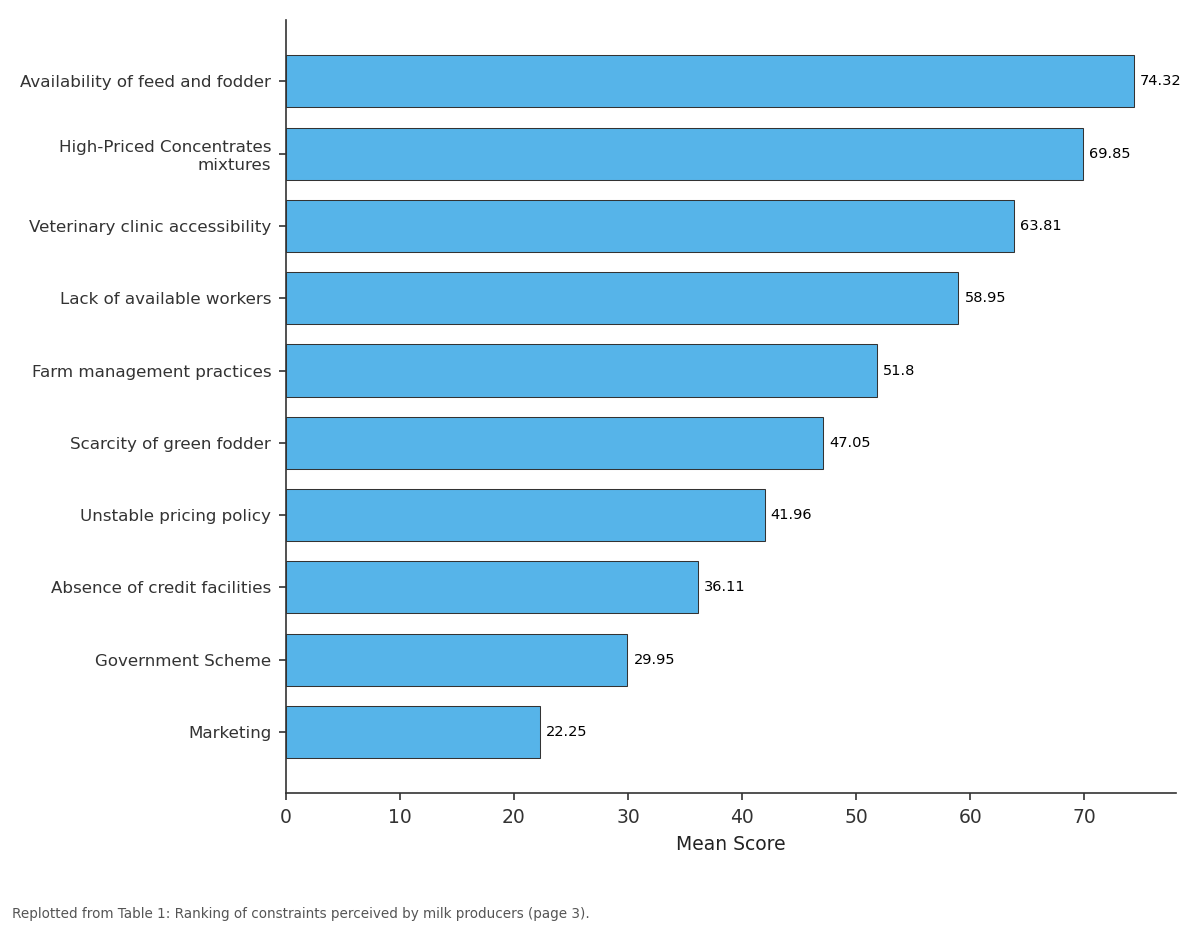
Overall / Mean Score: Availability of feed... vs High-Priced... vs Veterinary clinic... vs Lack of available... vs Farm management...
Replotted from Table 1 (page 3) of the original paper. Every bar is the paper's own table value.
View source evidence ↗Figures & tables
From the original paper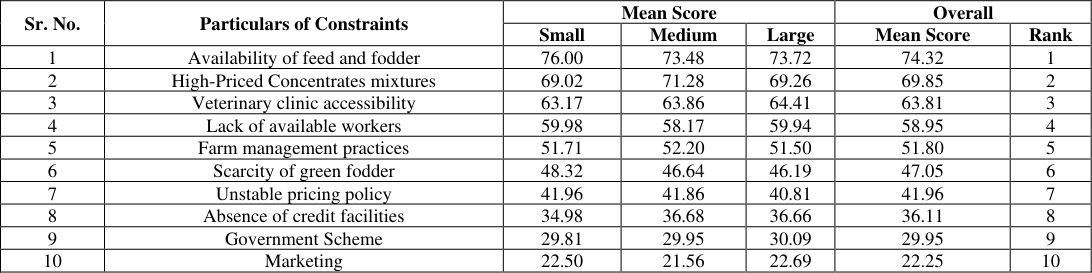 Table 1
Introduction
After Operation Flood in the 1970s, India's dairy industry expanded. India's 2018-19 milk production per person was 387 grams, higher than the country's Recommended Dietary Allowance for all meals. Since indigenous breeds are less productive, milk production is rising above 5% annually and could continue to grow faster. Increasing milk output requires improving productivity and adopting a feeding strategy. To achieve this, cattle breeds, feeding materials and procedures, maintenance, and animal health must improve. Dairy entrepreneurship needs to be improved indigenous livestock breeds, veterinary care, artificial insemination, and feeding techniques to boost livestock yield. Milk prices are only based on fat content. The milk procurement policy should include fat and SNF to increase trust in milk producers. Since the green revolution, the dairy business has taken over agriculture. The Indian white revolution performed better than the green revolution. In Marathwada, Maharashtra, many resource-poor farmers depend on rain-fed cultivation. The recent droughts and uneven rainfall have hurt the farm production. About 35% of the country is in a chronic drought risk zone (where annual rainfall is less than 650 mm) and 68% is now at risk of drought. The national irrigation average is 41%, whereas drought-prone areas have 29%. Dairy animals contribute significantly to the milk pool despite low productivity in dry farming. Dairy farmers' challenges must be recognized to generate valuable economic data for business expansion strategy. Considering this, the current study intended to identify dairy farmers' most pressing challenges so they might be used to strengthen the milk sector, notably in Marathwada, Maharashtra.
Materials and Methods
The Marathwad regions of Maharashtra State were chosen because to their poor milk output and productivity. Random sampling was employed to choose the milk-producing households in the Nanded and Latur districts of the Marathwada region in Maharashtra State for the year 2022-23.
Two blocks were randomly selected from each of the two districts, and three villages were chosen from each of the two blocks in each district. 195 households were chosen for the study. Before designing the structured interview schedule, identified 10 constraints and have respondents rank their perceived degree of difficulty. The study examined farmers' opinions on the several challenges impacting the dairy business through the Garrett ranking approach developed by Garrett and Woodworth in 1969. We calculated the percentages for each rank using the following equation.
Where, Ri j -Rank gave for the i th factor by the j th individual. Ni j -Number of factor ranked by the j th individual.
Results and Discussion
An attempt was made to establish the issues faced by milk producers in the research region through observation and discussion. Constraints refer to the challenges encountered by farmers in running and overseeing dairy operations. Many constraints obstructed the growth of the dairy industry in the area. The Garret ranking method has been employed to prioritize the limitations. The percent rank position of the identified restrictions was calculated and then the orders of merit were changed following Garret's (1981) method. The limitations were sorted based on their mean scores to establish their relative relevance.
Availability of feed and fodder
Dairy farmers in the research area were mostly limited by a consistent shortage of quality feed and fodder, as indicated by their average score of 74.32. Fodder consists of green, dry, and concentrated types. There is a limited supply of fresh fodder, with concentrates and hay following in availability. Small and fragmented land holdings, insufficient irrigation, scarcity of fodder seeds, and the proliferation of fodder tree seedlings could be contributing factors. The scarcity of fodder was mostly due to the absence of irrigation systems, as fodder crops had high water requirements. Small and medium-sized milk producers were unable to construct costly storage facilities because of inadequate feed storage infrastructures. Farmers did not cultivate dairy forage crops. Individuals mostly consumed grasses from forests and pastures, while cereal and pulse crop leftovers were used as animal feed. Dairy producers in Maharashtra's Vhidarba region faced challenges due to high prices of green fodder, dry fodder, and concentrate feed. A program managed by the state's Dairy Development and Animal Husbandry department promotes the cultivation of scientific fodder among farmers. This initiative includes awareness campaigns, sangosthi, book distribution, and demonstrations. The lack of fodder indicates that demonstrations and teaching on improved seed, sowing process, cutting management, and balanced feed were not provided. The absence of rural government infrastructure could be the reason.
High-Priced Concentrates mixtures
The majority of respondents experianced high Concentrate expenses as the second most significant limitation, with a mean score of 69.85. This could be because milk producers are shifting towards buying concentrated feed to meet the nutritional needs of their animals, leading to a high cost of concentrates. This could be due to an insufficient number of dependable suppliers in the local market, leading to a price hike, suppliers hoarding inputs to create an artificial scarcity, and local vendors manipulating the company's pricing.
Veterinary clinic accessibility
Most participants rated constraint as the third most important factor, with an average score of 63.81. They mentioned the vulnerability of crossbred animals to diseases, limited access to artificial insemination and veterinary services near the village, expensive veterinary care, and insufficient awareness of advanced management techniques. Institutions are constrained by the AI infrastructure. Insufficient veterinary services posed an issue. There is no veterinarian available in the neighborhood. Because there was no veterinary facility nearby, farmers had to transport their animals over ten or fifteen kilometers to get treatment and advice from a veterinarian. They also noted that the shortage of veterinary doctors or attendants is a major hindrance to dairy production in India.
Lack of available labours
The fourth restraint, with a mean score of 58.95 illustrated in Table 1, was the scarcity of labor. Dairy farming is a laborintensive sector that necessitates a continuous labour supply throughout the year for tasks like as grazing, stall feeding, shade cleaning, watering, animal washing, milking, and milk sales. Individuals from rural regions may associate agricultural work with diminished a sense of worth prompting a migration to urban areas in pursuit of a more stable lifestyle and educational opportunities.
| Sr. No. | Particulars of Constraints | Mean Score | — | — | Overall | — |
|---|---|---|---|---|---|---|
| Small | Medium | Large | Mean Score | Rank | ||
| 1 | Availability of feed and fodder | 76.00 | 73.48 | 73.72 | 74.32 | 1 |
| 2 | High-Priced Concentrates mixtures | 69.02 | 71.28 | 69.26 | 69.85 | 2 |
| 3 | Veterinary clinic accessibility | 63.17 | 63.86 | 64.41 | 63.81 | 3 |
| 4 | Lack of available workers | 59.98 | 58.17 | 59.94 | 58.95 | 4 |
| 5 | Farm management practices | 51.71 | 52.20 | 51.50 | 51.80 | 5 |
| 6 | Scarcity of green fodder | 48.32 | 46.64 | 46.19 | 47.05 | 6 |
| 7 | Unstable pricing policy | 41.96 | 41.86 | 40.81 | 41.96 | 7 |
| 8 | Absence of credit facilities | 34.98 | 36.68 | 36.66 | 36.11 | 8 |
| 9 | Government Scheme | 29.81 | 29.95 | 30.09 | 29.95 | 9 |
| 10 | Marketing | 22.50 | 21.56 | 22.69 | 22.25 | 10 |
Table text extracted from the original PDF; superscript letters are shown inline. The original table image is below.
View original table image
Farm management practices
The study found that most respondents have moderate understanding of scientific dairy farming procedures, ranking fifth with a mean score of 51.80. The majority of respondents have limited scientific knowledge regarding improved dairy farm management practices. These practices include feeding newborn calves, providing colostrum, preparing concentrate feed using local ingredients, creating a balanced ration for adult animals with green and dry fodder, determining the appropriate time for artificial insemination, recognizing heat detection symptoms, following vaccination schedules for calves and adult animals, understanding how to isolate sick animals, identifying different fodder varieties, dehorning, washing the udder before milking, cleaning utensils with boiled water or detergent before milking, recognizing the importance of the dry period, employing the correct milking technique, and discarding the initial streams of milk from each teat.
Scarcity of green fodder
The availability of feed and fodder remains to be a significant cause for concern, ranking sixth among the primary constraints with an average score of 47.05. There is a disparity between the demand and supply of green fodder.
During summer months, dairy farmers compensate for a shortage of green fodder by providing animals with an excessive amount of concentrate to sustain milk production levels, which increases the cost of milk production due to the high price of concentrate. The primary reasons for the absence of green fodder were identified as inadequate irrigation, insufficient supply of high-quality fodder seeds, and a lack of understanding regarding optimal fodder growth techniques. In the present study, the primary reasons for not cultivating fodder crops in their fields were identified as the limited and fragmented land holdings and the improper implementation of fodder development plans.
Unstable pricing policy
The inconsistent pricing strategy for milk procurement was the sixth most significant constraints, with a mean score of 41.96. The milk procurement pricing policy is announced semi-annually by the Dairy Co-operative society, private dairy sector, and Government entities to cover both peak and off-peak periods. Milk procurement agencies can surprise milk producers with price changes, either increasing or decreasing them, in response to market competition. The milk producer couldn't comprehend the Fat and SNF content in the milk, which determined the procurement price per liter.
Absence of credit facilities
Credit facilities were identified as the ninth most significant constraint in the study, scoring 36.11. The reason could be a demand for additional financial services in rural areas or insufficient knowledge among milk farmers regarding existing facilities. Milk producers are facing a credit issue for various expenses such as purchasing milch animals, machinery, utensils, constructing sheds, buying fodder, transporting milk, veterinary services, and expanding dairy operations.
Government Scheme
The Government Scheme's lack of knowledge ranks eighth among the constraints, with an average score of 29.95. Milk producers were unaware of the implementation of schemes under the National Dairy Plan aimed at increasing the production and productivity of milking animals, such as credit facilities for purchasing milking animals, supplying fodder seeds, constructing sheds, machinery, and bulk milk coolers (BMCs).
Marketing
The study showed that the marketing of milk and milk products was ranked seventh with a score of 22.25. The respondents stated that the milk producer faced obstacles due to the far location of the milk collecting facility, low pricing, the requirement for a consistent market, and issues with poor hygiene and storage. Milk spoilage was identified as a significant issue caused by transportation challenges from the procurement center to the chilling center, delayed payments from co-operative societies, high transportation costs, inadequate transport facilities for delivering milk to the collection center, and substantial penalties imposed by cooperative societies for spoilage.
Conclusion
The study found that the main challenges for milk producers in the Vidarbha regions of Maharashtra State were the consistent availability of feed and fodder throughout the year (Mean score: 74.32), the high cost of concentrates (69.85), and the lack of access to veterinary facilities (63.81). The main challenges faced by marginalized individuals include limited access to veterinary services, shortage of agricultural labor, lack of awareness about effective management practices, fluctuating pricing policies, insufficient credit facilities, ineffective government schemes, and marketing constraints for dairy products.
References
8 in the original paper- Meena DK, Sankhala G, Kant K, Prasad K. Constraints perceived by the dairy farmers about fodder production in Rajasthan state of India. Indian Journal of Dairy Science. 2017;70(2):244-246.
- Bhawar RS, Dixit PK, Sivaram M. Constraints faced by the dairy farmers in production and marketing of milk in northern dry zone of Karnataka. Indian Journal of Dairy Sci. 2020;73(3):274-279.
- Sharma H, Makwana MC, Kalamkar SS. Constraints faced by the members of organised and unorganized sector of milk producers in Gujarat. Journal of Livestock Science (ISSN online 2277-6214). 2021;12:23-30.
- Prusty SR, Sudhakar T. Economics of milk production in organized and unorganized sector in Cuttack district of Odisha-a comparative analysis. Indian Journal of Dairy Science. 2016;69(3):360-367.
- Selvi V. Darling. Constraints of Dairy Marketing. Carmelight. 2017;13(1):1-9.
- Adhikari B, Chauhan A, Bhardwaj N, Kameswari VLV. Constraints faced by dairy farmers in hill region of Uttarakhand. Indian J Dairy Sci. 2020;73(5):464-470.
- Based Dairy Farming. International Journal of Agriculture Sciences. 2020; ISSN: 0975-3710.
- Vykhaneswari K, Sunilkumar BG, Radha Y, Srinivasarao V, Rambabu P. Constraints faced by different stakeholders in dairy sector of Andhra Pradesh. International Journal of Agriculture Sciences. 2020;12(23):10411-10413.