
Research article · 2024 · Full text
International Journal of Agriculture Extension and Social DevelopmentPerception of urban and rural working women towards e-banking
Volume 7(3S) · Pages 34–38 · DOI: 10.33545/26180723.2024.v7.i3sa.383 ↗
Research areasICT Impact and Policies
Abstract
Author-writtenThe research study on “Perception of urban and rural working women towards e-banking services” was executed during the year of 2019-20. A total of 180 samples from two talukas were selected through purposive random sampling method and sub sample of 90 urban and 90 rural working women were selected. The self-structured schedule was used to collect required information. The statistical techniques like, frequency, percentage, correlation and t- test were used to analyse demographic variables, its relationship with perception of urban and rural working women about e-banking and to see the difference. The findings of the study revealed that majority the urban and rural respondents belonged to young age group and were graduates. Urban and Rural respondents belonged to upper middle class. Majority of the urban respondents perceived e-banking as very useful, convenient, efficient to do banking activity, easy to learn and easy to use. They perceived e-banking as trust worthy and self efficient to use. In rural area less number of the respondents perceived e-banking as very useful, convenient and efficient to do banking activity. Significant difference was observed between rural and urban working women’s perception towards e-banking services with t-value 3.658. The mean score of urban area was higher (62.10±8.482) compared to rural area (57.35±8.914). As rural respondents had less exposure, less knowledge, awareness towards new e-banking services and not adopted any of the e-banking facility except ATM as compared to urban women. So the rural respondents had negative perception towards e-banking services. Urban respondents had more positive perception towards e-banking services compared to rural respondents.
Summary
Source-checkedPlain-language reading of the full paper, prepared with AI and checked against the text. Each point links to the authors' own words.
Why it matters
- India is experiencing a significant digital drive, with active online banking users expected to grow from 45 million to 150 million by 2020. View evidence ↗
- Because e-banking is an extension of traditional branch banking, understanding customer perception is critical for its success. View evidence ↗
The question
- The study aims to examine how working women in urban and rural areas perceive e-banking services within a specific locality. View evidence ↗
What they did
- The researchers used purposive random sampling to select 180 working women from two talukas, split equally into 90 urban and 90 rural participants. View evidence ↗
- Perceptions were measured using a five-point Likert scale, ranging from 1 (strongly disagree) to 5 (strongly agree). View evidence ↗
- The study employed t-tests to compare the two groups and Karl Pearson’s correlation coefficient to analyze the relationship between perceptions. View evidence ↗
What they found
- A majority of urban women (60% agree, 25.56% strongly agree) found e-banking made banking activities easier, with a weighted mean score of 4.11. View evidence ↗
- Rural women also generally agreed that e-banking made activities easier (57.78% agree, 11.11% strongly agree), but with a lower weighted mean score of 3.80 compared to urban women. View evidence ↗
- Urban women perceived e-banking as easier to learn and use (74.44% agree, mean 3.87) than rural women, where only 45.56% agreed and 42.22% remained neutral (mean 3.4). View evidence ↗
- Urban women felt more comfortable with e-banking safeguards (75.56% agree, mean 3.889), while the majority of rural women were neutral (55.56%, mean 3.44). View evidence ↗
- Confidence in using e-banking was higher among urban women (90% agree, mean 3.90) than rural women (56.67% agree, mean 3.489). View evidence ↗
- A statistically significant difference in perception was found between the groups (t=3.658), with urban women having a higher mean score (62.10±8.482) than rural women (57.35±8.914). View evidence ↗
What it means
- The authors conclude that rural women have a more negative perception of e-banking due to lower exposure, knowledge, and awareness, often only using ATMs. View evidence ↗
- The study concludes that urban working women perceive e-banking as more useful, easier to use, more trustworthy, and more self-efficient than rural working women. View evidence ↗
Figures & tables
From the original paper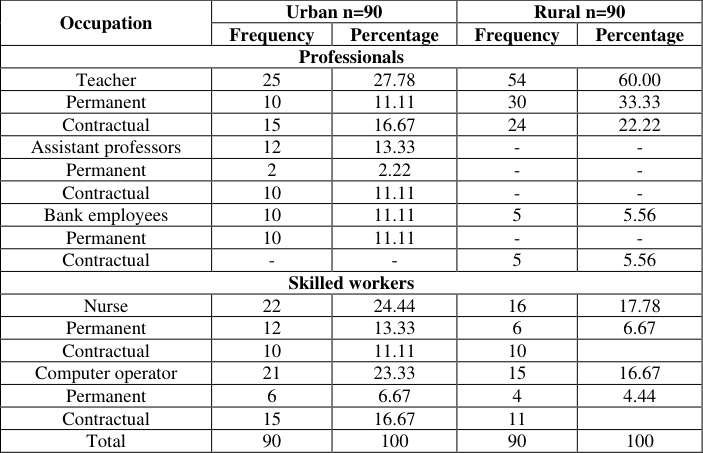 Table 1
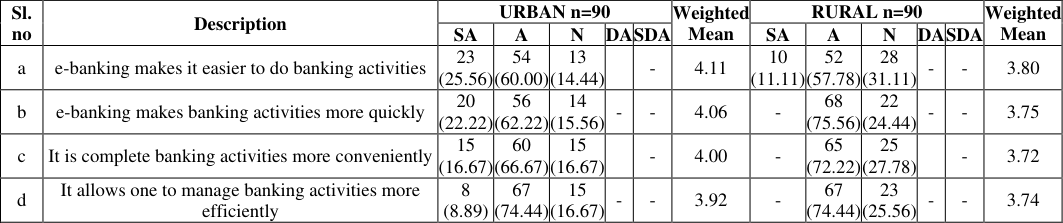 Table 2
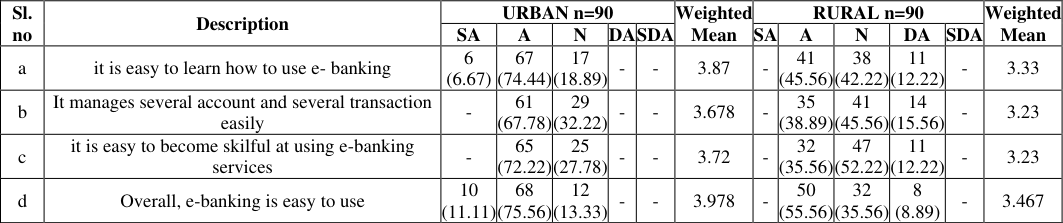 Table 3
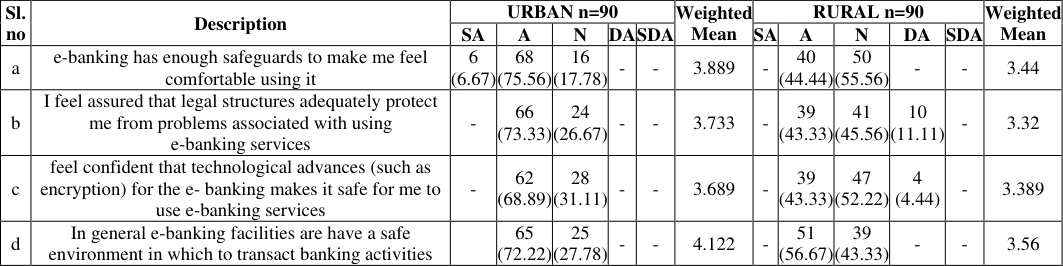 Table 4
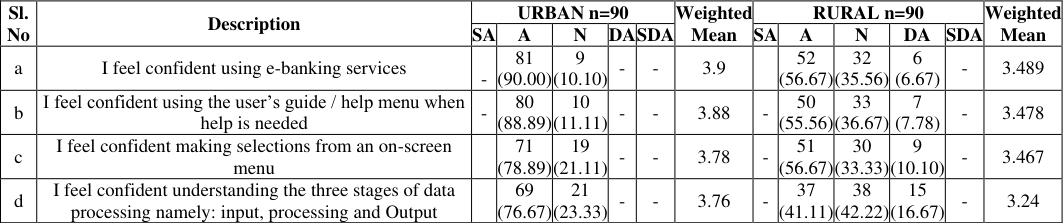 Table 5
 Table 6
Introduction
"I dream of a Digital India where mobile and e-banking ensures financial inclusion." Narendra Modi
Banking system always has an important role to play in every country's economy. It is vital for any nation as it provides the needs of credit for all the sections of the society. India is not only the world's largest independent democracy but it is also an emerging economic giant. The growth potential of India is based on its strong banking institution. The infusion of information technology in banking sector has completely revolutionized how the banking sector operated. In order to survive in the new globalized world, banks had to opt for this new change.
Banking in India has been through a long journey. It has seen a number of changes due to technology and innovation. Arrival of card, Introduction of Electronic Clearing Services (ECS), Electronic Funds Transfer (EFT) and concept of online banking and mobile banking are the various novelties which took place in banking sector. Now all the banks have started with concept of multi-channels like ATMs, credit cards, debit cards, telephone banking, mobile banking, internet banking etc. (Jasdeep Kour, 2015) [4] . It was ICICI bank which became the pioneer of e-banking in India. It was the first bank to introduce online banking services in 1996. Its initiatives were followed by Citibank and HDFC Bank who provided internet banking services in 1999.Various initiatives have been taken by both the Government and the Reserve Bank from time to time to smoothen the expansion of e-banking in India (Nidhi, 2016) [6] . Online banking (internet banking/e-banking or virtual banking) is an electronic payment system that enables customers of a bank or other financial institution to conduct a range of financial transactions through the financial institution's website. With the ongoing digital drive in India, the number of users opting for online banking is expected to double to reach 150 million mark by 2020, from the current 45 million active online banking users in India (Ministry of electronics and IT (Government of India, 2017) [5] .
As far as online banking adoption is concerned, security, trust and privacy concerns have been outlined as extremely important ones from the consumer's standpoint (Benamati and Serva, 2007) [1] . Online banking requires consumer involvement, as it requires the consumer to maintain and regularly interact with additional technology (Jane, 2004) [3] . Consumers who use e-banking use it on an ongoing basis and need to acquire a certain comfort level with the www.extensionjournal.com technology to keep using it (Servon and Kaestner, 2008) [9] . Risk and Privacy Concern is another important factor and is abbreviated as Risk Privacy. The element of trust in this context would relate to the security of transacting for consumers and determine the acceptability rate of this alternative delivery channel in the long run. Internet banking is just the extension of conventional branch banking. Here the services are being provided online that were originally provided in the branches. Thus, customer perception has got great importance in electronic banking as well. Hence the study focuses on the objective to study the perception of urban and rural working women towards ebanking services in a specified locality.
Materials and Methods
Materials and Methods
Research design
Urban and Rural working women were selected through purposive random sampling method from different professions. The study consisted of 180 subjects (90 urban and 90 rural working women) selected from two talukas. In each taluk four urban and four rural localities were selected randomly for data collection. The respondents were categorized as Young (25-35 yrs), middle (35-55 yrs) and old age (Above 55) groups based on the classification by Usha Rani (1999) [11] .
Tools and measures
General information pretested schedule was used to elicit auxiliary information of the subjects regarding age, gender, family composition. Socio Economic Status (Modified Kuppuswamy., 2020) [8] was employed to assess the SES of the family, education, occupation, income, and caste. The interview schedule, consisted of socio-personal characteristics of the respondent, motivational factors to adopt e-banking services, the respondents perception towards e-banking services and the problems faced by ebanking users. The construct measured on a five point likert scale as strongly agree, agree, neutral, disagree and strongly disagree with a highest score of 5 for strongly agree and lowest of 1score for strongly disagree. The scales measuring perceived usefulness and trust in the e-banking system were adapted from the study conducted by Nor (2005) [12] . Those measuring the perceived ease of use were found in the studies of Nor (2005) [12] and modified for use in this research.
Data collection procedures
Data was collected through interview method by individually administering the standardised scales. Urban and Rural working women were selected randomly from different professions and were briefed about the purpose of the study and interviewed. A pre-designed questionnaire was used for data collection. The case studies were conducted to get information on perception of working women about e banking services. Frequency and percentage were used to interpret the familial characteristics.
Comparison between two groups was measured by t-test. Karl Pearson's correlation coefficient analysis was carried out to assess the degree of relationship between perception of urban and rural working women towards e-banking services.
Results and Discussion
The results of the study perception of urban and rural working women towards e-banking services is presented in tables 1-6. The occupational details of the urban and rural working women presented in Table 1. The occupation was divided into professionals and skilled worker category. It showed that majority (52.22%) of the urban respondents are in Professional line which includes Teachers (Permanent 11.11%, contractual 16.67%), Assistant professors (Permanent 2.22%, contractual 11.11%), Bank employees (Permanent 11.11%), about 47.78 percent of the respondents were skilled workers i.e. Nurse (Permanent 13.33%, contractual 11.11%), Computer operators (Permanent www.extensionjournal.com 6.67%, contractual 16.67%) respectively. In rural area more than half of the respondents are professionals which include Teachers (Permanent 33.33%, contractual 22.22%), Bank employees (contractual 5.56%), skilled workers (34.44%), nurse (Permanent 6.67%, contractual 11.11%) and computer operators (Permanent 4.44%, contractual 12.22%) were found. The study was supported by Nilesh and Devyani (2019) [7] that majority (31%) of the respondents were teachers. Further in urban area 66.67 percent of the respondents agreed to the statement that e-banking makes banking activity conveniently, followed by 16.16 percent strongly agreed by urban respondents. The weighted mean score of urban respondents was 4.00. Among rural area majority (72.22%) agreed to this statement and the weighted mean score was 3.711 under the perceived usefulness. Majority (74.44%) of the urban respondents agreed to the statement of e-banking allows banking activities more efficiently. The weighted mean score was 3.92. Among rural area majority (74.44%) agreed to this statement and the weighted mean score was 3.74 under the perceived usefulness. It is clear from the table 3 that majority (74.44%) of the urban respondents agreed to the statement of e-banking is easy to learn and use and least (6.67%) of the respondents strongly agreed to this statement. The weighted mean score was 3.87. Among rural area majority (45.56%) agreed to this statement, followed by neutral (42.22%) and disagreed (12.22%). The weighted mean score was 3.4 of the first statement under the perceived ease of use. In urban area majority (67.78%) of the respondents agreed to the statement of e-banking manages several account and transaction easily. The weighted mean score was 3.678.
| Sl. no | Description | URBAN n=90 | — | — | — | — | Weighted Mean | RURAL n=90 | — | — | — | — | Weighted Mean |
|---|---|---|---|---|---|---|---|---|---|---|---|---|---|
| SA | A | N | DA | SDA | SA | A | N | DA | SDA | ||||
| a | it is easy to learn how to use e- banking | 6 (6.67) | 67 (74.44) | 17 (18.89) | - | - | 3.87 | - | 41 (45.56) | 38 (42.22) | 11 (12.22) | - | 3.33 |
| b | It manages several account and several transaction easily | - | 61 (67.78) | 29 (32.22) | - | - | 3.678 | - | 35 (38.89) | 41 (45.56) | 14 (15.56) | - | 3.23 |
| c | it is easy to become skilful at using e-banking services | - | 65 (72.22) | 25 (27.78) | - | - | 3.72 | - | 32 (35.56) | 47 (52.22) | 11 (12.22) | - | 3.23 |
| d | Overall, e-banking is easy to use | 10 (11.11) | 68 (75.56) | 12 (13.33) | - | - | 3.978 | - | 50 (55.56) | 32 (35.56) | 8 (8.89) | - | 3.467 |
Table text extracted from the original PDF; superscript letters are shown inline. The original table image is below.
View original table image
| Occupation | Urban n=90 | — | Rural n=90 | — |
|---|---|---|---|---|
| Frequency | Percentage | Frequency | Percentage | |
| Professionals | ||||
| Teacher | 25 | 27.78 | 54 | 60.00 |
| Permanent | 10 | 11.11 | 30 | 33.33 |
| Contractual | 15 | 16.67 | 24 | 22.22 |
| Assistant professors | 12 | 13.33 | - | - |
| Permanent | 2 | 2.22 | - | - |
| Contractual | 10 | 11.11 | - | - |
| Bank employees | 10 | 11.11 | 5 | 5.56 |
| Permanent | 10 | 11.11 | - | - |
| Contractual | - | - | 5 | 5.56 |
| Skilled workers | ||||
| Nurse | 22 | 24.44 | 16 | 17.78 |
| Permanent | 12 | 13.33 | 6 | 6.67 |
| Contractual | 10 | 11.11 | 10 | |
| Computer operator | 21 | 23.33 | 15 | 16.67 |
| Permanent | 6 | 6.67 | 4 | 4.44 |
| Contractual | 15 | 16.67 | 11 | |
| Total | 90 | 100 | 90 | 100 |
Table text extracted from the original PDF; superscript letters are shown inline. The original table image is below.
View original table image
Among rural area majority (45.56%) neutral to this statement, followed by agreed (38.89%), disagreed (15.56%) and the weighted mean score was 3.333 of the first statement under the perceived ease of use. Majority (72.22%) of the urban respondents agreed to the statement of e-banking is easy to become skilful at using ebanking service. The weighted mean score was 3.72. In rural area majority (52.22%) of the respondents said neutral to this statement, followed by agreed (35.56%), disagreed (12.22%) and weighted mean score was 3.23 under the perceived ease of use. www.extensionjournal.com
Further in urban area majority (75.56%) of the respondents agreed to the statement of overall e-banking is easy to use and least 11.11 percent of them strongly agreed to this statement respectively. The weighted mean score was 3.967.
Among rural area majority (55.56%) of the respondents said agreed to this statement and weighted mean score was 3.467 of the first statement under the perceived ease of use. Table 4 indicates that majority (75.56%) of the urban respondents agreed to the statement of e-banking has enough safeguard to make to feel comfortable using it and 6.67 percent of them strongly agreed to this statement and the weighted mean score was 3.889. Among rural area majority (55.56%) respondents said neutral to this statement, followed by 44.44of them agreed and weighted mean score was 3.44 under the trust in e-banking system. In urban area 73.33 percent of the respondents agreed to the statement of to feel assured that legal structures adequately protect them from problems associated with using e-banking services and the weighted mean score was 3.733. Among rural area 43.33 percent agreed (43.33%) to this statement respectively and the weighted mean score was 3.32 under the trust in e-banking system.
| Sl. no | Description | URBAN n=90 | — | — | — | — | Weighted Mean | RURAL n=90 | — | — | — | — | Weighted Mean |
|---|---|---|---|---|---|---|---|---|---|---|---|---|---|
| SA | A | N | DA | SDA | SA | A | N | DA | SDA | ||||
| a | e-banking has enough safeguards to make me feel comfortable using it | 6 (6.67) | 68 (75.56) | 16 (17.78) | - | - | 3.889 | - | 40 (44.44) | 50 (55.56) | - | - | 3.44 |
| b | I feel assured that legal structures adequately protect me from problems associated with using e-banking services | - | 66 (73.33) | 24 (26.67) | - | - | 3.733 | - | 39 (43.33) | 41 (45.56) | 10 (11.11) | - | 3.32 |
| c | feel confident that technological advances (such as encryption) for the e- banking makes it safe for me to use e-banking services | - | 62 (68.89) | 28 (31.11) | - | - | 3.689 | - | 39 (43.33) | 47 (52.22) | 4 (4.44) | - | 3.389 |
| d | In general e-banking facilities are have a safe environment in which to transact banking activities | 65 (72.22) | 25 (27.78) | - | - | 4.122 | - | 51 (56.67) | 39 (43.33) | - | - | 3.56 |
Table text extracted from the original PDF; superscript letters are shown inline. The original table image is below.
View original table image
Further 68.89 percent of the urban respondents agreed to the statement that they feel confident that technological advances (such as encryption) for the e-banking makes it safe for them to use e-banking service and The weighted mean score of urban respondents was 3.689. Among rural area majority (52.22%) of the respondents said neutral to this statement, followed by 43.33 percent of the respondents said agreed to above statement and the weighted mean score was 3.389 under the trust in e-banking system. Majority (72.22%) of the urban respondents agreed to the statement of e-banking facilities are having a safe environment in which to transact banking activities and the weighted mean score was 4.122. Among rural area majority (56.67%) agreed to this statement and weighted mean score was 3.56 under the trust in e-banking system. It is clear from the table 5 that, majority (90.00%) of the urban respondents agreed to the statement of they feel confident while using e-banking services. The weighted mean score was 3.90. Among rural area majority (56.67%) of the respondents agreed to this statement. The weighted mean score was 3.489 under the perceived self efficiency.
| Sl. No | Description | URBAN n=90 | — | — | — | — | Weighted Mean | RURAL n=90 | — | — | — | — | Weighted Mean |
|---|---|---|---|---|---|---|---|---|---|---|---|---|---|
| SA | A | N | DA | SDA | SA | A | N | DA | SDA | ||||
| a | I feel confident using e-banking services | - | 81 (90.00) | 9 (10.10) | - | - | 3.9 | 52 (56.67) | 32 (35.56) | 6 (6.67) | - | 3.489 | |
| b | I feel confident using the user’s guide / help menu when help is needed | - | 80 (88.89) | 10 (11.11) | - | - | 3.88 | - | 50 (55.56) | 33 (36.67) | 7 (7.78) | - | 3.478 |
| c | I feel confident making selections from an on-screen menu | 71 (78.89) | 19 (21.11) | - | - | 3.78 | - | 51 (56.67) | 30 (33.33) | 9 (10.10) | - | 3.467 | |
| d | I feel confident understanding the three stages of data processing namely: input, processing and Output | 69 (76.67) | 21 (23.33) | - | - | 3.76 | - | 37 (41.11) | 38 (42.22) | 15 (16.67) | - | 3.24 |
Table text extracted from the original PDF; superscript letters are shown inline. The original table image is below.
View original table image
In urban area majority (88.89%) of the respondents agreed to the statement of they feel confident while using the users guide/help menu when needed and the weighted mean score was 3.88. Among rural area majority (55.56%) of the respondents agreed to above statement. The weighted mean score was 3.478 under the perceived self efficiency. Further 78.89 percent of the urban respondents agreed to the statement that they feel confident making selections from an on screen menu and the weighted mean score was 3.78. Among rural area majority (56.67%) of the respondents agreed to this statement and the weighted mean score was 3.467 under the perceived self efficiency. Majority (76.67%) of the urban respondents agreed to the statement that they feel confident to understand the three www.extensionjournal.com stages of data processing and the weighted mean score was 3.76. Among rural area 41.11 percent agreed followed by 16.67 percent of the respondents disagreed to this statement and the weighted mean score was 3.24. majority of the urban respondents perceived e-banking makes banking activities more quickly followed by e-banking is easy to use, e-banking facilities were had a safe environment in which to transact banking activities and most of them felt confident while using e-banking services. But in rural area less number of respondents perceived e-banking makes banking activities more quickly followed by e-banking is easy to use. Reason might be the rural respondents had less awareness regarding e-banking services and they had less knowledge about computer and internet usage so they felt hesitation to use e-banking services and financial account handled by their husband and family members so they don't know much about e-banking services. The results are contradictory to the findings of Daniel (1999) [2] revealed that majority of respondent's perceived e-banking was useful followed by self efficient, ease of use and trust on the e-banking services. The similar study Uday Singh (2015) [10] found that around 45 percent of the respondents had positive perception towards e-banking services There is a significant difference between rural and urban working women perception towards e-banking services with t-value 3.658. The mean score of urban area was higher (62.10±8.482) compared to rural area (57.35±8.914). Because of rural respondents had less exposure, less knowledge, awareness towards new e-banking services and not adopted all e-banking facility except ATM compared to urban so the rural respondents had negative perception towards e-banking services.
Conclusion
From the study it can be concluded that majority of the urban and rural working women comes under the age group below 35 years. Aajority of the urban (27.78%) and rural (60.00%) working women were professionals. Majority of both urban (75.56%) and rural (72.22%) respondents belonged to upper middle class. Among urban respondents majority of them perceived e-bankingqas very useful, convenient, efficient to do banking activity, easy to learn and easy to use and perceived e-banking as trust worthy and self efficient to use. In rural area less number of the respondents perceived e-banking as very useful, convenient and efficient to do banking activity, easy to learn and easy to use and perceived e-banking as trust worthy and self efficient to use. There was significant difference between urban and rural working women's perception towards ebanking services with t-value 3.658. The mean score of urban area was higher (62.10+8.485) than compared to rural area (57.35+8.941). Most of the educated young generation of urban and rural working women used e-banking services more compared to older generation and most of the urban working women adopted new technology and other banking services compared to rural working women. Urban women perceived e-banking as more useful, ease of use, trust worthy and self efficient compare to rural women respondents.
Figures and tables from the paper
| Sl. no | Description | URBAN n=90 | — | — | — | — | Weighted Mean | RURAL n=90 | — | — | — | — | Weighted Mean |
|---|---|---|---|---|---|---|---|---|---|---|---|---|---|
| SA | A | N | DA | SDA | SA | A | N | DA | SDA | ||||
| a | e-banking makes it easier to do banking activities | 23 (25.56) | 54 (60.00) | 13 (14.44) | - | 4.11 | 10 (11.11) | 52 (57.78) | 28 (31.11) | - | - | 3.80 | |
| b | e-banking makes banking activities more quickly | 20 (22.22) | 56 (62.22) | 14 (15.56) | - | - | 4.06 | - | 68 (75.56) | 22 (24.44) | - | - | 3.75 |
| c | It is complete banking activities more conveniently | 15 (16.67) | 60 (66.67) | 15 (16.67) | - | 4.00 | - | 65 (72.22) | 25 (27.78) | - | 3.72 | ||
| d | It allows one to manage banking activities more efficiently | 8 (8.89) | 67 (74.44) | 15 (16.67) | - | - | 3.92 | - | 67 (74.44) | 23 (25.56) | - | - | 3.74 |
Table text extracted from the original PDF; superscript letters are shown inline. The original table image is below.
View original table image
| Variable | Urban n=90 | Rural n=90 | “t” value |
|---|---|---|---|
| Mean ± SD | Mean ± SD | ||
| Perception | 62.10±8.482 | 57.35±8.914 | 3.658* |
Table text extracted from the original PDF; superscript letters are shown inline. The original table image is below.
View original table image
References
11 in the original paper- Benamati S, Serva K. Innovation characteristics and innovation adoption implementation: A meta-analysis of findings. IEEE Transactions on Engineering Management. 2007;29(5):34-52.
- Daniel E. Provision of electronic banking in the UK and the Republic of Ireland. International Journal of Bank Marketing. 1999;17(2):72-82.
- Jane. Adoption and diffusion of electronic banking by customers: critical analysis of empirical evidences. International Journal of Financial Management. 2004;1(1):29-46.
- Jasdeep Kaur. Growth of E-Banking in India. International Journal of Research in Finance and Marketing. 2015;7(5):2231-5985.
- Ministry of Electronics and IT. 2017. Online banking users to reach 150 billion by 2020. [email protected].
- Nidhi Singh, Neeena Sinha. A study on mobile banking and its impact on customers' banking transactions: A comparative analysis of public and private sector banks in India. FIIB Business Review. 2016;5(2):48-53.
- Nilesh Anute, Devyani Ingale. An approach of urban and rural educated senior citizens towards e-banking services. Journal of Management Research and Analysis. 2019;6(1):42-44.
- Saleem SM. Modified Kuppuswamy socioeconomic scale updated for the year 2020. Indian Journal of Forensic and Community Medicine. 2020;7(1):1-3.
- Servon Q, Kaestner B. Internet banking: where does India stand? Journal of Contemporary Management. 2018;2(1):38-58.
- Uday Singh Rajput. Customer perception on E-banking service. Pacific Business Review International. 2015;8(4).
- Nor AM, Davis J, Sen B, Shipsey D, Louw SJ, Dyker AG, et al. The Recognition of Stroke in the Emergency Room (ROSIER) scale: development and validation of a stroke recognition instrument. The Lancet Neurology. 2005 Nov 1;4(11):727-734.