
Research article · 2024 · Full text
International Journal of Agriculture Extension and Social DevelopmentA study on rural homestays in Kumaon region of Uttarakhand (India): An alternative tourism product for sustainable rural development in hills
Volume 7(2) · Pages 524–528 · DOI: 10.33545/26180723.2024.v7.i2g.381 ↗
Research areasDiverse Aspects of Tourism Research
Abstract
Author-writtenHomestay is an important business activity which is also adopted in hill villages to supplement household income from same unit of rural property. In homestay family share a portion of their house with the visiting guests who stay with the family. The present study was conducted in Kumaon region of Uttarakhand (India) covering six homestays from randomly selected ten rural development blocks. The study reveals that majority of homestay owners were male (75.00%) in the middle age group (53.34%) with qualification graduate & above (70.00%) and possesses medium homestay business experience (70.00%). Lack of capital, poor road network, lack of recreational activities for children and lack of skill & development were major constraints in homestay business. Homestay can be an important economic intervention in rural transformation which also help to check youth migration to cities. Homestay can be sustainable in rural hills if it takes care of all three dimensions of sustainability viz economic, environmental as well as social. Cluster approach for homestay development and management can ensure sustainability in terms of economic, environmental as well as social dimension.
Summary
Source-checkedPlain-language reading of the full paper, prepared with AI and checked against the text. Each point links to the authors' own words.
Why it matters
- Combining farming with non-farm activities is recognized as a way to improve the well-being of rural households. View evidence ↗
- Despite having significant tourism potential, the state of Uttarakhand faces challenges with depopulation and the migration of youth. View evidence ↗
- Homestays serve as a business activity in hill villages that allows families to supplement their income using their existing rural property. View evidence ↗
What they did
- The research was conducted in 2022 within ten randomly selected rural development blocks in the Kumaon region of Uttarakhand. View evidence ↗
- Data was gathered using a scientifically developed interview schedule and analyzed through statistical means and comparison. View evidence ↗
What they found
- The majority of homestays in the study were controlled by males (75.00%), while females owned 25.00%. View evidence ↗
- A high proportion of homestay owners (70.00%) possessed an education level of graduate or above. View evidence ↗
- Most owners (70.00%) reported having a medium level of experience in the homestay business. View evidence ↗
- The majority of homestay owners (63.33%) had not received any formal training to operate their enterprise. View evidence ↗
- Lack of capital was the highest-ranked constraint perceived by homestay owners, cited by 91.67% (55 owners). View evidence ↗
- Poor road networks were the second most significant constraint, reported by 90.00% of owners. View evidence ↗
- A lack of recreational facilities for children was the third most common constraint, cited by 86.67% of owners. View evidence ↗
- Despite capital being a major constraint, 70.00% of homestay owners had not taken any financial help or loans to run their business. View evidence ↗
What it means
- The authors conclude that the Kumaon region has significant potential for homestays, which could serve as a key strategy to reduce youth migration to cities. View evidence ↗
- The authors recommend government intervention to provide credit, training, and improved transportation and road connectivity for homestay ventures. View evidence ↗
- The authors suggest a cluster-based group approach to organize homestays to achieve sustainable economic growth without harming society or the environment. View evidence ↗
Visual summary
2 visualsIllustrations explain the paper; charts are replotted from the paper's own table values.
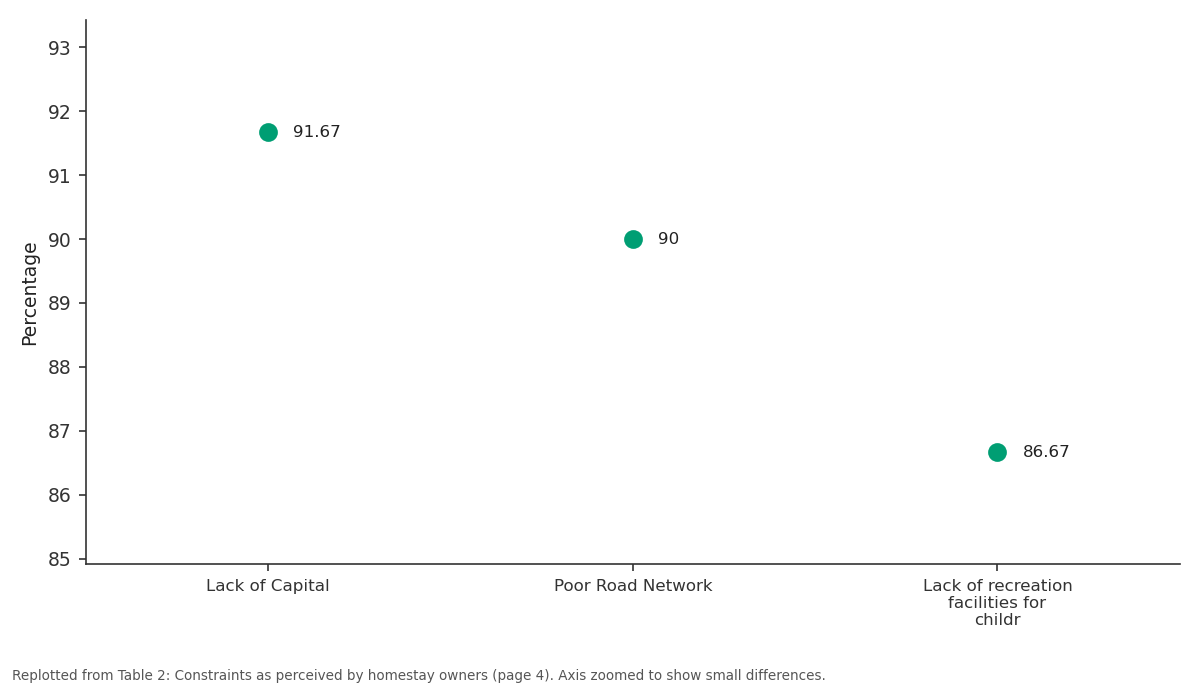
Percentage: Lack of Capital vs Poor Road Network vs Lack of recreation...
Replotted from Table 2 (page 4) of the original paper. Every bar is the paper's own table value.
View source evidence ↗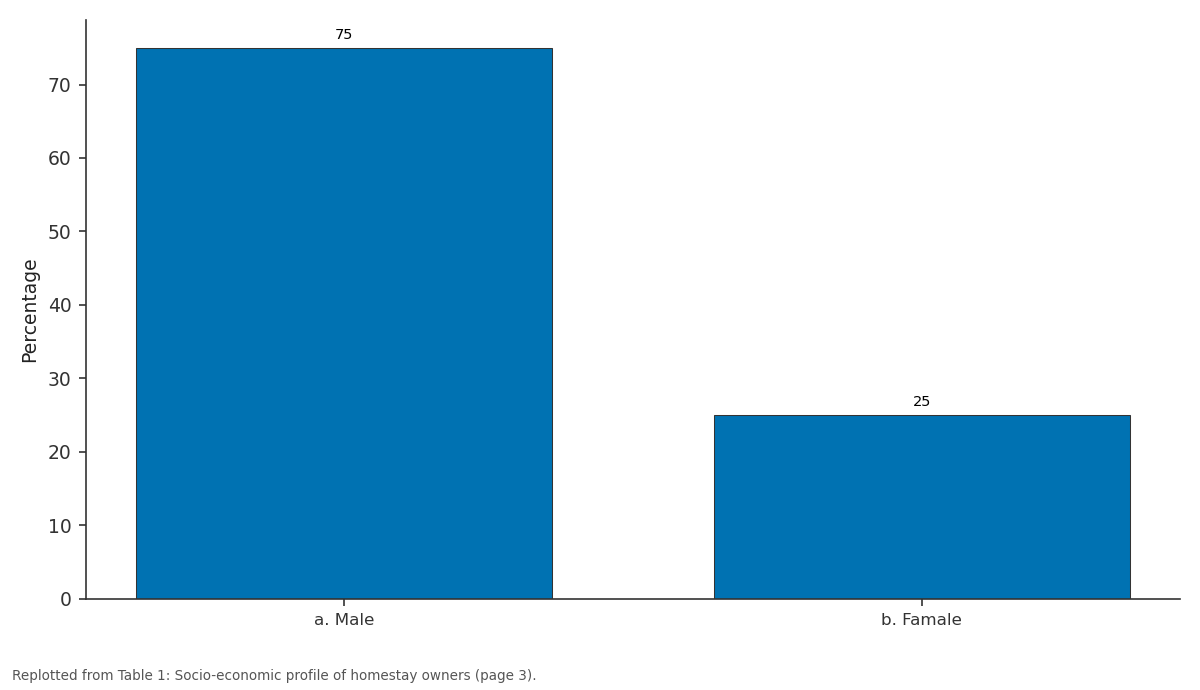
Percentage: a. Male vs b. Famale
Replotted from Table 1 (page 3) of the original paper. Every bar is the paper's own table value.
View source evidence ↗Figures & tables
From the original paper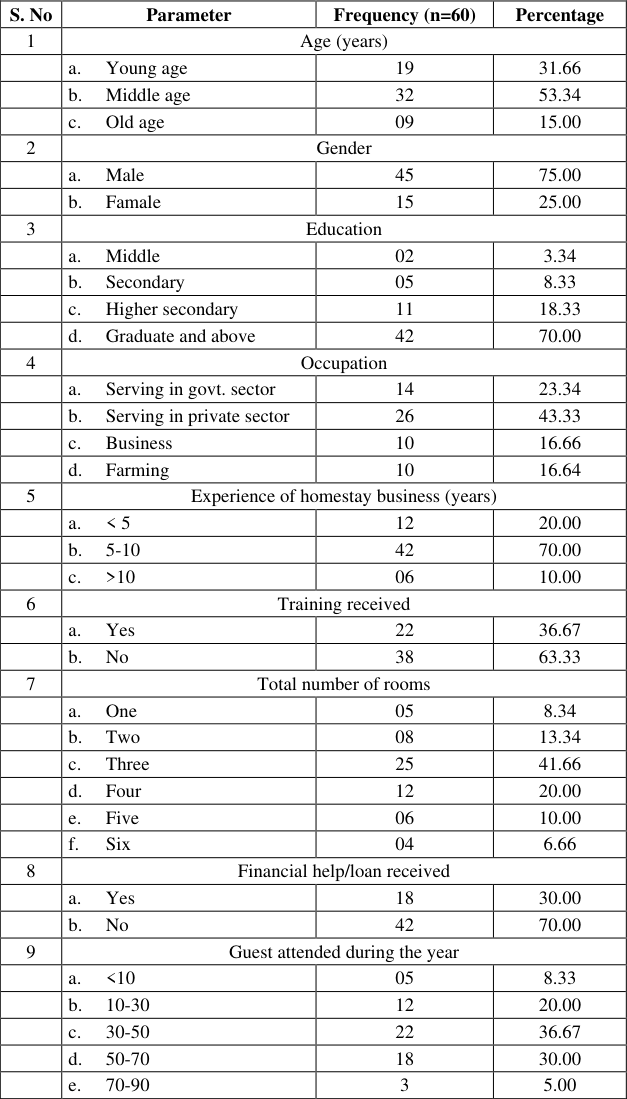 Table 1
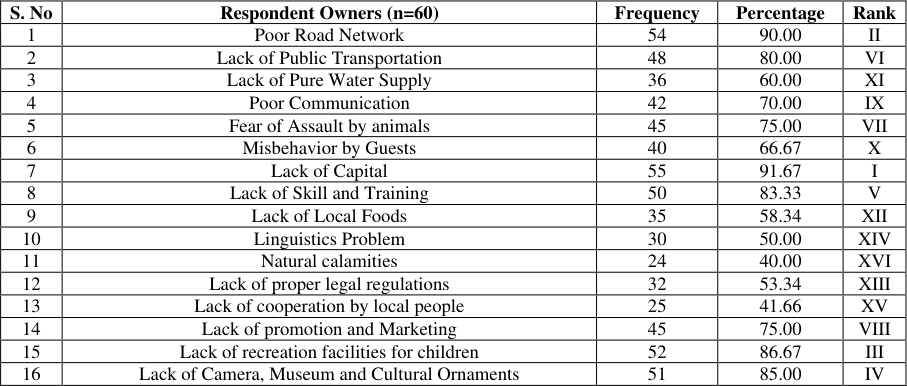 Table 2
Introduction
Traditionally people have been thinking hill villages as unit of population living in a confined area with dependency on agriculture and forests for livelihood. Rural differentia is considered in term of deprived situation of transportation, education and health facilities but it is also fact that rural people in hills always try to protect their traditional habits and culture. Rural people in hills assiduously earning their livelihood with their indefatigable hard work. There is emerging consensus that well-being of rural households improve with the blending of farm activities with non-farm activities (Kumar et al., 2014) [9] . The synergetic interaction of primary sector agriculture and service sector tourism is new way to harness more income from same unit of property. The infusion of new income generation activities like homestay venture especially in small hilly villages has bolstered economic growth and diversification in terms of economic opportunities. UNWTO (2021) stated "Tourism for rural development programs aims to ensure tourism contribution to reduce regional irregularities of income and development, fighting depopulation, progressing gender equality and women and youth empowerment, advancing innovation and digitalization, improving connectivity, infrastructure, access to finance and investment. Homestay is a unique hospitality system in which the tourist stays with the family as a member of the family. It aims at equipping the tourist with the knowledge of the hosts' way of life such as the lifestyle, folk arts, sculptures, cuisine etc. Hills have always been promising in delivery of beautiful landscapes, picturesque agriculture fields, excellent air quality, forest tracks and rural hospitality. With the development of infrastructure in rural hills connectivity and approachability has increased manifold. People from urban dwellings now found it easy to visit villages and they are keen to know rural environment, art, culture and heritage. Uttarakhand is a hill state which offer plethora of adorable scenery, pilgrimage, abundant wildlife and umpteen adventurous sports. There is no dearth of tourist activities in the state even then the state is facing problem of youth migration and depopulation. Both permanent and semi-permanent migration is seen in Uttarakhand (Jain, 2010) [7] . Unemployment is the major problem in rural areas as more than 50% of out-migration occurred for employment (Sati; 2021) [18] . The Government can create employment opportunities by creating an Eco-Task Force with due social security benefits, which will help in conserving forests and environment and could generate revenues for their sustainability (Mangani,; 2023) [11] . Introduction of tourists to beautiful hill farms have scope to diversify agriculture and generate more income from same unit of land (Singh et al 2017) [19] . Undoubtedly, home stay tourism would bring economic development and employment growth in rural areas. (Srivastava & Singh, 2019) [20] . Home stay business has emerged as an important economic activity in the state and the business is budding across all rural areas which may be important economic intervention to strengthen rural economy.While the homestay programme has encouraged local guardianship behaviour, opportunities to improve and www.extensionjournal.com expand conservation efforts with the help of communities in the region could be further developed, and require greater cooperation from concerned stakeholders in both public and private sectors (Bhalla et al; 2016) [3] . Rural tourism, with focus on Homestay, is being considered a means to ensure sustainable livelihood (Lalrinmawii; 2019) [10] . The development of these homestays have been linked to a range of local cultural activities; heritage and the natural capital component of a region; guiding and interpretation; forest patrols; development of promotional materials; equitable access for households across economic classes; crucial role of communities as tourism stakeholders; and towards conservation of natural resources and the environment (Chandan, & Singh, 2012; Dutta, 2012; Gangotia, 2013; Regmi & Walter, 2016) [1,5,6,13] . The review by Janjua (2021) [8] notes that important topics like-homestay branding, homestay and entrepreneurship, homestay and information & communication technology (ICT) competency, homestay operation training and development about sustaianbaility-are rarely addressed in the existing literature. Homestay offers hospitality which provides an exclusive experience where the tourist gets to know real culture and feel of the estimation. In spite of all the benefits offered by homestays, they are less popular in comparison to other accommodation services in India (Saini and Singh, 2022) [14] . Chaiyatorn et al. (2010) [4] found that homestays can ensure economic, social, and cultural benefits for local communities as well as sustainable development.
Exploring natural regality of Kumaon region of Uttarakhand while staying in rural homestay can add most enthralling moments in tourist life. Keeping in view the tremendous potential of rural homestay in Kumaon region the present study was planned with the following objectives:-1. To delineate the socio-economic profile of homestay owners 2. To study constraints as perceived by homestay owners. 3. To outline sustainability of rural homestays in hills.
Research Methodology
The present study was conducted to during the year 2022 in Kumaon region of Uttarakhand covering ten rural development blocks selected randomly. From each randomly selected development block, six home-stays were selected from exhaustive list of registered homestays. A total sixty homestay owners were selected for the study. Along with sixty homestay owners sixty visitors were also interviewed for the study thereby making a sample size of 120. The randomly selected units were interviewed with the help of scientifically developed interview schedule. The data collected was compiled, tabulated, analyzed and interpreted with statistical means and comparison.
Results and Discussion
Results and Discussion
Profile of Homestay Owners Age
It could be seen from the Table 1 that the majority of the homestay owners (53.34%) were under middle age category. The maximum and minimum of ages of homestay owners was 62 and 22 years. The average age of the owners was 47 years. The The results observed to be in conformity with the study conducted by Singh et al (2021) [15] , Basak et al (2021) [2] and Thakur & Monga (2022) [16] .
| S. No | Parameter | Frequency (n=60) | Percentage |
|---|---|---|---|
| 1 | Age (years) | ||
| a. Young age | 19 | 31.66 | |
| b. Middle age | 32 | 53.34 | |
| c. Old age | 09 | 15.00 | |
| 2 | Gender | ||
| a. Male | 45 | 75.00 | |
| b. Famale | 15 | 25.00 | |
| 3 | Education | ||
| a. Middle | 02 | 3.34 | |
| b. Secondary | 05 | 8.33 | |
| c. Higher secondary | 11 | 18.33 | |
| d. Graduate and above | 42 | 70.00 | |
| 4 | Occupation | ||
| a. Serving in govt. sector | 14 | 23.34 | |
| b. Serving in private sector | 26 | 43.33 | |
| c. Business | 10 | 16.66 | |
| d. Farming | 10 | 16.64 | |
| 5 | Experience of homestay business (years) | ||
| a. < 5 | 12 | 20.00 | |
| b. 5-10 | 42 | 70.00 | |
| c. >10 | 06 | 10.00 | |
| 6 | Training received | ||
| a. Yes | 22 | 36.67 | |
| b. No | 38 | 63.33 | |
| 7 | Total number of rooms | ||
| a. One | 05 | 8.34 | |
| b. Two | 08 | 13.34 | |
| c. Three | 25 | 41.66 | |
| d. Four | 12 | 20.00 | |
| e. Five | 06 | 10.00 | |
| f. Six | 04 | 6.66 | |
| 8 | Financial help/loan received | ||
| a. Yes | 18 | 30.00 | |
| b. No | 42 | 70.00 | |
| 9 | Guest attended during the year | ||
| a. <10 | 05 | 8.33 | |
| b. 10-30 | 12 | 20.00 | |
| c. 30-50 | 22 | 36.67 | |
| d. 50-70 | 18 | 30.00 | |
| e. 70-90 | 3 | 5.00 |
Table text extracted from the original PDF; superscript letters are shown inline. The original table image is below.
View original table image
Gender
Majority of homestay (75.00 percent) are controlled by males whereas female owns (25.00 percent) less homestay. The results of the study are in line with the findings of Similar findings were reported by Basak et al (2021) [2] and Nirmala (2021) [12] .
Occupation
Occupation status indicates the type of income generating activities undertaken by the respondents. The present study reveals that majority of the respondent homestay owners (60.00%) were working in private sector.
Education
Education is an act or process of acquiring general knowledge, developing the process of reasoning and judgment, and preparing oneself for mature life. Education status of an individual farmer plays vital role in realizing higher performance. The data depicted in Table 1 reveals that majority of the owners (70.00%) were having graduate or above level of education followed by higher secondary education status (18.33%). The phenomenon can be explained in light of enhanced education level creates awareness for income generation activities. Results were in conformity with the findings of Singh et al (2021) [15] , Nirmala (2021) [12] , Basak et al (2021) [2] and Thakur & Monga (2022) [16] .
Years of homestay experience
The data presented in Table 1 showed that maximum owners have medium homestay experience (70.00 percent) followed by short term experience (20.00 percent) and only 10.00 homestay owners have experience more than 10 years. Results are in conformity with the results reported by Nirmala (2021) [12] .
Training Received
Data presented in Table 1 reveals that majority of homestay owners (63.33 percent) have not received any training to run the enterprise whereas only 36.67% homestay owners have training exposure.
Total Number of Rooms
It is observed from Table 1 that maximum homestays (41.66 percent) have three rooms available for visiting guests followed by four (20.00 percent). Only 6.66 percent homestay owners have facility of six rooms.
Financial help/Loan Received
The present research reveals that that majority of homestay owners (70.00%) have not taken any financial help/loan to run the enterprise and only 30% of respondent found to have financial help/loan.
Number of Guests in a year
Table 1 shows data on Average Number of Guests in a year reveals that majority of homestays (36.67 percent) is visited by guests in a range of 30 to 50 followed by 50-60 guest range to the tune of 30.00 percent.
Sustainability of Rural Homestays
UNEP and UNWTO (2012), In tourism, sustainability refers to the utilization of tourist resources to increase the number of tourists and economic effect while preserving the resource base for future generations. Therefore, sustainable tourism should be considered as: a. use natural resources, which are a critical component of tourism activities, to their full potential, while taking into consideration about critical ecological processes that aid in the conservation of natural resources and biodiversity; b. respect the population's socio-cultural originality and maintain its conventional values and cultural legacy, which leads to intercultural understanding and tolerance between hosts and visitors; c. ensure maximum and sustainable economic activities that provide socio-economic advantages to all stakeholders, including jobs and financial security, as well as social welfare that allows visitors to remain longer at the tourist site and reduces poverty among locals; d. offer all important stakeholders with knowledge and engagement, as well as strong political leadership to guarantee active engagement and consent among all participants; e. maintain a high standard of tourist satisfaction and provide a meaningful understanding for tourists by exploring the knowledge of sustainability problems and encouraging to adapt sustainable activities among them; f. create policies, procedures, and programmes that take into consideration not just visitors' expectations of responsible natural resource management, but also the requirements of communities that support tourism initiatives based on the preservation of the environment (UNEP and UNWTO, 2012).
Homestay as a business activity is at nascent stage in Uttarakhand. In Kumaon region this economic venture has budded across all the districts with preferability to stay by the tourist in the region. The number of registered and unregistered homestay is increasing at a good pace and with the increase in units of this economic venture it become imperative to review sustainability which should not be only in economic terms but should also take care environmental issues and social values and ethics. According training, credit, skill up-gradation, water and waste management, business management ethics need to be addressed in government policies also. Group approach by organising homestay niches into cluster is possible solution to reach sustainability targets for economic growth, without detrimental effects on environment and society.
Summary and Conclusion
Tourism sector can be considered as an important driving force of economic development and in-depth analysis of data for the present study it is well established that rural people in hills are ready to adopt homestay venture for supplementing household income. Kumaon region of Uttarakhand has vast potential for homestays which can be an important intervention to check youth migration to cities. Homestay as an economic activity have potential to provide good employment opportunities at the doorstep of rural youth. Due to small sized landholdings in hill sustainable livelihood is major challenge for hill agriculture. Here rise the needs to supplement rural families' income with the introduction of new economic venture which must be environment friendly and socially acceptable. Homestay is an important economic venture to supplement farm families' income and to better harness its potential some constraint faced by homestay owners to be taken care.
Figures and tables from the paper
| S. No | Respondent Owners (n=60) | Frequency | Percentage | Rank |
|---|---|---|---|---|
| 1 | Poor Road Network | 54 | 90.00 | II |
| 2 | Lack of Public Transportation | 48 | 80.00 | VI |
| 3 | Lack of Pure Water Supply | 36 | 60.00 | XI |
| 4 | Poor Communication | 42 | 70.00 | IX |
| 5 | Fear of Assault by animals | 45 | 75.00 | VII |
| 6 | Misbehavior by Guests | 40 | 66.67 | X |
| 7 | Lack of Capital | 55 | 91.67 | I |
| 8 | Lack of Skill and Training | 50 | 83.33 | V |
| 9 | Lack of Local Foods | 35 | 58.34 | XII |
| 10 | Linguistics Problem | 30 | 50.00 | XIV |
| 11 | Natural calamities | 24 | 40.00 | XVI |
| 12 | Lack of proper legal regulations | 32 | 53.34 | XIII |
| 13 | Lack of cooperation by local people | 25 | 41.66 | XV |
| 14 | Lack of promotion and Marketing | 45 | 75.00 | VIII |
| 15 | Lack of recreation facilities for children | 52 | 86.67 | III |
| 16 | Lack of Camera, Museum and Cultural Ornaments | 51 | 85.00 | IV |
Table text extracted from the original PDF; superscript letters are shown inline. The original table image is below.
View original table image
References
14 in the original paper- Anand A, Chandan P, Singh RB. Homestays at Korzok: Supplementing rural livelihoods and supporting green tourism in the Indian Himalayas. Mountain Research and Development. 2012;32(2):126-136. www.extensionjournal.com
- Basak D, Bose B, Sarkar C, Roy S, Roy IC, Sarkar BC. Understanding sustainable homestay tourism as a driving factor of tourist's satisfaction through structural equation modelling: A case of Darjeeling Himalayan region, India. Current Research in Environmental Sustainability. 2021;3:100098.
- Bhalla P, Coghlan A, Bhattacharyaa P. Homestays' contribution to community-based ecotourism in the Himalayan region of India. Tourism Recreation Research. 2016;41(2):213-228.
- Chaiyatorn S, Kaoses P, Thitphat P. The developmental model of cultural tourism -Homestay of the Lao Vieng and Lao Song ethnic groups in the central region of Thailand. Journal of Social Sciences. 2010;6(1):130132.
- Gangotia A. Home stay scheme in Himachal Pradesh: A successful story of community-based tourism initiatives (CBTIS). Global Research Analysis. 2013;2(2):206-207.
- Kumar R, Deb U, Bantilan C, Nagaraj N, Bhattari M. Economic growth and rural transformation in Eastern India: Strategies for Inclusive Growth. Theme paper presented at the Pre-conference Symposium on "Transformation in Rural Economy and Employment Opportunities in Eastern India: Implications for Inclusive Growth," organized as part of the 15th Annual Conference of the Indian Society of Labour Economics (ISLE), held on 17 December 2014 at Ranchi, Jharkhand state; c2014.
- Lalrinmawii C. Homestay Tourism as Potential for Developing Rural Livelihood in Mizoram. International Journal of Humanities and Social Science Invention (IJHSSI). 2019;8(11):22-25. November 2019.
- Mangani RP. Uttarakhand: Focus on unemployment, migration. [Online]. Available from: https://www.dailypioneer.com/2022/columnists/uttarak hand--focus-on-unemployment--migration.html; c2023.
- Regmi KD, Walter PG. Conceptualising host learning in community-based ecotourism homestays. Journal of Ecotourism; c2016. DOI:10.1080/14724049.2015.1118108.
- Thakur J, Monga N. Role of Homestay in Reviving Tourism in Shimla. PUSA Journal of Hospitality and Applied Sciences. 2022;8(2):49-59.
- UNEP and WTO. United Nations Environment Programme and World Tourism Organization. Tourism in the Green Economy -Background Report. UNWTO, Madrid. [Online]. Available from: https://www.eunwto.org/doi/pdf/10.18111/9789284414529; 2012.
- Sati VP. Out-migration in Uttarakhand Himalaya: its types, reasons, and consequences. Migration Letters. 2021 May;18(3):281-295.
- Singh S, Raman NLM, Hansra BS. Perspectives of Agritourism in Himachal Pradesh: A New Dimension in Hill Agricultural Diversification. Journal of Community Mobilization and Sustainable Development. 2017;12(2):207-215.
- Srivastava A, Singh S. Sustainable tourism Development: potential of Home Stay business in Uttarakhand. IJMRT. 2019;13(1):51-63.
Cited by 1
From OpenAlex, OpenCitations and reference lists read by Scinovex
- Exploring the migration and development nexus in the Kumaon hills of the Indian Himalayan region: applying the social–ecological systems framework within a challenge-based learning environment ↗
Qing Heng Tan, Navarun Varma, Ramnarayan Kalyanaraman · Sustainability Science · 2026
❝ 1