
Research article · 2024 · Full text
International Journal of Advanced Biochemistry ResearchRakholiya TD, Khanpara AV, Bhumika Solanki and Polara RD
Volume 8(2) · Pages 685–690 · DOI: 10.33545/26174693.2024.v8.i2i.650 ↗
Research areasLiver Diseases and Immunity
Abstract
Author-writtenInvestigations on bionomics of fall armyworm, S. frugiperda (J.E. Smith) infesting maize was carried out at PG Research Lab, Department of Entomology, College of Agriculture, JAU, Junagadh. For this experiment, duration and measurement of different stages of S. frugiperda viz., eggs, larva, pupa, adult and were studied. The life cycle of S. frugiperda revealed that the number of eggs laid by female was 327.4±55.09. As far as the hatching percent and the incubation period were concerned, 81.0±5.91 percent and 2.43±0.67 days were recorded. Mean period of larval instars i.e., first, second, third, fourth, fifth, sixth was 2.56±0.49, 2.30±0.46, 2.03±0.60, 2.00±0.58, 2.40±0.61, 4.63±0.66, respectively with a total larval period of 15.93±1.48 days. Pre-oviposition, oviposition and post-oviposition periods were 4.2±0.75, 3.6±0.49 and 4.4±0.80 days, respectively. The period of pupal stage was 9.37±0.91 days. Male and female adult longevity were 8.8±1.17 and 11.6±1.02 days, respectively. Total male and female adult life span were 37.6±1.36 and 40.4±1.62 days, respectively having 1:1.72 (Male: female) of sex ratio. The morphometric data viz., larval body length; pupal length and adult body length and wing span were measured.
Summary
Source-checkedPlain-language reading of the full paper, prepared with AI and checked against the text. Each point links to the authors' own words.
Why it matters
- Maize is a critical global cereal crop that provides 50-60% of daily human energy needs. View evidence ↗
- Maize plants are susceptible to approximately 140 different species of insect pests. View evidence ↗
- The fall armyworm (S. frugiperda) is a significant pest, with its larval stage causing the most damage. View evidence ↗
The question
- The study aimed to investigate the bionomics of the fall armyworm (S. frugiperda) infesting maize. View evidence ↗
What they did
- The researchers measured the duration and physical dimensions of the egg, larval, pupal, and adult stages. View evidence ↗
- A vernier caliper was used to obtain morphometric measurements of all life stages. View evidence ↗
What they found
- Female fall armyworms laid an average of 327.4±55.09 eggs. View evidence ↗
- The eggs had a mean incubation period of 2.43±0.67 days and a mean hatching rate of 81.0±5.91%. View evidence ↗
- The total larval period averaged 15.93±1.48 days, with the sixth instar being the longest at 4.63±0.66 days. View evidence ↗
- The pupal stage lasted an average of 9.37±0.91 days. View evidence ↗
- Female adults lived longer (11.6±1.02 days) than male adults (8.8±1.17 days). View evidence ↗
- The total life span was 37.6±1.36 days for males and 40.4±1.62 days for females, with a sex ratio of 1:1.72 (Male:Female). View evidence ↗
- The reproductive cycle consisted of a pre-oviposition period (4.2±0.75 days), an oviposition period (3.6±0.49 days), and a post-oviposition period (4.4±0.80 days). View evidence ↗
What it means
- The authors conclude that understanding these bionomic parameters is essential for identifying the pest's most susceptible stage to develop effective management strategies. View evidence ↗
Figures & tables
From the original paper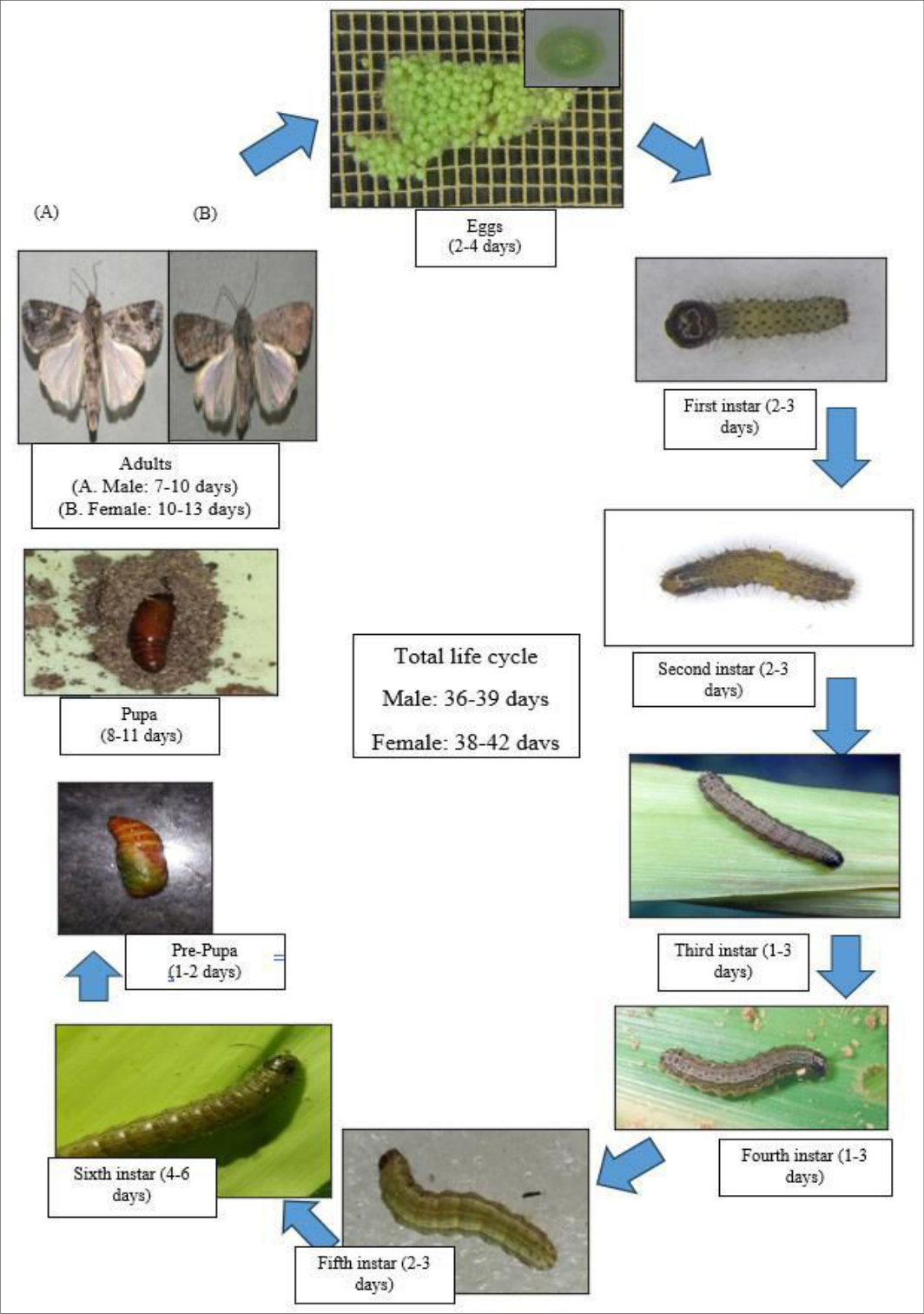 Figure 1
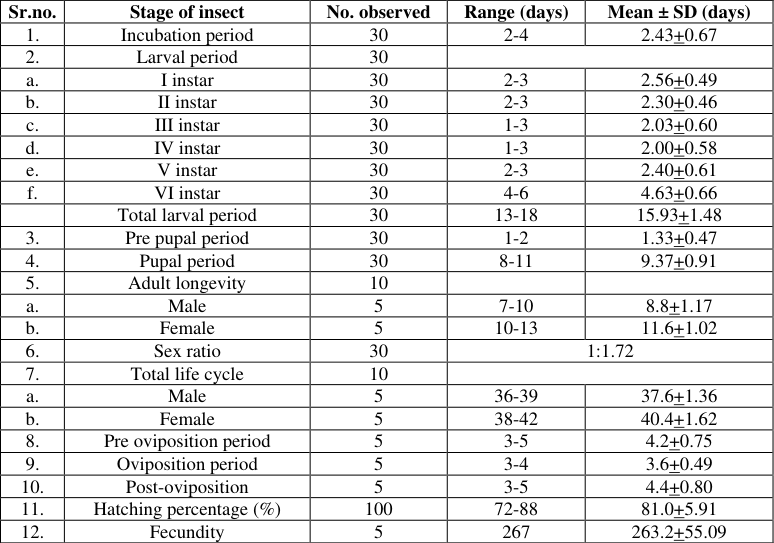 Table 1
Introduction
Maize (Zea mays subsp. mays) also known as corn is a cereal crop first domesticated by indigenous peoples in Southern Mexico about 10,000 years ago. Maize provides 50-60 percent of daily human energy requirements. Maize is a good source of the vitamin B complex, thiamin, niacin, and pantothenic acid (B5) and also supplies dietary fiber and some essential minerals i.e. magnesium, zinc, phosphorus, copper, etc. (Bathla et al., 2019) [6] . Maize is widely cultivated throughout the world, and a greater weight of maize is produced each year than any other grain. India produced 33.62 million tonnes in an area of 10.04 million hectares in 2021-22, whereas in Kharif 2022-23, maize production was 23.10 million tonnes in an area of 9.68 million hectares (Anon., 2022) [4] . In Gujarat, important districts growing maize are Dahod, Panchmahal, Vadodara, Kheda, Banaskatha, Bharuch, Anand and Dang. During 2020-21 in Gujarat, the kharif maize area, production and yield are 2867.05 ha., 4360.36 million tonnes, 1520.85 kg/ha yield respectively (Anon., 2020-21) [3] . The maize plant is attacked by 140 species of insect pests causing varying degrees of damage. However, only about a dozen are quite serious among these insect pests, only twelve species cause serious damage from sowing till storage (Arifie et al., 2019) [5] . The fall armyworm is an arthropod and larvae are the most damaging stage. Its scientific name is derived from Latin, which is frugiperda for last fruit, named because of the ability of species to destroy crops (Anon., 2017a). The fall armyworm moth lays eggs on the plant's foliage. The egg stage lasts for only 2-3 days in warmer weather. There are six "instars" in larval stage, whose entire duration is from 14-30 days. The first instar larvae are off-white to yellow with black head capsules and small black spots from which primary setae protrude. Larvae darken as they feed and appear greenish (Luginbill, 1928) [13] .
Materials and Methods
The bionomics of S. frugiperda was studied at the PG Research Laboratory, Department of Entomology, College of Agriculture, JAU, Junagadh. S. frugiperda larvae collected from a maize field were reared in a galvanized tray with fresh maize leaves and whorls in a BOD incubator (25±1 ℃, 70±5% Rh). Every day, sufficient fresh leaves and whorls were provided to S. frugiperda larvae after removing excreta and partially eaten leaves from the tray until the larvae changed to pre-pupal form. The top of the tray was covered with fine muslin cloth held in position by a rubber band. Before the formation of the pre-pupal stage, the Petri plate was filled with moist soil for pupation in the soil. The pupae formed in the soil were collected and transferred to another Petri plate for the emergence of the adults. A newly emerged male and female moth pair were confined in a glass jar with fresh maize leaves for resting and egg-laying. A small container with cotton swabs dipped in a five percent honey solution provided food. The jar was covered with muslin cloth and secured with a rubber band. Daily, fresh leaves were given, and eggs laid were collected for study. Observations included egg days, hatching percentage, larval days, pre-pupal and pupal days, preoviposition, oviposition and post-oviposition periods, fecundity, longevity of male and female, sex ratio, and total life span. Measurements of eggs, larval instars, pupa, and adults were taken with a vernier caliper.
Results and Discussion
Results and Discussion
Eggs
The eggs were typically laid in clusters of 267 to 395, either in a single layer or stacked in two to three layers. They were dome-shaped, covered with greyish-white scales from the female abdomen. Initially, the eggs were white to pale green, transitioning to brown or black just before hatching. The incubation period ranged from 2-4 days, with a mean of 2.43±0.67 days (Table 1). Egg laying took place at night in the lab, and hatching occurred in the early morning after 2-3 days. Kranthi et al. (2021) [12] revealed that the incubation period of fall armyworm eggs was 2-3 days with a mean of 2.28±0.075 days. The average length and width of eggs (Table 2) were 0.34±0.03 mm and 0.29±0.008 mm, respectively. These measurements align with Manjula et al. (2019) [14] , who reported egg dimensions as 0.47 mm in length and 0.29 mm in width. Sharanabasappa et al. (2018) [18] observed a comparable incubation period of 2.50±0.50 days on maize for fall armyworm, consistent with the present study. Egg hatching percentage for S. frugiperda moths reared on maize averaged 81.0±5.91 percent (Table 1), with a recorded range of 72% to 88%. These results align with Uma and Nagamandla (2018), who reported a similar hatching percentage of 81.50±8.49 percent for S. frugiperda on artificial diets, supporting the findings of the present study.
| Sr.no. | Stage of insect | No. observed | Range (days) | Mean ± SD (days) |
|---|---|---|---|---|
| 1. | Incubation period | 30 | 2-4 | 2.43+0.67 |
| 2. | Larval period | 30 | ||
| a. | I instar | 30 | 2-3 | 2.56+0.49 |
| b. | II instar | 30 | 2-3 | 2.30+0.46 |
| c. | III instar | 30 | 1-3 | 2.03+0.60 |
| d. | IV instar | 30 | 1-3 | 2.00+0.58 |
| e. | V instar | 30 | 2-3 | 2.40+0.61 |
| f. | VI instar | 30 | 4-6 | 4.63+0.66 |
| Total larval period | 30 | 13-18 | 15.93+1.48 | |
| 3. | Pre pupal period | 30 | 1-2 | 1.33+0.47 |
| 4. | Pupal period | 30 | 8-11 | 9.37+0.91 |
| 5. | Adult longevity | 10 | ||
| a. | Male | 5 | 7-10 | 8.8+1.17 |
| b. | Female | 5 | 10-13 | 11.6+1.02 |
| 6. | Sex ratio | 30 | 1:1.72 | |
| 7. | Total life cycle | 10 | ||
| a. | Male | 5 | 36-39 | 37.6+1.36 |
| b. | Female | 5 | 38-42 | 40.4+1.62 |
| 8. | Pre oviposition period | 5 | 3-5 | 4.2+0.75 |
| 9. | Oviposition period | 5 | 3-4 | 3.6+0.49 |
| 10. | Post-oviposition | 5 | 3-5 | 4.4+0.80 |
| 11. | Hatching percentage (%) | 100 | 72-88 | 81.0+5.91 |
| 12. | Fecundity | 5 | 267 | 263.2+55.09 |
Table text extracted from the original PDF; superscript letters are shown inline. The original table image is below.
View original table image
Larva First instar
The first instar larva of S. frugiperda exhibited a light greenish color with a prominent black head and minute hairs covering the body. The spiracles were observable in each instar. The duration of the first instar ranged from 2.00-3.00 days, with a mean of 2.56±0.49 days (Table 1), consistent with findings by Sharanabassapa et al. (2018) [18] who reported an average duration of 2.60±0.49 days. Navasero and Navasero (2020) [16] observed a yellowish first instar larva with a dark appearance due to a brownish-black setae and a black head. The development duration was 2.28±0.45 days for males and 2.40±0.49 days for females. The mean length and width of the first instar were 1.57±0.19 mm and 0.31±0.027 mm, respectively (Table 2), aligning with Reddy et al. (2021) [17] who reported a mean length of 1.42±0.28 mm and width of 0.28±0.06 mm for the first instar larva.
Second instar
In the second instar of S. frugiperda reared on maize, the size increased, and the head showed a slightly greenishbrown color, while the body exhibited a tinge of brown on the dorsum. Black spots, notably four arranged in a square pattern on the 8 th abdominal segment and an inverted 'Y' on the head, were observed under a binocular microscope. The mean duration of the second instar was 2.30±0.46 days (Table 1), with 2.00-3.00 days, in line with findings by Dubale et al. (2022) [8] who gave the mean period of 2.00±0.00 and 2.33±0.48 days. The mean length and width of the second instar larva were 1.57±0.19 mm and 0.31±0.027 mm, respectively (Table 2), contrasting with Reddy et al. (2021) [17] , who reported a mean length of 3.32±0.48 mm and a width of 0.69±0.04 mm.
Third instar
In the third instar, S. frugiperda larvae displayed a greenishorange color with a size larger than the second instar. The mean duration was 2.03±0.60 days (Table 1), ranging from 1.00-3.00 days. Dubale et al. (2022) [8] recorded an average of 2.10±0.31 days for the third instar. The mean length and width of the third instar larva were 5.98±0.53 mm and 1.88±0.23 mm, respectively (Table 2), aligning closely with Kalyan et al. (2020) [10] , who reported an average length of 6.2±0.30 mm.
Fourth instar
In the fourth instar, the larva exhibited a brownish head with white subdorsal and lateral lines. Notably, the 8 th abdominal segment displayed a square pattern arrangement of black spots, while a trapezoidal pattern arrangement of black spots was visible on the 1 st -7 th and 9 th segments. The fourth instar duration ranged from 1.00-3.00 days, with a mean of 2.00±0.58 days (Table 1). Consistent with this, Reddy et al. (2021) [17] observed a range of 2.00 -3.00 days with a mean of 2.4±0.51 days. The mean length and width of the fourth instar larva were 9.94±0.59 mm and 3.08±0.33 mm, respectively (Table 2), closely aligning with Kalyan et al. (2020) [10] , who reported an average length of 9.7±0.55 mm.
Fifth instar
The larva in its fifth instar exhibited a light brown color on its back and a greenish hue on the lower and sub-ventral sides, a distinctive feature shared with the fourth instar larva. The duration of the fifth instar spanned from 2.00-3.00 days, with an average of 2.40±0.61 days (Table 1). These results were in line with the earlier findings of Sharanabassapa et al. (2018) [18] , who reported an average duration of 2.00±0.00 days for the fifth instar larva of S. frugiperda. In terms of size, the mean length and width of the fifth instar larva were 16.28±1.06 mm and 4.74±0.49 mm, respectively (Table 2). Reddy et al. (2021) [17] corroborated these observations, revealing a mean length of 16.5±0.99 mm and a width of 4.74±0.33 mm.
Sixth instar
The sixth instar larva, the final stage, exhibited similarities with the fourth and fifth instars, characterized by a dull brown color on the dorsum and a greenish or reddish-brown color on the ventral and sub-ventral sides. The larva appeared thicker, more bulged, and slightly cylindrical, with a smooth body displaying clear and distinct segmentation. It grew larger with more prominent and darker spots compared to the fourth and fifth instar larvae. Cannibalism in S. frugiperda larvae was noted by Jason et al. (2001) [9] , occurring commonly, especially at low food quantities and high rearing densities, irrespective of the larva's sex. The probability of cannibalism was influenced by the larval stage. The duration of the sixth instar larva ranged from 4.00-6.00 days, with a mean of 4.63±0.66 days (Table 1), aligning closely with Sharanabassapa et al. (2018) [18] , who previously reported it as 4.50±0.50 days. Keerthi et al. (2021) [11] revealed the mean development time of the sixth larval instar was 5.08±0.74 days when larva were reared on maize. Regarding size, the mean length and width of the sixth instar larva were 33.9±1.55 mm and 5.89±0.22 mm, respectively (Table 2). These findings were consistent with Deole and Paul (2018) [7] , who reported lengths of 32-35 mm and a width of 6.01 mm.
Total larval period
The total larval duration ranged from 13-18 days, with a mean of 15.93±1.48 days (Table 1). These results were consistent with Murua et al. (2008), who reported an average larval duration of 18.18 days for S. frugiperda. Reddy et al. (2021) [17] observed a variation from 14-21 days, with a mean duration of 18.0±2.16 days.
Sex ratio
The sex ratio of male-female moth of S. frugiperda was 1:1.72. The present findings are in close Ahir et al. (2020) [1] studied the sex ratio of male:female was 1:1.30.
Pre-pupa and pupa
The full-grown larva ceased feeding, transitioning from a pale green to a bright brown color, releasing moisture and entering the pre-pupal stage. This stage lasted 1-2 days, averaging 1.33±0.47 days (Table 1), consistent with Deole and Paul (2018) [7] , who also observed 1-2 days pre-pupal period on maize. The reddish-brown pupa with cremasters exhibited sexual dimorphism, distinguished by the distance between the genital opening and anal entrance slots. Female pupae had a greater distance than male pupae. Pupation occurred within the soil, forming an earthen cocoon by binding soil particles with silk. The pupal period for S. frugiperda reared on maize averaged 9.37±0.91 days, ranging from 8.00-11.00 days (Table 1), aligning with Reddy et al. (2021) [17] , who reported a variation from 9 to 12 days with a mean duration of 9.9±0.99 days. The average length and width of the pupa were 15.94±1.27 mm and 4.93±0.12 mm, respectively (Table 2). These measurements closely resembled Reddy et al.'s (2021) [17] findings of an average length of 16.08±1.3 mm and a width of 4.94±0.15 mm.
Pre-oviposition, oviposition, postoviposition
The period before egg-laying (pre-oviposition) lasted 3-5 days, averaging 4.2±0.75 days. Oviposition primarily took place at night, with females laying eggs in clusters three to four days after emerging. The actual egg-laying period (oviposition) ranged from 3-4 days, with a mean of 3.6±0.49 days. Following oviposition, the post-oviposition period spanned from 3-5 days, with an average of 4.4±0.80 days (Table 1). Reddy et al. (2021) [17] reported a pre-oviposition period ranging from 2-3 days, averaging 2.7±0.48 days, while the oviposition period was 3-5 days, with a mean of 4.6±0.70 days. The post-oviposition period ranged from 2-3 days, averaging 2.6±0.52 days.
Adults
The adult moth was small to medium-sized, displaying clear sexual dimorphism. Male moths had forewings shaded in grey and brown, marked with triangular white spots, while females had less distinct markings ranging from uniform greyish brown to fine grey and brown mottling. Both sexes had iridescent silver-white hind wings with a narrow dark border. Female moths exhibited longer lifespans than males. Males lived for 7-10 days, averaging 8.8±1.17 days, whereas females had a longevity range of 10-13 days, with a mean of 11.6±1.02 days (Table 1). These findings were consistent with Dubale et al. (2022) [8] , who reported a female adult survival period of 9.8 days (range: 9-11 days) and a male survival period of 8.7 days (range: 7-11 days). Siddhapara et al. (2021) [19] found that male and female adults lived for 7.90±0.84 days and 10.60±1.22 days, respectively. Morphometric data analysis indicated that male moths were slightly larger than females. The mean body length of male moths was 15.42±1.25 mm, while females measured 15.08±1.58 mm (Tables 2). These findings aligned closely with Reddy et al. (2021) [17] , who reported a mean body length of 15.20±1.30 mm for males and 15.0±1.58 mm for females. In terms of wing span, male moths had a measurement of 32.77±2.08 mm, whereas females had a slightly smaller wing span of 32.15±2.40 mm (Table 2). Reddy et al. (2021) [17] found similar results, with a wing span of 32.4±2.07 mm for males and 31.8±2.38 mm for females.
Total life span
The average life span of male S. frugiperda reared on maize was 37.6±1.36 days, ranging from 36.00-39.00 days (Table 1). Similarly, the average life span of female moths was 40.4±1.62 days, with a range of 38.00-42.00 days. These findings align with Sharanabasappa et al. (2018) [18] , who reported a total life cycle duration of 37.50±5.00 days and 40.50±4.88 days for males and females.
Conclusion
Understanding the bionomics of the fall armyworm in maize is crucial for comprehending its life history and behaviors, aiding in the identification of its most susceptible stage and the development of effective management strategies.
Research on the biology of the fall armyworm on maize uncovered key aspects of its life cycle. Female adults laid between 267-395 eggs, with an incubation period of 2.43 days. The total larval duration spanned 15.93 days, followed by a pupal period lasting 9.37 days. The pre-oviposition, oviposition, and post-oviposition periods were observed as 4.2, 3.6, and 4.4 days, respectively. The average longevity of males and females was noted as 8.8 and 11.6 days, respectively. The entire life cycle, from egg to adult, was completed in 37.6 days for males and 40.4 days for females. Additionally, morphometric data, including larval body length, pupal length, adult body length, and wing span, were meticulously measured.
Acknowledgement
AcknowledgmentsI want to thank the Department of Entomology, College of Agriculture, Junagadh Agricultural University, Junagadh.
Figures and tables from the paper
References
19 in the original paper- Ahir KC, Mahla MK, Swaminathan R, Lekha, Dangi NL. Biology of fall armyworm, S. frugiperda (J.E. Smith) on maize (Zea mays L.). J Entomol Res. 2020;44(3):429-432.
- Anonymous. Fall armyworm. https://en.wikipedia.org/wiki/Fall_armyworm. Published 2017. Accessed February 26, 2024.
- Anonymous. Annual Progress Report; c2020-21. https://dag.gujarat.gov.in/Portal/News/1238_12_APY2018-19-2019-20-2020-21-red.pdf. Published 2020-21. Accessed February 26, 2024.
- Anonymous. Maize Outlook Report January to December 2022. https://angrau.ac.in/downloads/AMIC/OutlookReports/ 2022/1Maize%20Outlook%20Report%20%20January%20to% 20December%20%202022.pdf. Published 2022.
- Accessed February 26, 2024.
- Arifie U, Parveena B, Ahad I, Singh P, Dar ZA, Badri Z, Maqbool S, Aafreen S, Kumar R. Insect pests of maize at different altitudes of north Kashmir, Jammu and Kashmir. J Entomol Zool Stud. 2019;7:1123-1128.
- Deole S, Paul N. First report of fall armyworm, S. frugiperda (J.E. Smith), their nature of damage and biology on maize crop at Raipur, Chhattisgarh. J Entomol Zool Stud. 2018;6(6):219-221.
- Dubale JJ, Shinde BD, Mehendale SK, Bodake PS, Sawardekar SV. Biology of fall armyworm S. frugiperda (J.E. Smith) (Lepidoptera; Noctuidae) on maize in Konkan region of Maharashtra. Pharma Innov J. 2022;11(12):1842-1845.
- Jason WC, Trevor W, Ana E, Primitivo C, Ronald DC, Dave G. Age-related cannibalism and horizontal transmission of a nuclear polyhedrosis virus in larval S. frugiperda. Entomol. 2001;24(3):268-275.
- Kalyan D, Mahla MK, Babu SR, Kalyan RK, Swathi P. Biological parameters of S. frugiperda (J.E. Smith) under laboratory conditions. Int J Curr Microbiol Appl Sci. 2020;9(5):2972-2979.
- Keerthi MC, Mahesha HS, Manjunatha N, Gupta A, Saini R, Shivakumara KT, et al. Biology and oviposition preference of fall armyworm, Spodoptera frugiperda (J.E. Smith) (Lepidoptera: Noctuidae) on fodder crops and its natural enemies from Central India. Int J Pest Manage. 2021;69(3):215-224.
- Kranthi P, Devi RS, Rajanikanth P, Ramya V. Biology of an invasive fall armyworm, Spodoptera frugiperda (J.E. Smith) (Lepidoptera: Noctuidae) on chickpea flour based artificial diet. Pharma Innov J. 2021;10(10):14491452.
- Manjula K, Saheb YP, Sudheer MJ, Rao AR. Studies on biology, feeding habits and natural enemies of fall armyworm, S. frugiperda, a new invasive pest in India. J Entomol Zool Stud. 2019;7(6):1245-1250.
- Murua MG, Vera MT, Abraham S, Juárez ML, Prieto S, Head GP, et al. Fitness and mating compatibility of S. frugiperda (Lepidoptera: Noctuidae) populations from different host plant species and regions in Argentina. Ann Entomol Soc Am. 2008;101(3):639-649.
- Navasero MM, Navasero MV. Life cycle, morphometry and natural enemies of fall armyworm, S. frugiperda (J.E. Smith) (Lepidoptera: Noctuidae) on Zea mays L. in the Philippines. J Int Soc Southeast Asian Agric Sci. 2020;26(2):17-29.
- Reddy NA, Saindane YS, Chaudhari CS, Landage SA. Biology of fall armyworm S. frugiperda (J.E. Smith) on maize under laboratory conditions. Pharma Innov J. 2021;10(9):1997-2001.
- Sharanabasappa, Kalleshwaraswamy CM, Maruthi MS, Pavithra HB. Biology of invasive fall armyworm, S. frugiperda (J.E. Smith) (Lepidoptera: Noctuide) on maize. Indian J Entomol. 2018;80(3):540-543.
- Siddhapara MR, Patel KM, Patel AG. Biology and Morphometrics of Fall Army Worm S. frugiperda (J.E. Smith) on Maize. Indian J Entomol. 2021;83(4):627629.
- Uma MT, Nagamandla RS. Bionomics of fall armyworm, S. frugiperda (J.E. Smith). presentation at Entomology 2018: Advance and challenge in Hyderabad; c2018.