
Research article · 2024 · Full text
International Journal of Research in AgronomyEffect of zinc scheduling on yield and yield attributes of wheat crop (Triticum aestivum L.): A case study in Uttarakhand region
Volume 7(2) · Pages 509–511 · DOI: 10.33545/2618060x.2024.v7.i2g.360 ↗
Research areasAgricultural Science and FertilizationAgricultural Economics and PracticesPlant Micronutrient Interactions and Effects
Abstract
Author-writtenThis research was performed at the region of Uttrakhand College of Agriculture of HNBGU University. In order to investigate the “Effect of Zinc scheduling on yield and yield attributes of Wheat crop (Triticum aestivum L.) Var. – PBW-292, field experiment was carried out during rabi season (2021-2022). The layout of experimental field was laid randomized block design (RBD) with 6 treatments and 3 replications. Consisting of T1 (Control), T2 RDF 100% + 2 Kg /ha zinc (monohydrate), T3 RDF 100% + 2.5 Kg /ha zinc (monohydrate), T4 RDF 100% + 3 Kg /ha zinc (monohydrate), T5 RDF 100% + 3.5 Kg /ha zinc (monohydrate), T6 RDF 100% + 4 Kg /ha zinc (monohydrate). All treatments were applied at the time of sowing and half nitrogen applied as top dressing later. The results indicated that among all the treatments, T4 (RDF 100% + 3 kg/ha Zinc monohydrate), overall was found best for farmer point of view with respect to Number of grain spike-1 (31), Spike length (12.8 cm) test weight (44.23 gm), Biological yield (99.3 q ha-1), Grain yield (42.8 q ha-1), Straw yield (56.2 q ha-1). The aforementioned study suggests that applying zinc in addition to the recommended NPK can boost crop output. Applications of zinc and NPK at the same time will increase the yield even more. The quality of the crop will also improve because the nitrogen and zinc levels of the edible components were raised by these additions.
Summary
Source-checkedPlain-language reading of the full paper, prepared with AI and checked against the text. Each point links to the authors' own words.
Why it matters
- Wheat is a critical cereal crop for global food security, typically grown in temperate regions or high-altitude tropical areas during winter. View evidence ↗
- Zinc is an essential micronutrient for human health, playing a key role in various biochemical and physiological processes. View evidence ↗
- Zinc is vital for improving wheat yield, but many land areas in India lack the necessary zinc levels for optimal crop quality and quantity. View evidence ↗
The question
- The study aimed to investigate how different zinc scheduling affects the yield and yield attributes of the PBW-292 wheat variety. View evidence ↗
What they did
- The experiment used a randomized block design (RBD) consisting of six different treatments, each with three replications. View evidence ↗
- Treatments ranged from a control (T1) to varying levels of zinc monohydrate added to 100% Recommended Dose of Fertilizers (RDF), specifically 2, 2.5, 3, 3.5, and 4 kg/ha. View evidence ↗
- Zinc and other treatments were applied during sowing, while half of the nitrogen was applied later as a top dressing. View evidence ↗
- The crop was spaced at 20 x 23 cm across 18 total plots, with a gross plot size of 2m². View evidence ↗
What they found
- The highest grain yield (42.8 q ha-1), straw yield (56.2 q ha-1), and biological yield (99.3 q ha-1) were achieved with 3 kg/ha of zinc (T4), compared to the control's 23.8, 32.1, and 55.9 q ha-1 respectively. View evidence ↗
- Treatment T4 (3 kg/ha zinc) produced the best yield attributes, including a spike length of 12.28 cm, 31 grains per spike, and a test weight of 44.23 g, outperforming the control. View evidence ↗
- While T4 showed the maximum grain yield of 42.8 q ha-1, the authors noted it was at par with other treatments, including the control. View evidence ↗
- Excessive zinc application can decrease yield parameters because high levels of zinc can make other nutrients, such as phosphorus, unavailable in the soil. View evidence ↗
What it means
- The authors conclude that adding zinc to recommended NPK fertilizers boosts wheat production, especially when applied simultaneously. View evidence ↗
- The authors state that these additions improve crop quality by increasing the levels of nitrogen and zinc in the edible parts of the plant. View evidence ↗
Visual summary
3 visualsIllustrations explain the paper; charts are replotted from the paper's own table values.
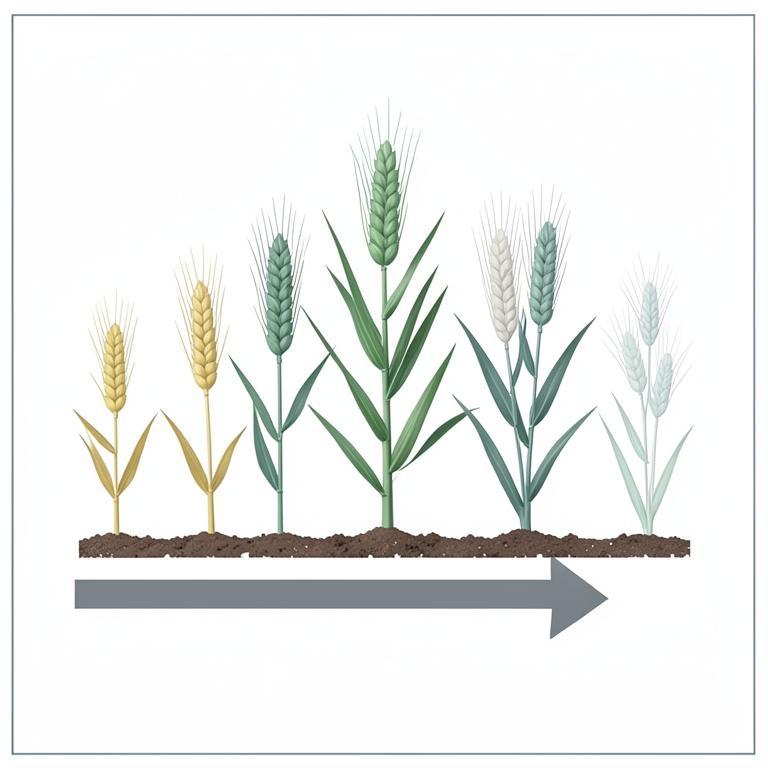
Zinc Dosage vs Yield
AI-generated conceptual illustration (wheat plants (Triticum aestivum L.)). It explains the idea and does not show study data.
View source evidence ↗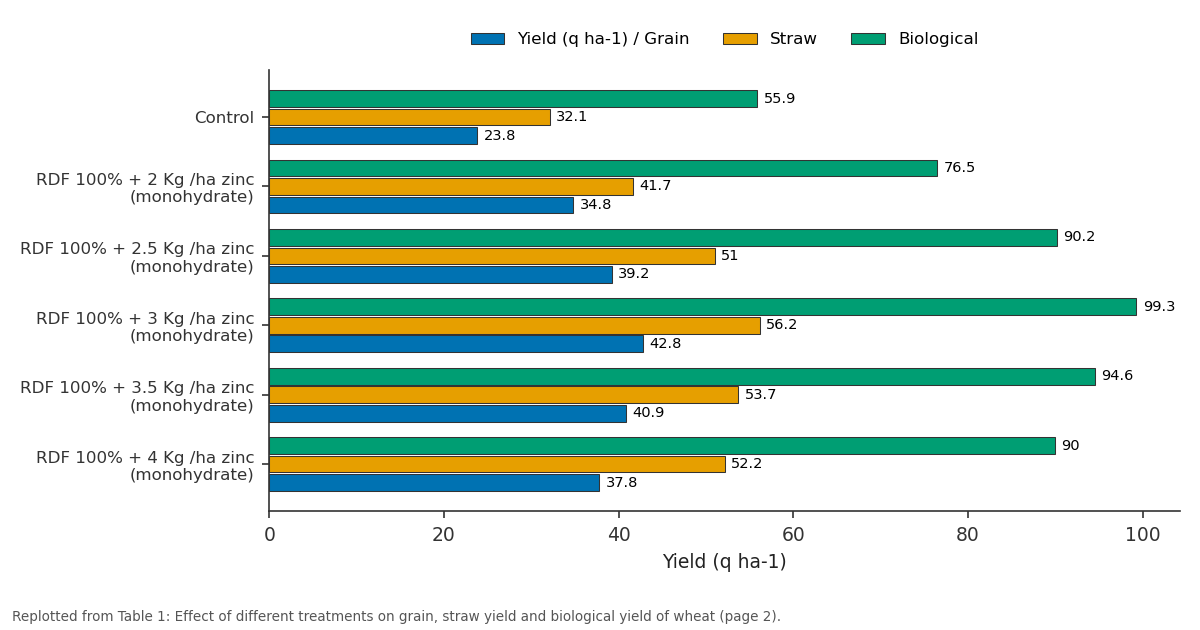
Yield (q ha-1) / Grain and Straw and more: Control vs RDF 100% + 2 Kg /ha... vs RDF 100% + 2.5 Kg /ha... vs RDF 100% + 3 Kg /ha... vs RDF 100% + 3.5 Kg /ha...
Replotted from Table 1 (page 2) of the original paper. Every bar is the paper's own table value.
View source evidence ↗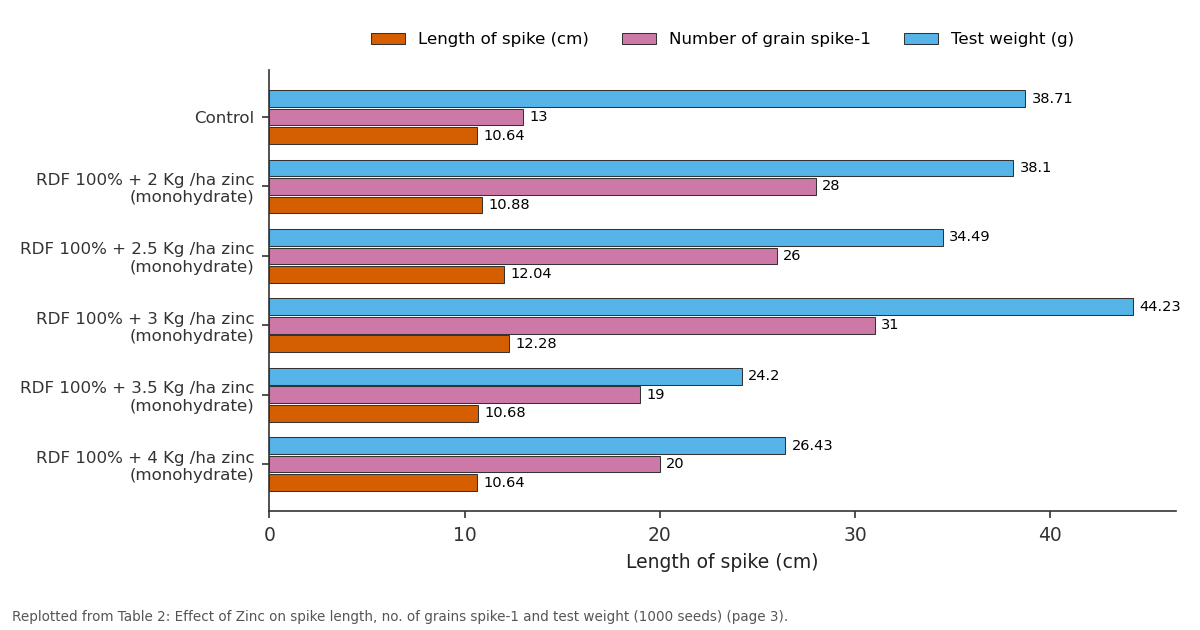
Length of spike (cm) and Number of grain spike-1 and more: Control vs RDF 100% + 2 Kg /ha... vs RDF 100% + 2.5 Kg /ha... vs RDF 100% + 3 Kg /ha... vs RDF 100% + 3.5 Kg /ha...
Replotted from Table 2 (page 3) of the original paper. Every bar is the paper's own table value.
View source evidence ↗Figures & tables
From the original paper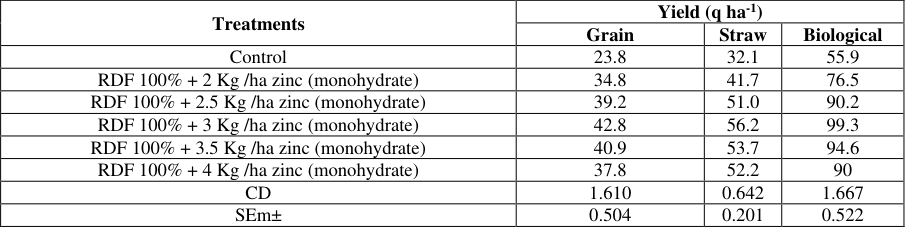 Table 1
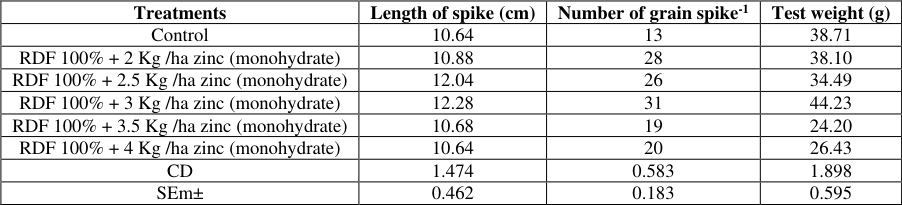 Table 2
Introduction
Wheat is primarily grown in temperate regions and also at higher altitude under tropical climatic areas in winter season. It is the single, most important cereal crop that has been considered as integral component of the food security system of the several nations. It is a Rabi season crop so it is less in under attack of pest and diseases. In modern agriculture, the application of fertilizer is very important. It acts as important agent to increase efficiency of soil in crop production (In financial year 2021, the estimated yield of wheat in the south Asian country of India was approximately 3.5 thousand kilograms per hectare). According to a recent assessment by the state's agriculture department, 359 lakh metric tons (LMT) of wheat will be produced in UP overall in 2022, which is 16 LMT fewer than the amount produced in 2021. Zinc is one of the most important micronutrients for human health, being involved in many physiological and biochemical processes. It is well documented that Zn deficiency impairs the immune system and increases the incidence of infectious diseases such as diarrhea and pneumonia, especially in the developing world (Walker and Black, 2007) [2] . Zn supply for people in the developing world comes mainly from cereal crops. Wheat is a highly consumed cereal crop (McKevith, 2004; Kumar et al. 2022) [5,4] . The Zn and Nitrogen availability also affect the yield and growth of late sown Wheat. So, the nitrogen scheduling is most common practice for better production of Wheat crop. Zinc element plays a vital role in the yield improvement of wheat. In India, most of the land patches available for wheat growth does not match the amount required for optimal yield affecting both quality and quantity. They are needed in trace amount but their availability in adequate manner improves the cell physiology that is reflected in yield. Zinc is very helpful in numerous plant processes -(a) uptake of nitrogen, (b) synthesis of chlorophyll, (c) in carbon anhydrase activity.
Deficiency of zinc [optimum 5.8%], reduce the functioning rate of protein synthesis and the protein content also decreased drastically. Zinc is very important element for cell membrane integrity and phytochrome activities. The grain yield and protein percentage in seed is increased by foliar application of zinc. Also, many agronomic traits are caused by foliar application of zinc. Irrigation with foliar application of zinc influences the growth and yield contributing characters of wheat. Zinc increases the amount of chlorophyll content and also the concentration of abscisic acid and due to this the components of wheat are increased. Over a fifth of India's land area (21.06) is arid and causes serious abiotic stress. Improving the zinc content of the grains that a big portion of the population consumes for their calories is required given the developing zinc shortage in Indian soil and the widespread public health issue of zinc deficiency. Wheat crop has very definable stages and it requires irrigation at all stages. Low moisture content in soil can affect the physiological appearance of the crop and the deficiency can appear as variations. Ensuring proper irrigation and disease control is very important at CRI (crown root initiation) stage which appears after 21 days of sowing for successful cultivation of wheat.
Material and Methods
It is 3088 square kilometres in size and is situated in Uttarakhand's northwest at an altitude of 450 metres above mean sea level (MSL). Geographically, Dehradun is situated between 77 0 34'45" and 78 0 18'30" east longitude and 29 0 58' and 31 0 2'30" north latitude. Dehradun experiences a humid subtropical climate. For a few days in the summer, temperatures can rise as high as 44 °C, and a scorching wind known as Loo blows through North India. In the plains, wintertime temperatures are often between 1 and 20 °C, and fog is extremely prevalent. Although Dehradun can experience below-freezing temperatures during severe cold spells, this is not typical. There are frequently long stretches of intense rainfall throughout the monsoon season. The soil at the test site is referred to as "sandy loam," and it has the qualities of a deep, well-drained, coarse loamy cover over fragmented soils and medium fertility. Five different locations throughout the field were used to collect a total of five soil samples from the top (0-15 cm) layer of the soil. A representative sample of the soil was taken for its physiochemical process after the soil had been properly mixed. The analysis revealed that the soil of the experimental site was Sandy loam in texture, good in organic matter, low in available nitrogen, medium in available phosphorus and Potassium contents with neutral in reaction and normal in electrical conductivity (0.23 dsm -1 ). The experimental site having slightly alkaline pH and experiment was laid out in completely Randomized block design (RBD). T 1 (Control), T 2 RDF 100% + 2 Kg /ha zinc (monohydrate), T 3 RDF 100% + 2.5 Kg /ha zinc (monohydrate), T 4 RDF 100% + 3 Kg /ha zinc (monohydrate), T 5 RDF 100% + 3.5 Kg /ha zinc (monohydrate), T 6 RDF 100% + 4 Kg /ha zinc (monohydrate). All the treatments were applied at the time of sowing except nitrogen which is later applied as top dressing in the crop period. The spacing of wheat crop was 20 x 23 cm. Gross plot size was 2m 2 (2 m x 1m) and net plot size was 12m 2 (6 x2 m 2 ). Total numbers of plots were 18.
Results and Discussion
Crop productivity depends on the amount of micro-nutrient is given to the crop. By giving proper cultural practices and adequate quantity of fertilizers results in good yield. The amount of zinc can affect the growth of crop as high amount decreases the yield parameters (i.e., grain yield, biological yield, straw yield). As more zinc create the unavailability of other nutrients like phosphorus in the soil. The optimum supply of essential plant nutrient from soil as well as fertilizer is mandatory for higher productivity. Maximum grains spike -1 , spike length, test weight grain yield, biological yield, straw yield was significantly affected by different treatments. The maximum grain yield was found at T 4 (42.8 q ha -1 ) and at par with T 5 , T 3 , T 2 , T 6 and the T 1 (control). In all treatments, zinc applied at the time of sowing but in different amount in different treated plots. The straw yield was found maximum in T 4 (56.2 q ha -1 ) and at par T 5, T 6 , T 3 , T 2 and T 1 . Likewise, the biological yield was found best in T 4 (99.3 q ha -1 ) and at par with T 5 , T 3 , T 6 , T 2 and T 1 . The highest test weight 44.23 gm is which is found in T 4 . Genc et al. (2008) [6] examined that Zn has vast functions in plant metabolic activities and consequently the deficiency of zinc has a multitude of effects on plant growth. Zinc sulphate specifically increases grain content, test weight, grain yield, straw yield, biological yield and decreases the harvest index. By applying Zinc Sulphate, the margins over costs increased but the highest marginal return occur through 5kg ha -¹ application. It is well known that zinc has adequate effect on stronger emergence, faster stand establishment, healthier root growth, greater potential vigor and increased yield potential. Data regarding the effect of zinc on the yield attributes of late sown wheat is given in Table 1 and other growth attributes presented in Table 2. Sardana et al. (2014) [8] studied the effect of N (120-150 kg /ha); P (60 kg P 2 O 5 /ha); K 2 O (30 and 60 kg/ha): ZnSO 4 (25 and 50kg/ha) on durum wheat cultivars PBW 233. Fertilizer application significantly increased the grain yield. The treatment 150:60:60:25 (N: P: K: Zn) produced the highest grain yield (37.4 q/ha), which was at par with the grain yield obtained (35.4 q/ha) at the rate of 150: 60: 30: 25 N: P: K: Zn, respectively. Parihar et al. (2005) [9] reported that application of Zn up to 10 kg ha -1 increased the grain yield by 7.2% over control. Chowdhury et al. (2008) [10] revealed that application of micronutrients (soil + foliar) was the best method to increase grain yield of wheat. Wroble (2009) [11] stated that both soil and foliar application of micronutrients were positively correlated with wheat grain yield.
| Treatments | Length of spike (cm) | Number of grain spike-1 | Test weight (g) |
|---|---|---|---|
| Control | 10.64 | 13 | 38.71 |
| RDF 100% + 2 Kg /ha zinc (monohydrate) | 10.88 | 28 | 38.10 |
| RDF 100% + 2.5 Kg /ha zinc (monohydrate) | 12.04 | 26 | 34.49 |
| RDF 100% + 3 Kg /ha zinc (monohydrate) | 12.28 | 31 | 44.23 |
| RDF 100% + 3.5 Kg /ha zinc (monohydrate) | 10.68 | 19 | 24.20 |
| RDF 100% + 4 Kg /ha zinc (monohydrate) | 10.64 | 20 | 26.43 |
| CD | 1.474 | 0.583 | 1.898 |
| SEm± | 0.462 | 0.183 | 0.595 |
Table text extracted from the original PDF; superscript letters are shown inline. The original table image is below.
View original table image
| Treatments | Yield (q ha-1) | — | — |
|---|---|---|---|
| Grain | Straw | Biological | |
| Control | 23.8 | 32.1 | 55.9 |
| RDF 100% + 2 Kg /ha zinc (monohydrate) | 34.8 | 41.7 | 76.5 |
| RDF 100% + 2.5 Kg /ha zinc (monohydrate) | 39.2 | 51.0 | 90.2 |
| RDF 100% + 3 Kg /ha zinc (monohydrate) | 42.8 | 56.2 | 99.3 |
| RDF 100% + 3.5 Kg /ha zinc (monohydrate) | 40.9 | 53.7 | 94.6 |
| RDF 100% + 4 Kg /ha zinc (monohydrate) | 37.8 | 52.2 | 90 |
| CD | 1.610 | 0.642 | 1.667 |
| SEm± | 0.504 | 0.201 | 0.522 |
Table text extracted from the original PDF; superscript letters are shown inline. The original table image is below.
View original table image
Conclusion
According to the aforementioned study, adding zinc to the recommended NPK can boost wheat production. Applications of zinc and NPK at the same time will increase yield even more. The quality of the crop will also improve because the nitrogen and zinc levels of the edible components were raised by these additions.
References
10 in the original paper- Aggarwal P, Choudhary KK, Singh AK, Chakraborty D. Variation in soil strength and rooting characteristics of wheat in relation to soil management. Geoderma. 2006;136(1-2):353-363.
- Belshe RB, Edwards KM, Vesikari T, Black SV, Walker RE, Hultquist M, et al. Live attenuated versus inactivated influenza vaccine in infants and young children. New Eng. J Med. 2007;356(7):685-696.
- Vipin K, Dhyani BP, Akansha S, Kumar S, Shahi UP, Maurya PK, et al. Effect of Nitrogen management on yield attributes and nitrogen-use efficiency of late -sown wheat (Triticum aestivum) in western Uttar Pradesh -Indian Journal of Agronomy. 2021;66(2):229-233.
- Kumar V, Dhyani BP, Shahi UP, Kumar S, Kumar A, Singh A. Effect of nitrogen schedule and management on yield of late-sown wheat (Triticum aestivum) in rice-wheat system. Indian Journal of Agronomy. 2022;67(2):144-147.
- McKevith B. Nutritional aspects of cereals. Nutrition Bulletin. 2004;29(2):111-142.
- McDonald GK, Genc Y, Graham RD. A simple method to evaluate genetic variation in grain zinc concentration by correcting for differences in grain yield. Plant and Soil. 2008;306(1):49-55.
- Jinger PD, Dhar S, Dass A, Sharma VK, Paramesh V, Vijayakumar S. Co-fertilization of Silicon and Phosphorus Influences the Dry Matter Accumulation, Grain Yield, Nutrient Uptake, and Nutrient-Use Efficiencies of Aerobic Rice. Silicon. 2022;14(9):4683-4697.
- Sardana K, Chugh S, Garg VK. The role of zinc in acne and prevention of resistance: have we missed the "base" effect. Int. J Dermatol. 2014;53(1):125-127.
- Chakraborty M, Manjunath KR, Panigrahy S, Kundu N, Parihar JS. Rice crop parameter retrieval using multitemporal, multi-incidence angle Radarsat SAR data. ISPRS Journal of Photogrammetry and Remote Sensing. 2005 Aug 1;59(5):310-322.
- Chowdhury D, Lieberman J. Death by a thousand cuts: granzyme pathways of programmed cell death. Annu. Rev. Immunol.. 2008 Apr 23;26:389-420.