
Research article · 2024 · Full text
International Journal of Research in AgronomyEfficacy of different bioagents seed treatment for controlling seed-borne Colletotricum sp. in chilli (Capsicum annum L.)
Volume 7(3) · Pages 05–07 · DOI: 10.33545/2618060x.2024.v7.i3a.364 ↗
Research areasPlant tissue culture and regenerationBanana Cultivation and Research
Abstract
Author-writtenIn tropical and subtropical areas, Colletotrichum capsici, which causes chilli anthracnose, is a significant barrier to the production of chillies. Study was aimed mainly to find the efficacy of various bioagents on the germination, seedling length and seedling vigour of C. capsici infected chilli seeds. Rudra and Byadagi are the two agronomically superior varieties selected for the study. Among all the treatments Trichoderma viride were found superior and significantly higher seed germination, seedling length, seed vigour index as compared to other treatments and control. Among the various bioagents, In the variety Rudra the highest germination percentage of 97.66%, The root length, shoot length, seedling length of T1 were 6.4 cm, 5.7 cm, 12.19 cm and seed vigour index of 1184.49 were obtained in T1 (2.5 ml of Trichoderma viride). In the variety Byadagi highest germination percentage of 95.33% , The root length, shoot length, seedling length were 6.87 cm, 5.6 m, 12.47 cm, The seed vigour index of 1196.79 were obtained in T2 (5 ml of Trichoderma viride). Among the bioagents Trichoderma viride, Pseudomonas fluorescens performs well and antagonists against the pathogen.
Summary
Source-checkedPlain-language reading of the full paper, prepared with AI and checked against the text. Each point links to the authors' own words.
Why it matters
- Chilli (Capsicum annum L.) is a globally cultivated crop valued for its edible green fruits and its use as a commercial spice. View evidence ↗
- Colletotrichum capsici is a major production bottleneck in tropical and subtropical regions, causing diseases such as anthracnose, fruit rot, dieback, and damping off. View evidence ↗
- The fungus Colletotrichum capsici can cause more than half of crop losses by damaging fruits both before and after harvest. View evidence ↗
The question
- The study aimed to evaluate how different bioagents affect the germination, seedling length, and vigour of chilli seeds infected with C. capsici. View evidence ↗
What they did
- The research was conducted in May 2022 at the College of Horticulture in Bagalkot, Karnataka. View evidence ↗
- The study used a completely randomized design with three replications, focusing on two superior chilli varieties: Rudra and Byadagi. View evidence ↗
- Seeds were treated with liquid forms of Trichoderma viride, Pseudomonas fluorescens, and Bacillus subtilis at dosages of 2.5 ml and 5 ml. View evidence ↗
- Measurements for seed germination, root/shoot length, and the seed vigour index were recorded 10 days after sowing. View evidence ↗
What they found
- For the Rudra variety, the highest germination rate of 97.66% was achieved using 2.5 ml of Trichoderma viride (T1). View evidence ↗
- For the Byadagi variety, the highest germination rate of 95.33% was achieved using 5 ml of Trichoderma viride (T2). View evidence ↗
- All tested bioagent seed treatments increased both seed germination and seedling vigour compared to the control group. View evidence ↗
What it means
- The authors conclude that Trichoderma viride and Pseudomonas fluorescens are effective bioagents for enhancing seed germination and seedling vigour in Rudra and Byadagi chilli varieties. View evidence ↗
- The authors recommend integrating bioagents into agricultural practices as a sustainable and eco-friendly alternative to chemical treatments for combating pathogens. View evidence ↗
Visual summary
3 visualsIllustrations explain the paper; charts are replotted from the paper's own table values.
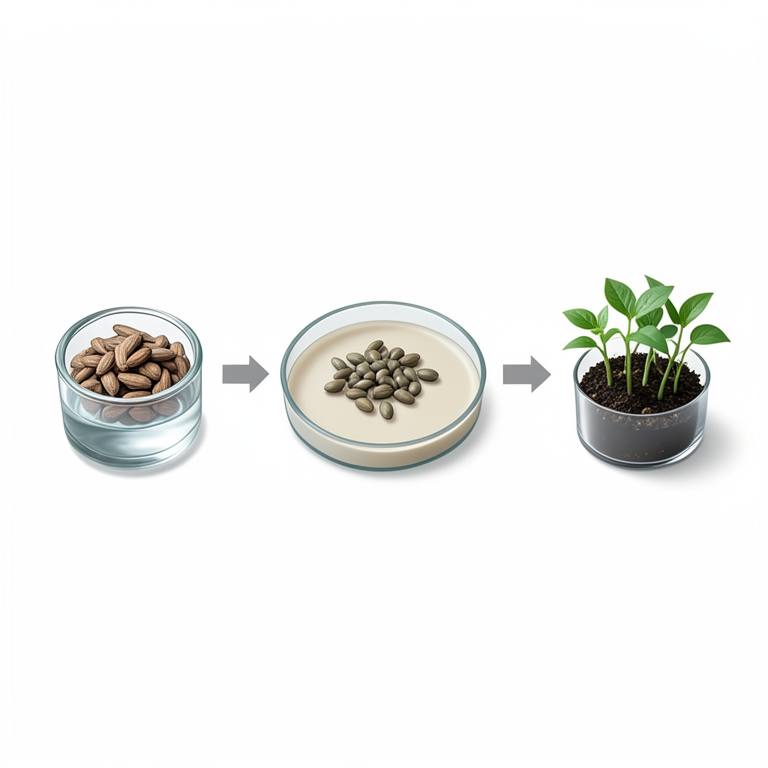
Bioagent Treatment Workflow
AI-generated conceptual illustration (chilli seeds (Capsicum annum L.)). It explains the idea and does not show study data.
View source evidence ↗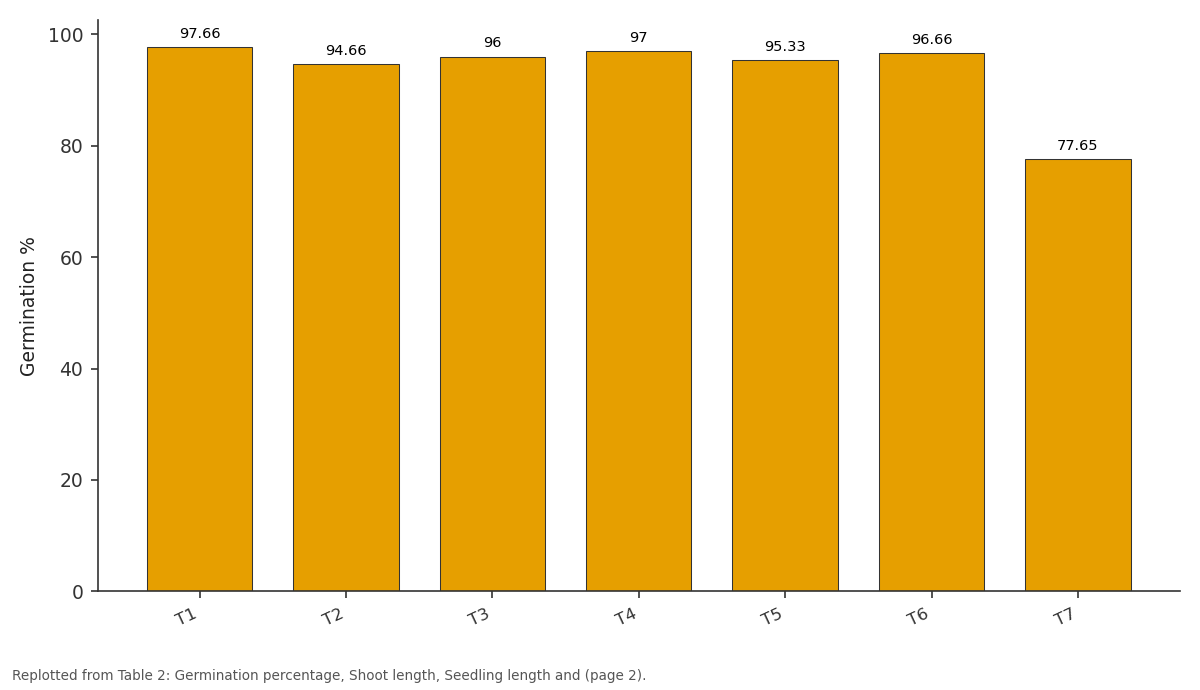
Germination %: T1 vs T2 vs T3 vs T4 vs T5
Replotted from Table 2 (page 2) of the original paper. Every bar is the paper's own table value.
View source evidence ↗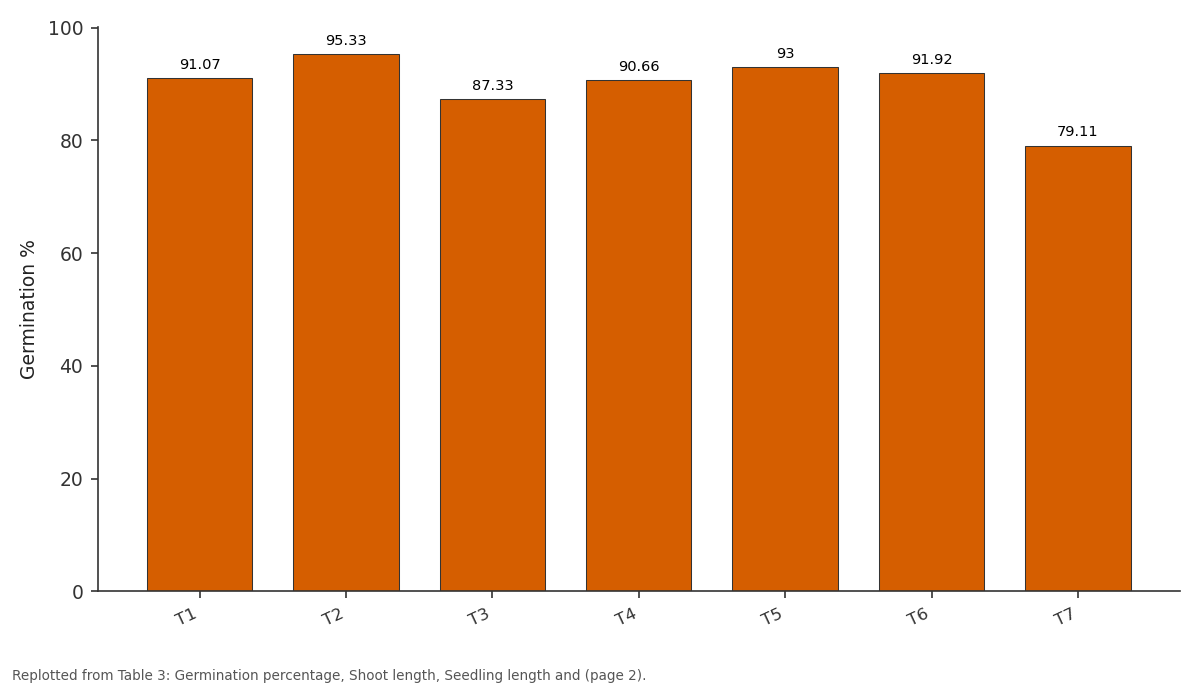
Germination %: T1 vs T2 vs T3 vs T4 vs T5
Replotted from Table 3 (page 2) of the original paper. Every bar is the paper's own table value.
View source evidence ↗Figures & tables
From the original paper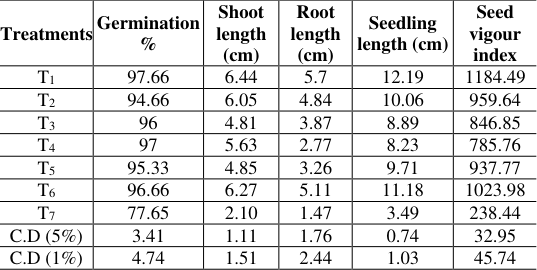 Table 2
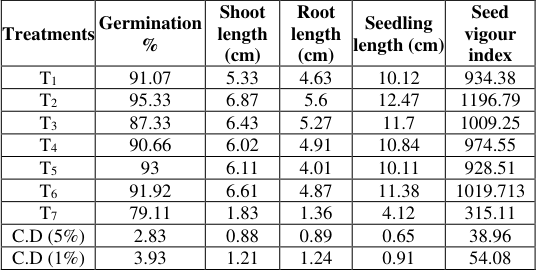 Table 3
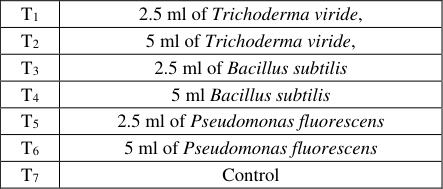 Table 1
Introduction
The chilli plant, Capsicum annum L., is mostly grown for its edible green fruits and for the dried chilli that is used as a commercial spice. It contains a lot of vitamin C, A, and B. Most tropical and subtropical nations, including those in India, Japan, Mexico, Turkey, the United States of America, and Africa, cultivate chillies. It offers a number of therapeutic benefits and is also effective for treating atomic dyspepsia, lumbago, neuralgia, and rheumatic illnesses (Pruthi, 1993) [12] . Sweet bell peppers, paprika, pimento, and other red pepper-based items all include Capsicum annuum L. The flavour of capsicum is what makes it stand out, as it is a fantastic source of vitamins A and C in addition to its pungency and therapeutic benefits. Its production and productivity have been impeded by a number of viral, bacterial, and fungal diseases that are susceptible to it. Early symptoms of the disease include a loss in photosynthetic area, while later symptoms include infestation of reproductive organs and commercially valuable produce. The illness reduces the plant's ability to photosynthesize. One of the main production bottlenecks in tropical and subtropical regions is Colletotrichum capsici, which causes a variety of disease symptoms such damping off, anthracnose or fruit rot, dieback in chilli. According to Pakdeevaraporn et al. (2005) [11] , this fungus severely damages chilli fruits both before and after harvest, accounting for more than half of crop losses. As the fungus causes necrosis of tender twigs from the tip backwards the disease is called die-back, when the crop is in flowering stage the infection typically starts. Flowers wither and wilt. Flowers are being shed in great abundance. The flower stalk withers and becomes dry. This withering spreads from the flower stalks to the stem, which results in the dieback of the branches and stem and the withering of the branches. Partially afflicted plants produce few, poor-quality fruits. On such dark lesions, Colletotrichum will develop a lot of fruiting bodies and spores. Pre-emergent and post emergent damping-off of seedlings in nurseries and transplanted fields is caused by the sowing of such infected seeds.
Farmers usually use fungicides to control this disease one of the alternative to overcome these problems is to replace the use of the chemical approach with the search for alternative control methods. Chemicals have been used for many years to manage the chilli anthracnose fruit rot, which has led to several unfavourable issues. Alternative control measures that are efficient at the farm level must be incorporated. The use of fungicides and locally accessible bio agents to control this seedborne infection at the farm level has not been the subject of any systematic research. In order to determine the effectiveness of different bioagents on the germination of chilli seeds contaminated with C. capsici, the current investigation was carried out.
Materials and Methods
The experiment was conducted during May 2022 in Department of seed science and technology, College of Horticulture, Bagalkot, Karnataka. The two agronomically superior varieties Rudra, and Byadagi were selected for the study in completely randomized design for 3 replications. All the observations were taken 10 days after sowing Isolation and Pathogenicity test of the pathogen C. capsici, a causal agent of anthracnose was isolated from two hundred anthracnose infected chilli seeds obtained; from Department of Plant pathology, College of Horticulture, Bagalkot, Karnataka. Anthracnose fungus was isolated by Blotter Method and Agar Plate Method described by ISTA (1976). After the pathogenecity test, isolates of C. capsici were cultured on PDA for 3 days. Then a most pathogenic isolate was used for further study.
Sources of bioagents and fungicides
The liquid form of three bioagents namely Trichoderma viride, Pseudomonas fluorescens, Bacillus subtilis at the rate of 2.5 ml and 5 ml were used to treat the seeds of two varieties Rudra and byadagi (Table 1) For studied the efficacy of bioagents as seed protectants against C. capsici, apparently healthy sterilized seeds of chilli were artificially contaminated with isolated pathogenic species of C. capsici. Hundred seeds per petri plate of such contaminated seeds were then treated with bioagents at the rate of 2.5 ml and 5 ml for 30 minutes in above solutions. The treated seeds were fine shade dried before sowing. The treated and untreated inoculated seeds were then placed in the petri plate under ambient conditions. Observations were recorded after 10 days on seed germination, root/shoot length and seed vigour index were noted.
| T1 | 2.5 ml of Trichoderma viride, |
|---|---|
| T2 | 5 ml of Trichoderma viride, |
| T3 | 2.5 ml of Bacillus subtilis |
| T4 | 5 ml Bacillus subtilis |
| T5 | 2.5 ml of Pseudomonas fluorescens |
| T6 | 5 ml of Pseudomonas fluorescens |
| T7 | Control |
Table text extracted from the original PDF; superscript letters are shown inline. The original table image is below.
View original table image
Statistical analysis
Seedling vigour was also calculated by formula suggested by Abdul Bakshi and Anderson (1973) [1] . Vigour index = Germination (%) x (Root length + shoot length) All other data were analyse using the computer package program DSAASTAT. [2] followed by T 6 (5 ml of Pseudomonas fluorescens) with 96.66%. P. fluorescens significantly decreased the seedling mortality (Padder et al., 2010) [10] it is prominently higher when compared to control. The root length, shoot length, seedling length of T 1 were 6.4 cm, 5.7 cm, 12.19 cm respectively. Antagonism with Trichoderma species against an array of phytopathogens has been reported (Kaur et al., 2006) [8] and the root length, shoot length, seedling length of T 6 were 6.27 cm, 5.11 cm, 11.18 cm respectively. The seed vigour index of T 1 and T 6 were 1184.49 and 1023.98 respectively. (Table 2) Based on the results obtained in the variety Byadagi the highest germination percentage 95.33 were obtained in T 2 (5 ml of Trichoderma viride), followed by T 6 (5 ml of Pseudomonas fluorescens) with 91.92%. Pseudomonas fluorescens was found better in increasing the germination percentage, dry weight, leaf area and chlorophyll content (Dutta et al., 2005) [4] it is prominently higher when compared to control. The root length, shoot length, seedling length of T 2 were 6.87 cm, 5.6 m, 12.47 cm respectively. Volatile and non-volatile compounds produced by T. viride and mycoparasitism might be responsible for the suppression of the pathogen (El-katalny el., 2001; Eziashi et al., 2007; Ghildiyal et al., 2008) [5][6][7] . The root length, shoot length, seedling length of T 6 were 6.61 cm, 54.87 cm, 11.38 cm respectively. P. fluorescens as observation in the present study might have tolerated or escaped from root infection facilitating an active absorption of nutrients thereby promoting the plant growth and health (Muthukumar et al., 2010) [9] The seed vigour index of T 2 and T 6 were 1196.79 and 1019.71 respectively (Table 3.). The results of treating chilli seeds that had been intentionally contaminated with isolated pathogenic species of C. capsici with various bioagents showed that all of the bioagents and antagonists had a significant impact on the percentage of germination, the length of the seedlings, and the vigour of the seedlings.
| Treatments | Germination % | Shoot length (cm) | Root length (cm) | Seedling length (cm) | Seed vigour index |
|---|---|---|---|---|---|
| T1 | 91.07 | 5.33 | 4.63 | 10.12 | 934.38 |
| T2 | 95.33 | 6.87 | 5.6 | 12.47 | 1196.79 |
| T3 | 87.33 | 6.43 | 5.27 | 11.7 | 1009.25 |
| T4 | 90.66 | 6.02 | 4.91 | 10.84 | 974.55 |
| T5 | 93 | 6.11 | 4.01 | 10.11 | 928.51 |
| T6 | 91.92 | 6.61 | 4.87 | 11.38 | 1019.713 |
| T7 | 79.11 | 1.83 | 1.36 | 4.12 | 315.11 |
| C.D (5%) | 2.83 | 0.88 | 0.89 | 0.65 | 38.96 |
| C.D (1%) | 3.93 | 1.21 | 1.24 | 0.91 | 54.08 |
Table text extracted from the original PDF; superscript letters are shown inline. The original table image is below.
View original table image
| Treatments | Germination % | Shoot length (cm) | Root length (cm) | Seedling length (cm) | Seed vigour index |
|---|---|---|---|---|---|
| T1 | 97.66 | 6.44 | 5.7 | 12.19 | 1184.49 |
| T2 | 94.66 | 6.05 | 4.84 | 10.06 | 959.64 |
| T3 | 96 | 4.81 | 3.87 | 8.89 | 846.85 |
| T4 | 97 | 5.63 | 2.77 | 8.23 | 785.76 |
| T5 | 95.33 | 4.85 | 3.26 | 9.71 | 937.77 |
| T6 | 96.66 | 6.27 | 5.11 | 11.18 | 1023.98 |
| T7 | 77.65 | 2.10 | 1.47 | 3.49 | 238.44 |
| C.D (5%) | 3.41 | 1.11 | 1.76 | 0.74 | 32.95 |
| C.D (1%) | 4.74 | 1.51 | 2.44 | 1.03 | 45.74 |
Table text extracted from the original PDF; superscript letters are shown inline. The original table image is below.
View original table image
Results and Discussion
Results and Discussion
Conclusion
In conclusion, this investigation unequivocally demonstrates the efficacy of using bioagents, particularly Trichoderma viride and Pseudomonas fluorescens, in enhancing seed germination, seedling vigour, and overall plant health in chilli varieties Rudra and Byadagi. The application of these bioagents significantly outperformed the control in terms of germination percentage, seedling growth metrics, and seed vigour index. Specifically, Trichoderma viride showed remarkable results in promoting seed germination and growth, with the highest germination percentages recorded in both chilli varieties. Pseudomonas fluorescens also played a crucial role in reducing seedling mortality and enhancing plant growth, indicating its potential as a biocontrol agent against phytopathogens. The findings underscore the importance of integrating bioagents into agricultural practices to combat pathogens and promote sustainable crop production. This study not only reaffirms the antagonistic properties of Trichoderma species against various phytopathogens but also highlights the beneficial effects of Pseudomonas fluorescens in supporting plant health, thereby offering a viable and eco-friendly alternative to chemical treatments in agriculture.
References
10 in the original paper- Abdul-Bakshi AA, Anderson JD. Vigour determination of soybean seeds by multiple criteria. Crop Science. 1973;13:630-632.
- Choudhary CS, Jain SC, Kumar RITES H, Choudhary JS. Efficacy of different fungicides, biocides and botanical extract seed treatment for controlling seed-borne Colletotrichum sp. in chilli (Capsicum annuum L.). The Bioscan. 2013;8(1):123-126.
- Dutta S, Singh RP, Jindal JI. Effect of antagonistic bacteria and plant defense activators on management of bacterial leaf spot of mungbean. Indian Phytopathology. 2005;58:269-275.
- El-Katatny M, Gudelj M, Robra KH, Elnaghy M, Gübitz G. Characterization of a chitinase and an endo-β-1,3-glucanase from Trichoderma harzianum Rifai T 2 4 involved in control of the phytopathogen Sclerotium rolfsii. Applied Microbiology and Biotechnology. 2001;56(1):137-143.
- Eziashi EI, Omamor IB, Odigie EE. Antagonism of Trichoderma viride and effects of extracted water-soluble compounds from Trichoderma species and benlate solution on Ceratocystis paradoxa. African Journal of Biotechnology. 2007;6(4):388-392
- Ghildiyal A, Pandey A. Isolation of cold-tolerant antifungal strains of Trichoderma sp. from glacial sites of Indian Himalayan region. Research Journal of Microbiology. 2008;3(8):559-564.
- Kaur M, Sharma OP, Sharma PN. In vitro effects of Trichoderma species on Colletotrichum capsici causing fruit rot of chilli (Capsicum annuum L.). Indian Phytopathology. 2006;59:243-245.
- Muthukumar A, Bhaskaran R, Sanjeevkumar K. Efficacy of endophytic Pseudomonas fluorescens (Trevisan) migula against chilli damping-off. Journal of Biopesticides. 2010;3(Special Issue):105.
- Padder BA, Sharma PN, Kapil R, Pathania A, Sharma OP. Evaluation of bioagents and biopesticides against Colletotrichum lindemuthianum and its integrated management in common bean. Notulae Scientia Biologicae. 2010;2(3):72-76.
- Pakdeevaraporn P, Wasee S, Taylor PWJ, Mongkolporn O. Inheritance of resistance to anthracnose caused by Colletotrichum capsici in Capsicum. Plant Breeding. 2005;124:206-208.