
Research article · 2024 · Full text
International Journal of Agriculture Extension and Social DevelopmentClimate resilience of chickpea and groundnut growers
Volume 7(2S) · Pages 128–130 · DOI: 10.33545/26180723.2024.v7.i2sb.373 ↗
Research areasAgricultural pest management studies
Abstract
Author-writtenClimatic variability and unpredictability are poised to worsen food security issues by placing pressure on agriculture. The response of cropping systems to fluctuating climatic conditions determines their success. Conventional farming methods have often fallen short in addressing this challenge. A study was conducted to evaluate the climate resilience of 120 farmers selected randomly. Data was gathered through personal interviews. Findings indicate that chickpea growers exhibited the highest climate resilience index at 54.00%, followed by groundnut growers at 52.06%. Overall, groundnut growers demonstrated a medium to high level of climate resilience, while chickpea farmers showed a medium to low level.
Summary
Source-checkedPlain-language reading of the full paper, prepared with AI and checked against the text. Each point links to the authors' own words.
Why it matters
- Climatic variability and unpredictability are expected to worsen existing food security issues. View evidence ↗
- Traditional farming methods have frequently failed to protect farmers from the negative effects of climate aberrations. View evidence ↗
- Chickpea yields are sensitive to temperature, with a reported decrease of 53 kg/ha for every 1°C increase in seasonal temperature. View evidence ↗
The question
- The study aimed to explore the climate resilience of farmers growing chickpea and groundnut. View evidence ↗
What they did
- The research took place in four selected taluks (Navalagund, Dharwad, Kundgol, and Hubli) within the Dharwad district. View evidence ↗
- Climate resilience was measured using a 15-statement scale assessing optimism, self-confidence, problem-solving skills, and preparedness for contingency crop planning. View evidence ↗
What they found
- The overall climate resilience index was slightly higher for chickpea growers (54.00%) than for groundnut growers (52.06%). View evidence ↗
- Preparedness for contingency planning was the dimension with the highest resilience index for both chickpea (62.77%) and groundnut (60.33%) growers. View evidence ↗
- Self-confidence was the lowest-scoring dimension of resilience for both chickpea (48.60%) and groundnut (47.66%) growers. View evidence ↗
- Most chickpea growers (68.33%) had medium climate resilience, while 16.67% were high and 15.00% were low. View evidence ↗
- The majority of groundnut growers (71.67%) exhibited medium climate resilience, with 15.00% high and 13.33% low. View evidence ↗
- The authors suggest that groundnut growers generally show a medium to high level of resilience, whereas chickpea farmers show a medium to low level. View evidence ↗
What it means
- The authors conclude that there is a need for tailored resilience strategies based on the specific vulnerabilities of different crops. View evidence ↗
- The authors recommend that initiatives should specifically focus on increasing the self-confidence of farmers to improve overall resilience. View evidence ↗
Visual summary
3 visualsIllustrations explain the paper; charts are replotted from the paper's own table values.
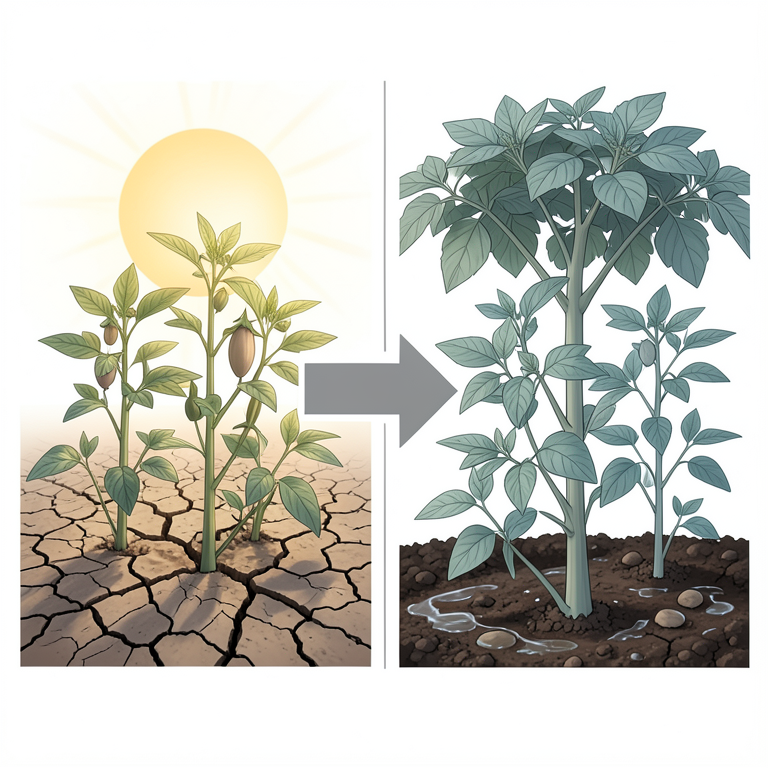
Dimensions of Climate Resilience
AI-generated conceptual illustration (chickpea and groundnut plants in a field). It explains the idea and does not show study data.
View source evidence ↗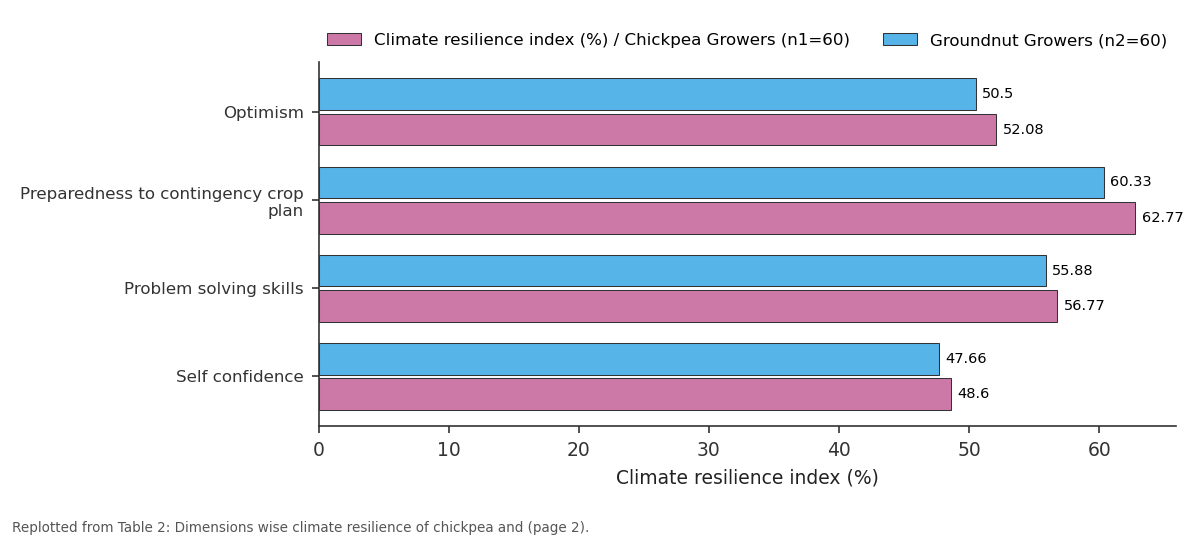
Climate resilience index (%) / Chickpea... and Groundnut Growers (n2=60): Optimism vs Preparedness to... vs Problem solving skills vs Self confidence
Replotted from Table 2 (page 2) of the original paper. Every bar is the paper's own table value.
View source evidence ↗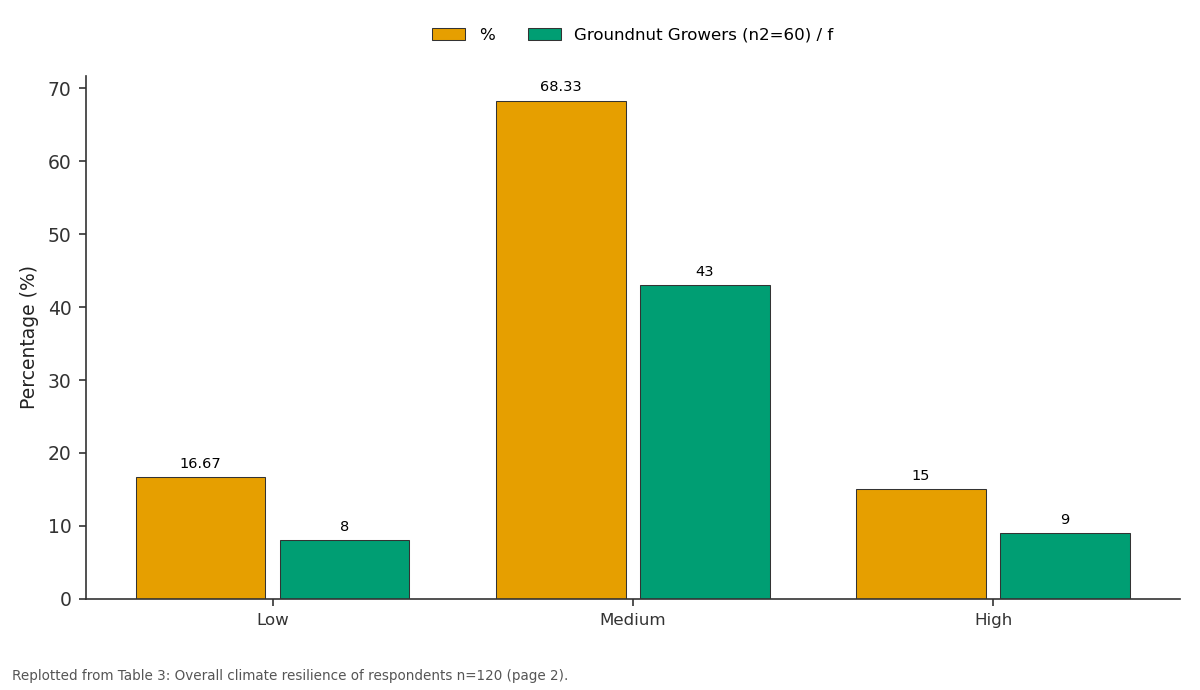
% and Groundnut Growers (n2=60) / f: Low vs Medium vs High
Replotted from Table 3 (page 2) of the original paper. Every bar is the paper's own table value.
View source evidence ↗Figures & tables
From the original paper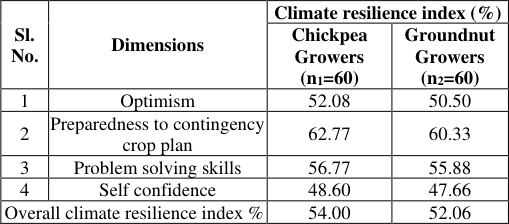 Table 2
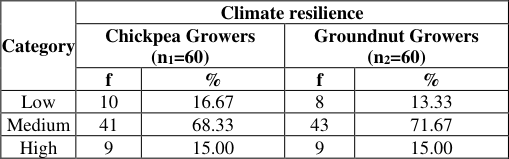 Table 3
 Table 1
Introduction
The delicate balance of agricultural ecosystems, the looming specter of climatic variability and unpredictability casts an ominous shadow, poised to exacerbate the already precarious problem of food security (Pathak et al., 2019) [1] . As nature's whims dictate, the response of cropping systems to these capricious climatic parameters emerges as a litmus test, delineating the thin line between agricultural prosperity and peril. Yet, despite the resilience inherent in the fabric of agriculture, conventional farming practices have often faltered in the face of such adversities, leaving farmers vulnerable to the relentless onslaught of climate aberrations. Struggling against the tide of change, farmers find themselves ensnared in a web of challenges, from the scarcity of technological solutions to the meager resource base that hampers adaptation efforts, particularly among smallholder farmers. Recognizing the imperative to fortify resilience against the shifting tides of climate change, Howden et al. (2007) [2] herald the need for enhanced capacity to manage climate risks, underlining the pivotal role of informed decision-making rooted in climate knowledge. It is within this crucible of agricultural adaptation that the coping mechanisms and adaptive strategies of the farming community must be honed and refined. In this pursuit, our study casts its gaze upon two pivotal crops-chickpea and groundnut, emblematic of pulse and oilseed cultivation, respectively-seeking to unravel the tapestry of climate resilience woven by growers amidst the tumultuous backdrop of climatic uncertainty. Through the lens of these crops, we embark on a journey to illuminate the intricate interplay between agriculture and climate resilience, laying the groundwork for informed interventions and sustainable agricultural practices in a world ever in flux.
Chickpea
Chickpea is a cool season legume crop mostly grown on residual soil moisture. High temperature and terminal drought are common in different regions of chickpea production with varying intensities and frequencies. Therefore, stable chickpea production will depend on the release of new cultivars with improved adaptation to major events such as drought and high temperature. A decrease in chickpea yields of 53 kg/ha was observed with a 1 • C increase in seasonal temperature. Similarly, with every 0.1 ºC temperature rise combined with 31% reduction in seasonal rainfall, the yield of chickpea decreased by 38.5 kg/ha (Daniel 2019) [5] .
Groundnut
Groundnut is one of the significant sources of oil, food, and fodder in India. It is grown in marginal arid and semiarid agro-ecosystems with wide yield fluctuations due to spatial variability of rainfall and soil. Climate change, which is predicted to increase the intra-and inter-annual rainfall variability, will further constrain the groundnut economy in India besides the global and domestic economic, social and policy changes. By 2050, climate change under an optimistic scenario will result in -2.3 to 43.2% change in groundnut yields across various regions in India when climate alone was factored in. But the change in groundnut yields ranged from -0.9% to 16.2% when economic (population and income) and market variables (Elasticities, www.extensionjournal.com trade, etc.) were also considered. Similarly, under pessimistic climate change scenario, the percent change in groundnut yields would be -33.7 to 3.4 with only the climate factored in and -11.2 to 4.3 with the additional economic and market variables included. This indicates the sensitivity of climate change impacts to differences in socioeconomic factors. (Kadiyala et al. 2021) [4] . Keeping above points in view, the present study is planned to explore Climate resilience of the chickpea and groundnut growers.
Materials and Methods
Resilience, defined as the capacity of a system to absorb shocks and rebound swiftly to normalcy when the external environment improves, was the focus of this study. The research was conducted in Dharwad district. Among the eight taluks in the district, four taluks-Navalagund, Dharwad, Kundgol, and Hubli-were selected based on the criterion of having the maximum area under chickpea and groundnut cultivation. From each of these taluks, 30 farmers were chosen, comprising 15 chickpea growers and 15 groundnut growers, resulting in a total sample size of 120 farmers. To measure climate resilience, a scale developed by Jansa (2015) [3] was utilized. This scale encompassed 15 statements that assessed various dimensions including selfconfidence, problem-solving skills, preparedness for contingency crop planning due to climate change, and optimism, which represent both technological and psychological variables. Participants' responses were recorded on a five-point continuum ranging from "strongly agree" to "strongly disagree," with corresponding scores of 5, 4, 3, 2, and 1, respectively, for positive statements, and vice versa for negative statements. The climate resilience score derived from this scale ranged from 15 to 75, providing a comprehensive assessment of farmers' resilience levels. Climate resilience index was computed by the following formula,
The respondents were grouped using frequency and percentage. Based on obtained score, the respondents were classified into three categories namely, 'low', 'medium' and 'high' using mean and standard deviation as a measure of check.
Results and Discussion
The study examined the climate resilience of growers across four dimensions: optimism, preparedness for contingency planning due to climate change, problem-solving skills, and self-confidence. Table 2 reveals that the overall climate resilience index was higher among chickpea growers at 54.00% compared to groundnut growers at 52.06%. Among the dimensions studied, preparedness for contingency planning exhibited the highest resilience index (62.77% for chickpea growers and 60.33% for groundnut growers), followed by problem-solving skills (56.77% for chickpea growers and 55.88% for groundnut growers), optimism (52.08% for chickpea growers and 50.50% for groundnut growers), and self-confidence (48.60% for chickpea growers and 47.66% for groundnut growers). In Table 3. The overall climate resilience of respondents is summarized. Among chickpea growers, the majority (68.33%) fell into the medium category of climate resilience, followed by high (16.67%) and low (15.00%) categories. Similarly, among groundnut growers, the majority (71.67%) were classified in the medium category of climate resilience, with 15.00% and 13.33% falling into the high and low categories, respectively. The results suggest that overall, groundnut growers exhibit a medium to high level of climate resilience, whereas chickpea farmers display a medium to low level. This discrepancy could be attributed to the higher sensitivity of chickpea to even slight changes in climate, particularly during flowering and grain-filling stages, compared to groundnut crops. These findings underscore the importance of understanding crop-specific vulnerabilities to climate variability and the need for tailored resilience strategies in agricultural practices.
Figures and tables from the paper
| Sl. No. | Category | Score range |
|---|---|---|
| 1 | Low | Less than (Mean – SD) |
| 2 | Medium | Between (Mean ± SD) |
| 3 | High | Above (Mean + SD) |
Table text extracted from the original PDF; superscript letters are shown inline. The original table image is below.
View original table image
References
4 in the original paper- Pathak, Parmer V, Joshi NS, Prajapati PJ, Hadiya N. Constraints faced by the farmers in adoption of improved cultivation practices of chickpea. International Journal of Current Microbiology and Applied Sciences. 2019;8(11):20-19.
- Howden, Godfray HCJ, Beddington JR, Crute IR, Haddad L, Lawrence D, et al. Food Security: The Challenge of Feeding 9 Billion People. Science. 2007;327:812-818.
- Yates J, Deeney M, Rolker HB, White H, Kalamatianou S, Kadiyala S. A systematic scoping review of environmental, food security and health impacts of food system plastics. Nature Food. 2021 Feb;2(2):80-87.
- Daniel BK. Using the TACT framework to learn the principles of rigour in qualitative research. Electronic Journal of Business Research Methods. 2019 Sep 1;17(3):118-129.