
Research article · 2024 · Full text
International Journal of Agriculture Extension and Social DevelopmentThe resonance of Odisha’s millet mission in transforming Ragi farming in Koraput district
Volume 7(2) · Pages 503–506 · DOI: 10.33545/26180723.2024.v7.i2g.372 ↗
Research areasAgricultural Economics and PracticesIndian History and PhilosophySocial and Economic Development in India
Abstract
Author-writtenOdisha Millet Mission (OMM), a flagship initiative started in 2017 by the department of Agriculture and Farmers’ Empowerment in the state of Odisha, aims to promote millet cultivation. Millets, being a super staple food positively impacting nutrition and well-being of tribal communities so, it’s crucial to find out the impact of Odisha Millet Mission on socio-economic life of Ragi growers. The study was conducted in the year 2020-2021 in Koraput district of Odisha. The methodology involves the selection of recipients and non- recipients from each village selected from two blocks, primary data was collected with pre-structured interview schedule and secondary data was collected from online sources, libraries, journals etc. Data analysis shows that recipient farmers outperformed non-recipients. The study identified that mission led to increased knowledge, adoption, productivity, higher annual income, and enhanced social participation among recipients and also contributed to the well-being of farmers, positively influencing various aspects of their agricultural practices and socio-economic conditions. Its success is further validated by the Indian government's endorsement and the request for its replication in other states. As a whole, this study offers insightful information to researchers, practitioners, and policymakers who are pursuing sustainable rural lives and food security.
Summary
Source-checkedPlain-language reading of the full paper, prepared with AI and checked against the text. Each point links to the authors' own words.
Why it matters
- Millets are considered intelligent crops that can help address global issues including rural livelihoods, climate change, and food security. View evidence ↗
- Ragi, or finger millet, provides significant health benefits due to its high content of calcium (0.38%), dietary fiber (18%), and phenolic compounds (0.3–3%). View evidence ↗
- The Odisha Millet Mission (OMM) was established in 2017 by the state government to promote millet cultivation specifically within tribal regions. View evidence ↗
The question
- The study aimed to determine how the Odisha Millet Mission impacted the socio-economic lives of Ragi farmers. View evidence ↗
What they did
- The research was conducted during 2020-21 in the Borigumma and Semiliguda blocks of the Koraput district. View evidence ↗
- The study used a sample of 120 farmers, split equally between 60 recipients of the mission and 60 non-recipients. View evidence ↗
- The mission's impact was measured by analyzing changes in social participation, annual income, productivity, adoption, and knowledge. View evidence ↗
What they found
- Adoption levels were higher among recipients, where 68.34% showed high adoption, while the majority of non-recipients (56.66%) showed only medium adoption. View evidence ↗
- Recipient farmers achieved higher productivity, with 68.33% producing over 10 qtl/ha, whereas 91.66% of non-recipients remained at a median production level. View evidence ↗
- While most farmers in both groups had low annual incomes, non-recipients had lower earnings (96.67% below INR 50,000) compared to recipients (90.66% at INR 50,000). View evidence ↗
- Recipient farmers were more socially active, with 56.66% showing medium social participation compared to 71.66% of non-recipients who showed low participation. View evidence ↗
- The OMM led to percentage increases for recipients over non-recipients in annual income (37.15%), adoption (38.49%), social participation (36.71%), productivity (35.36%), and knowledge (34.87%). View evidence ↗
- The overall calculated impact of the Odisha Millet Mission on recipient farmers compared to non-recipients was 36.51%. View evidence ↗
What it means
- The authors conclude that the Odisha Millet Mission had a substantial positive impact on the farmers who participated in the program. View evidence ↗
- The authors recommend the continued implementation and expansion of the mission, along with further technology adoption, to support backward and tribal farmers. View evidence ↗
Visual summary
3 visualsIllustrations explain the paper; charts are replotted from the paper's own table values.
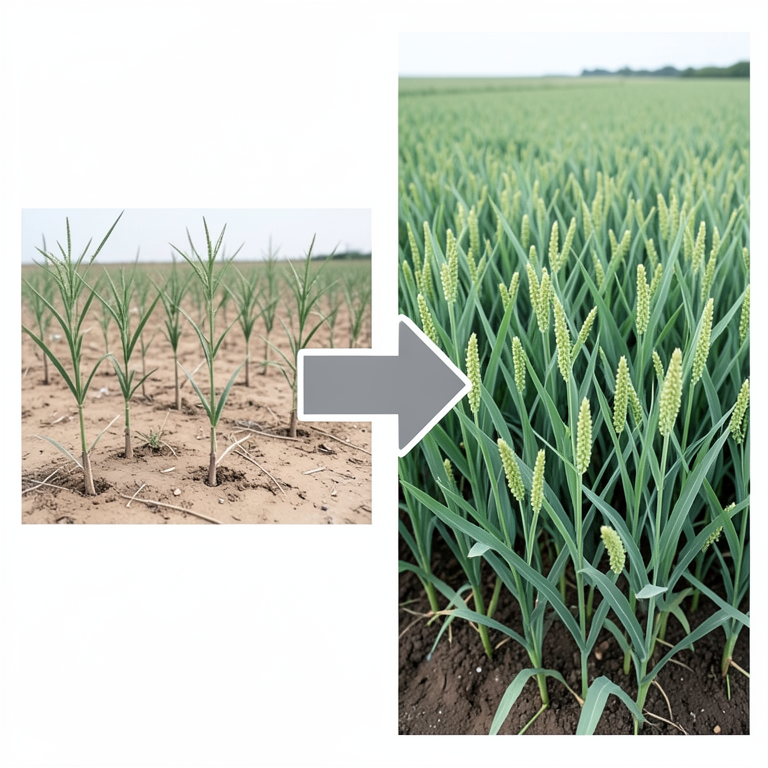
Impact Comparison
AI-generated conceptual illustration (Finger millet (Ragi) crops in the Koraput district landscape). It explains the idea and does not show study data.
View source evidence ↗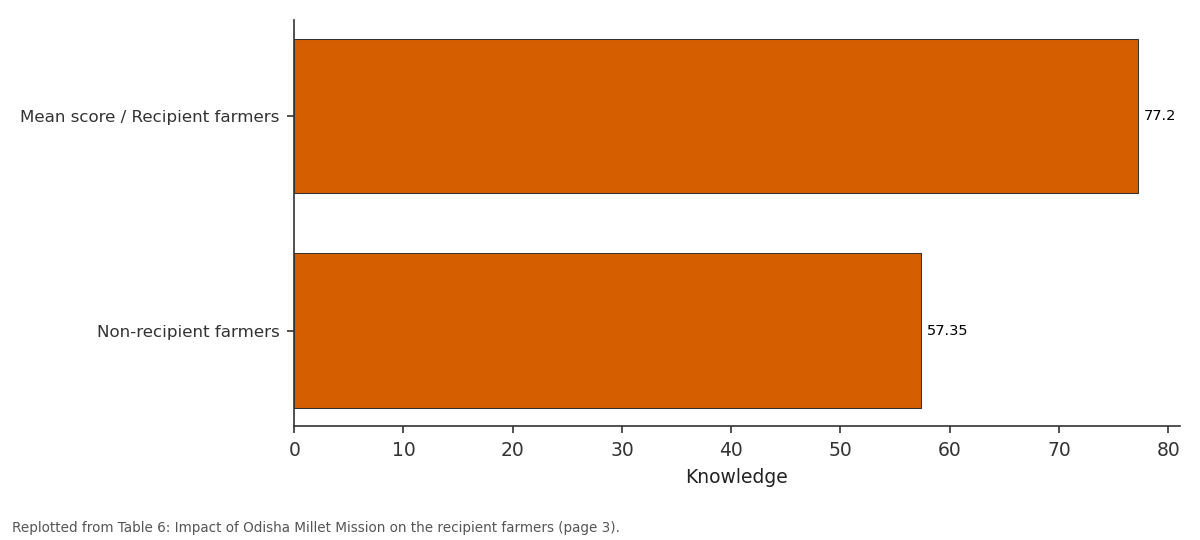
Knowledge: Mean score / Recipient... vs Non-recipient farmers
Replotted from Table 6 (page 3) of the original paper. Every bar is the paper's own table value.
View source evidence ↗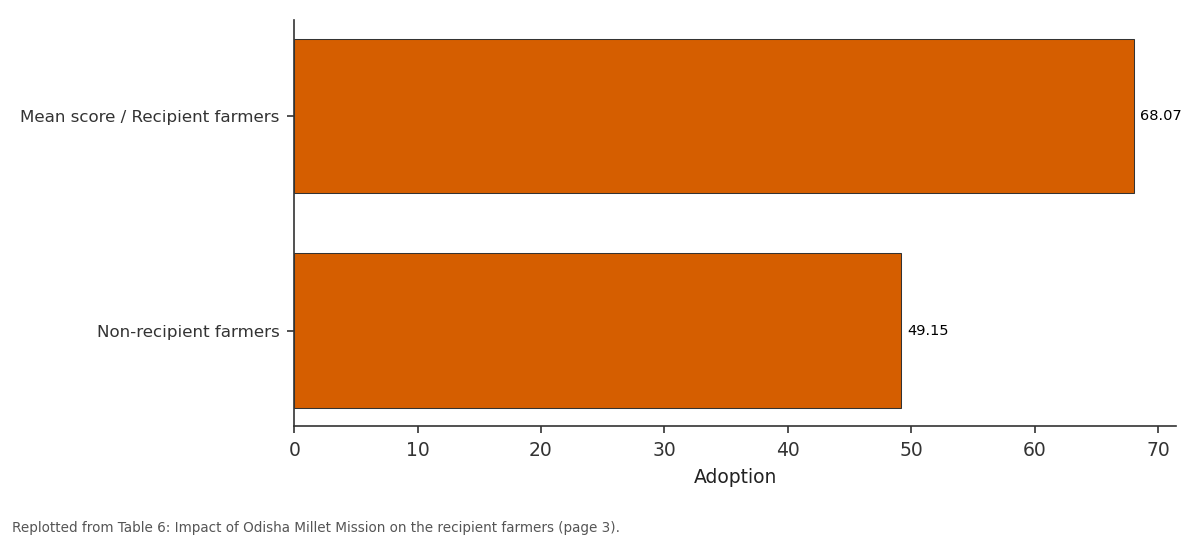
Adoption: Mean score / Recipient... vs Non-recipient farmers
Replotted from Table 6 (page 3) of the original paper. Every bar is the paper's own table value.
View source evidence ↗Figures & tables
From the original paper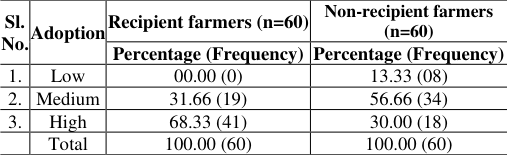 Table 2
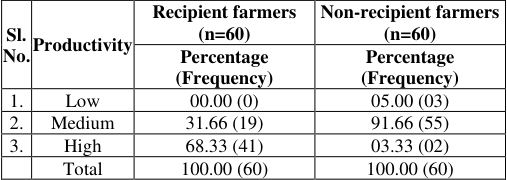 Table 3
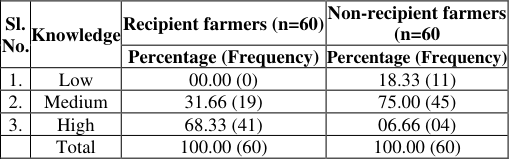 Table 1
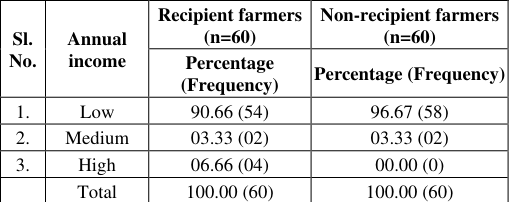 Table 4
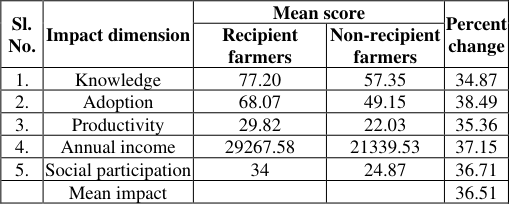 Table 6
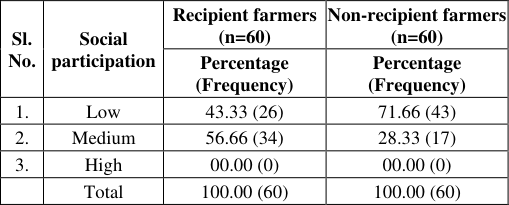 Table 5
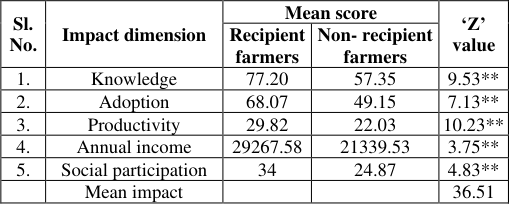 Table 7
Introduction
Millets are untapped and neglected groups of cereals which has Nutri-cereal potential. Although packed with nutrients and different nutraceutical substances, they are often seen as food for the less fortunate. (Chauhan et al., 2018) [4] . According to both nutritional and dietary patterns, millets have been cultivated for thousands of years making them oldest food crop known to human (Ambati and Sucharitha, 2019) [1] . Their excellent nutritional content and ability to withstand severe temperatures are well recognised (Sah et al., 2021) [14] . India is the world's largest millet growing country with 83 percent of Asia's and 26.6 percent of the world's millet cropping area. Millets are a staple of tribal cuisine in the Indian states of Odisha, Madhya Pradesh, Jharkhand, Rajasthan, Karnataka, and Uttarakhand (Sood et al., 2019) [16] . Millets belongs from family Poaceae. The Nutri-Cereals included, foxtail millet, finger millet, Kodo millet, proso millet, little millet, and barnyard millet (minor millets), pearl millet and sorghum, (major millets) (Dash and Rehman, 2023) [5] . Millets, known as "Harbingers of the Evergreen Revolution," are intelligent crops with remarkable benefits. They are highly nutritious, drought-resistant, eco-friendly, and economically valuable. Millets can contribute to global challenges like food security, climate change, and rural livelihoods. (Sangappa et al., 2023) [15] . Ragi (finger millet), rich in dietary fiber (18%), phenolic compounds (0.3-3%), and calcium (0.38%), offers abundant health benefits. Its nutritional significance is wellestablished due to these valuable components. Numerous anti-diabetics (Mishra et al., 2019) [11] , anti-tumerogenic, anti-atherosclerogenic, antioxidant, and antibacterial qualities are among the many additional well-known health benefits. (Devi et al., 2014) [6] . Millets are considered as "Nature's Nutraceuticals". It is a common crop in droughtprone locations and thrives well in poor soil because of its drought-escaping characteristics (Ray et al., 2021) [13] . The Initiative for Nutritional Security through Intensive Millet Promotion (INSIMP), launched by the Indian government, aims to promote millet cultivation for sustainable resource use and improved nutrition. Over the past decade, proactive measures have boosted awareness and consumption of millets, making them increasingly significant. (Rawat et al., 2021) [12] . In Odisha millets are considered as traditional food, fifteen out of thirty districts in the state cultivate millets. In 2017 the Department of Agriculture & Farmers Empowerment, Govt. of Odisha, launched the Odisha Millet Mission (OMM) as a special programme to promote millets in tribal areas of the state in consideration of the situation which has been carrying out operations in the production, processing, marketing and consumer verticals (Jena and Mishra, 2022) [10] . Due to the www.extensionjournal.com fact that millet needs to be resurrected and is the answer to both growing crop failures and nutritional deficiencies, Odisha is a leading producer of millet in the nation. In an effort to reduce malnutrition, millets were also a part of the public distribution system (PDS) and other government nutrition initiatives. (Ghosh and Ramana, 2022) [8] . Initially the programme was launched in 7 districts of Odisha covering 30 blocks and later on it was scaled up to 14 districts covering 72 blocks. It was implemented with community-based organization with support of local NGOs at block level.
Materials and Methods
The purposeful implementation of the study "The Resonance of Odisha's Millet Mission in Transforming Ragi Farming in Koraput District of Odisha" was localized to the tribal area of Koraput district of Odisha. The study was carried out in the year 2020-21 in two blocks of Koraput district i.e., Borigumma and Semiliguda which was selected purposively because of highest number of areas of implementation under Odisha Millet Mission (OMM). Three randomly villages were chosen from each block: Kumbhariput, Charagaon, and Cherangul from the Semiliguda block, and Kumuli, Dulaguda, and Aunli from the Borigumma block. Total 30 recipient and 30 nonrecipient farmers from every block were taken into consideration, with 10 recipient and 10 non-recipient farmers from each village. A sample of 120 farmers, comprising 60 recipients and 60 non-recipients, provided information. Information from each recipient and nonrecipient farmer was gathered using a pretested and organised interview schedule. Ex-post-facto research design was used for the study. Impact of Odisha Millet Mission have been examined in terms of changes in knowledge, adoption, productivity, yearly income, and social participation-all of which are expressed as percentage changes-using a variety of statistical methods, including frequency, percentage, mean, standard deviation, and the "Z Test". According to Table 1, none of the recipient farmer was found to have a poor degree of knowledge about approved ragi growing practices, some (31.66%) of the recipients having a medium level and majority (68.33%) of the recipients having a high level of knowledge. Regarding nonrecipient farmers, one third (75.00%) of them possessed a moderate degree of understanding regarding suggested ragi production techniques, with the remaining 18.33 percent and 06.66 percent having low and high levels of knowledge, respectively. The findings demonstrated that recipient farmers had knowledge levels significantly higher than those of non-recipient farmers which may be due to the fact that recipient farmers are having more sources of information under OMM. The findings of the study are in line with the findings of Chaddha et al., (2021) [3] in which he stated that the knowledge index of recipient is more than non-recipients in approx. all four aspect of scientific livestock farming practices. Data in table 2 showed that majority (68.34%) of recipient farmers had high adoption levels, while, 31.66 percent had medium adoption levels, and none had low adoption levels.
| Sl. No. | Knowledge | Recipient farmers (n=60) | Non-recipient farmers (n=60 |
|---|---|---|---|
| Percentage (Frequency) | Percentage (Frequency) | ||
| 1. | Low | 00.00 (0) | 18.33 (11) |
| 2. | Medium | 31.66 (19) | 75.00 (45) |
| 3. | High | 68.33 (41) | 06.66 (04) |
| Total | 100.00 (60) | 100.00 (60) |
Table text extracted from the original PDF; superscript letters are shown inline. The original table image is below.
View original table image
| Sl. No. | Adoption | Recipient farmers (n=60) | Non-recipient farmers (n=60) |
|---|---|---|---|
| Percentage (Frequency) | Percentage (Frequency) | ||
| 1. | Low | 00.00 (0) | 13.33 (08) |
| 2. | Medium | 31.66 (19) | 56.66 (34) |
| 3. | High | 68.33 (41) | 30.00 (18) |
| Total | 100.00 (60) | 100.00 (60) |
Table text extracted from the original PDF; superscript letters are shown inline. The original table image is below.
View original table image
Results and Discussion
Results and Discussion
Change in Knowledge
Change in Knowledge
Change in Adoption
In the case of non-recipient farmers, majority (56.66%) of them had medium adoption levels, some (13.33%) of them had low level of adoption, and 30.00 percent had high level of adoption. Table 2 stated that majority of recipient farmers were found in high level of adoption, whereas majority of non-recipient farmers found in medium level of adoption. According to Table 3, the majority (68.33%) of recipient farmers had high productivity of finger millet crop, i.e. over 10 qtl/ha, while 31.66 percent had medium productivity, i.e. between 5.01-10 qtl/ha and none of the recipient farmers had low production level. In the case of non-recipients, 91.66 percent of farmers had a median production level, subsequently 05.00 percent had low level of production of less than 5 qtl/ha while, 03.33 percent having a high degree of productivity. As a result, the majority of recipient farmers have a high level of production, while all non-recipient farmers have a medium level of output. www.extensionjournal.com High 00.00 (0) 00.00 (0) Total 100.00 (60) 100.00 (60)
| Sl. No. | Productivity | Recipient farmers (n=60) | Non-recipient farmers (n=60) |
|---|---|---|---|
| Percentage (Frequency) | Percentage (Frequency) | ||
| 1. | Low | 00.00 (0) | 05.00 (03) |
| 2. | Medium | 31.66 (19) | 91.66 (55) |
| 3. | High | 68.33 (41) | 03.33 (02) |
| Total | 100.00 (60) | 100.00 (60) |
Table text extracted from the original PDF; superscript letters are shown inline. The original table image is below.
View original table image
Change in Productivity
Change in Productivity
Change in Annual Income
Change in Annual Income
Change in Social Participation
Table 5 demonstrates that no recipient farmer had a high degree of social involvement, whereas the majority (56.66%) of recipient farmers had a medium level of social participation and 43.33 percent had a low level. Regarding those who were not receivers, the bulk of farmers (71.66%) participated in society at a low level, and the remaining 28.33 percent participated in society at a medium level. As a result, most recipient farmers participated in society at a moderate level, whereas most non-receiver farmers participated in society at a low level. This could be due to the fact that farmers benefited under Odisha Millet Mission are socially more active. When the impact Odisha Millet Mission as whole was considered, it is evident from Table 6 that, there was total 36.51 percent impact of Odisha Millet Mission on the recipient famers when compared with non-recipient farmers. It could thus be stated that the Odisha Millet Mission had a definite impact over recipient farmers in terms of change in productivity, adoption, annual income, knowledge, and social participation to the extent of 31.34 percent above and beyond the overall average. Similar findings were reported by Jadhav (2017) [9] who observed that, 34.22 percent impact on recipient famers about Crop Pest Surveillance and Advisory Project, Ghagare (2018) [7] observed that definite impact of seed production programme organized under RKVY project on the trainee farmers to the extent of 36.24 percent and Chabhan (2020) [2] observed that 31.34 percent impact of Odisha Millet Mission on recipient farmers over non-recipient farmers. 7 shows that 'Z' values of knowledge (09.53), adoption (07.13), production (10.23), annual income (3.75), and social involvement (4.83) were statistically significant at the probability level 0.01. As a result, it is possible to conclude that recipient farmers differ significantly from non-recipient farmers in terms of knowledge, adoption, productivity, annual income, and social participation. As a result of the Odisha Millet Mission, there was a clear difference in knowledge, adoption, productivity, annual income, and social participation among recipient farmers against non-recipient farmers. By the end, it is reasonable to say that the Odisha Millet Mission had a substantial positive impact on the farmers who benefited from it.
| Sl. No. | Social participation | Recipient farmers (n=60) | Non-recipient farmers (n=60) |
|---|---|---|---|
| Percentage (Frequency) | Percentage (Frequency) | ||
| 1. | Low | 43.33 (26) | 71.66 (43) |
| 2. | Medium | 56.66 (34) | 28.33 (17) |
| 3. | High | 00.00 (0) | 00.00 (0) |
| Total | 100.00 (60) | 100.00 (60) |
Table text extracted from the original PDF; superscript letters are shown inline. The original table image is below.
View original table image
| Sl. No. | Impact dimension | Mean score | — | Percent change |
|---|---|---|---|---|
| Recipient farmers | Non-recipient farmers | |||
| 1. | Knowledge | 77.20 | 57.35 | 34.87 |
| 2. | Adoption | 68.07 | 49.15 | 38.49 |
| 3. | Productivity | 29.82 | 22.03 | 35.36 |
| 4. | Annual income | 29267.58 | 21339.53 | 37.15 |
| 5. | Social participation | 34 | 24.87 | 36.71 |
| Mean impact | 36.51 |
Table text extracted from the original PDF; superscript letters are shown inline. The original table image is below.
View original table image
Impression of Odisha Millet Mission on the Recipient Farmers over Non-recipient Farmers
Impression of Odisha Millet Mission on the Recipient Farmers over Non-recipient Farmers
Assessing the Relevance of the Mean Differences
Assessing the Relevance of the Mean Differences
Conclusion
The research concludes that the Odisha Millet Mission makes a significant contribution to the field of agricultural development. By rigorously assessing the impact of the mission on recipient farmers, it provides empirical evidence of positive outcomes. The overall difference was determined to be 36.51 percent. The "Z" value for knowledge, adoption, production, yearly income, and social participation was shown to be favourably and highly significant at the 0.01 level of probability. The substantial increase in productivity, adoption, knowledge, annual income, and social participation among recipients underscores the mission's effectiveness. Moreover, the endorsement by the Indian Government and the call for replication in other states validate its success. The paper emphasizes the need for continued implementation, expansion, and technology adoption to uplift tribal and backward farmers. Overall, this research contributes valuable insights for policymakers, practitioners, and researchers working toward sustainable food security and rural livelihoods.
Figures and tables from the paper
| Sl. No. | Annual income | Recipient farmers (n=60) | Non-recipient farmers (n=60) |
|---|---|---|---|
| Percentage (Frequency) | Percentage (Frequency) | ||
| 1. | Low | 90.66 (54) | 96.67 (58) |
| 2. | Medium | 03.33 (02) | 03.33 (02) |
| 3. | High | 06.66 (04) | 00.00 (0) |
| Total | 100.00 (60) | 100.00 (60) |
Table text extracted from the original PDF; superscript letters are shown inline. The original table image is below.
View original table image
| Sl. No. | Impact dimension | Mean score | — | ‘Z’ value |
|---|---|---|---|---|
| Recipient farmers | Non- recipient farmers | |||
| 1. | Knowledge | 77.20 | 57.35 | 9.53** |
| 2. | Adoption | 68.07 | 49.15 | 7.13** |
| 3. | Productivity | 29.82 | 22.03 | 10.23** |
| 4. | Annual income | 29267.58 | 21339.53 | 3.75** |
| 5. | Social participation | 34 | 24.87 | 4.83** |
| Mean impact | 36.51 |
Table text extracted from the original PDF; superscript letters are shown inline. The original table image is below.
View original table image
References
14 in the original paper- Ambati K, Sucharitha KV. Millets-review on nutritional profiles and health benefits. Int. J Recent Sci. Res. 2019;10(7):33943-33948.
- Chaddha A, Jadoun YS, Singh J, Kansal SK. Comparative Analysis of Beneficiaries and Nonbeneficiaries about Scientific Livestock Farming Practices. Indian Journal of Animal Research. 2021. DOI: 10.18805/IJAR.B-4404.
- Chauhan M, Sonawane SK, Arya SS. Nutritional and Nutraceutical Properties of Millets: A Review. Clin J Nutr Diet. 2018;1:1-10.
- Dash S, Rehman AHM. Millets in the era of climate change. In: Verma B, Rao GVNRN, Patil VOK, Hiregoudar S, Saini A, Rana BB, editors. Millets: The ancient grain for the future. Kripa Drishti publications; 2023. p. 26-32.
- Devi PB, Vijayabharathi R, Sathyabama S, Malleshi NG, Priyadarisini VB. Health benefits of finger millet (Eleusine coracana L.) polyphenols and dietary fiber: A review. J Food Sci. Technol. 2014;51(6):1021-1040.
- Ghagare SP. Impact of seed programme organised under RKVY project. [Unpublished M.Sc. thesis]. Dr. PDKV, Akola; 2018.
- Ghosh N, Ramana DV. Millet and Money Promoting Sustainable Consumption in Southern Orissa. In: Bhattacharyya J, editor. Dealing with Socially Responsible Consumers. Palgrave Macmillan; 2022. p. 207-229. https://doi.org/10.1007/978-981-19-44574_13.
- Jena D, Mishra S. Growth and Decomposition of Millets in Odisha: 1960-61 to 2019-20. Agric. Sci. Digest. 2022;42(3):272-277. DOI: 10.18805/ag.D-5447.
- Mishra K, Yenagi NB, Hiremath U. Effect of nutrition education intervention to diabetic subjects on use of millet recipes in the management of diabetes. Indian J Extension Educ. 2019;55(4):101-106.
- Rawat L, Karnatak AK, Bisht TS, Kukreti A. Minor Millets: Profile and Ethnobotanical Scenario. In: Millets and Millets Technology. Springer; 2021. p. 5180.
- Ray S, Umesha C, Meshram MR. Response of Irrigation and Hydrogel on Growth and Yield of Pearl Millet (Pennisetum glaucum L.) under eastern UP condition. Biol Forum -An Int. J. 2021;13(2):404-407.
- Sah U, Dixit GP, Kumar H, Ojha J, Katiyar M, Singh V, et al. Performance of Millets in Bundelkhand Region of UP State. Indian J Extension Educ. 2021;57(4):120125.
- Sangappa, Dudekula R, Laxmi B, Charishma E, Babu KS. Strengthening Millet Value Chain through Farmer Producer Organizations. Indian J Extension Educ. 2023;59(3):26-31.
- Sood S, Joshi DC, Chandra AK, Kumar A. Phenomics and genomics of finger millet: current status and future prospects. Planta. 2019;250:731-751.