
Research article · 2024 · Full text
International Journal of Advanced Biochemistry ResearchAssessment of various management strategies implemented by farmers against Spodoptera frugiperda (J. E. Smith) in maize
Volume 8(2) · Pages 620–624 · DOI: 10.33545/26174693.2024.v8.i2h.642 ↗
Research areasAgricultural pest management studies
Abstract
Author-writtenExperiment on the effectiveness of various farming strategies were used to control S. frugiperda in maize during Kharif 2021 and Rabi 2022 at the Mahatma Phule Krishi Vidyapeeth, Rahuri. The experiment results showed that the standard check chlorantraniliprole 18.5% SC @ 0.4 ml/l recorded the lowest larval population (0.85 larvae/plant) and leaf damage score (2.57). Neem seed powder at 2 g/whorl was most effective and significantly superior to the rest of farmer practices, with the larval population of 0.91 larvae/plant. The next effective treatments were lime @ 5 g/whorl, soil @ 5 g/whorl and sand @ 5 g/whorl in reducing larval population and leaf damage infesting S. frugiperda. The highest grain yield (64.01 q/ha) was registered by chlorantraniliprole 18.5% SC followed by neem seed powder @ 2 g/whorl ((56.33 q/ha) and lime @ 5 g/whorl (47.40 q p/ha). The highest ICBR (1:3.66) was registered by chlorantraniliprole 18.5% SC followed by wood ash (1:1.85).
Summary
Source-checkedPlain-language reading of the full paper, prepared with AI and checked against the text. Each point links to the authors' own words.
Why it matters
- The fall armyworm (Spodoptera frugiperda) is a critical insect pest affecting various crops, particularly maize. View evidence ↗
- Overuse of chemical pesticides can lead to environmental contamination, pest resistance, and the loss of natural pest enemies. View evidence ↗
- Indigenous pest control methods are considered affordable and efficient alternatives that do not harm the ecosystem. View evidence ↗
The question
- The study aims to identify and summarize the most effective indigenous farming practices for managing fall armyworm to share with stakeholders. View evidence ↗
What they did
- The experiment was conducted at the Mahatma Phule Krishi Vidyapeeth farm in Rahuri during the Kharif 2021 and Rabi 2022 seasons. View evidence ↗
- The study used the Eco-parmeshwar (P-3302) maize cultivar in plots of 4 x 3 m², employing ten different treatments with three replications. View evidence ↗
- Treatments tested included various indigenous materials (wood ash, soil, sand, neem seed powder, lime, chilli extract, chlorine water, detergent water), a chemical standard (chlorantraniliprole), and an untreated control. View evidence ↗
What they found
- The chemical standard chlorantraniliprole (0.4 ml/l) was the most effective overall, resulting in the lowest larval population of 0.85 larvae per plant. View evidence ↗
- Among the indigenous farmer practices, neem seed powder (2 g/whorl) was the most effective, with a larval population of 0.91 larvae per plant. View evidence ↗
- The highest grain yields were achieved by chlorantraniliprole (64.01 q/ha), followed by neem seed powder (56.33 q/ha) and lime (47.40 q/ha). View evidence ↗
- Chlorantraniliprole produced the highest yield increase over the control (50.84%), while neem seed powder showed a significant increase of 32.73%. View evidence ↗
- The highest Incremental Cost-Benefit Ratio (ICBR) was recorded for chlorantraniliprole (1:3.66), followed by wood ash (1:1.85). View evidence ↗
What it means
- The authors conclude that neem seed powder, lime, and wood ash are effective indigenous practices for controlling fall armyworm. View evidence ↗
- The authors recommend that small-scale farmers use these indigenous practices as an environmentally sustainable way to manage the pest. View evidence ↗
Visual summary
3 visualsIllustrations explain the paper; charts are replotted from the paper's own table values.
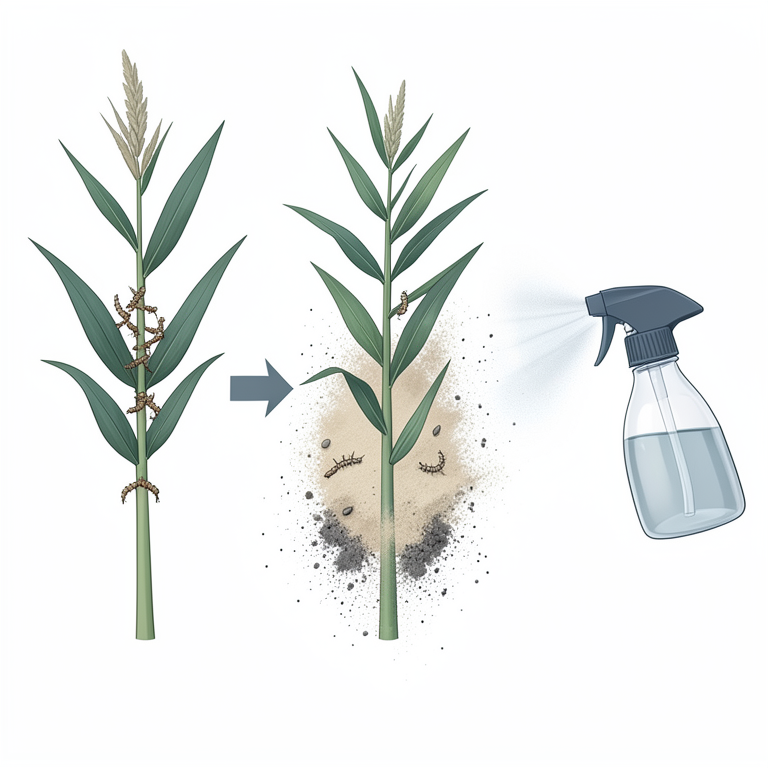
Comparison of Pest Control Methods
AI-generated conceptual illustration (maize plants and Spodoptera frugiperda larvae). It explains the idea and does not show study data.
View source evidence ↗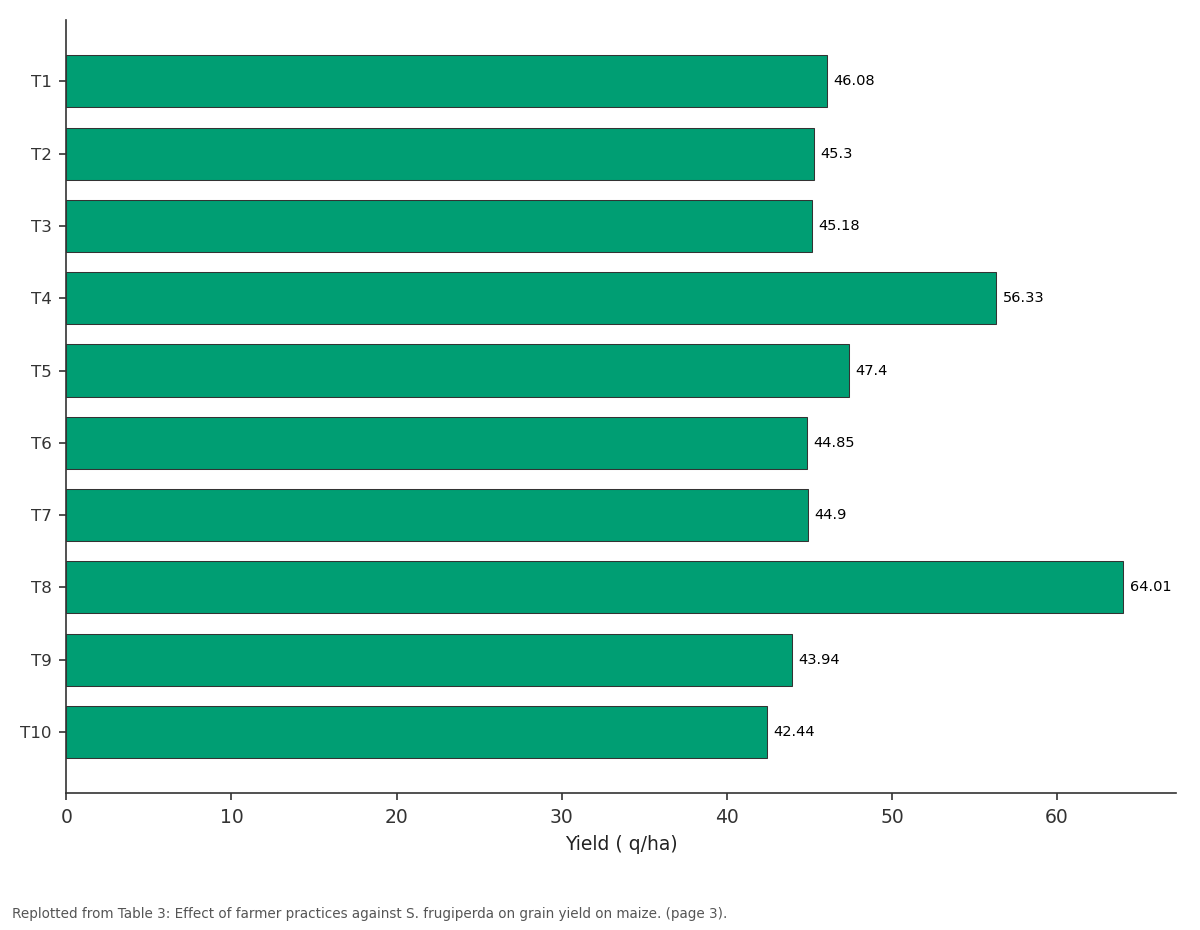
Average of two seasons: T1 vs T2 vs T3 vs T4 vs T5
Replotted from Table 3 (page 3) of the original paper. Every bar is the paper's own table value.
View source evidence ↗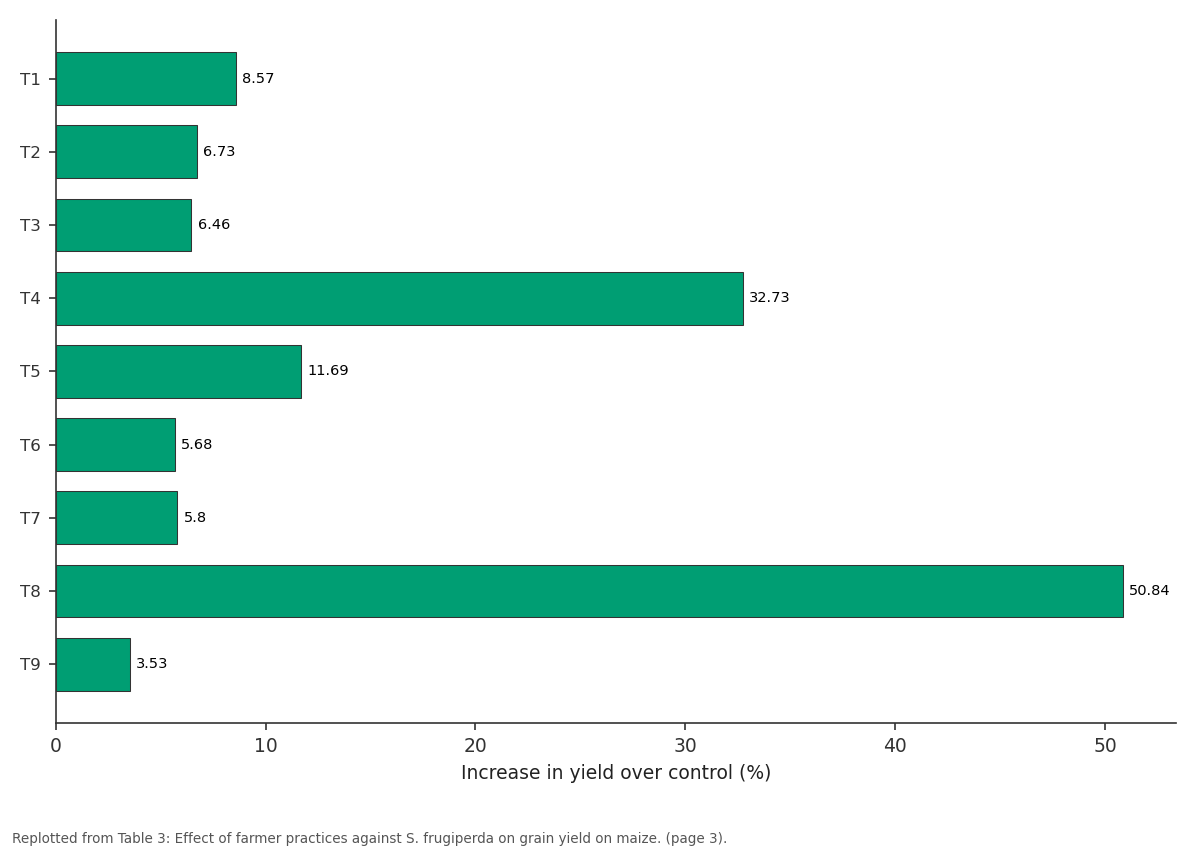
Increase in yield over control (%): T1 vs T2 vs T3 vs T4 vs T5
Replotted from Table 3 (page 3) of the original paper. Every bar is the paper's own table value.
View source evidence ↗Figures & tables
From the original paper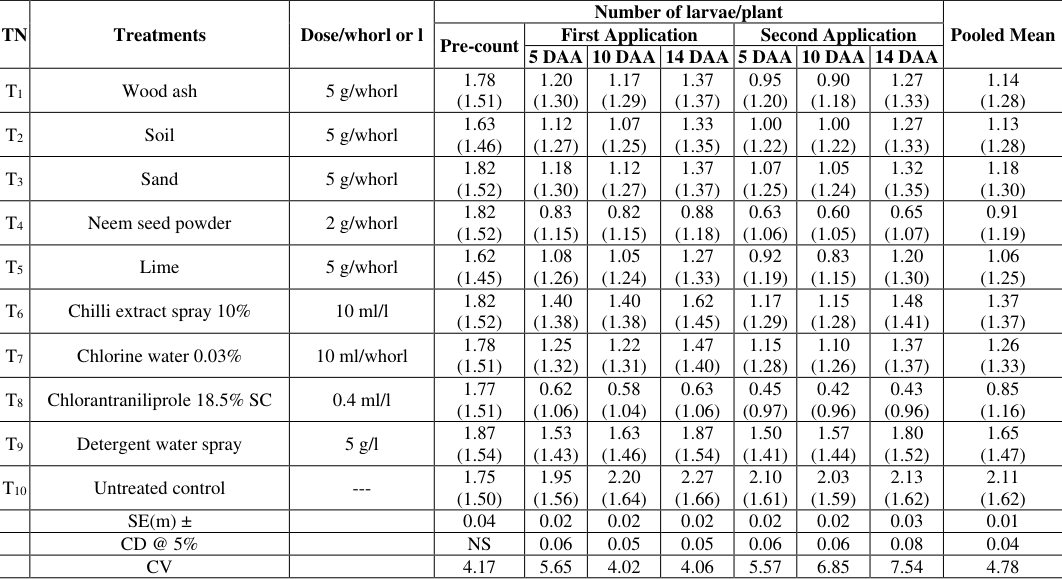 Table 1
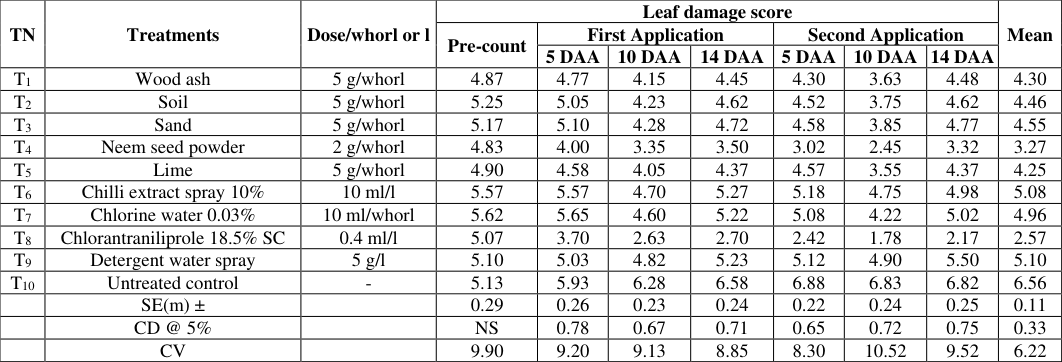 Table 2
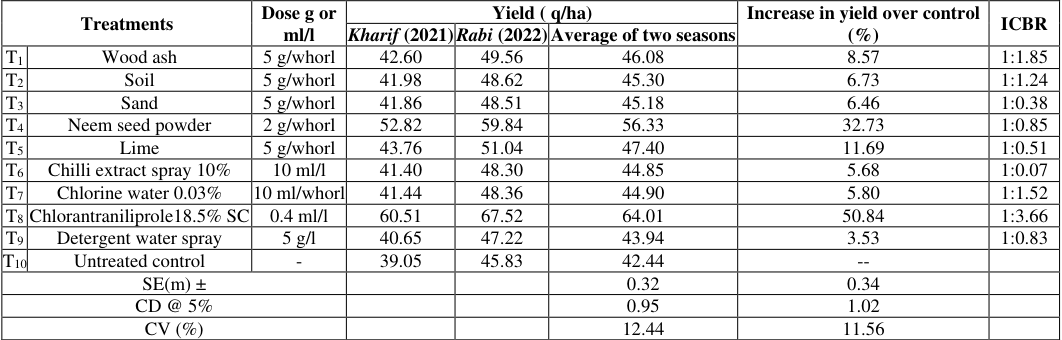 Table 3
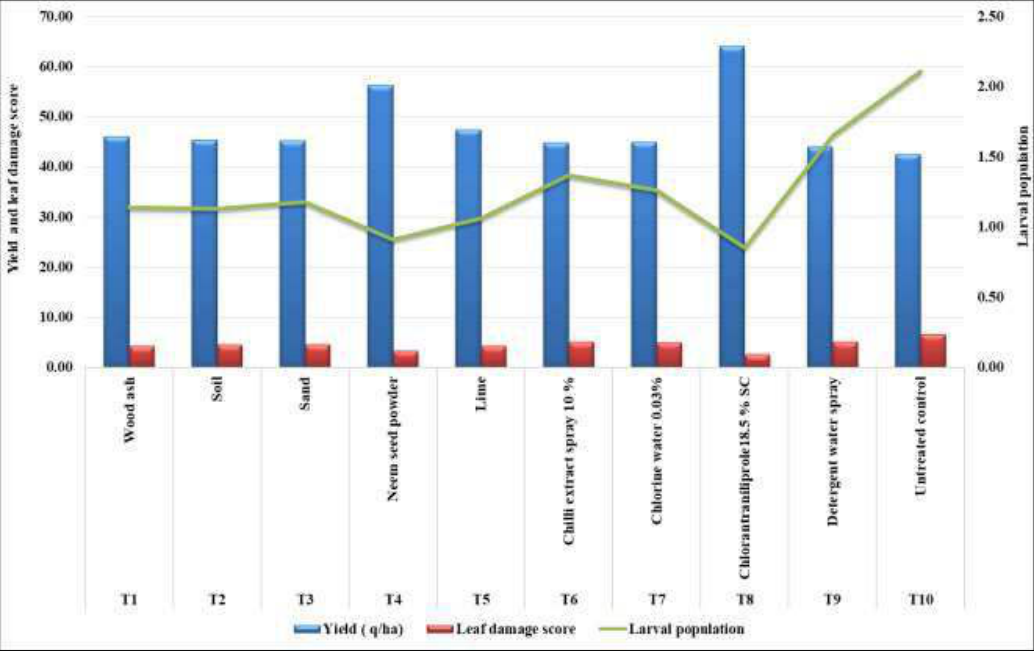 Figure 1
Introduction
The fall armyworm (FAW) (Spodoptera frugiperda), has most important insect pest for a many crop species, mostly maize (Luginbill, 1928) [10] . As an invasive species, FAW has expanded over Africa, the Near East, and Asia in recent years. Reports of FAW were recorded throughout continental West Africa in the early months of 2016 (Goergen, 2016) [8] . It rapidly expanded throughout sub-Saharan Africa in 2016, 2017 and by late 2018 (FAO, 2018) [6] . According to Ganiger et al. (2018) [7] it had been verified in Yemen and India by The purpose of this investigation is to summarize and choose the best indigenous knowledge and practices that may be shared with farmers and other farming stakeholders.
Materials and Methods
In Kharif 2021 and Rabi 2022, the experiment was carried out on the Mahatma Phule Krishi Vidyapeeth (MPKV) maize improvement project farm in Rahuri. The field experiment was carried out with ten treatments and three replications, with plot size 4 x 3 m 2 and spacing of 75 x 25 cm 2 . The cultivar Eco-parmeshwar (P-3302) was sown with all agronomical practices except plant protection measures. The treatments include: T 1 : Wood ash @ 5 g/whorl, T 2 : Soil @ 5 g/whorl, T 3 : Sand @ 5 g/whorl, T 4 : -Neem seed powder @ 2 g/whorl, T 5 : Lime @ 5 g/whorl, T 6 : Chilli extract spray 10% @ 10 ml/l, T 7 : Chlorine water 0.03% @ 10 ml/whorl, T 8 : Chlorantraniliprole -18.5% SC @ 0.4 ml/l used as standard check, T 9 : Detergent water spray @ 5 g/l and T 10 : Untreated control. Source: woos ash, soil, sand, lime, chilli, chlorine water were procured from local market. Both chlorantraniliprole (18.5% SC) and neem seed powder were supplied by Liebigs Agro Chem Pvt. Ltd., Kolkata and FMC India Pvt. Ltd. of Bandra Kurla Complex (E), Mumbai, respectively. Two treatment applications were given on the experimental plot at intervals of 14 days. As soon as the fall armyworm incidence was observed, the first treatments were applied. Pre count observation on larval population and leaf damage score were recorded before application treatment while post count observations were recorded after application of treatments at five, ten and fourteen days after application (DAA) in each plot. According to Davis and Williams (1992) [15] , the observations on leaf damage score were recorded on a grading range of 0 to 9. At harvesting grain yield was recorded in each plot and converted into q/ha for further statistical analysis. A randomised block design (RBD) was used to analyse the field experiment data. The designed ANNOVA was applied to the transformed data in order to compare the results among the treatments.
Results and Discussion
The data (Table 1) revealed that during Kharif 2021 and Rabi 2022, all treatments significantly reduced the incidence of larvae at 5, 10 and 14 days after two application of treatment; pretreatment counts varied from 1.62 to 1.87 and was statistically non-significant and showed chlorantraniliprole 18.5% SC is the best treatment which recorded larval population of 0.85 larvae per plant. Among the farmers practices the best treatment was neem seed powder @ 2 g/whorl which recorded larval population of 0.91 larvae per plant and lime @ 5 g/whorl (1.06 larvae/plant). This was followed by wood ash @ 5 g/whorl (1.13 larave/plant) and soil @ 5 g/whorl with larval population of 1.13 and 1.14 larvae, respectively. Whereas, untreated plots recorded the highest (2.11 larvae/plant) larval population in maize. In respect of effect of different treatments on leaf damage score during Kharif 2021 and Rabi 2022 (Table 2) revealed that pretreatment counts varied from 4.87 to 5.62, and at five, ten and fourteen days after two application of treatments there was reduction in leaf damage score of 2.57 with chlorantraniliprole 18.5% SC. In all farmers practice, neem seed powder @ 2 g/whorl was best treatment in reducing leaf damage score i.e.3.27 followed by lime @ 5 g/whorl (4.25) and wood ash @ 5 g/whorl (4.30). The highest leaf damage score (6.56) recorded by untreated plots. In comparison to the untreated control, all treatments showed noticeably increased yields. According to present experiment (Table 3), chlorantraniliprole 18.5% SC @ 0.4 ml/l has registered the highest yield i.e. 64.01 q/ha. In all farmer's practices, neem seed powder registered highest yield (56.33 q/ha) followed by Lime @ 5 g/whorl (47.40 q p/ha). Furthermore, among all treatments, the treatment with chlorantraniliprole @ 0.4 ml/l produced the highest percentage increase in yield (50.84%). It was followed by neem seed powder demonstrated significant increase in yield (32.73%). The highest ICBR (1:3.66) was recorded by plot treated with chlorantraniliprole 18.5% SC @ 1.88 ml/kg. The maximum ICBR were recorded in the treatments viz., wood ash, chlorine water 0.03% and soil with 1:1.85, 1:1.52 and 1:1.24, respectively. Chlorantraniliprole 18.5% SC was significantly superior over the rest of treatment by reducing larval population and leaf damage score which affected in increase in grain yield followed by neem seed powder and lime (Fig. 1). Experimental finding revealed that chlorantraniliprole @ 0.4 ml/l was best treatment over rest of the treatments against S. frugiperda is in conformity with several earlier workers Bajracharya et al. (2020) [3] reported that chlorantraniliprole 18.5% SC @ 0.4 ml/l was proved best treatment in all other treatments and recorded minimum leaf damage score. Ramesh and Tayde (2022) [12] concluded that chlorantraniliprole 18.5% SC (6.24%) was superior treatment in reducing larval population of S. frugiperda in maize. The results of Stevenson et al. (2017) [13] , who reported that small-scale African farmers generally used neem leaves or seeds to manufacture botanical pesticides to control S. frugiperda, are similar with the observations of the current investigation regarding the efficiency of neem seed powder at 2 g/l. Adeye et al. (2018) [2] reported that applying 4.5 litres of neem oil per hectare reduced the frequency and intensity of insect pest which caused damage to the plants. The findings of this study corroborate Hruska's (2019) [9] who concluded that lime is an easily obtained substance that is widely used by smallholder farmers globally to control S. frugiperda. According to CABI (2017) [4] , many smallholder farmers applied the sand combined with lime inside the whorl of maize for reducing the infestation of fall armyworm. The findings regarding wood ash's effectiveness are in line with Tambo et al. (2020) [14] , who found that 17.7 per cent of farmers in five African countries used ash in the whorl of maize, with an efficacy of 48-77% as against to 92-97% for synthetic pesticides. Similarly, ash added to the whorls reduced yield losses in maize due by S. frugiperda, as reported by Abrahams et al. (2017) [1] .
| Treatments | — | Dose g or ml/l | Yield ( q/ha) | — | — | Increase in yield over control (%) | ICBR |
|---|---|---|---|---|---|---|---|
| Kharif (2021) | Rabi (2022) | Average of two seasons | |||||
| T1 | Wood ash | 5 g/whorl | 42.60 | 49.56 | 46.08 | 8.57 | 1:1.85 |
| T2 | Soil | 5 g/whorl | 41.98 | 48.62 | 45.30 | 6.73 | 1:1.24 |
| T3 | Sand | 5 g/whorl | 41.86 | 48.51 | 45.18 | 6.46 | 1:0.38 |
| T4 | Neem seed powder | 2 g/whorl | 52.82 | 59.84 | 56.33 | 32.73 | 1:0.85 |
| T5 | Lime | 5 g/whorl | 43.76 | 51.04 | 47.40 | 11.69 | 1:0.51 |
| T6 | Chilli extract spray 10% | 10 ml/l | 41.40 | 48.30 | 44.85 | 5.68 | 1:0.07 |
| T7 | Chlorine water 0.03% | 10 ml/whorl | 41.44 | 48.36 | 44.90 | 5.80 | 1:1.52 |
| T8 | Chlorantraniliprole18.5% SC | 0.4 ml/l | 60.51 | 67.52 | 64.01 | 50.84 | 1:3.66 |
| T9 | Detergent water spray | 5 g/l | 40.65 | 47.22 | 43.94 | 3.53 | 1:0.83 |
| T10 | Untreated control | - | 39.05 | 45.83 | 42.44 | -- | |
| SE(m) ± | 0.32 | 0.34 | |||||
| CD @ 5% | 0.95 | 1.02 | |||||
| CV (%) | 12.44 | 11.56 |
Table text extracted from the original PDF; superscript letters are shown inline. The original table image is below.
View original table image
| TN | Treatments | Dose/whorl or l | Leaf damage score | — | — | — | — | — | — | Mean |
|---|---|---|---|---|---|---|---|---|---|---|
| Pre-count | First Application | Second Application | ||||||||
| 5 DAA | 10 DAA | 14 DAA | 5 DAA | 10 DAA | 14 DAA | |||||
| T1 | Wood ash | 5 g/whorl | 4.87 | 4.77 | 4.15 | 4.45 | 4.30 | 3.63 | 4.48 | 4.30 |
| T2 | Soil | 5 g/whorl | 5.25 | 5.05 | 4.23 | 4.62 | 4.52 | 3.75 | 4.62 | 4.46 |
| T3 | Sand | 5 g/whorl | 5.17 | 5.10 | 4.28 | 4.72 | 4.58 | 3.85 | 4.77 | 4.55 |
| T4 | Neem seed powder | 2 g/whorl | 4.83 | 4.00 | 3.35 | 3.50 | 3.02 | 2.45 | 3.32 | 3.27 |
| T5 | Lime | 5 g/whorl | 4.90 | 4.58 | 4.05 | 4.37 | 4.57 | 3.55 | 4.37 | 4.25 |
| T6 | Chilli extract spray 10% | 10 ml/l | 5.57 | 5.57 | 4.70 | 5.27 | 5.18 | 4.75 | 4.98 | 5.08 |
| T7 | Chlorine water 0.03% | 10 ml/whorl | 5.62 | 5.65 | 4.60 | 5.22 | 5.08 | 4.22 | 5.02 | 4.96 |
| T8 | Chlorantraniliprole 18.5% SC | 0.4 ml/l | 5.07 | 3.70 | 2.63 | 2.70 | 2.42 | 1.78 | 2.17 | 2.57 |
| T9 | Detergent water spray | 5 g/l | 5.10 | 5.03 | 4.82 | 5.23 | 5.12 | 4.90 | 5.50 | 5.10 |
| T10 | Untreated control | - | 5.13 | 5.93 | 6.28 | 6.58 | 6.88 | 6.83 | 6.82 | 6.56 |
| SE(m) ± | 0.29 | 0.26 | 0.23 | 0.24 | 0.22 | 0.24 | 0.25 | 0.11 | ||
| CD @ 5% | NS | 0.78 | 0.67 | 0.71 | 0.65 | 0.72 | 0.75 | 0.33 | ||
| CV | 9.90 | 9.20 | 9.13 | 8.85 | 8.30 | 10.52 | 9.52 | 6.22 |
Table text extracted from the original PDF; superscript letters are shown inline. The original table image is below.
View original table image
| TN | Treatments | Dose/whorl or l | Number of larvae/plant | — | — | — | — | — | — | Pooled Mean |
|---|---|---|---|---|---|---|---|---|---|---|
| Pre-count | First Application | Second Application | ||||||||
| 5 DAA | 10 DAA | 14 DAA | 5 DAA | 10 DAA | 14 DAA | |||||
| T1 | Wood ash | 5 g/whorl | 1.78 (1.51) | 1.20 (1.30) | 1.17 (1.29) | 1.37 (1.37) | 0.95 (1.20) | 0.90 (1.18) | 1.27 (1.33) | 1.14 (1.28) |
| T2 | Soil | 5 g/whorl | 1.63 (1.46) | 1.12 (1.27) | 1.07 (1.25) | 1.33 (1.35) | 1.00 (1.22) | 1.00 (1.22) | 1.27 (1.33) | 1.13 (1.28) |
| T3 | Sand | 5 g/whorl | 1.82 (1.52) | 1.18 (1.30) | 1.12 (1.27) | 1.37 (1.37) | 1.07 (1.25) | 1.05 (1.24) | 1.32 (1.35) | 1.18 (1.30) |
| T4 | Neem seed powder | 2 g/whorl | 1.82 (1.52) | 0.83 (1.15) | 0.82 (1.15) | 0.88 (1.18) | 0.63 (1.06) | 0.60 (1.05) | 0.65 (1.07) | 0.91 (1.19) |
| T5 | Lime | 5 g/whorl | 1.62 (1.45) | 1.08 (1.26) | 1.05 (1.24) | 1.27 (1.33) | 0.92 (1.19) | 0.83 (1.15) | 1.20 (1.30) | 1.06 (1.25) |
| T6 | Chilli extract spray 10% | 10 ml/l | 1.82 (1.52) | 1.40 (1.38) | 1.40 (1.38) | 1.62 (1.45) | 1.17 (1.29) | 1.15 (1.28) | 1.48 (1.41) | 1.37 (1.37) |
| T7 | Chlorine water 0.03% | 10 ml/whorl | 1.78 (1.51) | 1.25 (1.32) | 1.22 (1.31) | 1.47 (1.40) | 1.15 (1.28) | 1.10 (1.26) | 1.37 (1.37) | 1.26 (1.33) |
| T8 | Chlorantraniliprole 18.5% SC | 0.4 ml/l | 1.77 (1.51) | 0.62 (1.06) | 0.58 (1.04) | 0.63 (1.06) | 0.45 (0.97) | 0.42 (0.96) | 0.43 (0.96) | 0.85 (1.16) |
| T9 | Detergent water spray | 5 g/l | 1.87 (1.54) | 1.53 (1.43) | 1.63 (1.46) | 1.87 (1.54) | 1.50 (1.41) | 1.57 (1.44) | 1.80 (1.52) | 1.65 (1.47) |
| T10 | Untreated control | --- | 1.75 (1.50) | 1.95 (1.56) | 2.20 (1.64) | 2.27 (1.66) | 2.10 (1.61) | 2.03 (1.59) | 2.13 (1.62) | 2.11 (1.62) |
| SE(m) ± | 0.04 | 0.02 | 0.02 | 0.02 | 0.02 | 0.02 | 0.03 | 0.01 | ||
| CD @ 5% | NS | 0.06 | 0.05 | 0.05 | 0.06 | 0.06 | 0.08 | 0.04 | ||
| CV | 4.17 | 5.65 | 4.02 | 4.06 | 5.57 | 6.85 | 7.54 | 4.78 |
Table text extracted from the original PDF; superscript letters are shown inline. The original table image is below.
View original table image
Conclusion
According to the results of experiment, insecticide chlorantriniliprole 18.5% SC (Standard check) was proved the best treatment in reducing the larval population and leaf damage caused by S. frugiperda. In all the farmer's practices, neem seed powder @ 2 g/whorl, lime @ 5 g/whorl and wood ash @ 5 g/whorl were found effective for the control of S. frugiperda. Small-scale farmers can utilize these farming practices to manage fall armyworms in an environmentally sustainable manner.
Acknowledgement
AcknowledgementsThe Head of the Department of Entomology, PGI, MPKV, Rahuri (MS), is acknowledged by the authors for his essential assistance and direction throughout the experiment. This research was a component of the Ph.D. (Agri) dissertation that K S Pagire performed during Kharif 2021 and Rabi 2022 to PGI, Mahatma Phule Krishi Vidhyapeeth, Rahuri (MS), India.
References
14 in the original paper- Abrahams P, Bateman M, Beale T, Clottey V, Cock M, Colmenarez Y. Fall armyworm: Impacts and implications for Africa. Outlooks Pest Manag. 2017;28(5):196-201.
- Adeye AT, Sikirou R, Boukari S, Aboudou M, Amagnide GA, Idrissou BS, et al. Protection de la culture de mais contre Spodoptera frugiperda avec les insecticides plantneem, lambdace 25 EC et viper 46 EC et reduction de pertes de rendement au Benin. J Rech Sci Univ Lome. 2018;20:53-65.
- Bajracharya ASR, Bhat B, Sharma P. Field efficacy of selected insecticides against fall armyworm, S. frugiperda (J. E. Smith) in maize. J Plant Prot Soc. 2020;6:127-133.
- Chandola M, Rathore S, Kumar B. Indigenous pest management practices prevalent among hill farmers of Uttarakh and Manish. Indian J Tradit Knowl. 2011;10(2):311-315.
- FAO. Fall Armyworm Monitoring and Early Warning System (FAMEWS) Platform. 2018. Available from: URL: http://www.fao.org/fall-armyworm/en/. (last accessed 21 November 2018).
- Ganiger PC, Yeshwanth HM, Muralimohan K, Vinay N, Kumar ARV, Chandrashekara K. Occurrence of the new invasive pest, fall armyworm, Spodoptera frugiperda (J. E. Smith) (Lepidoptera, Noctuidae), in the maize fields of Karnataka, India. Curr Sci. 2018;115(4):621-23.
- Goergen G, Kumar PL, Sankung SB, Togola A, Tamo M. First report of outbreaks of the fall armyworm Spodoptera frugiperda (J E Smith) (Lepidoptera, Noctuidae), a new alien invasive pest in West and Central Africa. PLOS ONE. 2016;11:1-9.
- Hruska AJ. Fall armyworm (Spodoptera frugiperda) management by smallholders. CAB Reviews. 2019;14:043. https://doi.org/10.1079/PAVSNNR201914043
- Luginbill P. The fall armyworm. USDA Tech Bull. 1928;34:1-91.
- Montezano DG, Specht A, Sosa-Gómez DR, RoqueSpecht VF, Sousa-Silva JC, Paula-Moraes SV, et al. Host plants of Spodoptera frugiperda (Lepidoptera: Noctuidae) in the Americas. Afr Entomol. 2018;26(2):286-300.
- Ramesh M, Tayde AR. Comparative efficacy of selected chemicals and biopesticides against fall armyworm, Spodoptera frugiperda (J.E. Smith) on maize (Zea mays L.). Int J Plant Soil Sci. 2022;34(23):466-470.
- Stevenson PC, Isman MB, Belmain SR. Pesticidal plants in Africa: A global vision of new biological control products from local uses. Ind Crops Prod. 2017;110:2-9.
- Tambo JA, Day RK, Julien LG, Silvia S, Beseh PK. Birgitta OM, et al. Tackling fall armyworm (Spodoptera frugiperda) outbreak in Africa: An analysis of farmers' control actions. Int J Pest Manage. 2020;66(4):298-310
- Williams WP, Davis FM. Response of corn to artificial infestation with fall armyworm and Southwestern corn borer larvae. SW Entomol. 1990;15(2):163-166, Ref.10.