
Research article · 2024 · Full text
International Journal of Agriculture Extension and Social DevelopmentGender participation and drudgery in silkworm rearing
Volume 7(2S) · Pages 110–114 · DOI: 10.33545/26180723.2024.v7.i2sb.358 ↗
Research areasSilkworms and Sericulture ResearchInsect Utilization and Effects
Abstract
Author-writtenSericulture sector is a labour-intensive sector that provides employment to both men and women and offers chance for the upliftment of socio-economic status of the sericulture households. In reality, sericulture is an occupation by women and for women because women form more than 60% of the workforce and 80% of silk is consumed by them. Women constitute over 60% of those employed in down-stream activities of sericulture in the country. In this backdrop, the present study was carried out in Ramanagar district of Karnataka state during 2020-21 to know the extent of participation and drudgeries faced by sericulture households in silkworm rearing activities. Sixty farm men and women were personally interviewed using a pre-tested schedule.The results revealed that farm men and women had participated in the application of disinfectants (70.00% and 53.33%), maintenance of temperature (58.33% and 61.66%) and relative humidity (58.33% and 60.00%) in rearing house, feeding of silkworms (65.00% and 65.00%), bed spacing (61.66% and 60.00%), bed cleaning (63.33% and 66.66%), incubation of DFLS (58.33% and 66.66%), black boxing of DFLS (65.00% and 68.33%), brushing of DFLS (63.33% and 65.00%), pest management (96.66% and 41.66%) and cocoon harvesting (53.33% and 70.00%), respectively. The profile characteristics such as, age, education, experience in sericulture, innovativeness, achievement motivation, management orientation, risk orientation, attitude towards sericulture, farming commitment, economic motivation, training in sericulture, extension agency contact, extension participation, mass media exposure, and farm scientist contact of both farm men and women were having a significant association with their participation level. It was also found that less than half of the farm men and women experienced ‘back ache’ while applying disinfectants (26.66% and 16.66%), and performing operations such as, heating and cooling the rearing houses (10.00% and 13.33%), feeding the silkworms (46.66% and 48.33%), and bed cleaning (41.66% and 43.33%) practices, respectively.
Summary
Source-checkedPlain-language reading of the full paper, prepared with AI and checked against the text. Each point links to the authors' own words.
Why it matters
- Sericulture is an agro-based cottage industry that provides livelihood opportunities for millions of people. View evidence ↗
- Women are central to the sericulture profession, performing over 60% of the labor and consuming 80% of the silk. View evidence ↗
- Participation in sericulture allows women to engage in production and decision-making, which can improve their economic status and social standing. View evidence ↗
The question
- The study aimed to determine the level of participation and the physical hardships (drudgeries) experienced by sericulture households in the Ramanagar district of Karnataka. View evidence ↗
What they did
- The researchers interviewed a sample of 120 respondents, consisting of 60 men and 60 women from ten villages in the Kanakapura and Channapatna taluks. View evidence ↗
- The study utilized an ex-post-facto research design, as the researchers had no direct control over the independent variables. View evidence ↗
- Participation was measured by scoring 11 specific silkworm rearing activities, assigning a score of 1 for participation and 0 for non-participation. View evidence ↗
What they found
- Men participated in pest management at a significantly higher rate (96.66%) compared to women (41.66%). View evidence ↗
- There was no statistically significant difference in the overall mean participation scores between men (8.34) and women (7.99). View evidence ↗
- Nineteen independent profile variables collectively explained 75.50% of the variance in the participation levels of the respondents. View evidence ↗
- Back pain was a common drudgery, reported by 46.66% of men and 48.33% of women during silkworm feeding. View evidence ↗
- Itching during cocoon harvesting was experienced by 28.33% of men and 31.66% of women. View evidence ↗
- Inhalation of disinfectants caused cough and nasal infections in 25.00% of men and 13.33% of women. View evidence ↗
What it means
- The authors recommend providing more extension activities, such as training and field days, to motivate both men and women to engage profitably in sericulture. View evidence ↗
- To reduce physical hardships, the authors suggest using hand gloves, face masks, and eye masks during the handling and application of disinfectants. View evidence ↗
- The authors note that the extent of drudgery varies widely across the country based on factors like socio-economic status, local customs, and family size. View evidence ↗
Visual summary
3 visualsIllustrations explain the paper; charts are replotted from the paper's own table values.
Gender Participation Comparison
AI-generated conceptual illustration (Bombyx mori silkworms and mulberry leaves). It explains the idea and does not show study data.
View source evidence ↗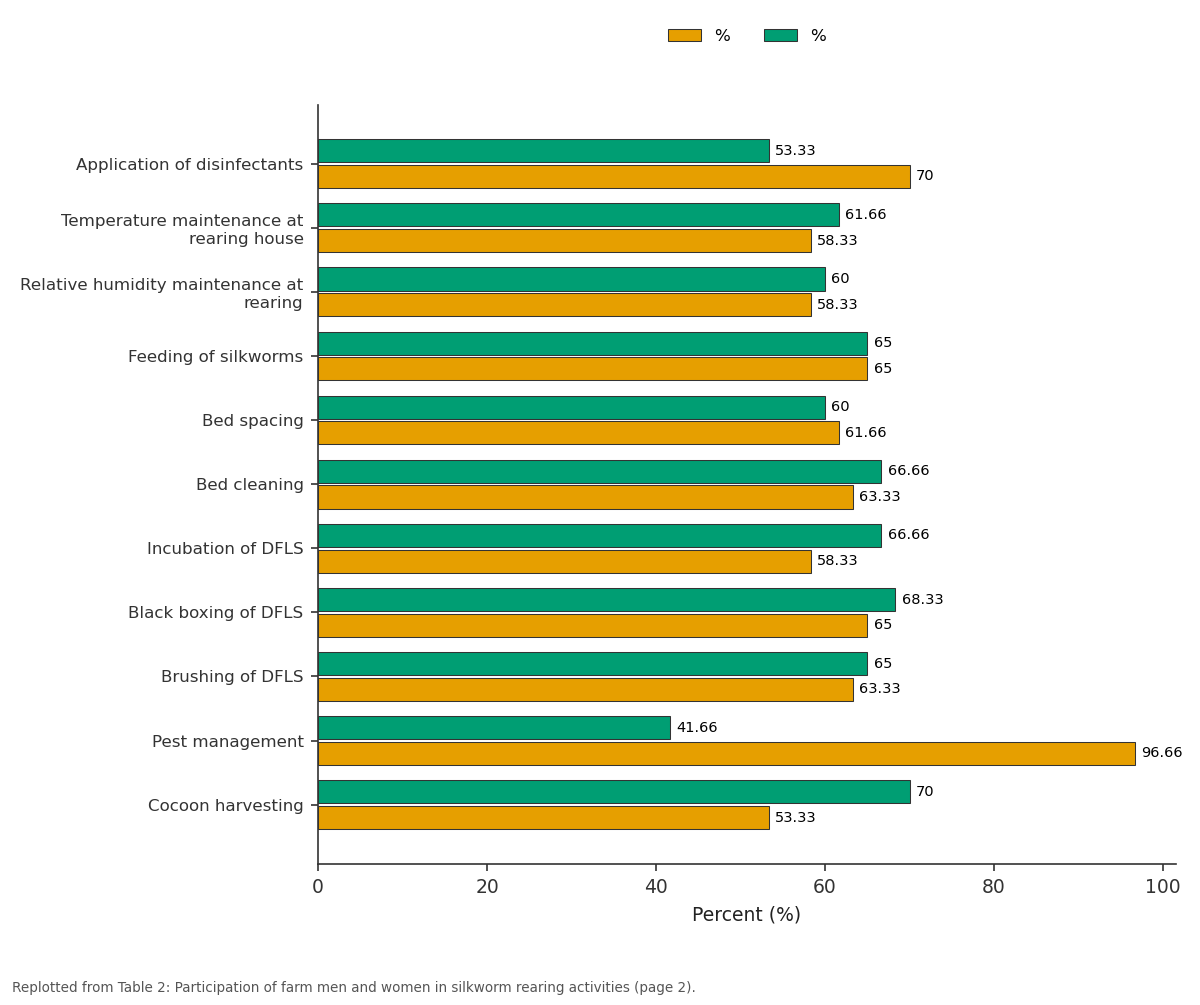
% and %: Application of... vs Temperature maintenance... vs Relative humidity... vs Feeding of silkworms vs Bed spacing
Replotted from Table 2 (page 2) of the original paper. Every bar is the paper's own table value.
View source evidence ↗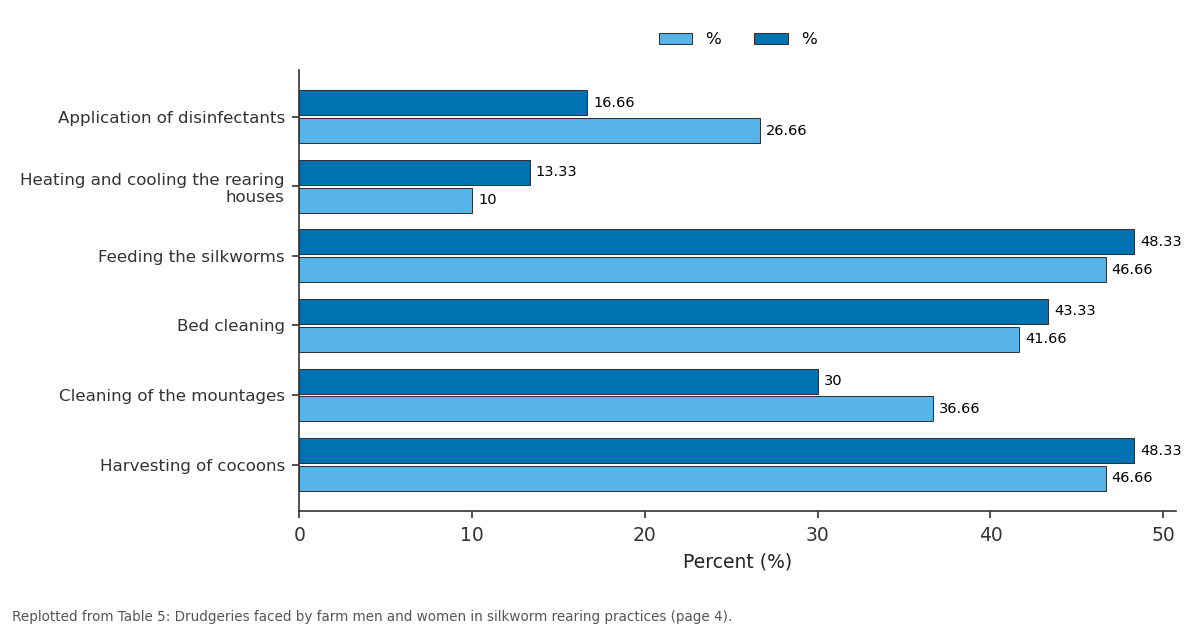
% and %: Application of... vs Heating and cooling the... vs Feeding the silkworms vs Bed cleaning vs Cleaning of the...
Replotted from Table 5 (page 4) of the original paper. Every bar is the paper's own table value.
View source evidence ↗Figures & tables
From the original paper Table 1
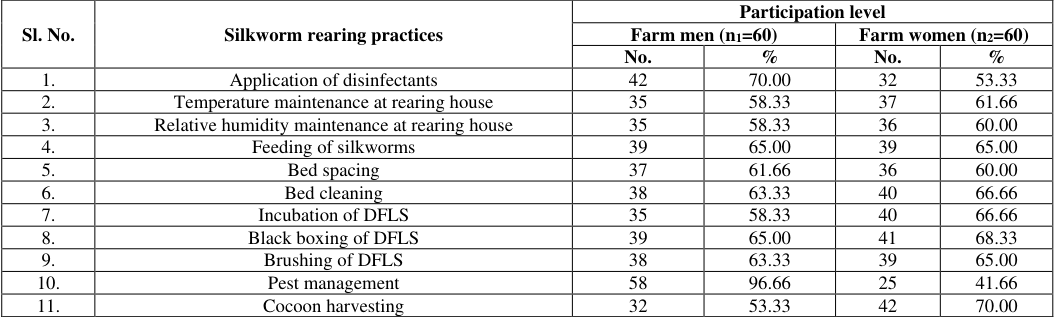 Table 2
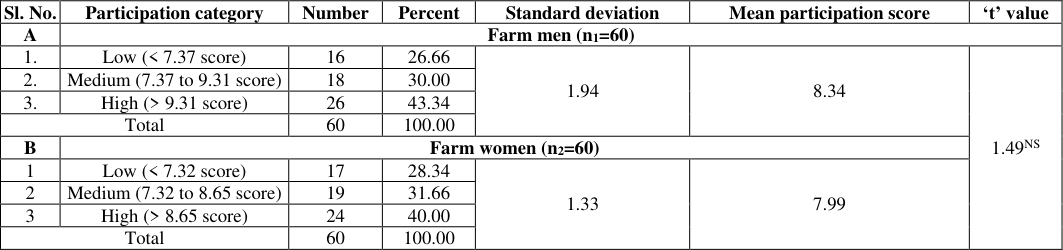 Table 3
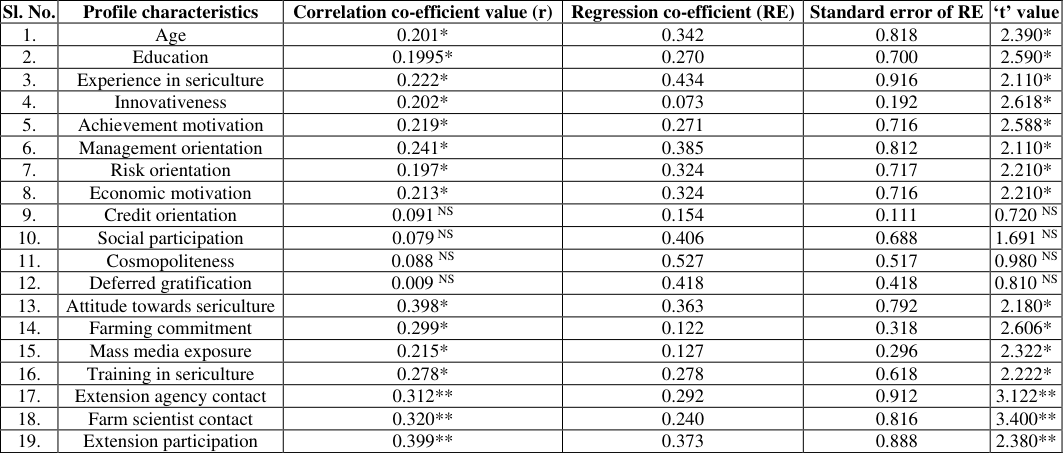 Table 4
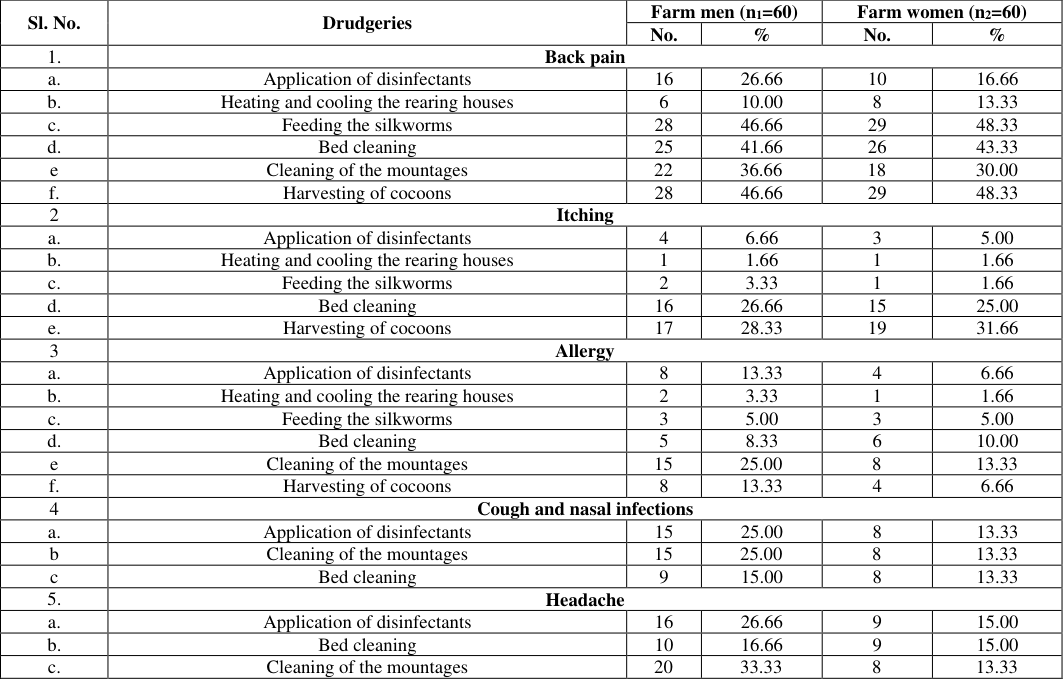 Table 5
Introduction
Sericulture is an agro-based cottage industry and it is the meeting point of art and science. Silk production is a livelihood opportunity for millions of people. It is one of the labour intensive and low capital intensive cottage industries with high output. India is the only country of the world which produces all the four major varieties of silks viz. mulberry, eri, muga and tasar. The country is the second largest producer of silk in the world. Sericulture plays an important role in the upliftment of socio-economic development of a largely agrarian economy like India. Sericulture is a women friendly economic activity in rural India. Women participate in a variety of sericulture activities and performing their tasks most skillfully. It offers an opportunities for women to participate directly in the production process and decision-making for bettering their economic circumstances and to elevate their status within the family and community. Due to their unique work ethic, women are generally favoured in sericulture. They work on a grainage, a silkworm farm, or a mulberry garden. Their role in post-cocoon technologies, starting with the silk reeling, weaving, and clothing manufacturing industries, is larger. According to recent studies, 10 million people rear silkworms; half a million people work in the silk industry; and Asia is the world's top silk-producing continent, accounting for 95% of the world's total output. Fifty-eight countries produce silk, with China, India, Japan, Brazil, and Korea among the top producers. For every Kilogram me of raw silk produced, sericulture can also create up to six jobs to women out of 11 new jobs. The sericulture business employs about eight million people in semi-urban and rural areas in India. A sizable portion of these employees are drawn from the economically underprivileged groups of society, including women. Sericulture is a profession performed by and for women because women perform more than 60% of the labour and consume 80% of the silk. In this backdrop, the present study was carried out with the following specific objectives: 1. To analyse the extent of participation of farm men and women in sericulture activities 2. To understand the relationship and extent of contribution of profile characteristics of farm men and www.extensionjournal.com
women on their participation level 3. To document the drudgeries faced by farm men and farm women in silkworm rearing activities
Materials and Methods
The study was conducted in Ramanagara district of Karnataka State during 2021-22. Ramanagara is a wellknown as Silk City and Sericulture is one of the main occupation in the district. In Karnataka, Ramanagara district stands third position in the cocoon production in terms of mulberry area (18975 ha), cocoon production (19662 tons) and cocoon productivity (89 kg/100 DFLS) during 2020-21 next to Chikkaballapura and Kolar districts (Anonymous 2021a) [1] . During the year 2020-21, mulberry was grown in 9528, 3609, 2691 and 311 ha of Kanakapura, Channapatna, Ramanagara and Magadi taluks of Ramanagara district, respectively. The study was purposively conducted in Kanakapura (9525 ha) and Channapatna (3609 ha) taluks, since mulberry is grown in more areas among the four taluks of Ramanagara district (Anonymous, 2021b) [2] . Five villages were randomly selected for the study from each of the two sampled taluks. Small and marginal farmers rearing silkworms were interviewed for the study since farm women of small and marginal farmers are more involved in decision making and participation in sericulture activities.
From each village, six farm households practicing sericulture were randomly selected. Relevant data were collected from the head of the family and his spouse. Thus, the final sample constituted 120 respondents (60 farm men and 60 farm women) from ten villages of Kanakapura and Channapatna taluks of Ramanagara district. Expost-facto research design was adopted for conducting the study. This design was considered appropriate because the phenomenon has already occurred and the researcher does not have direct control over independent variables. Dependent and Independent variables of the study Extent of participation (dependent variable) is defined as 'the degree to which the farm men and women have participated in various sericulture activities. It was measured using the procedure followed by Rajula Shanthy (2010) [6] with slight modification. A list of 11 silkworm rearing activities were presented to the respondents to know their extent of participation. To analyze the extent of participation of the participants a score of 0 and 1 were assigned for nonparticipation and participation in the sericulture activities, respectively. The minimum and maximum score one could get was 0 and 11, respectively. Based on the total score by the respondents on all the 11 silkworm rearing activities, they were categorized into low, medium and high level of participation considering mean and half standard deviation. Data regarding the 19 independent variables were collected from the respondents using a structured schedule with suitable scales/procedures. The collected data were analysed using frequency, percentage, mean, standard deviation, zero order correlation test, multiple regression analysis and student 't' test.
Results and Discussion
Results and Discussion
Participation of farm men and women in silkworm rearing activities
The results in Overall participation level of farm men and women in silkworm rearing activities: A greater proportion of farm men were having high level of participation (43.34%) in the silkworm activities, while 30.00 and 26.66% of the farm men were having medium and low level of participation, respectively. Similarly, 40.00% of the farm women were having high level of participation, followed by 31.66 and 28.34% of the farm women were having medium and low level of participation in recommended silkworm rearing practices/activities, respectively (Table 3). The 't' value (1.49) was found to be non-significant indicating that there is no significant difference in the mean participation score between the farm men (8.34) and women (7.99) in respect of the silkworm rearing practices activities.
| Sl. No. | Participation category | Number | Percent | Standard deviation | Mean participation score | ‘t’ value |
|---|---|---|---|---|---|---|
| A | Farm men (n1=60) | |||||
| 1. | Low (< 7.37 score) | 16 | 26.66 | 1.94 | 8.34 | 1.49NS |
| 2. | Medium (7.37 to 9.31 score) | 18 | 30.00 | |||
| 3. | High (> 9.31 score) | 26 | 43.34 | |||
| Total | 60 | 100.00 | ||||
| B | Farm women (n2=60) | |||||
| 1 | Low (< 7.32 score) | 17 | 28.34 | 1.33 | 7.99 | |
| 2 | Medium (7.32 to 8.65 score) | 19 | 31.66 | |||
| 3 | High (> 8.65 score) | 24 | 40.00 | |||
| Total | 60 | 100.00 |
Table text extracted from the original PDF; superscript letters are shown inline. The original table image is below.
View original table image
Relationship and extent of contribution of profile characteristics of farm men and women on the participation level in sericulture activities
Profile characteristics namely, credit orientation, social participation, cosmopoliteness and deferred gratification of farm men and women had no significant relationship with the participation in sericulture activities, whereas age, education, experience in sericulture, innovativeness, achievement motivation, management orientation, risk orientation, economic motivation, attitude towards sericulture, farming commitment, mass media exposure, training in sericulture, extension agency contact, farm scientist contact and extension participation of farm men women had significant to highly significant relationship with their participation in sericulture activities (Table 4). It is also observed from Table 4 that 15 profile characteristics of farm men and women (age, education, experience in sericulture, innovativeness, achievement motivation, management orientation, risk orientation, economic orientation, attitude towards sericulture, farming commitment, mass media exposure, training in sericulture, extension agency contact, farm scientist contact and extension participation) were significantly contributing to the increased participation in sericulture activities. All the 19 independent variables have contributed to the tune of 75.50% (R 2 = 0.755) in the participation of farm men and women in sericulture activities.
| Sl. No. | Profile characteristics | Correlation co-efficient value (r) | Regression co-efficient (RE) | Standard error of RE | ‘t’ value |
|---|---|---|---|---|---|
| 1. | Age | 0.201* | 0.342 | 0.818 | 2.390* |
| 2. | Education | 0.1995* | 0.270 | 0.700 | 2.590* |
| 3. | Experience in sericulture | 0.222* | 0.434 | 0.916 | 2.110* |
| 4. | Innovativeness | 0.202* | 0.073 | 0.192 | 2.618* |
| 5. | Achievement motivation | 0.219* | 0.271 | 0.716 | 2.588* |
| 6. | Management orientation | 0.241* | 0.385 | 0.812 | 2.110* |
| 7. | Risk orientation | 0.197* | 0.324 | 0.717 | 2.210* |
| 8. | Economic motivation | 0.213* | 0.324 | 0.716 | 2.210* |
| 9. | Credit orientation | 0.091 NS | 0.154 | 0.111 | 0.720 NS |
| 10. | Social participation | 0.079 NS | 0.406 | 0.688 | 1.691 NS |
| 11. | Cosmopoliteness | 0.088 NS | 0.527 | 0.517 | 0.980 NS |
| 12. | Deferred gratification | 0.009 NS | 0.418 | 0.418 | 0.810 NS |
| 13. | Attitude towards sericulture | 0.398* | 0.363 | 0.792 | 2.180* |
| 14. | Farming commitment | 0.299* | 0.122 | 0.318 | 2.606* |
| 15. | Mass media exposure | 0.215* | 0.127 | 0.296 | 2.322* |
| 16. | Training in sericulture | 0.278* | 0.278 | 0.618 | 2.222* |
| 17. | Extension agency contact | 0.312** | 0.292 | 0.912 | 3.122** |
| 18. | Farm scientist contact | 0.320** | 0.240 | 0.816 | 3.400** |
| 19. | Extension participation | 0.399** | 0.373 | 0.888 | 2.380** |
Table text extracted from the original PDF; superscript letters are shown inline. The original table image is below.
View original table image
Drudgeries faced by farm men and women in silkworm rearing
The results in Table 5 presents the data on findings related to the drudgeries faced by farm men and women in silkworm rearing activities. It is seen from the table 5 that less than half of the farm men and women experienced 'back ache' while applying disinfectants (26.66% and 16.66%), and performing operations such as, heating and cooling the rearing houses (10.00% and 13.33%), feeding the silkworms (46.66% and 48.33%), bed cleaning (41.66% and 43.33%), cleaning of mountages (36.66% and 30.00%) and harvesting of cocoons (46.66% and 48.33%), respectively. The findings revealed that less than one-third of the farm men and women experienced 'itching' while applying disinfectants (6.66% and 5.00%), performing operations like, heating and cooling the rearing houses (1.66% and 1.66%), feeding the silkworms (3.33% and 1.66%), bed cleaning (26.66% and 25.00%) and harvesting of cocoons (28.33% and 31.66%), respectively. Table 5 also reveals that less than one-fifth of the farm men and women experienced 'allergy' while applying disinfectants (13.33% and 6.66%) and performing operations like, heating and cooling the rearing houses (3.33% and 1.66%), feeding the silkworms (5.00% and 5.00%), bed cleaning (8.33% and 10.00%), cleaning of mountages (25.00% and 13.33%) and harvesting of cocoons (13.33% and 6.66%), respectively. It could also be observed from the Table 5 that less than one-fourth of the farm men and women perceived drudgery due to inhalation of disinfectant causing 'cough and nasal infestations' while applying disinfectants (25.00% and 13.33%), cleaning of mountages (25.00% and 13.33%) and performing bed cleaning (15.00% and 13.33%) activities. Over one-third of the farm men (26.66%) and 15.00% of the farm women experienced 'headache' while applying disinfectants, whereas 16.66% of the farm men and 15.00% of the farm women experienced 'headache' while carrying out bed cleaning practices and 33.00 and 13.33% of the farm men and women were experiencing 'headache' while cleaning the mountages, respectively. More or less similar findings were reported by Nishitha (2016) [5] , Malek et al., (2019) [4] and Biradar (2021) [3] .
| Sl. No. | Drudgeries | Farm men (n1=60) | — | Farm women (n2=60) | — |
|---|---|---|---|---|---|
| No. | % | No. | % | ||
| 1. | Back pain | ||||
| a. | Application of disinfectants | 16 | 26.66 | 10 | 16.66 |
| b. | Heating and cooling the rearing houses | 6 | 10.00 | 8 | 13.33 |
| c. | Feeding the silkworms | 28 | 46.66 | 29 | 48.33 |
| d. | Bed cleaning | 25 | 41.66 | 26 | 43.33 |
| e | Cleaning of the mountages | 22 | 36.66 | 18 | 30.00 |
| f. | Harvesting of cocoons | 28 | 46.66 | 29 | 48.33 |
| 2 | Itching | ||||
| a. | Application of disinfectants | 4 | 6.66 | 3 | 5.00 |
| b. | Heating and cooling the rearing houses | 1 | 1.66 | 1 | 1.66 |
| c. | Feeding the silkworms | 2 | 3.33 | 1 | 1.66 |
| d. | Bed cleaning | 16 | 26.66 | 15 | 25.00 |
| e. | Harvesting of cocoons | 17 | 28.33 | 19 | 31.66 |
| 3 | Allergy | ||||
| a. | Application of disinfectants | 8 | 13.33 | 4 | 6.66 |
| b. | Heating and cooling the rearing houses | 2 | 3.33 | 1 | 1.66 |
| c. | Feeding the silkworms | 3 | 5.00 | 3 | 5.00 |
| d. | Bed cleaning | 5 | 8.33 | 6 | 10.00 |
| e | Cleaning of the mountages | 15 | 25.00 | 8 | 13.33 |
| f. | Harvesting of cocoons | 8 | 13.33 | 4 | 6.66 |
| 4 | Cough and nasal infections | ||||
| a. | Application of disinfectants | 15 | 25.00 | 8 | 13.33 |
| b | Cleaning of the mountages | 15 | 25.00 | 8 | 13.33 |
| c | Bed cleaning | 9 | 15.00 | 8 | 13.33 |
| 5. | Headache | ||||
| a. | Application of disinfectants | 16 | 26.66 | 9 | 15.00 |
| b. | Bed cleaning | 10 | 16.66 | 9 | 15.00 |
| c. | Cleaning of the mountages | 20 | 33.33 | 8 | 13.33 |
Table text extracted from the original PDF; superscript letters are shown inline. The original table image is below.
View original table image
Conclusion
The findings revealed that a majority of the farm men and women were belonging to medium to high level of participation in sericulture activities. Adequate opportunities needs to be provided for both farm men and women to participate in the extension activities (discussion, demonstrations, meetings, training programmes, field days, farm schools, farmer field schools, exposure visit to progressive sericulturists farm, etc.) and frequent contacts with farm scientists and formal sericulture extension personnel (Demonstrator, Sericulture Officer and Assistant Director of Sericulture) will aid both in motivating by engaging themselves profitably in different sericulture activities.
The drudgery in silkworm rearing could be minimised by the use of hand gloves while mixing the disinfectants. Further, the use of face and eye masks will help in minimising drudgery during the application of disinfectants
Acknowledgement
www.extensionjournal.com and performing the operations like heating and cooling the rearing houses, feeding the silkworms, bed cleaning and harvesting the cocoons. The reduction in drudgery will lead to reduced fatigue and increase the participation of farm men and women in sericulture activities, however the extent of drudgery of the farm men and women in sericulture across the country vary widely with the nature of work, type of activity, their socio-economic status, local customs, size of family etc.
Figures and tables from the paper
| Participation categories | Criteria | Farm men (score) | Farm women (score) |
|---|---|---|---|
| Low | < (Mean – ½ SD) | < 7.37 | < 7.32 |
| Medium | (Mean + ½SD) | 7.37 – 9.31 | 7.32 – 8.65 |
| High | > (Mean + ½ SD) | > 9.31 | > 8.65 |
| Mean | 8.34 | 7.99 | |
| Standard deviation | 1.94 | 1.33 |
Table text extracted from the original PDF; superscript letters are shown inline. The original table image is below.
View original table image
| Sl. No. | Silkworm rearing practices | Participation level | — | — | — |
|---|---|---|---|---|---|
| Farm men (n1=60) | Farm women (n2=60) | ||||
| No. | % | No. | % | ||
| 1. | Application of disinfectants | 42 | 70.00 | 32 | 53.33 |
| 2. | Temperature maintenance at rearing house | 35 | 58.33 | 37 | 61.66 |
| 3. | Relative humidity maintenance at rearing house | 35 | 58.33 | 36 | 60.00 |
| 4. | Feeding of silkworms | 39 | 65.00 | 39 | 65.00 |
| 5. | Bed spacing | 37 | 61.66 | 36 | 60.00 |
| 6. | Bed cleaning | 38 | 63.33 | 40 | 66.66 |
| 7. | Incubation of DFLS | 35 | 58.33 | 40 | 66.66 |
| 8. | Black boxing of DFLS | 39 | 65.00 | 41 | 68.33 |
| 9. | Brushing of DFLS | 38 | 63.33 | 39 | 65.00 |
| 10. | Pest management | 58 | 96.66 | 25 | 41.66 |
| 11. | Cocoon harvesting | 32 | 53.33 | 42 | 70.00 |
Table text extracted from the original PDF; superscript letters are shown inline. The original table image is below.
View original table image
References
2 in the original paper- Biradar S. Perceived drudgery of farm women involved in agricultural activities. Indian Res J Extension Educ. 2002;12(1):103-106.
- Rajula Shanthy T. Gender perspectives for sustaining sugarcane based farming system. Indian Res J Extn Edn. 2010;10(1):112-116.