
Research article · 2024 · Full text
International Journal of Research in AgronomyProduction and productivity of mustard (Brassica juncea L.) intercropped in kabuli chickpea (Cicer kabulium L.) using land configuration
Volume 7(2) · Pages 420–424 · DOI: 10.33545/2618060x.2024.v7.i2f.332 ↗
Research areasAgronomic Practices and Intercropping SystemsAgricultural Science and FertilizationNitrogen and Sulfur Effects on Brassica
Abstract
Author-writtenThe investigation entitled “effect of intercropping of mustard (Brassica juncea l.) With kabuli chickpea (Cicer kabulium l.) Using land configuration on productivity and profitability” a research project was done at the organic research farm, Karguanji, institute of agricultural sciences, Bundelkhand University, Jhansi (u.p.) during rabi season 2019-20 and 2020-21. The experiment was laid out in a randomized complete block design with three replications with sowing methods using land configurations. The result revealed that, different land configuration significantly influenced growth parameters viz., plant height, dry weight of plant, yield attributes and yield of mustard and chickpea. The sowing of mustard and kabuli chickpea under furrow system and broad bed was identified to better method of intercropping compared to sole cropping of both as the growth parameters were slightly reduced but ultimately the yield equivalent term was apparently higher. Mustard grown in furrows + kabuli chickpea broad beds in ratio 1:3 under broad bed and furrow system gave higher yield and mustard equivalent yield, kabuli chickpea equivalent yield, land equivalent ratio LER. Thus, the broad bed and furrow system was identified to be most suitable sowing method for obtaining higher yield from mustard and kabuli chickpea intercropping under organic farming in Bundelkhand region of Uttar Pradesh.
Summary
Source-checkedPlain-language reading of the full paper, prepared with AI and checked against the text. Each point links to the authors' own words.
Why it matters
- Indian mustard is a major crop in India, occupying over 70% of the rapeseed-mustard land area with a total production of 8.0 million tonnes. View evidence ↗
- Chickpea is a significant edible legume in India, with a production of 5.1 million tonnes across 6.4 million hectares. View evidence ↗
- Intercropping is used in rainfed plains as an agronomic strategy to mitigate the risk of main crop failure. View evidence ↗
The question
- The study aimed to investigate how different land configurations for intercropping mustard and kabuli chickpea affect overall productivity and profitability. View evidence ↗
What they did
- The research was conducted at the organic research farm in Jhansi, Uttar Pradesh, during the rabi seasons of 2019-20 and 2020-21. View evidence ↗
- The experiment used a randomized block design with 10 different land configurations for mustard (cv. NRCHB101) and kabuli chickpea (Pusa 1053). View evidence ↗
- Mustard was sown at 4 kg/ha with 45 x 10 cm spacing, and kabuli chickpea was sown at 80 kg/ha with 30 x 10 cm spacing. View evidence ↗
- Researchers measured plant height, fresh weight, dry matter, and CGR at 30, 60, and 90 days after sowing, as well as final seed and stover yields. View evidence ↗
What they found
- The highest plant height for mustard was found in sole cropping (T1) and the SLBR intercropping system (T7) across all observation dates. View evidence ↗
- Mustard seed yield was highest in sole cropping (30.18 q/ha) and second-highest in the SLBR intercropping system (28.14 q/ha). View evidence ↗
- Intercropping reduced mustard yield, with the lowest reduction seen in T7 (6.75%) and the highest in T8 (43.63%) compared to sole cropping. View evidence ↗
- Kabuli chickpea grain yield was highest in sole cropping (22.89 q/ha) and second-highest in the BBF intercropping system (16.90 q/ha). View evidence ↗
- Intercropping reduced chickpea grain yield, with the smallest reduction in T8 (26.17%) and the largest in T7 (68.33%) in 2020. View evidence ↗
- The highest chickpea straw yield occurred in sole cropping (29.67 q/ha in 2019; 25.50 q/ha in 2020), followed by the BBF system (19.20 q/ha). View evidence ↗
What it means
- The authors conclude that the Broad Bed and Furrow (BBF) system, with mustard in furrows and three rows of chickpea on broad beds, is a superior intercropping method. View evidence ↗
- The BBF system is recommended as the most suitable sowing method for maximizing yields in organic mustard-chickpea intercropping in the Bundelkhand region. View evidence ↗
Visual summary
2 visualsIllustrations explain the paper; charts are replotted from the paper's own table values.
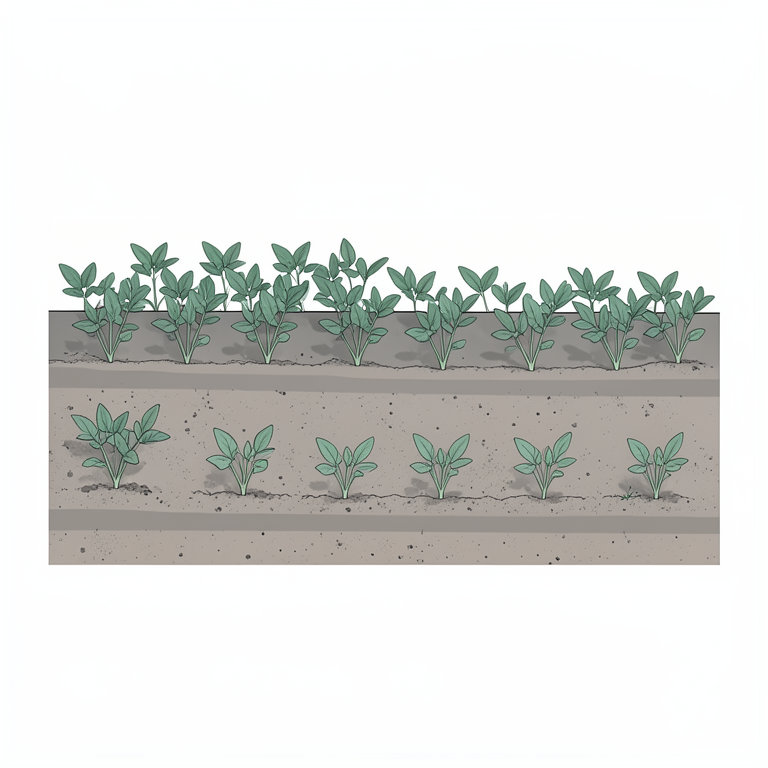
BBF Intercropping Layout
AI-generated conceptual illustration (Mustard (Brassica juncea) and Kabuli chickpea (Cicer kabulium) plants in a broad bed and furrow field system). It explains the idea and does not show study data.
View source evidence ↗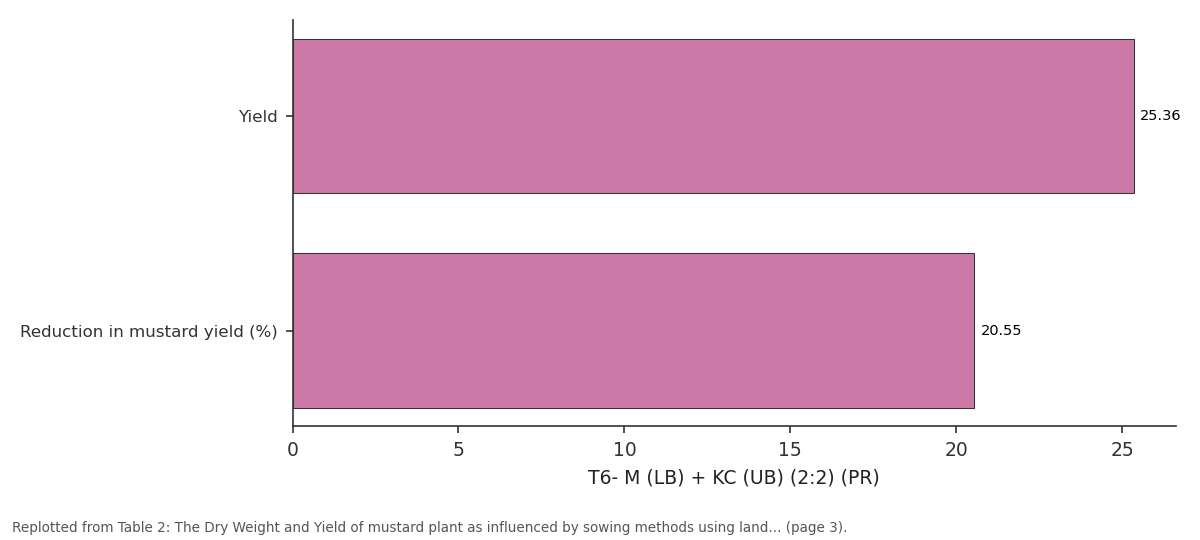
T6- M (LB) + KC (UB) (2:2) (PR): Yield vs Reduction in mustard...
Replotted from Table 2 (page 3) of the original paper. Every bar is the paper's own table value.
View source evidence ↗Figures & tables
From the original paper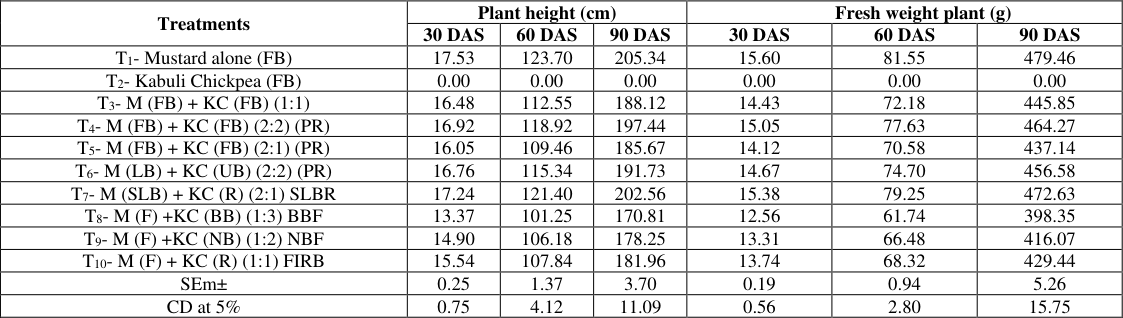 Table 1
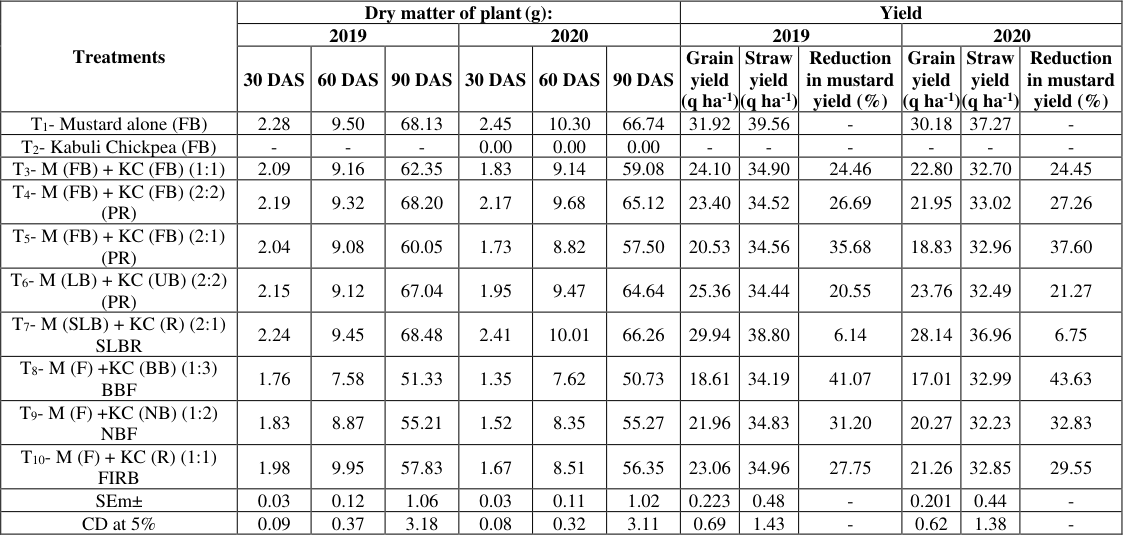 Table 2
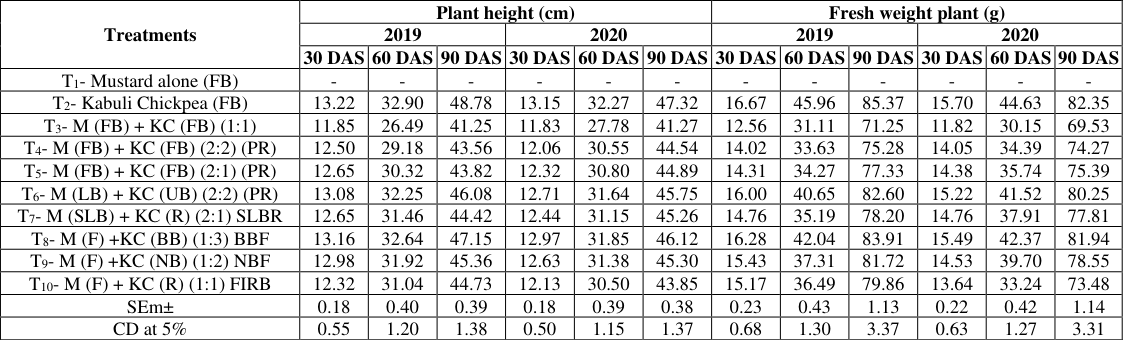 Table 3
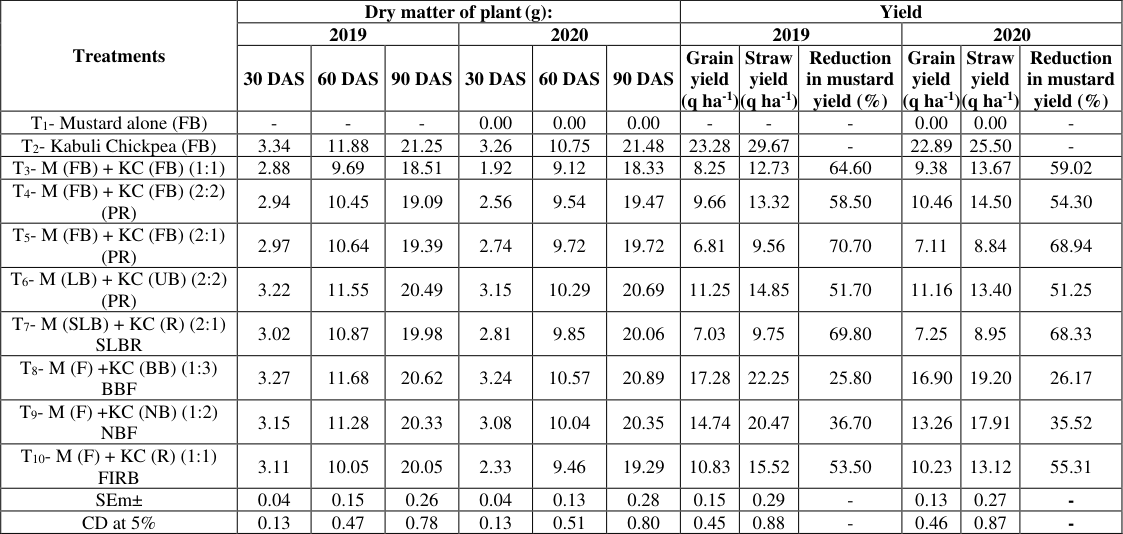 Table 4
Introduction
Indian mustard occupied more than 70% of the land used for the rapeseed-mustard crop group in India with a yield of 1188 kg/ha and an area harvested of 6.7 million hectares, India produced 8.0 million tonnes of rapeseed mustard. (Anonymous 2015) [2] . The third-largest edible legume produced worldwide, behind field pea and common bean, is chickpea. (Gaur et al., 2010) [7] . The chickpea crop has the highest area (6.4 mha), Production (5.1 m tonnes), and productivity (796 kg/ha). (Anonymous 2018) [3] . Increases in chickpea or mustard production are a key determinant of the system's profitability and sustainability since the system's low productivity is a critical problem. The limited research on nutrient-integrated chickpea/mustard intercropping indicate that the productivity of these crops will be increased and will remain high over time. (Kushwaha and De, 1987) [11] . In the vast rainfed plains of the nation, intercropping is one of the finest agronomical solutions to reduce risk and will serve as insurance against main crop failure. Because there is a lack of knowledge regarding the effects of integrated nutrient application in the chickpea-mustard intercropping system, the current study was conducted to determine whether using a combination of organic, inorganic, and biofertilizers under moisture-stress conditions could increase sustainable yield. In order to reduce soil erosion and increase the effectiveness of field crops' use of water, land management systems are crucial. Easy and uniform germination as well as growth and development of plant are provided by manipulation of sowing method. Land configuration increases water use efficiency as reported by (Deshmukh et al., 2014) [25] . Land configuration method includes the alteration of shape of seed bed and land surface. The growers of rapeseed, mustard, and other crops use a variety of sowing techniques to increase yields compared to flat beds or conventional sowing techniques. These techniques include broad bed and furrow sowing, furrow sowing, tied ridge sowing, ridge with mulches, alternate furrow sowing, and ridge sowing. Furrow planting offers better conditions for plant growth because it increases soil moisture, increases salt leaching, and decreases soil surface evaporation. (Zhang et. al., 2011; Singh et al. 2017) [24,19] . Modified land configurations, such as furrow irrigated raised bed (FIRB) has shown good promise in enhancing chickpea performance (Jat et. al. 2005; Ahlawat et. al., 2005) [8,1] . The limited studies are available on mustard + kabuli chickpea intercropping systems particularly under organic management.
Materials and Methods
A field experiment was carried out Organic Research Farm, Karguanji, Institute of Agricultural Sciences, Bundelkhand University, Jhansi (U.P.). to study "effect of intercropping of Mustard (Brassica juncea L.) with Kabuli Chickpea (Cicer kabulium L.) using land configuration on productivity and profitability'' during Rabi season of 2020-2021. The Jhansi district of Uttar Pradesh has a subtropical climate. Throughout the growth season, 123.8 mm of rainfall overall. 5.2 °C to 15.1 °C and 21.0 °C to 35.1 °C, respectively, were the weekly maximum and lowest temperatures for the course of the trial. The experimental plot's soil type was sandy clay loam with a low organic carbon content of 0.45%, low levels of accessible potassium (235 kg/ha), nitrogen (164 kg ha-1), and phosphorus (28.5 kg/ha), but high levels of the latter two. With an electrical conductivity of 0.26 dS/m, the soil reaction in the experimental field was almost neutral (pH 7.2). The experiment was laid out in a randomized block design, with two crops i.e. Mustard (cv. NRCHB101) and Chickpea (Pusa 1053) and 10 land configuration [T1: Mustard alone (FB) -(control I), T2: Kabuli Chickpea alone (FB) -(control II), T3: Mustard (FB) +Kabuli Chickpea (FB)(1:1), T4: Mustard (FB) + Kabuli Chickpea(FB)(2:2), T5: Mustard (FB) + Kabuli chickpea (FB)(2:1), T6: Mustard (LB) +Kabuli Chickpea (UB)(2:2) PR, T7: Mustard (SLB) + Kabuli Chickpea (R)(2:1) SLBR, T8: Mustard (F) +Kabuli Chickpea (BB)(1:3) BBF, T9: Mustard (F) +Kabuli Chickpea (NB)(1:2) NBF, T10: Mustard (F) + Kabuli Chickpea (R) (1:1) FIRB]. 10 rows, 38 meter long) 3.4 m x 3.4 m. Rhizobium culture were used to trat the seeds of chickpea and sown in well-prepared land by dibbling method with seed rates of 4 and 80 kg ha -1 for mustard and chickpea respectively A spacing of 45 × 10 cm for mustard and 30 × 10 cm for Kabuli Chickpea was adopted. Nitrogen, phosphorus and potassium (RBF) were applied in the ratio of 20:40:20 kg ha -1 as basal dose through the mixture of FYM, Vermicompost and Poultry manure 1/3 each. The crop was grown under rainfed condition with one pre-sowing irrigation was applied to the crop 7 days before sowing and only one lifesaving irrigation was applied. Weeding was done with the help of dryland weeder between the crop rows at 30 days and 45 days after sowing. Crops was Harvested manually with sickle and tied in bundles with tags from each plot and left for sun drying. Threshing operations were also performed treatment wise manually. The growth parameters, viz. plant height (cm), fresh weight/plant (g/plant), dry matter/plant (g/plant) and CGR at the 30, 60 and 90 DAS of both mustard and chickpea. Various yield parameter, viz. seed yield (kg/ha), Stover yield (kg/ha) and harvest index and equivalent yield at the time of harvesting of mustard and chickpea. The data on various parameters were statistically analysed by using CPCS-1 (Cochran and Cox, 1967) [6] .
Results and Discussion
Results and Discussion
The plant height was significantly influenced by all treatment combinations at 30, 60 and 90 DAS (Table 1). A perusal of the data showed that maximum plant height was recorded in T1 mustard alone (FB), at 30, 60 and 90 days after sowing which was at par with T7 mustard (SLB) + kabuli chickpea (R) (2:1) (SLBR) but significantly better than rest of the treatments in 2020. However, at 90 DAS, treatment T4 and T6 were also at par with T1 whereas treatment T4 was at par with T1. This might be due to better light interception and better moisture availability in shallow beds. The results are in conformity with those already reported by Singh et al. (2010) [18] and Yadav et al. (2010) [23] .
| Treatments | Plant height (cm) | — | — | Fresh weight plant (g) | — | — |
|---|---|---|---|---|---|---|
| 30 DAS | 60 DAS | 90 DAS | 30 DAS | 60 DAS | 90 DAS | |
| T1- Mustard alone (FB) | 17.53 | 123.70 | 205.34 | 15.60 | 81.55 | 479.46 |
| T2- Kabuli Chickpea (FB) | 0.00 | 0.00 | 0.00 | 0.00 | 0.00 | 0.00 |
| T3- M (FB) + KC (FB) (1:1) | 16.48 | 112.55 | 188.12 | 14.43 | 72.18 | 445.85 |
| T4- M (FB) + KC (FB) (2:2) (PR) | 16.92 | 118.92 | 197.44 | 15.05 | 77.63 | 464.27 |
| T5- M (FB) + KC (FB) (2:1) (PR) | 16.05 | 109.46 | 185.67 | 14.12 | 70.58 | 437.14 |
| T6- M (LB) + KC (UB) (2:2) (PR) | 16.76 | 115.34 | 191.73 | 14.67 | 74.70 | 456.58 |
| T7- M (SLB) + KC (R) (2:1) SLBR | 17.24 | 121.40 | 202.56 | 15.38 | 79.25 | 472.63 |
| T8- M (F) +KC (BB) (1:3) BBF | 13.37 | 101.25 | 170.81 | 12.56 | 61.74 | 398.35 |
| T9- M (F) +KC (NB) (1:2) NBF | 14.90 | 106.18 | 178.25 | 13.31 | 66.48 | 416.07 |
| T10- M (F) + KC (R) (1:1) FIRB | 15.54 | 107.84 | 181.96 | 13.74 | 68.32 | 429.44 |
| SEm± | 0.25 | 1.37 | 3.70 | 0.19 | 0.94 | 5.26 |
| CD at 5% | 0.75 | 4.12 | 11.09 | 0.56 | 2.80 | 15.75 |
Table text extracted from the original PDF; superscript letters are shown inline. The original table image is below.
View original table image
There was a gradual increase in fresh weight of plant with advancement in all the treatment combinations (Table 1). Significant differences with respect to fresh weight of plant of mustard were found at all the dates of observations. Maximum fresh weight of plant found in T1-mustard alone (FB), which was at par with T7-mustard (SLB) + kabuli chickpea (R) (2:1) (SLBR) but significantly higher than rest of the treatments. The same findings also reported by Yadav et al. (2010) [23] . 75 Note: M-Mustard, KC-Kabuli chickpea, FB-Flat beds system, PR-Paired row system SLBR-Shallow lower bed & Ridge system, BBF-Broad bed & Furrow, NBF-Narrow bed and Furrow system and FIRB-Furrow irrigated raised bed Dry matter of plant (g): Dry matter of plant significantly increased in the all the treatments combination at 30, 60 and 90 DAS (Table 2). The maximum dry matter of plant recorded with value T1 mustard alone (FB), which was at par with T7-mustard (SLB) + kabuli chickpea (R) (2:1) (SLBR) but significantly better than rest of the treatments. However, at 90 DAS treatment T4 and T6 were also at par with T1 respectively. Increase in dry matter might be due to better availability of space for efficient utilization of light, water and nutrients available to the individual plants, resulting in higher photosynthetic activity which increased leaf area and consequently result in higher dry matter production. The results are in conformity with those already reported by Punia et al. (1999) [14] , Khafi et al. (1997) [10] , and Yadav et al. (2010) [23] .
| Treatments | Dry matter of plant (g): | — | — | — | — | — | Yield | — | — | — | — | — |
|---|---|---|---|---|---|---|---|---|---|---|---|---|
| 2019 | 2020 | 2019 | 2020 | |||||||||
| 30 DAS | 60 DAS | 90 DAS | 30 DAS | 60 DAS | 90 DAS | Grain yield (q ha-1) | Straw yield (q ha-1) | Reduction in mustard yield (%) | Grain yield (q ha-1) | Straw yield (q ha-1) | Reduction in mustard yield (%) | |
| T1- Mustard alone (FB) | 2.28 | 9.50 | 68.13 | 2.45 | 10.30 | 66.74 | 31.92 | 39.56 | - | 30.18 | 37.27 | - |
| T2- Kabuli Chickpea (FB) | - | - | - | 0.00 | 0.00 | 0.00 | - | - | - | - | - | - |
| T3- M (FB) + KC (FB) (1:1) | 2.09 | 9.16 | 62.35 | 1.83 | 9.14 | 59.08 | 24.10 | 34.90 | 24.46 | 22.80 | 32.70 | 24.45 |
| T4- M (FB) + KC (FB) (2:2) (PR) | 2.19 | 9.32 | 68.20 | 2.17 | 9.68 | 65.12 | 23.40 | 34.52 | 26.69 | 21.95 | 33.02 | 27.26 |
| T5- M (FB) + KC (FB) (2:1) (PR) | 2.04 | 9.08 | 60.05 | 1.73 | 8.82 | 57.50 | 20.53 | 34.56 | 35.68 | 18.83 | 32.96 | 37.60 |
| T6- M (LB) + KC (UB) (2:2) (PR) | 2.15 | 9.12 | 67.04 | 1.95 | 9.47 | 64.64 | 25.36 | 34.44 | 20.55 | 23.76 | 32.49 | 21.27 |
| T7- M (SLB) + KC (R) (2:1) SLBR | 2.24 | 9.45 | 68.48 | 2.41 | 10.01 | 66.26 | 29.94 | 38.80 | 6.14 | 28.14 | 36.96 | 6.75 |
| T8- M (F) +KC (BB) (1:3) BBF | 1.76 | 7.58 | 51.33 | 1.35 | 7.62 | 50.73 | 18.61 | 34.19 | 41.07 | 17.01 | 32.99 | 43.63 |
| T9- M (F) +KC (NB) (1:2) NBF | 1.83 | 8.87 | 55.21 | 1.52 | 8.35 | 55.27 | 21.96 | 34.83 | 31.20 | 20.27 | 32.23 | 32.83 |
| T10- M (F) + KC (R) (1:1) FIRB | 1.98 | 9.95 | 57.83 | 1.67 | 8.51 | 56.35 | 23.06 | 34.96 | 27.75 | 21.26 | 32.85 | 29.55 |
| SEm± | 0.03 | 0.12 | 1.06 | 0.03 | 0.11 | 1.02 | 0.223 | 0.48 | - | 0.201 | 0.44 | - |
| CD at 5% | 0.09 | 0.37 | 3.18 | 0.08 | 0.32 | 3.11 | 0.69 | 1.43 | - | 0.62 | 1.38 | - |
Table text extracted from the original PDF; superscript letters are shown inline. The original table image is below.
View original table image
Yield of Mustard
Seed yield (q ha -1 ) It is evident from the data that all the treatments exerted significant variation on seed yield (Table 2). The maximum seed yield (30.18 q ha -1 was obtained with T1 mustard grown alone on (FB). The second-best treatment was found T7 mustard (SLB) + kabuli chickpea (R) (2:1) (SLBR) representing, yield of 28.14 q ha -1 . The percent reduction in mustard yield due to intercropping was maximum in treatment T8 (43.63%) while it was minimum yield reduction was found in treatment T7 (6.75%) when compared with sole cropping. Similar results also reported by Bultar et al. (2010) [5] , Singh et al. (2010) [18] and Lakshman et al. (2010) [12] . Who reported positive correlation between grain yield plant -1 with number of branches, leaves, leaf area, straw yield plant -1 and 1000 seed weight. -Note: M-Mustard, KC-Kabuli chickpea, FB-Flat beds system, PR-Paired row system, SLBR-Shallow lower bed & Ridge system, BBF-Broad bed & Furrow, NBF-Narrow bed and Furrow system and FIRB-Furrow irrigated raised bed Stover yield (q ha -1 ) An examination of data shows that stover yield (ha -1 ) of mustard significantly increased the maximum stover yield was found in T1 mustard alone (FB) (37.27 q ha -1 during 2020). The second best treatment was T7 mustard (SLB) + kabuli chickpea (R) (2:1) (SLBR) representing, (36.96 q ha -1 ). The same findings also reported by Singh et al. (1998) [20] .
The significantly higher plant height was found in T2 Kabuli chickpea alone (FB), which was at par with T8 mustard (F) + kabuli chickpea (BB) (1:3) (BBF), and T6 mustard (LB) + kabuli chickpea (UB) (2:2) (PR) but significantly better than rest of the treatments during (Table 3). However, at 90 DAS T2 was at par with T8 mustard (F) + kabuli chickpea (BB) (1:3) (BBF), but significantly better than rest of the treatments. It was mainly due to the fact that due to increased soil moisture, increased plant growth which influence plant height The similar findings also reported by Sher et al. (2006) [17] .
| Treatments | Plant height (cm) | — | — | — | — | — | Fresh weight plant (g) | — | — | — | — | — |
|---|---|---|---|---|---|---|---|---|---|---|---|---|
| 2019 | 2020 | 2019 | 2020 | |||||||||
| 30 DAS | 60 DAS | 90 DAS | 30 DAS | 60 DAS | 90 DAS | 30 DAS | 60 DAS | 90 DAS | 30 DAS | 60 DAS | 90 DAS | |
| T1- Mustard alone (FB) | - | - | - | - | - | - | - | - | - | - | - | - |
| T2- Kabuli Chickpea (FB) | 13.22 | 32.90 | 48.78 | 13.15 | 32.27 | 47.32 | 16.67 | 45.96 | 85.37 | 15.70 | 44.63 | 82.35 |
| T3- M (FB) + KC (FB) (1:1) | 11.85 | 26.49 | 41.25 | 11.83 | 27.78 | 41.27 | 12.56 | 31.11 | 71.25 | 11.82 | 30.15 | 69.53 |
| T4- M (FB) + KC (FB) (2:2) (PR) | 12.50 | 29.18 | 43.56 | 12.06 | 30.55 | 44.54 | 14.02 | 33.63 | 75.28 | 14.05 | 34.39 | 74.27 |
| T5- M (FB) + KC (FB) (2:1) (PR) | 12.65 | 30.32 | 43.82 | 12.32 | 30.80 | 44.89 | 14.31 | 34.27 | 77.33 | 14.38 | 35.74 | 75.39 |
| T6- M (LB) + KC (UB) (2:2) (PR) | 13.08 | 32.25 | 46.08 | 12.71 | 31.64 | 45.75 | 16.00 | 40.65 | 82.60 | 15.22 | 41.52 | 80.25 |
| T7- M (SLB) + KC (R) (2:1) SLBR | 12.65 | 31.46 | 44.42 | 12.44 | 31.15 | 45.26 | 14.76 | 35.19 | 78.20 | 14.76 | 37.91 | 77.81 |
| T8- M (F) +KC (BB) (1:3) BBF | 13.16 | 32.64 | 47.15 | 12.97 | 31.85 | 46.12 | 16.28 | 42.04 | 83.91 | 15.49 | 42.37 | 81.94 |
| T9- M (F) +KC (NB) (1:2) NBF | 12.98 | 31.92 | 45.36 | 12.63 | 31.38 | 45.30 | 15.43 | 37.31 | 81.72 | 14.53 | 39.70 | 78.55 |
| T10- M (F) + KC (R) (1:1) FIRB | 12.32 | 31.04 | 44.73 | 12.13 | 30.50 | 43.85 | 15.17 | 36.49 | 79.86 | 13.64 | 33.24 | 73.48 |
| SEm± | 0.18 | 0.40 | 0.39 | 0.18 | 0.39 | 0.38 | 0.23 | 0.43 | 1.13 | 0.22 | 0.42 | 1.14 |
| CD at 5% | 0.55 | 1.20 | 1.38 | 0.50 | 1.15 | 1.37 | 0.68 | 1.30 | 3.37 | 0.63 | 1.27 | 3.31 |
Table text extracted from the original PDF; superscript letters are shown inline. The original table image is below.
View original table image
The significantly higher fresh weight of plant (g) were recorded with in T2-Kabuli chickpea alone (FB), which was at par with T8 mustard (F) + kabuli chickpea (BB) (1:3) (BBF), and T6 at 30 DAS but significantly better than rest of the treatments. At 60 DAS, T2 was significantly better than rest of the treatments (Table 3). However, at 90 DAS, T8 and T6 was also at par with T2. The similar trends were also reported by Javiya et al. (1989) [9] , Singh et al. (2010) [18] and Thenua et al. (2010) [21] .
It is obvious from data that the significantly higher dry shoot weights of plant (g) were recorded with in T2 Kabuli chickpea alone (FB), which was at par with T8 mustard (F) + kabuli chickpea (BB) (1:3) (BBF), and T6 but significantly better than rest of the treatments throughout the research experiment (Table 4). The same findings also reported by Singh et al. (2010) [18] and Thenua et al. (2010) [21] .
| Treatments | Dry matter of plant (g): | — | — | — | — | — | Yield | — | — | — | — | — |
|---|---|---|---|---|---|---|---|---|---|---|---|---|
| 2019 | 2020 | 2019 | 2020 | |||||||||
| 30 DAS | 60 DAS | 90 DAS | 30 DAS | 60 DAS | 90 DAS | Grain yield (q ha-1) | Straw yield (q ha-1) | Reduction in mustard yield (%) | Grain yield (q ha-1) | Straw yield (q ha-1) | Reduction in mustard yield (%) | |
| T1- Mustard alone (FB) | - | - | - | 0.00 | 0.00 | 0.00 | - | - | - | 0.00 | 0.00 | - |
| T2- Kabuli Chickpea (FB) | 3.34 | 11.88 | 21.25 | 3.26 | 10.75 | 21.48 | 23.28 | 29.67 | - | 22.89 | 25.50 | - |
| T3- M (FB) + KC (FB) (1:1) | 2.88 | 9.69 | 18.51 | 1.92 | 9.12 | 18.33 | 8.25 | 12.73 | 64.60 | 9.38 | 13.67 | 59.02 |
| T4- M (FB) + KC (FB) (2:2) (PR) | 2.94 | 10.45 | 19.09 | 2.56 | 9.54 | 19.47 | 9.66 | 13.32 | 58.50 | 10.46 | 14.50 | 54.30 |
| T5- M (FB) + KC (FB) (2:1) (PR) | 2.97 | 10.64 | 19.39 | 2.74 | 9.72 | 19.72 | 6.81 | 9.56 | 70.70 | 7.11 | 8.84 | 68.94 |
| T6- M (LB) + KC (UB) (2:2) (PR) | 3.22 | 11.55 | 20.49 | 3.15 | 10.29 | 20.69 | 11.25 | 14.85 | 51.70 | 11.16 | 13.40 | 51.25 |
| T7- M (SLB) + KC (R) (2:1) SLBR | 3.02 | 10.87 | 19.98 | 2.81 | 9.85 | 20.06 | 7.03 | 9.75 | 69.80 | 7.25 | 8.95 | 68.33 |
| T8- M (F) +KC (BB) (1:3) BBF | 3.27 | 11.68 | 20.62 | 3.24 | 10.57 | 20.89 | 17.28 | 22.25 | 25.80 | 16.90 | 19.20 | 26.17 |
| T9- M (F) +KC (NB) (1:2) NBF | 3.15 | 11.28 | 20.33 | 3.08 | 10.04 | 20.35 | 14.74 | 20.47 | 36.70 | 13.26 | 17.91 | 35.52 |
| T10- M (F) + KC (R) (1:1) FIRB | 3.11 | 10.05 | 20.05 | 2.33 | 9.46 | 19.29 | 10.83 | 15.52 | 53.50 | 10.23 | 13.12 | 55.31 |
| SEm± | 0.04 | 0.15 | 0.26 | 0.04 | 0.13 | 0.28 | 0.15 | 0.29 | - | 0.13 | 0.27 | - |
| CD at 5% | 0.13 | 0.47 | 0.78 | 0.13 | 0.51 | 0.80 | 0.45 | 0.88 | - | 0.46 | 0.87 | - |
Table text extracted from the original PDF; superscript letters are shown inline. The original table image is below.
View original table image
Yield of Chickpea
Grain yield (q ha -1 ) The significantly higher grain yield (22.89 q ha -1 ) was recorded T2 Kabuli chickpea grown alone on (FB). The second-best treatment was T8 mustard (FB) + kabuli chickpea (BB) (1:3) when (BBF), given the yield of (16.90 q ha -1 ). The reduction in grain yield of chickpea (26.17%) is due to intercropping of mustard in treatment T8 which it was maximum (68.33%) in T7 during 2020 (Table 4). When compared with conventional sole cropping. Similar findings recorded by Saraf et al. (2010) [16] , Bahadur et al. (2002) [4] .
Straw Yield (q ha -1 ) All the treatments showed a significant increase in straw yield q ha -1 . The maximum straw yield (29.67 and 25.50 q ha -1 during 2019 and 2020 respectively) was recorded with T2 Kabuli chickpea grown alone (FB). The second-best treatment was found T8 mustard (F) + kabuli chickpea (BB) (1:3) (BBF), representing 19.20 q ha -1 straw yield (Table 4). Similar findings also reported by Saini and Faroda (1998) [15] and Bahadur et al. (2002) [4] .
Conclusion
The findings of this study indicate that mustard with chickpea successfully can be grown under organic management using land configurations. The sowing of mustard in furrow and 3 rows of kabuli chickpea on broad beds in furrow irrigated broad bed system (BBF) system was identified to better method of intercropping compared to sole cropping of both mustard and chickpea. The growth parameters of both mustard and chickpea were slightly reduced but ultimately the yield in equivalent term was apparently higher. The broad bed and furrow system was identified to be most suitable sowing method for obtaining higher yield from mustard and kabuli chickpea intercropping under organic farming in Bundelkhand region of Uttar Pradesh.
References
20 in the original paper- Ahlawat IPS, Gangaiah B, Singh O. Irrigation requirement in gram + Indian mustard intercropping system. Indian Council of Agricutural Research. 2005;75(1):23-26.
- Anonymous. Economic survey, 2014-15; c2015.
- Anonymous. Annual report 2017-2018. All India coordinated project on chickpea, IIPR, Kanpur; c2018. p. 114.
- Bahadur MM, Ashrofuzzamon M, Kabir MA, Chaudhary MF, Majumdar DAN. Response of chickpea varieties to phosphorus. Crop research Hisar. 2002;23(3):293-299.
- Jat RS, Ahlawat IPS. Effect of vermicompost, biofertilizer and phosphorus on growth, yield and nutrient uptake by gram and their residual effect on fodder maize (Zea mays). Indian Journal of Agricultural Sciences. 2005;74:359-361.
- Javiya JJ, Ahlawat IPS, Patel JC, Kanaria BB, Tank DA. Response of gram to irrigation under varying levels of nitrogen and phosphorus. Indian Journal of Agronomy. 1989;34(4):439-441.
- Khafi HR, Porwal BL, Mathukia RK, Malaviya DD. Effect of nitrogen, phosphorus and foliar application of agrochemical on Indian mustard. Indian Journal of Agronomy. 1997;42(1):152-154.
- Kushwaha R, De K. Intercropping of mustard with gram under different row ratios. Indian Journal of Agronomy. 1987;32(3):133-136.
- Li PH, Gan YT, Warkentin T, McDonald C. Morphological plasticity of chickpea in a semiarid environment. Crop Science. 2010;43:426-429.
- Punia SS, Singh BP, Kumar S. Production potential and returns of mustard intercropping system under rainfed condition of Haryana. Indian Journal of Agronomy. 1999;44(3):514-517.
- Saini SS, Faroda AS. Response of chickpea (Cicer arietinum) genotype 'H 86-143' to seed rates and fertility levels. Indian Journal of Agronomy. 1998;43(1):90-94.
- Singh S, Malik RK, Dhukia RS, Punia SS, Yadav A. Correlation and interaction studies in late sown chickpea (Cicer arietinum) under various irrigation, sulphur and seed inoculation levels. Environment and Ecology. 2006;245(S 3A):876-879.
- Singh AK, Singh SB, Singh AP, Singh AK, Mishra SK, Sharma AK, et al. Effect of different soil moisture regimes on biomass partitioning and yield of chickpea genotypes under intermediate zone of J & K. Journal of Food Legumes. 2010;23(2):156-158.
- Singh G, Ram Hari, Aggarwal N. Growth, Productivity and Economics of Kabuli Chickpea (Cicer arietinum L.) Genotypes in Response to Seed Rate in Northern India. International Journal of Current Microbiology and Applied Sciences. 2017;6(7):3917-3930.
- Singh M, Singh HB, Giri G. Quality, biometric and economics aspects of mustard and chickpea as influenced by intercropping and N and P fertilization. Annals of Agricultural Research. 1998;19(1):61-65.
- Thenua OVS, Singh SP, Shiv Kumar BG. Productivity and economics of chickpea (Cicer arietinum)-fodder sorghum (Sorghum bicolor) cropping system as influenced by P sources, bio-fertilizers and irrigation to chickpea. Indian Journal of Agronomy. 2010;55(1):22-27.
- Tomar RKS, Raghu JS. Response of chickpea to phosphorus and rhizobium inoculation under rainfed condition. Indian Journal of Pulses Research. 1994;7(1):3840.
- Yadav RP, Tripathi ML, Trivedi SK. Yield and quality of Indian mustard (Brassica juncea) as influenced by irrigation and nutrient levels. Indian Journal of Agronomy. 2010;55(1):56-59.
- Zhang H, Pala M, Oweis T, Harris H. Water use and water use efficiency of chickpea and lentil in a Mediterranean environment. Australian Journal of Agricultural Research. 2011;51:259-304.
- Deshmukh R, Sonah H, Patil G, Chen W, Prince S, Mutava R, et al. Integrating omic approaches for abiotic stress tolerance in soybean. Frontiers in Plant science. 2014 Jun 3(5):244.