
Research article · 2024 · Full text
International Journal of Agriculture Extension and Social DevelopmentMicrobial diversity of poultry house litters
Volume 7(2) · Pages 320–322 · DOI: 10.33545/26180723.2024.v7.i2e.340 ↗
Research areasAgricultural Systems and PracticesComposting and Vermicomposting Techniques
Abstract
Author-writtenMicrobial Diversity of poultry house litters was carried out in this study. Different samples of poultry litters (feather, dust and faeces) were collected from poultry house around Federal Polytechnic Nekede and transported to the laboratory for microbiological analysis. The analysis was carried out using ten-fold serial dilution. After which 0.1ml of the 10-2 dilution was inoculated onto sterile plates of Nutrient agar, MacConkey agar, Nutrient agar and Saboraud Dextrose agar standard culture media for enumeration of microorganisms. Total Viable Count of the poultry house litters ranged from 2x10³cfu/g to 2.0x10⁵cfu/g. The total fungal load ranged from 1.0x10³cfu/g to 4.0x10³cfu/g. The bacterial isolates obtained were Staphylococcus aureus, Escherichia coli, Bacillus spp. and Salmonella spp. while the possible fungi species obtained were Penicillium spp., Rhizopis spp., Alternaria spp., Sporotrichum spp. The isolation of these microorganisms is of public health significance since they can be transmitted to man directly through contact with poultry litter or indirectly through contaminated poultry products such as eggs or meat. Chicken droppings should be treated before being used as an organic fertilizer to reduce the microbial load and diversity and also prevent disease occurrences in consumers of these agricultural products. People who rear birds are advised to wash their hands thoroughly after contact with the chicken droppings before they touch foods to avoid infection.
Summary
Source-checkedPlain-language reading of the full paper, prepared with AI and checked against the text. Each point links to the authors' own words.
Why it matters
- Pathogenic microorganisms can persist in poultry waste, creating health and environmental risks for livestock. View evidence ↗
- While chicken droppings are used as organic manure, contaminated litter can threaten public health by contaminating agricultural products. View evidence ↗
- Microorganisms in poultry litter can be transmitted to humans either through direct contact or indirectly via contaminated meat and eggs. View evidence ↗
The question
- The study aimed to determine the microbial diversity found within poultry house litters. View evidence ↗
What they did
- Samples consisting of feathers, dust, and feces were collected from poultry houses near Federal Polytechnic Nekede for analysis. View evidence ↗
- To enumerate microorganisms, 0.1ml of the 10-2 dilution was inoculated onto Nutrient agar, MacConkey agar, and Saboraud Dextrose agar. View evidence ↗
- Bacteria were identified using Gram staining and biochemical tests, and fungi were characterized using lactophenol cotton blue staining. View evidence ↗
What they found
- The Total Viable Count (TVC) of the poultry house litters ranged from 2x10³ cfu/g to 2.0x10⁵ cfu/g. View evidence ↗
- The total fungal load in the samples ranged from 1.0x10³ cfu/g to 4.0x10³ cfu/g. View evidence ↗
- The study isolated several bacterial species, including Staphylococcus aureus, Escherichia coli, Bacillus spp., and Salmonella spp. View evidence ↗
What it means
- The authors concluded that poultry house litters contain pathogenic bacteria and fungi, which represents a public health concern. View evidence ↗
- The authors recommend treating chicken droppings before using them as organic fertilizer to reduce microbial load and prevent disease in consumers. View evidence ↗
- Bird rearers are advised to wash their hands thoroughly after contact with droppings to avoid food-borne infections. View evidence ↗
Visual summary
1 visualsIllustrations explain the paper; they do not show study data.
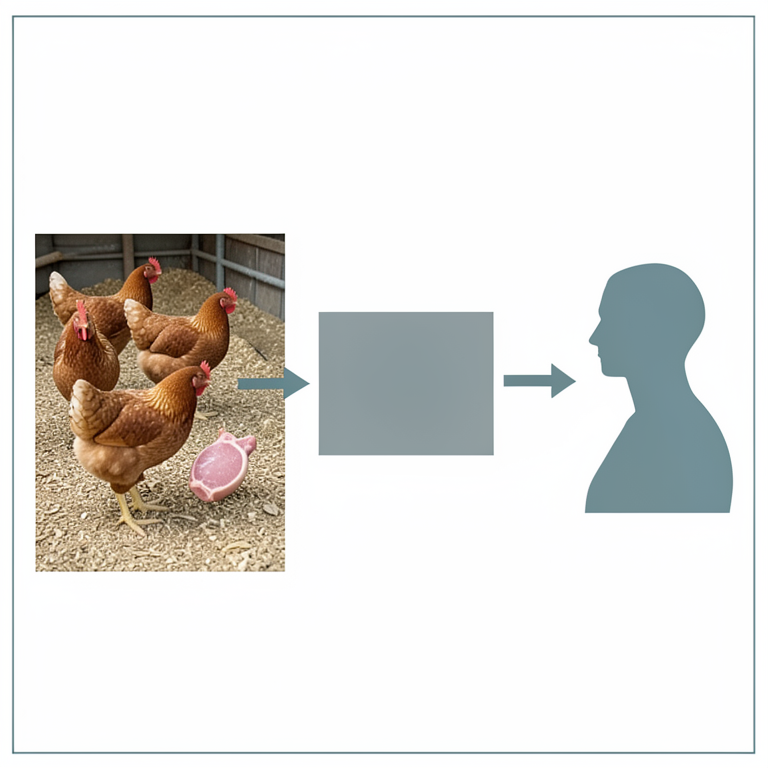
Transmission Pathway of Poultry Pathogens
AI-generated conceptual illustration (broiler chickens, poultry house litter, eggs, and raw meat). It explains the idea and does not show study data.
View source evidence ↗Figures & tables
From the original paper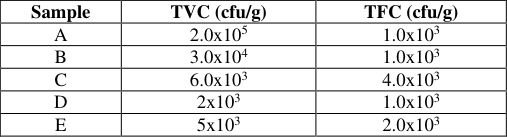 Table 1
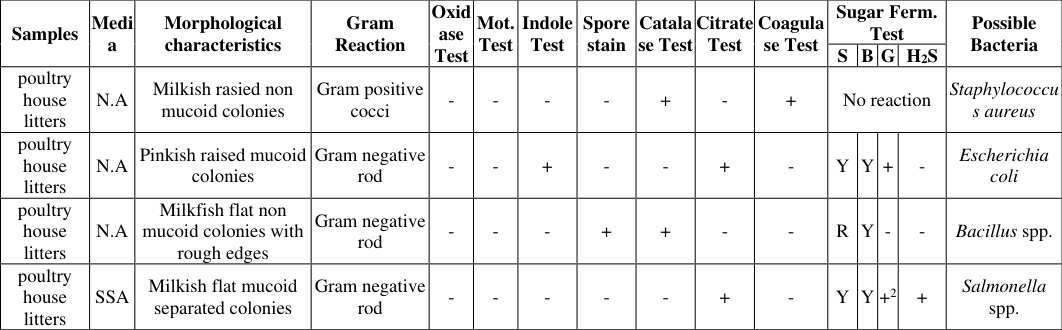 Table 2
 Table 3
Introduction 1.1 Background of study
When an animal eats, the food is digested and the remains of this food material is removed from its body inform of waste. Faeces from animals have a lower energy level compared to the original food which is eaten that contains up to 50% of the energy level, meaning that a significant amount of energy remains for the decomposers of ecosystems from food eaten (Bolan et al., 2010) [2] . Faeces serve as food and supplement to the usual diet of some animals. This is known as coprophagia and it occurs in different animal species such as young elephants eating the faeces of their mothers in order to gain essential gut flora. Frugivore is a term used to describe animals that eat fruits. Animals that eat fruit, disperse the seed through faeces without knowing and in doing so, seed dispersal successfully takes place, as seeds dispersed at the base of a plant has a low possibility of growing and often suffer predation. Once the seed can withstand the digestive system, it can be potentially dispersed away from the parent plant when excreted and obtains its own fertilizer at the same time. Pathogenic microorganisms can survive in poultry wastes. This leads environmental and health problems to livestock. The existence of these microorganisms which includes Escherichia coli, Staphylococcus and Bacillus species can cause various diseases in fowl. (Adegunioye, 2006) [1] . Contaminated drinking water sources by faeces of sick birds can be a source of transmission of diseases to bird flocks (Linda, 2016) [6] .
One of the most commonly isolated bacteria from chicken dropping is Salmonella. Salmonella which is a genus of rodshaped (bacillus) bacteria of the Enterobacteriaceae family. There are only two species of Salmonella, Salmonella bongori and Salmonella enterica, of which there are around six subspecies and innumerable serovars. The genus Escherichia, which includes the species E. coli belongs to the same family (Fabrega and Vila, 2013) [5] . Chicken dropping is a primary component of organic manure. However, the use of contaminated chicken dropping poses threat to public health because there is possibility of contamination of the agricultural products. Hence this work sought to isolate and characterize microorganisms from chicken droppings. There is need to determine the microbial load diversity of chicken droppings as this will be an indication of the possible public health implication of consuming contaminated products, Hence the aim of this study which determines the microbial diversity of poultry house litters.
Materials and Methods
Materials and Methods
Collection of samples
Different samples of poultry litters (feather, dust and faeces, etc) were collected from poultry house around Federal Polytechnic Nekede and taken to the laboratory for microbiological analysis.
Microbiological analysis of the samples
One gram (1g) of the samples was weighed and placed in nine millilitre (9 ml) of sterile water contained in a test tube www.extensionjournal.com and allowed to stand for about ten minutes to obtain a poultry litters; thereafter one millilitre (1 ml) of the solution was serially diluted using ten-fold serial dilution. After the serial dilution, 0.1ml of the 10 -2 dilution was inoculated onto sterile plates of Nutrient agar, MacConkey agar, Nutrient agar and Saboraud Dextrose agar standard culture media for enumeration of microorganisms. After inoculating the sterile media, they were incubated at 37 0 C for 24 hours for the bacteriological media and at 27 0 C for 48hours for the mycological media. After the incubation periods, the microorganisms enumerated on the culture plates were counted using the colony counter. The microbial isolates obtained were thereafter identified using cultural morphology. The bacterial isolates were further characterized using gram staining and biochemical tests while the fungal isolates were further characterised using lacto phenol cotton blue staining techniques.
Identification of Bacterial isolates
Typical colonies stored on nutrient agar and MacConkey agar slants at 4 ºC were Gram-stained (Cheesbrough, 2006) [3] . Cultural characteristics and biochemical tests such as Motility, Oxidase, Catalase, Coagulase, Indole, Sugar Production test, Citrate utilization test were carried out to further confirm the isolates.
Identification of Fungal Isolates
The fungal isolates were identified by morphological characteristics on Saboraund Dextrose Agar (SDA) and microscope examination after lactophonol cotton blue staining technique.
Results and Discussion
Results and Discussion
Results
The results of the microbial load of the poultry house litters is presented in Table 1.
| Sample | TVC (cfu/g) | TFC (cfu/g) |
|---|---|---|
| A | 2.0x10⁵ | 1.0x10³ |
| B | 3.0x10⁴ | 1.0x10³ |
| C | 6.0x10³ | 4.0x10³ |
| D | 2x10³ | 1.0x10³ |
| E | 5x10³ | 2.0x10³ |
Table text extracted from the original PDF; superscript letters are shown inline. The original table image is below.
View original table image
Discussion
The results of the Total Microbial load of the poultry house litters as presented in Table 1 showed that the Total Viable Count of the poultry house litters ranged from 2x10 3 cfu/g to 2.0x10 5 cfu/g. The total fungal load ranged from 1.0x10 3 cfu/g to 4.0x10 3 cfu/g. Lu et al. (2003) [7] reported the microbial composition of chicken dropping in the range of 10 9 cfu/g. Also reported microbial load of 10 10 cfu/g of poultry litter. However, the values obtained in this study were lower than those reported by the authors.
Conclusion and Recommendation 4.1 Conclusion
The outcome of this study has shown that poultry house litters contains pathogenic bacteria and fungi. The bacteria isolates were Staphylococcus aureus, Escherichia coli, Bacillus spp. and Salmonella spp. while the fungal species obtained were Penicillium spp., Rhizopus spp., Alternaria spp. and Sporotrichum spp. The isolation of these bacteria and fungi is of public health concern.
Recommendation
Chicken droppings should be treated before being used as an organic fertilizer to reduce the microbial load and diversity and also prevent disease occurrences in consumers of these agricultural products. People who rear birds should ensure that they wash their hands thoroughly after contact with the chicken droppings before they touch foods to avoid infection.
Acknowledgement
Conflict of interestThe authors declared that there is no conflict of interest regarding the publication of this manuscript.
Figures and tables from the paper
| Sample | Macroscopic appearance on SDA | Microscopic characteristics | Possible Fungi |
|---|---|---|---|
| poultry house litters | Whittish broom-like cottony colony with greenish centre | Septate hyphae with conidia bearing sterigmata | Penicillium spp. |
| poultry house litters | Whittish broom-like cottony colony | Non septate hyphae with terminal spore | Rhizopis spp. |
| poultry house litters | Front pink reverse black capitate cottony colonies | Branched conidia | Alternaria spp. |
| poultry house litters | Front cream reverse brown cerebriform and fluffy | Branched aseptate hyphae | Sporotrichum spp. |
Table text extracted from the original PDF; superscript letters are shown inline. The original table image is below.
View original table image
References
7 in the original paper- Adegunloye DV. Microorganisms Associated with Poultry Faeces. Journal of Food, Agriculture and Environment. 2006;4:41-42.
- Bolan NS, Szogi AA, Chuasavathi T, Seshadri B, Rothrock MJ, Panneerselvam P, et al. Uses and management of poultry litter. World's Poult Sci J. 2010;66:673-698.
- Cheesbrough M. District Laboratory Practice in Tropical countries (part 2, 2 nd edition). New York: Cambridge University Press. 2006;32:64-68.
- Fabrega A, Vila J. Salmonella enterica Serovar Typhimurium Skills to Succeed in the Host: Virulence and Regulation. Clin Microbiol Rev. 2013;26(2):308341.
- Linda CK, Kingsley RA, Connor TR, Harris SR, Parry CM, Al-Mashhadani MN, et al. Intracontinental spread of human invasive Salmonella typhimurium pathovariants in sub-Saharan Africa. Nature Genetics. 2016;44(11):1215-1221.
- Lu C, Toepel K, Irish R, Fenske RA, Barr DB, Bravo R, et al. Organic diets significantly lower children's dietary exposure to organophosphorus pesticides. Environ Health Perspect. 2003;114:260-263. DOI: 10.1289/ehp.8418.
- Winfield M, Groisman E. Role of Nonhost Environments in the Lifestyles of Salmonella and Escherichia coli. Appl Environ Microbiol. 2003;69(7):3687-3694.