
Research article · 2024 · Full text
International Journal of Advanced Biochemistry ResearchPopulation dynamics of Jassid on mungbean (Vigna radiata (L.) Wilczek) throughout the summer of 2018
Volume 8(2S) · Pages 501–503 · DOI: 10.33545/26174693.2024.v8.i2sg.617 ↗
Research areasAgricultural pest management studiesGenetic and Environmental Crop StudiesBotanical Research and Chemistry
Abstract
Author-writtenThe investigation was conducted at the Research Farm of Birsa Agricultural University in Kanke, Ranchi during the summer of 2018. The population of jassids began in the 5th week after sowing, specifically during the 16th standard meteorological week of April 2018. It increased steadily each week, peaking at the 10th week after sowing with 3.0 jassids per cage. This peak coincided with maximum temperatures (39.0 °C), minimum temperatures (22.7 °C), maximum relative humidity (85.6%), minimum relative humidity (45.0%), and rainfall (4.3mm). Subsequently, the Jassid population gradually declined and became negligible by the time of harvest. Correlation coefficient analysis indicated a positive and significant correlation with maximum and minimum temperatures, while relative humidity and rainfall did not show significant correlations.
Summary
Source-checkedPlain-language reading of the full paper, prepared with AI and checked against the text. Each point links to the authors' own words.
Why it matters
- Mungbean is the third most important pulse crop in India, following chickpea and pigeon pea. View evidence ↗
- Mungbeans are valuable for agriculture because they improve soil fertility through atmospheric nitrogen fixation. View evidence ↗
- Despite leading global pulse production, India's average productivity is hindered by abiotic and biotic factors. View evidence ↗
The question
- The study aimed to examine how climatic variables, specifically temperature, rainfall, and relative humidity, affect jassid infestation in mungbean crops. View evidence ↗
What they did
- The research was conducted as an experimental plot study during the summer of 2018 at Birsa Agricultural University in Ranchi, Jharkhand. View evidence ↗
- Mungbean genotype SML 668 was planted in 10 x 10 m plots in March, using a spacing of 30 cm between rows and 10 cm between plants. View evidence ↗
- The experiment utilized a randomized block design and was replicated three times. View evidence ↗
- Jassid populations were counted weekly using the split cage (Kooner cage) method and then correlated with weather data. View evidence ↗
What they found
- Jassid populations first appeared in the field during the 16th standard meteorological week, which was the 5th week after sowing. View evidence ↗
- The population grew steadily, reaching a peak of 3.0 jassids per cage by the 10th week after sowing. View evidence ↗
- The population peak occurred when maximum temperature was 39.0 °C, minimum temperature was 22.7 °C, relative humidity ranged from 45.0% to 85.6%, and rainfall was 4.3 mm. View evidence ↗
- There was a significant positive correlation between the jassid population and both maximum temperature (r = 0.773) and minimum temperature (r = 0.813). View evidence ↗
- Rainfall and relative humidity did not show a significant correlation with the jassid population. View evidence ↗
What it means
- The authors concluded that jassid populations increase with temperature, whereas other weather variables do not influence their population. View evidence ↗
Visual summary
3 visualsIllustrations explain the paper; charts are replotted from the paper's own table values.
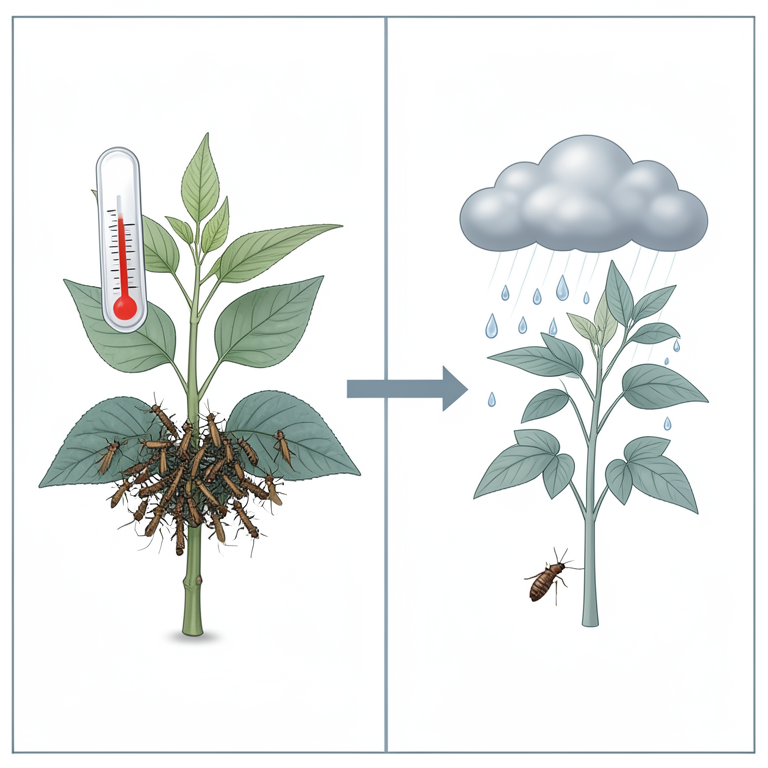
Influence of Weather on Jassids
AI-generated conceptual illustration (mungbean plants and jassid insects). It explains the idea and does not show study data.
View source evidence ↗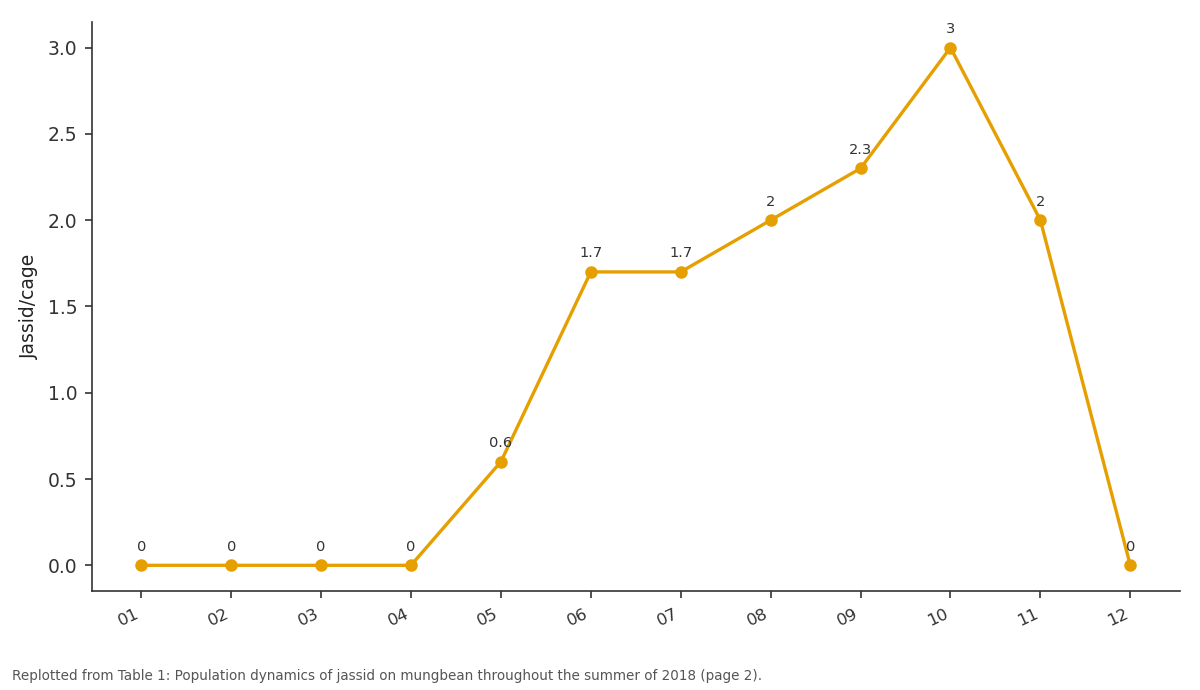
Jassid/cage: 01 vs 02 vs 03 vs 04 vs 05
Replotted from Table 1 (page 2) of the original paper. Every bar is the paper's own table value.
View source evidence ↗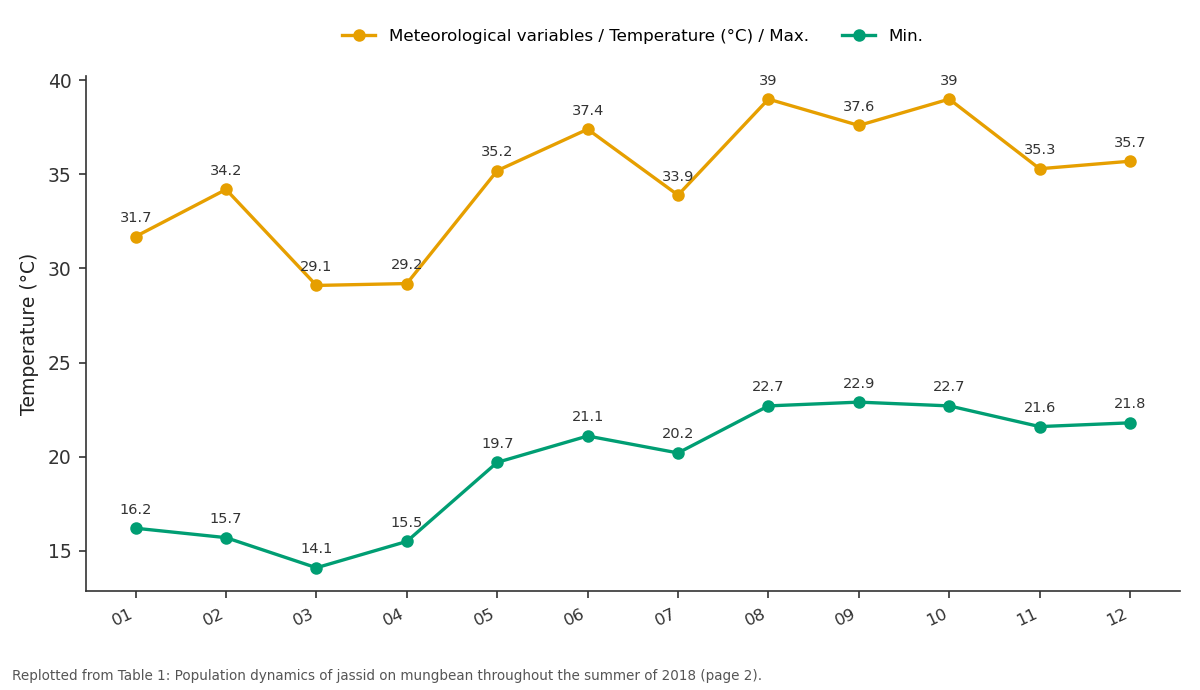
Meteorological variables / Temperature (°C)... and Min.: 01 vs 02 vs 03 vs 04 vs 05
Replotted from Table 1 (page 2) of the original paper. Every bar is the paper's own table value.
View source evidence ↗Figures & tables
From the original paper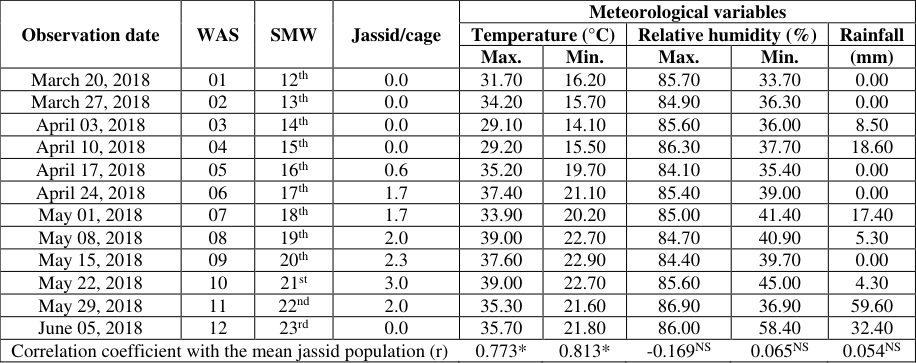 Table 1
Introduction
Green gram, or mungbean (Vigna radiata (L.) Wilczek), holds the distinction of being India's 3 rd most significant pulse or leguminous crop after chickpea and pigeon pea (Ved et al., 2008) [10] . Believed to originate from India and central Asia, mung bean cultivation traces back to prehistoric times in the Indian subcontinent. Referred to by various names such as mung, mungo, moong, green gram and golden gram (Chhabra and Kooner, 1998) [2] , this legume offers a nutritious blend of protein, fiber, and an array of vitamins and minerals. Notably, mung beans play a pivotal role in enhancing soil fertility by fixing atmospheric nitrogen (Hafeez et al., 1988) [3] . Following chickpea, mung bean is often considered a staple among lower-income groups due to its protein-rich nature, fulfilling a significant portion of their dietary protein requirements (Shafique et al., 2009) [8] . Mung beans are grown in many different nations, mostly in Asia's tropical and subtropical zones. Key mung bean-producing nations worldwide include India, Burma, China, the Philippines, Pakistan & Bangladesh. India leads the world in pulse production, however average productivity is still poor because of biotic and abiotic variables. This study is to examine the effects of climatic variables on jassid infestation and stability in mung bean crops, including rainfall (mm), temperature (°C), and relative humidity (%). As such, efforts have been undertaken to clarify the relationships between the dynamics of the jassid population and these abiotic variables, providing important information for formulating management plans to counteract them.
Materials and Methods
An experimental plot study was carried out during the summer crop season of 2018 at the research farm of Birsa Agricultural University, Kanke, Ranchi (Jharkhand), to look into the population dynamics of the Jassid, a significant insect pest of mung beans, in connection to abiotic factors. The test variety, mung beans of genotype SML 668, was planted in 10 × 10 m plots during the third week of March, with a 30 cm x 10 cm gap between rows and plants. All other agronomic operations were carried out in accordance with scientific recommendations, and the experiment was reproduced three times using a randomised block design (RBD). Weekly weather reports were gathered from the university's agro-meteorological observatory. Insecticide spraying was not applied to the crop during the cropping season; it was sowed on March 20 th , 2018. Weekly counts of the Jassid population were made using the split cage (Kooner cage) method, and the results were correlated with meteorological data. A wooden frame measuring 60 cm in height and 45 cm in diameter is used in the split cage (Kooner cage) method. It is coated in black cloth on all sides except the one where a rectangle glass pane measuring 28.5 cm by 58.5 cm is installed. The bottom of the cage is open. To facilitate observation, the cage is opened, encircling the crop plants, and the glass pane side is facing the sun. This allows jassids or whiteflies to gather on the glass, making it simple to count them (Kooner and Cheema, 2007) [5] . It was then determined what the Jassid mean population was.
Results and Discussion
An insect with a thin body that can feed on plant sap is equipped with sucking and piercing mouthparts. Both nymphs and adults exhibit sap-sucking behavior, injecting a toxin that leads to yellowing of leaves or the formation of yellow patches along the leaf margins. This is followed by vein distortion, leaf curling, and eventual burn-off (death) starting from the tips. These symptoms are referred to as hopper burn. The results on population dynamics of jassid showed that the population of jassid started before the flowering stage and continue till harvesting stage of mung bean crop. The number of jassid population varied from 0.6 to 3.0 per cage and was commenced in the field from 16 th standard meteorological week and continued up to 22 nd standard meteorological week. The 21 st standard meteorological week had the greatest number of jassid 3.0/cage, followed by 2.3, 2.0, and 2.0 in the 20th, 19th, and 22 nd standard meteorological weeks, in that order. The correlation coefficients between jassids and weather parameters are presented in the table. The data indicate that the jassid population exhibited a significant positive correlation with maximum temperature (r = 0.773*) and minimum temperature (r = 0.813*), influencing the population, while relative humidity and rainfall did not show any significant correlation with the jassid population. It can be concluded that the jassid population is highest with an increase in temperature (°C), while the other weather variables do not influence the population of jassid. These results were consistent with the findings of Mahmood et al. (2002) [7] . Jamshaid et al. (2010) [4] observed a significant and positive correlation between temperature and the jassid population, while the other weather factors were found to be ineffective on the jassid population. Bairwa and Singh (2017) [1] , along with Kumar et al. (2016) [6] , also reported that morning and evening relative humidity (R.H.) and rainfall had a non-significant correlation with the jassid population. When Singh and Yadav (2013) [9] looked at the seasonal abundance of pest insects on mung beans, they found that the average number of jassids per cage ranged from 0.4 to 5.8.
Conclusion
The abiotic variables that affected the variation in the jassid population infestation on mung beans were temperature (Temp. °C), relative humidity (RH %), and rainfall (mm). The average number of jassids per cage exhibited a substantial positive link with both maximum and minimum temperatures in correlation experiments, but no significant correlation was found with the other weather variables.
Acknowledgement
AcknowledgementThe author extends sincere gratitude to the Chairman of the Department of Agricultural Entomology at Birsa Agricultural University, Kanke, Ranchi, India, for invaluable assistance and support in the successful execution of the research.
Figures and tables from the paper
| Observation date | WAS | SMW | Jassid/cage | Meteorological variables | — | — | — | — |
|---|---|---|---|---|---|---|---|---|
| Temperature (°C) | Relative humidity (%) | Rainfall | ||||||
| Max. | Min. | Max. | Min. | (mm) | ||||
| March 20, 2018 | 01 | 12th | 0.0 | 31.70 | 16.20 | 85.70 | 33.70 | 0.00 |
| March 27, 2018 | 02 | 13th | 0.0 | 34.20 | 15.70 | 84.90 | 36.30 | 0.00 |
| April 03, 2018 | 03 | 14th | 0.0 | 29.10 | 14.10 | 85.60 | 36.00 | 8.50 |
| April 10, 2018 | 04 | 15th | 0.0 | 29.20 | 15.50 | 86.30 | 37.70 | 18.60 |
| April 17, 2018 | 05 | 16th | 0.6 | 35.20 | 19.70 | 84.10 | 35.40 | 0.00 |
| April 24, 2018 | 06 | 17th | 1.7 | 37.40 | 21.10 | 85.40 | 39.00 | 0.00 |
| May 01, 2018 | 07 | 18th | 1.7 | 33.90 | 20.20 | 85.00 | 41.40 | 17.40 |
| May 08, 2018 | 08 | 19th | 2.0 | 39.00 | 22.70 | 84.70 | 40.90 | 5.30 |
| May 15, 2018 | 09 | 20th | 2.3 | 37.60 | 22.90 | 84.40 | 39.70 | 0.00 |
| May 22, 2018 | 10 | 21st | 3.0 | 39.00 | 22.70 | 85.60 | 45.00 | 4.30 |
| May 29, 2018 | 11 | 22nd | 2.0 | 35.30 | 21.60 | 86.90 | 36.90 | 59.60 |
| June 05, 2018 | 12 | 23rd | 0.0 | 35.70 | 21.80 | 86.00 | 58.40 | 32.40 |
| Correlation coefficient with the mean jassid population (r) 0.773* 0.813* -0.169NS 0.065NS 0.054NS |
Table text extracted from the original PDF; superscript letters are shown inline. The original table image is below.
View original table image
References
10 in the original paper- Bairwa B, Singh PS. Population dynamics of major insect pests of green gram [Vigna radiata (L.) Wilczek] in relation to abiotic factors in genetic plains. The Bioscan-An International Quarterly Journal. 2017;12(3):1371-1373.
- Chhabra KS, Kooner BS. IPM system in agriculture Vol. 4, publ. Aditya Books Pvt. Ltd., New Delhi. 1998, p. 233-310.
- Hafeez FY, Aslam Z, Malik KA. Plant and Soil. 1988;106:3-8.
- Jamshaid I, Muhammad A, Mansoor H, Muhammad S, Muhammad N. Influence of abiotic factors on population fluctuation of Leafhooper, Amrasca biguttala (Ishida) on okra. Pak. J Zool. 2010;42(5):615621.
- Kooner BS, Harpreet Kaur Cheema. Screening of mung bean germplasm against whitefly, Bemisia tabaci and MYMV. Acta Hort. (ISHS). 2007;752:307-310 (Proceedings of 1 st International Conference on Indigenous Vegetables and Legumes, Dec 12-15, 2006 at ICRISAT, Patencheru).
- Kumar M, Singh PS. Population dynamics of major insect pest of black gram [Vigna mungo (L.) Hepper] in relation to weather parameters. International Journal of Agriculture Environment and Biotechnology. 2016;9(4):673-677.
- Mahmood T, Hussain SI, Khokar KM, Jeelani G, Ahmad M. Population dynamics of leaf hopper (Amrasca biguttula biguttula) on Brinjal and effect of abiotic factors on its dynamics. Asian J Plant Sci. 2002;4:403-404.
- Shafique M, Nadeem S, Hamed M, Atta BM, Shah TM. Pakistan Journal of Zoology. 2009;41:277-280.
- Singh PS, Yadav NK. Seasonal abundance of insect pests on mung bean and its correlation with abiotic factors. Journal of Entomological Research. 2013;37(4):297-299.
- Ved R, Massod A, Misra SK, Upadhyay RM. Studies on Sulphur, zinc and bio fertilizers on yield and yield attributes and nutrient content at different growth stages of mungbean. J Food Legumes. 2008;21(4):240-242.