
Research article · 2024 · Full text
International Journal of Advanced Biochemistry ResearchEffect of chemical pesticides on growth characteristics of Metarhizium anisopliae (Metschnikoff) Sorokin
Volume 8(2) · Pages 526–529 · DOI: 10.33545/26174693.2024.v8.i2g.609 ↗
Research areasNematode management and characterization studies
Abstract
Author-writtenThe outcomes on compatibility of different chemical pesticides with M. anisopliae clearly indicate that the highest mycelial growth (75.17 mm) was observed in flonicamid 50% WG followed by imidacloprid 17.8% SL (70.50 mm). The minimum (16.48 percent) growth inhibition of M. anisopliae was observed in pesticidal treatment with flonicamid 50% WG which indicates its better compatibility with M. anisopliae. Among chemical pesticides tested for their compatibility, the minimum percent growth inhibition was observed in flonicamid 50% WG (16.48 percent) followed by imidacloprid 17.8 SL (21.67 percent), deltamethrin 2.5% EC (26.30 percent) and chlorantraniliprole 18.5% SC (27.78 percent) indicating better compatibility with M. anisopliae than dimethoate 30% EC (69.07 percent), clothanidin 25% WG (54.81 percent) and difenthiuron 50% WP (51.30 percent) in which more than 50 percent growth inhibition was observed. Among fungicides, all the three fungicides propiconazole 25% EC (94.44 percent), difenoconazole 25% EC (77.22 percent) and copper oxychloride 50% WP (56.85 percent) indicating that they are not compatible with M. anisopliae.
Summary
Source-checkedPlain-language reading of the full paper, prepared with AI and checked against the text. Each point links to the authors' own words.
Why it matters
- Biological control agents in agricultural and horticultural ecosystems need protection from harmful pesticides to ensure their conservation. View evidence ↗
- Combining entomopathogenic fungi with compatible insecticides at sub-lethal doses can synergistically increase insect mortality. View evidence ↗
- Using compatible mixtures of fungi and insecticides is beneficial because it reduces the required insecticide dose, environmental pollution, and the risk of pest resistance. View evidence ↗
The question
- The study aimed to investigate the compatibility of the entomopathogenic fungus Metarhizium anisopliae with various botanical, biorational, and chemical pesticides. View evidence ↗
What they did
- The research was conducted between 2020 and 2021 at the Biocontrol laboratory of the Post Graduate Institute, MPKV, Rahuri. View evidence ↗
- The researchers used the standard poison food technique to evaluate how different pesticides affected M. anisopliae. View evidence ↗
- The laboratory experiment used a completely randomized design with 11 chemical pesticide treatments and 3 replications. View evidence ↗
- The radial mycelial growth of the fungus was measured and compared to an untreated control at 3, 5, and 7 days after inoculation. View evidence ↗
What they found
- Flonicamid 50% WG demonstrated the best compatibility with M. anisopliae, causing the lowest growth inhibition at 16.48%. View evidence ↗
- Imidacloprid 17.8% SL was the second most compatible pesticide, with a growth inhibition of 21.67%. View evidence ↗
- Propiconazole 25% EC was incompatible with M. anisopliae, resulting in no mycelial growth by day 7 and the highest growth inhibition at 94.44%. View evidence ↗
- All tested fungicides, propiconazole 25% EC (94.44%), difenoconazole 25% EC (77.22%), and copper oxychloride 50% WP (56.85%), were found to be incompatible with M. anisopliae. View evidence ↗
What it means
- The authors concluded that flonicamid 50% WG is highly compatible with M. anisopliae, followed by imidacloprid 17.8% SL. View evidence ↗
Visual summary
1 visualsIllustrations explain the paper; they do not show study data.
Pesticide Compatibility Spectrum
AI-generated conceptual illustration (Metarhizium anisopliae fungus). It explains the idea and does not show study data.
View source evidence ↗Figures & tables
From the original paper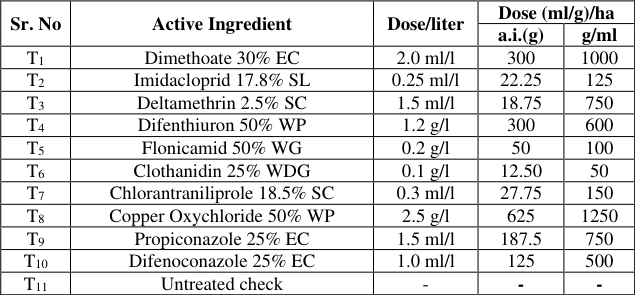 Table 1
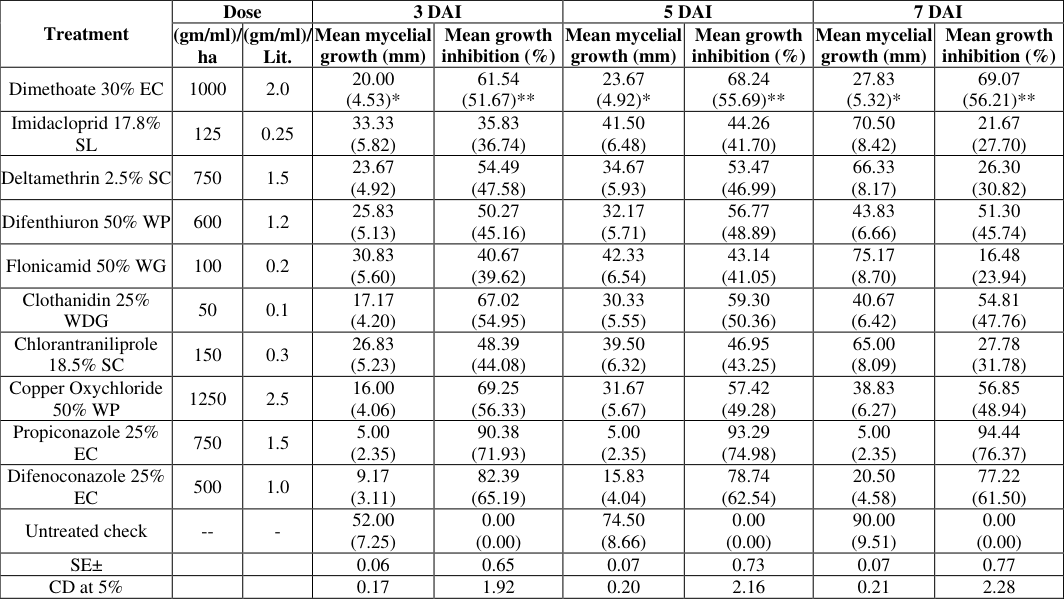 Table 2
Introduction
In order to conserve the ecofriendly biological microorganisms, biological control agents in nature, particularly within agricultural and horticultural ecosystems, must be protected from a wide range of harmful pesticides. As a result, determining their compatibility and interaction with pesticides, which is a key component of IPM programmes, is critical. In vitro studies have shown that various pesticides have selective effect on entomofungal infections, according to several researchers (Alves, 1986; Silva et al., 1993) [2,13] . To increase insect mortality, a compatible admixture of insecticides at sub-lethal concentrations and entomopathogenic fungus can operate synergistically. This is especially advantageous since it lowers the insecticide application dose, reduces environmental contamination and lowers the risk of resistance. To provide safe and effective control of insect pests, several compatible insecticides with entomopathogenic fungi and other biocontrol agents are utilized in various combinations (Asi et al., 2010; Bitsadze et al., 2013) [3,4] . Insecticides have a negative impact on non-target predatory organisms in nature, including EPFs like B. bassiana and M. anisopliae, which are entomopathogenic fungi. However, there are interactions between insecticides and entomopathogens. Insecticides at low doses combined with an entomopathogenic fungus can work together to increase insect pest mortality. This combination is especially beneficial since it reduces the amount of insecticide used, reduces environmental contamination and reduces pest resistance (Abidin et al., 2017) [1] .
Materials and Methods
The investigation on compatibility of Metarhizium anisopliae with botanical, biorational and chemical pesticides were carried out in Biocontrol laboratory, Department of Agriculture Entomology, Post Graduate Institute, MPKV, Rahuri, during 2020-2021.
Quantity of pesticide required
The amount of toxicant (i.e. actual ingredient) in required quantity of PDA was calculated with the help of following formula,
Result and Discussion
At 3 rd day after inoculation, the data on the impact of chemical pesticides on mean mycelial growth and percent growth inhibition of M. anisopliae revealed that the untreated control had the maximum (52.00 mm) mycelial growth and was considerably superior to the other treatments. Among the various pesticides tested for their compatibility with M. anisopliae the highest (33.33 mm) mycelial growth was observed in imidacloprid 17.8% SL and was significantly superior over rest of the pesticides. The Data on effect of pesticides on mycelial growth and growth inhibition of M. anisopliae at 7 th day after inoculation revealed that the highest (90.00 mm) mean mycelial growth was observed in untreated check and was significantly superior over the rest of the pesticidal treatments. Among the various pesticides tested for their compatibility with M. anisopliae the highest (75.17 mm) mycelial growth was observed in flonicamid 50% WG followed by imidacloprid 17.8% SL (70.50 mm).The fungicide propiconazole 25% EC was not found compatible with M. anisopliae as no mycelial growth was observed even at 7 th day after inoculation and it shows maximum 94.44% growth inhibition of M. anisopliae. The minimum (16.48%) growth inhibition of M. anisopliae was observed in insecticidal treatment with flonicamid 50% WG and was significantly superior over rest of the pesticides which indicates its better compatibility with M. anisopliae. The next superior treatment in percent growth inhibition was imidacloprid 17.8% SL (21.67%). The results on compatibility of chemical pesticides with M. anisopliae clearly indicates that the pesticides having better compatibility with M. anisopliae as having maximum mean mycelial growth in descending order are flonicamid 50% WG > imidacloprid 17.8% SL > deltamethrin 2.5% SC > chlorantraniliprole 18.5% SC > difenthiuron 50% WP > clothanidin 25% WDG > copper oxychloride 50% WP > dimethoate 30% EC > difenoconazole 25% EC > propiconazole 25% EC at 7 th day after inoculation (Table 2). The results clearly indicates that among chemical pesticides the minimum percent growth inhibition was observed in flonicamid 50% WG (16.48%) followed by imidacloprid 17.8 SL (21.67%), deltamethrin 2.5% EC (26.30%) and chlorantraniliprole 18.5% SC (27.78%) indicating better compatibility with M. anisopliae then dimethoate 30% EC (69.07%), clothanidin 25% WG (54.81%) and difenthiuron 50% WP (51.30%) in which more than 50% growth inhibition was observed. Among fungicides, all the three fungicides propiconazole 25% EC (94.44%), difenoconazole 25% EC (77.22%) and copper oxychloride 50% WP (56.85%) indicating that they are not compatible with M. anisopliae (Table 2) The present finding on compatibility of M. anisopliae with chemical pesticides are in corroboration with Sain et al. (2019) [12] who studied compatibility with the EPF in comparison to other chemical pesticides such as imidacloprid, fipronil, profenophos and triazophos, M. anisopliae with insecticides such as spiromesifen, difenthiuron, buprofezin, pyriproxyfen, and flonicamid were more compatible with EPFs at half doses. The present finding of the vegetative growth rate of M. anisopliae are in agreement with Khan et al. (2012) [7] who reported that imidacloprid (0.005%) were highly safe and most compatible to these M. anisopliae. In present findings also imidacloprid had shown better compatibility with M. anisopliae. Niassy et al. (2012) [9] who studied the compatibility of the Metarhizium anisopliae (Metschnikoff) Sorokin isolate ICIPE 69, with insecticides, viz., thiamethoxam and imidacloprid. Results revealed that the insecticide imidacloprid was highly compatible with Metarhizium anisopliae are in confirmation with present findings. Filho et al. (2001) [5] who studied compatibility of entomopathogenic fungus, M. anisopliae with thiamethoxam and imidacloprid. Statistical analysis showed that the reproductive and vegetative growth of M. anisopliae was not affected by thiamethoxam and imidacloprid. In present findings also imidacloprid had shown better compatibility with Metarhizium anisopliae. In conformation with the findings of Joshi et al. (2018) [6] who studied that in-vitro toxicity of four fungicides, viz., mancozeb 75% WP, carbendazim 50% WP, propiconazole 25% EC and hexaconazole 5% EC at different concentration for their effect on growth, inhibitory or synergistic effects and spore germination of Beauveria bassiana and Metarhizium anisopliae by growing them on insecticides and fungicides treated media. Among all fungicides tested only mancozeb 75% WP proved safe up to some extent at lower concentrations (0.5 and 0.25%) to test fungi with average amount of spore germination, whereas carbendazim 50% WP, hexaconazole 5% EC and propiconazole 25% EC were completely inhibitory in its action at all the concentrations. In present findings all the three fungicides, viz., propiconazole 25% EC, difenoconazole 25% EC and copper oxychloride 50% WP completely inhibiting the mycelial growth of M. anisopliae revealing that they are not compatible with M. anisopliae. Present findings are in corroboration with Khan et al. (2012) [7] who mentioned that members of triazole group including tebuconazole, hexaconazole, propiconazole and difenoconazole were not compatible with B. bassiana and M. anisopliae and caused complete or strong vegetative growth inhibition and spore germination. Present finding are not in agreement with Reddy et al. (2018) [11] reported that difenoconazole and tricyclazole fungicides were less toxic to Metarhizium anisopliae. The concentration of difenoconazole showed a negative correlation with growth of M. anisopliae during 10 days of incubation. A significant negative correlation between the growth of M. anisopliae and concentration of tebuconazole had an effect after 10 days of incubation, but it was stronger at 100 and 1000 ppm than difenoconazole, tricyclazole, hexaconazole, propiconazole and myclobutanil. Propiconazole fungicide was less toxic to Metarhizium anisopliae but was highly toxic to Beauveria bassiana and Lecanicillium lecanii @ 1000 and 10,000 ppm treatments implying that triazole fungicides are ineffective against entomopathogenic fungi tested @ 1000 ppm and 10000 ppm. Rachappa et al. (2007) [10] who reported that imidacloprid and spinosad were found safe to the fungus by inhibiting only 11.10 and 5.10 percent growth, respectively. Dimethoate was found comparatively less detrimental (30.77 to 33.77% inhibition) to the fungal growth. In general, significantly lesser growth inhibition was noticed in deltamethrin (36.7%). Imidacloprid and spinosad can be mixed with the fungus to get enhanced In present finding, dimethoate 30% EC recorded 69.07% growth inhibition and imidacloprid 17.8% SL was found safe to the M. anisopliae. Present findings are not in agreement with Kotwal et al. (2012) [8] who observed that Metarhizium anisopliae and copper oxychloride found to be most compatible and recorded less percent growth inhibition 28.66, 33.00 and 23.00 percent at three different concentrations.
| Treatment | Dose | — | 3 DAI | — | 5 DAI | — | 7 DAI | — |
|---|---|---|---|---|---|---|---|---|
| (gm/ml)/ ha | (gm/ml)/ Lit. | Mean mycelial growth (mm) | Mean growth inhibition (%) | Mean mycelial growth (mm) | Mean growth inhibition (%) | Mean mycelial growth (mm) | Mean growth inhibition (%) | |
| Dimethoate 30% EC | 1000 | 2.0 | 20.00 (4.53)* | 61.54 (51.67)** | 23.67 (4.92)* | 68.24 (55.69)** | 27.83 (5.32)* | 69.07 (56.21)** |
| Imidacloprid 17.8% SL | 125 | 0.25 | 33.33 (5.82) | 35.83 (36.74) | 41.50 (6.48) | 44.26 (41.70) | 70.50 (8.42) | 21.67 (27.70) |
| Deltamethrin 2.5% SC | 750 | 1.5 | 23.67 (4.92) | 54.49 (47.58) | 34.67 (5.93) | 53.47 (46.99) | 66.33 (8.17) | 26.30 (30.82) |
| Difenthiuron 50% WP | 600 | 1.2 | 25.83 (5.13) | 50.27 (45.16) | 32.17 (5.71) | 56.77 (48.89) | 43.83 (6.66) | 51.30 (45.74) |
| Flonicamid 50% WG | 100 | 0.2 | 30.83 (5.60) | 40.67 (39.62) | 42.33 (6.54) | 43.14 (41.05) | 75.17 (8.70) | 16.48 (23.94) |
| Clothanidin 25% WDG | 50 | 0.1 | 17.17 (4.20) | 67.02 (54.95) | 30.33 (5.55) | 59.30 (50.36) | 40.67 (6.42) | 54.81 (47.76) |
| Chlorantraniliprole 18.5% SC | 150 | 0.3 | 26.83 (5.23) | 48.39 (44.08) | 39.50 (6.32) | 46.95 (43.25) | 65.00 (8.09) | 27.78 (31.78) |
| Copper Oxychloride 50% WP | 1250 | 2.5 | 16.00 (4.06) | 69.25 (56.33) | 31.67 (5.67) | 57.42 (49.28) | 38.83 (6.27) | 56.85 (48.94) |
| Propiconazole 25% EC | 750 | 1.5 | 5.00 (2.35) | 90.38 (71.93) | 5.00 (2.35) | 93.29 (74.98) | 5.00 (2.35) | 94.44 (76.37) |
| Difenoconazole 25% EC | 500 | 1.0 | 9.17 (3.11) | 82.39 (65.19) | 15.83 (4.04) | 78.74 (62.54) | 20.50 (4.58) | 77.22 (61.50) |
| Untreated check | -- | - | 52.00 (7.25) | 0.00 (0.00) | 74.50 (8.66) | 0.00 (0.00) | 90.00 (9.51) | 0.00 (0.00) |
| SE± | 0.06 | 0.65 | 0.07 | 0.73 | 0.07 | 0.77 | ||
| CD at 5% | 0.17 | 1.92 | 0.20 | 2.16 | 0.21 | 2.28 |
Table text extracted from the original PDF; superscript letters are shown inline. The original table image is below.
View original table image
Conclusion
Flonicamid 50% WG was found to be highly compatible with M. anisopliae followed by imidacloprid 17.8% SL.
Acknowledgement
I wish to express my deepest sense of gratitude and indebtedness to my research guide and chairperson of my Advisory Dr. G.B. Kabre, Professor, Department of Agricultural Entomology, College of Agriculture, Dhule, M.P.K.V., Rahuri, for his invaluable guidance, constant encouragement, scholarly suggestions, untiring enthusiasm, affectionate behaviour, useful discussion and peerless criticisms during the course of investigation and preparation of manuscript. His kindness and devotion left an indelible impression in my mind.
Figures and tables from the paper
| Sr. No | Active Ingredient | Dose/liter | Dose (ml/g)/ha | — |
|---|---|---|---|---|
| a.i.(g) | g/ml | |||
| T1 | Dimethoate 30% EC | 2.0 ml/l | 300 | 1000 |
| T2 | Imidacloprid 17.8% SL | 0.25 ml/l | 22.25 | 125 |
| T3 | Deltamethrin 2.5% SC | 1.5 ml/l | 18.75 | 750 |
| T4 | Difenthiuron 50% WP | 1.2 g/l | 300 | 600 |
| T5 | Flonicamid 50% WG | 0.2 g/l | 50 | 100 |
| T6 | Clothanidin 25% WDG | 0.1 g/l | 12.50 | 50 |
| T7 | Chlorantraniliprole 18.5% SC | 0.3 ml/l | 27.75 | 150 |
| T8 | Copper Oxychloride 50% WP | 2.5 g/l | 625 | 1250 |
| T9 | Propiconazole 25% EC | 1.5 ml/l | 187.5 | 750 |
| T10 | Difenoconazole 25% EC | 1.0 ml/l | 125 | 500 |
| T11 | Untreated check | - | - | - |
Table text extracted from the original PDF; superscript letters are shown inline. The original table image is below.
View original table image
References
12 in the original paper- Abidin AF, Ekowati N, Ratnaningtyas NI. Insecticide compatibility to the entomopathogenic fungi Beauveria bassiana and Metarhizium anisopliae. Scripta Biologica. 2017;4(4):273-279.
- Asi MR, Bashir MH, Afzal M, Ashfaq M, Sahi ST. Compatibility of entomopathogenic fungi, Metarhizium anisopliae and Paecilomyces fumosoroseus with selective insecticides. Pakistan Journal of Botany. 2010;42(6):4207-4214.
- Bitsadze N, Jaronski S, Khasdan V, Abashidze E, Abashidze M, Latchininsky A, et al. Joint action of Beauveria bassiana and the insect growth regulators diflubenzuron and novaluron, on the migratory locust, Locusta migratoria. Journal of Pesticide Science. 2013;86:293-300.
- Filho AB, Jose EM, Almeida, Lamas C. Effect of thiamethoxam on entomopathogenic microorganisms. Neotropical Entomology. 2001;30(3):437-447.
- Joshi M, Gaur N, Pandey R. Compatibility of entomopathogenic fungi Beauveria bassiana and Metarhizium anisopliae with selective pesticides. Journal of Entomology and Zoology Studies. 2018;6(4):867-872.
- Khan S, Bagwan NB, Fatima S, Iqbal MS. In vitro compatibility of two entomopathogenic fungi with selected insecticides, fungicides and plant growth regulators. Libyan Agriculture Research Centre Journal International. 2012;3(1):36-41.
- Kotwal S, Parate RL, Mane SS, Deshmukh VV. Effect of Metarhizium anisopliae on Spodoptera litura and compatibility with chemicals. International Journal of Science. Environment and Technology. 2012;1(5):499505.
- Niassy S, Maniania NK, Subramanian S, Gitonga ML, Maranga R, Obonyo AB, et al. Compatibility of Metarhizium anisopliae isolate ICIPE 69 with agrochemicals used in French bean production. International Journal of Pest Management. 2012;58(2):131-137.
- Rachappa V, Lingappa S, Patil RK. Effect of agrochemicals on growth and sporulation of Metarhizium anisopliae (Metschnikoff) Sorokin. Karnataka Journal of Agricultural Sciences. 2007;20(2):410-413.
- Reddy S, Reddy MLN, Pushpalatha M. Interaction of fungicides with bio-control agents. Journal of Entomology and Zoology Studies. 2018;6(4):545-551.
- Sain SK, Monga D, Kumar R, Nagrale DT, Hiremani NS, Kranthi S. Compatibility of entomopathogenic fungi with insecticides and their efficacy for IPM of Bemisia tabaci in cotton. Journal of Pesticide Science. 2019;44(2):97-105.
- Silva L, Silva RFP, Heineck MA. In vitro evaluation of the effect of different insecticides on the sporulation of fungus Nomuraea rileyi (Farlow) Samson. Annals of the Entomological Society of Brazil. 1993;22:99-103.