
Research article · 2024 · Full text
International Journal of Geography Geology and EnvironmentA geographical analysis of disparity levels in religious population in Khandesh region
Volume 6(1) · Pages 200–203 · DOI: 10.22271/27067483.2024.v6.i1c.222 ↗
Research areasIslamic Studies and History
Abstract
Author-writtenReligion in Khandesh is characterized by the diversity of religious beliefs and practices. Khandesh possesses six of the India’s major religions; namely Hindu, Islam, Buddhism, Jainism, Christianity, and Sikhism. According to the 2011 census, Hinduism has the principal religion in the Khandesh Region at Jalgaon (81.74%), Dhule (89.01%), and Nandurbar (92.31%). According to the 2011 census, Muslims Religion has the second number religion in the Jalgaon (13.25%), Dhule (9.16%), and Nandurbar (5.84%). According to the 2011 census, Christians Religion has low population the Jalgaon (3.4%), Dhule (0.65%), and Nandurbar (0.51%). According to the 2011 census, Jain Religion has low population the Jalgaon (0.49%), Dhule (0.26%), and Nandurbar (0.38%). According to the 2011 census, Jalgaon (0.23%), Dhule (0.18%) and Nandurbar (0.3%) have very small Buddhist populations. 2011 census, Sikh Religion has very low population the Jalgaon (0.07%), Dhule (0.04%), and Nandurbar (0.04%). The main point of the study of this research paper in Khandesh section is that some people have not stated their religion.
Summary
Source-checkedPlain-language reading of the full paper, prepared with AI and checked against the text. Each point links to the authors' own words.
Why it matters
- Religion is considered a primary attribute of cultural geography that significantly influences the social, cultural, and economic development of a population. View evidence ↗
- The spatial distribution of religious groups can impact social stability, where high concentrations in specific areas may lead to riots, while mixed communities can promote peace and harmony. View evidence ↗
- The Khandesh region is characterized by religious diversity, containing six of India's major religions: Hinduism, Islam, Buddhism, Jainism, Christianity, and Sikhism. View evidence ↗
The question
- The objective of this study was to analyze the disparities in the religious population across the Khandesh region. View evidence ↗
What they did
- The researchers used secondary data obtained from the 2011 Census of India. View evidence ↗
- The study area focused on three specific districts within the Khandesh region: Nandurbar, Dhule, and Jalgaon. View evidence ↗
- Data analysis involved processing, tabulation, and compilation, with results presented using cartographic methods. View evidence ↗
What they found
- Hinduism is the dominant religion in all three districts, with the highest percentage found in Nandurbar (92.31%), followed by Dhule (89.01%) and Jalgaon (81.74%). View evidence ↗
- Christian populations are significantly higher in Jalgaon (3.4%) compared to Dhule (0.65%) and Nandurbar (0.51%). View evidence ↗
- The Jain community has its highest concentration in Jalgaon (0.49%), with lower percentages in Nandurbar (0.38%) and Dhule (0.26%). View evidence ↗
- Buddhist populations are very small across the region, with the highest reported in Nandurbar (0.3%), followed by Jalgaon (0.23%) and Dhule (0.18%). View evidence ↗
- Sikh populations are very low, with a slightly higher concentration in Jalgaon (0.07%) than in Dhule (0.04%) or Nandurbar (0.04%). View evidence ↗
- A small portion of the population did not state their religion, with the highest percentage in Jalgaon (0.65%), followed by Dhule (0.63%) and Nandurbar (0.44%). View evidence ↗
What it means
- The authors conclude that Nandurbar has the highest percentage of Hindus (92.31%) and Jalgaon has the highest percentage of Muslims (13.25%) in the region. View evidence ↗
- The authors state that Jain, Sikh, and Christian populations represent a small share of the total religious population in the Khandesh region. View evidence ↗
Visual summary
3 visualsIllustrations explain the paper; charts are replotted from the paper's own table values.
Religious Distribution Comparison
AI-generated conceptual illustration (The Khandesh region of Maharashtra, India, featuring the districts of Nandurbar, Dhule, and Jalgaon). It explains the idea and does not show study data.
View source evidence ↗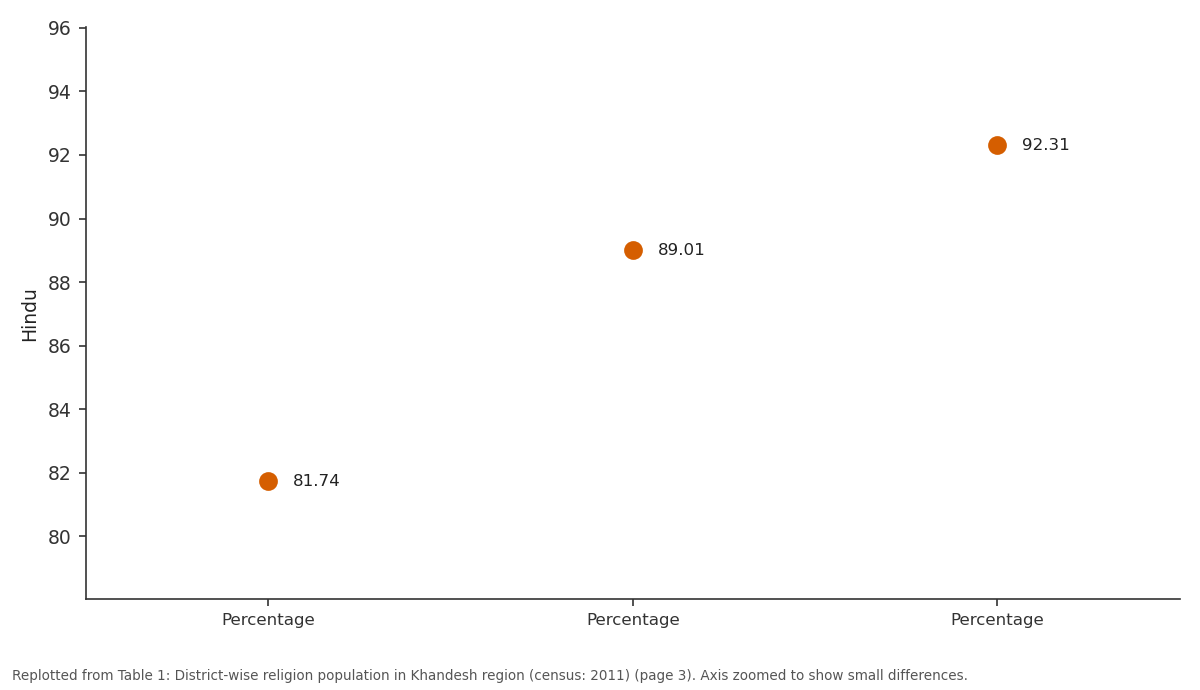
Hindu: Percentage vs Percentage vs Percentage
Replotted from Table 1 (page 3) of the original paper. Every bar is the paper's own table value.
View source evidence ↗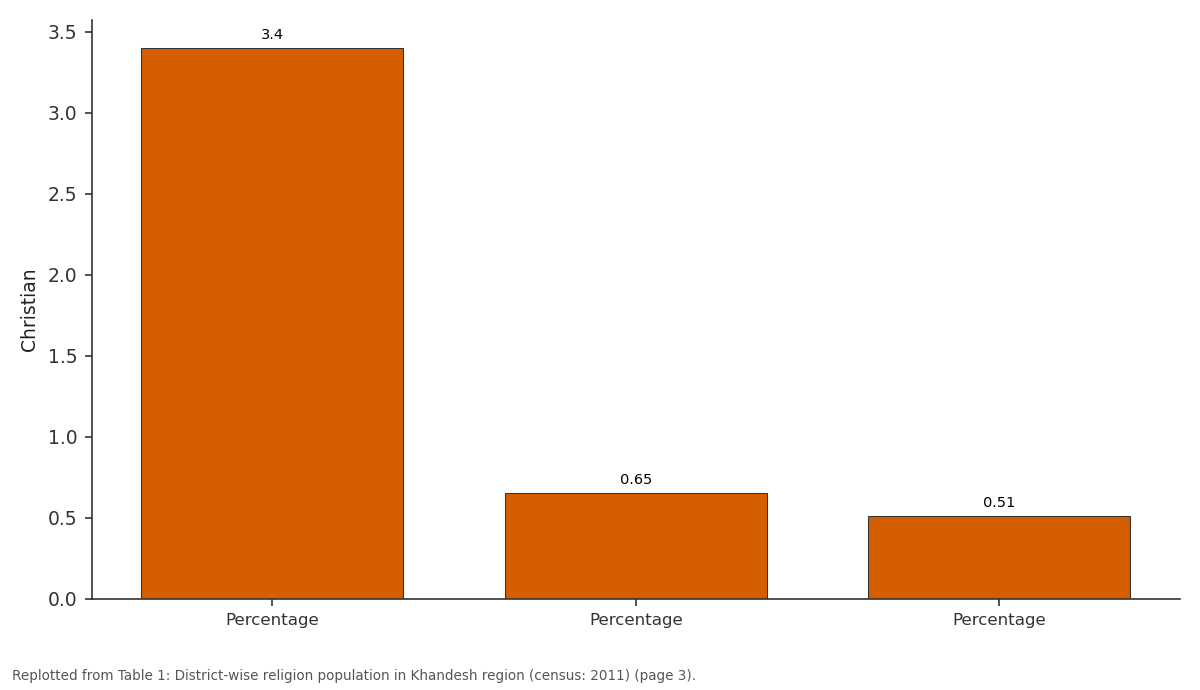
Christian: Percentage vs Percentage vs Percentage
Replotted from Table 1 (page 3) of the original paper. Every bar is the paper's own table value.
View source evidence ↗Figures & tables
From the original paper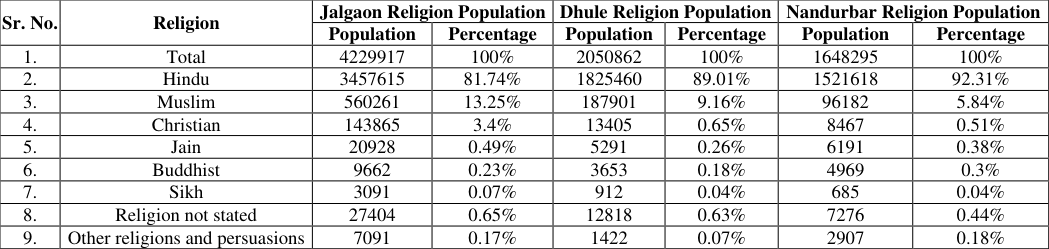 Table 1
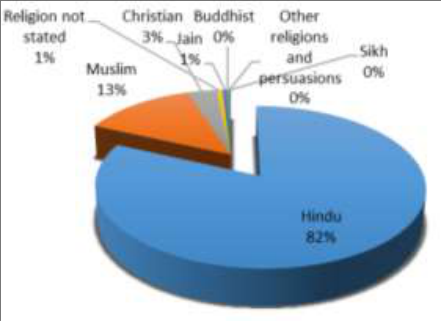 Figure 1
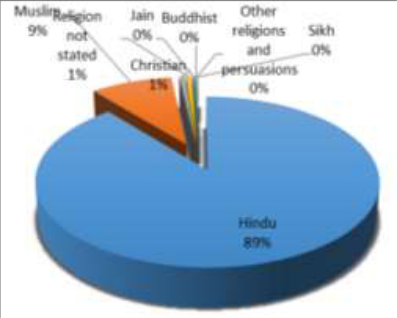 Figure 2
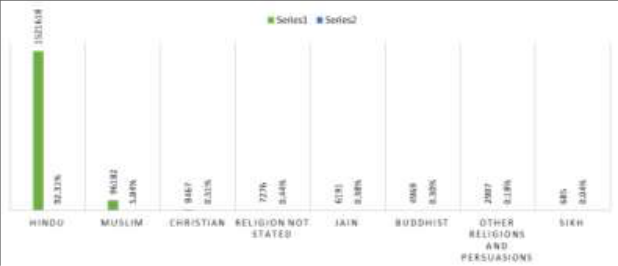 Figure 3
Introduction
Religion is the most important point attribute of cultural geography. Social, cultural, and economic development in qualities of population mostly affected by the religion. The spatial distribution of religious communities is not uniform throughout the Khandesh. Many geographical factors affect the distributional in pattern of religious. The concentration of religious communities in particular area or region also leads to communal riots whereas religious communities living in combination and association enhance the feeling of peace and communal harmony. Religion is an important in social factor affecting distribution of growth in population of any region. Religion returns in the Indian census provide a wonderful kaleidoscope of the country s rich social composition, as many religions have originated in the country and few religions of foreign origin have also flourished here. India has the distinction of being the land from where important religions namely Hinduism, Buddhism, Sikhism, and Jainism have originated at the same time the country is home to several indigenous faiths tribal religions which have survived the influence of major religions for centuries and are holding the ground firmly Regional con-existence of diverse religious groups in the country makes it really unique and the epithet unity in diversity is brought out clearly in the Indian Census. Religion is a set of organized beliefs, practices, and systems that most often relate to belief and worship of a controlling force such as a personal god or another supernatural being. While this is a basic definition, there are many different understandings of what religion is, and not all religions are centred on a belief in a god, gods, or supernatural forces. There are an estimated 10,000 distinct religions worldwide. About 84% of the world's population is affiliated with Christianity, Islam, Hinduism, Buddhism, or some form of folk religion. The religiously unaffiliated demographic includes those who do not identify with any particular religion, atheists, and agnostics. While the religiously unaffiliated have grown globally, many of the religiously unaffiliated still have various religious beliefs. Religions in Khandesh, sometimes also termed Dharmic religions or Khandesh religions, are the religions that originated in the Khandesh Region.
These religions, which include in Khandesh, Jainism, Buddhism, and Sikhism, are also classified as three districts in Khandesh religions. Although Indian religions are connected through the history of Khandesh, they constitute a wide range of religious communities and are not confined to the Khandesh subcontinent. Khandesh Region in India Religion has history influenced society on a political, cultural, and economic level. There is a sense of pride associated with the country's rich religious history as the traditions of Hinduism, Buddhism, Sikhism, and Jainism all emerged out of India. Moreover, while a majority of people in Khandesh identify as Hindu. Some of the types of religions include but are certainly not limited to Christianity, Buddhism, Islam, Hinduism, Jainism, Judaism, Confucianism Indigenous American religions, Shinto, Sikhism, Taoism, Traditional African religions, Zoroastrianism, Rastafarianism, etc.
Research Methodology
The data for the present study was collected by secondary sources i.e. census of India 2011. The data were processed, tabulated and compiled, and represented by cartographic methods. The sources of religions related books, journals, research papers, websites, etc.
Objective
To study the disparity in Religious Population in Khandesh Region.
Study Area
The study region lies in the North Western corner of the Deccan plateau located between 20°15′30″N to 22°03′00″N latitudes and 73°47′00″E to 76°16′00″E longitudes and is bound to the north by the Satpura Ranges, to the south by the hills of Ajanta and to the west by the Northern Most ranges of the Western Ghats. The study region comprises three districts, viz. Nandurbar, Dhule and Jalgaon. The district Nandurbar consists of six talukas named Akrani, Akkalkuwa, Taloda, Shahada, Navapur and Nandurbar. Dhule district has 4 talukas Shirpur, Shindkheda, Sakri and Dhule, while Jalgaon district comprises 15 talukas Chopda, Yawal, Raver, Amalner, Dharangaon, Jalgaon, Bhusawal, Muktainagar, Parola, Erandol, Bodwad, Bhadgaon, Chalisgaon, Pachora and Jamner.
Distribution of religious population in Khandesh region
Distribution of religious population in Khandesh region
Figures and tables from the paper
| Sr. No. | Religion | Jalgaon Religion Population | — | Dhule Religion Population | — | Nandurbar Religion Population | — |
|---|---|---|---|---|---|---|---|
| Population | Percentage | Population | Percentage | Population | Percentage | ||
| 1. | Total | 4229917 | 100% | 2050862 | 100% | 1648295 | 100% |
| 2. | Hindu | 3457615 | 81.74% | 1825460 | 89.01% | 1521618 | 92.31% |
| 3. | Muslim | 560261 | 13.25% | 187901 | 9.16% | 96182 | 5.84% |
| 4. | Christian | 143865 | 3.4% | 13405 | 0.65% | 8467 | 0.51% |
| 5. | Jain | 20928 | 0.49% | 5291 | 0.26% | 6191 | 0.38% |
| 6. | Buddhist | 9662 | 0.23% | 3653 | 0.18% | 4969 | 0.3% |
| 7. | Sikh | 3091 | 0.07% | 912 | 0.04% | 685 | 0.04% |
| 8. | Religion not stated | 27404 | 0.65% | 12818 | 0.63% | 7276 | 0.44% |
| 9. | Other religions and persuasions | 7091 | 0.17% | 1422 | 0.07% | 2907 | 0.18% |
Table text extracted from the original PDF; superscript letters are shown inline. The original table image is below.
View original table image
References
7 in the original paper- Anon. Maharashtra State Gazetteers: Jalgaon District. Directorate of Government Printing, Stationary and Publications, Government of Maharashtra; c2006. Ebook prepared in 2006. Available at.
- Garud BD, Yadav SS, Borale RP. Traditional knowledge of plants of western Khandesh region of Maharashtra for snake bites. International Journal of Plant Sciences. 2010;5(1):337-339.
- Singh M. Religion in India: Religious Composition of Population and Religious Regions. Maharshi Dayanand University Research Journal ARTS. 2019;18(1):63-80. ISSN: 0972-706X.
- Gill MS, Bhardwaj PD. The Religious Composition of India's Population. 2010;25(2):61-76. Available at https://www.researchgate.net/publication/265025360.
- Mohanty P, Kulkarni-Joshi S, Hasnain SI. Prolegomenon to the Bhil and Pawra Relations in West Khandesh in Maharashtra: A Reassessment of Evidence for an Early Substratum. Indian Linguistics. 2013;74(12):95-104. ISSN: 0378-0759. Available at: https://www.researchgate.net/publication/279418309.
- Patil PH, Bafna PS, Pawara RB, Mutha RE. Traditional Knowledge of Medicinal Plants in Tribes of Khandesh: Need of Time to Preserve for Prosperity of Mankind. International Journal of Pharma O 2 . 2020;2(4):237-241. ISSN: 2582-4708. Available at https://www.researchgate.net/publication/343188946.
- Ingle ST, Patil SN, Mahale NK, Mahajan YJ. Analyzing rainfall seasonality and trends in the North Maharashtra region. Journal of Environmental Earth Sciences. 2018 Sep;77:651.