
Research article · 2024 · Full text
International Journal of Geography Geology and EnvironmentAnalysis of non-timber forest product’s availability and livelihood in Nandurbar district (M.S)
Volume 6(1) · Pages 113–118 · DOI: 10.22271/27067483.2024.v6.i1b.210 ↗
Research areasAgricultural Economics and Practices
Abstract
Author-writtenThis article attempts to focus on the current status of NTFPs and its importance in the tribal livelihood. NTFPs provide tribal people with food, fuel, medicine, construction materials, and income. About 70 percent of the tribal population in selected sample villages depend on the NTFPs for their livelihood. NTFPs have commercial, socio-economic and environmental values in tribal communities. More than 68 species of plants are recognized as producing NTFPs and about 50 species of these are commonly used in local trade. Non-Timber Forest Products (NTFPs) are the forest products derived from both plants and animals whose tangible values are often made to avert reaching a region exchequer. Throughout the human history, these products are used by a variety of purposes like food, fuel, fodder, fibber traditional medicine, agricultural amenities, domestic materials, construction materials, and the likes. Many traditional beliefs and cultural values are also associated with these products. The present study is carried out in Satpura Hills and Forest of Nandurbar district in Maharashtra to understand the importance of NTFPs in the daily life of tribal people living in the area adjacent to the forest, the economic importance of NTFPs used by them and evaluate the lacunae of government strategies for their preservation.Objectives of the Study1.To determine the role of forest products in a tribal livelihood system.2.To estimate the contribution of NTFPs to household income and employment. 3.To study the contribution of NTFPs such as Amchoor, Mahua, Chironji, Hirada, Jamun, Oalame, etc. to income for ensuring food and livelihood security.4.To analyze the methods of collection, processing and marketing of NTFPs. 5.To find out the problems faced by tribal communities engaged in Non-Timber forest production.
Summary
Source-checkedPlain-language reading of the full paper, prepared with AI and checked against the text. Each point links to the authors' own words.
Why it matters
- Non-Timber Forest Products (NTFPs) are essential for tribal communities, providing critical resources such as food, fuel, medicine, and income. View evidence ↗
- In the selected sample villages, approximately 70% of the tribal population relies on NTFPs for their livelihood. View evidence ↗
The question
- The study aims to understand the daily and economic importance of NTFPs for tribal people in the Satpura Hills of Nandurbar district and evaluate gaps in government preservation strategies. View evidence ↗
What they did
- The researchers employed both qualitative and quantitative methodologies for data collection and analysis. View evidence ↗
- The study randomly selected 560 households (approximately 10.74% of the 5,215 total households in the region) that were engaged in NTFP activities. View evidence ↗
What they found
- The field survey identified 68 NTFP plant species used by local tribes to meet various needs. View evidence ↗
- Among the identified species, the most collected parts were leaves (30 species), followed by roots (18), bark (14), fruits (10), tubers (8), and flowers (5). View evidence ↗
- According to community perception, 65 species are used for medicinal purposes, while 14 species are consumed. View evidence ↗
- Participation in NTFP collection and processing varied by group: females had the highest involvement at 40.00%, followed by males at 34.10% and children at 25.90%. View evidence ↗
- Tendu leaves are the most important NTFP for domestic use, with 100% of the collected leaves being used by the collector's own household for activities like Bidi making. View evidence ↗
- Men and children participate more in collecting NTFPs that require climbing trees, likely due to social disapproval of women climbing trees. View evidence ↗
What it means
- The authors conclude that the Satpura Mountain region's richness in NTFPs is vital for increasing tribal income and that developing NTFP enterprises could help alleviate poverty. View evidence ↗
Visual summary
1 visualsIllustrations explain the paper; charts are replotted from the paper's own table values.
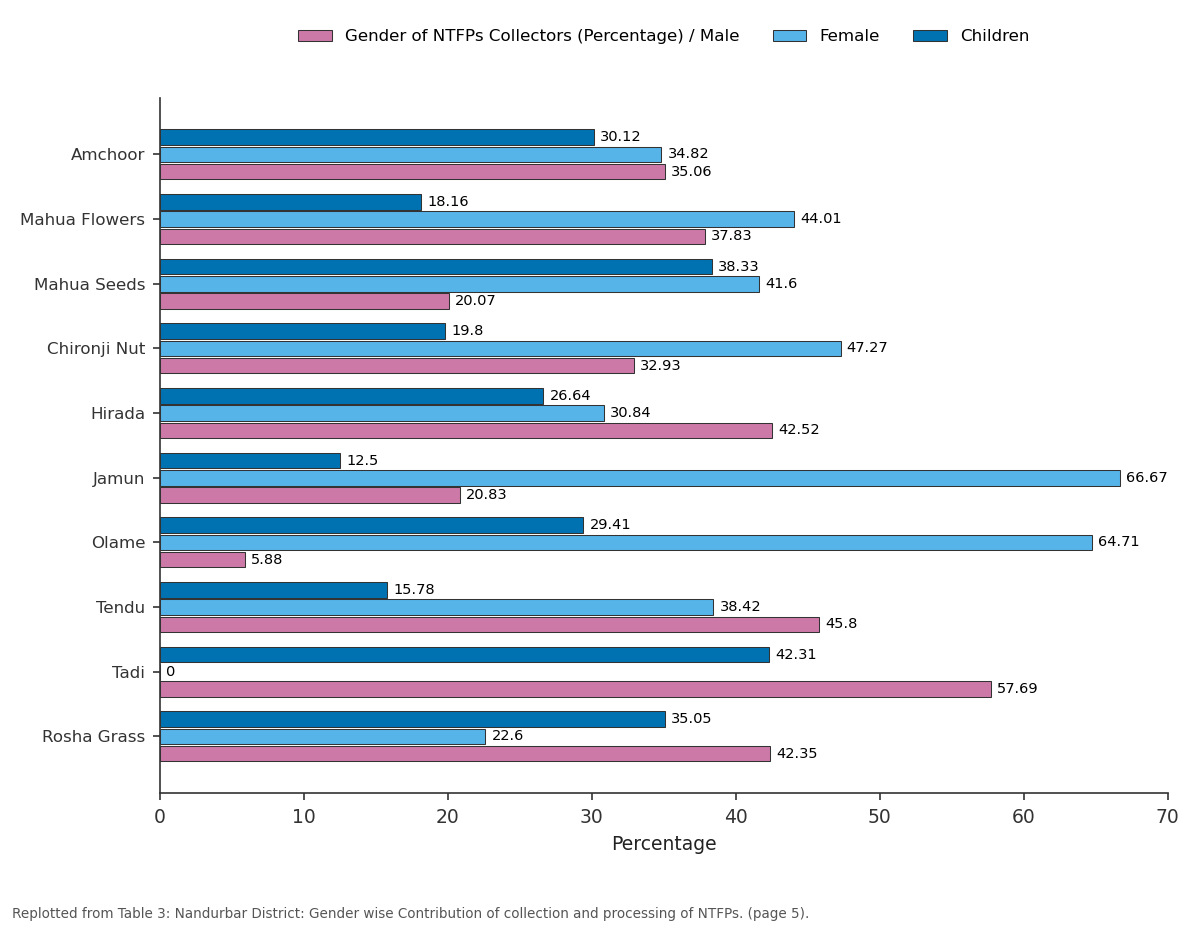
Gender of NTFPs Collectors (Percentage) /... and Female and more: Amchoor vs Mahua Flowers vs Mahua Seeds vs Chironji Nut vs Hirada
Replotted from Table 3 (page 5) of the original paper. Every bar is the paper's own table value.
View source evidence ↗Figures & tables
From the original paper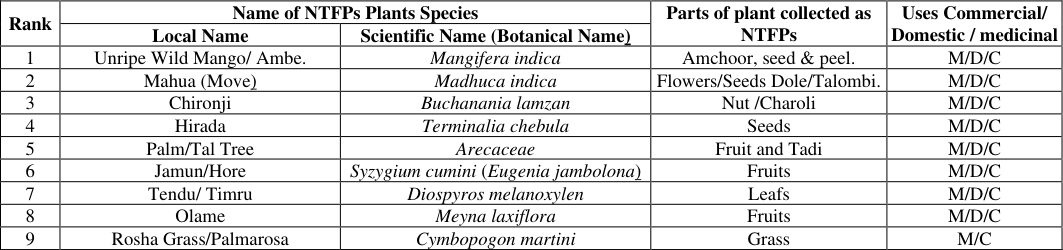 Table 1
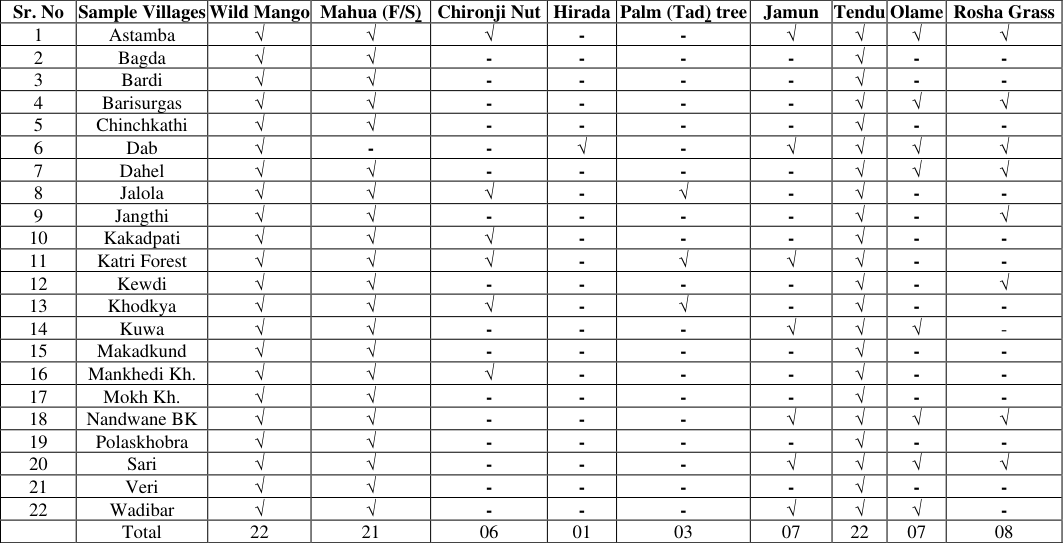 Table 2
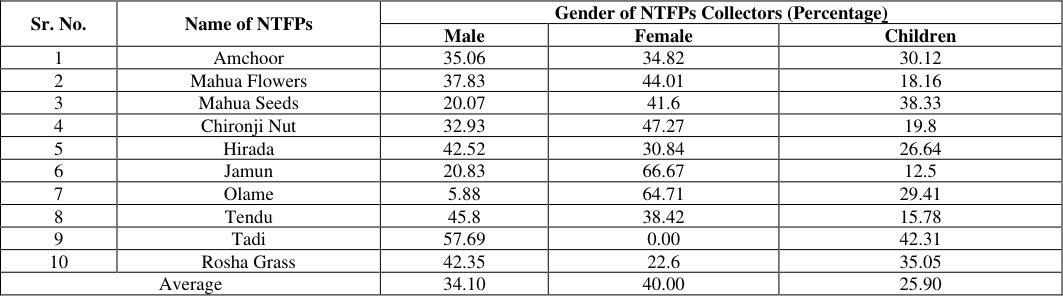 Table 3
Introduction
Non-timber forest products (NTFPs) are the products that are derived from forests other than timber NTFPs have recently been considered an important forest product, but for rural communities. These products have always been an important life support system For diverse ethnic groups all over the world, they have important cultural values and significance. NTFP revenue shares are ranging from just few percent to over 50 percent in and between region's communities. In the western Satpura of Nandurbar district in Akkalkuwa and Dhadgaon tehsil informal channels for NTFPs harvesting and storage than formal channels. The collection and processes of NTFPs in the study area is carried out mainly by tribal groups. They collect and processes for their family requirements, and to sell. They sell about 90 percent NTFPs at the local market directly, while others are sold or exchange to basic things of village level glossary shops. They sell some NTFPs like Mahua flowers, Tadi, Rosha grass, Jamun and Oalame directly to the consumer. This structure of NTFPs collection and processes are not subject matter to any limitation or rule.
Meaning and Definition of Non-Timber Forest Products
The Non-Timber Forest Products (NTFPs) include all biological materials other than timber extracted from natural forests and non-forest for human and animal use and have both consumptive and exchange value. NTFPs comprise medicinal plants, fruits, resins barks, roots and tubers, leaves, flowers, seeds, dry fruits & nut, honey and so on. They are also known as Non-wood, minor, secondary, special forest products.
In India, there are no specific (Legal) definitions of terms like Non-Timber Forest Products (NTFPs) or Minor Forest Products (MFPs). Till the Schedule Tribe and other traditional forest Dwellers, Forest Rights Act, 2006 defined MFPs as under, "Minor forest produce includes all nontimber forest produce of plant origin including bamboo, brushwood, stumps, cane, cocoons, honey, wax, lac, tendu/kendu leaves, medicinal plants and herbs, roots, tubers and alike".
Review of literature
A very few geography researchers worked on NTFPs, in India. The importance of NTFPs discussed in a global context. It included the types and nature of NTFPs worldwide, for domestic as well as commercial purposes. The collection of NTFPs from the local forest and their cultivated areas for getting cash income or used by indigenous people themselves can be traced thousands of year ago. Collection and use of NTFPs is a key issue and related not only to living standards improvement and traditional culture of indigenous people but also conservation of biodiversity and sustainable development of concerned regions (Lhungdim et al., 2023) [10] . Traditional market not only provides a major venue to indigenous people for getting cash income from their products but also is important sites for spreading traditional knowledge on plant use and conservation. However, non-timber forest products (NTFPs) play a dominant role among the tribal people and provide a source of income and subsistence living. NTFPs have importantly been cited as a significant forest product showed that NTFPs have been widely known to lead to the wellbeing of several rural and urban households and communities worldwide in different forms reported that NTFPs are critical to the functioning, security, and reduction of subsistence, particularly for people residing in forest areas explained that there are three major reasons for the forest dwellers to be reliant on the forest products. They stated first of all, the collection of forest products can be an 'attractive' job for them, secondly, it could be the only option and the only way to struggle with poverty, and finally, forest people follow these activities due to strong cultural or spiritual reasons. Identified that NTFPs are collected by forest dwellers, living within or outside forest areas, for the subsistence as well as commercial purposes. Around 400 million people directly and more than 1 billion people indirectly depend on NTFPs throughout the world. Elicited that in Africa, forest people collect NTFPs for food, fuel, medicines, decorative, construction materials, fodder, industrial raw materials etc. he show In Sierra Leone, for example, about 14 percent of foodstuffs and 32 percent of medicines are produced from NTFPs. About 10 percent of tribal people tribal in Ghana collects NTFPs on a regular basis for their cash income purposes. In Sub-Saharan Africa, tribal people are involved in NTFP collection for cash income purposes only. Find out at least 150 Non-Wood Forest Products (NWFPs) are of major significance in national and international trade, and the annual export value of these products was estimated at $11 billion in 1994. China is the prime exporter of NWFPs, followed by India, Indonesia, Viet Nam, Malaysia, the Philippines, and Thailand. Pointed out that the most reliable estimates indicate that from 200 million to 300 million people earn much of their subsistence income from non-industrial forest products. Found that the NTFPs generate the revenues for supporting the rural people instead of having a contribution to the construction-oriented appeal summarize that the Non-Wood Forest Products (NWFPs) presently provide subsistence, employment, and income, particularly for the rural poor, and support small, household-based enterprises, especially in developing countries. Beside that he explained the NTFP's role in the economic and commercial context stated that tropical forests provide natural insurance to forest dwellers. With reference to the Brazilian Amazon, they focused on the economic importance of NTFPs in forest livelihoods. Researcher explained that due to the uncertainty of agricultural work in and around forest areas, local poor people rely on the harvesting of NTFPs to manage shortages of agricultural products. Thus, not only the poorest interior forest dwellers but also forest fringe people, for whom the harvesting of NTFPs is not the subsistence occupation, place considerable dependence on the collection of NTFPs. explained the role of NTFPs in the economy of forest fringe dwellers of South-West Bengal noted that rural households spend income realized from NTFPs to buy food to maintain their families. Hegde (1996) [5] examined that Jenu kurubas derived more employment and income from commercial Non-Wood Forest products than the Soligas and Betta kurubas communities reported that, almost six months in a year, the forest dwellers in Western Ghats zone of Maharashtra were unemployed shows that the tribal living in the high altitude areas of Himachal Pradesh was leading a very tough and hard life reported that production of NTFPs fluctuated also between Years documented detailed information on about 85 plants investigated medicinal plants having ethno botanical uses.
Noteworthy Contribution in the Field: Beside that several scholar focuses on various aspects of non-timber forest products and sustainable livelihood of tribal's and rural people.
Data and Methodology
The qualitative and quantitative methodologies were used to collect data and its analysis. The techniques for the analysis of data, ethical issues and problems faced during the field survey are also examined. For the research, the collection of qualitative and quantitative data and information, both primary and secondary sources gave equal priority. Primary and secondary data, analyzed qualitative as well as quantitative methodologies have been used concurrently. The primary data were collected through the purposefully designed questionnaire from the households, local middleman and traders in intensive field visit in the study area.
Selection of the Sample Villages
All the two Tahsils namely Akkalkuwa and Dhadgaon of Western Satpura mountain ranges in Nandurbar district were included in the study. In Western Satpura Mountain area, out of 94 villages in Akkalkuwa Tahsil researcher selected 13 villages as sample villages. In Dhadgaon Tehsil out of 162 villages researcher selected 09 villages as a sample village. About 8.60 percent villages are selected as sample villages to fulfil the objectives. Besides that, it is also helpful to detail study of NTFPs availability production and NTFPs collectors' livelihood.
Selection of the Respondents
Those forest villages with the highest numbers of households dependent on NTFPs were given priority for selection in the survey. Considering the diverse nature and size of the study region and gauging the limitations, out of 5215, households of the Satpura Mountain region in Akkalkuwa and Dhadgaon Tehsil 560 households were randomly selected, as sample household engaged in NTFPs activities, (About 10.74 percent of total households) representing 13 villages from Akkalkuwa and 09 villages from Akrani Tahsil.
Study area
The present study is confined Western Satpura in Nandurbar district extends between 21 0 0 ' North to 22 0 03' north latitudes and 73 0 33 ' east to 74 0 32 ' east Longitudes. Nandurbar district lies in the northwestern part of Maharashtra. Nandurbar district with the geographical area of 5034.23 Sq.km. has an amorphous shape. As per census, 2011 total population of sample villages are 30147 about 97.73 percent. Population belonging from tribal included Bhil, Pawra and Dhanka Tadi tribes was selected based on forest dependence live within forest area. In the study region, a major forest cover is a concentrate in Satpura mountain ranges like Toranmal Plateau, Astamba Hill, Baba Siraj Donger, Debramal, Patri Donger, Noktyadev, Nandwan Donder, Boksa Donger, Dahel, Walamba etc. Forest area of the region comes under dry deciduous type. In past, the forest was comparatively dense and flourished in two storeys. However, researchers present field observation show that the area is affected by deforestation activities. These forests are the most important forests yielding commercial timbers and Non-Timber Forest products of high value.
Akkalkuwa Tahsil has the highest forest cover in proportion to their geographical area at 45.10 percent (39167 hectares), followed by Akrani Tahsil at 32.85 percent (25392 hectares). Among the Tahsils, Taloda 15.03 percent, Nawapur 11.79%, Nandurbar 10.53 percent and has lowest forest cover in Shahada Tahsil (6.48%) On the basis of field survey researcher identified 68 plants and 2 insect species that were used to fulfil the varied needs of local forest dwellers. Out of them, 14 plant species collect their bark, 30 for leaves, 10 fruits, 5 flowers, 18 roots, and 8 tubers etc. Community perception on us of NTFPs reveals that 14 species consumed, 65 species used for medicinal purpose. It was interesting to note that forest dwellers residents sell as many as 15 species in the local market to earn cash income. Out of them, 09 NTFP plant species was very important for domestic, traditional medicinal and commercial purposes and it is shown in table No.2. All households collect NTFPs for subsistence while involved in commercial collection and processes of plant species, viz. unripe wild mango, Mahua flowers and seeds, Chironji, Hirada, Jamun, Olame, Rosha Grass, Tendu Leaves and Tadi. Based on the availability of the product in a year, their market value and demand, amount of collection and its processes, usability, commercial and domestic importance, the most important NTFPs have been ranked separately use. Table No. 3 clearly shows that the participatory involvement of tribal household members in the collection and processing of Non-Timber forest products (NTFPs). The researcher finds out there was the differential in participatory involvement among males, females and children with 34.10, 40.00 and 25.90 percent respectively participated in the collection and processes of different NTFPs. Table no 3. Reveals that Women play the dominant role in the collection, processing and sale of Non-Timber Forest Produce. From the perspective of its being an occupation predominantly practiced by women NTFPs acquire even greater significance. Development of the NTFP sector not only has a more direct impact in terms of enhancing the income of women but most often puts that income right into their hands. An understanding of the role of women in the NTFP economy and the importance of NTFP based income for tribal women is essential for undertaking a programme to allocate funds for the development of various economic activities in the tribal areas. While men excel in work that requires greater physical strength, women excel in work that requires greater skill or requires greater stamina. Making Amchoor participation involvements share was equal of males and females, due to dried Amchoor demand and rate was higher in all other NTFPs. Involvement of female members was higher than (more than 50 percent) the male and children members for the collection of NTFPs like Mahua flowers, Mahua seeds, Chironji, Jamun and Olame. And the contribution of males was higher in the collection of Hirada, Tendu leaves, harvesting tadi and Rosha grass. NTFPs involving tedious long working hours have greater participation from woman and children. NTFPs such as collection of Mahua flowers, Mahua seeds, Jamun, Olame, Chironji nut and even production of Amchoor from unripe mangoes need to be collected over long hours to be profitable. A typical day for a Mahua flowers starts at around five o' clock in the morning and ends around 11 th o' clock without breakfast. It is also found that all such NTFPs, like the collection of Jamun, Olame and sometimes Tendu leaves, which require the walk long distance, have the greater participation of woman. NTFPs that require climbing trees usually have a greater participation of men and children (Someone less than 14 years in age (Approx.) like unripe mangoes, Mahua seeds (Talambi), Tadi etc. were found to be collected more by men than by the women. Those women have a lower participation, however, does not probably imply due to lack of climbing skills. Most young girls in tribal and rural areas know how to climb trees almost as well as boys of their age do. The lower participation probably comes from social disapproval of women climbing trees. Collection of NTFPs like talambi, mango and hirada usually involve a husbandwife team with the man climbing the tree and shaking the branches to make the fruits fall while the woman does gathering it.
Conclusion
The researcher has been examined of places, where found the collection of major NTFPs in the study area the collectors was in more than 50 percent of the total collection in forest area and followed by surrounding area in own land's NTFPs tree species depends on the availability of NTFPs species. Unripe mangoes, Mahua flowers and Mahua seeds are very important NTPFs in the study region, about one-third collection of unripe mangoes, Mahua flowers and Mahua seeds are collections in their own land and surrounding areas. NTFPs like Hirada, Jamun, Oalame, Tendu leaves and Rosha Grass was collected in the forest and surrounding areas. The researcher has found some NTFPs were self-consumed and domestic used for the collectors. The most important NTFPs for domestic use is Tendu leaves, of which 100 percent is self-used by collectors household. In the study area local tribal's collection Tendu leaves are very small scales. There are only used domestic purposes, like households purpose of Bidi making. NTFPs like Olame, Jamun, and wild mango, are self-consumed by households. Other items that are collected mainly for domestic use includes Mahua flower, Rosha grass and tendu leaves. Satpura Mountain is rich in NTFPs, which plays an important role in increasing tribal income. NTFP enterprises are a potential way to contribute to poverty alleviation.
Figures and tables from the paper
| Rank | Name of NTFPs Plants Species | — | Parts of plant collected as NTFPs | Uses Commercial/ Domestic / medicinal |
|---|---|---|---|---|
| Local Name | Scientific Name (Botanical Name) | |||
| 1 | Unripe Wild Mango/ Ambe. | Mangifera indica | Amchoor, seed & peel. | M/D/C |
| 2 | Mahua (Move) | Madhuca indica | Flowers/Seeds Dole/Talombi. | M/D/C |
| 3 | Chironji | Buchanania lamzan | Nut /Charoli | M/D/C |
| 4 | Hirada | Terminalia chebula | Seeds | M/D/C |
| 5 | Palm/Tal Tree | Arecaceae | Fruit and Tadi | M/D/C |
| 6 | Jamun/Hore | Syzygium cumini (Eugenia jambolona) | Fruits | M/D/C |
| 7 | Tendu/ Timru | Diospyros melanoxylen | Leafs | M/D/C |
| 8 | Olame | Meyna laxiflora | Fruits | M/D/C |
| 9 | Rosha Grass/Palmarosa | Cymbopogon martini | Grass | M/C |
Table text extracted from the original PDF; superscript letters are shown inline. The original table image is below.
View original table image
| Sr. No | Sample Villages | Wild Mango | Mahua (F/S) | Chironji Nut | Hirada | Palm (Tad) tree | Jamun | Tendu | Olame | Rosha Grass |
|---|---|---|---|---|---|---|---|---|---|---|
| 1 | Astamba | √ | √ | √ | - | - | √ | √ | √ | √ |
| 2 | Bagda | √ | √ | - | - | - | - | √ | - | - |
| 3 | Bardi | √ | √ | - | - | - | - | √ | - | - |
| 4 | Barisurgas | √ | √ | - | - | - | - | √ | √ | √ |
| 5 | Chinchkathi | √ | √ | - | - | - | - | √ | - | - |
| 6 | Dab | √ | - | - | √ | - | √ | √ | √ | √ |
| 7 | Dahel | √ | √ | - | - | - | - | √ | √ | √ |
| 8 | Jalola | √ | √ | √ | - | √ | - | √ | - | - |
| 9 | Jangthi | √ | √ | - | - | - | - | √ | - | √ |
| 10 | Kakadpati | √ | √ | √ | - | - | - | √ | - | - |
| 11 | Katri Forest | √ | √ | √ | - | √ | √ | √ | - | - |
| 12 | Kewdi | √ | √ | - | - | - | - | √ | - | √ |
| 13 | Khodkya | √ | √ | √ | - | √ | - | √ | - | - |
| 14 | Kuwa | √ | √ | - | - | - | √ | √ | √ | - |
| 15 | Makadkund | √ | √ | - | - | - | - | √ | - | - |
| 16 | Mankhedi Kh. | √ | √ | √ | - | - | - | √ | - | - |
| 17 | Mokh Kh. | √ | √ | - | - | - | - | √ | - | - |
| 18 | Nandwane BK | √ | √ | - | - | - | √ | √ | √ | √ |
| 19 | Polaskhobra | √ | √ | - | - | - | - | √ | - | - |
| 20 | Sari | √ | √ | - | - | - | √ | √ | √ | √ |
| 21 | Veri | √ | √ | - | - | - | - | √ | - | - |
| 22 | Wadibar | √ | √ | - | - | - | √ | √ | √ | - |
| Total | 22 | 21 | 06 | 01 | 03 | 07 | 22 | 07 | 08 |
Table text extracted from the original PDF; superscript letters are shown inline. The original table image is below.
View original table image
| Sr. No. | Name of NTFPs | Gender of NTFPs Collectors (Percentage) | — | — |
|---|---|---|---|---|
| Male | Female | Children | ||
| 1 | Amchoor | 35.06 | 34.82 | 30.12 |
| 2 | Mahua Flowers | 37.83 | 44.01 | 18.16 |
| 3 | Mahua Seeds | 20.07 | 41.6 | 38.33 |
| 4 | Chironji Nut | 32.93 | 47.27 | 19.8 |
| 5 | Hirada | 42.52 | 30.84 | 26.64 |
| 6 | Jamun | 20.83 | 66.67 | 12.5 |
| 7 | Olame | 5.88 | 64.71 | 29.41 |
| 8 | Tendu | 45.8 | 38.42 | 15.78 |
| 9 | Tadi | 57.69 | 0.00 | 42.31 |
| 10 | Rosha Grass | 42.35 | 22.6 | 35.05 |
| Average | 34.10 | 40.00 | 25.90 |
Table text extracted from the original PDF; superscript letters are shown inline. The original table image is below.
View original table image
References
11 in the original paper- Churpal D, Gauraha AK, Pathak H, Tuteja SS. Economically and traditionally important nontimber forest products (NTFPs) of Chhattisgarh. Journal of Pharmacognosy and Phytochemistry. 2021;10(1):89-92.
- Chandel PK, Prajapati RK, Dhurwe RK. Documentation of NTFPs and medicinal plants available in Dhamtari forest area. Journal of Pharmacognosy and Phytochemistry. 2018;7(1):15241530.
- Hegde R, Suryaprakash S, Achoth L, Bava KS. Extraction of NTFPs in the Forest of B. R. Hill. Contribution to Rural Income. Economic Botany. 1996;50(3):243-251.
- Megeri KB. Participation Behavior of Indigenous People in Non-Timber Forest Products Extraction in Western Ghats Forests. Karnataka Journal of Agricultural Science. 2011;24(2):170-172.
- Lhungdim MH, Adhikary M, Adhikary MM. Tribal farmers' ethnopedological knowledge about decision support systems in Churachandpur district of Manipur State. South Asian J Agric Sci. 2023;3(2):12-16.
- Bhugolshastra Sanshodhan Patrika. 2016;33(2):57-62.
- Petres CM, Gentry AH, Mendelsohn RO. Valuation of Amazonian Forest Nature. Forests. 1989;339(6227):655-656.
- Sharma K, Sharma R, Devi N. Non-Timber Forest Products (NTFPs) and Livelihood Security: An Economic Study of High Hill Temperate Zone Households of Himachal Pradesh. Economic Affairs. 2019;64(2):305-315.
- Shrestha S, Shrestha J, Shah KK. Non-Timber Forest Products and their Role in the Livelihoods of People of Nepal: A Critical Review. Grassroots Journal of Natural Resources. 2020;3(2):42-56.
- Talukdar NR, Choudhury P, Rofik AB, Singh B. Importance of Non-Timber Forest Products (NTFPs) in rural livelihood: A study in Patharia Hills Reserve Forest, northeast India. Elsevier Trees, Forests and People. 2021;3:100042.
- Padvi AT, Nile UV. Importance of Mahua Trees on Tribal Livelihood of Satpura in Nandurbar District. Maharashtra Bhugolshastra Sanshodhan Patrika. 2014;30(1):44-48.
Cited by 1
From OpenAlex, OpenCitations and reference lists read by Scinovex
- Assessing the socio-spatial effects of forest degradation in Kaimur Wildlife Sanctuary, Bihar, India ↗
Shashi Bhushan, Sucharita Sen · Trees Forests and People · 2025
Forests are central to livelihoods in rural India, especially among marginalized groups living adjacent to protected areas. Socio-economic inequalities in accessing forest resources, however, are poorly understood, particularly between caste groups. This research investigates forest dependence and land use dynamics during the last four decades (1977–2022) of the Kaimur Wildlife Sanctuary, Bihar, India. Mixed methods combine remote sensing and GIS-based…
❝ 1PDF