
Research article · 2024 · Full text
International Journal of Geography Geology and EnvironmentEnvironmental management and sustainable development
Volume 6(1) · Pages 177–179 · DOI: 10.22271/27067483.2024.v6.i1c.219 ↗
Research areasSustainable Development and Environmental Policy
Abstract
Author-writtenEnvironmental management focuses on maintaining natural resources such as timber. Water and open land without diminishing or destroying them. Sustainable development seeks to meet human needs without depleting resource. The four main types of sustainability are human, social, economic and environmental. Coordinated approaches are necessary for solving the major environmental and sustainability problems facing the developing as well as developed regions of the world. There is therefore a need to have a better understanding of the multidisciplinary interrelationships between sustainable development, human health and the environment. Specific emphasis was placed on globalization and sustainable growth, bioethics and poverty, organizational performance and sustainability, environmental management and individual progress, human and ecosystem health, and water resources and recycling. Objective: The most important objective of sustainable development is to balance our economic, environmental and social needs, allowing prosperity for now and future generations.
Summary
Source-checkedPlain-language reading of the full paper, prepared with AI and checked against the text. Each point links to the authors' own words.
Why it matters
- Environmental management is defined as the practice of maintaining natural resources, including water, timber, and open land, to prevent their destruction or diminution. View evidence ↗
- Sustainable development is the effort to satisfy current human needs without depleting the resources available for the future. View evidence ↗
- Sustainability is categorized into four primary types: human, social, economic, and environmental. View evidence ↗
The question
- The primary objective of sustainable development is to create a balance between economic, environmental, and social needs to ensure prosperity for current and future generations. View evidence ↗
What they did
- The author's analysis emphasizes several key areas, including globalization, bioethics, poverty, organizational performance, ecosystem health, and water recycling. View evidence ↗
- The paper adopts a multidisciplinary approach to examine the interrelationships between the environment, human health, and sustainable development. View evidence ↗
What they found
- Local community involvement in environmental management is identified as a necessary prerequisite for achieving sustainable development. View evidence ↗
- The frequency of natural disasters is increasing in correlation with the expansion of human activities. View evidence ↗
- Unified and sustainable management of natural resources can improve community resilience to disasters by reversing environmental degradation. View evidence ↗
- Long-term sustainability and positive growth are impossible if the natural resource base continues to deteriorate. View evidence ↗
- Integrated land-use planning is required to coordinate technological and non-technological methods for effective pollution prevention. View evidence ↗
What it means
- The author concludes that sustainable development is the only viable path to ensure that environmental systems continue to support life in urban environments. View evidence ↗
- The author recommends that development programs prioritize human needs and the equitable distribution of benefits over a sole focus on economic growth. View evidence ↗
Visual summary
1 visualsIllustrations explain the paper; they do not show study data.
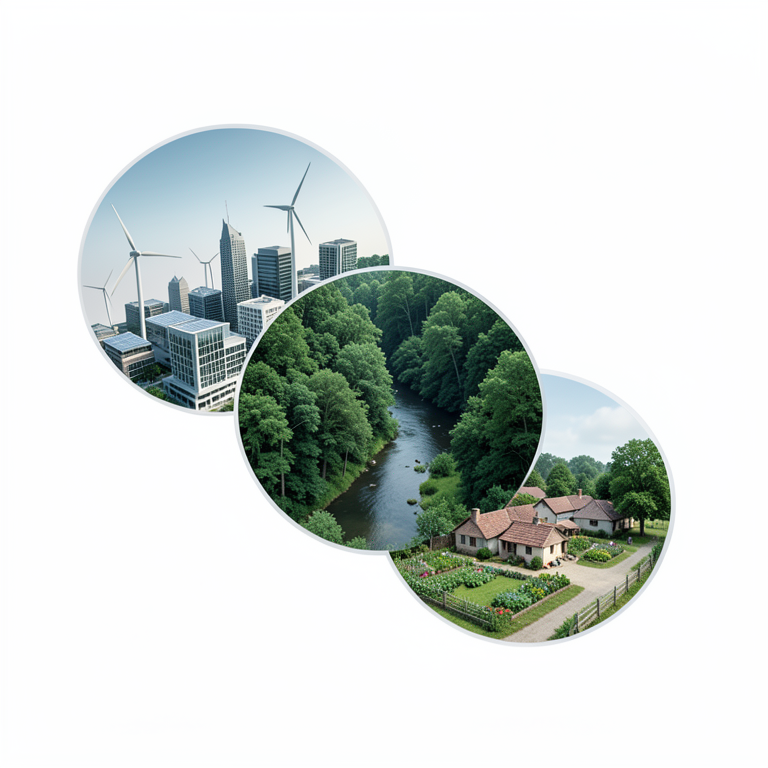
The Balance of Sustainable Development
AI-generated conceptual illustration (A stylized landscape featuring a modern city, a lush forest, and a diverse community village). It explains the idea and does not show study data.
View source evidence ↗Introduction
Sustainable Development continues to be the key idea around which Environment and Development are structured. The whole world depends on nature and ecosystem amenities to provide the conditions for a decent, healthy, and secure life. Environmental problems went far beyond the edges of any country, region and local areas and thus had an impact on the world as a whole, globalizing the responsibilities to a wide extent. To sustain socioeconomic development and improve eminence of life, it becomes inexorable to consider natural environment as the sole principal. The "lost decade for sustainable development" also indicates deepening poverty, global inequality and environmental destruction". Many people also rely that environmental teething troubles can wait until developing countries are richer. Sustainable development was, therefore, not about technology but about a political structure, which established authority and gave people, the victims of environmental degradation, rights over natural resources. The involvement of local communities in Environmental Management was a prerequisite for sustainable development. More attention is required on emerging technologies that are "environment friendly." It cannot be implemented by specialists hired precisely for the project. It needs to be implemented every day by the people who live and work in the community.
Ecosystems and Environmental Health
Ecosystems and Environmental Health Mankind is living in ecosystems that can be recognized at many different levels, ranging from, for example, a small forest to the entire globe. Natural ecological systems are dynamically stabilized based on balanced inputs and outputs. The work of Abdulla et al. 2009 [2] assessed atmospheric pollution, its consequences on humans and the environment, and perspectives toward its control. They also assessed pesticides, their persistence in the environment, the direct effects on human health, and the toxicological aspects of water pollution; and food borne diseases. In his case study area of Jobos Bay, Puerto Rico, Laboy-Nieves reported that the Bay is a very dynamic ecosystem, where its natural history had been sculpted by physical, biological and anthropological factors. A related aquatic environmental health study was presented.
The continual discharge of chemical substances in aquatic ecosystems can bring about changes in the structure and functioning of the biotic community.
Human Progress and Environmental Management
How do we make sustainability a commitment rather than just a compliance cost? Building sustainable firms and organizations requires a commitment to people's development. Staff development programs can only be successful if organizations have a clear sense of their place in assessed the sustainable management tool known as Triple Bottom Line Reporting This instrument has become more important and widespread in recent years. Some of those corporations are using these reports as a way to push their sustainability commitments further. However, the success of these techniques depends on the commitment, skill and character of the people implementing them. Emotions are an essential part of human life the interaction between the emotional process and the cognitive process may explain why humans excel at making decisions based on incomplete information; acting on our gut-feelings also performed a study emotion.
Disaster Management
The waves of natural disasters are increasing over time in corresponding to the expansion of human activity. Mounting urbanization upturns exposure and vulnerability of large numbers of people to natural hazards. Sustainable and unified management of natural resources will increase the flexibility of communities to disasters by retreating current trends of environmental degradation.
Natural and Manmade 2. Disaster Risk Management and Urbanization
Natural and Manmade 2. Disaster Risk Management and Urbanization
Resource Management
Resource Management is the resourceful and active positioning of an organization's resources when they are necessary. Section 2 (a) of Environment Protection Act 1986 "environment" includes water, air and land and the interrelationship which exits among and between water, air and land, and human beings, other living creature, plants microorganism and property.4 Sustainable management of natural resources are required for achieving food, nutritional, environmental and livelihood security in the country. Sustainable management of natural resources is vibrant for the development. Positive growth and long-term sustainability cannot thrive on a worsening natural resource base. The condition is getting further compounded with the recent climate change impacts on natural resources 1. Forest &Forestry 2. Land Resources 3. Water Resources 4. Mines and Mineral 5. Indigenous Knowledge.
Pollution Prevention
Pollution prevention is well-defined as the use of processes, practices, materials, products, substances or energy that avoids or minimizes the creation of pollutants and waste, and reduces the overall risk to the environment and human health. What can be done to slow the human population growth? "Experience shows that the most effective ways to slow human population growth are to encourage family planning, to reduce poverty, and to elevate the status of women. Effective pollution prevention can be achieved only by integrated land-use planning which offers the broad framework for coordinating technological and nontechnological means to achieve sustainable development
Waste Management
The social and economic development of a country can cause an increase in pressures on its environment and increases the need for a reduction in environmentally damaging activities. Some of these damaging activities involve the production and disposal of waste. The more waste we produce, the more we have to dispose, either by recycling and re-using, burial (Landfill) or Burning (Ignition). Meeting human needs is inseparably allied with the abstraction and processing of resources, substances and materials which generate some kind of benefit. At the end of their intended use, these products and materials become available once again in the form of waste, and may be reused as raw materials. Hence, the handling of resources is an essential component of any strategy for sustainable development.
Urban Waste 2. Nuclear Waste
Urban Waste 2. Nuclear Waste
Conclusion
Sustainability is ultimately about the interplay between people and ecologies. We constantly seek to maintain or enhance our quality of life -a rich mix of basic and more abstract needs. Our fundamental task in the coming decades is to redesign our socio-political-economic system in ways that reintegrate the dependencies between people and our underpinning ecological systems. In the context of globalization, establishment of interactions between socioeconomic development plans and natural spaces, and taking natural and cultural compounds into consideration as a whole are a starting point for developing the concept of countrywide physical plan. This relationship contains a diverse range of research, analysis and planning processes at different levels. Furthermore, geographical space analysis will lead to the collection of data about ecosystems and will bring about the management and sustainability of ecological and economic resources in the planning process of national, regional and local areas. The only way forward, in order to assure that resources and environmental systems will keep sustaining life in this urban environment, is through sustainable development. Development programmes should give special attention to human needs, and the distribution of development benefits, rather than focus all efforts on economic development. A more people-orientated development should empower people to take greater control over all aspect of their lives: social, political, economic and ecological.
References
1 in the original paper- Jain AK. Sustainable development and waste management. 2007, 13(1).
Cited by 11
From OpenAlex, OpenCitations and reference lists read by Scinovex
- Support for environmental protection: an integration of ideological-consistency and information-deficit models ↗
Phillip John Ehret, Aaron C. Sparks, David K. Sherman · Environmental Politics · 2016
The divergent roles of education in predicting environmental support among liberals, conservatives, and moderates in the United States are explained by integrating ideological-consistency and information-deficit models. Increased political polarization among elites has led to divergent environmental positions advocated by liberal and conservative political and media leaders; it was predicted that education would increase public attention to these elite cues and,…
❝ 63 - Cactus roles and impacts of cochineal insect on cactus performance in Southern Tigray, Ethiopia ↗
Tsegay Lijalem Mesele, Habtegiorgis Kebede Berhe · Environment Development and Sustainability · 2024
❝ 6 - Changes of South Baltic Region Climate: Agroecological Challenges and Responses ↗
Galina M. Barinova, Eugene V. Krasnov, Гаева Дара Владимировна · Springer eBooks · 2014
❝ 3 - Identifying and addressing challenges in gross pollutant trap maintenance: perspectives from the Australian stormwater industry ↗
Justine Barrett, Brad Dalrymple, Joanna Vince, Britta Denise Hardesty · Marine Pollution Bulletin · 2025
A common approach to removing pollution from stormwater is through the installation of gross pollutant traps (GPTs). However, GPTs are often not maintained effectively, leading to pollution accumulation and additional pollution bypassing into natural environments. To explore why GPTs are not always maintained, we surveyed representatives from the Australian stormwater industry ( n = 94) using convenience non-probability sampling. Collectively,…
❝ 2PDF - Sustainable Wastewater Management ↗
Nevra Öztürk Atay, Esra Feyzioğlu-Demir · ACS symposium series · 2025
Access to safe and clean water is at risk as water resources and quality are being depleted due to industrialization, urbanization, population growth, climate change and agricultural practices. Pollutants in wastewater with a high potential to harm nature, humans and the entire ecological system are contaminating clean water resources such as groundwater, seas, lakes and streams, causing water pollution. Therefore,…
❝ 1 - The Prevalence of Fissured Peace, Justice and Sustainable Development in Nigeria and other Developing Countries ↗
Chukwuma Sr Chrysanthus · Greenfort International Journal of Applied Medical Science · 2025
This article contributes to strategies in sustainable human health, environmental quality, socioeconomic development and quality of life in both developing and developed nations as significantly impacted in by processes and products of anthropogenic and natural forces both externally and internally with geopolitical intendments. Nigeria has become embellished within inextricably conflicting challenges, issues and opportunities of climate change, socioeconomic problems, environmental…
❝ 1PDF - Rethinking Power and Forestry Governance in Colonial and Post-Colonial Tanzania: Towards a Poststructural Political Ecology ↗
Danstan Mukono · The African Review · 2022
Abstract There is an emerging scholarly concern for reconstructing and engaging with diverse approaches that theorize the question of power. Scholars focusing on the Global South critically explore how power dynamics shaping forestry governances hold western colonial assumptions that erase complexities of nature-society relations. Yet, many studies have not systematically (re)conceptualized issues of knowledge-power nexus as an instrument of control…
❝ 1 - Effluent discharge and stream pollution by a rubber factory: a case study of field 20 stream in Odukpani, Cross River State ↗
Joel Efiong, BE Eze · African Journal of Educational Studies in Mathematics and Sciences · 2006
Increases in socio-economic activities worldwide have been accompanied by a faster growth in pollution stress on especially the aquatic environment. In Nigeria, there are many cases of aquatic pollution that have not been documented. Water quality investigation of Field 20 Stream in Pamol (Nigeria) Limited Estate, Odukpani, Cross River State, was conducted weekly between April and June 2004 spanning a…
❝ 1PDF - The Circular Economy: A Paradigm Shift Towards Sustainability with Reference to an Indian City Raipur ↗
Deepti Patnaik, Srikanta Patnaik · Circular economy and sustainability · 2025
❝ 0 - The importance of social and environmental responsibility in corporate environments: use of electric energy ↗
Anita Flaviana Dias, Vitória Aparecida de Lima Oliveira, Vitória Maria da Conceição Santos, Ana Carolina Corrêa Baracho dos Santos Buongermino, Adriano Carlos Moraes Rosa · International Journal of Scientific Management and Tourism · 2023
Socio-environmental responsibility happens in the face of a commitment where companies discuss, agree and become responsible for adopting marketing postures based on ethics and righteousness. These become responsible, taking into account the social and environmental impacts that their decisions result in and the changes that this brings to the environment in which they are in. The purpose of this article…
❝ 0PDF - مدى وعي معلمات المرحلة الثانوية بخصائص التنمية المستدامة في دولة الکويت ↗
مها هيف عيدان الظفيري · Maǧallaẗ Kulliyyaẗ Al-Tarbiyyaẗ Bil-Manṣūraẗ · 2021
هدف البحث إلى قياس مدى وعي معلمات المرحلة الثانوية في دولة الکويت بخصائص التنمية المستدامة، وتکونت هذه عينة البحث من 60 معلمة، کما اعتمد البحث على المنهج الوصفي لتحليل البيانات التي تم جمعها بأداة استبانة لقياس مدى وعي المعلمات بالتنمية المستدامة بأبعادها الثلاث وهي: البعد البيئي والبعد الاقتصادي والبعد الاجتماعي، وخلصت نتائج البحث إلى أن الاتجاه العام لاستجابات المشارکين تقع…
❝ 0PDF