
Research article · 2024 · Full text
International Journal of Geography Geology and EnvironmentGeographical study of primary health care center distribution in Nandurbar district
Volume 6(1) · Pages 105–108 · DOI: 10.22271/27067483.2024.v6.i1b.208 ↗
Research areasHealthcare Systems and ReformsHIV/AIDS Impact and Responses
Abstract
Author-writtenIn the 21st century, the standard of living has become fast. Therefore, there is a constant change in people's mindset. In which the health of the people is a major one. Taking care of the health of the people is an important task of the government, for which the government is working to fulfill this responsibility by establishing various health centers in India.According to national health plan every primary health centers is expected to provide Primary health care services to population of 30,000 in plain and 20,000 in hilly, Tribal and deserts areas and sub-centers service for every 5,000 in plain and 3,000 populations in the hilly, tribal and deserts area.Nandurbar district area has been selected for present study. Nandurbar district is an administrative district in the northwest corner of Maharashtra state in India. Nandurbar is a tribal-dominated district; therefore, since the population of tribals is more in this area and there is still no health awareness in this society, taking care of their health is an important issue. In this area total 61 primary health center and 290 sub-centre exiting. But considering the population of this district according to 2011 census is the number of these health centers sufficient?
Summary
Source-checkedPlain-language reading of the full paper, prepared with AI and checked against the text. Each point links to the authors' own words.
Why it matters
- The Indian government is responsible for establishing health centers to ensure the health of its population. View evidence ↗
- Nandurbar is a tribal-dominated district where health awareness is low, making healthcare provision a critical issue. View evidence ↗
- National health plan norms require one primary health center (PHC) per 20,000 people and one sub-center per 3,000 people in tribal, hilly, or desert areas. View evidence ↗
The question
- The study aims to evaluate the adequacy of healthcare services and the relationship between population distribution and the availability of health facilities in Nandurbar. View evidence ↗
What they did
- The research utilized secondary data from the 2011 census, the district health office, and the NHRM Tehsil health office. View evidence ↗
- The adequacy of services was measured by calculating the ratio of the total population to the number of primary health centers and sub-centers. View evidence ↗
What they found
- PHC distribution is inadequate in several tehsils: Nandurbar tehsil has 2.5 times the population norm per center, while Nawapur, Taloda, and Shahada have about 1.5 times the norm. View evidence ↗
- The district has 290 sub-centers, serving an average population of 5,683 people per center. View evidence ↗
- According to tribal norms, 549 sub-centers are required, meaning the existing 290 centers are almost half of the required amount. View evidence ↗
- There is a total requirement of 259 additional sub-centers across the district's taluks to meet national health care mission standards. View evidence ↗
What it means
- The authors conclude that there is an urgent need for planning to increase the number of healthcare centers to match the population as per national norms. View evidence ↗
Visual summary
2 visualsIllustrations explain the paper; charts are replotted from the paper's own table values.
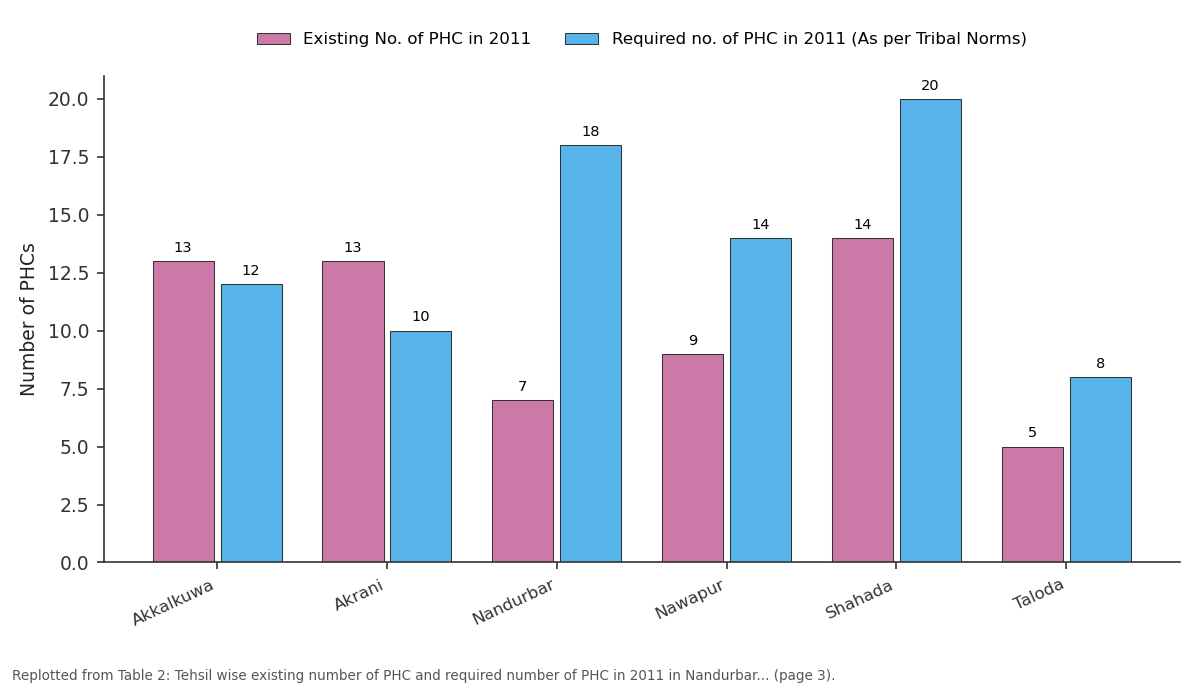
Existing No. of PHC in 2011 and Required no. of PHC in 2011 (As per Tribal...: Akkalkuwa vs Akrani vs Nandurbar vs Nawapur vs Shahada
Replotted from Table 2 (page 3) of the original paper. Every bar is the paper's own table value.
View source evidence ↗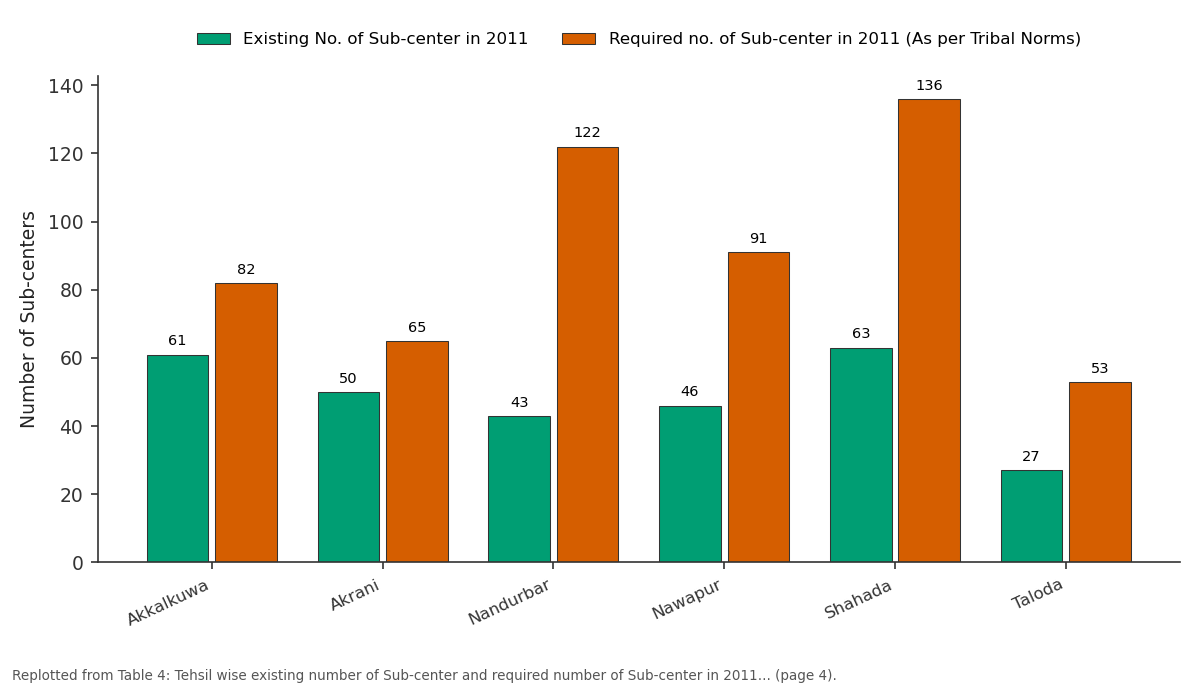
Existing No. of Sub-center in 2011 and Required no. of Sub-center in 2011 (As per...: Akkalkuwa vs Akrani vs Nandurbar vs Nawapur vs Shahada
Replotted from Table 4 (page 4) of the original paper. Every bar is the paper's own table value.
View source evidence ↗Figures & tables
From the original paper Table 1
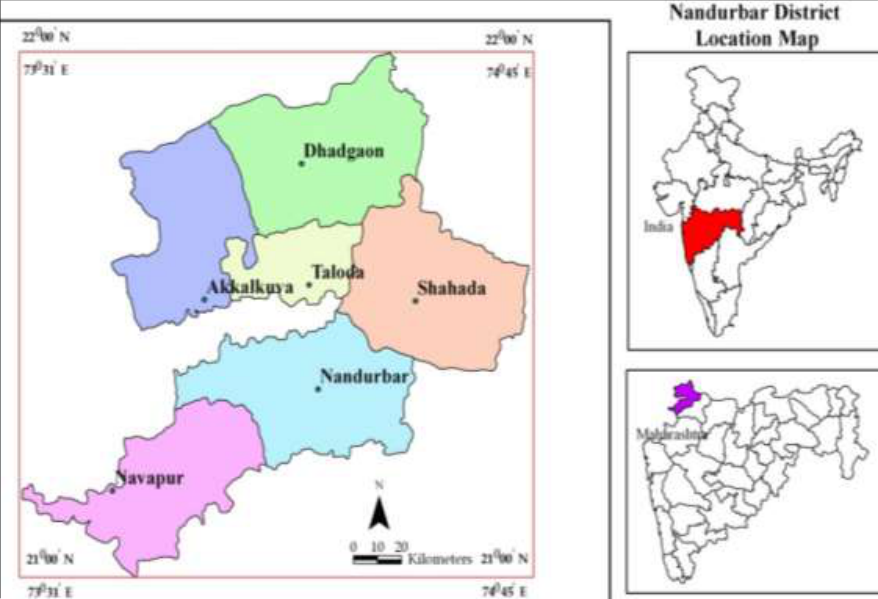 Figure 1
 Table 2
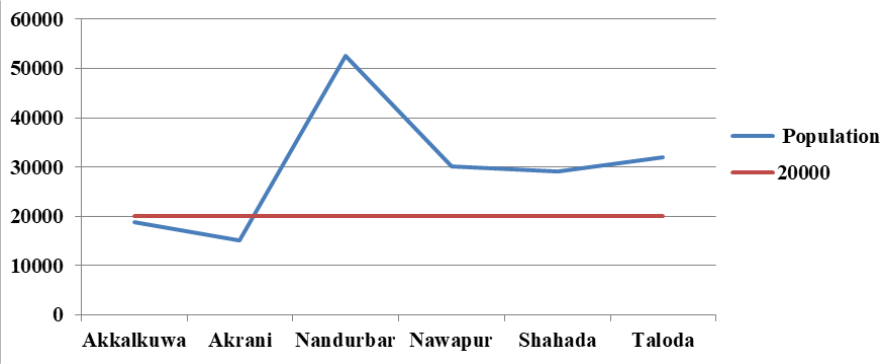 Figure 2
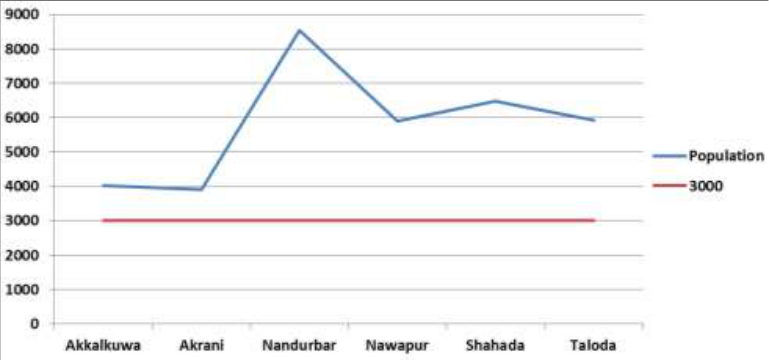 Figure 3
 Table 3
 Table 4
Introduction
Healthy People are the Success of area. That's why Health has been declared as the fundamental right of an individual and the states have been assigned the responsibility for the health of their people. So the central and state governments in India are trying to expand and improve their health care services. However, there is a great rift between the required and available health care facilities in rural and tribal areas. The central government established a norm for the set-up of primary health centers and to provide medical facilities to large number of people. The health planners in India think primary health centers and sub centers as the proper infrastructure to provide health service to the rural and tribal population. The primary health care infrastructure provides the first level contact between the population and health care providers. A primary health care service centre is an important concern for the increasingly growing population in the rural and tribal area. The health service is directly concerned with human beings. The central government established norms for the set-up of primary health centers to provide medical facilities to large number of people the health planners in India think that primary health centers and sub centers are the proper infrastructure to provide health services to the rural and tribal population. According to national health plan every primary health centers is expected to provide Primary health care services to population of 30,000 in plain and 20,000 in hilly, Tribal and deserts areas and sub-centers service for every 5,000 in plain and 3,000 populations in the hilly, tribal and deserts area.
Study Area
Nandurbar district area has been selected for present study. Nandurbar district is an administrative district in the northwest corner of Maharashtra state in India. On 1 July 1998 Dhule was bifurcated as two separate districts now known as Dhule and Nandurbar. Nandurbar is a tribal-dominated district; the district headquarters are located at Nandurbar city.
Nandurbar district lies between latitudes 21°00'N and 22° 03'N and longitudes between 73°31'E and 74°32'E. Nandurbar district occupies an area of 5,955 sq.km. Nandurbar district is bounded to the south and south-east and east by Dhule district, to the west, west -north and north is the state of Gujarat, to the north and north-east is the state of Madhya Pradesh. The northern boundary of the district is defined by the great Narmada River. The district has a population of 16, 48, 295 persons according to the 2011 census. Nandurbar is a tribaldominated district therefore According to national health plan every primary health centers is expected to provide Primary health care services to population of 20,000 and sub-center services to population of 3,000 people.
Database and Methodology
The present paper is based on secondary data. The secondary data is collected from district health office and NHRM, Tehsil health office. Population data is collected from census report of the year 2011. Projected population is calculated on the basis of 2011 data. The ratio of primary health centers / sub center and total population is calculated by the following formulas.
Ratio = Total population / number of primary health centers
Primary health centers
The primary health center or primary healthcare center (PHC) is the basic structural and functional unit of the public health services in developing countries. PHCs were established to provide accessible, affordable and available primary health care to people, in accordance with the Alma Ata Declaration of 1978 by the member nations of the World Health Organization (WHO).
Tehsil wise ration of primary health center and population in Nandurbar district
In Study area Nandurbar District consists of 6 tehsil and total 61 PHC. As per national health plan norms, there shall be one Primary Health Center established for every 30,000 population in plain areas and for every 20,000 population in hilly/tribal/desert areas. An Analysis of the above chart and graph shows that, the primary health centre are much less in number then the required for the populations served by per primary health centre in Akkalkuva and Akrani tehsil is laser than the norms. But the number of health care centers available to the population in 4 tehsil of Nandurbar district is less. In Nandurbar tehsil 2.5 times more population than the norms and in Nawapur, Taloda, and Shahada tehsil about 1.5 times more population than the norms. It is not suitable for the health care of the people there. Nandurbar district which has 6 tehsils including Akkalkuva and Akrani tehsil have seen the completion of implementation of National Health Scheme or the number of PHC is complementary to its population. But Nandurbar, Nawapur, Shahada taluks of Nandurbar district do not fulfill these criteria. Therefore, the number of PHCs in these four tehsils is expected to increase by 25 PHC as per the criteria.
Sub-Center
In the public sector, a Health Sub-centre is the most peripheral and first point of contact between the primary health care system and the community. A Sub-centre provides interface with the community at the grass-root level, providing all the primary health care services. It is the lowest rung of a referral pyramid of health facilities consisting of the Sub-centers, Primary Health Centers,
Tehsil wise ration of Sub-center and population in Nandurbar District
As per population norms, there shall be one Sub-centre established for every 5000 population in plain areas and for every 3000 population in hilly/tribal/desert areas. From the above table it can be seen that, the number of sub centers available in Nandurbar district is almost half as per population. Therefore, there is a requirement of 259 subcenters in almost all taluks of the district. As per national health care mission this situation is dangers for the health care in district population.
Conclusion
As per Norms the requirement of a primary health center per 20,000 population in area that means the ration 1:20,000. But in Nandurbar district is great rift between the required and available health care facilities in the study area. As compare to above said ratio only Akkalkuwa and Akrani tehsil has higher ratio between PHC and Population 1:18912 and 1:15058 respectively. Because this tehsil have covered by mountain areas and they more schedule tribes' population than other tehsils in Nandurbar district. As campare to above say no anyone tehsil ratio match between Sub-center and total Population in Nandurbar district.
It is clear that there is necessity of introducing planning and increase ratio between health care center and population as per norms.
Figures and tables from the paper
| Sr. No. | Tehsil | Area | Total Population | PHC | Ration: Pop. surved 1: 20,000 (As per Tribal Norms) |
|---|---|---|---|---|---|
| 1. | Akkalkuwa | 936.02 | 245,861 | 13 | 18912 |
| 2. | Akrani | 1,282.31 | 195,754 | 13 | 15058 |
| 3. | Nandurbar | 1,022.12 | 367446 | 07 | 52492 |
| 4. | Nawapur | 1,030.23 | 271852 | 09 | 30205 |
| 5. | Shahada | 1,181.27 | 407728 | 14 | 29123 |
| 6. | Taloda | 452.94 | 159654 | 05 | 31930 |
| Total | 5,955.00 | 1,648,295 | 61 | 27021 |
Table text extracted from the original PDF; superscript letters are shown inline. The original table image is below.
View original table image
| Sr. No. | Tehsil | Area | Total Population | Existing No. of PHC in 2011 | Required no. of PHC in 2011 (As per Tribal Norms) |
|---|---|---|---|---|---|
| 1. | Akkalkuwa | 936.02 | 245,861 | 13 | 12 |
| 2. | Akrani | 1,282.31 | 195,754 | 13 | 10 |
| 3. | Nandurbar | 1,022.12 | 367446 | 07 | 18 |
| 4. | Nawapur | 1,030.23 | 271852 | 09 | 14 |
| 5. | Shahada | 1,181.27 | 407728 | 14 | 20 |
| 6. | Taloda | 452.94 | 159654 | 05 | 8 |
| Total | 5,955.00 | 1,648,295 | 61 | 82 |
Table text extracted from the original PDF; superscript letters are shown inline. The original table image is below.
View original table image
| Sr. No. | Tehsil | Area | Total Population | Sub Center | Ration: Pop. Surved 1: 3000 (As per Tribal Norms) |
|---|---|---|---|---|---|
| 1. | Akkalkuwa | 936.02 | 245, 861 | 61 | 4030 |
| 2. | Akrani | 1, 282.31 | 195, 754 | 50 | 3915 |
| 3. | Nandurbar | 1, 022.12 | 367446 | 43 | 8545 |
| 4. | Nawapur | 1, 030.23 | 271852 | 46 | 5909 |
| 5. | Shahada | 1, 181.27 | 407728 | 63 | 6471 |
| 6. | Taloda | 452.94 | 159654 | 27 | 5913 |
| Total | 5, 955.00 | 1, 648, 295 | 290 | 5683 |
Table text extracted from the original PDF; superscript letters are shown inline. The original table image is below.
View original table image
| Sr. No. | Tehsil | Area | Total Population | Existing No. of Sub-center in 2011 | Required no. of Sub-center in 2011 (As per Tribal Norms) |
|---|---|---|---|---|---|
| 1. | Akkalkuwa | 936.02 | 245,861 | 61 | 82 |
| 2. | Akrani | 1,282.31 | 195,754 | 50 | 65 |
| 3. | Nandurbar | 1,022.12 | 367446 | 43 | 122 |
| 4. | Nawapur | 1,030.23 | 271852 | 46 | 91 |
| 5. | Shahada | 1,181.27 | 407728 | 63 | 136 |
| 6. | Taloda | 452.94 | 159654 | 27 | 53 |
| Total | 5,955.00 | 1,648,295 | 290 | 549 |
Table text extracted from the original PDF; superscript letters are shown inline. The original table image is below.