
Research article · 2024 · Full text
International Journal of Agriculture Extension and Social DevelopmentProblems faced by the tribal women during collection and marketing of Minor Forest Produce (MFPs) and suggestions given by them to overcome the problems
Volume 7(2) · Pages 347–349 · DOI: 10.33545/26180723.2024.v7.i2e.345 ↗
Research areasSouth Asian Studies and ConflictsIndian History and PhilosophySocial and Economic Development in India
Abstract
Author-writtenThe present research was carried out in the Kanker district of the state of Chhattisgarh in 2022–2023. Each of the Kanker Forest Department's (3) divisions were purposefully chosen for this study because they have the maximum number of tribal and the greatest amount of forest area. From each selected divisions, 40 tribal women beneficiaries of Van Dhan Yojna were selected. In this way, total 120 tribal women were considered as respondents for this study. The data were collected with the help of well structured pre-tested interview schedule through personal interview. The findings of this study with regard to problems faced by the respondents revealed that 90.00 percent of respondents faced problems during the collection of MFPs was scattered distribution of MFPs and majority 88.33 percent of respondents faced problems regarding to the marketing of MFPs are perishable nature of MFPs, while; 90.83 percent respondents suggested for forestation should be done in village level/forest land, to overcome the problems faced by them in the collection and marketing of MFPs.
Summary
Source-checkedPlain-language reading of the full paper, prepared with AI and checked against the text. Each point links to the authors' own words.
Why it matters
- Non-timber forest products (NTFPs) are economically significant in India, contributing 40% of forest revenues and 55% of forest-based employment. View evidence ↗
- MFPs are critical for the sustainable livelihoods and overall well-being of tribal populations by providing essential income and employment. View evidence ↗
The question
- The study aimed to identify the problems tribal women face during the collection and marketing of MFPs and to gather their suggestions for overcoming these issues. View evidence ↗
What they did
- The research was conducted in the Kanker district of Chhattisgarh between 2022 and 2023. View evidence ↗
- The study sample consisted of 120 tribal women beneficiaries of the Van Dhan Yojna, randomly selected (40 from each of the three forest divisions: Kanker, west Bhanupratapur, and East Bhanupratapur). View evidence ↗
- Data were gathered through personal interviews using a pre-tested, structured interview schedule. View evidence ↗
What they found
- The most significant problem during collection was the scattered distribution of MFPs, reported by 90.00% of respondents. View evidence ↗
- Unpleasant weather during collection was a problem for 79.17% of the respondents. View evidence ↗
- Regarding marketing, the most prevalent issue was the perishable nature of MFPs, affecting 88.33% of respondents. View evidence ↗
- Low and fluctuating market prices were reported as a marketing problem by 80.00% of the respondents. View evidence ↗
- The most common suggestion to overcome these problems was to implement forestation at the village or forest land level, suggested by 90.83% of respondents. View evidence ↗
- 84.17% of respondents suggested that a Minimum Support Price (MSP) should be followed for the marketing of MFPs. View evidence ↗
- 82.50% of respondents suggested organizing programs for forest regeneration to increase productivity. View evidence ↗
What it means
- The authors conclude that scattered distribution, perishability, price fluctuations, and bad weather are the primary obstacles disrupting the collection and promotion of MFPs. View evidence ↗
- To address these issues, the authors highlight the respondents' recommendations for localized forestation, the implementation of MSP, and forest regeneration programs. View evidence ↗
Visual summary
2 visualsIllustrations explain the paper; charts are replotted from the paper's own table values.
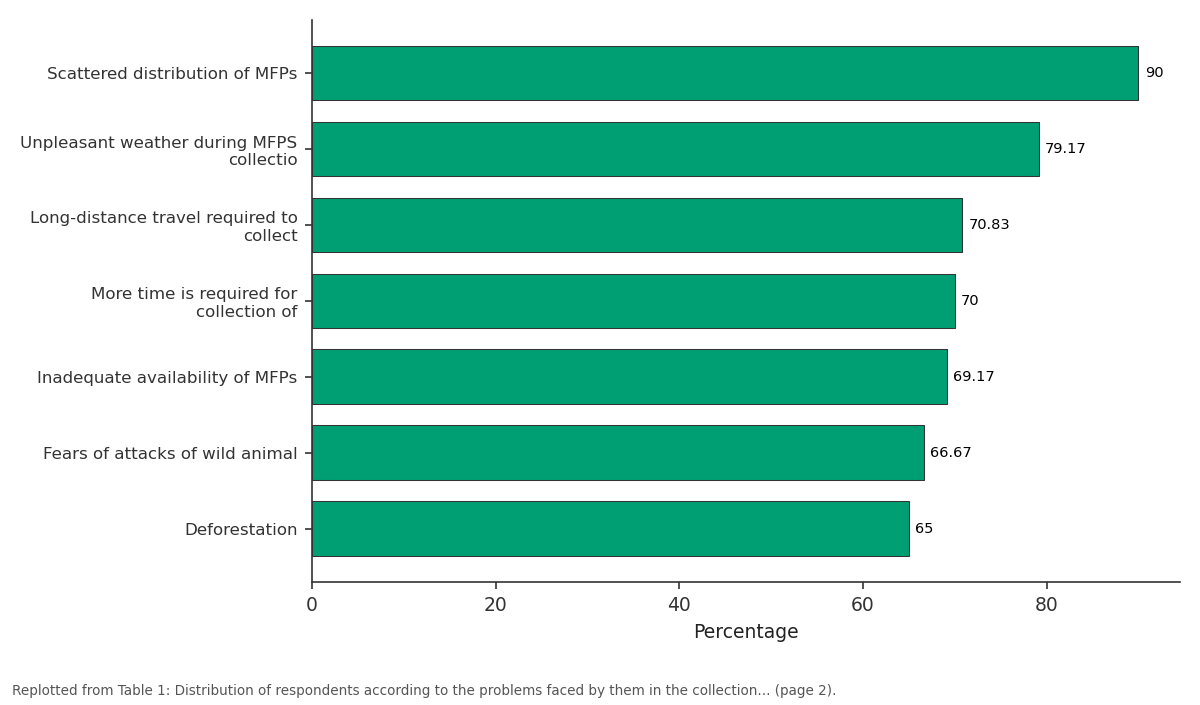
Percentage: Scattered distribution... vs Unpleasant weather... vs Long-distance travel... vs More time is required... vs Inadequate availability...
Replotted from Table 1 (page 2) of the original paper. Every bar is the paper's own table value.
View source evidence ↗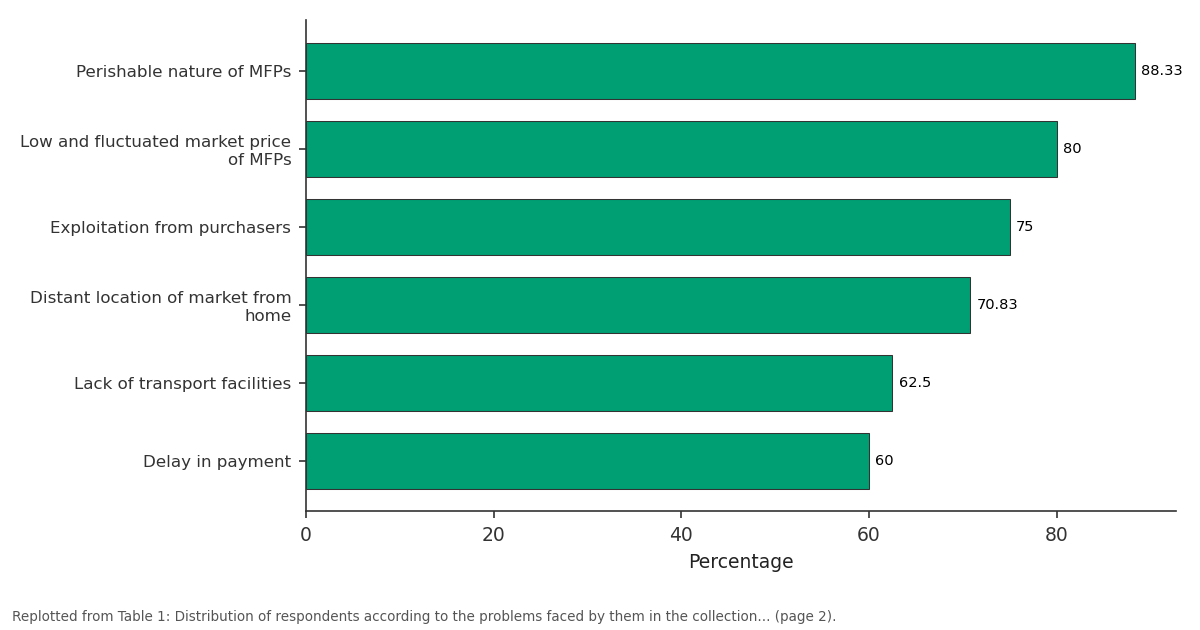
Percentage: Perishable nature of... vs Low and fluctuated... vs Exploitation from... vs Distant location of... vs Lack of transport...
Replotted from Table 1 (page 2) of the original paper. Every bar is the paper's own table value.
View source evidence ↗Figures & tables
From the original paper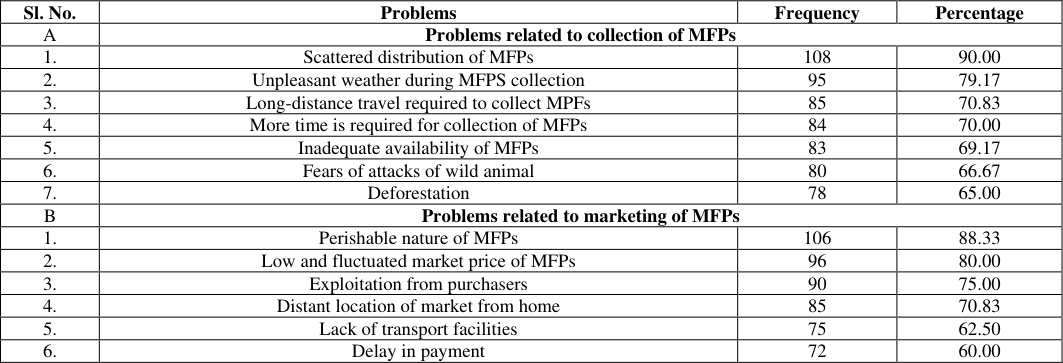 Table 1
 Table 2
Introduction
It is widely recognized that India's forest thrived primarily in areas where there is a significant tribal population. This phenomena is mostly explained by the historical desire of tribal people to protect and enhance their forests. Forests always had a vital role in their economy, culture, and other aspects of life. All forest products of plant origin except timber, such as bamboo, brush wood, stumps, cane, tussar, cocoons, honey, wax, lac, tendu or Kendu leaves, medicinal plants and herbs, roots, tubers, and the like, are referred to as "minor forest produce." India has about 16000 plant species; out of which 3000 yield NTFPs providing 40% of forest revenues and 55% forest based employment (Shit and Pati, 2012) [8] . According to World Resource Institute, over 500 million people in India are dependent on NTFPs for their subsistence and cash income (Sarmah and Arunachalam, 2011) [7] . Chhattisgarh is gifted with the most pristine and abundant set of natural resources in the country. The total forest cover area in the state is 55,717 km sq, which is 41.21 percent of its geographical area (Indian forest report, 2021) [9] . The Kanker (Uttar Bastar Kanker) district possesses a forest cover spanning 3,396.01 square kilometers, which constitutes 47.42% of its overall geographical expanse. The tribal population of this district stands at 414,770 individuals, comprising 55.4% of the total population within the Kanker (Uttar Bastar Kanker) district in Chhattisgarh. Among these alternative sources of income, Minor Forest Products (MFPs) hold a particularly crucial role in enabling their sustainable livelihoods. MFPs provide a source of income and employment that significantly contributes to the well-being of the tribal population.
Materials and Methods
The research was carried out in Kanker district of Chhattisgarh. The Forest Department of Kanker has been divided into 3 divisions namely Kanker, west Bhanupratapur and East Bhanupratapur. From each forest division, 40 tribal women beneficiaries of Van Dhan Yojna were selected randomly, thus total of 120 (40×3=120) beneficiaries were selected for the study.The data was collected personally by using a pretested structured interview schedule. Collected data was tabulated and processed by using appropriate statistical tools and methods.
Results and Discussion
Results and Discussion
Problems faced by the respondents during collection and marketing of MFPs
The result shows that the majority 90.00 percent of respondents faced problems during the collection of MFPs was scattered distribution of MFPs, followed by 79.17 www.extensionjournal.com percent of respondent faced unpleasant weather during MFPs collection, while 70.83 percent of respondent faced long-distance travel required to collect MFPs, followed by 70.00 percent respondent faced more time required for collection of MFPs, followed by 69.17 percent respondent faced inadequate availability of MFPs, while 66.67 percent respondents faced by fear of attacks of wild animal, and 65.00 percent respondents faced deforestation during collection of MFPs. Gupta et al., (2015) [2] reported some prevailing problems like low and fluctuated market price, lack of developed market, existence of bad weather causes significant interruption in collection and marketing of NTFPs. Almost same findings were also reported by Patel et al. (2008) [4] and Nedanovska (2012) [3] . The majority 88.33 percent of respondents faced problems regarding to the marketing of MFPs are perishable nature of MFPs, followed by 80.00 percent respondents faced low and fluctuated market price of MFPs, followed by 75.00 percent respondents faced exploitation from purchasers, while 70.83 percent respondents faced distant location of market from home, while 62.50 percent respondents faced lack of transport facilities, and 60.00 percent respondents faced a delay in payment. PUNEETH, J. ( 2015) [5] reported some similar problems related to marketing are perishable nature of MFPs and delay in timely payment. Ahenkan and Boon (2010) [1] reported that the NTFPs marketing in rural areas of Ghana are unorganized, far from home and farmers also lack the necessary marketing skills, lower cost of NTFPs and information required for optimal performance. Tejaswi (2007-2008) [10] reported nearly identical outcomes.
3.2 Suggestions were given by the respondents to overcome the problems related to the collection and marketing of MFPs: It portrays that the majority 90.83 percent of the respondents suggested that forestation should be done in village level/forest land, followed by 84.17 percent respondents suggested for MSP for MFPs marketing should be followed, while 82.50 percent of respondents suggested that programs for forest regeneration to enhance the forest productivity be organized,
Figures and tables from the paper
| Sl. No. | Problems | Frequency | Percentage |
|---|---|---|---|
| A | Problems related to collection of MFPs | ||
| 1. | Scattered distribution of MFPs | 108 | 90.00 |
| 2. | Unpleasant weather during MFPS collection | 95 | 79.17 |
| 3. | Long-distance travel required to collect MPFs | 85 | 70.83 |
| 4. | More time is required for collection of MFPs | 84 | 70.00 |
| 5. | Inadequate availability of MFPs | 83 | 69.17 |
| 6. | Fears of attacks of wild animal | 80 | 66.67 |
| 7. | Deforestation | 78 | 65.00 |
| B | Problems related to marketing of MFPs | ||
| 1. | Perishable nature of MFPs | 106 | 88.33 |
| 2. | Low and fluctuated market price of MFPs | 96 | 80.00 |
| 3. | Exploitation from purchasers | 90 | 75.00 |
| 4. | Distant location of market from home | 85 | 70.83 |
| 5. | Lack of transport facilities | 75 | 62.50 |
| 6. | Delay in payment | 72 | 60.00 |
Table text extracted from the original PDF; superscript letters are shown inline. The original table image is below.
View original table image
| Sl. No. | Suggestions | Frequency | Percentage |
|---|---|---|---|
| 1. | Forestation should be done in the village level/forest land | 109 | 90.83 |
| 2. | MSP for MFPs marketing should be followed | 101 | 84.17 |
| 3. | Programs for forest regeneration to enhance the forest productivity be organized | 99 | 82.50 |
| 4. | Checking of over-collection of MFPs | 92 | 76.67 |
| 5. | Subsidy & bonus should be given in time | 90 | 75.00 |
| 6. | Timely market information about MFPs | 87 | 72.50 |
| 7. | Springiness in forest rule and regulations for MFPs collection | 77 | 64.17 |
Table text extracted from the original PDF; superscript letters are shown inline. The original table image is below.