
Research article · 2024 · Full text
International Journal of Advanced Biochemistry ResearchOptimisation of button mushroom cultivation through locally available substrates under Kashmir conditions
Volume 8(2S) · Pages 367–369 · DOI: 10.33545/26174693.2024.v8.i2se.600 ↗
Research areasFungal Biology and Applications
Abstract
Author-writtenSix agro bye products which include wheat straw, paddy straw, corn straw, paddy husk and typha grass were evaluated as base substrates for button mushroom production, keeping the other ingredients constant for all substrates. Colonization occurred in all types of compost The maximum yield (9.76 kg mushroom per qt compost was recorded in wheat straw and minimum (6.69 kg mushroom per qt compost) in soybean straw and other substrates being statistically identical with it. Average no of fruit bodies per kilogram mushroom, single fruit body weight, pileus and stipe diameter were statistically identical in all treatments. Thus all the above locally and easily available agro-wastes can be successfully utilized for button mushroom production in different regions of the valley.
Summary
Source-checkedPlain-language reading of the full paper, prepared with AI and checked against the text. Each point links to the authors' own words.
Why it matters
- Increasing population and limited arable land for traditional crops make mushrooms a necessary alternative food resource. View evidence ↗
- Mushroom cultivation serves as a biotechnological method to convert lignocellulosic agricultural waste into protein. View evidence ↗
- Commercial mushroom farming is well-suited for the agro-climatic conditions of the Jammu and Kashmir region. View evidence ↗
The question
- The study aimed to evaluate six different locally available agricultural by-products as base substrates for producing button mushrooms. View evidence ↗
What they did
- The compost was prepared by mixing 300 kg of the chosen straw with specific amounts of poultry manure, rice bran, corn liquor, linseed meal, urea, and potash. View evidence ↗
- The composting process involved turning the pile on the 7th, 14th, 21st, 28th, 32nd, and 35th days, with gypsum added during the first four turnings. View evidence ↗
- Spawning was performed at a rate of 0.5% by weight, with colonization typically taking 10 to 15 days. View evidence ↗
- Data analysis used a completely randomized design (CRD) with a critical difference calculated at a 5% probability level. View evidence ↗
What they found
- Wheat straw produced the highest yield at 9.76 kg per qt of compost, while soybean straw produced the lowest at 6.69 kg per qt. View evidence ↗
- Paddy husk had the highest average number of fruit bodies per kg (82.80) and single fruit body weight (12.60 g), followed by wheat straw and typha grass. View evidence ↗
- There were no statistically significant differences in the average diameter of the pileus and stipe across all tested substrates. View evidence ↗
- All six tested agro-waste substrates successfully supported the colonization of mushroom mycelium. View evidence ↗
What it means
- The authors conclude that locally available, low-cost organic substrates are potentially suitable for button mushroom production. View evidence ↗
- Using local agricultural waste for mushroom cultivation is recommended as a method to reduce environmental pollution. View evidence ↗
Visual summary
3 visualsIllustrations explain the paper; charts are replotted from the paper's own table values.
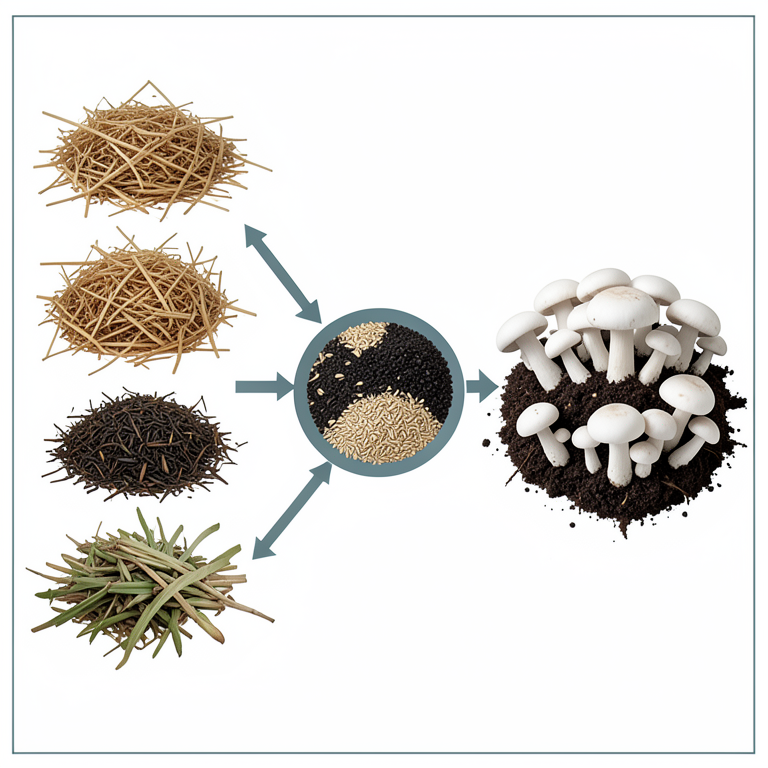
Substrate Comparison Setup
AI-generated conceptual illustration (Agaricus bisporus (button mushrooms) and agricultural waste substrates). It explains the idea and does not show study data.
View source evidence ↗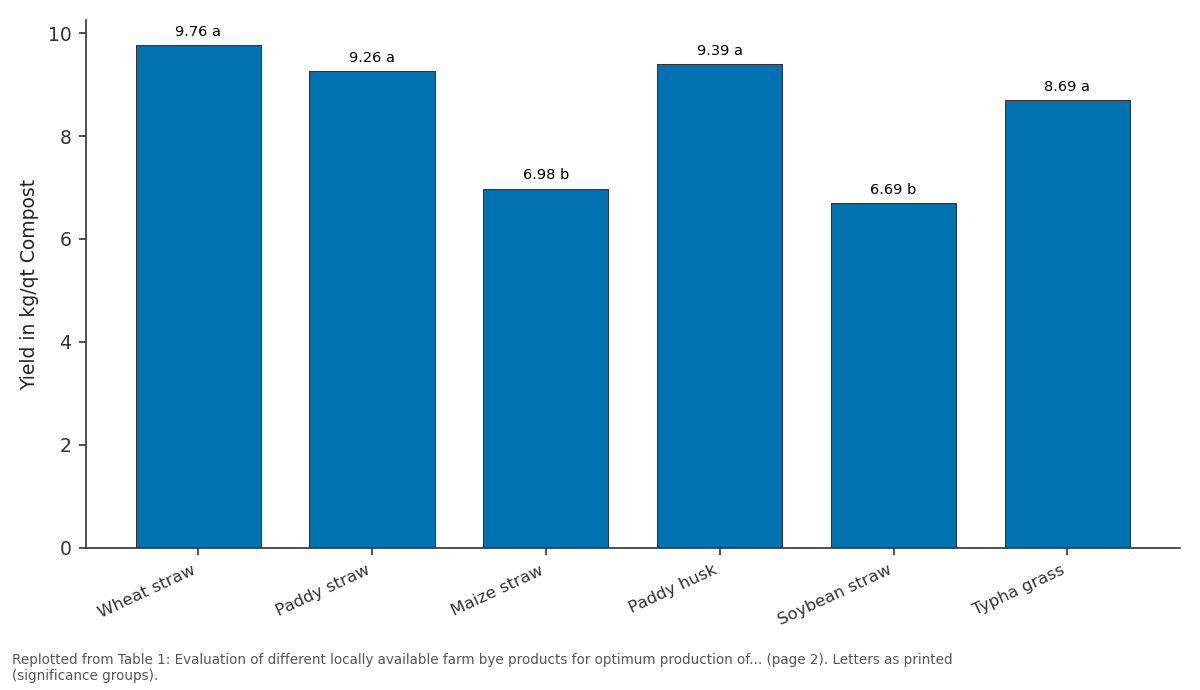
Yield in kg/qt Compost: Wheat straw vs Paddy straw vs Maize straw vs Paddy husk vs Soybean straw
Replotted from Table 1 (page 2) of the original paper. Every bar is the paper's own table value.
View source evidence ↗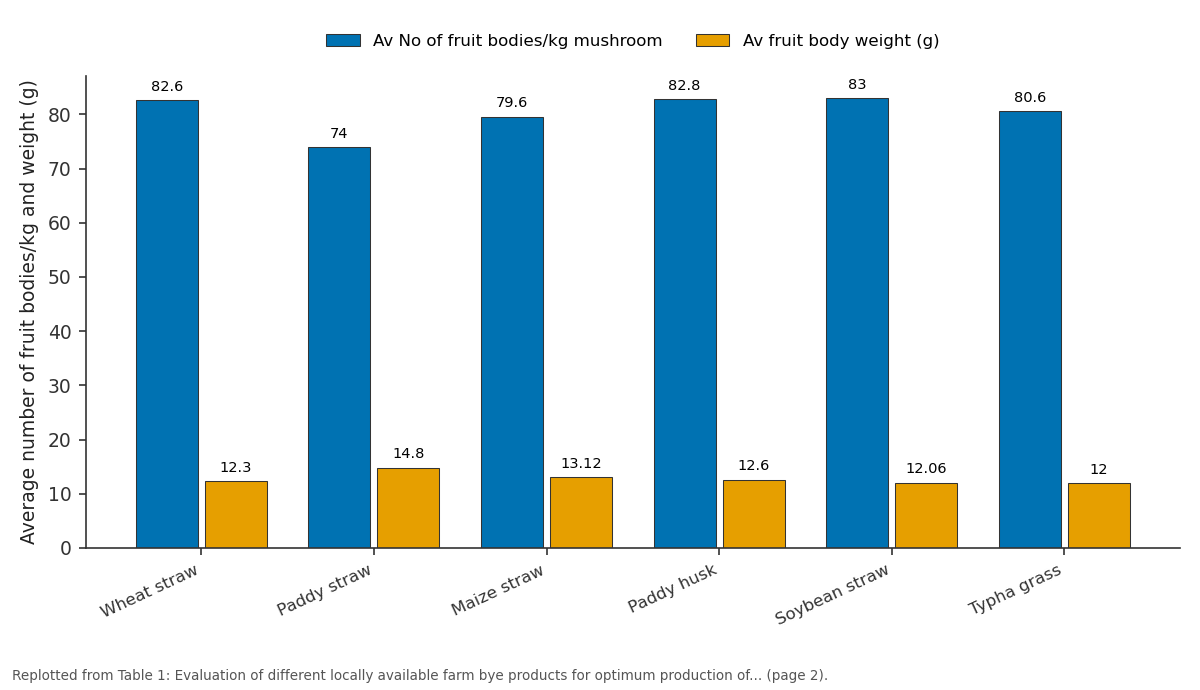
Av No of fruit bodies/kg mushroom and Av fruit body weight (g): Wheat straw vs Paddy straw vs Maize straw vs Paddy husk vs Soybean straw
Replotted from Table 1 (page 2) of the original paper. Every bar is the paper's own table value.
View source evidence ↗Figures & tables
From the original paper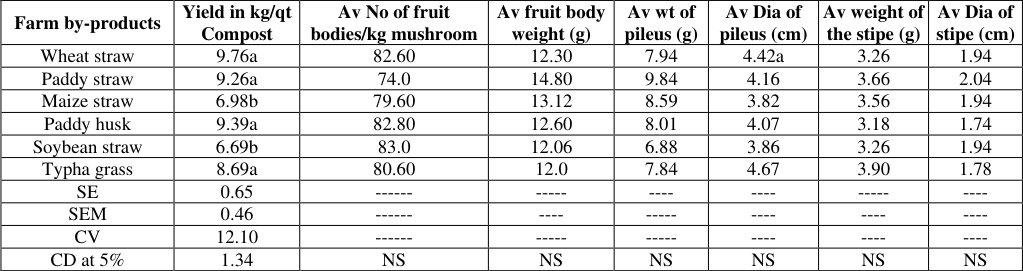 Table 1
Introduction
The enormous increase in our population has necessitated food production through alternate resources such as mushroom as the availability of arable land for traditional crops is unlikely to increase. There are about 5000 different species of mushrooms of which at least 1250 are reported to be edible. The cultivation of edible mushrooms is a biotechnological intervention for the conversion of various lingo-cellulosic agro-waste into proteins. Their cultivation on extensive scale can help solve many problem such as protein shortage, resource recovery and reuse as well as part of environmental management. The commercial mushroom cultivation is an appropriate agribusiness suiting the agro-climatic conditions of Jammu and Kashmir state. Its cultivation involves low-cost eco-friendly technology wherein locally available farm wastes are utilized as raw material. The temperate climatic conditions prevailing in Kashmir valley are quite conducive for mushroom cultivation almost throughout the year.
Materials and Methods
Six agro bye products which include wheat straw, paddy straw, corn straw, soyabean straw, paddy husk and typha grass were evaluated as base substrate for button mushroom production by long method of compositing. The other ingredients were kept constant for all substrates. The time taken in compositing of the various agro-wastes were the same. The process involved the chopping of the substrates to pieces of 20-30 cm size followed by filling in water filled drums or tubs. Poultry manure (200 kg), Rice bran (50 kg), Corn liquor 5 litres, linseed meal (7 kg), urea (5 kg), Potash (2 kg) was mixed in 300 kg straw (wheat straw, paddy straw, corn straw, soyabean straw, paddy husk and typha grass). the ingredients are stacked into a pile of 1.5 m height and 1.10 m width. The heap was then compresses by applying light pressure. perforated pipes were kept vertically in the pile for aeration. The turning of the pile was done on 7 th day, 14 th day, 21 st day 28 th day wherein 10-15 kg gypsum was added. The 5 th and the final turning was done on the 32 nd and 35 th day respectively. The compost with a light brown color and no smell of ammonia was then ready for spawning with mushroom mycelium. The spawn is prepared on sterilized wheat grains. thorough spawning was done at the rate of 0.5% by weight, which took on an average of 10-15 days for complete colonization of the compost and the spawned compost was filled in polythene bags. For effective sporophore production soil: peat mixture in 2:1or 3:1 ratio was done after sterilization with 2% formalin. A fine spray of water, 70-80% relative humidity and 16-18 °C temperature. The first flush was ready about 18 days after casing and the mushroom were picked by gentle twisting.
Statistical analysis
The data was statistically analysed following the (CRD) completely randomized design for all the treatments. The critical difference (CD) was worked at 5% probability level. All the treatments were seen to be statistically insignificant.
Results and Discussion
Six agro bye products which include wheat straw, paddy straw, corn straw, paddy husk and typha grass were evaluated as base substrates for button mushroom production, keeping the other ingredients constant for all substrates. Compositing was quicker in wheat straw, paddy straw, corn straw and paddy husk. Colonization occurred in all types of compost. As evident from (Table 1) maximum yield (9.76 kg mushroom per qt) compost was recorded in wheat straw and minimum (6.69 kg mushroom per qt compost) in soybean straw. The other substrates viz., soybean straw, paddy straw, paddy husk and typha grass recorded 9.26.9.36 and 8.69 kg mushroom per qt compost and were statistically identical with wheat straw. Average no of fruit bodies per kilogram mushroom and single fruit body weight was seen to be highest in paddy husk (82.80 and 12.60) followed by wheat straw (82.60 and 12.30) and typha grass (80.60 and 12.0), respectively Hayes and Shandilya. (2018) [1] . Average diameter of Pileus and Stipe were statistically identical in all treatments. The locally available low cost substrates have demonstrated that the locally available organic substrates are potentially suitable for use in the production of button mushrooms. In all of the six substrates, the phase of flushes did not have any effect on the yield. There was statistically no significant difference between (p>0.05) the yield parameters of control (paddy straw) and other low cost substrates used in the experiment. This depicted that other agro wastes used were equally viable substrates for button mushroom cultivation. As far as yield and other quality parameters were analysed they were shown to show the same value as the paddy straw could produce. It might be a way of reducing agro waste in the environment first as reported by Kuyper et al. (2022) [2] as cultivation of the button mushroom on local agricultural wastes creates a way of reducing environmental pollution. The four substrates screened, all supported the growth of the mushroom though to a varying degrees. This confirms the report of Poppe (2000) [4] that button mushroom could be grown on agricultural waste. Apart from the paddy straw which is the traditional substrate for the cultivation of the mushroom, other substrates were equally good. In terms of the number of fruitbodies produced, weight of the fruitbodies and diameter of the pileus it was as good as the control. This agrees with the findings of Randle (2004) [5] who reported that button mushroom can be cultivated on other unsupplemented agricultural waste Randle and Hayes (2002) [6] . The duration of growth is very short and many fruitbodies could be produced within the period. It was also reported by Landlord (2004) [3] that they are not only excellent edible mushroom but also can colonize substrates and grow quickly on some agro waste. There was statistically no significant difference between (p>0.05) the yield parameters of control (paddy straw) and other agro by products Tewari and Sohi (1976) [7] . This means that the other agro waste viz., wheat straw, paddy straw, corn straw, paddy husk and typha grass could be used to produce the mushroom as much as the paddy straw could produce Toker et al., (2017) [8] . It might be a way of reducing agro waste in the environment first as reported by Kuyper et al. (2022) [2] that the cultivation of button mushroom on local agricultural creates a way of reducing environment pollution.
| Farm by-products | Yield in kg/qt Compost | Av No of fruit bodies/kg mushroom | Av fruit body weight (g) | Av wt of pileus (g) | Av Dia of pileus (cm) | Av weight of the stipe (g) | Av Dia of stipe (cm) |
|---|---|---|---|---|---|---|---|
| Wheat straw | 9.76a | 82.60 | 12.30 | 7.94 | 4.42a | 3.26 | 1.94 |
| Paddy straw | 9.26a | 74.0 | 14.80 | 9.84 | 4.16 | 3.66 | 2.04 |
| Maize straw | 6.98b | 79.60 | 13.12 | 8.59 | 3.82 | 3.56 | 1.94 |
| Paddy husk | 9.39a | 82.80 | 12.60 | 8.01 | 4.07 | 3.18 | 1.74 |
| Soybean straw | 6.69b | 83.0 | 12.06 | 6.88 | 3.86 | 3.26 | 1.94 |
| Typha grass | 8.69a | 80.60 | 12.0 | 7.84 | 4.67 | 3.90 | 1.78 |
| SE | 0.65 | ------ | ----- | ---- | ---- | ----- | ---- |
| SEM | 0.46 | ------ | ---- | ----- | ---- | ---- | ---- |
| CV | 12.10 | ------ | ----- | ----- | ---- | ---- | ---- |
| CD at 5% | 1.34 | NS | NS | NS | NS | NS | NS |
Table text extracted from the original PDF; superscript letters are shown inline. The original table image is below.
View original table image
Conclusion
Low cost substrates have demonstrated that the locally available organic substrates are potentially suitable for use in the production of button mushrooms as they are not only excellent edible mushroom but also can colonize substrates and grow quickly on some agro waste. Cultivation of the button mushroom on local agricultural wastes creates a way of reducing environmental pollution.
References
5 in the original paper- Hayes WA, Shandilya TR. Casing soil and compost substrates used in the artificial culture of Agaricus bisporus, the cultivated mushroom. Indian J Mycol Plant Pathol. 2018;7:5-10.
- Randle PE. Supplementation of mushroom composts: A review. Mushroom J. 2004;151:241-269.
- Randle PH, Hayes WA. Progress in experimentation on the efficiency of composting and compost. Mushroom Sci. 2002;8:789-795.
- Tewari RP, Sohi HS. Studies on the use of paddy straw and maize stalks as substitutes for wheat straw to prepare synthetic compost for cultivation of European mushroom Agaricus bisporus. Indian J Mushrooms. 2016;2(2):18-20.
- Toker H, Baysal E, Yigitbasi ON, Colak M, Peker H, Simsek H, Yilmaz H. Cultivation of Agaricus bisporus on wheat straw and waste tea leaves-based composts using poplar leaves as an activator material. Afr J Biotechnol. 2017;6(3):204-212.
Cited by 1
From OpenAlex, OpenCitations and reference lists read by Scinovex
- Evaluation of Different Substrates in Composting for Cultivation of Agaricus bisporus under Agro-ecological Conditions of West Bengal ↗
C. Shanmugaraj, M. K. Biswas · Journal of Advances in Biology & Biotechnology · 2024
Aim: This study aims to evaluate the effectiveness of different compost substrates in the cultivation of Agaricus bisporus (button mushroom) in the lateritic belt of West Bengal, India, by assessing parameters such as spawn run period, pinhead formation, sporophore production, yield, and biological efficiency. Study Design: A Completely Randomized Design (CRD) with three replications per treatment was implemented to ensure…
❝ 3PDF