
Research article · 2024 · Full text
International Journal of Agriculture Extension and Social DevelopmentStudy on identification of gender discrimination practices to access health care: Gandhi’s vision
Volume 7(2S) · Pages 100–103 · DOI: 10.33545/26180723.2024.v7.i2sb.349 ↗
Research areasSocial and Economic Development in IndiaIndian History and Philosophy
Abstract
Author-writtenPersistent imbalance between men and women in all facets of society inevitably leads to discrimination based on gender. Discrimination against women varies in scope and intensity depending on contextual factors such culture, politics, ethnicity, location, country, and economy. But discrimination based on gender is seen as a major roadblock in progress, and it's been linked to violence against women. Therefore, policymakers around the world are focused on achieving gender equality because it boosts economic growth and ensures the development process can continue. In traditional patriarchal societies it is generally believed that women should remain confined to their families and under legal and customary subjection of their husbands or other male family members. During pre-Gandhian times gender inequality and gender violence were all pervasive. Women were regarded as the root cause of all evil and responsible for downfall of men. Women had a decidedly inferior status and were totally dependent on men. Women were confined to the family and remained under legal and customary subjection of their husbands or other male family members. Customs and practices like female infanticide, child marriage, purdah (veil), dowry, polygamy, sati, repeated pregnancies, permanent and pathetic widowhood, illiteracy, wife beating and verbal abuse made life of common women very hard. In such an atmosphere Gandhi gave a totally new perspective regarding gender equality and non violence. He not only opposed the harmful practices and encouraged regeneration of women but gave the ideal that women are not just equal and different but superior to men. The fact that the culturally entrenched practices of gender discrimination in the distribution of health care facilities is still in fashion, especially in metropolitan regions where access to health care services ought to be universal, highlights the darker side of this patriarchal culture. Gandhiji’s famous message almost six decades ago at the All India Women's Conference on December 23, 1936 was:
Summary
Source-checkedPlain-language reading of the full paper, prepared with AI and checked against the text. Each point links to the authors' own words.
Why it matters
- Gender discrimination arises from a persistent imbalance between men and women across various societal aspects. View evidence ↗
- Gender-based discrimination is considered a significant barrier to progress and is associated with violence against women. View evidence ↗
- Culturally entrenched gender discrimination persists in the distribution of healthcare facilities, even in metropolitan areas where access should be universal. View evidence ↗
The question
- The study aims to identify gender discrimination practices in accessing healthcare, viewed through the lens of Gandhi's vision. View evidence ↗
What they did
- The main survey was conducted in three sites: Panchyawala, Dhawas, and Heerapura. View evidence ↗
- A total of 617 households were visited during the survey period in 2023. View evidence ↗
- Data from interview schedules were processed and analyzed using the Statistical Package for the Social Sciences (SPSS). View evidence ↗
- The analysis employed chi-square statistical methods, cartographic techniques, and literature evaluation. View evidence ↗
What they found
- Across all sampled neighborhoods and regardless of gender, private facilities were the most requested treatment option. View evidence ↗
- In the high-category Ward No. 3 of Basri Municipality, 48.39% of males and 55.88% of females used private facilities. View evidence ↗
- In moderately developed wards, men had higher access to expensive private facilities (57.89% to 71.05%) compared to women (45.45% to 47.83%). View evidence ↗
- In low-income wards, men used expensive private facilities at higher rates (50% to 61.54%) than women (43.28% to 51.72%). View evidence ↗
- Except for one high-category ward, male patients rarely used home remedies, whereas female patients used them as a primary therapy option in most wards. View evidence ↗
- Gender discrimination in healthcare access is evident in medium and low-category wards, while it is minimal in high-category wards. View evidence ↗
What it means
- The authors conclude that women remain disadvantaged in accessing medical care, especially in areas with medium and low development levels. View evidence ↗
- The authors state that the gender gap in healthcare access varies depending on the degree of development of the location. View evidence ↗
Visual summary
3 visualsIllustrations explain the paper; charts are replotted from the paper's own table values.
Development vs. Discrimination
AI-generated conceptual illustration (Urban residential wards with varying infrastructure levels). It explains the idea and does not show study data.
View source evidence ↗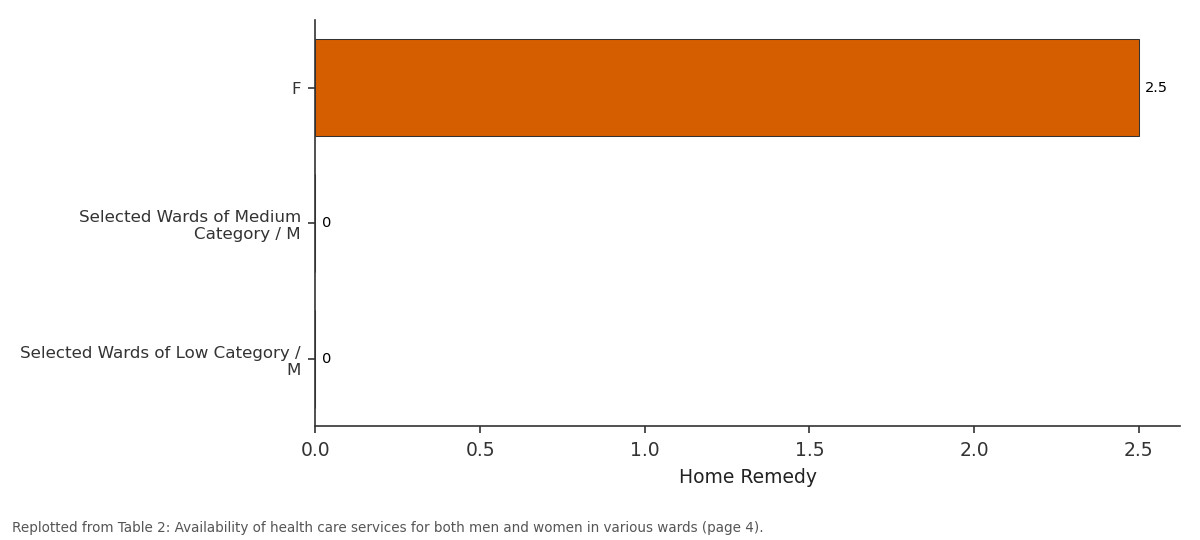
Home Remedy: F vs Selected Wards of... vs Selected Wards of Low...
Replotted from Table 2 (page 4) of the original paper. Every bar is the paper's own table value.
View source evidence ↗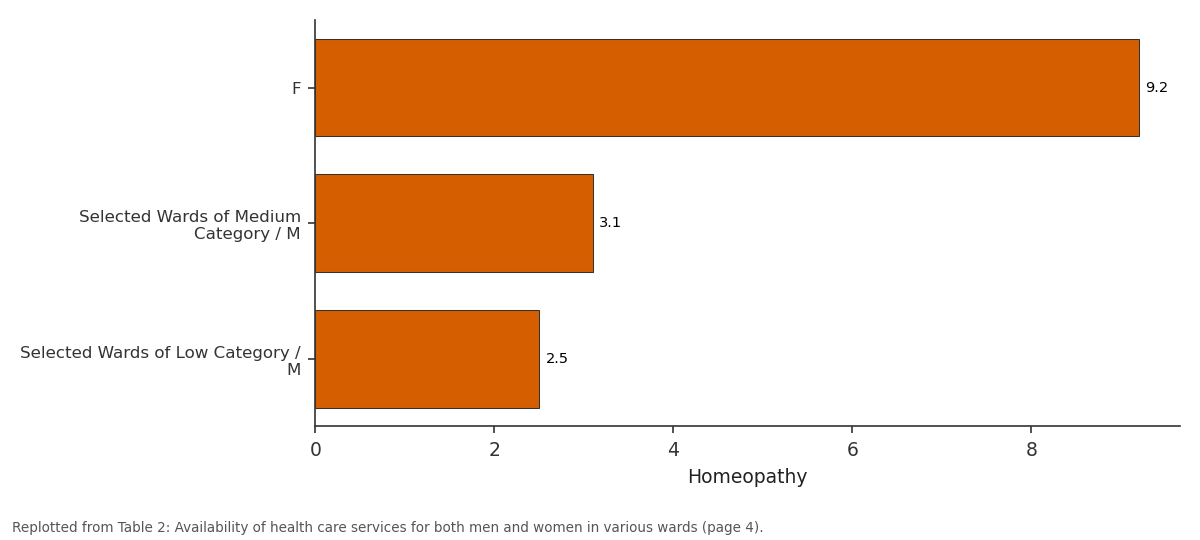
Homeopathy: F vs Selected Wards of... vs Selected Wards of Low...
Replotted from Table 2 (page 4) of the original paper. Every bar is the paper's own table value.
View source evidence ↗Figures & tables
From the original paper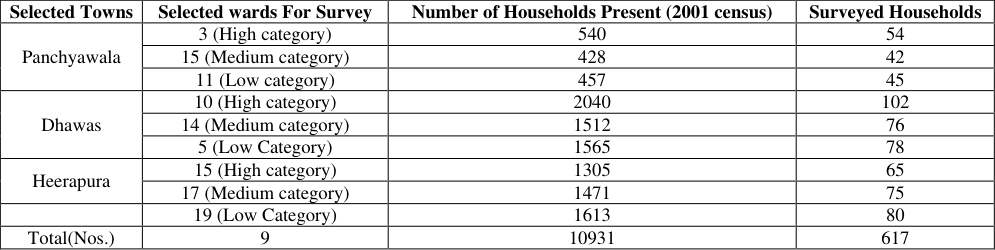 Table 1
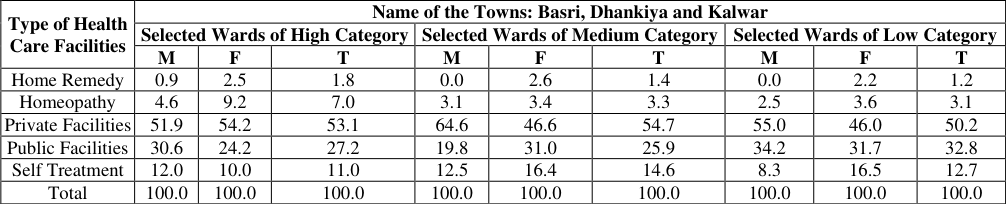 Table 2
Introduction
One of the most telling metrics of a country's progress is its health care system. Health is a crucial component of every nation's developmental and transformative process. Some aspects of economic and social change can either improve or detract from the health status of the population; for example, the health status of the people not only determines the life expectancy at birth, but it also takes into consideration the productive age and economic productivity, employment, and earning capacity, all of which have implications for the economic and social well-being of the population as a whole. On the other side, people's health is influenced by a number of economic factors such as their level of income, employment, buying power, and poverty. Indeed, this feedback loop is characteristic of developing economies (Rani Gopal, 1987) [7] . As a result, health research is crucial for fostering human resource development and economic progress. In advancing the idea of "one world health" and ushering in a new age of international cooperation in the area of medicine, the global Health Organization (WHO) has done a major benefit to humanity. In common use, the term "health" refers to a state of physical and mental well-being, within a supportive social network. However, "Health is a state of complete physical, mental, and social well-being and not merely the absence of diseases" (Sharma, 2000) is the most widely accepted definition of health as given by WHO. In addition, the preamble to the WHO's constitution states, "Governments have a responsibility for the health for their people, which can be fulfilled only by a provision of adequate health and social measures." As a result, in 1970, the World Health Assembly passed a resolution declaring the right to health to be a basic human right. The 30th World Health Assembly then adopted the slogan "Health for All by the Year 2000 A.D." in 1977. Health for all was reaffirmed as a fundamental human right and global social objective at the Alma Ata Conference in 1978. This aim is vital to ensuring that all people are able to meet their most fundamental requirements and enjoy the highest possible quality of life.
"It is health that is real wealth and not pieces of gold and silver" -MK GANDHI When Gandhiji's name is taken in the context of health, it's essential to quote him. He believed in giving away the materialism that's often seen in the present India. Health is always the real wealth and, along with education, is the corner stone for a long-lasting sustainable development. The www.extensionjournal.com constitution of India guarantees the 'right to life' as a fundamental right and makes the 'right to health' an obligation for the government. But to label it as solely the responsibility of the government is in disregard to the ways Gandhiji had taught us to live. Health is a choice in a continuum and the result is from collective decisions on your lifestyle, environment, thought and spirituality, not merely what you may derive from a health care provider. Gandhiji had a view that modern medicine was the bane of man and was used to circumvent our own shortfalls of lifestyle. When our body tells us our ways of life have been corrupted, we resort to the shortcut of medicines and do not face the need for lifestyle changes.
Methodology
For the selection of the study area, extensive secondary data work was conducted by collecting data from a variety of sources in order to gain a comprehensive understanding of the area's physical layout. It provides a comprehensive analysis of the area's environment, as well as its socioeconomic, demographic, cultural, and political situations. After that, it's important to conduct an empirical research to examine the study's primary goals. In fact, the study's whole analysis is predicated. Panchyawala, Dhawas, and Heerapura were the sites of the main survey. Unfortunately, not every neighborhood in these three cities could be investigated due to time and funding constraints. The sex ratio, literacy rate, and labor force participation rate were thus selected as the primary criteria for all of the districts in these three cities. These decisions are motivated by the following factors: One of the most important sociodemographic indicators, the sex ratio may be used to predict the skewed gender dynamics of a region's population. In-depth field surveys were conducted in predetermined areas of the three cities to collect the main data. A wellstructured questionnaire, tailored to the needs of this study, has been developed for data collection. Five to ten percent of all census households in the targeted areas of the three municipalities in 2023 have been randomly picked using a basic random sample approach. Table provides information on the number of homes in the research area that were surveyed by ward. During the survey's target period of 2023-2023, a total of 617 different houses were visited. The completed interview schedule was double-checked and tagged for electronic data processing before being imported into the Statistical Package for the Social Sciences (SPSS) system for tabulation and analysis after each round of fieldwork. All the variables have had their initial frequency counts stated. In order to discover the findings of the research, cross tables of the primary study variables with chosen dependent variables have been constructed. The tabulated data has been quantified, analyzed, discussed, and synthesized through the use of various cartographic techniques, appropriate statistical methods (such as chisquare), visual aids (such as photographic records), and the critical evaluation of relevant literature.
Review of Literature
Maintaining a healthy population is crucial to a country's economic success and human resource expansion. As a result, poor health is now widely acknowledged as both an important barometer of social welfare and a driving force behind economic inequality. The right to health, according to Haq (2005) [3] , is the most fundamental of all human rights, and research shows that spending more on people's health improves their productivity on the job. Reduced illness, low morbidity, and a lighter disease burden are all indicators of an overall population with a higher health status. Good health is, therefore, a goal unto itself. If a country's people were freed from sickness, it might devote its spare time and energy to improving its economic and political standing, as well as its educational and occupational opportunities, among other things (World Bank, 1993) [11] . The fact that health is an indication of wellbeing is common knowledge because of the obvious positive effects it has on both individual happiness and the economy as a whole (Shariff, 1999) [9] . Hazarika (2000) [1] looked at the gender gap in nutrition and health care spending in Pakistan to learn why parents choose to provide for their boys in South Asia. According to his research, boys under the age of five are given preference when it comes to receiving medical attention. Girls, however, seem to be just as well fed, if not better so, than males. Differential rewards to parents from investing in boys and girls are seen as fundamental causes of intra-household gender discrimination, rather than parental preference for males. Similarly, a cross-sectional household survey in a rural area of South India found that both non-poor and poor women were subject to "pure gender bias" in the form of nontreatment, while poor women were also subject to "rationing bias" in the form of discontinued treatment (Iyer et al., 2007) [2] . Similarly to India and Pakistan, Nepalese researchers Pokhrel (2007) [5] examined the impact of gender on parents' decisions to take their children to the doctor. Illness is only one aspect of how gender roles www.extensionjournal.com influence health care decisions, including who gets the sick kid, how much money is spent on medical bills, and what kind of doctor gets called in. However, research by Sauerborn, Berman, and Nougtara (1996) [8] in the West African country of Burkina Faso indicates that parents place less value on the provision of health care for children because they are seen as "unproductive," compared to the provision of health care for adults. Findings did not indicate gender bias in health care use, and parents used income and output stability as a criterion for allocating resources to their children regardless of gender.
Results and Discussions Access to Healthcare Facilities Based on Gender
The availability of various health care facilities in the research region, split up by gender, to provide a clear image of the real situation in today's urban society. Table displays a breakdown, by ward, of the various treatments received by sick men and women in the chosen wards of the three cities. Table shows that across all of the sampled neighborhoods in the three cities, private facilities account for the greatest share of treatment requests, regardless of gender. This is followed by public facilities; self-treatment, homeopathy, and home remedy measures. Analysis of treatment use by ward reveals that in Basri Municipality's Ward No. 3 (High Category), 48.39% of males and 55.88% of females had visited private physicians or private clinics. Similarly, 51.06 percent of men and 50.98 percent of women in Ward No 10 (High Category) of Dhankiya Municipality choose to get treatment from private institutions, whereas 56.67 percent of men and 57.14 percent of women in Ward No 15 (High Category) of Kalwar Municipality do so instead. According to the data, a similar percentage of sick people of both sexes have sought care from private physicians or private clinics in the affluent neighborhoods of the three cities studied. .54 percent, 50 percent, and 57.14 percent of men prefer to use more pricey private facilities, while only 51.72 percent, 43.28 percent, and 46.51 percent of women do so. When compared to their male counterparts, female patients in these medium and low-income wards are more likely to have access to less expensive health care options like home remedy, homeopathy, government hospitals, and selftreatment measures, further highlighting the discrimination faced by women everywhere.
Health care facility among the study area's sample population, broken down by gender
The research also demonstrates that male patients in all of the study area's other chosen wards have never turned to home remedy techniques for treatment, with the exception of Ward No 3 (High Category) of Basri Municipality. Instead, only female patients have opted for home remedy techniques as a primary therapy option in majority of the research area's chosen wards. Thus, the research reveals the existence of gender discrimination against women in terms of access to health care services used for treatment, particularly in the wards of the medium and low categories of all the three chosen cities. In the top group, there is essentially little evidence of gender prejudice against women.
Gender discrimination in access to health care facilities
This section examines the degree to which men and women experience discrimination in the study region with regards to the availability of various types of health care services. www.extensionjournal.com
As can be seen in Table , regardless of the area's degree of development, the majority of patients visit private clinics, followed by public clinics, the self-care, then homoeopathy, and finally home remedy methods. The wealthy may more easily afford the hefty costs associated with private medical care and nursing home stays. Therefore, low-income families often choose for more affordable alternatives when seeking medical care. On the other hand, many of them have been forced to pay for expensive private practitioners and nursing homes because of a lack of doctors, paramedical staff, medicines, and poor quality of health care in the public hospitals in the study area.
However, a somewhat bleak picture emerges when breaking down access to health care by gender in various wards at varying development levels. It's fascinating to discover that outside of the most advanced hospitals, a far smaller percentage of female patients than male choose to use private health care services. Specifically, the research shows that in areas with a medium or low level of development, female patients are actively encouraged to seek treatment from cheaper health care facilities like home remedy, homoeopathy, government hospitals, and self treatment measures, highlighting the discrimination that exists between the sexes. This proves that women are still being disadvantaged in terms of access to medical care, particularly in areas with medium and low levels of development. In more developed neighborhoods, however, signs of gender prejudice against women are less noticeable.
Conclusion
According to the results of the research, despite the fact that girls are generally healthier than males, they have greater rates of morbidity. This suggests that concerns about women's health and mortality are being mostly ignored in the region under investigation. The survey also found that although the overall percentage of people taking "no health action" is low, it is much higher among sick women than men. This is likely due to the fact that women face far more obstacles while attempting to travel than males do. Women are more likely to be excluded from making use of the health system's amenities than males are because of the institutional nature of the Indian healthcare system (Mathur, 1995) [4] . Women are less likely to seek medical help because they have learned from generation to generation that men tend to ignore their pain and because they worry about the costs involved (Rana, et al, 2005) [6] . Women are disproportionately responsible for taking care of children and maintaining the home. Because of this, people are often too busy or unmotivated to address their health concerns. This study's findings suggest that the gender gap in this field changes with the sample study location's degree of development. This is evident due to the interconnected nature of factors such as the literacy rate, educational status, work participation rate, income, and standard of living of individuals, all of which contribute to shaping the general public's worldview and cultural perception of "gender practise" within society.
Figures and tables from the paper
| Selected Towns | Selected wards For Survey | Number of Households Present (2001 census) | Surveyed Households |
|---|---|---|---|
| Panchyawala | 3 (High category) | 540 | 54 |
| 15 (Medium category) | 428 | 42 | |
| 11 (Low category) | 457 | 45 | |
| Dhawas | 10 (High category) | 2040 | 102 |
| 14 (Medium category) | 1512 | 76 | |
| 5 (Low Category) | 1565 | 78 | |
| Heerapura | 15 (High category) | 1305 | 65 |
| 17 (Medium category) | 1471 | 75 | |
| 19 (Low Category) | 1613 | 80 | |
| Total(Nos.) | 9 | 10931 | 617 |
Table text extracted from the original PDF; superscript letters are shown inline. The original table image is below.
View original table image
| Type of Health Care Facilities | Name of the Towns: Basri, Dhankiya and Kalwar | — | — | — | — | — | — | — | — |
|---|---|---|---|---|---|---|---|---|---|
| Selected Wards of High Category | Selected Wards of Medium Category | Selected Wards of Low Category | |||||||
| M | F | T | M | F | T | M | F | T | |
| Home Remedy | 0.9 | 2.5 | 1.8 | 0.0 | 2.6 | 1.4 | 0.0 | 2.2 | 1.2 |
| Homeopathy | 4.6 | 9.2 | 7.0 | 3.1 | 3.4 | 3.3 | 2.5 | 3.6 | 3.1 |
| Private Facilities | 51.9 | 54.2 | 53.1 | 64.6 | 46.6 | 54.7 | 55.0 | 46.0 | 50.2 |
| Public Facilities | 30.6 | 24.2 | 27.2 | 19.8 | 31.0 | 25.9 | 34.2 | 31.7 | 32.8 |
| Self Treatment | 12.0 | 10.0 | 11.0 | 12.5 | 16.4 | 14.6 | 8.3 | 16.5 | 12.7 |
| Total | 100.0 | 100.0 | 100.0 | 100.0 | 100.0 | 100.0 | 100.0 | 100.0 | 100.0 |
Table text extracted from the original PDF; superscript letters are shown inline. The original table image is below.
View original table image
References
4 in the original paper- Hazarika. Gender Differences in Children's Nutrition and Access to Health care in Pakistan. Journal of Developmental Studies. 2000;57(1):73-92.
- Iyer A, Sen G, George A. The dynamics of gender and clan in access to health care: evidence from rural Karnataka, India. International Journal of Health Services. 2007;37(3):537-554. [http://www.ncbi.nlm.nih.gov/pubmed]
- Pokhrel S, Snew R, Dung H, Hidagat B, Flersa S, Sanerborn R. Gender risk and child health care utilization in Nepal. Health policy. 2007;74(1):100-109. [http://linkinghub.elsevier.com/retrieve/pii/]
- Sauerborn R, Berman P, Nougtara A. Age bias, but no gender bias, in the intra-household resource allocation for health care in Rural Burkina Faso. Health Transit Review. 1996;6(2):131-145. [http://www.ncbi.nlm.nih.gov/pubmed/1016396]