
Research article · 2024 · Full text
International Journal of Research in AgronomyCluster frontline demonstration for enhancing the productivity of sesame at Chirang district of Assam
Volume 7(2) · Pages 311–312 · DOI: 10.33545/2618060x.2024.v7.i2d.319 ↗
Research areasAgricultural Economics and PracticesAgricultural Science and FertilizationSesame and Sesamin Research
Abstract
Author-writtenThe present study was carried out at different villages of Chirang district of Assam where cluster front line demonstration (CFLD) of high yielding variety (HYV) of sesame (ST-1683) was conducted by Krishi Vigyan Kendra, Chirang, Assam during kharif 2020-21 to 2022-23 in 60 ha area covering 161 farmers to evaluate the impact of CFLD on productivity and profitability of sesame. Yield data of both demonstration and farmers practice were recorded and their yield gap, technology gap, extension gap and technology index were analyzed. The yield of sesame was registered 12.33 to 37.88 percent higher over farmer’s variety. However, the yield and B:C ratio was recorded maximum in CFLD plots than the farmer’s practices. On an average the technology gap, extension gap and technology index were recorded as 1.21 qha-1, 2.63 qha-1 and 29.26 percent respectively.
Summary
Source-checkedPlain-language reading of the full paper, prepared with AI and checked against the text. Each point links to the authors' own words.
Why it matters
- Sesame is a critical oilseed crop in Assam, valued for its high oil content (46-64%) and its use in food, nutrition, and bio-medicine. View evidence ↗
- Sesame production in Assam is limited by biotic stresses, unpredictable rainfall, low soil fertility, and a lack of farmer awareness regarding high-yielding varieties and improved production technologies. View evidence ↗
- Cluster Front Line Demonstrations (CFLD) are used to showcase effective production technologies and management strategies directly on farmers' fields. View evidence ↗
The question
- The study aimed to increase oilseed availability and disseminate knowledge of improved production techniques among sesame farmers in the Chirang district. View evidence ↗
What they did
- The study evaluated the impact of CFLD on sesame productivity and profitability using the high-yielding variety ST-1683 across 60 hectares and 161 farmers in Chirang, Assam, from 2020-21 to 2022-23. View evidence ↗
What they found
- CFLD plots achieved average seed yields of 6.2 to 6.4 q/ha, which was 12.33% to 37.88% higher than the farmers' practice yields of 5.0 to 5.4 q/ha. View evidence ↗
- The study recorded average values of 1.21 q/ha for the extension gap, 2.63 q/ha for the technology gap, and a technology index of 29.26%. View evidence ↗
- The technology index, which indicates the feasibility of a variety in farmer fields, ranged from 27.78% to 31.11% over the three-year period. View evidence ↗
What it means
- The authors conclude that adopting improved production technologies can significantly narrow the technological gap and increase sesame productivity in the Chirang district. View evidence ↗
- The authors recommend that the Krishi Vigyan Kendra continue encouraging local farmers to adopt improved varieties and techniques to reduce the extension gap. View evidence ↗
Visual summary
2 visualsIllustrations explain the paper; charts are replotted from the paper's own table values.
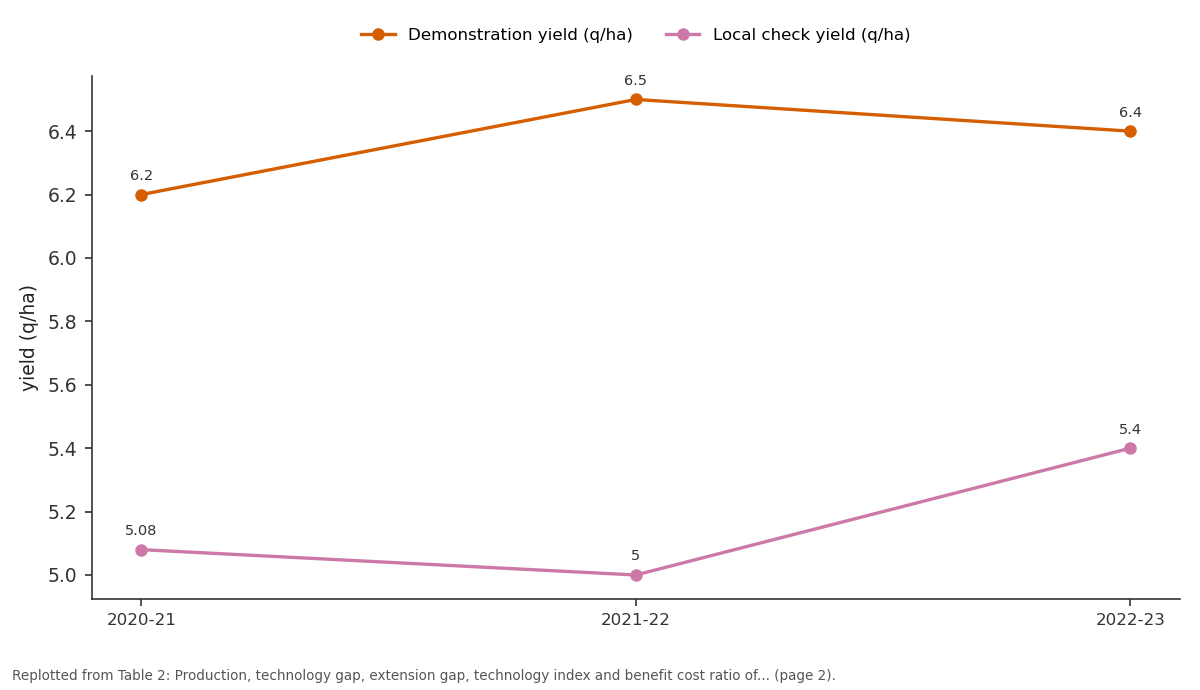
Demonstration yield (q/ha) and Local check yield (q/ha): 2020-21 vs 2021-22 vs 2022-23
Replotted from Table 2 (page 2) of the original paper. Every bar is the paper's own table value.
View source evidence ↗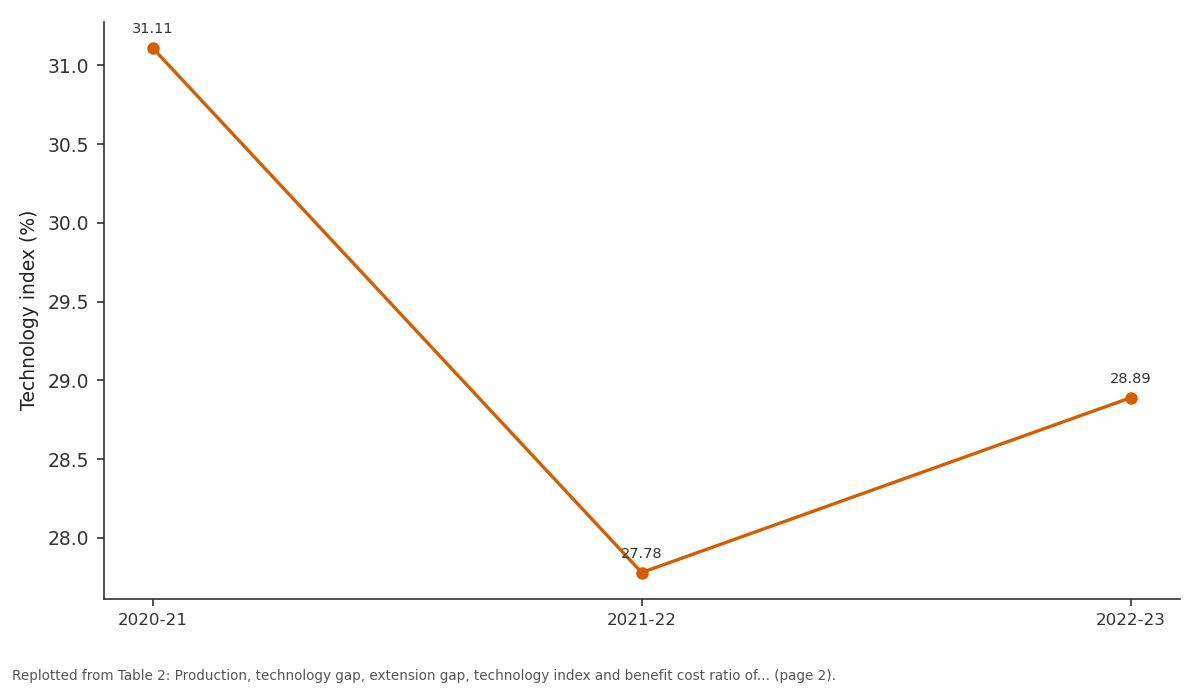
Technology index (%): 2020-21 vs 2021-22 vs 2022-23
Replotted from Table 2 (page 2) of the original paper. Every bar is the paper's own table value.
View source evidence ↗Figures & tables
From the original paper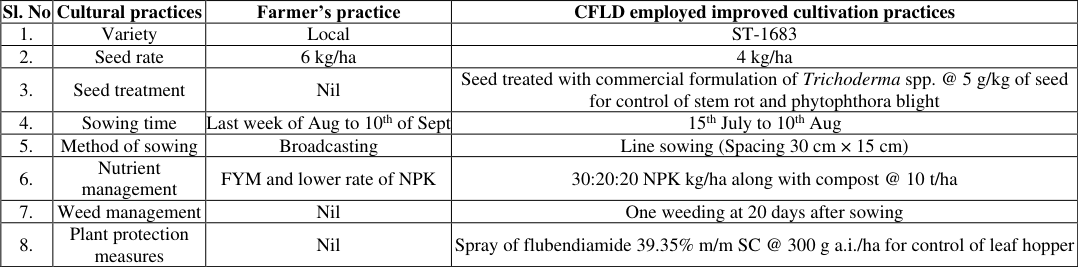 Table 1
 Table 2
Introduction
Sesame is one of the important oilseed crop grown extensively in almost all district of Assam. The crop has the highest oil content (46-64%) and seeds are a good source of food, nutrition, edible oil, and bio-medicine due to the presence of beneficial antioxidants. India leads the globe with a sown area of 51.66 thousand ha and a production of 17.64 thousand tons. It is a versatile crop, and the average production of sesame (413 kg/ha) in India is low as compare to other countries (535 kg/ha). Biotic stresses, rainfall uncertainty, and low soil fertility levels are important reasons for low production of sesame in Assam. Majority of farmers of Assam are unaware of new and high yielding varieties and they generally don't follow the improved production technology which ultimately reduces the production. Under the National Food Security Mission, the Government of India has designed a program to promote cluster oilseed cultivation through KVKs to meet the oilseeds demand. The primary goal of CFLD is to showcase production technology and management strategies on farmer fields in a variety of farming conditions. In this regard KVK, AAU, Chirang has conducted CFLD programme on sesame using high yielding variety ST-83. The objective of this study is to increase the general availability of oilseed and spread knowledge about improved production techniques among the sesame farmers of the district.
Methodology
The study was carried out by Krishi Vigyan Kendra (KVK), Chirang, Assam using sesame variety ST 1683 in different villages during Kharif from 2020-21 to 2022-23. A total area of 60 ha covering 161 farmers were selected for the study. The treatments were selected following the recommended practice of packages. The farmer's method was used as a control plot or local check (Table 1). For demonstration plots, farmers were supplied essential inputs and technical assistance by the KVK Scientist. The data were collected from both CFLD plots and farmers' practice plots and their technological gap, the extension gap and the technology index were calculated by using the specified formula as stated below
| Sl. No | Cultural practices | Farmer’s practice | CFLD employed improved cultivation practices |
|---|---|---|---|
| 1. | Variety | Local | ST-1683 |
| 2. | Seed rate | 6 kg/ha | 4 kg/ha |
| 3. | Seed treatment | Nil | Seed treated with commercial formulation of Trichoderma spp. @ 5 g/kg of seed for control of stem rot and phytophthora blight |
| 4. | Sowing time | Last week of Aug to 10th of Sept | 15th July to 10th Aug |
| 5. | Method of sowing | Broadcasting | Line sowing (Spacing 30 cm × 15 cm) |
| 6. | Nutrient management | FYM and lower rate of NPK | 30:20:20 NPK kg/ha along with compost @ 10 t/ha |
| 7. | Weed management | Nil | One weeding at 20 days after sowing |
| 8. | Plant protection measures | Nil | Spray of flubendiamide 39.35% m/m SC @ 300 g a.i./ha for control of leaf hopper |
Table text extracted from the original PDF; superscript letters are shown inline. The original table image is below.
View original table image
Results and Discussion
The results of all demonstrations conducted at farmers' fields of Chirang district throughout the kharif season of 2020-21 to 2022-23 has been given in Tables 2. The technological interventions of CFLDs during the three years of demonstrations were found to have a beneficial impact on the production of sesame over FP. The average seed yield of sesame under CFLDs ranged from 6.2 to 6.4 q ha -1 as compared to 5.0 to 5.4 q ha -1 in case of FP which was 12.33 to 37.88 percent higher over the FP during 2020-21 to 2022-23. The use of improved variety, a proper seed rate, nutrient inputs and weed control may be responsible for the increase in grain production of sesame under CFLDs over FP. Similar yield enhancement in different crops in cluster frontline demonstrations were reported by Kumar et al., (2010) [4] in bajra; Kumar et al., (2020) [4] in sesame; Deka et al., (2021) [2] in rapeseed and Jakhar and Kumar (2022) [3] in green gram. During the three years of the investigation, an average extension gap and technological gap was recorded as 1.21 qha -1 of 2.63 qha -1 respectively. Likewise, the technology index varied from 27.78 to 31.11 percent during 2020-21 to 2022-23. The technology index indicates whether a particular variety or technology is feasible for use in a farmer's field. The viability of a certain technology is increased by a decrease in the technology index value (Table 2). Similar results were also observed by Bamboriya and Singh (2020) [1] . However, higher benefit-cost ratio was observed in CFLD plots compare to the farmer's practice plot (Table 2). Hence, higher benefit cost ratios proved the economic viability of the cultivation practices and convinced the farmers to adopt the cultivation practices of new variety of rapeseed (Deka et al., 2021 and Kumar et al., 2022) [2,6] .
Conclusion
The present study concludes that adopting improved sesame production technology can narrow the technological gap to a significant level, increasing sesame productivity in the Chirang district of Assam. In order to close the gap between farmer practices and demonstrations for increased sesame production in the Chirang district, Krishi Vigyan Kendra, Chirang also offers appropriate technical help through various extension and educational methods. Implementing different extension activities, such as training programs, field days, method demonstrations, etc., under CFLD programs in farmer's fields, can also help to achieve the horizontal expansion of improved sesame production technology. In addition, Krishi Vigyan Kendra should encourage the locals to adopt improved varieties and production techniques to narrow the extension gap.
References
7 in the original paper- Bamboriya SD, Singh G. Role of cluster frontline demonstrations in enhancement of sesame productivity. J. rural agric. res. 2020;20(2):41-43.
- Deka P, Baishya BK, Bhagawati G, Bhuyan MK, Nath RK. Yield Gap Analysis of Rapeseed (Brassica campestris var. Toria) in Kokrajhar District of Assam, India. Asian J. agric. ext. 2021;39(10):425-428.
- Jakhar DS, Kumar S. Impact of Cluster Front Line Demonstrations on Green Gram (MH-421) in Sirsa District of Haryana State. Ind. J. Ext Ed. 2022;58(1):166-168.
- Kumar A, Kumar R, Yadav VPS, Kumar R. Impact assessment of frontline demonstration of bajra in Haryana state. Indian Res. J Ext. Edu. 2010;10(1):105-108.
- Kumar S, Tiwari RK, Kumar S, Kumar R, Ghosh S, Upadhaya B, et al. Performance Evaluation of Cluster Front Line Demonstration Programme on Sesame (Sesamum indicum L.) in Samastipur District, Bihar, India. Int. J. Curr. Microbiol. App. Sci. 2020;9(5):316-320.
- Kumar S, Tiwari RK, Upadhaya B, Kumar S, Kumar R. Response of Green Gram Demonstrated Technology under Cluster Front Line Demonstration in Samastipur, Bihar, India. Ind. J Ext Ed. 2022;58(2):213-216.
- Samui SK, Maitra S, Roy DK, Mandal AK, Saha D. Evaluation of front-line demonstration on groundnut. J Indian Soc. Coastal Agric. Res. 2000;18(2):180-183.