
Research article · 2024 · Full text
International Journal of Agriculture and Food ScienceAnalysis of labor productivity in intercropping farming of cayenne pepper and tobacco in Subak Gede Sukawati, Gianyar Regency, Bali
Volume 6(1) · Pages 47–52 · DOI: 10.33545/2664844x.2024.v6.i1a.166 ↗
Research areasAgricultural and Environmental ManagementAgriculture and Agroindustry StudiesAgronomic Practices and Intercropping Systems
Abstract
Author-writtenEvery agricultural activity requires labor for the continuity of the process. This research aims to analyze the cost structure, income, and labor productivity of intercropping cayenne pepper and local tobacco in Subak Gede Sukawati, Gianyar Regency, Bali. The sampling technique used was proportional random sampling, with a total of 36 respondents. The analysis technique used is qualitative-descriptive analysis. The research results show that 1) the cost structure of intercropping cayenne pepper and tobacco farming in Subak Gede Sukawati in the 2022 planting season consists of total costs of IDR 110,977,760/ha, with variable costs of 83.37% and fixed costs of 16.63% of total costs; 2) farmers' income in this intercropping farming is IDR 40,907,960/ha; and 3) labor productivity in this intercropping farming is IDR 127,519/HOK. This value is greater than the wages of agricultural sector workers in the research area. The research suggestions are: 1) farmers continue to carry out intercropping farming; 2) carry out further research regarding the analysis of the suitability of commodities with land and agro-climatic conditions in various agricultural areas as well as identifying the advantages and disadvantages of each commodity cultivated in intercropping; and 3) the government facilitates researchers and farmers to increase farmers income.
Summary
Source-checkedPlain-language reading of the full paper, prepared with AI and checked against the text. Each point links to the authors' own words.
Why it matters
- Labor is a critical production input in farming because it drives other production factors and significantly impacts overall productivity. View evidence ↗
- Farmers often use intercropping patterns as a strategy to minimize potential financial losses. View evidence ↗
- Intercropping cayenne pepper and tobacco faces labor shortages, particularly for tobacco which requires skilled workers, forcing farmers to hire expensive outside labor. View evidence ↗
The question
- The study aims to analyze the income, cost structure, and labor productivity of farmers intercropping cayenne pepper and local tobacco in Subak Gede Sukawati, Bali. View evidence ↗
What they did
- The study used proportional random sampling to select 36 respondents from a total population of 183 farmers who intercropped cayenne pepper and tobacco during the 2022 season. View evidence ↗
- The research was conducted in Subak Gede Sukawati, Gianyar Regency, Bali, between October 2023 and January 2024. View evidence ↗
- Data was collected through interviews, direct observation, and literature reviews. View evidence ↗
- The researchers employed a qualitative-descriptive analysis technique to process the data. View evidence ↗
What they found
- The primary expenses for intercropping were labor (54.76%), seeds (19.41%), and land rental (12.80%). View evidence ↗
- Total labor used was 96.24 Person Working Days (PWD), with 53.85% (51.82 PWD) coming from outside the family and 46.15% (44.42 PWD) from within the family. View evidence ↗
What it means
- The authors conclude that the traditional decision to intercrop cayenne pepper and tobacco is correct as it ensures income above local labor wages despite price fluctuations. View evidence ↗
- The authors recommend that farmers continue intercropping while focusing on increasing labor efficiency. View evidence ↗
- Future research is needed to analyze commodity suitability with land and agro-climatic conditions and to identify specific advantages and disadvantages of intercropped commodities to minimize risk. View evidence ↗
Visual summary
1 visualsIllustrations explain the paper; charts are replotted from the paper's own table values.
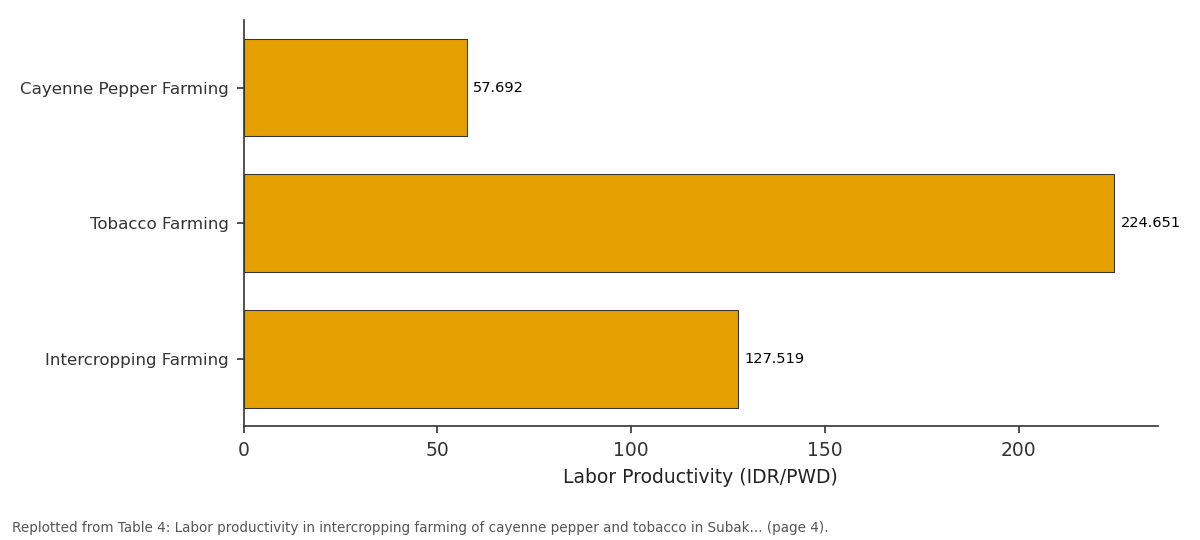
Labor Productivity (IDR/PWD): Cayenne Pepper Farming vs Tobacco Farming vs Intercropping Farming
Replotted from Table 4 (page 4) of the original paper. Every bar is the paper's own table value.
View source evidence ↗Figures & tables
From the original paper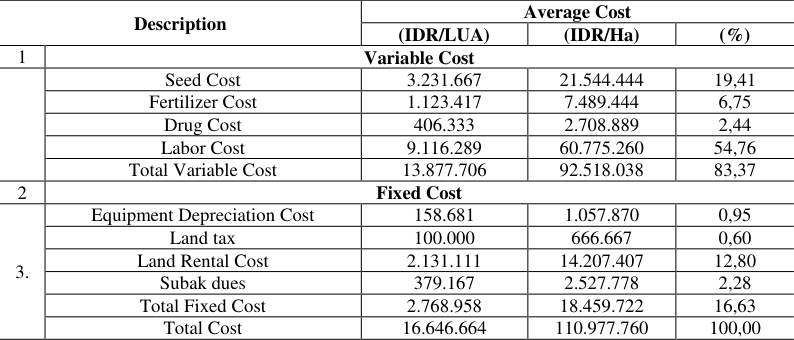 Table 1
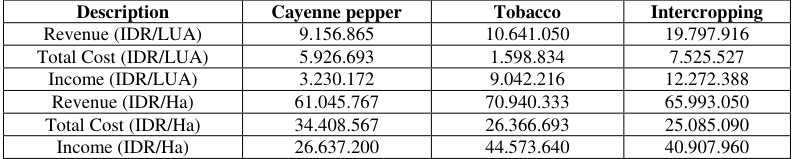 Table 2
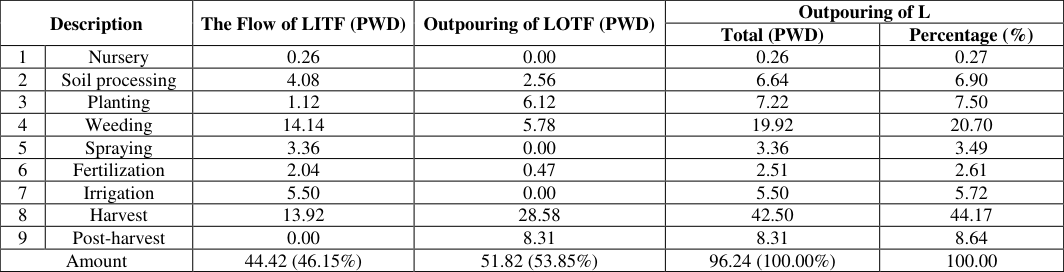 Table 3
 Table 4
Introduction
Labor is one of the main production factors (Input), which plays a very important role in a farming business because it is a driving force for other production factors. The use of labor greatly influences farming productivity. According to Oktarina, & Afriyatna [1] and Simatupang et al., [2] , all stages of work in farming require labor, such as clearing land, cultivating land, planting, fertilizing, maintaining, harvesting, and post-harvest. The farming production process is influenced by land area, labor, and capital. These factors also simultaneously influence farming income [3] . Farming labor is obtained from within the family and outside the family. Labor in the family is generally not valued in terms of money. On the other hand, workers from outside the family can be daily or part-time workers who are paid according to local wages. Rational and efficient use of labor is the basis for obtaining high service rewards for farmers in managing their farming businesses [4] . Labor requirements vary at each stage of farming activities and the types of crops cultivated. Activities that require a lot of labor, for example, during the planting and harvest seasons. Stages that require less labor, for example, when waiting for harvest activities or during maintenance activities. If family labor is insufficient, farmers look for labor from outside the family [5] . The amount of additional labor from outside the family depends on labor needs, the availability of labor in the family, and planting patterns. According to the results of research conducted by Nurmala et al., [6] , farmers choose planting patterns based on experience, the physical condition of the land, the availability of irrigation water, the agro-climate, economic factors, and the risks they face. Many farmers apply intercropping cropping patterns because farmers believe that by implementing this cropping pattern, farmers can minimize losses.
Therefore, Subak Gede Sukawati farmers in Gianyar Regency have implemented an intercropping cropping pattern for quite a long time and from generation to generation. The types of plants intercropping in Subak Gede Sukawati are cayenne pepper and local tobacco. The intercropping pattern for cayenne pepper and tobacco is carried out during one growing season. The planting period for cayenne pepper lasts for eight months, from April -December, some even take a year until cayenne pepper die and wait for crop rotation [7] . Meanwhile, the planting period for people's tobacco, which is planted intercropping with cayenne pepper, only lasts one planting season, namely from April to July of the same year, or from 90 to 110 days old. In Subak Gede Sukawati, Gianyar Regency, there are 13 subaks divided into three groups. Every year, the three groups carry out planting patterns regulated by Pekaseh Subak Gede Sukawati. Arrangements are made based on the availability of irrigation water. In 2022, there will be a Subak group that grows rice and a Subak group that grows secondary crops in the form of cayenne pepper and community tobacco, which are cultivated intercropping. This research focuses on Subak which carries out intercropping of cayenne pepper and tobacco during the 2022 planting season. There are several obstacles experienced by farmers in Subak Gede Sukawati, both technical and non-technical. One of the non-technical obstacles is the lack of labor availability in intercropping cayenne pepper and tobacco farming [8] . Especially in tobacco farming, which requires a lot of labor and requires those with special skills, to overcome this, farmers bring in labor from outside with quite expensive wages. Difficulty obtaining labor hampers the process of managing and harvesting the results of intercropping cayenne pepper and tobacco farming optimally. This affects labor productivity. Based on these problems, a study was carried out regarding the analysis of labor productivity in chili intercropping farming cayenne pepper and tobacco in Subak Gede Sukawati, Gianyar Regency, Bali. The objectives to be achieved in this research are; 1) To analyze the cost structure of intercropping cayenne pepper and tobacco farming in Subak Gede Sukawati; 2) To analyze income from intercropping cayenne pepper and tobacco farming in Subak Gede Sukawati; and 3) To Analyzing labor productivity in intercropping cayenne pepper and tobacco farming in Subak Gede Sukawati.
Materials and Methods
This research was conducted in Subak Gede Sukawati, Gianyar Regency, Bali from October 2023 to January 2024. The selection of the research location was carried out purposively with the consideration that Subak Gede Sukawati is a tobacco-producing center in Bali Province.
The types of data used in this research are quantitative and qualitative data [9,10] . Quantitative data includes fixed costs, including the number, price, and economic life of agricultural equipment, and land tax, as well as variable costs, including the number and wages of labor, the amount and price of fertilizer, the amount and price of medicines, the quantity and price seeds, quantity and price of products To analyze farmers' income from intercropping cayenne pepper and tobacco farming in the 2022 planting season using the following formulation according to Suratiyah [11] and Widyantara [12] .
1. Calculate the total costs in one planting season using the formula
2. Calculate the total revenue from farming using the following formula
Notes TR = Total Revenue (IDR) Y = Production (Kg) PY = Product Price (IDR)
Calculate farming income using the following formula
Analyzing the amount of labor outflow and analyzing labor productivity in intercropping farming in Subak Gede Sukawati in 2022 using the formula according to Widyantara [12] as follows: is 30 acres, and the largest area is between 25 and 35 acres (50%). As many as 92% of farmers have the status of sharecroppers, that is, they carry out farming on product sharing land. Almost all farmers, namely 97%, make farming their main job.
Cost structure
The cost structure of intercropping cayenne pepper and tobacco farming consists of variable costs, fixed costs, and total costs incurred during one planting season in 2022, with details in Table 1. The area of cultivated land for intercropping of cayenne pepper and tobacco for each farmer is 30 acres. Table 1 shows that the total costs incurred by farmers intercropping cayenne pepper and tobacco in Subak Gede Sukawati in the 2022 planting season are IDR 110.977.760, with total variable costs amounting to 83.37% of the total costs, while fixed costs are 16.63% of the total cost. Variable costs have a much higher percentage compared to fixed cost percentages. The three largest costs of intercropping cayenne pepper and tobacco farming, respectively, in terms of the largest value, are labor costs (54.76%), seed costs (19.41%), and land rental costs (12.80%). The high cost of labor in farming is due to the high need for labor in cayenne pepper farming, especially the need for labor during the harvest period. The use of labor during harvest in cayenne pepper farming is 31.89 PWD (56.96%) of the total labor used in cayenne pepper farming. The longer the harvest period for cayenne pepper, the more labor is required. Meanwhile, in tobacco farming, the highest use of labor is during harvesting and weeding, namely 20.75 PWD, or 51.55% of the total labor use. This finding is in line with the findings of Bakari [4] and Musilah et al., 2021 [13] who stated that labor costs are the highest component of food crop farming costs.
| Description | — | Average Cost | — | — |
|---|---|---|---|---|
| (IDR/LUA) | (IDR/Ha) | (%) | ||
| 1 | Variable Cost | |||
| Seed Cost | 3.231.667 | 21.544.444 | 19,41 | |
| Fertilizer Cost | 1.123.417 | 7.489.444 | 6,75 | |
| Drug Cost | 406.333 | 2.708.889 | 2,44 | |
| Labor Cost | 9.116.289 | 60.775.260 | 54,76 | |
| Total Variable Cost | 13.877.706 | 92.518.038 | 83,37 | |
| 2 | Fixed Cost | |||
| 3. | Equipment Depreciation Cost | 158.681 | 1.057.870 | 0,95 |
| Land tax | 100.000 | 666.667 | 0,60 | |
| Land Rental Cost | 2.131.111 | 14.207.407 | 12,80 | |
| Subak dues | 379.167 | 2.527.778 | 2,28 | |
| Total Fixed Cost | 2.768.958 | 18.459.722 | 16,63 | |
| Total Cost | 16.646.664 | 110.977.760 | 100,00 |
Table text extracted from the original PDF; superscript letters are shown inline. The original table image is below.
View original table image
Analysis of farming income in overlapping farming of cayenne pepper and tobacco
In this research, farming income from intercropping cayenne pepper and tobacco farming is the difference between the income obtained and the total costs incurred, apart from labor costs. The results of calculating farming income from intercropping cayenne pepper and tobacco can be seen in Table 2. The area of cayenne pepper and tobacco farming is 15 acres each per farmer, so the area of intercropping cayenne pepper and tobacco farming per farmer is 30 acres. In the 2022 planting season, the income of farming from cayenne pepper farming in Subak Gede Sukawati is lower than the income of farmers from tobacco farming. This is caused by the high production costs of cayenne pepper farming, which affect the income received by farmers. In addition, there are price fluctuations and productivity fluctuations. The average price of cayenne pepper decreased by 10.17%, namely from IDR21.151/kg in 2019 to IDR 19.000/kg in 2022. On the other hand, there was an increase in the average price of chopped dry tobacco by 26.23%, from IDR 46.172/kg in 2019 to IDR 58.285/kg in 2022. The price of cayenne pepper used in the analysis is the price of fresh cayenne pepper at the farmer level, and the price of tobacco is the price of dried, chopped tobacco. Productivity fluctuations are caused, among other things, by climate change. This greatly affects the income from cayenne pepper farming and tobacco farming. The results of this research are following the results of research conducted by Diputri et al., 2021 [14] , which shows that the income from cayenne-tobacco intercropping farming in 2018 was profitable. Looking at the conditions of intercropping farming in Subak Gede Sukawati proves that the farmers' decision to use the intercropping cropping pattern was correct. This is shown by the income of farming from cayenne pepper farming, which is cultivated intercropping with tobacco, which is more profitable than when cayenne pepper farming is carried out in monoculture. The results of this research are in line with the opinions of Warman, & Kristiana 2018 [15] and Ridho & Suminarti 2020 [16] , who state that intercropping between annual crops and annual crops will be more profitable than monoculture. This is because intercropping farming can overcome the risk of losses caused by price fluctuations, reduce operational costs, and is a solution to increase farmers' income.
| Description | Cayenne pepper | Tobacco | Intercropping |
|---|---|---|---|
| Revenue (IDR/LUA) | 9.156.865 | 10.641.050 | 19.797.916 |
| Total Cost (IDR/LUA) | 5.926.693 | 1.598.834 | 7.525.527 |
| Income (IDR/LUA) | 3.230.172 | 9.042.216 | 12.272.388 |
| Revenue (IDR/Ha) | 61.045.767 | 70.940.333 | 65.993.050 |
| Total Cost (IDR/Ha) | 34.408.567 | 26.366.693 | 25.085.090 |
| Income (IDR/Ha) | 26.637.200 | 44.573.640 | 40.907.960 |
Table text extracted from the original PDF; superscript letters are shown inline. The original table image is below.
View original table image
Analysis of labor productivity in overlapping farming of cayenne pepper and tobacco
Outpouring of labor: Wages for agricultural sector workers in Subak Gede Sukawati at the time this research was conducted were IDR 100.000/PWD. There is no difference in wages between male workers and female workers. Working time starts at 07.00 WITA -12.00 WITA, then takes a break and resumes at 14.00 WITA -17.00 WITA, so the total working hours of the workforce are 8 hours/PWD. The distribution of the labor force for intercropping cayenne pepper and tobacco farming in Subak Gede Sukawati in 2022 per activity can be seen in Table 3. The use of labor in intercropping cayenne pepper and tobacco farming in Subak Gede Sukawati in 2022 comes from within the family as much as 44.42 PWD (46.15%) and from outside the family as much as 51.82 PWD (53.85%) of the total outflow of intercropping labor for cayenne pepper and tobacco, namely 96.24 PWD. This shows that the use of labor outside the family (LOTF) is greater than the use of labor within the family (LWTF). The higher use of LOTF compared to LITF is due to activities that require fast processing time and more labor, such as planting, harvesting, and post-harvest tobacco. This is based on research conducted by Saputro et al., 2018 [17] , which states that the use of labor outside the family is greater than labor within the family in farming.
| Description | — | The Flow of LITF (PWD) | Outpouring of LOTF (PWD) | Outpouring of L | — |
|---|---|---|---|---|---|
| Total (PWD) | Percentage (%) | ||||
| 1 | Nursery | 0.26 | 0.00 | 0.26 | 0.27 |
| 2 | Soil processing | 4.08 | 2.56 | 6.64 | 6.90 |
| 3 | Planting | 1.12 | 6.12 | 7.22 | 7.50 |
| 4 | Weeding | 14.14 | 5.78 | 19.92 | 20.70 |
| 5 | Spraying | 3.36 | 0.00 | 3.36 | 3.49 |
| 6 | Fertilization | 2.04 | 0.47 | 2.51 | 2.61 |
| 7 | Irrigation | 5.50 | 0.00 | 5.50 | 5.72 |
| 8 | Harvest | 13.92 | 28.58 | 42.50 | 44.17 |
| 9 | Post-harvest | 0.00 | 8.31 | 8.31 | 8.64 |
| Amount | 44.42 (46.15%) | 51.82 (53.85%) | 96.24 (100.00%) | 100.00 |
Table text extracted from the original PDF; superscript letters are shown inline. The original table image is below.
View original table image
Outpouring of labor
Agricultural labor productivity is critical to the well-being of rural populations, long-term economic growth, and structural change. Low agricultural labor productivity will result in limited food supplies, higher food costs, lower farmer incomes, and ultimately reduced purchasing power [18, 19] . Analysis of labor productivity in the agricultural sector has been carried out by several researchers with various approaches Daniel et al., 2014 [20] Suratman, 2021 [21] , and Rohansyah [22] , with a range of farmer labor productivity values of IDR 82,026/PWD to IDR 208.105/PWD. Labor productivity is also measured by dividing the amount of production (kg) by the amount of labor (PWD) carried out by [23,24] , obtaining labor productivity of 3.84 kg/PWD up to 389 kg/PWD. In this research, the productivity of farmers' labor in intercropping cayenne pepper and tobacco farming in Subak Gede Sukawati in 2022 is measured based on the division between farmers' income from farming (IDR/LUA) and the amount of labor poured into farming (PWD/LUA). Labor productivity was analyzed for the commodities cayenne pepper and tobacco, as well as the intercropping between cayenne pepper and tobacco (Table 4). The results of the analysis show that the highest labor productivity is in tobacco farming because the price of tobacco has increased and the production costs incurred are relatively smaller because the tobacco planting period is faster than the cayenne pepper planting period. The value of labor productivity in tobacco farming can cover the shortfall in labor productivity in cayenne pepper farming. The results of this research prove that the farmers' decision to implement an intercropping pattern between cayenne pepper and tobacco for generations since Subak Gede Sukawati was founded was correct. This is supported by research results showing that even though there were fluctuations in input and product prices, several farmers failed to harvest one of the commodities, but the farmers still earned income above the prevailing labor wages in the local area. Implementing intercropping cropping patterns can also increase the efficiency of labor use and reduce unemployment in the agricultural sector. This is because farming activities are carried out in stages from seeding to post-harvest, and the time required for each stage of activity for each commodity varies relatively between commodities that are cultivated intercropping. This opinion is in line with Dhakal et al., [25] , who stated that around 41.59% of farmers implemented intercropping patterns as an adaptation strategy to reduce climate change. Things that need further research related to this research include 1) Analyzing the suitability of commodities with land and agro-climatic conditions in various agricultural areas; 2) Identifying the advantages and disadvantages of each commodity that is cultivated intercropping so that the right commodity is chosen, so that risks can be minimized and farmers' income can be increased [26] .
| Description | — | Farmers Income (IDR/LUA) | Outpouring of L (PWD/LUA) | Labor Productivity (IDR/PWD) |
|---|---|---|---|---|
| 1 | Cayenne Pepper Farming | 3.230.172 | 55.99 | 57.692 |
| 2 | Tobacco Farming | 9.042.216 | 40.25 | 224.651 |
| 3 | Intercropping Farming | 12.272.388 | 96.24 | 127.519 |
Table text extracted from the original PDF; superscript letters are shown inline. The original table image is below.
View original table image
Conclusion
Based on the results of the research and discussion, conclusions can be drawn
Suggestion
Based on these conclusions, the suggestions that can be given are 1. Farmers continue to carry out intercropping farming and increase the efficiency of using labor. 2. Researchers conducted research related to this research, including 1) analyzing the suitability of commodities with land and agro-climatic conditions in various agricultural areas; 2) identifying the advantages and disadvantages of each commodity that is cultivated intercropping so that the risks that will be faced can be minimized.
3. The government facilitates researchers and farmers so they can increase farmers' income.
Use of AI tools declaration
The author states that he did not use Artificial Intelligence (AI) tools in creating this article.
Acknowledgement
AcknowledgmentThe author would like to thank all parties who have provided input, criticism, and support so that the author can complete this e-journal as well as possible. The author hopes that this journal can be useful for readers.
References
19 in the original paper- Oktarina U, Afriyatna S. Analysis of labor deployment in pineapple (Ananas comosus L.) farming in Lubuk Karet Village, Betung District, Banyuasin Regency. Societa. 2022;11(1):43-49.
- Simatupang JT, Hutapea KP, Aguaninta DS. Analysis of the influence of production factors on shallot farming production and income. Research Journal of Agricultural Sciences. 2021;19(2):37-45.
- Christie GB, Dewi RK, Dewi IAL. Risk of overlapping farming income from cayenne pepper and tobacco in Subak Gede Sukawati, Gianyar Regency. Journal of Agribusiness and Agritourism. 2022;11(1):82-92.
- Bakari Y. Analysis of cost and income characteristics of rice farming. Journal of Agricultural Socio-Economic. 2019;15(3):265. https://DOI.org/10.20956/jsep.v15i3.7288.
- Mujianingsih A, Hiadayati A, Sjah T. Analysis of income and labor absorption in melon and watermelon farming in Central Lombok Regency. Agricultural Science & Technology. 2017;25(1):131-136. https://agroteksos.unram.ac.id/index.php/Agroteksos/art icle/view/53.
- Nurmala L, Soetoro S, Noormansyah Z. Analysis of costs, income and R/C of cabbage (Brassica oleracea) farming (A Case in Cibeureum Village, Sukamantri District, Ciamis Regency). Agro info Galuh Student Sci J. 2016;2(2):97.
- Musilah RN, Putri TA, Utami AD. Activities and production costs of rice farming in the UPSUS Pajale Program in Demak Regency. Agribus Forum. International Journal of Agriculture and Food Science https://www.agriculturaljournals.com 2021;11(2):153-166. https://DOI.org/10.29244/fagb.11.2.153-166.
- Diputri PET, Sudarma IM, Artini NWP. Analysis of rice monoculture farming and Chili Tobacco intercropping. Journal of Agribusiness and Agritourism. 2021;10(1):117-126.
- Warman GR, Kristiana R. Examining the intercropping planting system for annual crops. Proceeding Biology Education Conference. 2018;15(1):791-794.
- Ridho MN, Suminarti NE. The Effect of climate change on the productivity of cayenne pepper plants (Capsicum frutescens L.) in Malang Regency. Journal of Crop Production. 2020;8(3):304-314.
- Saputro AG, Supardi S, Ani SW. Analysis of the time spent by corn farmers in Tabongo District, Gorontalo Regency. SEPA: Journal of Agricultural SocioEconomics. 2018;15(1):50-57.
- Mulu M, Ngalu R, Lazar FL. Intercropping planting pattern in West Satar Punda Village, East Manggarai Regency, East Nusa Tenggara Province. Agrocreative. 2020;6(1):72-78. https://DOI.org/10.29244/agrokreatif.6.1.72-78.
- Bakti AS, Sari SPL, Yuni Elmita S, Ilmia Y, Harini NVA. Outpouring of corn farming labor in the Register 38 Mount Balak Protected Forest Area. Journal of Agriculture and Animal Science (Agrimals). 2023;3(1):10-17.
- Daniel HA, Suyatno A. The Effect of farmers' labor deployment on family income in Tekalong Village, Mentebah District, Kapuas Hulu Regency. Journal of Scientific Research and Reports. 2014;3(1):1-13.
- Suratman YYA. Distribution and productivity of mustard farming workers (Brassica juncea L.) in Landasan Ulin Utara Village, Liang Anggang District, Banjarbaru City. Ziraa'ah Agriculture Science Magazine. 2016;41(2):222-232.
- Rohansyah. Analysis of the labor productivity index for rubber farming businesses in Bentok Darat Village, Bati-Bati District, Tanah Laut Regency, South Kalimantan Province. Science Media. 2017;10(1):2834.
- Adepoju A, Obialo A. Agricultural labor productivity growth and food insecurity transitions among maize farming households in rural Nigeria. Poljoprivrede Economics. 2022;69(4):1093-1107. https://DOI.org/10.5937/ekopolj2204093a.
- Dhakal C, Khadka S, Park C, Escalante CL. Climate change adaptation and its impacts on farm income and downside risk exposure. Resources, Environ Sustainability. 2022;10(7):100082. https://DOI.org/10.1016/j.resenv.2022.100082.
- Yulitasari D, Pramastiwi FE, Situmorang S. Analysis of the cost structure, income and risks of carrot farming in Balik Bukit District, West Lampung. 2022;9(3):12731282.