
Research article · 2024 · Full text
International Journal of Veterinary Sciences and Animal HusbandrySurgical management of traumatic evisceration of abdominal contents in a common cobra
Volume 9(1) · Pages 1307–1309 · DOI: 10.22271/veterinary.2024.v9.i1r.1117 ↗
Research areasUrological Disorders and TreatmentsHernia repair and management
Abstract
Author-writtenA clinical case of common cobra (Naja Naja) was presented with a history of laceration at ventral region and evisceration of abdominal content due to injury during excavation. The snake was anaesthetized with inj. Midazolam HCl @ 1 mg/kg i/m and Ketamine HCl @ 20 mg /kg i/m cranial half of its body. Protruded organs (intestine, mesentery and gall bladder) were lavaged with acriflavine diluted in lukewarm normal saline. Organs were carefully repositioned in abdominal cavity. The musculature was sutured with polyglactin 910 No. 2-0 in simple interrupted pattern. The skin was closed with nylon No. 2-0 in simple interrupted pattern. After treatment snake was handed over to local rescue team. However, snake died after 3 days. Post-mortem examination revealed that there was extensive injury of all major internal organs.
Summary
Source-checkedPlain-language reading of the full paper, prepared with AI and checked against the text. Each point links to the authors' own words.
Why it matters
- Snakes frequently suffer physical injuries caused by predators, vehicles, or human attempts to kill them. View evidence ↗
- Proper immobilization and anesthesia are critical for treating venomous snakes to ensure the safety of handlers and reduce stress for the animal during painful procedures. View evidence ↗
- Standard wound care for snakes involves cleaning tissues with warm saline, removing dead tissue, and preventing secondary infections. View evidence ↗
The question
- The study aims to report on the surgical management of a case involving the evisceration of abdominal contents in a snake. View evidence ↗
What they did
- The subject was a common cobra (Naja Naja) weighing 2kg and measuring 165 cm, which suffered a ventral laceration and abdominal evisceration during excavation. View evidence ↗
- For emergency surgery, the snake was anesthetized and restrained using intramuscular injections of Midazolam HCl at 1 mg/kg and Ketamine HCl at 20 mg/kg. View evidence ↗
- A pre-operative survey radiograph was performed using an Allenger Mars 6 X-ray machine (47 kvP, 3 mAS) to assess the extent of the injury. View evidence ↗
- The eviscerated organs, including the gall bladder, mesentery, and intestine, were cleaned using a lukewarm normal saline solution diluted with acriflavine. View evidence ↗
- Post-operative care included intramuscular injections of Enrofloxacin at 5 mg/kg and Meloxicam at 0.3 mg/kg. View evidence ↗
What they found
- The pre-operative radiograph showed no detectable injuries, although it was unable to fully assess the internal organs. View evidence ↗
- Despite the surgical intervention and subsequent handover to a rescue team, the snake died three days after treatment. View evidence ↗
- A post-mortem examination revealed that the cause of death was extensive internal injury, including a ruptured liver and intestines, which had not been visible on the initial radiographs. View evidence ↗
What it means
- The authors concluded that the combination of Midazolam and Ketamine provided satisfactory anesthesia for performing major surgery on abdominal evisceration. View evidence ↗
Figures & tables
From the original paper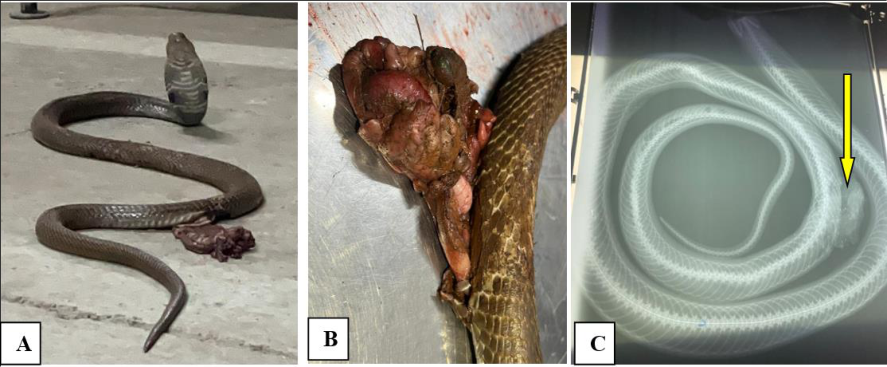 Figure 1
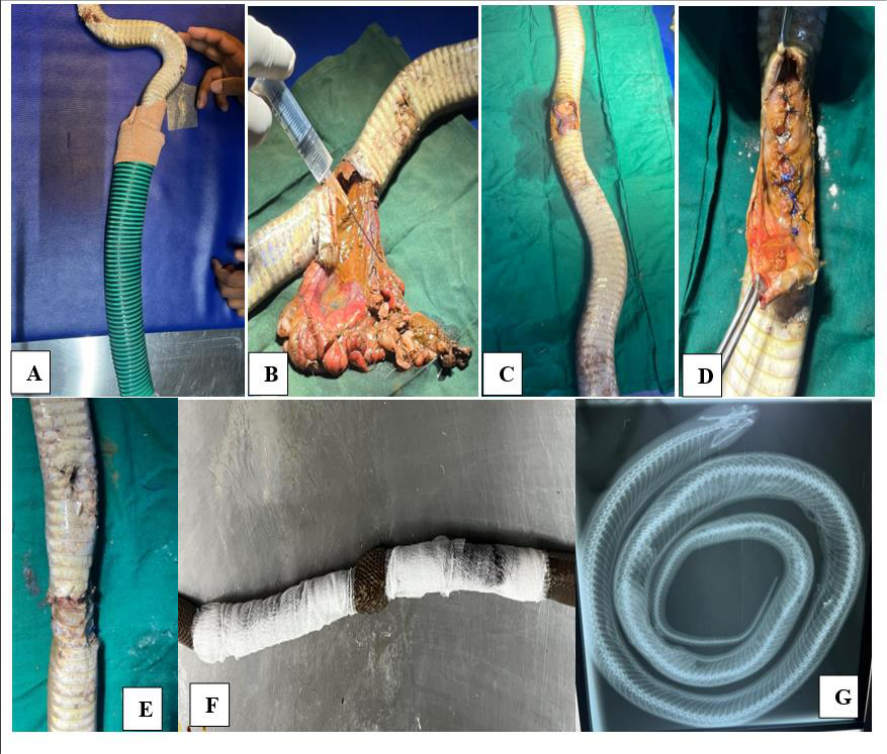 Figure 2
Introduction
Injury in snakes is often inflicted by predators, vehicles or inflicted by people trying to kill them. Evisceration of abdominal content, hemipenes and cloaca results due to such kind of traumatic injury (Jadhav et al., 2007) [12] . During clinical examination leading to painful manipulations, the snake require appropriate immobilization and anaesthesia specially in order to reduce handlers and patient stress and in order to work under safety specially in venomous snakes (Fowler, 1995) [9] . The wound treatment in snakes is based on cleaning the injured tissue using warm saline solution, debridement of devitalized areas and prevention against secondary infections (Mitchell and Diaz-Figueroa, 2004) [14] . Other complementary procedures used to enhance the speed of lesion healing, includes use of antibacterial compounds, antiseptics and occlusive dressings (Clarck, 1980 and Amber et al., 1983) [5,1] . The present report includes surgical management of evisceration of abdominal content in a snake.
Case presentation
A clinical case of common cobra (Naja Naja) weighing 2kg and measuring 165 cm in length was presented with a history of laceration at ventral region during excavation and evisceration of abdominal contents which were soiled and the colour of contents had turned out (Fig 1A and1B). The snake was alert, moving and in defensive position. The snake was scheduled for emergency surgery and restrained by using inj. Midazolam HCl @ 1 mg/kg i/m and inj. Ketamine HCl @ 20 mg/kg i/m. First aid was provided and bandaging was done to protect the injury sites. Pre-operatively, the snake was subjected to survey radiograph in order to evaluate the extent of injury using Allenger Mars 6 X-ray machine with 47 kvP and 3 mAS in sternal recumbancy on a 12X15" film which was processed manually. On radiograph there were no detectable injuries to the snake. However, the other internal organs could not be assessed (Fig. 1C). C: Pre-operative radiograph showed no injury to bones and eviscerated organ can be appreciated.
Surgical treatment
After induction of anaesthesia the snake was restrained and head of the snake secured in a pipe throughout the period of operation (Fig 2A)
Discussion
Main causes of physical injuries in snakes were traumatic origin viz., accidents and inflicted by people trying to kill. In the present case traumatic injury caused by caused by JCB machine during excavation. Similar finding were recorded by Raut et al. (2008) [16] , Chaudhary et al. (2010) [4] , Rocha and Mota (2013) [6] and Roberta and Antônio (2021) [17] . The snake was restrained and anaethesized using inj. Midazolam @ 1 mg/kg b.wt i/m and Ketamine HCl @ 20 mg/kg b.wt i/m. Thompson et al., (2016) [20] reported that use of Midazolam-Ketamine combination was safe for surgical procedures on snakes. Chaudhary et al. (2010) [4] opined that administration of injections should be done in cranial half of the body in snakes as body is having large dorsal musculature associated with ribs and vertebrae. Suturing of musculature was done using Polyglactin as it was favoured over catgut as reptiles lack proteolytic enzyme which will hamper absorption of catgut and may cause further complication as opined by Bennet, (1989) [2] . The skin and scales were closed with nylon no. 2-0 in simple interrupted pattern as suggested by Chaudhary et al. (2010) [4] . In the present case inj. enrofloxacin was administered in accordance with Young et al. (1997) [19] as it showed effective antimicrobial property for combating post surgical infection. Divers et al. (2010) [8] opined that inj. meloxicam appears to be safe and effective drug and had no adverse effects at high doses in snakes. After treatment snake was handed over to local rescue team. However, snake died 3 rd after surgery. Post-mortem examination was performed to evaluate the cause of death which revealed that there was extensive internal injury, ruptured intestines and liver (Fig 3) which were not appreciable in survey radiography. Hence, we opined that the survey radiography was not a sufficient diagnostic aid in including the extent of injuries to the internal organs in snakes.
Conclusion
In the present case use of inj. Midazolam and inj. Ketamine anesthesia was found to be satisfactory to carry out major surgery of evisceration of abdominal contents. Along with radiography further diagnostic tools viz., CT will be required to evaluate extend of internal injuries.
Figures and tables from the paper
References
14 in the original paper- Amber EI, Henderson RA, Swaim SF, Gray BW. A comparison of antimicrobial efficacy and tissue reaction for four antiseptics on canine wounds. Vet Surg. 1983;12:63-68.
- Bennett RA. Reptilian surgery part 1. Basic principles in the Compendium Collection, U.S, 1989, 1.
- Chaudhary PS, Varshney JP, Deshmukh VV. Ruptured stomach in common Cobra (Naja naja) and its surgical correction. Intas Polivet. 2010;11:406-407.
- Clark CH. Use of antibiotics in wounds. Mod Vet Pract. 1980;61:307-312.
- Divers SJ, Papich M, McBride M, Stedman NL, Perpinan D, Koch TF, et al. Pharmacokinetics of meloxicam following intravenous and oral administration in green iguanas (Iguana iguana). Am J Vet Res. 2010;71:12771283.
- Glenn JL, Straight R, Snyder CC. Clinical use of ketamine hydrochloride as an anesthetic agent for snakes. Am J Vet Res. 1972;33:1901.
- Hernandez-Divers S. Snake anesthesia and surgery. Proc North Am Vet Conf. 2008;22:1767.
- Jadhav SS, Disale DS, Mukherjee S. Tail amputation in Indian spectacled cobra-A case report. Zoos' Print J. 2007;22(12):2950.
- Mitchell MA, Diaz-Figueroa O. Wound management in reptiles. Vet Clin North Am Exot Anim Pract. 2004;7:123-140.
- Mustafa S, Zlateva N. Anaesthesia, chemical restraint and pain management in snakes (serpentes) -a review. Tradit Mod Vet Med. 2018;3(1):4.
- Raut PA, Sonkhusale VG, Khan LA, Nakade MK, Bodkhe AM. A case report of the management of snake's injury in captivity. Vet World. 2008;1(11):346.
- Da Rocha Braga R, Lima Ramos AR. Traumatized Reptiles: A Retrospective Study of Wild Reptiles Examined in Northeastern Brazil. Acta Sci Vet Sci. 2021;3(10):28-32.
- Sladky KK, Mans C. Clinical Anesthesia in reptiles. J Exot Pet Med. 2012;21:17-31.
- Thompson AE, Anisimowicz Y, Miedema B, Hogg W, Wodchis WP, Aubrey-Bassler K. The influence of gender and other patient characteristics on health care-seeking behaviour: a QUALICOPC study. BMC family practice. 2016 Dec;17(1):1-7.