
Research article · 2024 · Full text
International Journal of Agriculture Extension and Social DevelopmentA study on adoption of natural farming practices in northern transition zone of Karnataka
Volume 7(2) · Pages 191–196 · DOI: 10.33545/26180723.2024.v7.i2c.329 ↗
Research areasAgricultural Economics and PracticesLivestock Management and Performance ImprovementAgricultural Systems and Practices
Abstract
Author-writtenThe present study was conducted in Dharwad and Belgavi districts of Karnataka state during 2021-22. The adoption level of farmers about natural farming practices was studied by employing “Ex-post facto” research design and by using simple random sampling technique in Dharwad and Belgavi districts constituting a total sample size of 120 farmers. It was observed that 39.17 percent of farmers were noticed in low adoption level of natural farming practices, followed by 30.83 percent in medium adoption category and 30.00 percent of farmers in high adoption category. Large majority (96.67%) of natural farming practicing farmers maintained indigenous desi cow. The large majority of farmers (99.17%) adopted jeevamrutha application and ghanajeevamrutha application was observed to be adopted by 43.33 percent farmers. Regarding adoption of weed management practices, cent percent of the farmers followed hand weeding and intercultivation practices. Regarding pest and disease management, majority of the farmers adopted sour butter milk (75.00%), neemastra (62.50%), dashaparni (36.67%), agniastra (27.50%), brahmastra (18.33%) and shunti astra (8.33%). It was observed that only 30.00 percent of the farmers adopted intercropping of crop-tree association followed by 24.17 percent were practicing intercropping of monocots and dicots.
Summary
Source-checkedPlain-language reading of the full paper, prepared with AI and checked against the text. Each point links to the authors' own words.
Why it matters
- Natural Farming (NF) or Zero Budget Natural Farming (ZBNF) is an alternative approach used to improve farmer income as traditional fertilizer responses decline. View evidence ↗
- Adopting natural farming is considered vital for sustainable agriculture because it can increase income while reducing expenses on synthetic pesticides, herbicides, and fertilizers. View evidence ↗
The question
- The study aimed to measure how extensively farmers in the Northern Transition Zone (zone 8) of Karnataka adopted recommended natural farming practices. View evidence ↗
What they did
- The research used an ex-post facto design and simple random sampling in the Dharwad and Belgavi districts of Karnataka during 2021-22. View evidence ↗
- A total sample of 120 farmers was selected, consisting of 15 farmers from each of the eight selected hoblis who had benefited from an NF project between 2018-19 and 2021-22. View evidence ↗
- The researchers evaluated 37 sub-practices across 10 main categories, scoring each as either adopted (1) or not adopted (0). View evidence ↗
What they found
- The overall adoption levels were split, with 39.17% of farmers showing low adoption, 30.83% medium adoption, and 30.00% high adoption. View evidence ↗
- A vast majority of the farmers (96.67%) maintained an indigenous desi cow, which is a fundamental resource for natural farming. View evidence ↗
- Jeevamrutha application was the most widely adopted practice, used by 99.17% of the farmers. View evidence ↗
- Intercropping had low adoption rates, with only 30.00% practicing crop-tree association and 24.17% practicing monocot-dicot intercropping. View evidence ↗
- A majority of the farmers (78.33%) implemented the practice of erecting contours and bunds in their fields. View evidence ↗
- Farmers attributed low adoption levels to the cumbersome nature of preparing certain inputs (ashtras), lack of skills, inadequate information, and the risk of lower yields in the first few years. View evidence ↗
What it means
- The authors conclude that the high rate of low adoption requires the extension system to provide more training, Farm Schools, demonstrations, and exposure visits. View evidence ↗
- To overcome input scarcity and the difficulty of preparation, the authors recommend producing inputs at the community level through village-based commodity interest groups. View evidence ↗
Visual summary
1 visualsIllustrations explain the paper; they do not show study data.
Adoption Level Distribution
AI-generated conceptual illustration (small-scale farmland in Karnataka, India). It explains the idea and does not show study data.
View source evidence ↗Figures & tables
From the original paper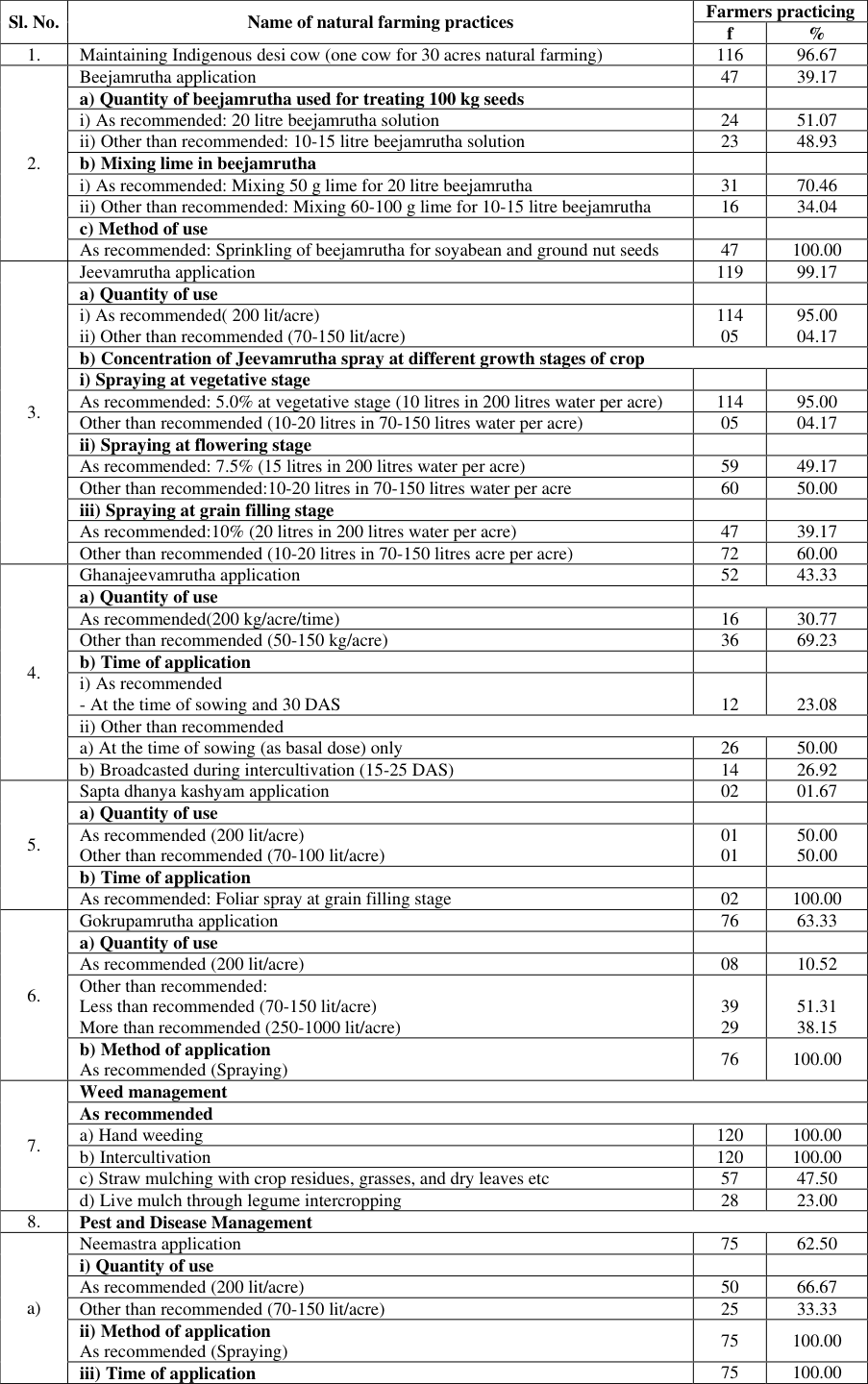 Table 1
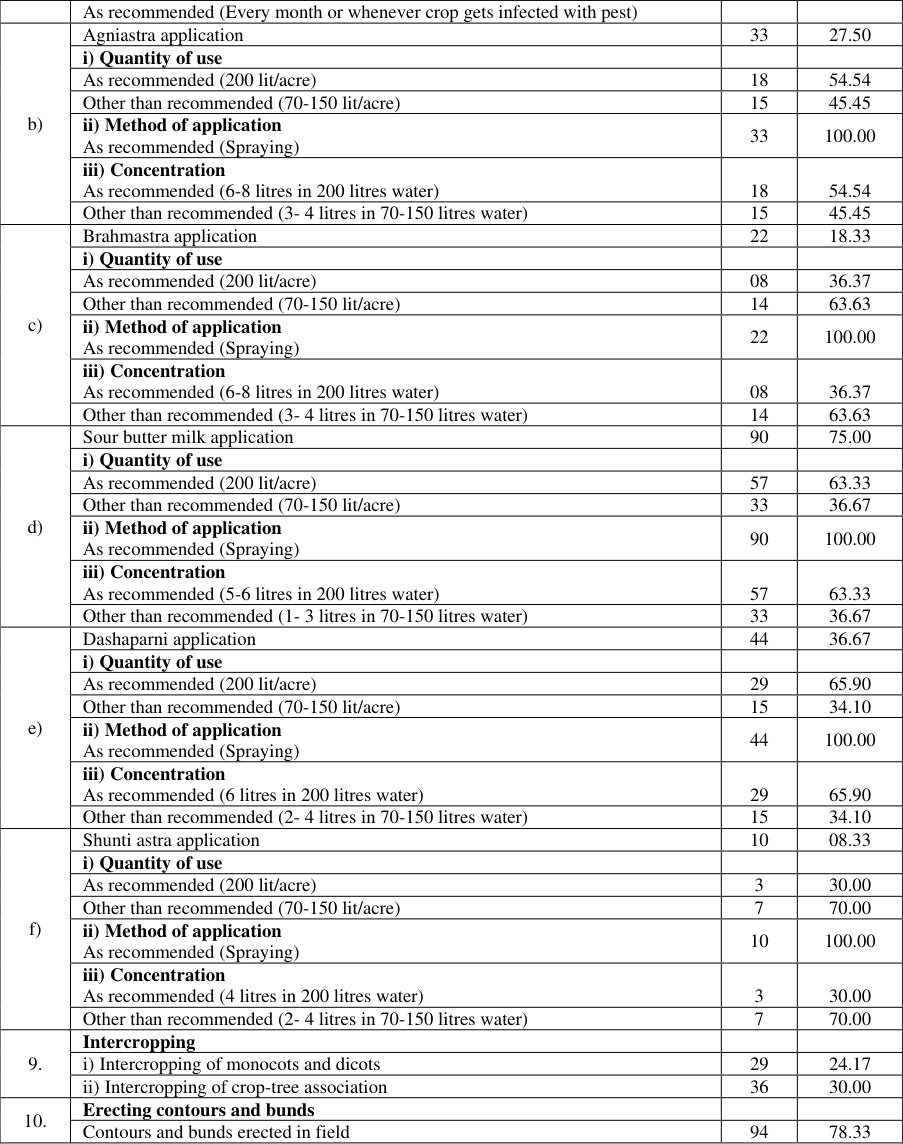 Table 2
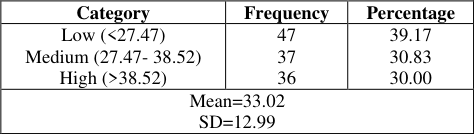 Table 2
Introduction
Natural Farming (NF) or Zero Budget Natural Farming (ZBNF), emerged as one of the alternative farming practices for improving the farmers' income, in the backdrop of declining fertilizer response and farm income. It is considered by FAO as a strategy to ensure greater food security. Initially, a Japanese farmer, Masanobu Fukuoka proposed natural farming, which is founded on the philosophy of working with natural cycles and processes of the natural world. ZBNF which aims to safeguard the environment, public health, and communities is suggested as a neoteric approach to improve both traditional and modern agricultural practices. In July 2018, the National Institution for Transforming India (NITI Aayog) discussed the scope for promoting ZBNF in the entire country. To support natural farming, Government initiated Rastriya Krishi Vikas Yojana (RKVY-RAFTAR) during 29 May 2007, followed by Paramparagat Krishi Vikas Yojana (PKVY) during 2015-16 and Bhartiya Prakritik Krishi Padhati (BPKP) during 2020-21. Karnataka state initiated ZBNF based on grassroots social movement in 2002. Considering the importance of adoption of natural farming practices as an important component of sustainable farming system which helps the farmers to increase their income and cut down the cost of synthetic fertilizers, pesticides and herbicides, the present study was conducted to measure the extent of adoption of recommended natural farming practices among farmers in the Northern Transition Zone (zone 8) of Karnataka.
Materials and Methods
The study was conducted in Dharwad and Belgavi districts of Karnataka in the year 2021-22 by using Ex-post facto research design and simple random sampling technique. These districts were purposively selected wherein Natural Farming (NF) project was implemented during 2018-19 and also keeping in view the maximum area under natural farming in northern transition zone of Karnataka. Considering the maximum area covered under natural farming in the selected districts, Dharwad and Hubli talukas in Dharwad district and Belagavi and Hukkeri talukas in Belgavi district were finalized. And from each taluka two hoblis were selected, thus four hoblis from each district was finalized. By employing simple random sampling technique, 15 farmers practicing natural farming benefited under Natural Farming (NF) project which was implemented during 2018-19 to 2021-22 (in zone-8 of Karnataka) in each hobli were randomly selected to constitute a total sample of 120 farmers. To study the adoption level of farmers about natural farming practices, a structured interview schedule was prepared by reviewing the previous studies and pretested in the non-sample area for its practicability and relevancy. Adoption of natural farming was operationally defined as the extent to which the respondents adopted the www.extensionjournal.com recommended natural farming practices. Considering the importance of recommended practices in natural farming, 37 sub practices under 10 main practices were delineated. The adoption of each of recommended production technologies was quantified by giving "1" score to adoption and "0" to non-adoption.
Results and Discussion
Results and Discussion
Adoption of recommended agronomic practices of natural farming
The critical observation on adoption of recommended natural farming practices among the farmers as furnished in Table 1 has been presented below.
| Sl. No. | Name of natural farming practices | Farmers practicing | — |
|---|---|---|---|
| f | % | ||
| 1. | Maintaining Indigenous desi cow (one cow for 30 acres natural farming) | 116 | 96.67 |
| 2. | Beejamrutha application | 47 | 39.17 |
| a) Quantity of beejamrutha used for treating 100 kg seeds | |||
| i) As recommended: 20 litre beejamrutha solution | 24 | 51.07 | |
| ii) Other than recommended: 10-15 litre beejamrutha solution | 23 | 48.93 | |
| b) Mixing lime in beejamrutha | |||
| i) As recommended: Mixing 50 g lime for 20 litre beejamrutha | 31 | 70.46 | |
| ii) Other than recommended: Mixing 60-100 g lime for 10-15 litre beejamrutha | 16 | 34.04 | |
| c) Method of use | |||
| As recommended: Sprinkling of beejamrutha for soyabean and ground nut seeds | 47 | 100.00 | |
| 3. | Jeevamrutha application | 119 | 99.17 |
| a) Quantity of use | |||
| i) As recommended( 200 lit/acre) ii) Other than recommended (70-150 lit/acre) | 114 05 | 95.00 04.17 | |
| b) Concentration of Jeevamrutha spray at different growth stages of crop | |||
| i) Spraying at vegetative stage | |||
| As recommended: 5.0% at vegetative stage (10 litres in 200 litres water per acre) | 114 | 95.00 | |
| Other than recommended (10-20 litres in 70-150 litres water per acre) | 05 | 04.17 | |
| ii) Spraying at flowering stage | |||
| As recommended: 7.5% (15 litres in 200 litres water per acre) | 59 | 49.17 | |
| Other than recommended:10-20 litres in 70-150 litres water per acre | 60 | 50.00 | |
| iii) Spraying at grain filling stage | |||
| As recommended:10% (20 litres in 200 litres water per acre) | 47 | 39.17 | |
| Other than recommended (10-20 litres in 70-150 litres acre per acre) | 72 | 60.00 | |
| 4. | Ghanajeevamrutha application | 52 | 43.33 |
| a) Quantity of use | |||
| As recommended(200 kg/acre/time) | 16 | 30.77 | |
| Other than recommended (50-150 kg/acre) | 36 | 69.23 | |
| b) Time of application | |||
| i) As recommended - At the time of sowing and 30 DAS | 12 | 23.08 | |
| ii) Other than recommended | |||
| a) At the time of sowing (as basal dose) only | 26 | 50.00 | |
| b) Broadcasted during intercultivation (15-25 DAS) | 14 | 26.92 | |
| 5. | Sapta dhanya kashyam application | 02 | 01.67 |
| a) Quantity of use | |||
| As recommended (200 lit/acre) Other than recommended (70-100 lit/acre) | 01 01 | 50.00 50.00 | |
| b) Time of application | |||
| As recommended: Foliar spray at grain filling stage | 02 | 100.00 | |
| 6. | Gokrupamrutha application | 76 | 63.33 |
| a) Quantity of use | |||
| As recommended (200 lit/acre) | 08 | 10.52 | |
| Other than recommended: Less than recommended (70-150 lit/acre) More than recommended (250-1000 lit/acre) | 39 29 | 51.31 38.15 | |
| b) Method of application As recommended (Spraying) | 76 | 100.00 | |
| 7. | Weed management | ||
| As recommended | |||
| a) Hand weeding | 120 | 100.00 | |
| b) Intercultivation | 120 | 100.00 | |
| c) Straw mulching with crop residues, grasses, and dry leaves etc | 57 | 47.50 | |
| d) Live mulch through legume intercropping | 28 | 23.00 | |
| 8. | Pest and Disease Management | ||
| a) | Neemastra application | 75 | 62.50 |
| i) Quantity of use | |||
| As recommended (200 lit/acre) | 50 | 66.67 | |
| Other than recommended (70-150 lit/acre) | 25 | 33.33 | |
| ii) Method of application As recommended (Spraying) | 75 | 100.00 | |
| iii) Time of application | 75 | 100.00 |
Table text extracted from the original PDF; superscript letters are shown inline. The original table image is below.
View original table image
Maintaining indigenous desi cow
The data on maintaining indigenous desi cow by the natural farming practicing farmers (Table 1) revealed that majority of farmers (96.67%) found to maintained indigenous desi cow. Since maintaining indigenous desi cow is the basic needed resource for practicing natural farming. Hence, majority of natural farming practicing farmers maintained indigenous desi cow for practicing natural farming.
Beejamrutha application
It was observed that 39.17 percent of farmers were found to practice beejamrutha. Among the practicing farmers, the recommended quantity of beejamrutha was applied by 51.07 percent farmers whereas 48.93 percent found to follow less than recommendation dose (10-15 litre). The practice of mixing recommended quantity of lime was noticed among 70.46 percent farmers, whereas more than recommendation (60-100 g lime for 10-15 litre beejamrutha) was observed with 34.04 percent farmers. However, the recommended method of use was adopted by all the farmers. Not realizing the importance of the practice and their usual practice of using less quantity of spray solution were found to be the reasons for less adoption. The past research study conducted by Kumar et al. (2020) [3] also reported that 40-50 percent of the farmers adopted beejamrutha.
Jeevamrutha application
In case of jeevamrutha application, it was found that large majority of farmers (99.17%) were found to adopt this practice. Among the practicing farmers, the recommended quantity of application of jeevamrutha was applied by 95.00 percent of farmers whereas, only 4.17 percent found to follow less than recommendation dose (70-150 litre). The recommended concentration of spray at vegetative stage was noticed among 95.00 percent of farmers whereas only 4.17 percent found to follow less than recommendation dose. Whereas, recommended concentration of spray at flowering stage and grain filling stage was adopted by 49.17 percent and 50.00 percent respectively. Kumar et al. (2019) [2] and Kumar et al. (2020) [3] in their research study also reported that nearly 100.00 percent natural farming practicing farmers adopted Jeevamrutha.
Ghanajeevamrutha application
Among the 43.33 percent of farmers found to adopted ghanajeevamrutha. The recommended quantity of ghanajeevamrutha was applied by nearly one-third of farmers (30.77%) whereas 69.23 percent found to follow less than recommended dose (70-150 kg). However, recommended time of application was noticed among 23.08 percent of farmers at the time of sowing (as basal dose) and 30 DAS, while 50.00 and 26.92 percent of farmers were found to follow the other than recommended time of application (at the time of sowing (as basal dose) and broadcasted during intercultivation (15-25 DAS)). The past research study of Kumar et al. (2019) [2] and Kumar et al. (2020) [3] also reported that large number farmers practicing ghanajeevamrutha.
Sapta dhanya kashayam application
Adoption of sapta dhanya kashayam by the farmer as shown in table 1, revealed that only two farmers (1.67%) were found to adopted. Among the practicing farmers, one farmer noticed to follow the recommended quantity and another farmer found to practiced less than recommended dose (70-150 litre). However, the recommended time of application was adopted by both the farmers. Lack of knowledge and nonavailability of getting the materials were the main reasons for the situation.
Gokrupamrutha application
With respect to gokrupamrutha application, it was observed that 63.33 percent of farmers were found to adopted the practice. The detailed practice wise adoption remarked that the recommended quantity of gokrupamrutha was applied by only 10.52 percent farmers whereas 51.31 percent found to applied less than recommended dose (70-150 litre) and 38.15 percent applied more than recommended dose (250-1000 litre). But, the recommended method of application was noticed among all the farmers. Non-availability of required quantity of materials and lack of knowledge were the main reasons for the situation.
Weed management
In weed management all the farmers were found to practiced hand weeding and intercultivation. However, straw mulching with crop residues, grasses, dry leaves etc and live mulch through legume intercropping was adopted by 47.50 and 23.00 percent farmers respectively. Majority of farmers have the tendency to go for second crop immediately and also they find no time for practicing straw and live mulching. Hence, the less adoption of the practice.
Intercropping
With respect to intercropping, the study pointed out that less than one-third of farmers found to practiced intercropping of monocots and dicots (24.17%) and intercropping of croptree association (30.00%).
Erecting contours and bunds
It was witnessed that majority (78.33%) of natural farming practicing farmers erected contours and bunds in their field. www.extensionjournal.com
Pest and Disease management 2.1 Neemastra application
The practice of neemastra application was noticed among 62.50 percent of farmers. Among the practicing farmers, the recommended quantity of neemastra was applied by twothird farmers (66.67%) whereas 33.33 percent found to follow less than recommended dose (70-150 litre). Whereas, the recommended method and time of application was adopted by all the farmers. The reason behind using less recommended dose was due to the scarcity of required materials for preparing neemastra. Whereas, the recommended method and time of application was adopted by all the farmers. The results are in consonance with the findings of Neelam and Kadian (2016) [6] and Kumar et al. (2019) [2] . The results of the study conducted by Kumar et al. (2020) [3] also reported that around 50-60 percent of the farmers adopted the use of neemastra.
Agniastra application
It was observed that agniastra application was noticed with 27.50 percent of farmers. The detailed adoption of the practice highlighted that, 54.54 percent of practicing farmers applied recommended quantity and concentration of agniastra. Whereas, 45.45 percent found to practiced less than recommended dose (70-150 litre) and concentration (3-4 litres in 70-150 litres water). However, the recommended method of application was adopted by all the practicing farmers. The main reason behind using less recommendation dose was due to scarcity of required materials for preparation.
Brahmastra application
The results on adoption of brahmastra, as depicted in Table 1, brings to light that only 18.33 percent of farmers found to practiced brahmastra. Among the practicing farmers, 36.37 percent farmers adopted recommended quantity and concentration. Whereas, 63.63 percent found to followed less than recommendation dose (70-150 litre) and concentration (3-4 litres in 70-150 litres water). However, the recommended method of application was noticed among all the farmers. The reasons behind less adoption of brahmastra application noticed were lack of knowledge and scarcity of required materials for preparation.
Sour butter milk application
The practice of sour butter milk application was noticed with 75.00 percent farmers. Among them, the recommended quantity and concentration of sour butter milk was observed with 63.33 percent farmers. Where as, 36.67 percent farmers found to practiced less than recommendation dose (70-150 litre) and less than recommended concentration (1-3 litres in 70-150 litres water) of sour butter milk. The high adoption of sour butter milk application was due to better knowledge and realisation of importance of practice.
Dashaparni application
It was found that 36.67 percent farmers found to practiced dashaparni. Among these practicing farmers, the recommended quantity and concentration of use was observed with 66.90 percent farmers whereas 34.19 percent found to followed less than recommendation dose (70-150 litre) less than recommendation concentration (2-4 litres in 70-150 litres water). The non-availability of required materials in sufficient quantity was the main reason for less adoption.
Shunti astra application
The practice of shunti astra application was noticed that only 8.33 percent of farmers. Among the practicing farmers, only 30.00 percent were found to adopted recommended quantity and concentration of shunti astra extract. But, the majority were found practiced less than recommended quantity and concentration of shunti astra extract. The probable reason behind the less adoption of shunti astra was lack of knowledge about the practice.
Overall adoption of recommended natural farming practices
The distribution of natural farming practicing farmers in the overall adoption of recommended natural farming practices as shown in Table 2 revealed that high percent of farmers (39.17%) were noticed in low adoption level of natural farming practices, whereas, similar distribution was reported in medium (30.83%) adoption category and high adoption category (30.00%). The possibility of relatively lesser yields in initial years, lack of skills in preparation of different asthras, inadequate information on natural farming practices (specially on practices like sapta dhanya kashayam, agniastra, brahmastra, dashparni, shunti astra etc.) and cumbersome practice of preparing neemastra, agniastra, brahmastra, dashparni, shunti astra as expressed by the farmers were the reasons for the high distribution of farmers in low adoption level. Similarly, the high incidence of low adoption of organic farming and natural farming practices were also reported in the past research studies conducted by Bhople et al. (2001) [1] and Thayagarajan and Ramanathan (2001) [11] . Whereas, more distribution of medium adoption was reported from Saxena and Singh (2000) [9] , Ranganatha et al. (2001) [8] , Meena (2010) [4] , Patel et al. (2017) [7] , Monikha and Jansirani (2019) [5] and Srinivasa Rao et al. (2021) [10] . www.extensionjournal.com
| Category | Frequency | Percentage |
|---|---|---|
| Low (<27.47) Medium (27.47- 38.52) High (>38.52) | 47 37 36 | 39.17 30.83 30.00 |
| Mean=33.02 SD=12.99 |
Table text extracted from the original PDF; superscript letters are shown inline. The original table image is below.
View original table image
| — | As recommended (Every month or whenever crop gets infected with pest) | — | — |
|---|---|---|---|
| b) | Agniastra application | 33 | 27.50 |
| i) Quantity of use | |||
| As recommended (200 lit/acre) | 18 | 54.54 | |
| Other than recommended (70-150 lit/acre) | 15 | 45.45 | |
| ii) Method of application As recommended (Spraying) | 33 | 100.00 | |
| iii) Concentration As recommended (6-8 litres in 200 litres water) | 18 | 54.54 | |
| Other than recommended (3- 4 litres in 70-150 litres water) | 15 | 45.45 | |
| c) | Brahmastra application | 22 | 18.33 |
| i) Quantity of use | |||
| As recommended (200 lit/acre) | 08 | 36.37 | |
| Other than recommended (70-150 lit/acre) | 14 | 63.63 | |
| ii) Method of application As recommended (Spraying) | 22 | 100.00 | |
| iii) Concentration As recommended (6-8 litres in 200 litres water) | 08 | 36.37 | |
| Other than recommended (3- 4 litres in 70-150 litres water) | 14 | 63.63 | |
| d) | Sour butter milk application | 90 | 75.00 |
| i) Quantity of use | |||
| As recommended (200 lit/acre) | 57 | 63.33 | |
| Other than recommended (70-150 lit/acre) | 33 | 36.67 | |
| ii) Method of application As recommended (Spraying) | 90 | 100.00 | |
| iii) Concentration As recommended (5-6 litres in 200 litres water) | 57 | 63.33 | |
| Other than recommended (1- 3 litres in 70-150 litres water) | 33 | 36.67 | |
| e) | Dashaparni application | 44 | 36.67 |
| i) Quantity of use | |||
| As recommended (200 lit/acre) | 29 | 65.90 | |
| Other than recommended (70-150 lit/acre) | 15 | 34.10 | |
| ii) Method of application As recommended (Spraying) | 44 | 100.00 | |
| iii) Concentration As recommended (6 litres in 200 litres water) | 29 | 65.90 | |
| Other than recommended (2- 4 litres in 70-150 litres water) | 15 | 34.10 | |
| f) | Shunti astra application | 10 | 08.33 |
| i) Quantity of use | |||
| As recommended (200 lit/acre) | 3 | 30.00 | |
| Other than recommended (70-150 lit/acre) | 7 | 70.00 | |
| ii) Method of application As recommended (Spraying) | 10 | 100.00 | |
| iii) Concentration As recommended (4 litres in 200 litres water) | 3 | 30.00 | |
| Other than recommended (2- 4 litres in 70-150 litres water) | 7 | 70.00 | |
| 9. | Intercropping | ||
| i) Intercropping of monocots and dicots | 29 | 24.17 | |
| ii) Intercropping of crop-tree association | 36 | 30.00 | |
| 10. | Erecting contours and bunds | ||
| Contours and bunds erected in field | 94 | 78.33 |
Table text extracted from the original PDF; superscript letters are shown inline. The original table image is below.
View original table image
Conclusion
The study highlighted the adoption level of natural farming practicing farmers about recommended natural farming practices in northern transition zone of Karnataka. It indicated that that 39.17 percent of farmers were noticed in low adoption level of natural farming practices, followed by 30.83 percent in medium adoption category and 30.00 percent of farmers in high adoption category. Majority of farmers adopted jeevamrutha (99.17%), application of sour butter milk (75.00%), gokrupamrutha (63.33%), and neemastra (62.50%), but less percent adopted ghanajeevamrutha (43.33%), beejamrutha (39.17%), dashaparni (36.67%), agniastra (27.50%), brahmastra (18.33%), and shunti astra (8.33%). The incidence of low adoption level of farmers needs greater attention from the extension system to organize training programmes, conduct Farm School (FS), demonstrations and exposure visits. The www.extensionjournal.com less adoption of recommended natural farming practices because of non-availability of natural farming inputs and also cumbersome process practices necessitates the production of inputs at community level by encouraging commodity interest groups at the village levels.
References
10 in the original paper- Bhople RS, Shinde PS, Dhule SS. Knowledge and adoption of biocontrol pest management in cotton. Maharashtra Journal of Extension Education. 2001;20:18-21.
- Kumar R, Kumar S, Yashavanth BS, Meena PC. Natural farming practices in India: Its adoption and impact on crop yield and farmers' income. Indian Journal of Agricultural Economics. 2019;74(3):421432.
- Meena BS. Socio-economic study of organic farming in irrigated North Western plain zone of Rajasthan. Agricultural Science Digest. 2010;30(2):94-100.
- Monikha CR, Jansirani R. Adoption of organic farming practice among certified organic farmers in western zone of Tamil Nadu. Journal of Pharmacognosy and Phytochemistry. 2019;8(4):658-660.
- Neelam HSC, Kadian KS. Cow based natural farming practice for poor and small land holding farmers: A case study from Andhra Pradesh, India. Agricultural Science Digest: A Research Journal. 2016;36(4):282286.
- Patel VB, Prajapati MR, Joshi SG. Adoption of organic farming practices by organic farmers in North Gujarat. Gujarat Journal of Extension Education. 2017;28(1):182-184.
- Ranganatha AD, Veerabhadriah V, Lalitha KC. Adoption of organic farming practices by small farmers. Agriculture Extension Review. 2001;13:3-5.
- Saxena KK, Singh RL. Adoption of organic farming practices by farmers of Malwa region. Maharashtra Journal of Extension Education. 2000;19:53-55.
- Srinivasa Rao MMV, Patro TSSK, Lakshman K, Ravisankar N, Panwar AS. Study on perception and extent of adoption of natural farming practices in Vizianagaram district of Andhra Pradesh, India. The Pharma Innovation Journal. 2021;10(8):989-993.
- Thayagarajan S, Ramanathan N. Adoption of biofertilizers in rice cultivation. Indian Journal of Extension Education. 2001;37(3 & 4):179-182.