
Research article · 2024 · Full text
International Journal of Agriculture Extension and Social DevelopmentManagement practices followed by traditional goat farmers in different regions of Gujarat
Volume 7(2) · Pages 197–200 · DOI: 10.33545/26180723.2024.v7.i2c.330 ↗
Research areasLivestock Management and Performance ImprovementAgricultural Economics and PracticesAgricultural Systems and Practices
Abstract
Author-writtenThe current research was carried out in various regions of Gujarat. A total of 160 goat farmers were chosen through a multistage random sampling technique. The findings indicated that the majority of goat farmers in different areas of Gujarat, except for South Gujarat, had open-type goat houses with a solid floor. Most of the farmers utilized full walls with enclosed roofing for their goat houses. Additionally, a large number of goat farmers maintain good sanitary conditions by regularly cleaning the shed and utensils, as well as washing the udder before milking. Regarding goat health, it was observed that the majority of farmers preferred allopathic medication for their goats and did not follow a vaccination schedule. This lack of adherence to vaccination was primarily due to the farmers' lack of awareness about the vaccination schedule in different regions of Gujarat and overall in the state. Furthermore, a significant proportion of goat farmers did not cultivate fodder and provided their goats with unchaffed fodder in group. Additionally, all farmers allowed their goats to graze from morning to evening between 9 am to 5 pm.
Summary
Source-checkedPlain-language reading of the full paper, prepared with AI and checked against the text. Each point links to the authors' own words.
Why it matters
- Goats are versatile animals used for meat, milk, fiber, skin, and manure, providing farmers with a sustainable source of income. View evidence ↗
- The goat population in India is significant, reaching 148.88 million according to the twentieth livestock census. View evidence ↗
The question
- The study aimed to investigate the management practices of traditional goat farmers in Gujarat, specifically regarding housing, sanitation, health, and fodder. View evidence ↗
What they did
- The researchers used a multistage random sampling technique to select 160 goat farmers for the study. View evidence ↗
- The sampling process involved purposively selecting eight high-population districts and talukas, followed by the random selection of two villages and five respondents per village. View evidence ↗
What they found
- Across Gujarat, the majority of goat farmers (56.25%) utilized open-type housing for their animals. View evidence ↗
- Most goat farmers in Gujarat (56.25%) used pakka (solid) floors, while 43.75% used kacha (unpaved) floors. View evidence ↗
- Regarding wall construction, 53.13% of farmers in Gujarat used full walls, and 46.87% used half walls. View evidence ↗
- Close-type roofing was the most common choice among farmers in Gujarat, with 31.87% opting for open roofing. View evidence ↗
- A high percentage of farmers (91.25%) in Gujarat regularly clean their goat houses to prevent disease. View evidence ↗
- The majority of goat farmers (91.25%) in Gujarat practice washing the udder before milking. View evidence ↗
- Vaccination adherence is low, with 70% of farmers in Gujarat not following a vaccination schedule, compared to 30% who do. View evidence ↗
- Allopathic medication is the most used treatment (48.75%), while 28.75% of farmers use a combination of allopathic and ayurvedic medicines. View evidence ↗
- Most farmers (73.75%) in Gujarat do not cultivate their own fodder, relying instead on grazing. View evidence ↗
- Unchaffed fodder is the primary supply method (64%), followed by a mix of both types (34%) and chaffed fodder alone (14.38%). View evidence ↗
- Group feeding is overwhelmingly preferred, used by 88.75% of farmers, while only 11.25% feed goats individually. View evidence ↗
What it means
- The authors conclude that the typical goat farming setup in Gujarat consists of open-type houses with solid floors, full walls, and closed roofing. View evidence ↗
- The study identifies a significant lack of awareness among farmers regarding vaccination schedules as a reason for poor adherence. View evidence ↗
Visual summary
1 visualsIllustrations explain the paper; they do not show study data.
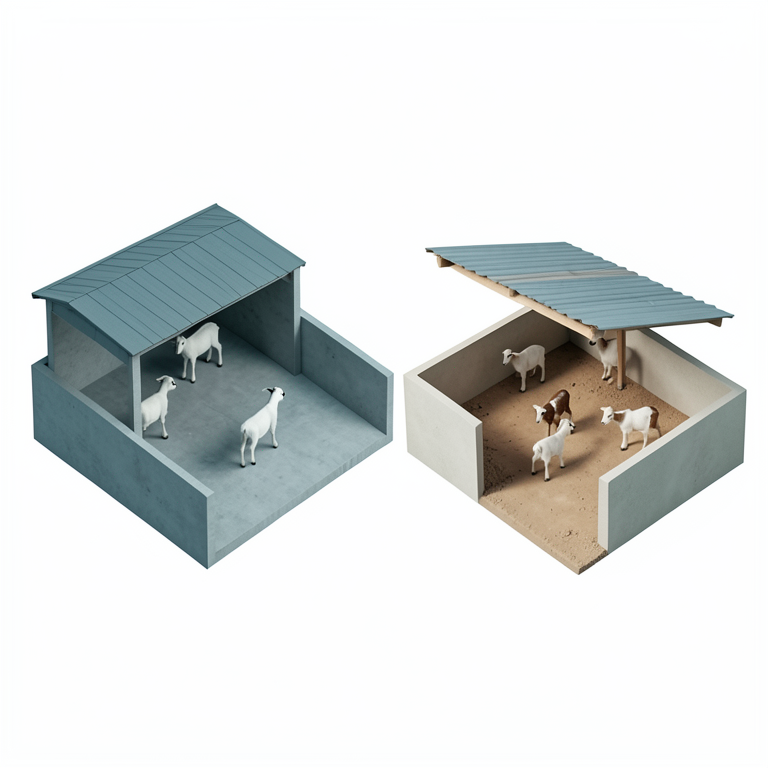
Typical Goat Housing Structure
AI-generated conceptual illustration (goat kids in a traditional housing structure). It explains the idea and does not show study data.
View source evidence ↗Figures & tables
From the original paper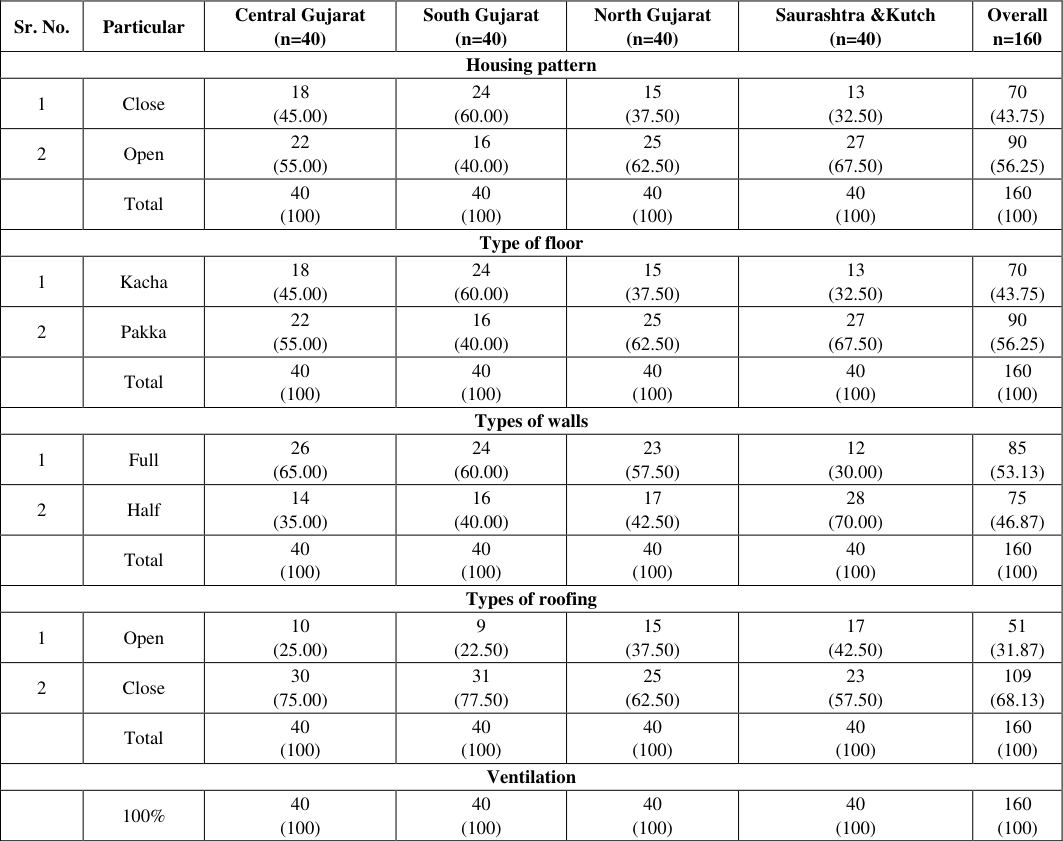 Table 1
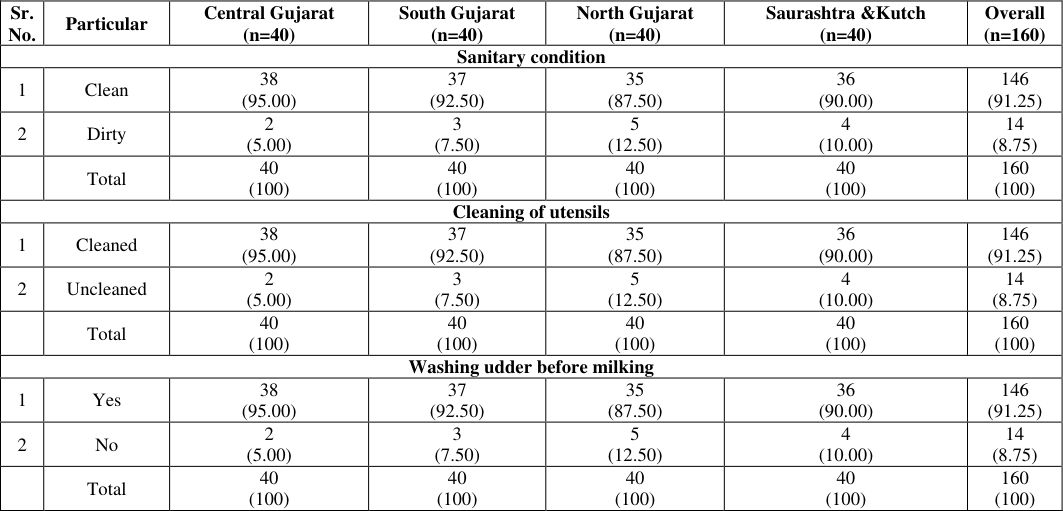 Table 2
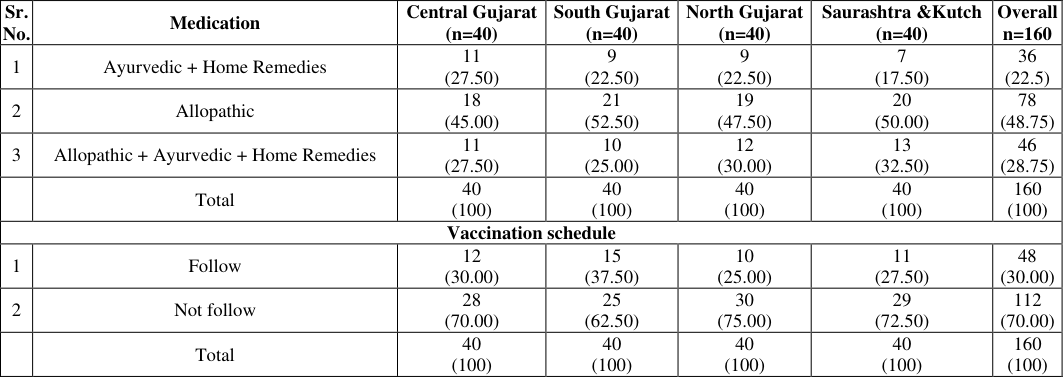 Table 3
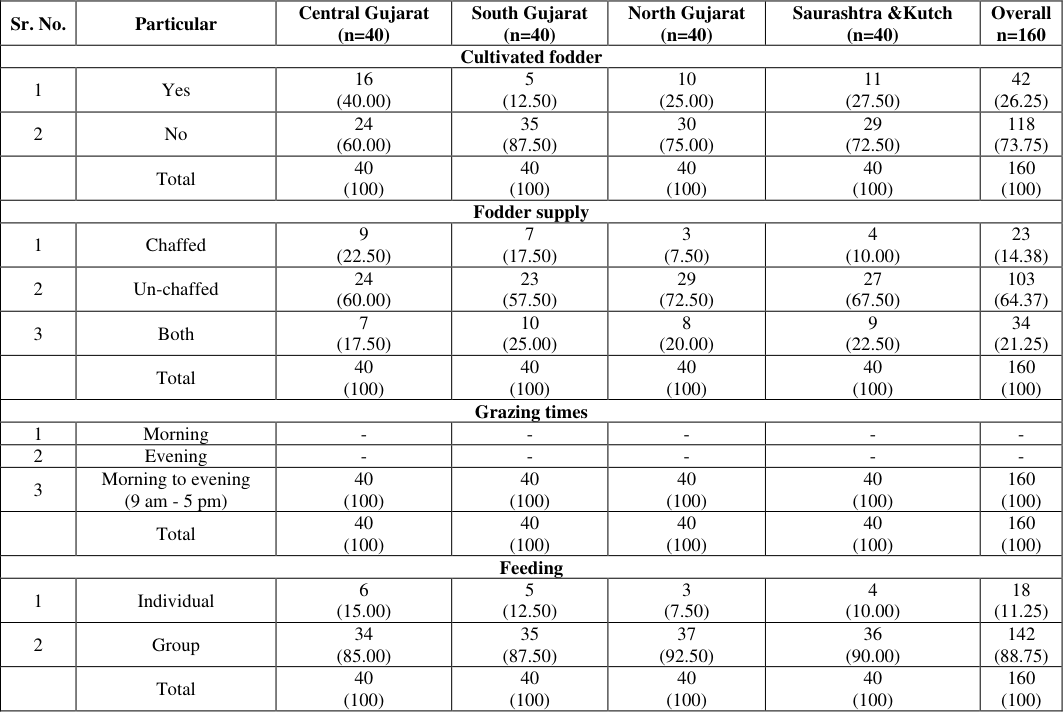 Table 4
Introduction
The goat, scientifically known as Capra aegagrus hircus, is a highly adaptable and versatile animal. In India, it is known as the "poor man's cow." In recent times, there has been a growing trend in goat farming and the breeding of domestic goats. Goats are primarily raised for multiple purposes, including meat, milk, fiber, skin and manure. These diverse uses make goats valuable assets to farmers and communities, as they provide a sustainable source of income and essential resources for various aspects of human life. Goats are adaptable animals that can survive in a wide range of conditions. According to the twentieth livestock census, the goat population in India is 148.88 million below tables shows that the goat population is increasing than the previous year's census. The 2019 livestock census estimated that there were 5,18,640 goats in Gujarat in 2018-19. The districts with the highest goat populations were Dahod, Panchmahal, Kachchh, Vadodara and Banaskantha.
Materials and Methodology
The present study was conducted in different region of Gujarat. A total 160 goat farmers were selected using multistage random sampling techniques. In the first stage, eight districts were selected purposively according to the highest population area of goats. In the second stage, taluka was selected purposively. In the third stage, two villages were selected randomly. In the fourth stage, randomly five respondents were selected. In this way, 160 respondents were have been selected. Data were collected through personal interview with the help of semi structure schedule in which management practices related to housing pattern, sanitary, health and fodder practices.
Results and Discussion
Results and Discussion
Housing pattern
It was observed that, in Central Gujarat (55%) and north Gujarat (62.5%) most of the farmers had open types of housing for goats. In South Gujarat (60%) and Saurashtra and kutch (67.5%) majority of goat farmers had close types of goat house. In overall Gujarat most of goat farmers (56.25%) had open type of houses. Kumar et al. (2017) [1] reported that 72.09 percent of goat farmers provide open type of house. Sabapara et al. (2014) [2] majority of goat farmers respondent prefer close housing system. It was found that majority of goat farmers had pakka types of floor for goat houses in Central Gujarat (55%) in North Gujarat (62.5%) Saurashtra & Kutch (67.5%). In South Gujarat, 60 percent of goat farmers use kacha types of floors for housing goats. In Gujarat, most of the goat farmers (56.25%) had pakka types of floors for housing of goats followed by 43.75 percent of goat farmers used kacha types of floors for housing goats. Pakka type of floor easily maintain sanitary condition. Similar result found by Kumar et al. (2017) [1] , they reported that 88.78 percent of goat farmers provide pakka type of floor. www.extensionjournal.com 1 revealed that majority goat farmers had full walls for goat housing in Central Gujarat (65%), South Gujarat (60%) North Gujarat (57.5%). In Saurashtra and kutch, majority of goat farmers used half walls (70%) for goat housing followed and overall Gujarat, most farmers used full types of walls (53.13%) for goat housing and 46.87 percent goat farmers used half types of goat housing. Kumar et al. (2017) [1] found that majority of goat shed wall were full. Study revealed that, majority of goat farmers had close roofing for goat houses in Central Gujarat (75%), South Gujarat (77.5%) North Gujarat (62.5%) Saurashtra and kutch, (57.5%). In Gujarat, most of the goat farmers adopted close types of roofing followed by 31.87 percent of goat farmers adopted open types of roofing. It was observed that all farmers had ventilated types of houses to provide fresh air.
Sanitary condition
Table 2 shows goat farmers maintain sanitary conditions in goat houses in different regions of Gujarat. Majority of goat farmers regularly clean goat houses in Central Gujarat (95%), South Gujarat (92.5%), North Gujarat (87.5%), Saurashtra & Kutch (90%). In Gujarat majority of goat farmers (91.25%) clean goat houses regularly to prevent diseases followed by 8.75 percent not cleaning goat houses regularly. Thorat et al. (2017) [4] reported that 90 percent of farmers clean goat shelters regularly. Table 2 revealed that, Majority of Goat farmers daily cleaned of utensils in Central Gujarat (95%), South Gujarat (92.5%), North Gujarat (87.5%), Saurashtra & Kutch (90%). In overall Gujarat majority (91.25%) of goat farmers clean utensils every days followed by 8.75 percent of goat farmers did not use clean utensils. Similar findings were reported by Sabapara et al. (2014) [2] , found that majority of goat farmers used clean utensils. It was observed that, majority of goat farmers wash udder before milking in Central Gujarat (95%), South Gujarat (92.5%), North Gujarat (87.5%), Saurashtra and Kutch (90%) In Gujarat, majority of goat farmers (91.25%) washing udder before milking followed by 8.75 percent goat farmers did not wash udder before milking. This finding is close to Pawar (2020) [5] , found that traditional goat farmers washed udder before milking goat. www.extensionjournal.com
| Sr. No. | Particular | Central Gujarat (n=40) | South Gujarat (n=40) | North Gujarat (n=40) | Saurashtra &Kutch (n=40) | Overall (n=160) |
|---|---|---|---|---|---|---|
| Sanitary condition | ||||||
| 1 | Clean | 38 (95.00) | 37 (92.50) | 35 (87.50) | 36 (90.00) | 146 (91.25) |
| 2 | Dirty | 2 (5.00) | 3 (7.50) | 5 (12.50) | 4 (10.00) | 14 (8.75) |
| Total | 40 (100) | 40 (100) | 40 (100) | 40 (100) | 160 (100) | |
| Cleaning of utensils | ||||||
| 1 | Cleaned | 38 (95.00) | 37 (92.50) | 35 (87.50) | 36 (90.00) | 146 (91.25) |
| 2 | Uncleaned | 2 (5.00) | 3 (7.50) | 5 (12.50) | 4 (10.00) | 14 (8.75) |
| Total | 40 (100) | 40 (100) | 40 (100) | 40 (100) | 160 (100) | |
| Washing udder before milking | ||||||
| 1 | Yes | 38 (95.00) | 37 (92.50) | 35 (87.50) | 36 (90.00) | 146 (91.25) |
| 2 | No | 2 (5.00) | 3 (7.50) | 5 (12.50) | 4 (10.00) | 14 (8.75) |
| Total | 40 (100) | 40 (100) | 40 (100) | 40 (100) | 160 (100) |
Table text extracted from the original PDF; superscript letters are shown inline. The original table image is below.
View original table image
Medication
Table 3 showed that, most of goat farmers give allopathic medicine to goat in Central Gujarat (45%), South Gujarat (52.5%), North Gujarat (47%), Saurashtra & Kutch (50%). In Gujarat, most of the goat farmers used allopathic medication (48.75%) followed by 28.75 percent goat farmers used allopathic and ayurvedic both types of medicine for treatment similar result found by Kumar et al. (2017) [1] , majority of goat farmers use allopathic medicine for treatment of goats. It was observed that majority of goat farmers not followed vaccination schedule in Central Gujarat (70%), South Gujarat (62.5%), North Gujarat (75%), Saurashtra and Kutch (72.5%). In overall Gujarat, most of the goat farmers (70%) did not follow the vaccination schedule in their goats while 30 percent followed the vaccination schedule in their goats for good health and disease prevention. The reasons behind this were, most of farmers did not know about the vaccination schedule. Similar study found by Sorthiya et al. (2015) [3] and Kumar et al. (2017) [1] , majority of goat farmers did not follow vaccination schedule. 4 revealed that, most of goat farmers did not cultivated fodder for their goat in Central Gujarat (60%), South Gujarat (87.5%), North Gujarat (75%), Saurashtra and Kutch (72.5%). In Gujarat, most of the goat farmers (73.75%) not cultivated fodder for their goat and farmer maintained their goats on grazing followed by 26.25 percent goat farmers cultivated fodder for their goats because majority of goat farmers were small and marginal and they were using their land for their food grain cultivation. Kumar et al. (2017) [1] found same result that 88.33 percent of tradition goat farmers did not cultivated fodder. www.extensionjournal.com Study found that most of goat farmers supply unchaffed fodder to goat in Central Gujarat (60%), South Gujarat (57.5%), North Gujarat (72.5%), Saurashtra and kutch (67.5%). In overall Gujarat majority (64%) farmers provided unchaffed fodder to goats followed by 34 percent goat farmers had provided both types (chaffed and unchaffed) and 14.38 percent provided chaffed fodder. Similar result was found by Pawar (2021) [5] most of farmers provided unchaffed fodder to their goats. Kumar et al. (2017) [1] reported that most of the goat farmer supply fodder in form of unchaffed. Also observed that all farmers sent their goats for grazing in all regions of Gujarat. Sabapra et al. and Pawar (2021) [5] reported that traditional goat farmers daily allowed there goat for grazing for more than 5 hours. Study found that, majority of goat farmers (85%) gives feeds to their goats in groups. In Central Gujarat (85%), South Gujarat (87.5%), North Gujarat (92.5%), Saurashtra and kutch (90%). In Gujarat, 88.75 percent of goat farmers feed their goats in groups and 11.25 percent of goat farmers feed their goats in individuals. Same result observed by Kumar et al. (2017) [1] , revealed that that 95.24 percent of farmers feed their goats in group.
Conclusion
Most of the goat farmers had open type goat house with pakka floor, full wall and close roofing in different regions of Gujarat and overall Gujarat. Majority of goat farmers had clean goat shed used clean utensils and washed udder before milking. Majority of goat farmers give allopathic medication for prevention of disease and did not follow vaccination schedule because farmers were not aware about vaccination schedule. Majority of goat farmer did not cultivate fodder and supply unchaffed fodder to their goats in groups. All farmers sent their goat to grazing daily from morning to evening.
Figures and tables from the paper
| Sr. No. | Particular | Central Gujarat (n=40) | South Gujarat (n=40) | North Gujarat (n=40) | Saurashtra &Kutch (n=40) | Overall n=160 |
|---|---|---|---|---|---|---|
| Housing pattern | ||||||
| 1 | Close | 18 (45.00) | 24 (60.00) | 15 (37.50) | 13 (32.50) | 70 (43.75) |
| 2 | Open | 22 (55.00) | 16 (40.00) | 25 (62.50) | 27 (67.50) | 90 (56.25) |
| Total | 40 (100) | 40 (100) | 40 (100) | 40 (100) | 160 (100) | |
| Type of floor | ||||||
| 1 | Kacha | 18 (45.00) | 24 (60.00) | 15 (37.50) | 13 (32.50) | 70 (43.75) |
| 2 | Pakka | 22 (55.00) | 16 (40.00) | 25 (62.50) | 27 (67.50) | 90 (56.25) |
| Total | 40 (100) | 40 (100) | 40 (100) | 40 (100) | 160 (100) | |
| Types of walls | ||||||
| 1 | Full | 26 (65.00) | 24 (60.00) | 23 (57.50) | 12 (30.00) | 85 (53.13) |
| 2 | Half | 14 (35.00) | 16 (40.00) | 17 (42.50) | 28 (70.00) | 75 (46.87) |
| Total | 40 (100) | 40 (100) | 40 (100) | 40 (100) | 160 (100) | |
| Types of roofing | ||||||
| 1 | Open | 10 (25.00) | 9 (22.50) | 15 (37.50) | 17 (42.50) | 51 (31.87) |
| 2 | Close | 30 (75.00) | 31 (77.50) | 25 (62.50) | 23 (57.50) | 109 (68.13) |
| Total | 40 (100) | 40 (100) | 40 (100) | 40 (100) | 160 (100) | |
| Ventilation | ||||||
| 100% | 40 (100) | 40 (100) | 40 (100) | 40 (100) | 160 (100) |
Table text extracted from the original PDF; superscript letters are shown inline. The original table image is below.
View original table image
| Sr. No. | Particular | Central Gujarat (n=40) | South Gujarat (n=40) | North Gujarat (n=40) | Saurashtra &Kutch (n=40) | Overall n=160 |
|---|---|---|---|---|---|---|
| Cultivated fodder | ||||||
| 1 | Yes | 16 (40.00) | 5 (12.50) | 10 (25.00) | 11 (27.50) | 42 (26.25) |
| 2 | No | 24 (60.00) | 35 (87.50) | 30 (75.00) | 29 (72.50) | 118 (73.75) |
| Total | 40 (100) | 40 (100) | 40 (100) | 40 (100) | 160 (100) | |
| Fodder supply | ||||||
| 1 | Chaffed | 9 (22.50) | 7 (17.50) | 3 (7.50) | 4 (10.00) | 23 (14.38) |
| 2 | Un-chaffed | 24 (60.00) | 23 (57.50) | 29 (72.50) | 27 (67.50) | 103 (64.37) |
| 3 | Both | 7 (17.50) | 10 (25.00) | 8 (20.00) | 9 (22.50) | 34 (21.25) |
| Total | 40 (100) | 40 (100) | 40 (100) | 40 (100) | 160 (100) | |
| Grazing times | ||||||
| 1 | Morning | - | - | - | - | - |
| 2 | Evening | - | - | - | - | - |
| 3 | Morning to evening (9 am - 5 pm) | 40 (100) | 40 (100) | 40 (100) | 40 (100) | 160 (100) |
| Total | 40 (100) | 40 (100) | 40 (100) | 40 (100) | 160 (100) | |
| Feeding | ||||||
| 1 | Individual | 6 (15.00) | 5 (12.50) | 3 (7.50) | 4 (10.00) | 18 (11.25) |
| 2 | Group | 34 (85.00) | 35 (87.50) | 37 (92.50) | 36 (90.00) | 142 (88.75) |
| Total | 40 (100) | 40 (100) | 40 (100) | 40 (100) | 160 (100) |
Table text extracted from the original PDF; superscript letters are shown inline. The original table image is below.
View original table image
References
4 in the original paper- Kumar D, Singh VK, Yadav AK, Jha AK, Singh J. Socio-economic factors and management practices followed in eastern Uttar Pradesh for rearing of Jaunpuri goat. Indian J Anim Res. 2017;52(9):13731377.
- Sabapara GP. Socio-Economic Profile of Goat Rearers and Marketing Practices of Goats in Southern Gujarat, India. Livestock Res Int. 2016;4(2):83-87.
- Sorathiya LM, Fulsoundar AB, Raval AP, Patel MD, Tyagi KK. Goat rearing practices of Ahir community in high rainfall zones of South Gujarat. J Anim Res. 2016;6(3):537-541.
- Thorat GN, Vahora SG, Patel DC. Adoption of Health Care Management Practices Adopted By Tribal Farmers In Goat Farming. Guj J Ext Edu. 2017;28(1):114-116.
Cited by 1
From OpenAlex, OpenCitations and reference lists read by Scinovex
- Bacterial pneumonia in goats: Prevalence and epidemiological patterns
Vidhi P Patel1, Khushi S Saini1, Dr. Sarita Devi, Darshanaben K Asari · International Journal of Veterinary Sciences and Animal Husbandry · 2025
Pneumonia is a major respiratory disorder in goats, contributing significantly to morbidity and mortality. This study was conducted over a nine-month period to determine the incidence and epidemiological patterns of bacterial pneumonia in goats from the Banaskantha region of Gujarat. A total of 178 goats presenting with clinical signs of respiratory illness were screened, and deep nasal swab samples were collected for bacterial isolation and identification. Bacterial pneumonia was confirmed in 82 goats, with an overall incidence of 46.06% (82/178). Age-wise analysis revealed a significantly hi