
Research article · 2024 · Full text
International Journal of Agriculture and Food ScienceStudies on development and standardization of multigrain Bhakarwadi
Volume 6(1) · Pages 43–46 · DOI: 10.33545/2664844x.2024.v6.i1a.165 ↗
Research areasAgricultural Economics and Practices
Abstract
Author-writtenThe multigrain Bhakarwadi was prepared as a nutritional point of view. The studies on development and standardization of multigrain Bhakarwadi was successfully done and evaluated for proximate analysis and storage study. The Sorghum, Pearl millet and Ragi are a staple food for majority of the population in some parts of India and other developing countries. Sorghum, Pearl millet and Ragi Contain carbohydrate, calcium, Phosphorous and iron. The work has been carried out to preparation of multigrain Bhakarwadi i.e. (T1)10:10:5, (T2)15:5:5, (T3)5:15:5 is Sorghum, Pearl millet and Ragi flour respectively. Multigrain Bhakarwadi formulation T2 was most acceptable than other treatments. The preparations of Bhakarwadi includes mixing of multigrain flour then make a dough than make a chapatti and spread spices stuff (masala) and roll the chapatti, cut into small pieces and fry in oil. Proximate composition of multigrain Bhakarwadi was Carbohydrate (34.6%), Protein (8.7%), Fat (29%), Moisture (21.7%), Ash (2.4%) and Energy (434.2 Kcal) were best among all the levels. Multigrain Bhakarwadi prepared recorded highest score in all the quality attributes and good storage stability. It was concluded that the multigrain Bhakarwadi can be stored for four months in High Density Poly Ethylene (HDPE) pouches at room temperature. So multigrain Bhakarwadi can satisfy the needs of consumer such as quality.
Summary
Source-checkedPlain-language reading of the full paper, prepared with AI and checked against the text. Each point links to the authors' own words.
Why it matters
- Sorghum, pearl millet, and ragi are staple foods in parts of India and other developing nations, providing essential nutrients like carbohydrates, calcium, phosphorus, and iron. View evidence ↗
- Bhakarwadi is a traditional crispy, deep-fried snack made of flour-based disks stuffed with coconut and poppy seeds, designed for long-term storage. View evidence ↗
- Using a multigrain flour mixture for Bhakarwadi is intended to increase the energy value and nutrient content, specifically carbohydrates, calcium, and iron, for consumers. View evidence ↗
The question
- The study aimed to develop and standardize a multigrain Bhakarwadi and evaluate its nutritional composition and storage stability. View evidence ↗
What they did
- Three multigrain formulations were tested using different ratios of sorghum, pearl millet, and ragi flour: T1 (10:10:5), T2 (15:5:5), and T3 (5:15:5). View evidence ↗
- Ten semi-trained academic staff members evaluated the snacks' appearance, color, flavor, aftertaste, texture, and overall acceptability using a 9-point Hedonic scale. View evidence ↗
- The nutritional properties, including moisture, ash, fat, protein, and fiber, were measured following AOAC (2000) standard procedures. View evidence ↗
- Data analysis was performed using a Completely Randomized Design (CRD) to compare the different formulations. View evidence ↗
What they found
- Formulation T2 was the most acceptable to consumers, scoring 9 points for overall acceptability compared to 7 for T0 and T3, and 7.5 for T1. View evidence ↗
- The resulting product was brown and oval in shape, weighing 3 grams with dimensions of 3 cm x 2 cm x 1 cm. View evidence ↗
- The multigrain Bhakarwadi demonstrated good storage stability and can be kept for four months at room temperature when stored in High Density Poly Ethylene (HDPE) pouches. View evidence ↗
What it means
- The authors conclude that multigrain Bhakarwadi made from sorghum, pearl millet, and ragi provides high nutritional quality and health benefits due to its protein, carbohydrate, calcium, and iron content. View evidence ↗
- The study recommends formulation T2 as the superior version because it was more acceptable across sensory attributes than T1 and T3. View evidence ↗
Visual summary
2 visualsIllustrations explain the paper; charts are replotted from the paper's own table values.
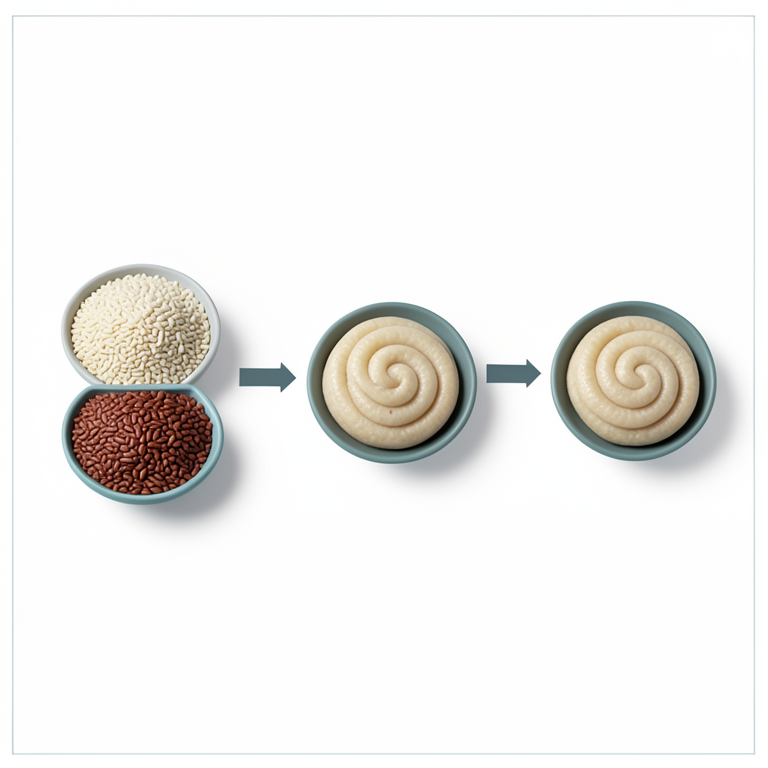
Multigrain Formulation Comparison
AI-generated conceptual illustration (multigrain Bhakarwadi snacks and raw grains (sorghum, pearl millet, and ragi)). It explains the idea and does not show study data.
View source evidence ↗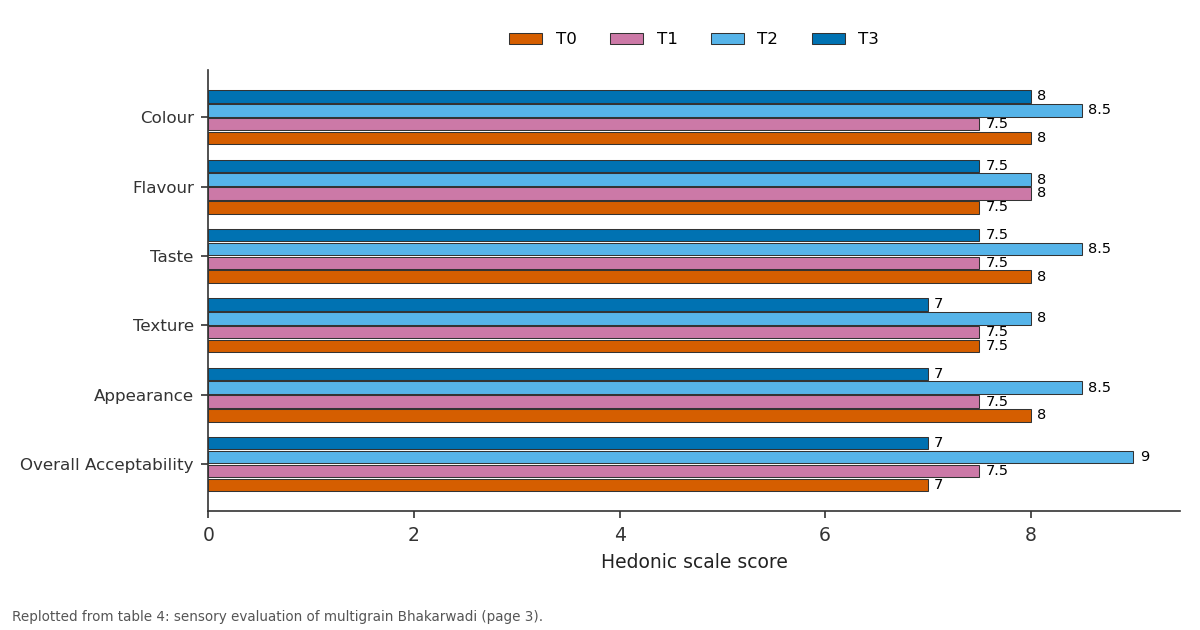
T0 and T1 and more: Colour vs Flavour vs Taste vs Texture vs Appearance
Replotted from Table 4 (page 3) of the original paper. Every bar is the paper's own table value.
View source evidence ↗Figures & tables
From the original paper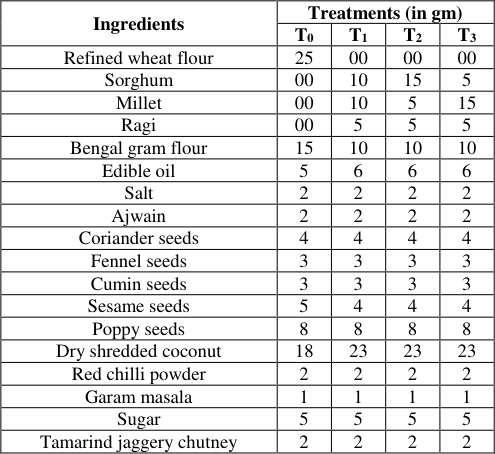 Table 1
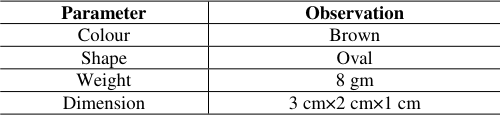 Table 2
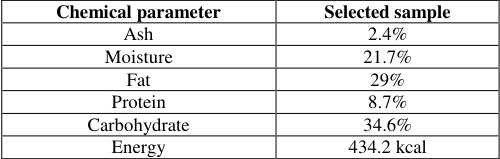 Table 3
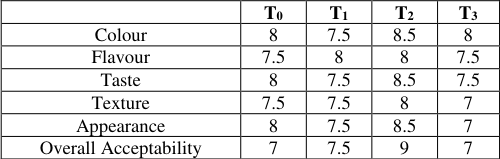 Table 4
Introduction
Bhakarwadi is developed as a snack which can be stored for weeks. The flour based round disks are stuffed with roasted poppy seeds, coconut and deep fried to a crispy finish. There are mainly two types of Bhakarwadi, Maharashtra Bhakarwadi of Pune and Gujarati Bhakarwadi of Vadodara. It is popular addition on the Farsan Menu, adding crunch and a warming, sweetness to the menu (Sengupta and Shah, 2016) [12] . Millet having scientific name (Pennisetum glaucum) belonging to family (Poaceae). It is small seeded and is known as coarse Cereal. Millet is widely grown in the semiarid tropics of Africa and Asia. It constitutes a major source of Carbohydrates (63.8%) and Proteins (12.5%), It has Moisture (12%), Fat (3.5%), crude fiber (5.2%), Minerals (3.1%), and provides energy about 364 kcal. It also contains Calcium (8 mg), Iron (2.9 mg), Thiamin (0.41 mg), Riboflavin (0.28 mg), Niacin (4.5 mg). (Saleh, et al. 2013) [11] . Millets are rich in Phytochemicals, including phytic acid which is beloved to lower cholesterol, and phytate, which as associated with reduced cancer risk. (Amadou and Mahamadou (2013) [1] . Millets may also contain toxicants such as-Micotoxins including a) Aflatoxin B1; b) Ochratoxin A; c) Fumonisin B1; d) Deoxynivalenol; e) Zearalenon; (Thielecke and Nugent, 2018) [14] . Sorghum having Scientific name (Sorghum bicolor L.) and family (Poaceae). Sorghum is one of the mos Timportan T Staple Food grain grown mostly in the semi-arid tropics of Asia, Africa, America and Australia. Drought tolerance makes Sorghum especially important in dry regions. (Kumar et al, 2011) [6] . Sorghum acts as a principal source of Energy, Proteins, Vitamins and Minerals. It consists of Moisture (7.3%), Minerals (1.8%), Protein (13.4%), Fat (3.1%), Fiber (2.1%), and Carbohydrates (72.4%). It contains Phytochemicals like Tannins (194.50-995.72 mg/g), Phenolic (16.63-102.82 mg/g) and Flavonoids (0.20-0.36). In Sorghum, there are Toxicants such as Trypsin Inhibitor, Phytic acid, Tannins, Polyphenols were present (Idris et al, 2005) [3] . Ragi is common name of finger Millet (Eleusine coracana L.) in India. It is cultivated broadly in major parts of India and Africa. Finger millet is a subtropical and tropical grain which can withstand in drought and high temperature environment. Finger Millet is used as poor man's crop due to its elongated sustainable strength as it could be kept securely for a number of years devoid of any insect and pest infestation. (Rathore et al. 2019) [9] . It belongs to Poaceae family. Ragi or Finger Millet has a polygonal rhombic shape. It is small in size varying diameter from 1-2 mm. Finger Millet have a deep brown to shades ranging from red to almost black. (Shobana et al. 2013) [13] . Finger millet is one of the rich sources of nutrient compared to other cereal crop. It contains moisture content about (12%), Dietary fiber (18%), Protein (9.8%), Carbohydrate (81.5%), Starch (65-75%), Fat (1-1.7%), Minerals (2.7%), and Crude fiber (4.3%) that equivalent to other millets and cereals. It is also rich source of Calcium (344 mg), Phosphorous (2283 mg), Iron (3.9 g) Vitamin B and Vitamin E and other Micronutrient. It contains Anti-nutritional factor such as Tannins (0.04-3.47%), Phytate (0.48%), Oxalate (0.36%) and Polyphenols (Rathore et al. 2019) [9] . Bhakarwadi is the snacks product. Generally, it is prepared by whole wheat flour and Bengal gram flour. We prepare Bhakarwadi by mixing the multigrain flour as they provide the significant amount of Carbohydrates. They also provide Minerals like Calcium and Iron. This mixture of multigrain will provide the higher Energy value with more nutrients to the consumers.
Materials and Methods
Materials and Methods
Procurement of raw material
Raw materials required during present investigation were procured from local market such as Sorghum, Pearl millet, Ragi, Bengal gram flour, salt, sugar, Ajwain, Coriander seeds, Fennel seeds, Cumin seeds, Sesame seeds, Poppy seeds, dry shredded coconut, tamarind pulp Jaggery, Garam masala, red chilli powder and edible oil etc. Most of the chemicals and equipments used in this investigation were of analytical grade which are obtained from College of Food Technology Saralgaon, Thane.
Physical properties of multigrain Bhakarwadi
The colour of multigrain Bhakarwadi was determined by visual observations, the length, breadth and width of multigrain Bhakarwadi was measured by vernier calliper. The weight of multigrain Bhakarwadi was measured on analytical weighing balance.
Chemical properties of multigrain Bhakarwadi
Proximate composition such as moisture, ash, crude fat, crude protein and crude fibre of all the Ingredients and multigrain Bhakarwadi was determined according to the procedures given in AOAC (2000) [16] . For moisture determination samples were dried in oven aT130 ºC for 60 minutes. For ash determination samples were placed in muffled furnace at 550 °C to burn out all carbon compounds leaving in organic part (ash). Fat was determined by Fat extraction unit by using n. Hexane. For fibre determination, samples were treated with 1.25% Sulphuric acid and Sodium Hydroxide solution. After filtration of digested materials, it was washed with hot water and then ignited. By calculating loss of weight after ignition, crude fibre contents were determined. Protein contents were determined by using Kjeldahl's unit.
Sensory evaluation of multigrain Bhakarwadi
Prepared products were evaluated for sensory characteristics in terms of appearance, color, flavor, aftertaste, texture and overall acceptability by 10 semi-trained panel members comprised of academic staff members using 9-point Hedonic scale. Judgments were made through rating the product on a 9 points Hedonic scale with corresponding descriptive terms ranging from 9 'like extremely' to 1 'dislike extremely'. The obtained results were recorded in sensory score card.
Statistical analysis
The analysis of variance of the data obtained was done by using Completely Randomized Design (CRD) for different treatments as per the method given by Panse and Sukhatme (1967) [15] . The analysis of variance revealed at significance of p<0.005 level S.E and C.D. aT5 Percent level is mentioned wherever required.
Preparation of multigrain flour for preparation of Bhakarwadi
Sorghum, Pearl millet and Ragi were cleaned properly then Sorghum, Pearl millet and Ragi was grinded in household flour mill. The flours were sieved through of BS 100 mm-Mesh size. All the flours were stored in air tight containers for further use.
Formulation of multigrain Bhakarwadi
Multigrain Bhakarwadi prepared with incorporation varying levels of Sorghum flour, Pearl Millet flour and Ragi flour were investigated. The formulation was made by varying levels of Sorghum flour, Pearl millet flour and Ragi flour viz., 00:00:00, 10:10:5, 15:5:5 and 5:15:5 Percent respectively and data were illustrated. T2 was selected on the basis of sensory evaluations which show high score for Colour, Taste and Appearance. The color of T2 sample as per table is 8.5 point while sample T0 (8), T1 (7.5), T3 (8). The flavour of sample T2 was acceptable with 8 Point while samples T0 (7.5), T1 (8), T3 (7.5). The taste of sample T2 was selected by 8.5 points while other samples points are T0 (8), T1 (7.5), T3 (7.5). The texture of sample T2 was selected by 8 points while other samples points are T0 (7.5), T1 (7.5), T3 (7). The appearance of sample T2 was selected by 8.5 points while other samples T0 (8), T1 (7.5), T3 (7). The overall acceptability of sample T2 was selected by 9 points while other samples points are T0 (7), T1 (7.5), T3 (7). According to above table sample T2 more acceptable than other sample and more acceptable to consumer satisfaction.
Conclusion
In the present study finally it is concluded that multigrain Bhakarwadi prepared from different Variations of multigrain Sorghum, Pearl millet and Ragi has high Nutrition quality and also it is rich in protein, carbohydrates and some vital minerals such as calcium and iron in proper amount and has great health benefits. The present investigation carried out for information of multi grain Bhakarwadi in which T2 sample found more superior than sample T1 and T3 so, T2 sample is more acceptable on its sensory attributes.
Figures and tables from the paper
| Ingredients | Treatments (in gm) | — | — | — |
|---|---|---|---|---|
| T0 | T1 | T2 | T3 | |
| Refined wheat flour | 25 | 00 | 00 | 00 |
| Sorghum | 00 | 10 | 15 | 5 |
| Millet | 00 | 10 | 5 | 15 |
| Ragi | 00 | 5 | 5 | 5 |
| Bengal gram flour | 15 | 10 | 10 | 10 |
| Edible oil | 5 | 6 | 6 | 6 |
| Salt | 2 | 2 | 2 | 2 |
| Ajwain | 2 | 2 | 2 | 2 |
| Coriander seeds | 4 | 4 | 4 | 4 |
| Fennel seeds | 3 | 3 | 3 | 3 |
| Cumin seeds | 3 | 3 | 3 | 3 |
| Sesame seeds | 5 | 4 | 4 | 4 |
| Poppy seeds | 8 | 8 | 8 | 8 |
| Dry shredded coconut | 18 | 23 | 23 | 23 |
| Red chilli powder | 2 | 2 | 2 | 2 |
| Garam masala | 1 | 1 | 1 | 1 |
| Sugar | 5 | 5 | 5 | 5 |
| Tamarind jaggery chutney | 2 | 2 | 2 | 2 |
Table text extracted from the original PDF; superscript letters are shown inline. The original table image is below.
View original table image
| Parameter | Observation |
|---|---|
| Colour | Brown |
| Shape | Oval |
| Weight | 8 gm |
| Dimension | 3 cm×2 cm×1 cm |
Table text extracted from the original PDF; superscript letters are shown inline. The original table image is below.
View original table image
| Chemical parameter | Selected sample |
|---|---|
| Ash | 2.4% |
| Moisture | 21.7% |
| Fat | 29% |
| Protein | 8.7% |
| Carbohydrate | 34.6% |
| Energy | 434.2 kcal |
Table text extracted from the original PDF; superscript letters are shown inline. The original table image is below.
View original table image
| — | T0 | T1 | T2 | T3 |
|---|---|---|---|---|
| Colour | 8 | 7.5 | 8.5 | 8 |
| Flavour | 7.5 | 8 | 8 | 7.5 |
| Taste | 8 | 7.5 | 8.5 | 7.5 |
| Texture | 7.5 | 7.5 | 8 | 7 |
| Appearance | 8 | 7.5 | 8.5 | 7 |
| Overall Acceptability | 7 | 7.5 | 9 | 7 |
Table text extracted from the original PDF; superscript letters are shown inline. The original table image is below.
View original table image
References
14 in the original paper- Amadou I, Mahamadou EG. Millets: Nutritional Composition, Some Health Benefits and Processing. Food Science and Nutrition Journal. 2013;25(7):501508.
- Chhabra N, Kaur A. Studies on physical and engineering characteristics of maize, pearl millet and soybean. Journal of Pharmacognosy and Phytochemistry. 2017;6(6):1-5.
- Idris HW, Rahman MS, Elmakib H, Babiker EE, Abdullahi H. Phytic acid and tannin and minerals of sorghum. Journal of Food Technology. 2005;3(3):410416.
- Itagi C, Hemalatha S. Variability in grain physicochemical composition in different sorghum [Sorghum bicolor (L) Molench] Genotypes. International Journal of Current Microbiology and Applied Science. 2017;6(7):2610-2618.
- Jambamma KI, Kailappen R. Study of physicochemical properties of food grain sorghum and produce Tready to cook mix food from sorghum. International Journal of Recent Scientific Research. 2019;1(3):96-99.
- Kumar A, Reddy SVB, Sharma CH, Rao SP, Ramaiha B, Reddy SP. Recent Advances In Sorghum Genetic Enhancement Research ATICRISAT. American Journal of Plant Science. 2011;2(4):589-600.
- Nazni P, Bhuvaneswari J. Analysis of physico-chemical and functional characteristics of finger millet (Eleusina Coracana L.) and little millet (P. sumantranse). International Journal of Food and Nutritional Sciences. 2015;4(3):109-114.
- Ramashia SE, Gwata ET, Meddows-Taylor S, Anyasi TA, Jideani AIO. Some physical and functional properties of finger millet (Eleusine Corcona) obtained in sub-Saharan Africa. Food Research International Journal. 2017;9(65):1-8.
- Rathore T, Singh R, Kamble D, Upadhya A, Thangalakshmi S. The Pharma Innovation Journal. 2019;8(4):283-291.
- Swami SS, Swami SB. Physical properties of finger millet (Eleusine Carcana). International Journal of Agricultural Engineering. 2010;3(1):156-160.
- Saleh MS, Zangi Q, Chen J, Shen Q. Millet Grains: Nutritional Quality, Processing, and Potential Health Benefits. Comprehensive Reviews in Food Science. 2013;3(7):419-426.
- Sengupta R, Shah A. Flaxcurry Bhakarwadi. Global Journal for Research Analysis. 2016;5(8):59-61.
- Shobana S, Krishnaswami K, Malleshi N, Anjana R, Palaniappan L, Mohan V. Finger Millet: A review of its nutritional properties, processing and plausible health benefits. Advances in Food and Nutrition Research Volume. 2013;69:1-39.
- Thielecke F, Nuggent PA. Contaminants in grain-A major risk for whole grain safety? Nutrients Journal. 2018;12(10):12-13.