
Research article · 2024 · Full text
International Journal of Agriculture Extension and Social DevelopmentGoat Farming: An Alternative source of livelihood & income generation for small, marginal farmers’ & also for landless people in Bihar
Volume 7(2S) · Pages 50–53 · DOI: 10.33545/26180723.2024.v7.i2sa.327 ↗
Research areasLivestock Management and Performance ImprovementAgricultural Economics and PracticesAgricultural Systems and Practices
Abstract
Author-writtenThe State where people mainly depend on agriculture in which 92% farmers are marginal and small out of which 56% are in category of near to landless, compelled to work as laborers. In this condition they require an additional source of income so that they can spend their life easily. In this situation goat farming may be a source for their bread and butter. In goat farming there is hug potential to grow the rural economy and increase the standard of living. Majorly Goat farming is a secondary source of income in Bihar but with minimum investment and low technical skill set it play very important role in the bedtime specially for poor people. In the context of Seemanchal region, if a person has three mother goats, with an average arrangement they can earn up to 20,000 rupees per year. This research shows that how goat farming is a source of income generation and source of livelihood & also shows that female member of family can contribute to boost in economy of family. Bihar is the 4th largest goat population (12.82 million Goat) in India. Goat farming is not only for poor families, goat rearing is also sustainable and profitable option for different categories of rural households.
Summary
Source-checkedPlain-language reading of the full paper, prepared with AI and checked against the text. Each point links to the authors' own words.
Why it matters
- In Bihar, a large majority of the population (76%) is involved in farming, but very few (7.5%) own more than 2 hectares of land. View evidence ↗
- Agriculture is the primary dependency in the state, where 92% of farmers are small or marginal, and 56% of those are nearly landless and forced to work as laborers. View evidence ↗
What they did
- The study was conducted between June and July 2022 in the Forbesganj and Raniganj blocks of Araria district, using questionnaires and SHG discussions with 584 households. View evidence ↗
- Participants were required to have owned at least one goat and been involved in goat rearing for more than one year. View evidence ↗
- Female goat rearers made up 87% of the 584 households surveyed, indicating that women primarily manage goat rearing. View evidence ↗
What they found
- Education levels were low among the 584 households, with 71.23% having an education level below grade eight and only 2.86% being graduates. View evidence ↗
- Regarding annual spending per goat, 60% of respondents spent 80 Rs, while 31.33% only spent money when treatment was necessary. View evidence ↗
- Goat rearing serves as a secondary income source for 91.4% of households, and 88.22% use their goats as an emergency fund. View evidence ↗
- Annual earnings from goat rearing varied, with 32.70% of households earning approximately 15,000 rupees and 22.60% earning approximately 20,000 rupees. View evidence ↗
- Women are the primary caregivers for goats in 78.22% of households, while only 21.78% of households share the responsibility equally between males and females. View evidence ↗
What it means
- The authors conclude that goat rearing is a vital income source for small, medium, and landless farmers, offering better returns with low investment in feeding and precautionary care. View evidence ↗
- The authors note that the lack of an organized market for buying and selling goats allows middlemen to take unfair advantage. View evidence ↗
Visual summary
2 visualsIllustrations explain the paper; charts are replotted from the paper's own table values.
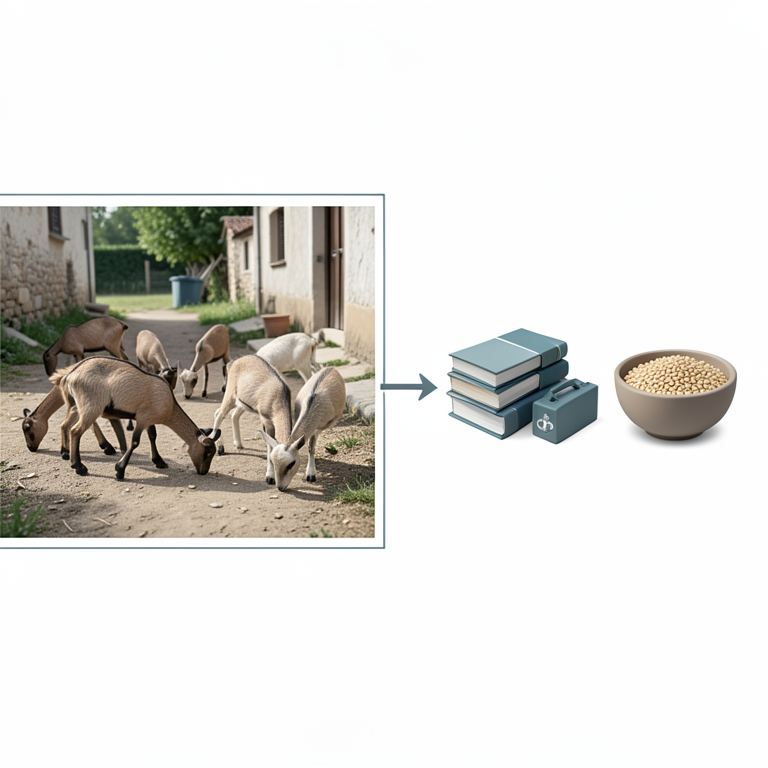
Goat Rearing as a Financial Safety Net
AI-generated conceptual illustration (domestic goats in a rural Bihar village setting). It explains the idea and does not show study data.
View source evidence ↗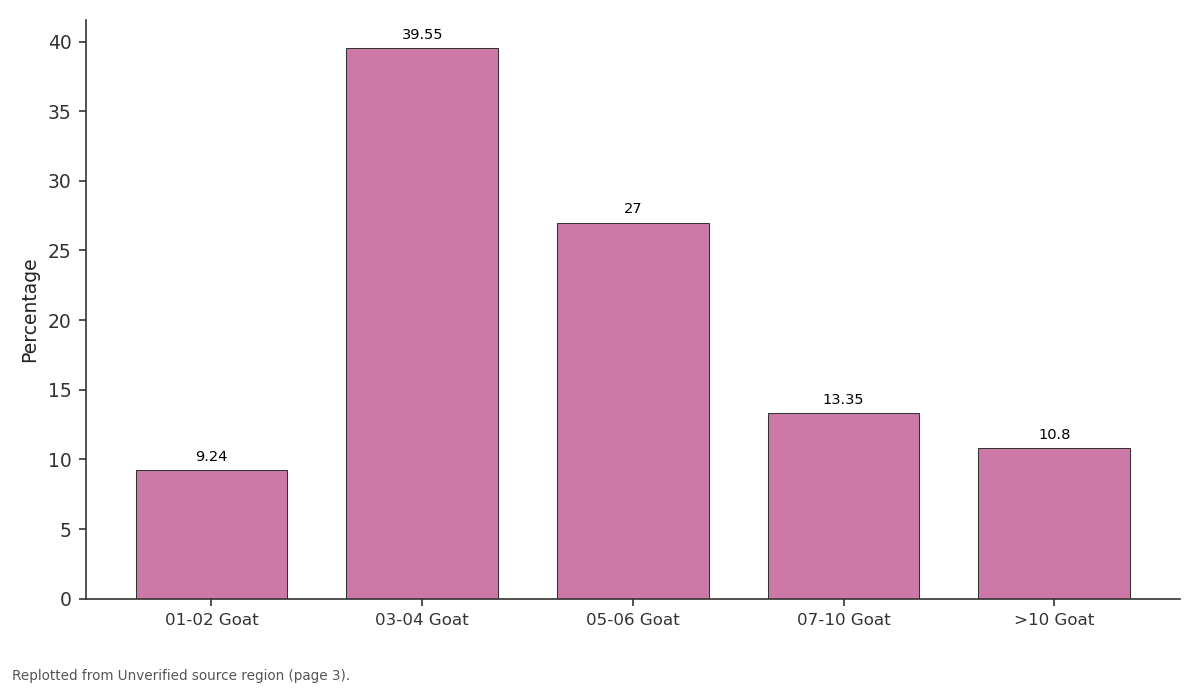
Percentage: 01-02 Goat vs 03-04 Goat vs 05-06 Goat vs 07-10 Goat vs >10 Goat
Replotted from a table (page 3) of the original paper. Every bar is the paper's own table value.
View source evidence ↗Introduction
In Bihar, where 76% of people are engaged in farm activity and in which only 7.5% of people farmers hold land above 2 hectares. They mainly depend on agriculture activity for their income generation eighter they work as a laborer in others' farm/ place so that cannot full-full their requirement. They are required alternative sources of income and with low-investment is also very minimum because a small and marginal farmers' farms production is not as much that they can invest for any business establishment or landless people who is working as a daily wages labor in other farmers' field or any other places they even kept a cattle or buffalo because they have not enough land other than their small hut. Goats contribute approx. Rs 38 590 crore annually in the national economy and account for 27.80% of total livestock in the country (20 th Livestock census) [1] . The Share of goat in meat production in India is approx. 13.53% (BAHS 2019) [2] . According to 20th Livestock census Bihar is the 4 th largest goat population state i.e. 12.82 million and contribute approx. 8.16 % in total India Goat Population. Goat also called from different name like ATM of poor man because there are not any difficulties at the time of money requirement, goat sold very easily at local market or even at farmer's house. It plays vary crucial role in the upliftment of farmer mainly to the small, marginal & landless agricultural labours in India (Kumar et al., 2014) [3] . In Switzerland goat is nicknamed as "Swiss baby's foster mother' (Chakrabarti et al., 2014) [4] In Bihar goat rearing mainly done with Black Bengal bread and managed under extensive production system by small, marginal, and landless farmers i.e. about 86% in India (Nandi et al., 2011) [7] It is mainly meat producing animal in West Bengal along with the adjoining part of the Jharkhand, Orissa, Bihar, Tripura states of India (Zeshmarani et al., 2007) [5] . It has also Black Bengal goats tended to have a potentiality of milk production (Dhara et al., 2011) [6] . In Bihar farmers mainly keep Black Bangal breed of goat for meet purpose very few people keep for milk, Black Bangal breed of goat poor in milk production. Other than Bihar it is also popular in Bangladesh, West Bengal, Assam, and Odisha. In the Bihar where scope of employment is very low if government agencies will provide facilities in commercial farming promoting semi-intensive or strategic feeding management systems through field demonstrations, development in high potential pure-breed bucks, promotion of goat health calendar, development of feeding resources at village level by improving wasteland and community pastures etc. goat farming can be a better source of livelihood (Singh et al. 2018) [8] Objective of Study A. To know about the importance of goat rearing for the small, marginal and land less people. www.extensionjournal.com B. To know how goat rearing generate livelihoods and how it is instant source of money that can full fill basic requirement of day-to-day life.
Materials and Methods
This research is done through the household survey with questionnaires and from discussion in the different self-help group (SHGs) at two blocks Forbesganj and Raniganj in Araria district between June and July 2022 with 584 households. In this only those farmers were part of survey and group discussions who has at least on goat and involve in goat rearing from more than one year. Out of 584 households 87% female goat rears taken part in the survey and group discussion and it is also true goat rearing mainly done by the female.
About the Araria District
Araria district is a part of Purnea division. The district occupies an area of 2830 sq. km. It has a view of Mount Kanchenjunga (One of the great peaks of the Himalayan range) This district has total 2 sub-divisions namely Araria and Forbesganj and 9 blocks. Where population is 2811569 (2011 Census) and literacy rate is 53.53% (Araria) [9] . Araria district share international border with Nepal and affected with flood, people are mainly dependent on agriculture.
Results and Discussion
a. It is found that out of 584 person who has taken part in this survey in which 428 people i.e.73.29% of total respondents who has less than 1 hec. Cultivated land and out of 428 people 34 respondents was mainly daily wedges labour they are land less that population is 5.8 % of the total population. This figure shows that only crop cultivation cannot full fill their family need, so they have required any other source of income.
No of People with cultivated land b. In the survey 39.55% households have 03-04 goat and 27% households have 07-10 goat that is good number for goat farming and for income generation. c. In the 584 household 71.23% respondents replies that his/her education is below eight and only 2.86 % was graduate. In this situation it is also very important there must be an alternative source of income because people are not as much educated as they can get any job other than labour and they also replies that for the labour do not even get work throughout the year. In Showing and harvesting season they get job easily but, in the offseason, when harvesting and sowing completed it is very difficult to get work in the village. d. In the question 'How much amount on an average they spent on the goat per year.', 60% of them replied that they spent 80 Rs. on a goat while 31.33% household replied that they spent money only when goat need treatment. Many of goat farmers don't invest in precautionary activity but other 68.77 % replies that they spent money other than treatment like vaccination, deworming and in feed supplements.
Yearly Spent Money on Per Goat e. 88.22% household replies that they use their goat as an emergency fund 3.18% replies that they keep goat for their own use as meat purpose, but they also reply that we can also sale if we have any emergency and have not any another source of income at that time. Only 8.6% replies that they are rearing goat for commercial purpose and one member of my family are engaged in only for goat rearing and they have also separate house for goat with other facilities like small goat farm. They also say that they have no other source of income, or any job, goat farming is a source of livelihood for them. 91.4% household use goat rearing as a secondary source of income, but goat rearing is also very important part of life because that play very important role at the time of emergency. f. 78.22% replies that female member mainly take care of goat and involve in goat rearing and only 21.78% replies that both male and female member equally take part in goat rearing. This also shows that how female also supporting in family income. g. Almost every household reply that there is not any organized market for goat sale, they sale their goat in local haat near their village or sale to the butcher at home through traditional method but they don't face any problem to sale the goat. They also reply that supply is less than demand.
Conclusion
Goat rearing is very important source of income for the small and medium (Especially landless) farmer, with the low investment in the feeding with precautionary activities better return can be taken by the farmer. Goat farming can be primary source of income through which person can fulfil their primary requirement. Along with several scope goat farming has many odds due to lack of organized market for goat sale and purchase, middleman taking extra advantage. Goat farming is moving from traditional to commercial farms so in the goat farming there is hug potential to grow. At village level who is rearing 1-5 goat they are doing distress sale through traditional method, there is need to extension service. Goat rearing has huge potential in developing economic and food security in rural areas so that there should be government support through which flock size can increase for sufficient net return.
References
6 in the original paper- Kumar KU, Reader ML, Singh R, Balwada G, Chaturvedi D. Economics of goat farming under traditional low input production system in Bikaner District. Asian J Ani. Sci. 2014;9(2):160-163.
- Chakrabarti A, Kumari R, Dayal S, Dey A. http://www.krishisewa.com/cms/articles/livestock/406goatfarming.html. 2014.
- Zeshmarani S, Dhara KC, Samanta AK, Samanta R, Majumder SC. Reproductive performance of goats in Eastern and Northeastern India. Livest. Res. Rural Dev. 2007;19:8.
- Dhara KC, Ray N, Taraphder S, Guha S. Milk production performance of Black Bengal goats in West Bengal. 2012;3(2):17-20. http://www.academicjournals.org/IJLP
- Nandi D, Roy S, Bera S, Kesh SS, Samanta AK. The rearing system of Black Bengal Goat and their farmers in West Bengal, India. Veterinary World. 2011;4(6):254-257.
- Singh M, Ramachandran N, Chauhan M, Singh S. Doubling rural farmers' income through goat farming in India: prospects and potential, Indian Farming. 2018;68(1):75-79.