
Research article · 2024 · Full text
International Journal of Research in AgronomyConstraints faced by the farmers in accessing information regarding agriculture
Volume 7(2S) · Pages 13–15 · DOI: 10.33545/2618060x.2024.v7.i2sa.296 ↗
Research areasAgricultural Innovations and Practices
Abstract
Author-writtenAgriculture is the backbone of our India. Because now a days agriculture main sources of income. So farmers problem our first priority. The main problem faces by the Indian agriculture farmers at time the knowledge of mass media, infrastructure, easily non availability of resources viz. farm magazine journal etc. whereas others may challenges faced like understanding problem of language- not availability of programmes in local language in television, radio and newspaper. Farmers faced new technologies regarding irrigation, cultivation, weeds management, fertilizer, pesticide knowledge, infrastructure problem organic farming etc. so many governments organization work in this related problem but hundred percent achievement not possible because lack of delivery system. Government lot of programmes implemented for agriculture farmers to empower them. We don’t have a rich source for improve effective delivery system that can convert into a effective facilitation in terms of increasing agriculture productivity and farmers knowledge. For betterment of agriculture, we have to think about corporate farming for solution. Central and state government must take a proactive action.
Summary
Source-checkedPlain-language reading of the full paper, prepared with AI and checked against the text. Each point links to the authors' own words.
Why it matters
- Agriculture serves as a primary source of income and is considered the backbone of India. View evidence ↗
- Indian farmers face significant challenges regarding infrastructure, the availability of resources like journals and magazines, and knowledge of mass media. View evidence ↗
- Farmers struggle to access information on new technologies related to organic farming, pesticides, fertilizers, weed management, cultivation, and irrigation. View evidence ↗
The question
- The objective of this study was to identify the problems farmers encounter when seeking agricultural information. View evidence ↗
What they did
- The study used random sampling to select 75 respondents from the Mundiyagarh gram panchayat in the Jaipur district. View evidence ↗
- Data was gathered using a structured interview schedule developed with expert suggestions, focusing on information sources, crop production needs, and seeking-information problems. View evidence ↗
- Information was collected via personal interviews conducted at the farmers' homes. View evidence ↗
- The researchers analyzed the data using percentages, means, and correlation coefficients. View evidence ↗
What they found
- Poor contact with extension workers was identified as the most serious problem, with 42.66% of respondents rating it as 'more serious'. View evidence ↗
- Poor network signals were rated as a 'more serious' problem by 33.33% of the farmers. View evidence ↗
- A lack of knowledge regarding mass media was also considered a 'more serious' problem by 33.33% of respondents. View evidence ↗
- The long distance to information centers was rated as a 'more serious' problem by 32% of the farmers. View evidence ↗
- Lack of ICT facilities was viewed as a 'low serious' problem by 37.33% of the respondents. View evidence ↗
- Education was rated as a 'low serious' problem by 34.66% of the respondents. View evidence ↗
What it means
- The authors recommend that the government increase the number of agriculture officers and extension agents, improve access to public extension services, and provide proper training programs. View evidence ↗
- The authors suggest that corporate farming should be considered as a solution and that central and state governments must take proactive action. View evidence ↗
Visual summary
1 visualsIllustrations explain the paper; charts are replotted from the paper's own table values.
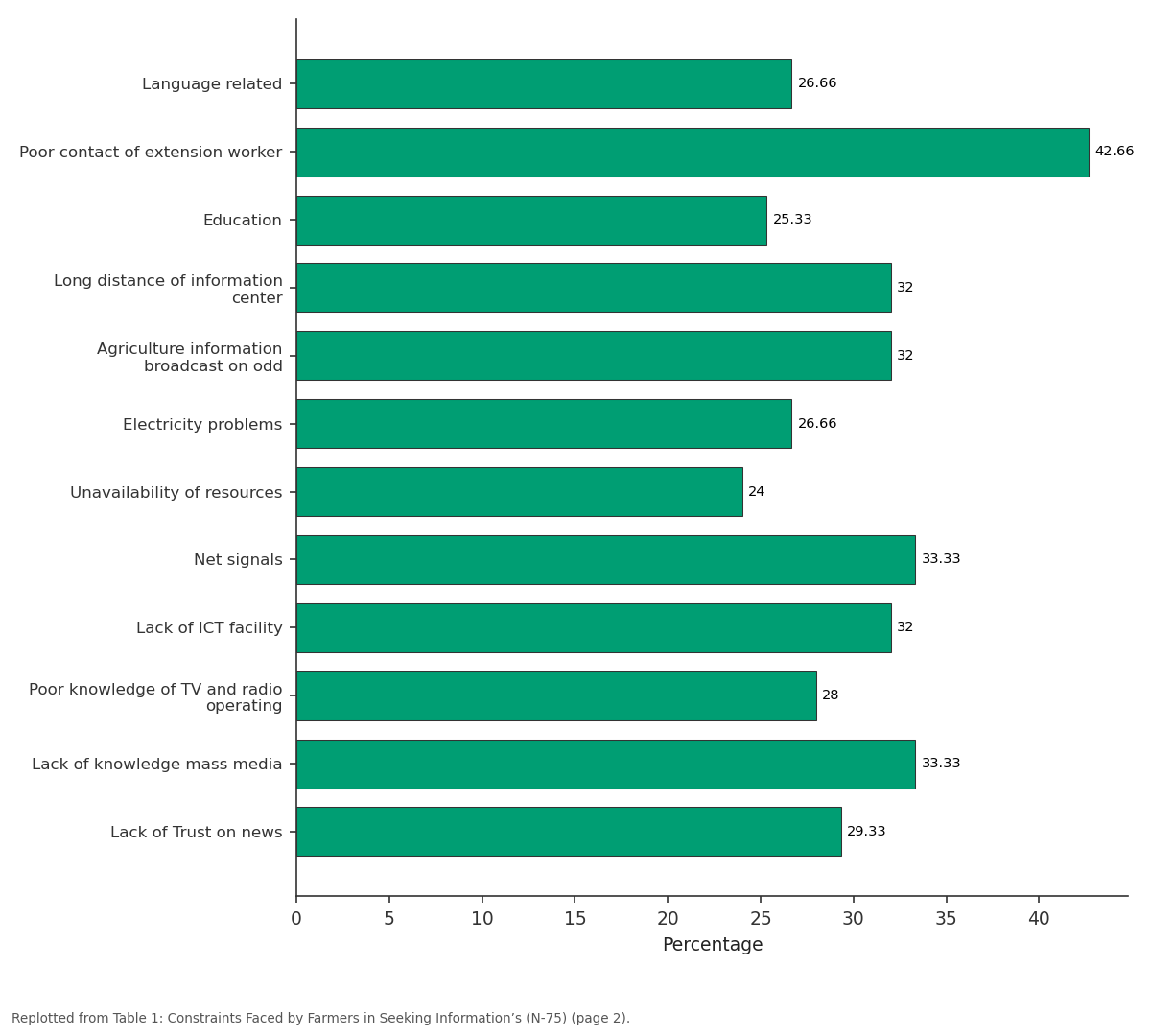
Percentage: Language related vs Poor contact of... vs Education vs Long distance of... vs Agriculture information...
Replotted from Table 1 (page 2) of the original paper. Every bar is the paper's own table value.
View source evidence ↗Figures & tables
From the original paper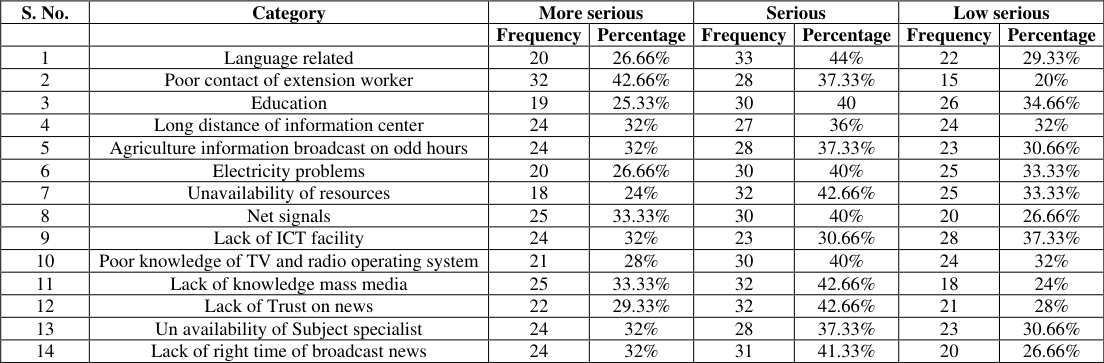 Table 1
Introduction
In past era agriculture technique was eco friendly but did not yield crop comparing now. Any way that is enough for those people as there was led population. Those farmers were seen as god but now it is in contrast. Only government are respecting farmers and that too only for those belong to their state or country. Even farmer families do not give respect if they have low income or if their crop failed. Some parents resisting their children in choosing agriculture as their career field due to their disrespectful towards farmers but they do not understand that without farmers due to influence of this society. Now days many farmers left their farming work and went to same nearby industries. The findings from the referred study show that poor/unreliable information, infrastructure, high illiteracy levels, low income, lack of electricity and high cost of ICTs have limited the accessibility of information services in rural areas. According to, the information needs of farmers change from time to time due to changing needs on emerging issue in agricultural technologies and innovations, environmental changes and agricultural policies. Yet, there is inadequate information for farmers. The main problem is where to locate and how to evaluate the information. This problem is not only limited to farmers in similar challenge. A better understanding of farmers' information needs and information sources could help guide extension and other agricultural programs to better target specific groups of farmers for appropriate interventions.
Objectives: To know the problem faced by farmers in seeking agriculture information.
Review Literature
Choudhary (2017) [7] conducted study on "information utilization behaviour of tomato growers in Jaipur district of Rajasthan India". Study revealed constraints faced by the respondents were high charges of mass media (84.44%), time unsuitability of mass media for agriculture information (79.44%), irregular electricity supply (76.94%), lack of trustworthy information (76.66%), poor communication ability of extension personnel (75%), poor literacy of respondents (70.83%) and lack of knowledge about use of mass media (65.55%). Maratha and Badodia (2016) [6] organized a study on "Information sources and utilization behaviour of vegetable grower at Swai Madhopur District in Rajasthan India". This study revealed that respondents of the vegetable grower suffered from financial difficulty (60.83%), inadequacy of facility (45%) and language barrier (50%). Kumar et al. (2016) [7] conducted study on "Problem faced by the farmers in adoption of mitigation and adaptation of climate change practices in agriculture in Manas block and Malhargarh block of Neemuch district of Madhya Pradesh". This study revealed many constraints faced by farmer's lack of information on appropriate adaptation option (66.60%), shortage of cultivable land and unpredictable weather (64.33%), high cost of technology (62.33%), poor access to market (41.15%) and poor finance (35.66%). Das (2015) [9] reported study on "problem of rural farmers: a case study based on the Lawphulabori village under the Nagon district Assam India". This study find out many problem faced by farmers for seeking information poverty (60%), illiteracy (65.56%),lack of mechanization (45.67%), lack of capital formation (39.86%), poor agriculture marketing (35%) and lack of knowledge. Syiem and Raj (2015) [10] reported study on "An access and usages of information communication technology for agriculture and rural development by the tribal farmers of Meghalaya State of North East India". This study revealed more challenges faced by illiteracy (50.14%), lack of awareness (58.43%), poor finance (41.77%), low network connectivity (58.43%), negative attitude towards ICTs (46.07%) and high cost of repairing ICTs (38.19%).
Methodology
Sample selection: Mundiyagarh gram panchayat of Jaipur district was selected for the study. A total number of available 75 respondents select as a sample for the study. Sampling method was random sampling. Construction of the tool: A structured interview schedule was prepared with the help of suggestions of some experts.
The interview schedule contained statements regarding crop production need, using sources for information, problems faced by the farmers seeking information. Data collection: Data collection through personal interview method at their home. Statistical analysis: Data were analyze by the application of mean, percentage and correlation coefficient as statistical measurement. In this study we found that in more serious problem category poor contact of extension worker farmers were facing the problem to poor contact of extension workers is more serious problem, lack of knowledge of mass media and poor net signals were also faced as more serious problem by 33.33 percent respondents. 32 percent farmers indicated that long distance of information center as more serious problem. Lack of ICT facility, education, unavailability of resources were faced as low serious problem 37.33 percent. 34.66 percent respectively. This problem poor contact of extension worker as the lowest serious problem by the 20 percent respondents.
Results and Discussion
Results and Discussion
Conclusion
The major problem of crop Production at present are the lack of knowledge poor contact of extension worker farmers were facing the problem to poor contact of extension workers is more serious problem, lack of mass media knowledge and poor net signals were also faced as more serious problem by 33.33 percent respondents. 32percent farmers indicated that long distance of information center as more serious problem. We don't have delivery system. So many farmers problem found in this research. There are so many schemes objective to empower of farmers and agriculture. For improvement of agriculture government should improve access to public extension services and increasing extension agent, expand number of agriculture officer and facilitate proper training programmes to improve their knowledge and skill in the agriculture activity.
Figures and tables from the paper
| S. No. | Category | More serious | — | Serious | — | Low serious | — |
|---|---|---|---|---|---|---|---|
| Frequency | Percentage | Frequency | Percentage | Frequency | Percentage | ||
| 1 | Language related | 20 | 26.66% | 33 | 44% | 22 | 29.33% |
| 2 | Poor contact of extension worker | 32 | 42.66% | 28 | 37.33% | 15 | 20% |
| 3 | Education | 19 | 25.33% | 30 | 40 | 26 | 34.66% |
| 4 | Long distance of information center | 24 | 32% | 27 | 36% | 24 | 32% |
| 5 | Agriculture information broadcast on odd hours | 24 | 32% | 28 | 37.33% | 23 | 30.66% |
| 6 | Electricity problems | 20 | 26.66% | 30 | 40% | 25 | 33.33% |
| 7 | Unavailability of resources | 18 | 24% | 32 | 42.66% | 25 | 33.33% |
| 8 | Net signals | 25 | 33.33% | 30 | 40% | 20 | 26.66% |
| 9 | Lack of ICT facility | 24 | 32% | 23 | 30.66% | 28 | 37.33% |
| 10 | Poor knowledge of TV and radio operating system | 21 | 28% | 30 | 40% | 24 | 32% |
| 11 | Lack of knowledge mass media | 25 | 33.33% | 32 | 42.66% | 18 | 24% |
| 12 | Lack of Trust on news | 22 | 29.33% | 32 | 42.66% | 21 | 28% |
| 13 | Un availability of Subject specialist | 24 | 32% | 28 | 37.33% | 23 | 30.66% |
| 14 | Lack of right time of broadcast news | 24 | 32% | 31 | 41.33% | 20 | 26.66% |
Table text extracted from the original PDF; superscript letters are shown inline. The original table image is below.
View original table image
References
10 in the original paper- Chandrakant A, Ghosh S, Sigandhup R. Agriculture information need and their fulfillment as perceived by the farmer in changing agriculture scenario in Maharashtra. Indian Journal of Extension Education. 2017;53(2):11-17.
- Swain, Kumar. Information seeking behaviour and use of information sources by farmers in Haryana. International Journal of Information Movement. 2017;2(5):79-84.
- Vaggi D, Kamble T. Agriculture information need of farmers in Hyderabad Karnataka Region. International Journal of Development Research. 2017;7(8):14376-143.
- Choudhary S. Information utilization behaviour of tomato growers in Jaipur district of Rajasthan. M.Sc thesis, SKN College of Agriculture, Jobner. 2017.
- Yadav S. Information need and information seeking behaviour of female workers in Lakipur Tea Garden. Journal of Humanities and Social Science. 2017;22(12):3742.
- Maratha P, Badodia SK. Information sources and utilization behaviour of vegetable growers at Swai Madhopur block, Swai Madhopur district in Rajasthan. The Journal of Rural and Agriculture Research; 2016.
- Kumar MP, Singh RJ, Pandey DK, Singh Ram, Jadav NB, Rajput. Problems faced by the farmers in adoption of mitigation and adaptation of climate change practices in agriculture. International Journal of Agriculture Science. 2016;8(56):3086-3088.
- Jalaj K, Kala P. Case study of tribal farmers' agriculture information needs and accessibility in Attapady tribal block, Kerala. Journal of Humanities and Social Science. 2015;20:07-20.
- Das P. Problems of rural farmers: a case study based on the Lawphulabori village under the Raha block development area of Nagon district, Assam. Journal of Humanities and Social Science. 2015;20:40-43.
- Syiew R, Raj S. Access and usages of ICT for agriculture and rural development by the tribal farmers in Meghalaya state of northeast India. Journal of Agriculture Information. 2015;6(3):24-41.
Cited by 1
From OpenAlex, OpenCitations and reference lists read by Scinovex
- Information matters: how does access to agricultural knowledge systems shape the agricultural landscape in South Asia? ↗
Pragya Timsina, Anjana Chaudhary, Emma Karki, Kali Ratan Chakma, Gunjan Rana, Saurya Karmacharya et al. · The Journal of Agricultural Education and Extension · 2026
Purpose Agricultural information is not only central to shaping individual decisions but also plays a critical role in structuring regional agricultural practices, social relationships, and the broader information network environment within which farmers operate. This study investigates the structure and performance of agricultural information systems in South Asia’s Eastern Gangetic Plains (EGP), spanning Bangladesh, India and Nepal, where smallholder farmers…
❝ 0