
Research article · 2024 · Full text
International Journal of Research in AgronomyGrowth parameters and yield attributes as influenced by doses and split application of nitrogen on wheat in acidic soils of Meghalaya
Volume 7(2) · Pages 146–149 · DOI: 10.33545/2618060x.2024.v7.i2c.297 ↗
Research areasAgricultural Science and Fertilization
Abstract
Author-writtenA field experiment was conducted to study the effect of N doses and split application on plant height, dry matter production and yield of wheat in acidic soils of Meghalaya. Nitrogen application increased the plant height, dry matter production and yield. Nitrogen dose of 120 kg ha-1 in three equal split applications (1/3 at basal+1/3 at CRI+1/3 at booting) recorded significantly increased the plant height, dry matter production and yield of wheat compared to N as single basal application.
Summary
Source-checkedPlain-language reading of the full paper, prepared with AI and checked against the text. Each point links to the authors' own words.
Why it matters
- Wheat is a critical staple food crop globally and in India, playing a major role in reducing global hunger. View evidence ↗
- Nitrogen is a primary nutrient required in large quantities for plant growth; its deficiency significantly reduces crop yields. View evidence ↗
- Soil acidity is a widespread issue in Northeast India, with approximately 65% of the area having a pH below 5.5. View evidence ↗
The question
- The study aimed to evaluate how different doses and split applications of nitrogen affect the plant height, dry matter production, and yield of wheat grown in the acidic soils of Meghalaya. View evidence ↗
What they did
- The experiment used wheat variety Nw-1014 during the 2019-20 Rabi season in Umiam, Meghalaya, in soil with a pH of 5.4. View evidence ↗
- Phosphorus and potassium were applied at 40:40 kg ha-1 as a basal dose across treatments. View evidence ↗
What they found
- The highest plant height (107.21 cm) was achieved with 120 kg N ha-1, which was significantly greater than the heights recorded for 80 kg N ha-1 (101.94 cm) and 40 kg N ha-1 (97.37 cm). View evidence ↗
- Dry matter accumulation was significantly higher with 120 kg N ha-1 compared to lower doses, and the split application of 1/3 basal, 1/3 CRI, and 1/3 booting yielded the highest dry matter. View evidence ↗
- Nitrogen fertilization significantly improved all yield attributes compared to unfertilized plots, including panicle number (2.09), panicle length (8.70 cm), and grain weight per plant (2.58 g). View evidence ↗
- The 120 kg N ha-1 dose produced the highest economic yield (4.41 t ha-1), biological yield (13.31 t ha-1), and straw yield (8.89 t ha-1). View evidence ↗
What it means
- The authors conclude that a nitrogen level of 120 kg ha-1, applied in split doses and combined with proper acidic soil management, is recommended to achieve maximum grain and biological yields. View evidence ↗
Visual summary
2 visualsIllustrations explain the paper; charts are replotted from the paper's own table values.
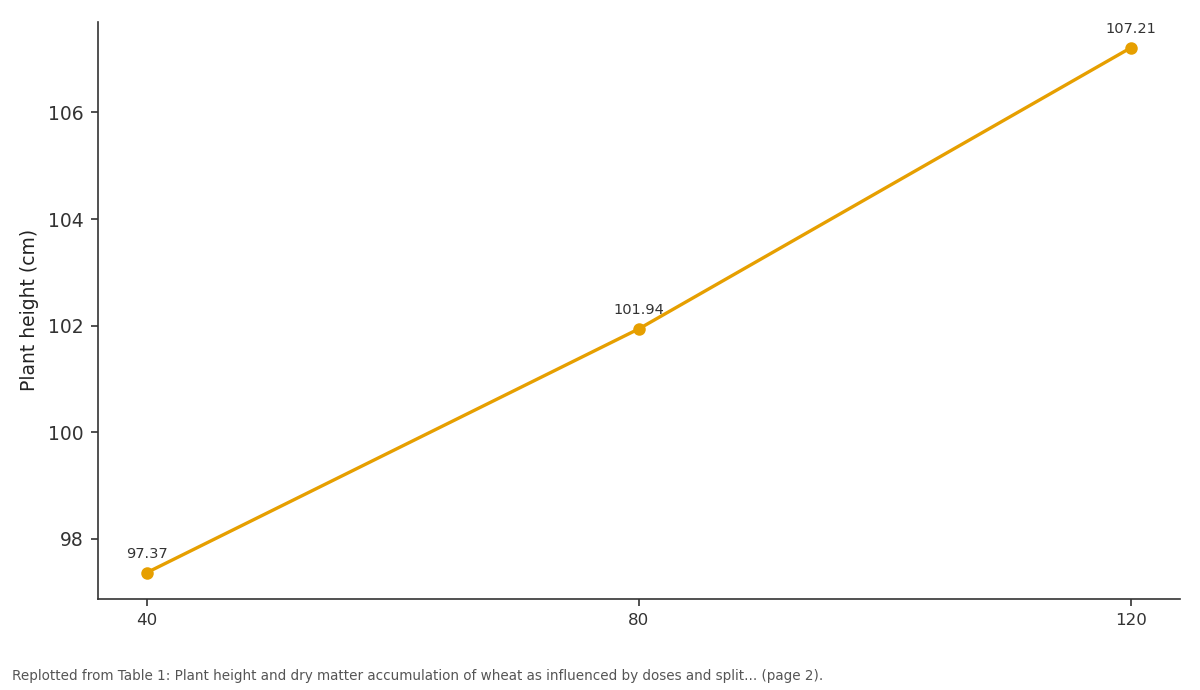
Plant height (cm): 40 vs 80 vs 120
Replotted from Table 1 (page 2) of the original paper. Every bar is the paper's own table value.
View source evidence ↗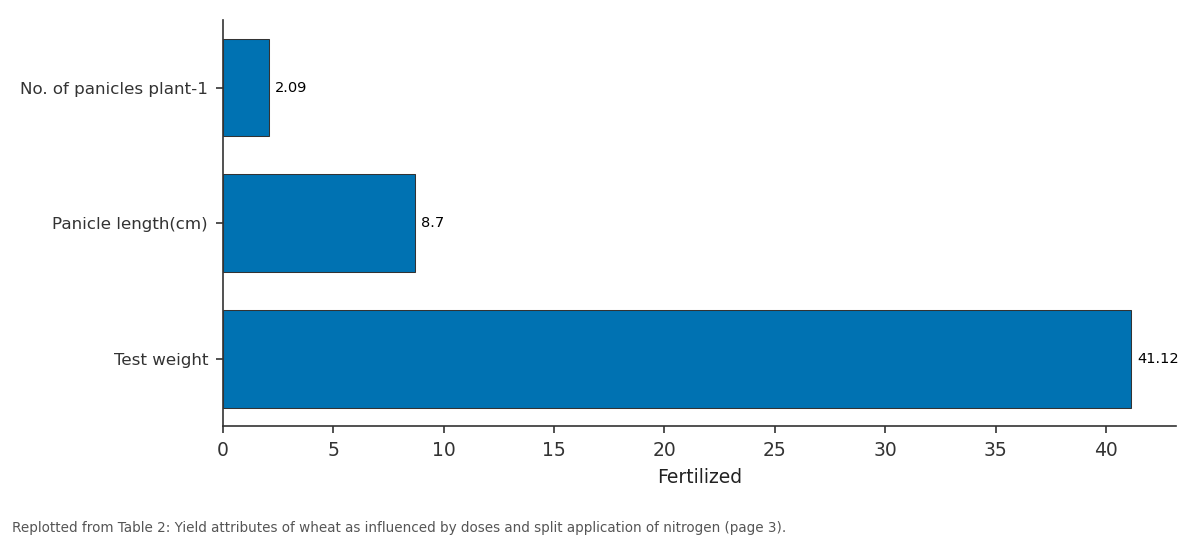
Fertilized: No. of panicles plant-1 vs Panicle length(cm) vs Test weight
Replotted from Table 2 (page 3) of the original paper. Every bar is the paper's own table value.
View source evidence ↗Figures & tables
From the original paper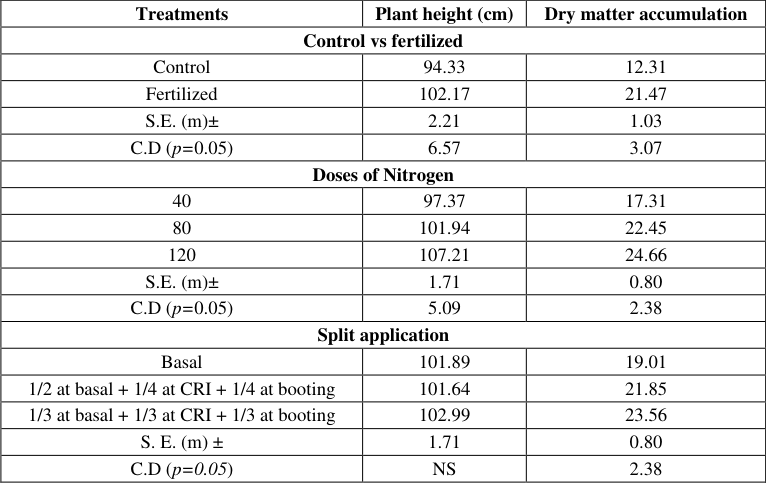 Table 1
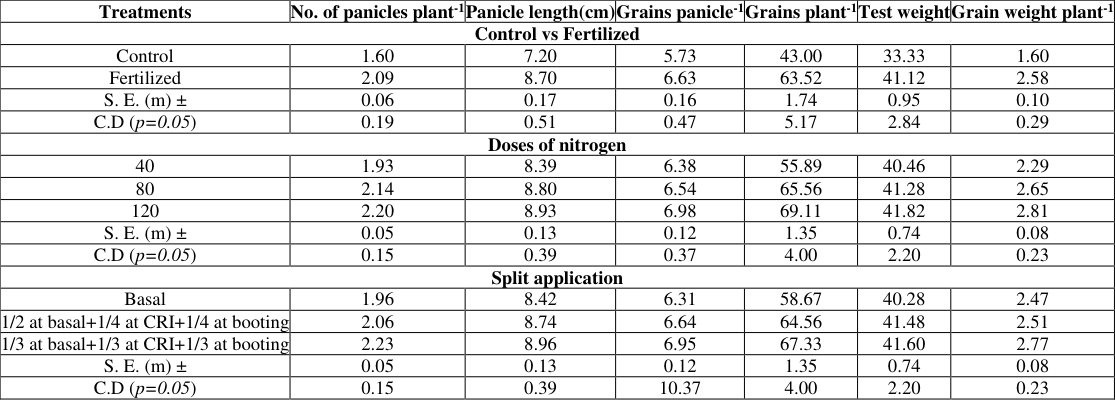 Table 2
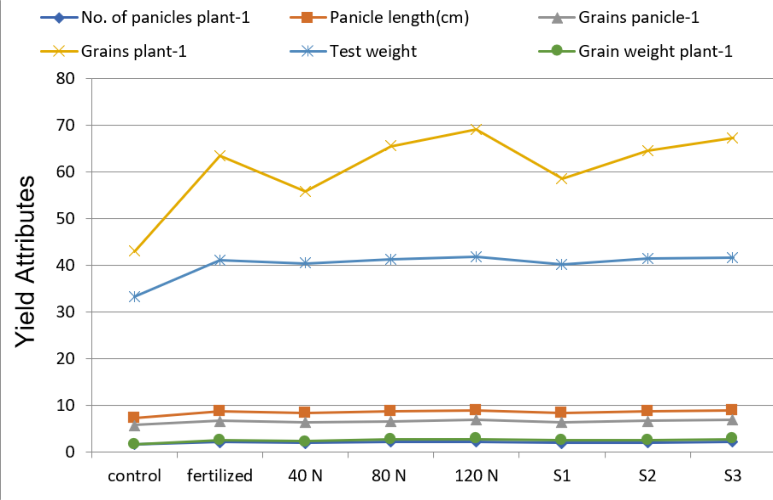 Figure 1
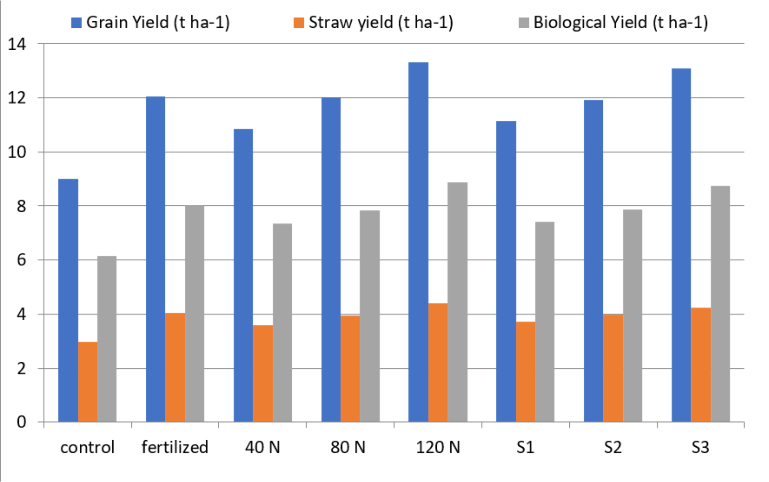 Figure 2
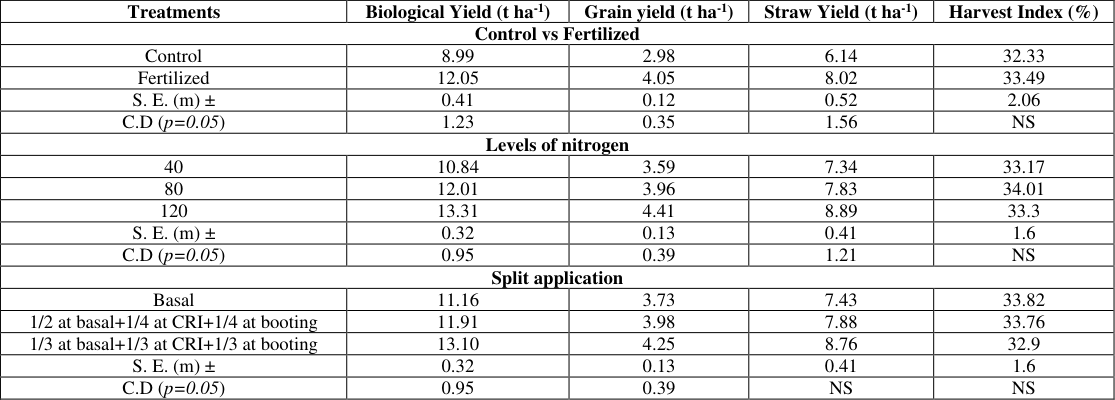 Table 3
Introduction
Wheat is one of the important staple food crops of both the world and India after rice crop. It plays a significant role in eliminating global hunger. It is a good source of carbohydrates, minerals, vitamins, dietary fiber and a protein called Gluten. Gluten helps make the bread dough and sticks together. The whole wheat includes wheat germ and bran provides protection against diseases like diverticulitis, ischaemic, constipation, heart disease, appendicitis, diabetes and obesity. It is a widely adapted crop due to complexity of its genome which provides plasticity to the crop and is grown from temperate irrigated land to dry and high rainfall areas and from warm humid to dry cold environments. Globally, India ranks second for wheat production after China. It is the second important food crop after rice in India and the world. Wheat is contributing nearly 35 percent to the national food basket and plays an important role in food and nutritional security. This crop occupies area, production and productivity of 30.8 m ha, 98.5 Mt and 3.2 t ha -1 , respectively in India and finds a major place in meals of common population in major wheat growing states. Nitrogen is one of the major nutrients which require more quantity by the crop plants to achieve higher yields (Finney et al., 1957; Delogu et al., 1998 and Zecevic et al., 2010 [5,2,10] . It consists of nucleic acids, ATP (adenosine triphosphate), and ADP (adenosine diphosphate) and help in cell growth and reproduction. Nitrogen deficiency in plant systems causes significantly reduction in plant growth and yields. When nitrogen applied from the inorganic sources like urea it may prone to various losses like volatilization, leaching, surface runoff and denitrification. Almost 65% of area in Northeast India has soil acidity severity i.e. pH below 5.5 (Sharma and Singh, 2002) [9] . Optimum doses of N at critical growth stages like crown root initiation, active vegetative stage; booting and grain filling stages significantly improved the plant growth and yields.
Materials and Methods
A field experiment was conduct during Rabi season 2019-20 at College of Post Graduate Studies in Agricultural Sciences, Umiam, Meghalaya. The experimental field's soil had a pH of 5.4 with available nitrogen (277.22 kg ha -1 ), available phosphorus (16.5 kg ha -1 ), available potassium (235.32 kg ha -1 ) and organic carbon (2.1%). Wheat variety Nw-1014 was sown. The seeds were sown manually with spacing of 20×5 cm.
0, 40, 80 and 120 kg N ha -1 were applied as per treatment and 40:40 Kg ha -1 , P 2 O 5 K 2 O were applied. The entire phosphorus and potassium dosage was applied as a basal. The experiment was laid out in FRBD (Factorial Randomized Block Design) replicated thrice with ten treatments viz., T0: Control, T 1 : N40 as full basal, T 2 : N20 as basal+N10 at CRI+N10 at booting, T 3 : N13.33 at basal+N13.33 at CRI+N13.33 at booting, T 4 : N80 as basal, T 5 N40 as 1/2 at basal + N20 as 1/4 at CRI + N20 as 1/4 at booting, T 6 N26.66 as 1/3 at basal + N26.66 as 1/3 at CRI + N26.66 1/3 at booting, T 7 : N120 as basal, T 8 N60 as 1/2 at basal +N30 at CRI +N30 at booting and T 9 N40 as 1/3 at basal + N40 as 1/3 at CRI + N40 as 1/3 at booting. The data was analysed using standard statistical techniques.
Results and Discussion
Effect on plant height (cm) Data on plant height presented in Table 1. N fertilized treatments found significantly higher plant height at harvest (102.17 cm) over control plot (94.33 cm). Imposition of different doses of N has resulted in significant variation among the treatments and higher plant height was recorded with application of 120 kg N ha -1 and lowest was recorded with control treatment. Maximum plant height was recorded (107.21 cm) with 120 kg N ha -1 which was significantly more over the plant height recorded from 80 kg N ha -1 (101.94 cm) and 40 kg N ha -1 (97.37 cm).
| Treatments | Plant height (cm) | Dry matter accumulation |
|---|---|---|
| Control vs fertilized | ||
| Control | 94.33 | 12.31 |
| Fertilized | 102.17 | 21.47 |
| S.E. (m)± | 2.21 | 1.03 |
| C.D (p=0.05) | 6.57 | 3.07 |
| Doses of Nitrogen | ||
| 40 | 97.37 | 17.31 |
| 80 | 101.94 | 22.45 |
| 120 | 107.21 | 24.66 |
| S.E. (m)± | 1.71 | 0.80 |
| C.D (p=0.05) | 5.09 | 2.38 |
| Split application | ||
| Basal | 101.89 | 19.01 |
| 1/2 at basal + 1/4 at CRI + 1/4 at booting | 101.64 | 21.85 |
| 1/3 at basal + 1/3 at CRI + 1/3 at booting | 102.99 | 23.56 |
| S. E. (m) ± | 1.71 | 0.80 |
| C.D (p=0.05) | NS | 2.38 |
Table text extracted from the original PDF; superscript letters are shown inline. The original table image is below.
View original table image
Effect on dry matter production (g plant -1 ) Data on dry matter accumulation presented in Table 1. N fertilized treatments found significantly higher plant dry matter (21.47 g) over control plot (12.31 g). Among the doses 120 kg N ha -1 recorded significantly higher dry matter accumulation over 80 kg N ha -1 and 40 kg N ha -1 and with respect to the split applications of 1/3 at basal + 1/3 at CRI + 1/3 at booting recorded higher dry matter followed by 1/2 at basal + 1/4 at CRI + 1/4 at booting and basal at the time of sowing.
Effect on yield and yield attributes
Data on yield parameters presented in Table 1. The N fertilized plots were recorded significantly higher yield attributes like No. of panicles plant -1 (2.09), Panicle length (8.70 cm), Grains panicle -1 (6.63), Grains plant -1 (63.52), Test weight (41.12) and Grain weight plant -1 (2.58 g) over control (unfertilized) plots. Among the various doses120 kg N ha -1 was recorded higher yield attributes followed by 80 kg N ha -1 and 40 kg N ha -1 . Maximum yield attributes associated with N was applied in three equal split applications as 1/3 at basal+1/3 at CRI+1/3 at booting followed by 1/2 at basal+1/4 at CRI+1/4 at booting and single application as basal at the time of sowing. Data on yield parameters presented in Table 2. Significantly higher yield was recorded with N fertilized treatments over control plots. The various doses brought significantly higher yields. The 120 kg N ha -1 was recorded higher economic yield (4.41t ha -1 ), biological yield (13.31 t ha -1 ) and straw yield (8.89 t ha -1 ) and followed by 80 kg N ha -1 and 40 kg N ha -1 . Among the split application of N which was applied at equal split at 1/3 at basal+1/3 at CRI+1/3 at booting stage recorded significantly higher economic yield (4.25 t ha -1 ), biological yield (13.10 t ha - 1 ) and straw (7.86 t ha -1 ) yield over remaining two applications. The increase in yields may be due to correct application of N doses at critical stages of wheat crop influenced higher plant growth, photosynthesis and accumulation of dry matter in the plants and which combindly influenced the increase in higher yield attributes and it is resulted in higher yields of wheat. The similar results were reported by Deshmukh, Pandey, Biswas and Singh.
| Treatments | No. of panicles plant-1 | Panicle length(cm) | Grains panicle-1 | Grains plant-1 | Test weight | Grain weight plant-1 |
|---|---|---|---|---|---|---|
| Control vs Fertilized | ||||||
| Control | 1.60 | 7.20 | 5.73 | 43.00 | 33.33 | 1.60 |
| Fertilized | 2.09 | 8.70 | 6.63 | 63.52 | 41.12 | 2.58 |
| S. E. (m) ± | 0.06 | 0.17 | 0.16 | 1.74 | 0.95 | 0.10 |
| C.D (p=0.05) | 0.19 | 0.51 | 0.47 | 5.17 | 2.84 | 0.29 |
| Doses of nitrogen | ||||||
| 40 | 1.93 | 8.39 | 6.38 | 55.89 | 40.46 | 2.29 |
| 80 | 2.14 | 8.80 | 6.54 | 65.56 | 41.28 | 2.65 |
| 120 | 2.20 | 8.93 | 6.98 | 69.11 | 41.82 | 2.81 |
| S. E. (m) ± | 0.05 | 0.13 | 0.12 | 1.35 | 0.74 | 0.08 |
| C.D (p=0.05) | 0.15 | 0.39 | 0.37 | 4.00 | 2.20 | 0.23 |
| Split application | ||||||
| Basal | 1.96 | 8.42 | 6.31 | 58.67 | 40.28 | 2.47 |
| 1/2 at basal+1/4 at CRI+1/4 at booting | 2.06 | 8.74 | 6.64 | 64.56 | 41.48 | 2.51 |
| 1/3 at basal+1/3 at CRI+1/3 at booting | 2.23 | 8.96 | 6.95 | 67.33 | 41.60 | 2.77 |
| S. E. (m) ± | 0.05 | 0.13 | 0.12 | 1.35 | 0.74 | 0.08 |
| C.D (p=0.05) | 0.15 | 0.39 | 10.37 | 4.00 | 2.20 | 0.23 |
Table text extracted from the original PDF; superscript letters are shown inline. The original table image is below.
View original table image
Conclusions
The yield of wheat crop is associated with N because it is an essential major primary nutrient helps in plant metabolism. Meghalaya is well known for its being top position as world wettest place with very high acidic soils. On the basis of the above-mentioned findings, it may be inferred that, the treatment with nitrogen level of 120 kg ha-1 was recorded significantly higher over other treatments. The split application of 120 kg N ha -1 along with proper acidic soil management can achieve higher grain yield and biological yield of wheat.
Acknowledgement
AcknowledgementIt is my great pleasure to give my heartfelt gratitude to Dr. A.K. Singh, Assistant Professor (Agronomy), Dr. V. Ram, Professor (Farming Systems Management), head of the department, Dr. Dr. Lala I.P. Ray, Associate Professor (Soil and Water Conservation Engineering), and Dr. Sanjay Swami, Professor (SSAC), College of Post Graduate Studies in Agricultural Sciences, Umiam, Meghalaya for their continuous help and motivation during the course of experiment.
Figures and tables from the paper
| Treatments | Biological Yield (t ha-1) | Grain yield (t ha-1) | Straw Yield (t ha-1) | Harvest Index (%) |
|---|---|---|---|---|
| Control vs Fertilized | ||||
| Control | 8.99 | 2.98 | 6.14 | 32.33 |
| Fertilized | 12.05 | 4.05 | 8.02 | 33.49 |
| S. E. (m) ± | 0.41 | 0.12 | 0.52 | 2.06 |
| C.D (p=0.05) | 1.23 | 0.35 | 1.56 | NS |
| Levels of nitrogen | ||||
| 40 | 10.84 | 3.59 | 7.34 | 33.17 |
| 80 | 12.01 | 3.96 | 7.83 | 34.01 |
| 120 | 13.31 | 4.41 | 8.89 | 33.3 |
| S. E. (m) ± | 0.32 | 0.13 | 0.41 | 1.6 |
| C.D (p=0.05) | 0.95 | 0.39 | 1.21 | NS |
| Split application | ||||
| Basal | 11.16 | 3.73 | 7.43 | 33.82 |
| 1/2 at basal+1/4 at CRI+1/4 at booting | 11.91 | 3.98 | 7.88 | 33.76 |
| 1/3 at basal+1/3 at CRI+1/3 at booting | 13.10 | 4.25 | 8.76 | 32.9 |
| S. E. (m) ± | 0.32 | 0.13 | 0.41 | 1.6 |
| C.D (p=0.05) | 0.95 | 0.39 | NS | NS |
Table text extracted from the original PDF; superscript letters are shown inline. The original table image is below.
View original table image
References
9 in the original paper- Biswas P, Kamal AMA, Rahman MM, Samanta SC. Effect of seed rate, split application, and time of irrigation on growth, yield and protein content of wheat. Bangladesh Journal of Scientific and Industrial Research. 1999;34(2):312-314.
- Delogu G, Cattivelli L, Pecchioni N, De Falcis D, Maggiore T, Stanca AM. Uptake and agronomic efficiency of nitrogen in winter barley and winter wheat. European Journal of Agronomy. 1998;9:11-20.
- Deshmukh SC, Rathore AS, Sinha NK. Efficiency of split application of nitrogen and phosphorus in irrigated wheat. Crop Research Hisar. 1994;8(3):493-498.
- Finney KF, Meyer JW, Fryer HC. Effect of foliar spraying of Pawnee wheat with urea solutions on yield, protein content and protein quality. Journal of Agronomy. 1957;49:341-347.
- Pandey IB, Singh H, Tiwari S. Response of timely sown wheat to levels and time of nitrogen application. Journal of Research, Birsa Agricultural University. 2003;15(1):35-38.
- Sarwar MH, Sarwar MF, Sarwar M, Qadri NA, Moghal S. The importance of cereals (Poaceae: Graminae) nutrition in human health: A review. Journal of Cereals and Oilseeds. 2013;4(3):32-35.
- Singh RK, Kumar P, Prasad B, Das AK, Singh SB. Effect of split application of nitrogen on the performance of wheat (Triticum aestivum L.). International Journal of Agricultural Sciences. 2016;12(1):32-37.
- Sharma UC, Singh RP. Acid soils of India, their distribution, management and future strategies for higher productivity. Fertilizer Association of India. 2002;47(3):4552.
- Zecevic V, Knezevic D, Boskovic J, Micanovic D, Dozet G. Effect of Nitrogen Fertilization on Winter Wheat Quality. Cereal Research Communications. 2010;38(2):243-249.