
Research article · 2024 · Full text
International Journal of Agriculture Extension and Social DevelopmentSericulture in the Lakhimpur District of Assam: Unravelling the Threads of Tradition and Development
Volume 7(2) · Pages 152–157 · DOI: 10.33545/26180723.2024.v7.i2c.318 ↗
Research areasSilkworms and Sericulture ResearchAgricultural Economics and PracticesAgricultural Systems and Practices
Abstract
Author-writtenSericulture in Assam holds a rich historical and cultural significance. Assam, known for its unique climate and conducive environment, has been a traditional hub for silk production. The state is renowned for its Muga and Eri silk varieties, each contributing to the vibrant textile heritage. The sericulture industry in Assam not only plays a pivotal role in the economic landscape but also fosters employment opportunities in rural areas. Despite its cultural and economic significance, challenges such as pest management, technology adoption, and market fluctuations persist. This research paper explores the intricate landscape of sericulture in the Lakhimpur district of Assam, investigating the entire silk production cycle from silkworm rearing to silk processing. The study delves into the historical significance of sericulture in the region, highlighting its cultural and economic importance. Through a multidimensional analysis, the paper assesses the socioeconomic impact of sericulture on local communities, shedding light on employment opportunities, income generation, and overall community development. Furthermore, sustainable sericulture practices are scrutinized, emphasizing environmentally friendly approaches that ensure the longevity of this traditional industry. The findings of this research contribute valuable insights to both academic discourse and practical strategies for fostering sustainable sericulture practices in the Lakhimpur district and beyond.
Summary
Source-checkedPlain-language reading of the full paper, prepared with AI and checked against the text. Each point links to the authors' own words.
Why it matters
- Assam is a traditional center for silk production due to its favorable environment and deep historical and cultural ties to sericulture. View evidence ↗
- The silk industry is economically vital for Assam, particularly in providing jobs for rural populations. View evidence ↗
- The industry faces ongoing difficulties regarding market stability, the adoption of new technologies, and the management of pests. View evidence ↗
The question
- The study aims to investigate the full silk production cycle, from rearing to processing, specifically within the Lakhimpur district of Assam. View evidence ↗
- The research seeks to analyze the socioeconomic impact of sericulture on job creation, income diversification, and general regional development. View evidence ↗
What they did
- The investigation was conducted across four villages in the Lakhimpur district: Silikhaguri, Gohain tekela, Mojoguri, and Bhogmon. View evidence ↗
- Data was collected from 100 total beneficiaries, consisting of 25 randomly selected individuals from each of the four villages. View evidence ↗
- Primary data was obtained through a standardized personal structured interview schedule. View evidence ↗
What they found
- Housing in the study area is predominantly non-permanent, with 95% of respondents living in Kachha houses and only 5% in Pakka houses. View evidence ↗
- The average land distribution for a sericulture farmer includes 3.5 bighas (0.48 ha) for host plants, 2.5 bighas (0.32 ha) for paddy, and smaller portions for seasonal crops, bamboo, and other plantations. View evidence ↗
- On average, three family members are involved in sericulture activities. View evidence ↗
- Risk is a significant factor, with 45% of the 100 respondents reporting losses in their sericulture activities. View evidence ↗
- Sericulture has contributed to an average annual income increase of Rs. 25,000 per respondent. View evidence ↗
- A proposed farm plan suggests that increasing investment to Rs. 6,160 could raise expected income to Rs. 50,520, improving the benefit-cost ratio to 7.20:1. View evidence ↗
What it means
- The authors conclude that the industry must balance the preservation of cultural heritage with the adoption of innovations to improve efficiency and environmental sustainability. View evidence ↗
- The authors recommend that the government provide adequate insurance options to protect rearers from financial losses. View evidence ↗
Figures & tables
From the original paper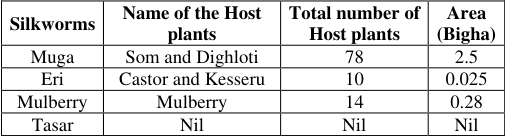 Table 1
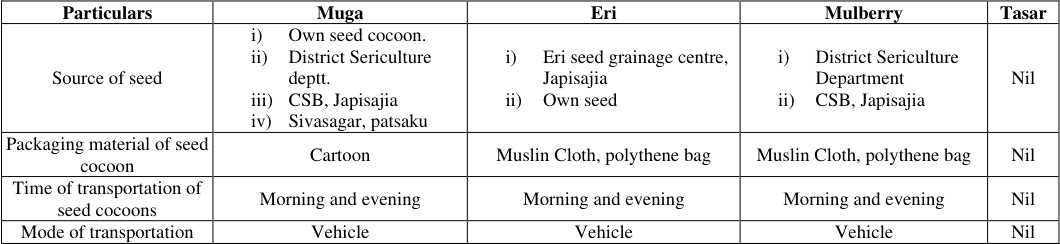 Table 2
 Table 3
 Figure 2
 Figure 3
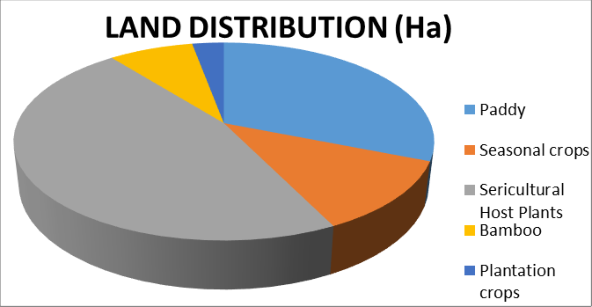 Figure 1
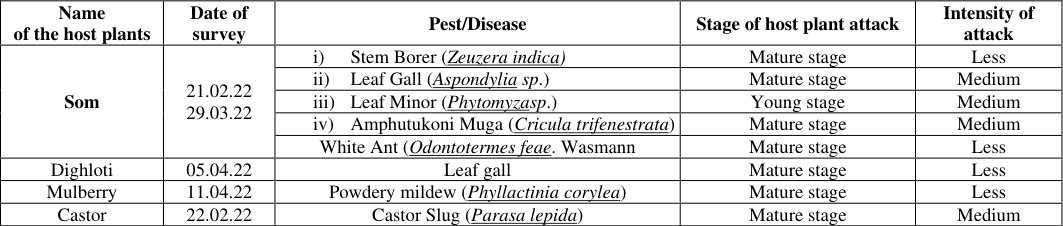 Table 4
 Figure 4
 Figure 5
 Figure 6
 Figure 7
 Figure 8
 Figure 10
 Figure 9
Introduction
The unique state of Assam in North-East India located between 24 048' and 27'009' north latitudes and 89'082' and 96'110' east longitudes has a rich history, deeply intertwined with the state's cultural and economic fabric. Known for its conducive climate and abundant natural resources, Assam has emerged as a significant hub for silk production. The sericulture industry in the region primarily focuses on the cultivation of silkworms and the production of high-quality silk, contributing to both local livelihoods and the state's economic growth. Nestled in the verdant landscapes of Assam, the Lakhimpur district stands as a cradle of tradition and a hub for the ageold practice of sericulture. North Lakhimpur serves as its headquarters. Lakhimpur district is bordered to the north by the districts of Siang and Papumpare in Arunachal Pradesh, and to the east by the Subansiri River and Dhemaji District in Dhemaji. The district is located approximately in latitudes 26.48' and 27.53' north and longitudes 93.42' and 94.20' east. For centuries, the region's identity has been based on the manufacturing of silk, which is firmly embedded in the region's cultural fabric. In order to fully understand the complex aspects of sericulture in the Lakhimpur district, this research study will examine its historical foundations, evaluate its socioeconomic effects in the present, and identify the ties that bind tradition to contemporary advancement. Even while sericulture has surely been crucial in forming Lakhimpur's identity, it is important to recognise its current importance as well as its potential going forward. This study aims to clarify the socioeconomic aspects of sericulture by analysing how it creates jobs, expands income options, and advances the district's general development. Moreover, the study explores the ecological aspects of sericulture in Lakhimpur in a time when sustainability is crucial. In order to ensure that sericulture not only survives but flourishes in the constantly changing terrain, we strive to find a balance between tradition and innovation by closely examining the environmental impact and investigating sustainable strategies within the sector. By means of this investigation, the study aims to provide a comprehensive comprehension of sericulture in the Lakhimpur district, presenting perspectives that beyond scholarly inquiry to advise policies, procedures, and sustainable development programmes. We want to value and protect the cultural heritage while building a robust and sustainable sericulture sector for future generations as we untangle the strands of tradition and progress. Lakhimpur, an Assamese district, is unique in the sericulture scene because of its focus on Muga Silk. Muga silk is a type of wild silk that is specifically associated with the Indian state of Assam. The silk has a sparkling, glossy texture, a natural yellowish golden tinge, and is renowned for its extraordinary longevity. Renowned for its golden sheen, Muga Silk has its origins in the ancient sericulture legacy of www.extensionjournal.com Lakhimpur. This introduction explores the special significance of Muga Silk in Lakhimpur, highlighting its cultural significance, economic influence, and the laborintensive technique of producing this fine silk. Muga is known scientifically as Antheraea assamensis helfer. The insect is holometabolous, going through four phases in its life cycle: egg, larva, pupa, and adult moth. It is one type of insect that creates extremely precious and unusual golden coloured threads is the muga. The only region in the world where muga rearers have been historically growing Muga silkworms since time immemorial is the Brahmaputra valley in Assam. Apart from Tripura, it is found in the wild in other north-eastern Indian states, where people raise it after gathering it from the jungles. Muga's historical legacy dates back to Assamese prehistory. In the Mahabharata, King Bhogodatta of Kamrupa engaged in fierce combat with the Pandavas while donning a turbine made of Muga cloth atop his head. This is known as elocution. Even the Rig-Veda reminds us to think back to the clothing made with golden threads. The significance of muga silk-that is, the bestowal of golden muga cloth-was also discovered in the Kautilya Arthasastra. In this way, the muga industry changed into an agro-based industry, gained magnificent prestige, and opened up new opportunities. The fact that the muga industry in Assam and the Lakhimpur district has become self-sufficient and has taken the lead in the manufacturing of muga silk is a source of great pride. Due to Muga's arboreal nature, their rearers have historically placed them in trees such as Persia bombycina and sualo, Litsea salicifolia. Some rearers even go so far as to gather seed cocoons from various districts in upper Assam, such as Lakhimpur, and from other districts like Dhemaji, Dibrugarh, Sivasagar, Jorhat, etc., and place them in a bamboo sokori pera. Larvae growth and maturity are mostly influenced by the climate. After 22 to 50 days of feeding on the leaves, the larvae grow enough to begin weaving their cocoons. After gathering, rearers place them on saloni. The silkworms flow off their skin four times as larvae to promote growth, although their skin is extremely sensitive during this time. Various species of birds, snacks, and monkeys are the larvae's enemies. When it matures, it is referred to as a pupae. Every mature worm is gathered
Materials and Methods
The present investigation was carried out in 4 villages, namely Silikhaguri, Gohain tekela, Mojoguri and Bhogmon Village of Lakhimpur district, Assam based on potentiality and production of muga cocoons, where three types of sericulture -Muga, Eri and Mulberry are being practiced. Lakhimpur district is major silk growing area where almost every household is more or less engaged in sericulture activity. According to information obtained from the Central Silk Board in North Lakhimpur and the Department of Sericulture in Lakhimpur, there are 14,441 Mulberry rearers, 9030 Eri rearers, and 7571 Muga rearers in around 716 villages. The primary data was gathered using the personal structured interview schedule that Nagaraja (1989) [3] standardised from the sampled respondents. As previously mentioned, four communities were chosen at random, with 25 beneficiaries in each community, in order to gather data. As a result, 100 beneficiaries were chosen from every village. The farmers were categorized into main and supplemental groups according to their level of employment engagement.
M = (1/N) fx,
Where N = Number of observation F = Frequency (collected data) x = Variable (as per situation)
Results and Discussion
On the basis of study, the analysis pertaining to employment, income, occupation, risks factor and social impact, Domestic Expenditure, Type of live stocks, Cocoon production, Duration of rearing of silkworm, Basic preparation for sericulture, Occupation before sericulture, Displacement for sericulture, Suggestion for change.
A. Status of House:
In study area analysis of the first type of information related that the Kachha houses are about 95%. On the other hand Pakka house are 5%out of total respondents. Regarding ownership of house all the respondents have their own house in all the villages. B. Land Distribution: Every seri farmer had been indulging in sericulture farming since long time. During the survey in the study area, it is found that on an average every seri farmer grows paddy in 2.5 bighas (0.32 ha) of land, and differen tseasonal crops in 0.8 bighas (0.12 ha), sericultural host plants in 3.5 bighas (0.48ha), bamboo in 0.5 bighas (0.08 ha) and other plantation crops in 0.2 bighas (0.03 ha) of land as shown in Figure 1.
C. Status of Working
Member: Among the families of the 4 villages under survey, It is observed that in Gohain tekela village the number of working members in 10 families is 2, in 12 families 3 and in 3 families 4 are working whereas in Mojoguri, the number of working members in 6 families is only 1 and in 9 families 2, and in 10 families 3 members are working. In Silikhaguri, and Bhogmon Village in 15 families 02, in 7 families 03 members and in 3 families 04 members are working. It is clear through the analysis that average 3 members are involved in the occupation from the families. It means there is a positive attitude of the members from each family. D. Occupation before Adopting Sericulture: Out of 100 respondents from study area, for 75 of them the main occupation before adoption of sericulture was Agriculture, whereas 25 respondents do as agriculture labour. It is also worth mentioning that most of them are highly benefitted by adopting sericulture along with agriculture.
E. Assessment of Host plants:
Assessing the number of host plants and available leaves on the host plants of the farmer would help in obtaining the profit and proper utilization of the natural resources of the farmer would help in finding possible ways to intervene in order to help the farmer in deriving benefit from the available resources. In the study area, the total number of available host plants for a seri farmer was assessed and on an average the host plant of Muga silkworm, namely Som was found to be highest followed by mulberry plantation as depicted in Table .1. www.extensionjournal.com
F. Procurement of seed cocoons
During the study in the villagers under considerations, the procurement of seed cocoons were surveyed and the details of the data are depicted in Table . 2.
G. Cultivation Practices for host plant production
The seri farmers collected the planting material from District Sericulture Deptt. Farm, Japisajia. They have followed various cultivation practices like land preparation, ploughing, levelling and spacing. The details are presented in Table . 3. I. Risk Factor and Sericulture: Every step of the sericulture process, from raising the raw silk to marketing it, carries some level of risk. Of the 100 responders, 45 had experienced a loss due to sericulture, whereas the remaining 55 had not incurred any harm. It conveys the difficulty and danger associated with it. Nearly all of them blamed the loss on atmospheric fluctuations and unfavorable weather, such as heavy rains, high temperatures, storms, and pollution, which can induce illness and cause crops to fail entirely. Numerous respondents said they were not compensated by the government. The officers of the sericulture department offer their full cooperation to each and every respondent.
K. Existing Farm Plan
Farm planning is the technique of making sound decisions by the farmers. It is a scheme for the operation and organizing of the farm business.
After evaluation of the existing farm plan, it was found that on an average a farmer having 1.2 bighas of land covered by sericultural host plants bears Rs. 800 for host plant production which includes the cost of saplings, land preparation, fertilizer and land revenue whereas a farmer on an average invest Rs. 970 for rearing of silkworm which involves cost of the seed, rearing appliances and disinfectants. Thus the total cost of investment is Rs.1800 (approx.) and the total income earned on an average by a farmer amounts to Rs.14000 which includes selling of saplings, muga cocoon, raw muga silk, eri cut cocoons, etc. This brings the benefit-cost ratio to 6.7:1.
L. Proposed Farm Plan
From the analysis of the existing farm plan, a new plan was proposed to the sericulture farmers in order to increase their income from sericultural activities. The total proposed investment to be made by an individual farmer is Rs. 6160 which includes cost of host plant cultivation, silkworm rearing and cost of reeling and spinning. As per the proposed investment, the expected income to be earned from selling of saplings, muga cocoon, raw muga silk, eri cut cocoons, etc. is Rs. 50,520. This will increase the benefit-cost ratio to 7.20:1.
M. Suggestions for Change
The survey discovered that the rearers had a variety of issues, the most common being financial, environmental, and marketing difficulties. should be used as a network to bridge the information gap that exists between the government and rearers and weavers regarding sources of funding, the availability of current technology, the market, etc. This will benefit future generations. e) The environment and climate pose a significant challenge to parents. The scientifically designed safe room is where the cocoons should be kept to protect them from climate-related threats. f) The government ought to offer the rearers sufficient insurance options. When people have losses, it aids them.
Conclusion
In conclusion, this research paper provides a comprehensive overview of sericulture in the Lakhimpur district of Assam. The findings underscore the significant historical, cultural, and economic contributions of sericulture to the region. Through an exploration of the entire silk production process, from silkworm rearing to silk processing, the study illuminates the intricate dynamics of this traditional industry. The socioeconomic impact of sericulture emerges as a central theme, revealing its role in generating employment, fostering income opportunities, and contributing to the overall development of local communities. The paper emphasizes the need for continued support and strategic interventions to harness the full potential of sericulture as a catalyst for sustainable development in the Lakhimpur district. Additionally, the examination of sustainable sericulture practices underscores the importance of adopting eco-friendly approaches to ensure the long-term viability of this industry. As sericulture stands at the intersection of tradition and modernity, the research advocates for a balance that preserves cultural heritage while embracing innovations that enhance efficiency and environmental responsibility. In light of these insights, the study not only adds depth to the understanding of sericulture in the Lakhimpur district but also offers practical implications for policymakers, researchers, and practitioners. By acknowledging the challenges and opportunities within the sericulture sector, this research paper serves as a foundation for future endeavors aimed at fostering sustainable development and preserving the rich legacy of sericulture in Assam.
Figures and tables from the paper
| Silkworms | Name of the Host plants | Total number of Host plants | Area (Bigha) |
|---|---|---|---|
| Muga | Som and Dighloti | 78 | 2.5 |
| Eri | Castor and Kesseru | 10 | 0.025 |
| Mulberry | Mulberry | 14 | 0.28 |
| Tasar | Nil | Nil | Nil |
Table text extracted from the original PDF; superscript letters are shown inline. The original table image is below.
View original table image
| Particulars | Muga | Eri | Mulberry | Tasar |
|---|---|---|---|---|
| Source of seed | i) Own seed cocoon. ii) District Sericulture deptt. iii) CSB, Japisajia iv) Sivasagar, patsaku | i) Eri seed grainage centre, Japisajia ii) Own seed | i) District Sericulture Department ii) CSB, Japisajia | Nil |
| Packaging material of seed cocoon | Cartoon | Muslin Cloth, polythene bag | Muslin Cloth, polythene bag | Nil |
| Time of transportation of seed cocoons | Morning and evening | Morning and evening | Morning and evening | Nil |
| Mode of transportation | Vehicle | Vehicle | Vehicle | Nil |
Table text extracted from the original PDF; superscript letters are shown inline. The original table image is below.
View original table image
| Name of the host plants | Date of survey | Pest/Disease | Stage of host plant attack | Intensity of attack |
|---|---|---|---|---|
| Som | 21.02.22 29.03.22 | i) Stem Borer (Zeuzera indica) | Mature stage | Less |
| ii) Leaf Gall (Aspondylia sp.) | Mature stage | Medium | ||
| iii) Leaf Minor (Phytomyzasp.) | Young stage | Medium | ||
| iv) Amphutukoni Muga (Cricula trifenestrata) | Mature stage | Medium | ||
| White Ant (Odontotermes feae. Wasmann | Mature stage | Less | ||
| Dighloti | 05.04.22 | Leaf gall | Mature stage | Less |
| Mulberry | 11.04.22 | Powdery mildew (Phyllactinia corylea) | Mature stage | Less |
| Castor | 22.02.22 | Castor Slug (Parasa lepida) | Mature stage | Medium |
Table text extracted from the original PDF; superscript letters are shown inline. The original table image is below.
View original table image
References
3 in the original paper- Bonia B. Muga Silk Rearers: A Field Study of Lakhimpur District of Assam, International Journal of Scientific & Technology Research. 2020;9(4):2277.
- Kalita T, Dutta Karabi. Biodiversity of sericigenous insects in Assam and their role on employment generation, Journal of entomology and zoology studies. 2014;2(5):119-125.
- Nagaraj N, Chandrakanth MG, Murthy SR. The economics of sericulture in Karnataka. Indian Silk. 1986;25(4):13-19.