
Research article · 2024 · Full text
International Journal of Advanced Biochemistry ResearchEffect of lime, sulphur and boron on the germination of chickpea (Cicer arietinum L.) in acidic soil of Jharkhand
Volume 8(2S) · Pages 183–185 · DOI: 10.33545/26174693.2024.v8.i2sc.534 ↗
Research areasAgricultural Science and FertilizationPlant Micronutrient Interactions and EffectsAgricultural pest management studies
Abstract
Author-writtenThis field investigation was carried out with the objective to study the “Effect of lime, boron and sulphur on germination of chickpea in acidic soils of Jharkhand”. The experiment was carried out during Rabi season of 2022-23 in the experimental field of Department of Agriculture, Jharkhand Rai University, Ranchi. These were eight treatments with three replications consisting of three components viz. lime (@3q/ha), boron (@1kg/ha) and sulphur (@20 kg/ha) in different combinations as basal along with the recommended dose of fertilizer (25:50:25 kg/ha). Observations were recorded on three parameters viz. germination percentage, vigour index and number of days taken in germination. RDF+ Lime @3q/ha + Sulphur@20 kg/ha+Boron@1 kg/ha recorded higher germination percentage and germination index. Then was no effect of lime, sulphur or boron on days taken in germination. Though the number of days in germination reduced due to NPK application. The maximum number of days taken for germination was observed in control plot.
Summary
Source-checkedPlain-language reading of the full paper, prepared with AI and checked against the text. Each point links to the authors' own words.
Why it matters
- Pulses are essential components of the Indian economy and traditional cuisine. View evidence ↗
- Chickpea is a significant ancient pulse crop traditionally cultivated in India starting in October. View evidence ↗
- Acidic soils limit the availability of micronutrients, which negatively impacts the germination, growth, and development of chickpea crops. View evidence ↗
The question
- The study aimed to evaluate how the application of lime, boron, and sulphur affects the germination of chickpea in the acidic soils of Jharkhand. View evidence ↗
What they did
- The field experiment took place during the 2022-23 Rabi season at Jharkhand Rai University in Ranchi. View evidence ↗
- The study used a randomized block design with eight treatments and three replications, utilizing plots measuring 3×2 m². View evidence ↗
- Treatments included combinations of lime (3q/ha), boron (1kg/ha), and sulphur (20kg/ha) applied as basal along with a recommended fertilizer dose of 25:50:25 kg/ha. View evidence ↗
- The researchers measured three specific parameters: germination percentage, vigour index, and the number of days required for germination. View evidence ↗
What they found
- The highest germination percentage of 98.4% was achieved with the combination of RDF, lime, boron, and sulphur (T8), performing similarly to T6 and T7. View evidence ↗
- The control group (T1) showed the lowest germination rate at 95%. View evidence ↗
- The highest germination index was 767.2 in the T8 treatment, while the control (T1) had the lowest index of 626.3. View evidence ↗
- Germination was slowest in the control plot (13 days) and fastest in all fertilizer-treated plots (T2 to T8), which all took 11 days. View evidence ↗
- While NPK application reduced the time to germinate, the addition of lime, sulphur, or boron had no further effect on the number of days taken for germination. View evidence ↗
What it means
- The authors conclude that the combination of RDF, lime, boron, and sulphur (T8) provides the best results for germination percentage and index. View evidence ↗
- The authors state that improving seed treatment is an easy way to boost germination and agricultural productivity. View evidence ↗
Visual summary
3 visualsIllustrations explain the paper; charts are replotted from the paper's own table values.
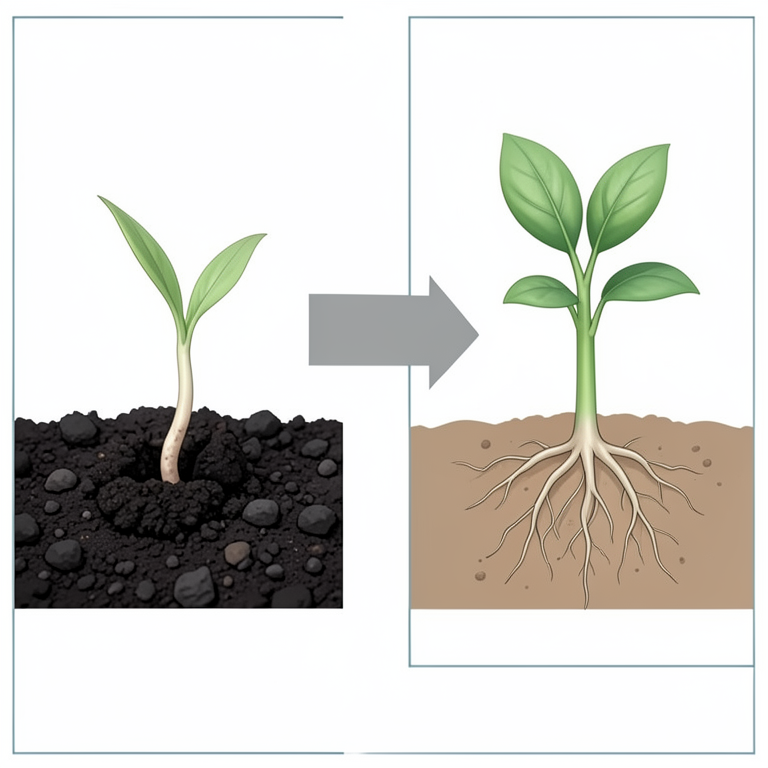
Impact of Soil Amendments on Germination
AI-generated conceptual illustration (chickpea seeds (Cicer arietinum L.) in soil). It explains the idea and does not show study data.
View source evidence ↗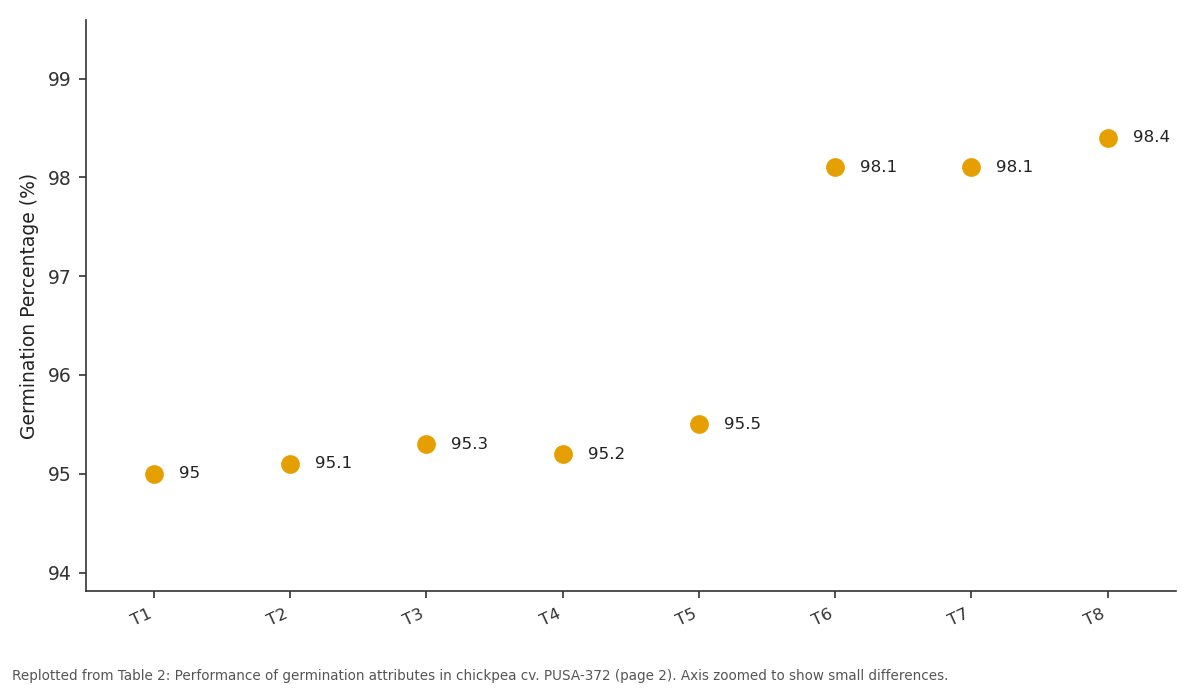
Germination Percentage (%): T1 vs T2 vs T3 vs T4 vs T5
Replotted from Table 2 (page 2) of the original paper. Every bar is the paper's own table value.
View source evidence ↗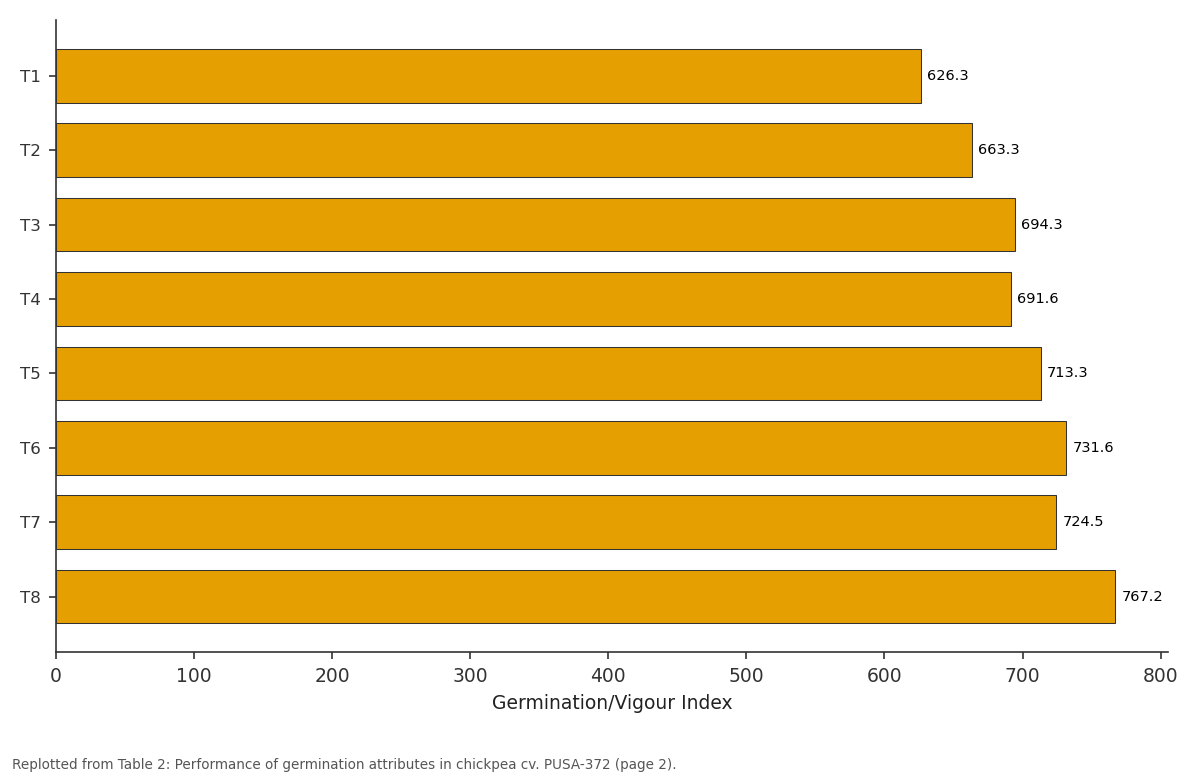
Germination/Vigour Index: T1 vs T2 vs T3 vs T4 vs T5
Replotted from Table 2 (page 2) of the original paper. Every bar is the paper's own table value.
View source evidence ↗Figures & tables
From the original paper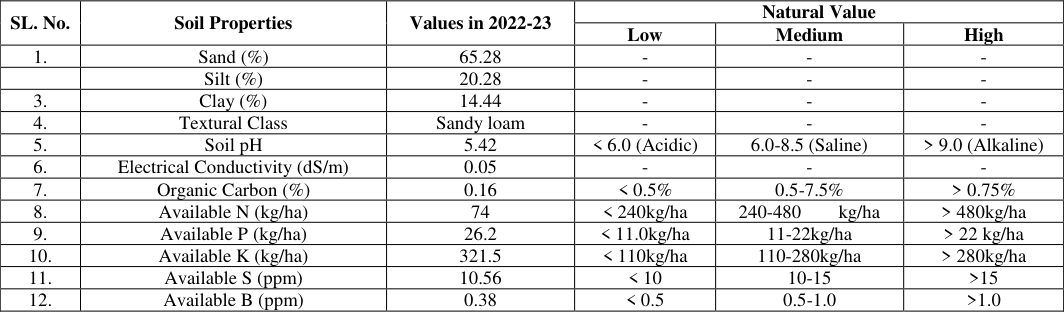 Table 1
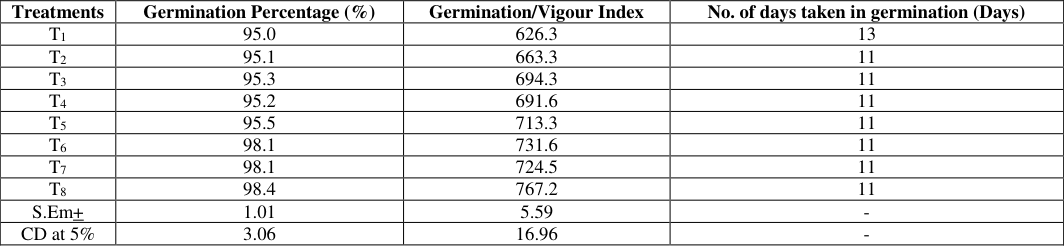 Table 2
Introduction
Pulses are a great natural gift that are crucial to the Indian economy and cuisine (Jat et al, 2012) [7] . As per Niti Ayog Working Group on Demand and Supply Projections Towards 2033, the demand for pulses is projected to increase from 26.72 million tonnes in 2021-22 to 32.64 million tonnes in 2029-30. The current production of pulses are 29.96 million tonnes. (PIB, Government of India). The most significant ancient pulse crop, chickpea (Cicer arietinum L.) traditionally grown in India during October month. It is primarily grown in semi-arid and warm temperate regions of the world where the temperature ranges from 20 0 to 30 °C. It is one of the Rabi crops that is most widely grown in India. The chickpea holds a prominent position among the pulses in the nation and also important due to its high nutritional value, maximal acreage of cultivation, and high productivity rates. Because in acidic soils, micronutrients have a limited availability. Micronutrient availability is highest in the very slightly to medium acid range. Due to low availability of micronutrients, the germination, growth and development of chickpea crop affect. Advisely seed germination is a complex physiological process which is mainly depends on environmental signals such as moisture, temperature, humidity, light, nitrate etc. While, poor seed germination is the major limiting factor of some of the important pulse crops including chickpea. The seed germination percentage of many pulse crops is very poor as well as late germination occurs. Rapid germination, maximum germination percentage and healthy seedlings are very much essential to fulfil the growing demands for yield (Dongre, 2007) [5] . Liming of acid soil is a commonly used soil improvement technique for effective use of native soil nutrients and better recovery of applied fertilisers, leading to enhanced production. When several crops are grown in an acidic soil type, with legumes included in the mix, it is highly desirable. As a result, crops that are sensitive to soil acidity like chickpea can be cultivated in limed soil because it enhances base saturation capacity, raises soil pH to nearly neutrality, inactivates Al, Fe, and Mn, inhibits P fixation, lowers exchange acidity, and stimulates microbial activity which causes better germination. The use of macro and micronutrients will be optimised which increase germination. After N, P, and K, sulphur is regarded as the fourth important nutrient. As a component of vitamins (thiamine and biotin) and other physiologically active compounds like lipoic acid, acetyl coenzyme-A, ferredoxin, and glutathione, it is essential for the synthesis of proteins, especially those containing S-containing amino acids like methionine, cystine, and cysteine (Kala et al., 2017) [8] . Sulphur's advantageous effect as a result of better root development (Lange et al. 1994) [9] . In plants, boron (B) is essential for the synthesis of cell walls, the transport of sugar, cell division, differentiation, membrane function, root elongation, control of plant hormone levels, and generative growth which leads to better germination. The soil application of boron is important when the concentration of B in the soil is less than 0.3 mg/kg (Ahlawat et al. 2007) [1] . Boron deficiency can be caused by high pH is larger than 6.5-7.0 (Sims, 2000) [11] , which occur in highly leached sandy soils or in low organic matter soils and causes harmful effect in germination. In light of this, the current experiment was conducted to determine the proper dosages of lime, sulphur, boron to apply to chickpea in Chotanagpur Plateau (Jharkhand).
Understanding the significance of the aforementioned information, the current study was conducted to assess the impact of boron, sulfur and lime on germination of chickpea.
Materials and Methods
The present investigation was carried out in the experimental field of Department of Agriculture, Jharkhand Rai University, Namkum Campus, Ranchi. The experiment was laid out in 3×2 m 2 plots in a randomized block design (RBD) with three replications and eight treatments including control viz., T1-Control (No nutrient); T2-RDF (NPK-25:50:25 kg/ha); T3-RDF + Lime @3q/ha; T4-RDF + Boron @ 1kg/ha; T5-RDF + Sulphur @ 20kg/ha; T6-RDF + Lime @3q/ha + Boron @ 1kg/ha; T7-RDF + Lime @3q/ha + Sulphur @ 20kg/ha; T8-RDF + Lime @3q/ha + Boron @ 1kg/ha + Sulphur @ 20kg/ha. Seeds were treated by Rhizobium culture, @10 g/kg before sowing. The treated seeds were kept in shade approximately for 2 hours to get it dry and then sown in the plots as per treatment. The observations on germination percentage, germination index and number of days taken in germination were recorded in this experiment. Available B (ppm) 0.38 < 0.5 0.5-1.0 >1.0
Results and Discussions
Based on the findings, every trait under investigation was impacted by the treatments, and a significant difference was observed between the control and the plots treated with lime, sulfur, and boron (Tables -2). Germination percentage was influenced significantly with application of lime, sulphur and boron. The germination percentage performance ranged from 95 to 98.4, with a mean value of 96.3. The highest germination percentage (98.4%) was reported in the treatment T8 (RDF + Lime @3q/ha + Boron@1kg/ha + Sulphur @ 20kg/ha) which was at par with the treatments T6 and T7. The treatment T1 (Control) exhibited the lowest germination rate of 95%.
Germination index was also influenced significantly with application of lime, sulphur and boron. With an average value of 701.5, mean performance of the germination index varied from 626.3 to 767.2. The higher germination index was obtained by the T8 (RDF + Lime @3q/ha + Boron @ 1kg/ha + Sulphur @ 20kg/ha) (767.2). The treatment T1 (Control) had the lowest germination index (626.3). Mean performance of number of days taken in germination ranged from 11 to 13 days with the mean value-11.25 days. The latest germination (13 days) was recorded in the treatment T1 (Control). The earliest germination (11 days) was recorded in rest of all the treatments with fertilizer (T2 to T8). [10] also reported increased germination of lime applied plots over lime not applied plots in sorghum. Lime improves base saturation capacity of soil, increases the soil pH to near neutrality, inactivate Al, Fe and Mn, reduces P fixation, decreases exchange acidity, stimulates microbial activity as a result of which varieties of crops sensitive to soil acidity could be grown in a limed soil. The maximum crop growth rate might be due to the positive effect of lime in an acid soil which not only replaces hydrogen ions, raises soil pH and makes NPK in more available from but also thereby increasing germination percentage of legume crop. Zhao et al. (2007) [12] also reported the same trend of effect of lime in acid soil. Azimi et al. (2013) [4] reported that the speed of germination was reported to be maximum with the high levels of NPK. The increase in speed of germination with the application of nitrogen can be attributed to the fact the faster initiation of metabolic activities in the seed.
Conclusion
Based on present investigation, it can be concluded that the treatment T8 (RDF + Lime@3q/ha + Boron @ 1kg/ha + Sulphur@20kg/ha) showed superior performance on germination percentage and germination index followed by T6-RDF + Lime@3q/ha + Boron@1kg/ha and T7-RDF + Lime@3q/ha + Sulphur@20kg/ha. When as NPK application was found effective in days taken in germination.
The study demonstrated that improving seed treatment is a straightforward, expensive, and easy way to boost germination performance, which improves agricultural productivity, particularly for farmers that have limited land resources. The demonstrates unequivocally that each micronutrient has a different method of action.
Acknowledgement
AcknowledgementAuthors are thankful to Dr. R.P Singh 'Ratan', Dean, Department of Agriculture, Jharkhand Rai University, Ranchi and Dr. Shashi Bhushan Kumar, Associate Professor, Department of Soil Science and Agricultural Chemistry, Faculty of Agriculture, Birsa Agricultural University, Ranchi for providing necessary facilities, encouragement and support.
Figures and tables from the paper
| SL. No. | Soil Properties | Values in 2022-23 | Natural Value | — | — |
|---|---|---|---|---|---|
| Low | Medium | High | |||
| 1. | Sand (%) | 65.28 | - | - | - |
| Silt (%) | 20.28 | - | - | - | |
| 3. | Clay (%) | 14.44 | - | - | - |
| 4. | Textural Class | Sandy loam | - | - | - |
| 5. | Soil pH | 5.42 | < 6.0 (Acidic) | 6.0-8.5 (Saline) | > 9.0 (Alkaline) |
| 6. | Electrical Conductivity (dS/m) | 0.05 | - | - | - |
| 7. | Organic Carbon (%) | 0.16 | < 0.5% | 0.5-7.5% | > 0.75% |
| 8. | Available N (kg/ha) | 74 | < 240kg/ha | 240-480 kg/ha | > 480kg/ha |
| 9. | Available P (kg/ha) | 26.2 | < 11.0kg/ha | 11-22kg/ha | > 22 kg/ha |
| 10. | Available K (kg/ha) | 321.5 | < 110kg/ha | 110-280kg/ha | > 280kg/ha |
| 11. | Available S (ppm) | 10.56 | < 10 | 10-15 | >15 |
| 12. | Available B (ppm) | 0.38 | < 0.5 | 0.5-1.0 | >1.0 |
Table text extracted from the original PDF; superscript letters are shown inline. The original table image is below.
View original table image
| Treatments | Germination Percentage (%) | Germination/Vigour Index | No. of days taken in germination (Days) |
|---|---|---|---|
| T1 | 95.0 | 626.3 | 13 |
| T2 | 95.1 | 663.3 | 11 |
| T3 | 95.3 | 694.3 | 11 |
| T4 | 95.2 | 691.6 | 11 |
| T5 | 95.5 | 713.3 | 11 |
| T6 | 98.1 | 731.6 | 11 |
| T7 | 98.1 | 724.5 | 11 |
| T8 | 98.4 | 767.2 | 11 |
| S.Em+ | 1.01 | 5.59 | - |
| CD at 5% | 3.06 | 16.96 | - |
Table text extracted from the original PDF; superscript letters are shown inline. The original table image is below.
View original table image
References
8 in the original paper- FAOSTAT; c2011. http://faostat.fao.org/site/567/Desktop Default.aspx. (Accessed 12th December 2011).
- Department of Agriculture and Farmers' Welfare and Press Information Bureau, Government of India; c202122. https://pib.gov.in/PressReleseDetailm.aspx?PRID=1808 671.
- Azimi MS, Jahanfar D, Sayfzadeh S, Zare S. Evaluation of Amino Acid and Salicylic Acid application on yield and growth of wheat under water deficit. International Journal of Agriculture and Crop Science. 2013;5(3):5-7.
- International Seed Testing Association. International rules for seed testing rules 1996. Seed Science and Technology; c2001. p. 24.
- Jat NR, Rana BS, Jat SK. Estimation of losses due to pulse beetle in chickpea. The Bioscan. 2013;8:861-863.
- Kala DC, et al. Effect of Graded Doses of Sulphur and Boron on Yield Attributes and Nutrient Uptake by Chickpea at Department of Soil Science, G.B. Pant University of Agriculture and Technology, Pantnagar, Uttarakhand. International of Current Microbiology and Applied Sciences. 2017;6(6):55-60.
- Magalhaes PC, Ferreira DMN, Vasconcelos CA, Azevedo JT, Borba CS. Effect of pelleting on germination and development of sorghum cultivation. Revista Brasileria de sementes. 1994;16(1):20-25.
- Zhao J, Michalk LY, Wen Y, Kemp KR, Gand D, Helen N. Effect of phosphorus, potassium and lime application on pasture in acidic soils in Yunnan province, China. New Zealand Journal of Agricultural Research. 2007;50:523-535