
Research article · 2024 · Full text
International Journal of Advanced Biochemistry ResearchAssessment of jackfruit-based squash preparation methods
Volume 8(2S) · Pages 62–66 · DOI: 10.33545/26174693.2024.v8.i2sa.527 ↗
Research areasSports Performance and TrainingMuscle metabolism and nutrition
Abstract
Author-writtenAgriculture and horticulture is main occupation of farmers of Bokaro district. In Jharkhand state, Bokaro district is famous as vegetable belt. Jack fruit is produced in huge amount in Bokaro district. When jack fruit starts to ripe, rural people consumed it happily in beginning. But, after sometime, rural people left ripe jack fruit on their tree which fall down on ground and decompose after being over ripe. In this way, a huge wastage of ripe jack fruit occurred. The basic reason behind this huge wastage was lack of knowledge regarding value addition and preservation of ripe jack fruit among local rural farm families. Therefore, an OFT was conducted in Koh panchayat in year 2020 with an objective to maximum utilization of ripe jack fruit as well as to prevent its huge wastage. Three treatment were taken named as Farmers Practice (F.P.), Technological Option I (T.O.I) and Technological Option II( T.O.II). In F.P., local consumption pattern of ripe jack fruit was considered. Local rural people consumed bulbs of ripe jack fruit just as fruit. In T.O.I, squash was developed by the use of ripe jack fruit only and in T.O.II, squash was developed from ripe jack fruit blended with ripe mango. After that, calculation of all three food produce nutritive value was done. Along with this, sensory evaluation and economics was analyzed. Regarding, both nutritive value and sensory evaluation different parameters like appearance, color, taste, flavor and overall acceptability, mango blended jack fruit squash (T.O.II) found best, whereas Farmers Practice (F.P.) was cost effective among all three treatments. So, it is concluded that this ripe jack fruit based squash could help in preventing huge wastage of ripe jack fruit as well as be potential source of rural income generation for the deprived farming communities.
Summary
Source-checkedPlain-language reading of the full paper, prepared with AI and checked against the text. Each point links to the authors' own words.
Why it matters
- In the Bokaro district, large quantities of ripe jackfruit are wasted because they are left on trees to decompose once initial consumption slows. View evidence ↗
- The primary cause of this fruit wastage is a lack of knowledge among rural farming families regarding how to preserve or add value to ripe jackfruit. View evidence ↗
- Jackfruit is a nutrient-dense food, providing 88 Kcal of energy and 19.8% carbohydrates per 100 grams, along with essential minerals and fiber. View evidence ↗
The question
- The study aimed to maximize the use of ripe jackfruit and prevent wastage through an On-Farm Trial (OFT) conducted in 2020. View evidence ↗
What they did
- The research compared three methods: Farmers Practice (eating fresh bulbs), Technological Option I (jackfruit-only squash), and Technological Option II (jackfruit and mango blended squash). View evidence ↗
- The study used 10 kg jackfruit purchased for Rs100 and employed a 1-10 score card method for sensory evaluation of the resulting products. View evidence ↗
- Nutritional values were calculated based on the ingredients used, referencing 'The Nutritive Value of Indian Foods' (2004). View evidence ↗
What they found
- Fresh ripe jackfruit bulbs (Farmers Practice) contained the highest levels of beta-carotene among the three treatments. View evidence ↗
- The mango-blended squash (T.O.II) had the highest carbohydrate value, while the jackfruit-only squash (T.O.I) had the lowest levels of protein, fat, iron, beta-carotene, and vitamin C. View evidence ↗
- The mango-blended squash (T.O.II) was ranked first in sensory evaluation, scoring highest in appearance, color, flavor, taste, and overall acceptability. View evidence ↗
- The mango-blended squash (T.O.II) yielded the highest net profit per unit at Rs131.29, compared to Rs121.37 for jackfruit squash (T.O.I) and Rs29.60 for fresh bulbs (FP). View evidence ↗
- While fresh jackfruit bulbs last only a few hours, both the jackfruit-only and mango-blended squashes extended the shelf life up to four months. View evidence ↗
What it means
- The authors conclude that producing jackfruit-based squash can prevent significant fruit waste and serve as a viable source of income for rural farming communities. View evidence ↗
Visual summary
3 visualsIllustrations explain the paper; charts are replotted from the paper's own table values.
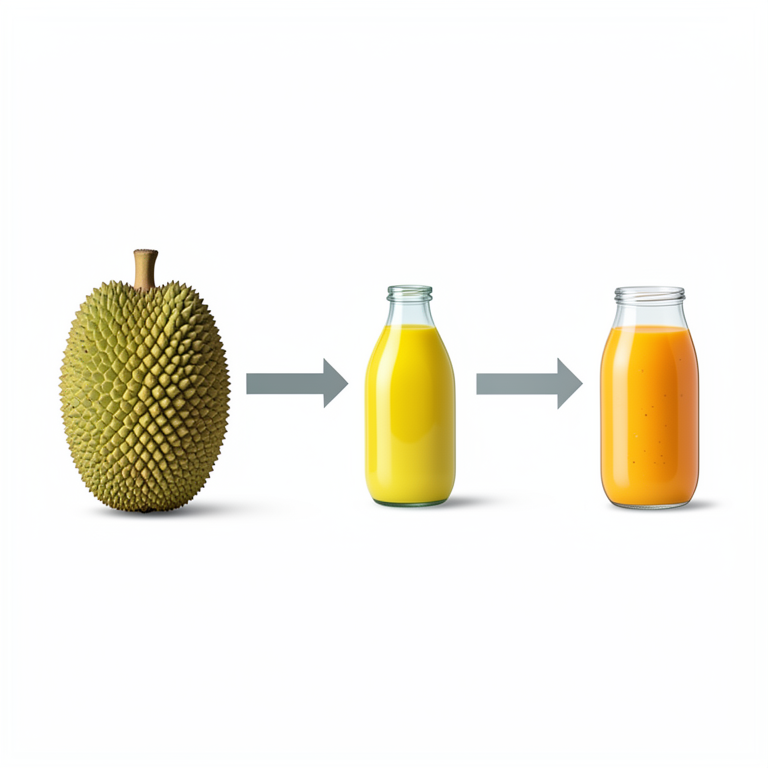
Comparison of Preparation Methods
AI-generated conceptual illustration (jackfruit and mango fruits). It explains the idea and does not show study data.
View source evidence ↗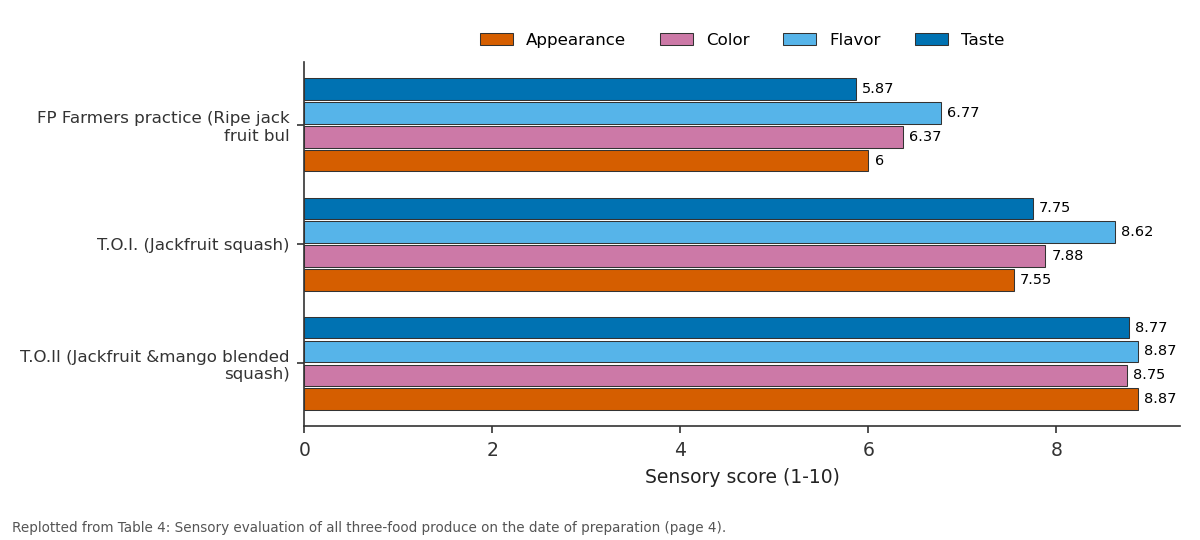
Appearance and Color and more: FP Farmers practice... vs T.O.I. (Jackfruit... vs T.O.II (Jackfruit...
Replotted from Table 4 (page 4) of the original paper. Every bar is the paper's own table value.
View source evidence ↗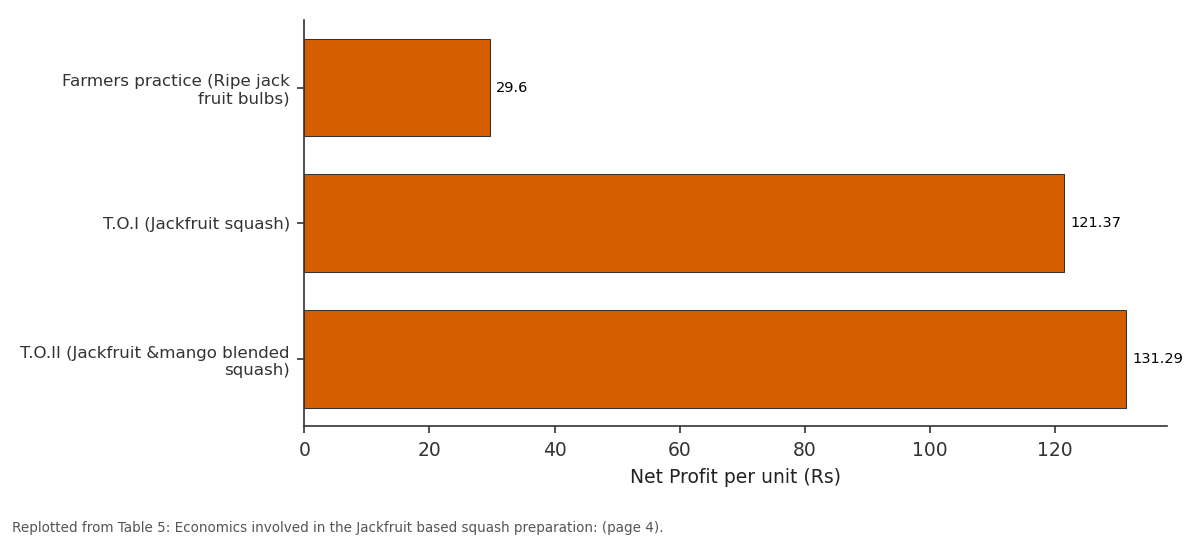
Net Profit per unit: Farmers practice (Ripe... vs T.O.I (Jackfruit squash) vs T.O.II (Jackfruit...
Replotted from Table 5 (page 4) of the original paper. Every bar is the paper's own table value.
View source evidence ↗Figures & tables
From the original paper Table 1
 Table 2
 Table 3
 Table 4
 Table 5
Introduction
Agriculture and horticulture is main occupation of farmers of Bokaro district. In Jharkhand state, Bokaro district is famous as vegetable belt. Approximate 39.21 per cent of the total area is presently under agriculture land and under horticulture area is approximate 9.09 per cent of the cultivable land (https://bokaro.nic.in. dated 5/11/2023). Jack fruit is produced in huge amount in Bokaro district. Tender jackfruit is a popular vegetable. Unripe jackfruit is used for pickles while ripe one is eaten fresh just as fruit. Baby jack fruit are made into a variety of cuisines in the rural tribal and urban cultures (https://www.nbpgr.ernet.in cited on 1/11/2023). In Holi, jackfruit sabji is most favorite dishes in Jharkhand. Jack fruit plant is widely distributed on waste land, marginal land and on road side in rural areas. Yet, jack fruit heavily produced even in neglected condition.
Production status of Jackfruit in India
Jack fruit (Artocarpus heterophyllus) is indigenous to India (Shakuntala Manay, 1987) [18] . India is the first major producer of jackfruit in the world with an annual average production of 1.4 million tones with Jharkhand sitting in the eighth position in terms of total annual production (https://sahasa.in cited on 02/11/2023). Jharkhand's total production in jackfruit is 117.46 tones and the shares is 6.78% (https://theindianblog.in). Jharkhand data of jack fruit is updated yearly from March, 2013 to 2023, the average data was 137.54 Ton (https://www.ceicdata.com dated on 5/11/2023).
19.8 percent carbohydrate and from 100 gram fruit it gives 88 Kcal energy. It also good source of fiber, calcium, iron, potassium and sodium. It acts as source of complete nutrition for the human beings. Almost having the exact nutrients equivalent to mother's milk (Priya et al, 2016) [15] .
In this way, it is clear that on one side it is rich in minerals and vitamins and can take place of other fruits and vegetable and on other hand it is good source of energy also. So, it can play role of staple food also. Both, value added products of jack fruit can help in overcome food and nutritional security related problem in rural areas. [12] (Nutritive Value of Indian Foods)
Special Nutritional Properties of Jack fruit
Jack fruit is a powerhouse of nutrients and have many special nutritional properties. It plays an important role in the treatment of digestive disorder lie ulcer and constipation being a complex carbohydrate and fiber rich fruit. High number of antioxidants is responsible for its anti-caner properties. It is good source of vitamin A which is essential for good vision and magnesium also. Magnesium plays maor role in calcium metabolism and maintains bone health. Jack fruit is rich in iron which helps in preventing anemia and also good source of potassium (Priya et al., 2016) [15] . The high potassium in jackfruit lowers blood pressure and reducing the risk of heart attack or stroke (https://www.agroexporters.net cited on 2/11/20223).
Health Benefit of Jackfruit
Apart being a highly nutritious fruit, jack fruit have so many medicinal properties also. Jack fruit also contains many antioxidants. (Ambily and Davis, 2016) [9] . Antioxidants plays very important role in the treatment of all kind of degenerative diseases like cancer. For example. total 14 to 18 carotenoids were reported. It is also rich in phyto-nutrients. A good amount of copper of jack fruit plays a key role in the thyroid metabolism and vitamin C, which helps in fighting against infections (Priya et al., 2016) [15] . "Jacalin" an extract of jack fruit inhibited growth of HIV infection and AIDS and also helps in cancer treatment (Rajan, 2007) [14] . Tender jack fruit juice along with coconut milk and jiggery is used in the treatment of drug poisoning (Sanmugam, 2007) [16] .
Need of the Hour: Chemical Preservation of Jack Fruit
Jharkhand is on the eighth position in terms of total Indian annual production as per data of year 2018-19. As per a government report in 2022, India lost approximate 5 o 13 per cent of total fruits and vegetables production. If, this is converted into monetary term, it is loss of approximate of worth over Rupees 1, 52,000 crores (https;//finshots.in cited on 3/12/223). India processes hardly 1.0 % of the total fruits and vegetables unlike other developed countries Sethi, (1994) [17] . Bokaro district is rich in Jack fruit production. Tender jack fruit is consumed with choice as vegetable and mature unripe jack fruit is used as pickle. When jack fruit starts to ripe, rural people consumed it happily in beginning. But, after sometime, rural people left ripe jack fruit on their tree which fall down on ground and decompose after being over ripe. In this way, a huge wastage of ripe jack fruit occurred. The basic reason behind this huge wastage was lack of knowledge regarding value addition and preservation of ripe jack fruit among local rural farm families. In such situation, low cost processing technologies are needed to keep preserved product within the reach of a much wider section of the population. The solution lies in the use of an appropriate low cost technologies and one of the simple method is chemical preservation by the addition of simple chemicals like sugar, acid, preservatives etc. This simple method of chemical preservation are easy to follow, economical and could cater indigenous need and save loses of fruit (Sethi, 1994) [17] . Jack fruit is very nutritive but problem is it is seasonal and perishable, which necessitates its chemical preservation (Ambilyand Davis, 2016) [9] . So, it has become an urgent need to develop value added products from jack fruit through chemical preservation suitable for rural areas and for income generation also.
Methodology
In Bokaro district, there was abundant availability of ripe jack fruit from last week of June to last week of August month of the year. Unripe jackfruit is consumed with choice as vegetable or made in to pickles. When jack fruit starts to ripe, rural people consumed it happily in begining. But, after sometime, rural people left ripe jack fruit on their tree which fall down on ground and decompose after being over ripe. In this way, a huge wastage of ripe jack fruit occurred. The basic reason behind this huge wastage of ripe jack fruit is lack of knowledge regarding value addition and preservation among local rural farm families. Therefore, an OFT was conducted in Koh panchayat through KVK, Bokaro in year 2020 with an objective to maximum utilization of fully ripe jack fruit as well as to prevent its huge wastage. In the present study, three treatments named as Farmers Practice (F.P.), Technological Option I(T.O.I) and Technological Option II( T.O.II) were taken. In F.P., local consumption pattern of ripe jack fruit was considered. Local rural people consumed bulbs of ripe jack fruit just as fruit. In T.O.I, squash was developed by the use of ripe jack fruit only and in T.O.II, squash was developed from ripe jack fruit blended with ripe mango.
Steps of preparation of squash from ripe jack fruit:
In the preparation of squash, a sequence of steps was followed which is given below one by one. [11] . In the present study, squash was selected as preserved product because it is simple and easy in preparation and most suited product for intense summer season of June to August in Bokaro district, an industrial area. In T.O.I, after preparing sugar syrup, fine paste of ripe jack fruit bulb and prepared sugar syrup was mixed and once again filtered with muslin cloth. After that, preservative(KMS) was added in it, then squash was ready. Same procedure was followed in T.O.II, but difference was in place of using sole fine paste of ripe jack fruit bulb, ripe mango pulp was blended with fine paste of ripe jack fruit bulb was used. Rest of the procedure was same. g. Bottling, packaging and storage of squash: Since study was conducted in rural areas so bottling was done in plastic bottles and storing was done in their home at room temperature for few months.
Calculation of Nutritive value of all three food produce:
Nutritive value of all three produce of the study was calculated with the help of book titled as The Nutritive Value of Indian Foods (Goplalan, 2004) as per the ingredients used in the treatments. In Farmers Practice, only bulbs of ripe jack fruit was used whereas in T.O.I and in T.O.II, squash was developed and ingredients used were ripe jack fruit, sugar and ripe mango.
Sensory evaluation through score card method:
In the present study, sensory evaluation was done with the help of score card method because it is easy and simple as compared to other scaling methods. In technical parameters of sensory evaluation, appearance, color, flavor, taste and over all acceptability were taken. In this method, scoring was done on quality characteristics of the product in whole numbers using scale given below.
Scoring scale: 1-2 Very poor, 3-4 Poor, 5-6 Fair, 7-8 Good, 9-10 Very good
4.
Shelf life analysis of all three-food produce: Shelf life was analyzed by observing its appearance, color, flavor and taste of the all three food produce of the study.
Cost analysis of all three produce of the study:
Cost analysis of all three produce of the study was done at the end of the study. In general, local people consume bulbs of ripe jack fruit just as fruit. Cost analysis of squash of T.O.I and T.O.II was done.
Result & Discussion
After completing all steps mentioned in the methodology, results are given below in tables and discussed in detail one by one.
Nutritive value of all three-food produce of the study Jack fruit is rich source of many nutrients. So, calculation of nutritional value of all three-food produce of the study was essential. Nutritive value of all three-food produce was calculated as per given method mentioned in methodology.
In Farmers Practice, only bulbs of ripe jack fruit was used whereas in T.O.I squash developed from ripe jack fruit and in T.O.II, from ripe jack fruit blended with ripe mango were used. In these three food produce, ripe jack fruit, ripe mango and sugar were used as raw ingredients. Calculated nutritive value is given in Table no.4. After calculating the nutritive value, it was found that bulbs of ripe jack fruit had highest value in beta-carotene. Whereas squash of T.O.II had highest carbohydrate value and squash developed from only ripe jack fruit had least protein, fat, iron, beta-carotene and vitamin-C among all the three treatments. In this way, it could be said that T.O.II was found best from nutritional composition point of view when all three produce were compared.
Sensory Evaluation of all three-food produce of the study Sensory evaluation is very important step which helps in advertising any new food product in the market. After calculating the nutritive value of all three-food produce, sensory evaluation was done with the help of score card method. In Farmers Practice (FP), only bulbs of ripe jack fruit was consumed whereas in T.O.I, squash developed from ripe jack fruit and in T.O.II squash developed from ripe jack fruit blended with ripe mango were consumed. In sensory evaluation assessment, it was revealed from the study that squash developed by the use of ripe jack fruit blended with ripe mango was best in appearance, color, flavor, taste and overall acceptability and squash developed by the use of only ripe jack fruit found second in position.
Since bulbs of ripe jack fruit was very sweet in taste and have very strong sweet flavor which is responsible for its low acceptability. Finally, squash developed in T.O.II was found best in all sensory parameters mentioned above. When grading was done and it was graded as first. A study was conducted by Ambily and Davis, (2016) [9] in which sensory evaluation of seven variations of tender jack fruit was done.
Economics involved in the Jackfruit based squash preparation Any technology's success depends on the economics involved in the development of the new food product. So, it should be cost effective also along with other qualities. Both from entrepreneurship development and consumer point of view, its economics should be profitable for both groups. Assessment of Shelf life of all three produce of the study: Shelf life assessment of all three-food produce of the study was assessed. It is very important to know till what period that particular product should be in the market for the consumption purpose. It was clear from the present study that the shelf life of bulbs of ripe jack fruit was only of few hours. Due to very strong sweet aroma of ripe jack fruit, rural people cannot keep it for long time at their home whereas the shelf life of both squash developed from only ripe jack fruit (T.O.I) and developed from ripe jack fruit blended with ripe mango(T.O.II) was upto four month. As per the study conducted by Kumar and Deen (2018) [13] wood apple squash was safe and suitable for consumption upto 5 month.
Conclusion
Jackfruit is a rich source of several nutrients and is produced in huge amount in Bokaro district but there was no knowledge regarding its value addition and preservation. That's why large amount of jack fruit become wasted in season. There are ample opportunities for value addition and preservation of ripe jack fruit. The present study ad shown that this fruit has got good potential for preservation into simple and easy product with long shelf life like squash. So, it is concluded that jackfruit-based squash could prevent its huge wastage as well as a potential source of rural income generation for the deprived farming communities.
Figures and tables from the paper
| Nutrients Stage of jack fruit | Protein (g) | Fat (g) | Minerals (g) | Fiber (g) | Carbohydrate (g) | Energy (kcal) | Cal (mg) | Iron (mg) | Phosphorus (mg) |
|---|---|---|---|---|---|---|---|---|---|
| Jackfruit tender | 2.6 | 0.3 | 0.9 | 2.8 | 9.4 | 51 | 30 | 1.7 | 40 |
| Jackfruit seed | 6.6 | 0.4 | 1.2 | 1.5 | 25.8 | 133 | 50 | 1.5 | 97 |
| Ripe Jackfruit | 1.9 | 0.1 | 0.9 | 1.1 | 19.8 | 88 | 20 | 0.56 | 41 |
Table text extracted from the original PDF; superscript letters are shown inline. The original table image is below.
View original table image
| Parameters Treatments | Appearance | Color | Flavor | Taste | Overall acceptability | Overall grading |
|---|---|---|---|---|---|---|
| FP Farmers practice (Ripe jack fruit bulbs) | 6.00 | 6.37 | 6.77 | 5.87 | 5.87 | 3rd |
| T.O.I. (Jackfruit squash) | 7.55 | 7.88 | 8.62 | 7.75 | 7.75 | 2nd |
| T.O.II (Jackfruit &mango blended squash) | 8.87 | 8.75 | 8.87 | 8.77 | 8.75 | Ist |
Table text extracted from the original PDF; superscript letters are shown inline. The original table image is below.
View original table image
| Parameters Treatments | Cost of produce per unit | Market price per unit | Net Profit per unit | B:C Ratio |
|---|---|---|---|---|
| Farmers practice (Ripe jack fruit bulbs) | 20.40Rs/kg | 50 (Rs/kg) | 29.60 | 2.45 |
| T.O.I (Jackfruit squash) | 62.91 Rs/liter | 184. 28 Rs/liter squash | 121.37 | 2.92 |
| T.O.II (Jackfruit &mango blended squash) | 81.56Rs/liter | 212.85 Rs/liter squash | 131.29 | 2.60 |
Table text extracted from the original PDF; superscript letters are shown inline. The original table image is below.
View original table image
References
6 in the original paper- CEIC Data. https://www.ceicdata.com dated 5/11/2023.
- Sahasa. https://sahasa.in cited on 02/11/2022.
- The Indian Blog. https://theindianblog.in cited on 02/11/2023.
- CEIC Data. https://www.ceicdata.com cited on 02/11/2023.
- Ambily M, Davis A. Effects of Dehydration Techniques for the Development of Ready to Cook Tender Jackfruit. Journal of Agriculture and Veterinary Science. 2016;9(2):51-56.
- Kumar A, Deen B. Studies on preparation and preservation of squash from wood apple (Limonia acidissima L.). International Journal of Chemical Studies. 2018;6(1):1513-1516.