
Research article · 2024 · Full text
International Journal of Advanced Biochemistry ResearchProblems perceived by the Farmers in acquisition of improved papaya production technology in Muzaffarpur District of Bihar
Volume 8(2S) · Pages 59–61 · DOI: 10.33545/26174693.2024.v8.i2sa.526 ↗
Research areasAgricultural Economics and PracticesLivestock Management and Performance ImprovementPapaya Research and Applications
Abstract
Author-writtenIn the years 2020–21, research was carried out in the Bihar district of Muzaffarpur to find out the farmers face challenges particularly those who cultivate papayas, experienced in obtaining better technology for producing the fruit. As we all know that the state of Bihar divided into four Agro climatic zones based on soils, climate, topography, vegetation, temperature, rainfall, crops etc. The Muzaffarpur district falls under Agro-climatic zone- I, situated in Northern west portion of the state. The soil type of this agro-climatic zone as well as mentioned district is medium acidic, heavy textured and sandy loam which is favourable for Papaya production. For this reason, the present researcher choosen this district for the study. For the current research study only one block named Sakra among the 16 blocks was purposefully chosen based on the largest area used for papaya growing and the greatest number of papaya growers. Based on greater area coverage, six villages called as Gauri har Khalik nagar, Sarmastpur, Ghanipur, Bejha, Majhaulia, and Katesar. were arbitrarily chosen and given consideration for the study. With assistance from DHO, Muzaffarpur, a list of papaya farmers in each of the chosen villages was developed. From every village that was chosen, twenty papaya farmers were identified. As a result, the study's sample consisted of 120 papaya producers overall. The majority of farmers (87.50%) are unaware of how to determine fertilizer, around 72.50 percent of the papaya crop was harvested by others, and they faced several different problems that have been addressed in this study. The improved papaya production technology required to be adopted by the papaya producers, thus extension specialists should undertake numerous demonstrations and field visits.
Summary
Source-checkedPlain-language reading of the full paper, prepared with AI and checked against the text. Each point links to the authors' own words.
Why it matters
- Papaya is a highly valued crop for farmers because it provides high returns per hectare, requires minimal space, and produces fruit within one year. View evidence ↗
- Bihar ranks thirteenth in India for papaya production, producing approximately 0.044 million tons on 2,000 hectares, though its average yield is below the national average. View evidence ↗
- The Muzaffarpur district is suitable for papaya production due to its medium acidic, heavy textured, and sandy loam soil. View evidence ↗
The question
- The study aimed to identify the challenges faced by papaya farmers in the Muzaffarpur district of Bihar regarding the acquisition of improved production technology. View evidence ↗
What they did
- The researchers purposefully selected the Sakra block from 16 available blocks because it had the highest number of growers and the largest area dedicated to papaya. View evidence ↗
- Data was collected through interviews conducted at farmers' homes or farms, and the results were analyzed using percentages. View evidence ↗
What they found
- The most significant problem reported by farmers was a lack of knowledge on how to calculate fertilizer, affecting 87.50% of the respondents. View evidence ↗
- The appearance of various diseases was the second most common challenge, reported by 80.00% of the farmers. View evidence ↗
- A significant portion of farmers (72.50%) reported that their papaya fruits were harvested by other people. View evidence ↗
- Heavy rainfall and a wet climate, which tend to reduce fruit sweetness, were identified as a problem by 68.33% of growers. View evidence ↗
- Winter frost susceptibility was a major concern for 61.67% of the surveyed farmers. View evidence ↗
- Nearly half of the farmers (49.17%) noted the predominance of backyard cultivation as a challenge. View evidence ↗
- Faulty planting systems were identified as a problem by 40.00% of the respondents. View evidence ↗
- A lack of training programs regarding improved production technology was reported by 26.33% of farmers. View evidence ↗
- The absence of agricultural personnel was cited as a problem by 19.17% of the farmers. View evidence ↗
What it means
- The authors conclude that papaya producers need to adopt improved production technology and recommend that extension specialists increase field visits and demonstrations. View evidence ↗
Visual summary
2 visualsIllustrations explain the paper; charts are replotted from the paper's own table values.
Hierarchy of Farmer Challenges
AI-generated conceptual illustration (Papaya plants in a field). It explains the idea and does not show study data.
View source evidence ↗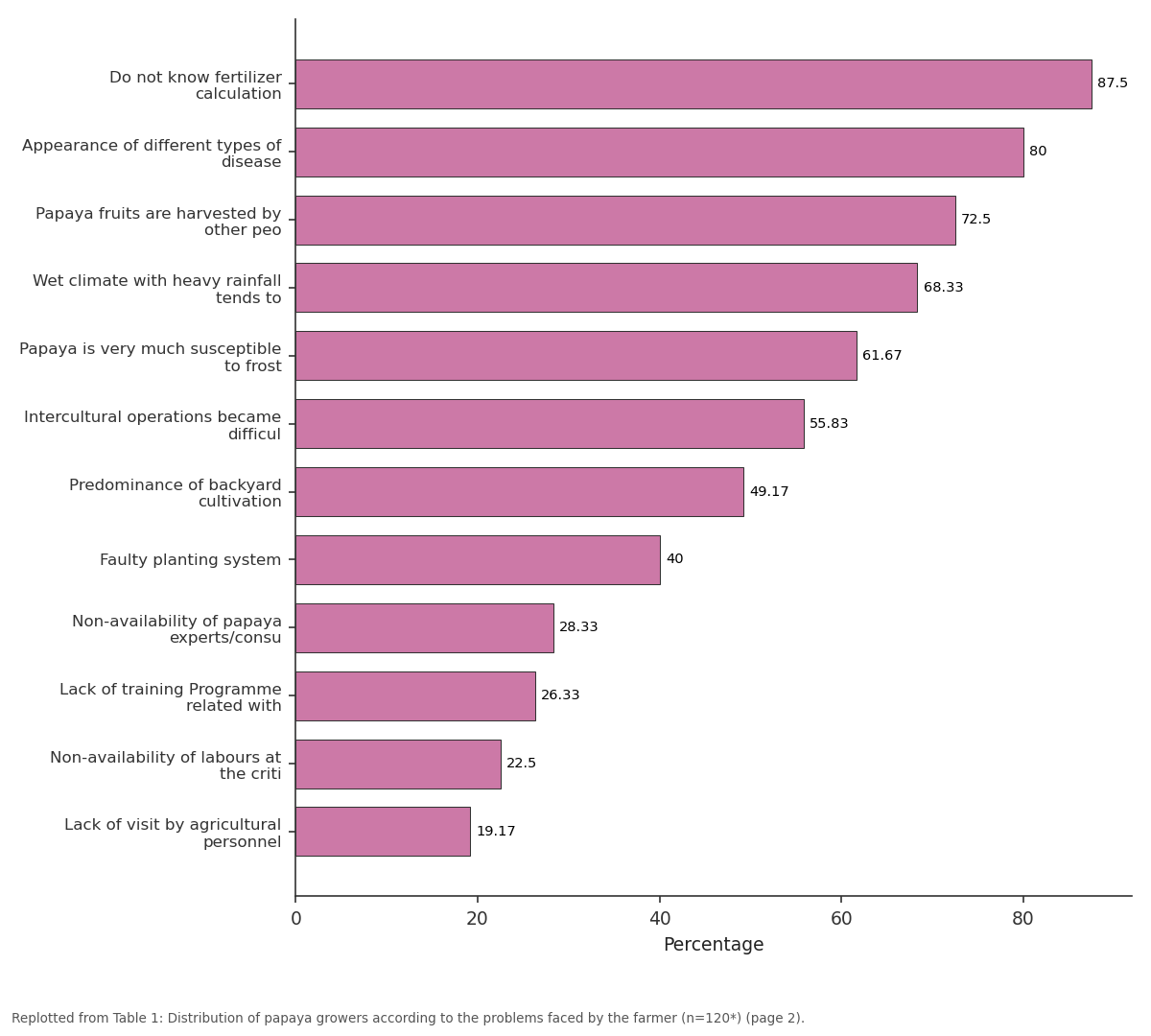
Percentage: Do not know fertilizer... vs Appearance of different... vs Papaya fruits are... vs Wet climate with heavy... vs Papaya is very much...
Replotted from Table 1 (page 2) of the original paper. Every bar is the paper's own table value.
View source evidence ↗Figures & tables
From the original paper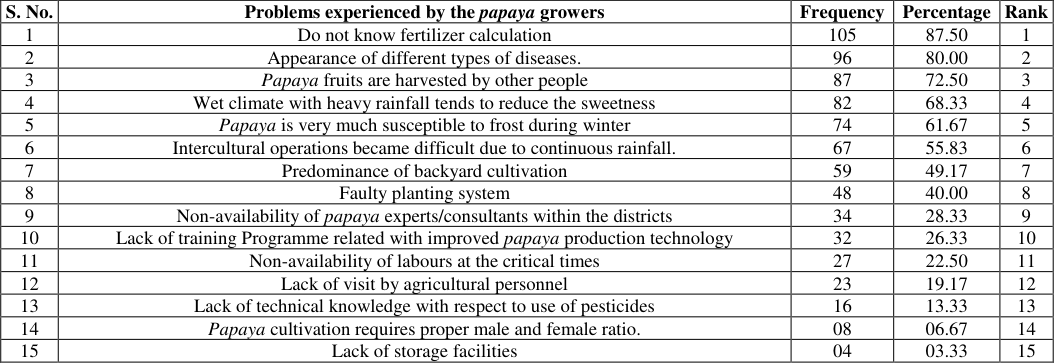 Table 1
Introduction
A sizable portion of India's overall agricultural output comes from horticulture, a professional field of agriculture (Sankaran 2021) [6] . If the current resources are fully used, horticultural crops especially fruits have a significant export potential and may generate significant amounts of foreign cash (Yadav 2010) [8] . Horticulture has received more attention in recent years as a means of developing waste areas that are unsuitable for the profitable production of field crops. The papaya (Carica papaya) fruit is highly prized by farmers in general because it yields higher money per hectare, takes less space per plant, and fruits within a year of being planted. Papaya's widespread distribution demonstrates the fruit's significance to agriculture and the global economy. People in tropical and subtropical regions have long recognized it and grown it in their own gardens (Chauhan 2013) [3] , since it yields rapid returns and can adapt to a variety of soil types and climates. In many tropical nations, it has moved from being a crop grown in backyard gardens to commercial orchards. It produces one among the most fruits per hectare. With an annual production of over 4.958 million tons and an area covered by 0.118 million acres, India is the global leader in papaya production. Brazil, Mexico, Nigeria, Indonesia, China, Peru, Thailand, and the Philippines are among the other leading producers. Gujarat is the nation's leading producer of papayas, with 1.17 million tons produced on 19130 hectares. The second is Andhra Pradesh, which produces around 0.668 million tons in an area of 8790 hectares. In terms of papaya output, Bihar ranks thirteenth with around 0.044 million tons produced over 2000 hectares. Papaya is mostly grown in the districts of Vaishali, Samastipur, Begusarai, Patna, and Muzaffarpur in Bihar. In Bihar, the average papaya yield is lower than the national average. Area and production have both gone up, but productivity growth has not been all that noteworthy. The availability of high-quality seed and seedlings was one of the many issues that farmers faced when cultivating papayas (Assefa 2015) [1] . Other issues included pollination issues brought on by single-sex plants, lower fruit shelf life, fruit marketing, and a lack of prior knowledge about papaya production, which led to poor plantations and decreased economic term (Gaikar 2014) [4] if papaya farmers use the suggested producing techniques. Poor producers' socioeconomic circumstances and lack of newer technologies might be the cause of the papaya's low average yield (Banerjee 2010) [2] . There are currently few research studies in the field of knowledge and acceptance level finding of enhanced papaya production technique among producers across the nation, and just one such study can be found in Bihar. However, the Bihar district of Muzaffarpur lacks such research. Our training programmes ought to put more of an emphasis on introducing new technologies to farmers outside of the walls of labs and research facilities and on making them goal-oriented. Further improvements are required to increase its profitability (Kumar 2021) [5] , but papaya producers still face a number of challenges related to production andmarketing.
Methodology
Out of the 16 blocks that make up the Muzaffarpur district, only one, Sakra, was specifically chosen based on having the greatest area dedicated to papaya growing as well as the greatest number of papaya growers. With cooperation from DHO, Muzaffarpur, a list of villages that cultivate papaya was created. Due to their greater area coverage, only six villages-Gauri har Khalik nagar, Sarmastpur, Ghanipur, Bejha, Majhaulia, and Katesar were chosen at random and given consideration for the research. With input from DHO, Muzaffarpur, a list of papaya farmers in each of the chosen villages was developed. From every village that was chosen, twenty papaya farmers were picked up. The study's sample consisted of 120 papaya producers overall. Using this practical experience, a thorough literature analysis, and conversations with academics and professionals in the field, the researcher chose two dependent variables and twelve independent factors for this study. Tables are used to show the primary data that was gathered using the interview schedule. The percentages in the tables are examined to create analytical research and facilitate the comparison of various data types. Interviews were conducted in order to gather data. We got in touch with the responders at their homes or farms. The respondents' recorded answers were scored in order to be tabulated, and the relevant statistical methods were used for the study. The above table shows that a higher percentage of papaya growers identified their main challenges as not knowing how to calculate fertiliser (87.50%), the emergence of various diseases (80.00%), the fact that papaya fruits are harvested by others (72.50%), the wet climate with heavy rainfall that tends to reduce the sweetness (68.33%), the fact that papaya is highly susceptible to frost during the winter (61.67%), the fact that backyard cultivation predominates (49.17%), the use of faulty planting systems (40.00%), the lack of papaya experts/consultants within the districts (28.33%), the absence of training programmes related to improved technology for papaya production (26.33%), the lack of storage facilities (22.50%), and the absence of agricultural personnel (19.17%), Lack of technical expertise on the use of pesticides (13.33%), improper male to female ratios in papaya agriculture (06.67%), and labour shortages during key periods(03.33%).
Results and Discussions
Results and Discussions
Conclusion
A higher percentage of papaya growers identified their main issues as not knowing how to calculate fertiliser (87.50%), observing various diseases (80.00%), having other people harvest their fruits (72.50%), the wet climate and heavy rainfall which tends to reduce the sweetness (68.33%), the high risk of frost during the winter (61.67%), the difficulty of intercultural operations due to continuous rainfall (55.83%), the prevalence of backyard cultivation (49.17%), flawed planting systems (40.00%), the lack of papaya experts/consultants within the districts (28.33%), the absence of training programmes related to improved technology for papaya production (26.33%), the lack of storage facilities (22.50%), the absence of agricultural personnel (19.17%), Lack of technical expertise on the use of pesticides (13.33%), inappropriate male to female ratios in papaya agriculture (06.67%), and labour shortages during key periods (03.33%).
Figures and tables from the paper
| S. No. | Problems experienced by the papaya growers | Frequency | Percentage | Rank |
|---|---|---|---|---|
| 1 | Do not know fertilizer calculation | 105 | 87.50 | 1 |
| 2 | Appearance of different types of diseases. | 96 | 80.00 | 2 |
| 3 | Papaya fruits are harvested by other people | 87 | 72.50 | 3 |
| 4 | Wet climate with heavy rainfall tends to reduce the sweetness | 82 | 68.33 | 4 |
| 5 | Papaya is very much susceptible to frost during winter | 74 | 61.67 | 5 |
| 6 | Intercultural operations became difficult due to continuous rainfall. | 67 | 55.83 | 6 |
| 7 | Predominance of backyard cultivation | 59 | 49.17 | 7 |
| 8 | Faulty planting system | 48 | 40.00 | 8 |
| 9 | Non-availability of papaya experts/consultants within the districts | 34 | 28.33 | 9 |
| 10 | Lack of training Programme related with improved papaya production technology | 32 | 26.33 | 10 |
| 11 | Non-availability of labours at the critical times | 27 | 22.50 | 11 |
| 12 | Lack of visit by agricultural personnel | 23 | 19.17 | 12 |
| 13 | Lack of technical knowledge with respect to use of pesticides | 16 | 13.33 | 13 |
| 14 | Papaya cultivation requires proper male and female ratio. | 08 | 06.67 | 14 |
| 15 | Lack of storage facilities | 04 | 03.33 | 15 |
Table text extracted from the original PDF; superscript letters are shown inline. The original table image is below.
View original table image
References
7 in the original paper- Assefa AG, Mesgina SH, Abrha YW. Response of onion (Allium cepa L.) growth and yield to different combinations of N, P, S, Zn fertilizers and compost in northern Ethiopia. International Journal of Science and Research. 2015;4(2):985-989.
- Banerjee PK, Biswal S. Techno-socio psycho-economic constraints of papaya growers in adopting recommended practices for sugarcane cultivation. Journal of Inter Academician. 2010;14(1):85-89.
- Chauhan R, Singh HP, Singh R, Singh JP. Constraints encountered in adoption of fruit production technology on different sizes of farms in District Badaun (U.P.). Progressive Research. 2013;8(1):46-51.
- Gaikar BH, Jadhav VP. Practices of Farm Management on the Productivity of Orange Cultivation, Nashik District of Maharashtra. Life Sciences International Research Journal. 2014;1(1):90-193.
- Kumar SA, Karthikeyan C. Factors Influencing the Utilization of "UzhavanApp" as Perceived by the Farmers in Tamil Nadu. Madras Agricultural Journal. 2021;107(10-12):1-5.
- Sankaran M, Dinesh MR. Biodiversity of Tropical Fruits and their Conservation in India. Journal of Horticultural Sciences. 2021;15(2):107-126. Retrieved from https://jhs.iihr.res.in/index.php/jhs/article/view/8947.
- SRM, SPD. Effect of Calcium Nitrate and Potassium Nitrate Priming on Seed Germination and Seedling Vigour of Papaya (Carica papaya L.). Journal of Horticultural Sciences. 2019;14(2):149-154. https://doi.org/10.24154/JHS.2019.v14i02.010.
Cited by 1
From OpenAlex, OpenCitations and reference lists read by Scinovex
- Advances, challenges, and future prospects of in vitro propagation in papaya (Carica papaya L.) ↗
Priyanka Rajan, Je Hyun Kang, Premkumar Natraj, Chan Kyu Lim, Ho Bang Kim, Seong‐Cheol Kim · Plant Cell Tissue and Organ Culture (PCTOC) · 2025
❝ 4