
Research article · 2024 · Full text
International Journal of Biology SciencesIsolation, phenotypic characterization and molecular identification of fungal pathogens of sweet pepper (Capsicum annuum L.) Fruit in Sokoto State Nigeria
Volume 6(1) · Pages 106–110 · DOI: 10.33545/26649926.2024.v6.i1b.194 ↗
Research areasPlant Pathogens and Fungal DiseasesPlant Pathogens and Resistance
Abstract
Author-writtenSweet pepper (Capsicum annum L.) belongs to the family Solanaceae; it is an important group of vegetables extensively cultivated in almost every country of the world]. A purposive sampling technique was used to select three farms in each Local Government to represent the four Agricultural zones of the state. The state has four Agricultural zones namely: Gwadabawa (Sokoto West), Isa (Sokoto East), Sokoto (Sokoto Central) and Tambuwal (Sokoto South) zones. Each zone has between 5 - 6 Local Governments’ areas. One hundred and twenty fruits were collected for the study. Cultural, microscopic and molecular techniques were used to identify the fungi, while poisoned food techniques was used to confirm the pathogenicity of the fungi isolated. Five fungal species which include Fusarium oxysporum, Fusarium equiseti, Fusarium culmorum, Aspergillus niger and Aspergillus fumigatus were isolated, identified and were found to be pathogenic to sweet pepper fruits. Fusarium oxysporum had the highest frequency of occurrence of all the four Agricultural zones investigated with Aspergillus niger exhibiting the highest degree of virulence on sweet pepper. The findings of this study recommended that studies should be conducted on plant extracts in management of fungal diseases of sweet pepper fruit in Sokoto state.
Summary
Source-checkedPlain-language reading of the full paper, prepared with AI and checked against the text. Each point links to the authors' own words.
Why it matters
- Sweet pepper (Capsicum annum L.) is a globally cultivated and important vegetable crop from the Solanaceae family. View evidence ↗
- In sub-Saharan Africa, including Nigeria, sweet pepper production is significantly constrained by yield losses caused by viruses, bacteria, and phytopathogenic fungi. View evidence ↗
- Identifying the specific diseases causing yield declines in Sokoto State, Nigeria, is essential for creating effective management strategies to improve crop yields. View evidence ↗
The question
- The study aimed to isolate, phenotypically characterize, and molecularly identify fungal pathogens affecting sweet pepper fruits in Sokoto State, Nigeria. View evidence ↗
What they did
- Fungi were isolated using Potato Dextrose Agar (PDA) medium and incubated in the dark at 32±2 °C for 72 hours during October. View evidence ↗
- Identification was performed using microscopic morphological characteristics and molecular analysis via genomic DNA extraction and PCR. View evidence ↗
- Pathogenicity was confirmed by inoculating healthy fruits with fungal mycelium, sealing them with Vaseline jelly, and incubating them in triplicate for 10 days. View evidence ↗
What they found
- Five fungal species, Fusarium oxysporum, F. equiseti, F. culmorum, Aspergillus niger, and A. fumigatus, were identified as pathogens of sweet pepper fruits. View evidence ↗
- Fusarium oxysporum was the most frequent pathogen found across all investigated samples (41.60%), followed by Fusarium equiseti (33.30%). View evidence ↗
- Aspergillus niger, Aspergillus fumigatus, and Fusarium culmorum each occurred with a frequency of 8.30%. View evidence ↗
- Aspergillus niger was the most virulent pathogen, with mycelia or rots covering 82.35% of the fruit. View evidence ↗
- Fusarium equiseti showed the second highest virulence (67.06%), while F. culmorum (59.21%) and A. fumigatus (50.98%) showed medium levels of virulence. View evidence ↗
- Despite being the most frequent, Fusarium oxysporum was the least virulent of the five pathogens, covering 43.32% of the fruit. View evidence ↗
What it means
- The authors recommend further research into the use of environmentally friendly plant extracts to manage fungal diseases of sweet pepper fruits in Sokoto State. View evidence ↗
Visual summary
2 visualsIllustrations explain the paper; charts are replotted from the paper's own table values.
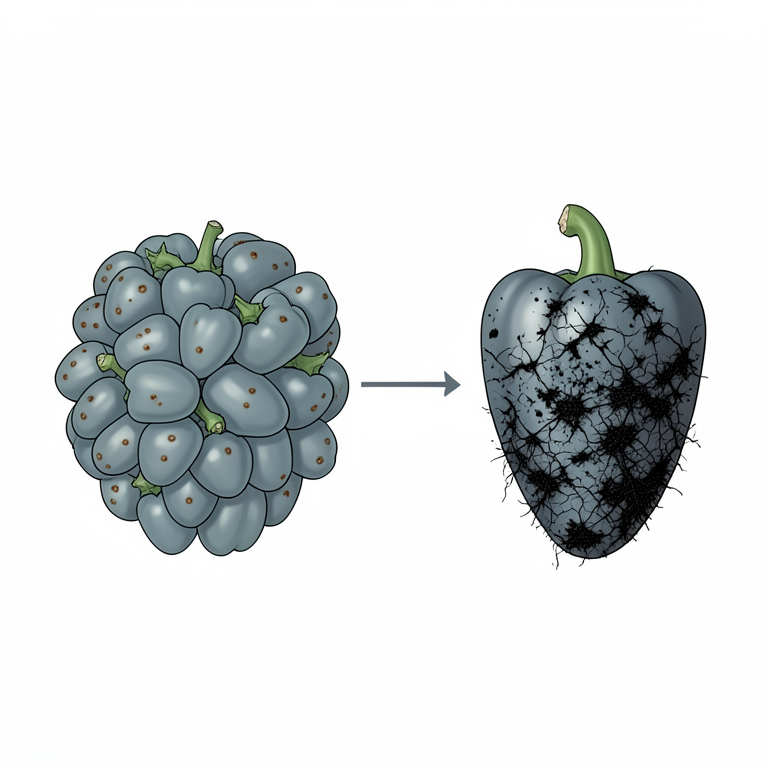
Frequency vs Virulence Comparison
AI-generated conceptual illustration (sweet pepper fruits (Capsicum annuum L.)). It explains the idea and does not show study data.
View source evidence ↗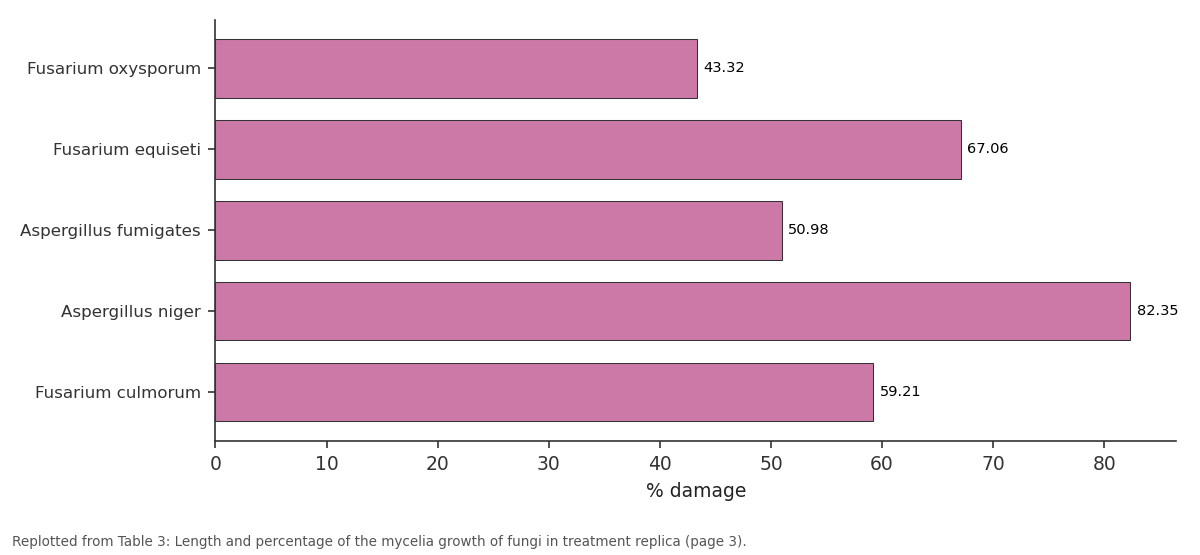
% damage (B)(A) × 100: Fusarium oxysporum vs Fusarium equiseti vs Aspergillus fumigates vs Aspergillus niger vs Fusarium culmorum
Replotted from Table 3 (page 3) of the original paper. Every bar is the paper's own table value.
View source evidence ↗Figures & tables
From the original paper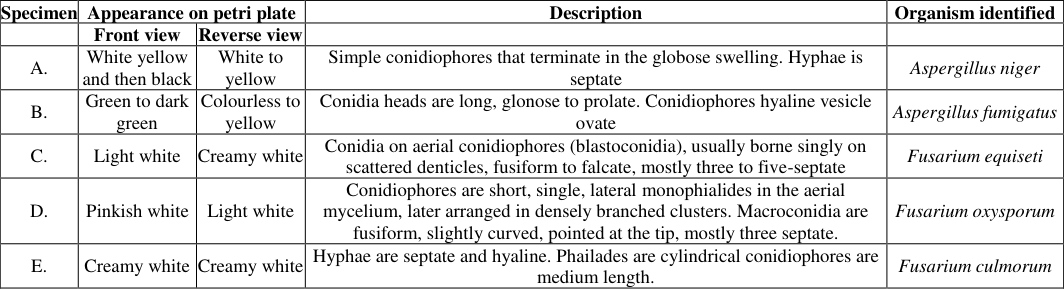 Table 1
 Table 2
 Table 3
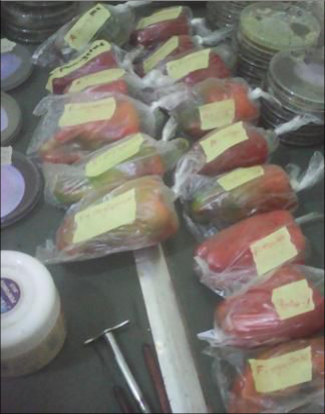 Figure 1
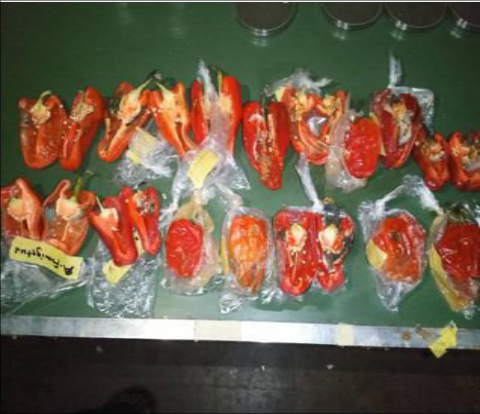 Figure 1
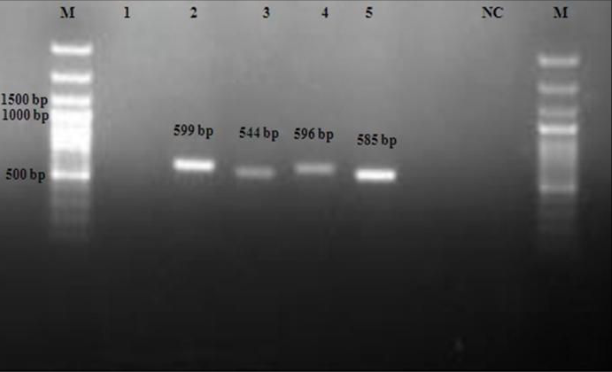 Figure 1
Introduction
Sweet pepper (Capsicum annum L.) belongs to the family Solanaceae; it is an important group of vegetables extensively cultivated in almost every country of the world (Channabasavanna and Setty, 2000) [8] . The crop thrives best in warm climate, where frost is not a problem during the growing seasons. In general, it requires temperatures ranging from 25-35 °C (Olalla and Valero, 1994) [16] . The sweet pepper also known as Bell pepper, is one of the most varied and widely used foods in the world; it originated in Mexico and Central America regions and Christopher Columbus encountered it in 1493 (Kelley and Boyhan, 2009) [14] . Sweet pepper is the world's second most important vegetable after tomato (Anon, 1989) [5] . It is one of the most important vegetable grown in other parts of sub-humid and semi-arid tropics (Aliyu, 2000) [4] . The Pepper grown worldwide consists of approximately 22 wild species and five domesticated species. The five domesticated species include C. Annum, C. Frutescens, C. Chinenses, C. Baccatum and C. pubescens R. (Bosland and Votava, 2000) [7] . Capsicum species can be divided into several groups based on fruit/pod characteristics ranging in pungency, colour, shape, intended use, flavor, and size. Despite their vast trait differences most cultivars of peppers commercially cultivated in the world belong to the species C. Annum (Lin et al., 2013) [15] . There are an estimated 1,600 different varieties of pepper (Capsicum annum) throughout the world (Delelegn, 2011) [9] . Diseases are major constraints to sweet pepper production in sub-Saharan Africa including Nigeria. Phytopathogenic fungi, bacteria and viruses have been reported to cause a major yield loss in pepper. The National Programme for Agriculture and Food Security (NPAFS) (2009) reported that the yield of pepper between 1999 and 2004 declined from 2939 tonnes to 2912 tonnes and 2744 tonnes to 2469 tonnes.
Between 2007 and 2009 despite the increased hectrage from 22.5 hectares to 26.92 hectares of land, the yield was not commensurate (5532 tonnes to 6063 tonnes). The decline according to Jaliya and Sani (2006) [11] , and Abdulmalik et al., 2012) [2] have been attributed to biotic and abiotic factors like weeds, pests, diseases and environmental stress. Information on specific diseases responsible for the decline in yield and production of sweet peppers in Sokoto State, Nigeria is very important for the development of effective control strategy for the management of diseases in farmers' fields in order to improve yields. The study is aimed at isolation, phenotypic characterization and molecular identification of fungal pathogens of Sweet Pepper (Capsicum annuum L.) Fruit in Sokoto State Nigeria.
Materials and Methods
Materials and Methods
Sources of isolates
The fungal isolates used in this study were obtained from a study of fungal pathogens of Sweet Pepper (Capsicum annuum L.) Fruit in Sokoto State Nigeria Samples of healthy and physically damaged sweet pepper fruits used in this study were collected from twelve (12) farms of the four selected local government areas, from the four Agricultural zones in Sokoto State (Gwadabawa, Isa, Sokoto and Tambuwal). Both kinds of sample (physically healthy and physically damaged), were each collected in a separate sterile polythene bag and transported to the mycology laboratory of the Botany Unit of the Biological Science Department, Usman Danfodiyo University, Sokoto (Within 2 hours of collection) for the isolation of fungi.
Isolation of fungal pathogens
Potato Dextrose Agar (PDA) Medium was used for isolation of fungi in this study. The media was prepared according to manufacturer's instructions. Portion of the sweet pepper fruits were cut aseptically with the aid of sterile scissors into small pieces (5 mm). It was then placed centrally on Petridishes containing solidified PDA (Fawole and Oso, 1988) [10] . The plates were then incubated at room temperature (32±2 °C) in the dark for 72 hours in the month of October. The fungal colony grown from the incubated plates was subcultured into fresh medium until pure culture was obtained.
Identification of fungal pathogens (Phenotype)
The Microscope used was MC30 in the mycology laboratory of Usmanu Danfodiyo University Sokoto to examine the colony characteristics to establish identity of Fungi. A sterile needle was used in taking a little portion of the hyphae containing spores on the sterile glass slide, stained with lacto phenol cotton blue and then examined under the microscope for fungal structures. The macroscopic/culture features and the microscopic characteristics observed were then compared with fungal identification atlas for identification of the fungi (Snowdon, 1990) [18] . An isolated fungus was identified based on colony and morphological characteristics, such as color and shape observed with the microscope. The Morphological characteristics and appearance of the fungi isolated were confirmed and authenticated with the help of Mycological Atlas Book of Robert and Ellen, (1988) [20] .
Infection/pathogenicity study: To ascertain the Pathogenicity of the various fungi that were isolated the approach of Balogun et al., (2005) [6] were employed. Fresh and apparently healthy sweet pepper fruits were surfacedsterilized with methanol for 30 seconds and then rinsed three times in distilled water. With a 7mm diameter flamesterilized cork borer, cylindrical cores were removed from each fruit. An equal diameter of fungal mycelium was punctured and used to inoculate the apparently healthy fruits earlier punctured. Vaseline jelly was smeared to completely seal the surface of each of the inoculated pepper fruit to prevent external infection and then incubate for 10 days in triplicate. The control was inoculated with disc of solidified potato dextrose agar medium. The symptom developed with different fungal isolates was compared to the control. The pathogen was re-isolated and identified using the same procedures described earlier.
The number of times each fungus occurs on the samples was recorded and the percentage frequency of occurrence was determined and recorded.
Molecular identification of fungal pathogens
Genomic DNA was extracted from the isolated fungal pathogens using Qiagen ® DNA extraction kit according to the manufacturer's instructions. The PCR was carried out using Qiagen Top Taq master mix kit. A total of 25 uL reaction mix was prepared containing: 12.5 uL Qiagen Toptaq master mix, 1 uL of 10 micromolar each of ITS1 and ITS4, 1.5 uL of coral load, 1 uL of nuclease free water and 8 uL of DNA template. The tubes were mixed and transferred into applied biosystems 9700 programmed thermocycler with the following cycling conditions: Initial denaturation at 94 degrees for 3 minutes, followed by 40 cycles of denaturation at 94 degrees for 30 seconds, annealing at 49 degrees for 1 minute, extension at 72 degrees for 1 minute, followed by final extension at 72 degrees for 10 minutes. He amplicons were resolved in a 1% agarose pre-stained with ethidium bromide. The gel image was viewed using a UV transilluminator in a Biorad XRS gel documentation device.
Results
Results
Isolation and identification of fungal pathogens of sweet pepper fruit (Capsicum annuum L.) in Sokoto State, Nigeria
The fungal species and morphological characteristics are outlined in Table 1. Five species of two genera of fungal pathogens that include Fusarium and Aspergillus were identified. The genera of Fusarium include: Fusarium oxysporum, Fusarium equiseti and Fusarium culmorum, the genera of Aspergillus include: Aspergillus niger and Aspergillus fumigatus and their relative frequency are shown in Table 2.
| Percentage frequency of occurrence | — | — | — | — | — |
|---|---|---|---|---|---|
| Goronyo | Gwadabawa | Bodinga | Kware | Total n (%) | |
| A. niger | 0 (0.00) | 9 (100.0) | 0 (0.0) | 0 (0.0) | 9 (8.3%) |
| A. fumigates | 0 (0.0) | 0 (0.0) | 9 (100.0) | 0 (0.0) | 9 (8.3%) |
| F. oxysporum | 9 (20.0) | 21 (46.7) | 6 (13.3) | 9 (20.0) | 45 (41.7%) |
| F. equiseti | 6 (16.7) | 0 (0.0) | 12 (33.3) | 18 (50.0) | 36 (33.3%) |
| F. culmorum | 9 (100.0) | 0 (0.0) | 0 (0.0) | 0 (0.0) | 9 (8.3%) |
| Total | 24 (22.2%) | 30 (27.8) | 27 (25.0) | 27 (25.0) | 108 (100%) |
Table text extracted from the original PDF; superscript letters are shown inline. The original table image is below.
View original table image
Percentage occurrence of fungal isolates
Five fungal pathogens (Aspergillus niger, Aspergillus fumigatus, Fusarium oxysporum, Fusarium equiseti, and Fusarium culmorum) were found to be pathogens of Sweet pepper fruits in Sokoto State, Nigeria. Fusarium oxysporum had the highest frequency of occurrence of fungal pathogen in all the Sweet pepper investigated with 41.60% frequency, followed by Fusarium equiseti with 33.30%. Aspergillus niger, Aspergillus Fumigatus and Fusarium culmorum had the same frequency of occurrence of 8.30% Table 2. ) [19] . The PCR products were sequenced, following Basic local alignment search tool (BLAST) analysis in GenBank (NCBI) revealed that bands 2, 3, 4 and 5 were Aspergillus niger, Fusarium sterilihyphosum, Fusarium sterilihyphosum and Fusarium proliferatum Appendix 7.
Sequenced PCR products
Sequenced PCR products
Discussion and Conclusion
Isolation and identification of fungal pathogens associated with sweet pepper fruit in this research revealed five fungal species from two genera of Aspergillus and Fusarium. Out of the fungal species isolated, Fusarium oxysporum was found to have the highest rate of occurrence in all the four Agricultural zones studied. The fungus Fusarium oxysporum was frequently incriminated in diseases of sweet paper as reported by Abada and Ahmad, (2014) [1] that isolated Alternaria spp., F. oxysporum, Pythium spp., Rhizoctonia solani, Sclerotium rolfsii and Trichoderma spp. from the roots of wilted sweet pepper plants in Egypt. In line with this, Jamiolkowska, (2009) [12] Recovered Alternaria alternata, Fusarium oxysporum, F. equiseti, F. solani and Colletotrichum coccodes from stem base and root rot of hot pepper. Similarly, Sanogo and Caepenter, 2006 [17] , Alegbejo et al., (2006) [3] Isolated from wilted chile pepper (Capsicum annuum) in New Mexico, Verticillium dahliae, Pythium capsici, R. solani, and species of Fusarium, Penicillium, and Aspergillus. Alegbejo et al., (2006) [3] Identified from root (P. capsici) and stem (P. capsici and F. oxysporum) of stem rot and wilt diseases of pepper plant in Northern Nigeria. Determination of the Pathogenisity of fungal species isolated in this research on Sweet Pepper fruit revealed that the isolated fungi are pathogenic to sweet pepper fruit with Aspergillus niger exhibiting the highest degree of virulence. This is similar to Balogun et al., 2005 [6] who's, reported the same result with Aspergillus niger having the highest level of virulence in Ilorin, North central Nigeria. Five Fungal species, namely Aspergillus niger, Fusarium equiseti, Fusarium culmorum, Aspergillus Fumigatus and Fusarium oxysporum were identified and were found to be pathogenic to Sweet Pepper fruit in the State. Fusarium oxysporum was found to have the highest rate of occurrence in all the four Agricultural zones studied. However, Aspergillus niger exhibited the highest level of virulence with Mycelia and/or rots covering about 82.35% of the Sweet Pepper fruit.
Recommendation
From the findings of this study it can be recommended that studies should be conducted on the use of environmentally friendly plant extracts in management of fungal diseases of sweet pepper fruit in Sokoto state.
Figures and tables from the paper
| Test fungus | Original length of the fruit (mm) (A) | Length of mycelia growth in sweet pepper (mm) | — | — | Average (B) | % damage (B)(A) × 100 |
|---|---|---|---|---|---|---|
| Fruit 1 | Fruit 2 | Fruit 3 | ||||
| Fusarium oxysporum | 85 | 49 | 31 | 30.5 | 36.83±10.54 | 43.32% |
| Fusarium equiseti | 85 | 79 | 20.5 | 71.5 | 57.00±31.83 | 67.06% |
| Aspergillus fumigates | 85 | 49 | 21 | 60 | 43.33±20.11 | 50.98% |
| Aspergillus niger | 85 | 80.5 | 60 | 69.5 | 70.00±10.26 | 82.35% |
| Fusarium culmorum | 85 | 70 | 50.5 | 30.5 | 50.33±19.75 | 59.21% |
Table text extracted from the original PDF; superscript letters are shown inline. The original table image is below.
View original table image
References
11 in the original paper- Abada KA, Ahmed MA. Management Fusarium wilt of sweet pepper by Bacillus strains. American Journal of Life Sciences. 2014;2(6-2):19-25.
- Abdulmalik MM, Olarewaju JD, Usman IS, Ibrahim A. Effects of moisture stress on flowering and fruit set in sweet pepper (Capsicum annum L.) cultivars. Production Agriculture and Technology, PAT. 2012;8(1):191-198.
- Alegbejo M, Lawal A, Chindo P, Banwo O. Outbreak of basal stem rot and wilt disease of pepper in northern Nigeria. Journal of Plant Protection Research. 2006;46(1):7-13.
- Aliyu L. The effects of organic and mineral fertilizer on growth, yield, and composition of pepper. Biological Agriculture and Horticulture. 2000;18(1):29-36.
- Balogun OS, Odeyemi GA, Fawole OB. Evaluation of the pathogenic effect of some fungal isolates on fruits and seedlings of pepper (Capsicum spp). Journal of Agriculture Resources and Development. 2005;4(2):159-169.
- Channabasavanna AS, Setty RA. Effect of different irrigation intervals on sweet pepper. South Indian Horticulture. 2000;39(5):296-299.
- Jamiołkowska A. Fungi isolated from underground part of hot pepper (Capsicum annuum) plants cultivated in the field. Phytopathologia. 2009;51:37-44.
- Lin SW, Chou YY, Shieh HC, Ebert AW, Kumar S, Mavlyanova R, et al. Pepper (Capsicum spp.) germplasm dissemination by AVRDC -The World Vegetable Center: An overview and introspection. Chronica Horticulture. 2013;53(3):21-27.
- Olalla F, Valero JA. Growth and production of bell pepper under different irrigation intervals. Research series Arkansas Agricultural Experimental Station. 1994;466:92-95.
- Sanogo S, Carpenter J. Incidence of phytophthora blight and Verticillium wilt within Chile pepper field in New Mexico. Plant Diseases. 2006;90(3):291-296.
- Snowdon AL. Other tropical and subtropical fruits. In A Colour Atlas of Postharvest Diseases and Disorders of Fruits and Vegetables General Introduction and Fruits. Wolfe Scientific, London. 1990;1:166-169.
Cited by 1
From OpenAlex, OpenCitations and reference lists read by Scinovex
- Seasonal Variation in Fungal Pathogens Affecting Sweet Pepper (Capsicum annuum L.) in the Agricultural Zones of Sokoto State, Nigeria ↗
Abdulkadir Shehu, Sanusi Muhammad, Habsatu Shehu, Abubakar Muhammad Nasiru, Abdulkadir Shehu · Asian Journal of Biological Sciences · 2025
Background and Objective: Diseases significantly constrain sweet pepper (Capsicum annuum L.) production in Sub-Saharan Africa, including Nigeria, with phytopathogenic fungi causing substantial yield losses.This study examined the seasonal variation in fungal pathogens affecting sweet peppers in Sokoto State, Nigeria.Materials and Methods: Fungal isolates were obtained from visibly damaged sweet pepper samples collected across the four agricultural zones of the state…
❝ 0PDF