
Research article · 2024 · Full text
International Journal of Biology SciencesOptimization of the releases of the parasitoid Habrobracon hebetor Say in jute bags containing different support diets of Corcyra cephalonica Stainton for the management of the millet ear miner Heliocheilus albipunctella de Joannis in the Zinder region of Niger
Volume 6(1) · Pages 50–54 · DOI: 10.33545/26649926.2024.v6.i1a.189 ↗
Research areasAgriculture and Rural Development Research
Abstract
Author-writtenMillet, Pennisetum glaucum (LEEKE) R.Br. is one of the most important foods for the rural population in sub-Saharan Africa. However, this crop is subject to damage caused by the millet head miner, Heliocheilus albipunctella De Joannis. Management of this pest is currently based on the release of the parasitoid Habrobracon hebetor Say. A study was conducted in a real environment to test the performance of release bags containing different support diets in order to optimize the biological control of this pest. The study was conducted in 15 villages in the Zinder region in the commune of Matameye and Mirriah. Five treatments were done. Release bag containing millet, millet bran, groundnut shell, bran combined with millet and control treatment Release bags without substrates. Infestations were considered before releasing. At the level of each treatment, 12 release bags were set up, arranged in batches of 3 on each side of the village according to the cardinal points of the village. Four weeks after the releases, data were collected on 400 millet heads per village to note the parasitism of H. Hebetor on the millet head miner. The results revealed an average infestation rate of 79.13% in the area. The parasitism rate was not different between the treatments and this rate varied from 14.10% to 22.1%. The estimated cost of different support diets for the release bags shows a reduction of 80% by substituting millet for the peanut shell. These data may contribute to optimizing H. hebetor release methods and reducing the cost of the technology.
Summary
Source-checkedPlain-language reading of the full paper, prepared with AI and checked against the text. Each point links to the authors' own words.
Why it matters
- Millet is a critical food source for rural populations living in sub-Saharan Africa. View evidence ↗
- The millet head miner (Heliocheilus albipunctella) is a devastating pest that can cause infestation levels up to 95%, leading to significant yield losses. View evidence ↗
- Biological control using the parasitoid Habrobracon hebetor is the current management method, but the cost of the release bags, which depends on the support substrate, is a barrier for some producers. View evidence ↗
The question
- The study aimed to determine if the type of diet used in the release bags affects the parasitism rate of millet ear miner larvae by H. hebetor in a field setting. View evidence ↗
What they did
- The research was conducted across 15 villages in the Zinder region of Niger, with 12 jute bags placed per village across four cardinal directions. View evidence ↗
- Five treatments were tested: bags containing millet, millet bran, groundnut shell, a combination of bran and millet, and a control group with no substrate. View evidence ↗
- Parasitism data were collected four weeks after release by examining 400 millet heads per village. View evidence ↗
What they found
- The average infestation rate of the millet head miner in the study area was 79.13%, with rates ranging from 38.5% to 85.5% across different villages. View evidence ↗
- There were no significant differences in parasitism rates between the different diet treatments (p=0.45), with rates generally varying between 14.10% and 22.1%. View evidence ↗
- Substituting millet with peanut shells reduced the estimated cost of support diets by 80%, with bag production costs ranging from 75 to 85.71 FCFA. View evidence ↗
What it means
- The authors conclude that the support substrate does not significantly influence parasitism rates, and therefore, expensive millet-based substrates can be replaced by cheaper peanut shells. View evidence ↗
- The authors recommend using peanut shells or no substrate to reduce costs, which they believe will facilitate the scaling up of biological control technology in Niger. View evidence ↗
Visual summary
1 visualsIllustrations explain the paper; they do not show study data.
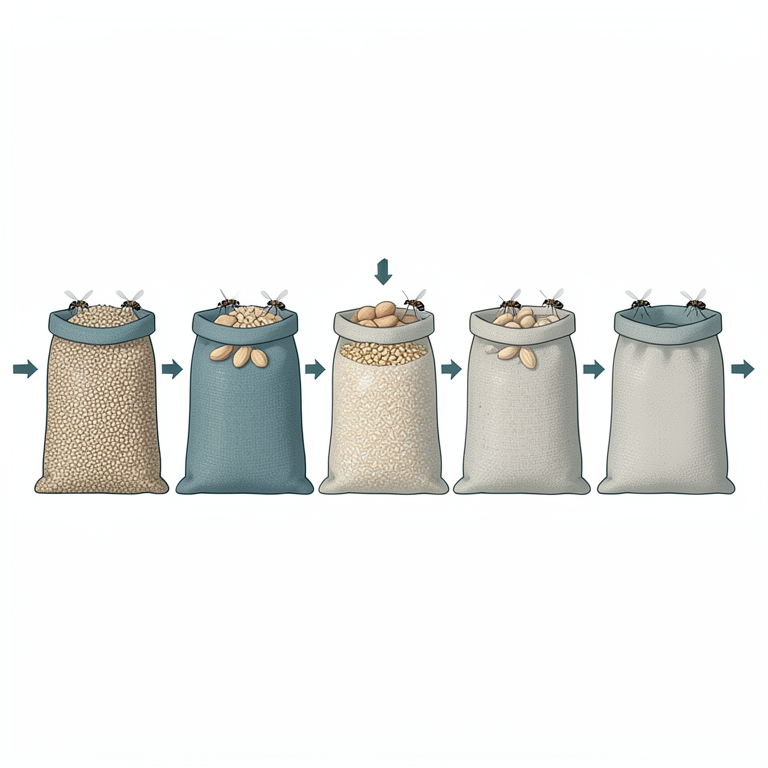
Comparison of Release Bag Substrates
AI-generated conceptual illustration (jute bags containing different organic substrates and Habrobracon hebetor parasitoids). It explains the idea and does not show study data.
View source evidence ↗Figures & tables
From the original paper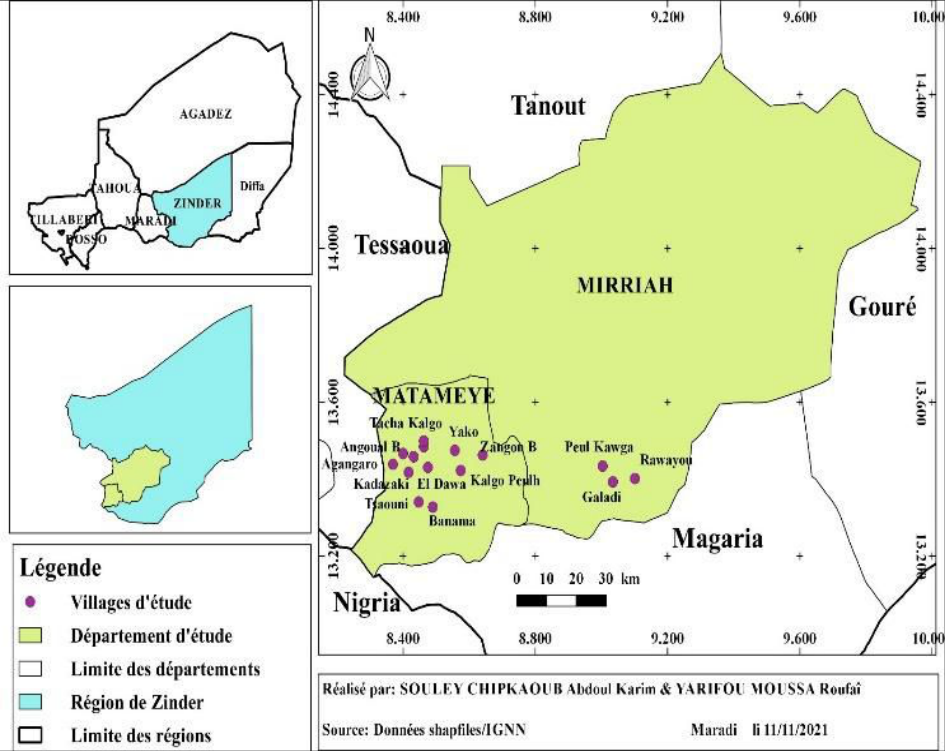 Figure 1
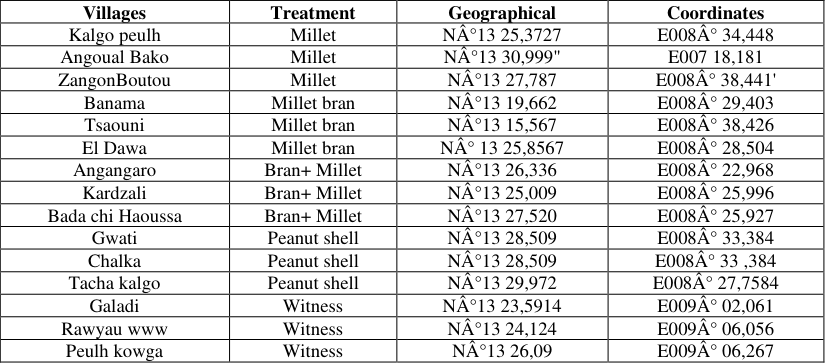 Table 1
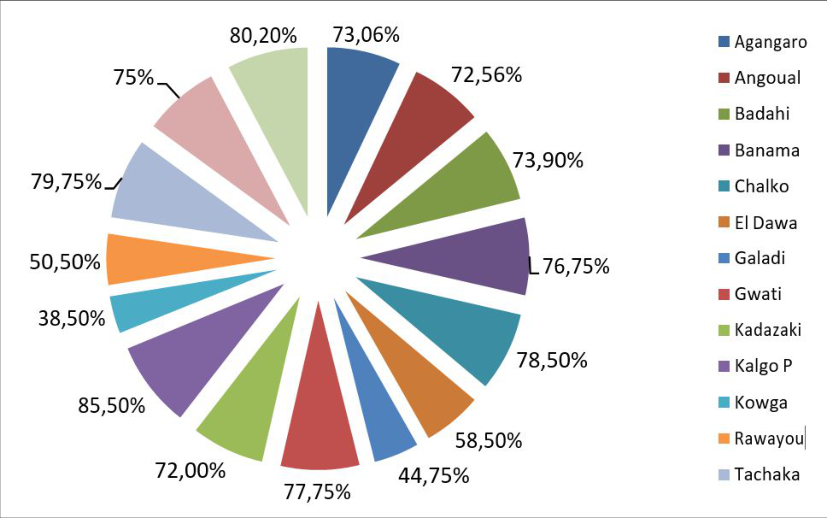 Figure 2
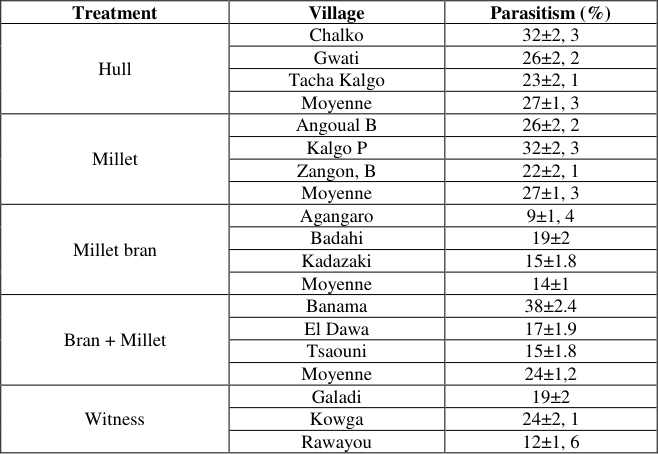 Table 2
 Table 3
Introduction
Millet is the seventh cereal crop in the world. In Africa cultivation covers more than 21 million hectares. It occupies 43% of the arable land in Niger and contributes up to 40% (Agriculture) source (FAOSTAT, 2018) [6] . Despite this significant contribution to the national economy, the production of millet still faces several constraints. These are: abiotic factors including climatic hazards, erosion, poor soil and biotic constraints including: diseases, weeds insect pests. Many insects affect the crop, including locusts (grasshoppers and locusts during the invasion period), the stem borer (Coniestaigne fusalis), flower insects (Pseudocolaspis setulosa, Rhyniptiainsf uscata, Dysdercus volkeri) and the leaf miner. ear of millet (Heliocheilus albipunctella de Joannis) (Gahukar and Ba, 2019) [9] . For more than a decade, the millet head miner caterpillar has remained one of the most devastating insects, causing significant damage (Halilou, 2017) [13] . Millet head miner infestation levels can reach 95% with yield losses. A significant infestation rate of the millet head miner Amadou et al., (2017) [1] has been recorded. Faced with this scourge, biological control is the most effective agro-ecological method currently GIMEM (2008) [10] . However, some producers find the cost of the release bags expensive, the cost of the bag varies according to the cost of the support substrate introduced into the release bag Since the first years of testing, the release device has consisted of jute bags in which are introduced 300 to 500 g of millet, 25 larvae of C. cephalonica and 2 fertilized females of H. hebetor.
It is in the search for an alternative solution that will allow the purchase price of the bags to be revised downwards that this present study was born, the theme of which is "Study of optimization of the releases of the parasitoid Habrobracon hebetor Say in jute bags containers of different support diets of Corcyra cephalonica Stainton for the management of the millet head miner caterpillar in 15 villages in the Zinder region. » the general objective is to optimize an efficient method of producing parasitoids. This specifically involves: i) Evaluating the rates of parasitism of the MEM by parasitoids from different diets; ii) Determine an alternative diet for the good production of Corcyra cephalonica and the parasitoid H. hebetor; iii) Determine the level of infestation of the millet head miner in producers' fields. The research question that arises is the following: Does the diet contained in the release bags influence the parasitism of the larvae of the millet ear miner by H. hebetor in a peasant environment?
Methodology Presentation of the study sites
The study was conducted in 15 villages in the Zinder region in the communes of Matamey (12 villages) and Mirriah (3 villages). The 12 villages of Matamey are: Kalgo peulh, Angoual Bako, Zangon Boutou, Banama, Tsaouni, El Dawa, Angoro, Kardzali, Bada chi Hausa, Gwati, Chalka and Tacha kalgo. The villages of Mirriah are: Galadi, Rawyau and Peulh kowga.
Choice of release villages
Areas with early sowing were targeted during prospecting (photo 3 A). The release was carried out in villages with fields infested by the millet head miner. The first step for the release is the gathering of the population at the village chief. This gathering is followed by a session to raise awareness of the producers of the leaf miner cycle and biological control using posters on the biology of biological control and the release device. Then, 4 pilot producers are systematically chosen to place the release bags under the attic of their field, respecting the 4 cardinal points of the village.
Release device
12 jute bags were placed per village; i.e. three bags per side (East, West, South and North). A minimum distance of 5 km was observed between two contiguous villages having received the release. The system is made up of 15 villages, including 12 release villages in the municipality of Matameye and 3 control villages in the municipality of Mirriah The different treatments involved in the study are listed in Table 1 below.
| Villages | Treatment | Geographical | Coordinates |
|---|---|---|---|
| Kalgo peulh | Millet | N°13 25,3727 | E008° 34,448 |
| Angoual Bako | Millet | N°13 30,999" | E007 18,181 |
| ZangonBoutou | Millet | N°13 27,787 | E008° 38,441' |
| Banama | Millet bran | N°13 19,662 | E008° 29,403 |
| Tsaouni | Millet bran | N°13 15,567 | E008° 38,426 |
| El Dawa | Millet bran | N° 13 25,8567 | E008° 28,504 |
| Angangaro | Bran+ Millet | N°13 26,336 | E008° 22,968 |
| Kardzali | Bran+ Millet | N°13 25,009 | E008° 25,996 |
| Bada chi Haoussa | Bran+ Millet | N°13 27,520 | E008° 25,927 |
| Gwati | Peanut shell | N°13 28,509 | E008° 33,384 |
| Chalka | Peanut shell | N°13 28,509 | E008° 33 ,384 |
| Tacha kalgo | Peanut shell | N°13 29,972 | E008° 27,7584 |
| Galadi | Witness | N°13 23,5914 | E009° 02,061 |
| Rawyau www | Witness | N°13 24,124 | E009° 06,056 |
| Peulh kowga | Witness | N°13 26,09 | E009° 06,267 |
Table text extracted from the original PDF; superscript letters are shown inline. The original table image is below.
View original table image
Data analysis and processing
The data was first recorded in a model in Excel. After cleaning, the data is subjected to an analysis of variance under SPSS. This is how the comparison of the means of the different parameters was carried out.
Results infestation rate
In this study, the infestation of millet head miner was estimated by the proportion of ears bearing at least one mine. The infestation rate varied from 38.5 to 85.5% depending on the study villages with an average of 79.13% (Figure 2). The pest larvae were present in the fields during the parasitoid release operation.
Variation in Parasitism rate
After three (3) weeks of release, average parasitism rates ranging from 14.10 to 27.13% were recorded with an average of 22% for all villages. Low rates of parasitism were observed in the millet bran treatment (14%) and the control (18%). However, no significant differences between the treatments were observed (F=0.99; p=0.45) (
Bag production cost variation
The cost of production was estimated through the prices of the materials used for the manufacture of the bag. These are jute fabrics and the substratum which is a dietary support for Corcyra cephalonica. This estimate did not consider the biological price of Corcyra cephalonica and H. hebetor larvae. Indeed, the production cost per bag varied from 75 to 85.71 FCFA per treatment. The lowest cost was obtained in the bags with shell and the control (Without substrate). It should be noted that it is the cost of diets that varies while that of the jute fabric used is constant.
Discussion
The millet head miner is an important pest of millet in the study area. The results reveal very high proportions of ears attacked compared to the infestations reported by Amadou et al., (2017) [1] in 2015 and 2016. The infestation of millet was quite heterogeneous between the villages. A study carried out in Senegal (Soti et al., 2015) [14] showed that several factors, including the earliness of emergence and the density of millet, determine the infestation of fields by the millet head miner. The variability noted in the present study could be explained by the random distribution of rainfall and the diversified cultivation practices. The data obtained therefore confirm that the millet head miner constitutes a serious and permanent threat to the production of millet in the region. Zinder with an average infestation rate of 79.13% in the villages visited. In 2006, with the implementation of the GIMEM project financed through the competitive fund of the CCRP, biological control activities against the millet head miner concerned several countries in the Sahel. Biological control has recently been documented in the Sahel ( [4,1,[11][12] with the aim of developing an intervention strategy to limit the damage that the miners cause. The device for releasing H. hebetor makes it possible to optimize the damage of the caterpillar for this several diets (substratum) have been highlighted, even the rate of production of parasitism of the latter and to reduce the ceiling of purchases from producers. The substratum used in the manufacture of the release bags does not seem to influence the rate of parasitism in the fields. The study showed that there was no significant difference between the treatments. In reality, the diet used in the release bags constitutes support for the C. cephalonica larvae. The fertilized females of H. hebetor introduced into the bags paralyze the caterpillars and thus block their feeding. It has been found that during the rearing of H. hebetor in the laboratory, this parasitoid paralyzes more than 80% of the caterpillars before 12 hours of incubation. The parasitoid lays its eggs on the caterpillar which provides a food source for its offspring before they emerge. However, the bags placed in the fields under the granaries or hung on the trees were in contact with the relative humidity which is high during the rainy season. This work showed that this humidity did not impact the emergence of H. hebetor adults. The control device was placed in priority in the threatened areas. This intervention based on the use of living organisms corresponds well to biological control as defined by Ferron (1999) [7] . The rate of parasitism presenting an average of 22.1%, the study shows us that there is no significant difference in the results at the level of the different treatments and the substrates based on millet can be replaced by the peanut shell. and this study has been verified water entomology laboratory II. The average rate of parasitism of millet head miner larvae by the device put in place therefore contributed to the mortality of millet head miner larvae, as already demonstrated by Ba et al., (2013) [3] ; Baoua et al., (2014) [5] and Amadou et al., (2019) [2] also the average mortality of millet head miner larvae, 76% after release, is comparable to the rate of 77% estimated by producers, by Ba et al., (2013) [3] , in Burkina Faso and 75% reported by Baoua et al., (2014) [5] in the Konni area in Niger and a rate varying between 29.75 and 32.35% by Amadou et al., (2019) [2] in the Maradi region in 2019. In terms of cost, the peanut shell costs less than millet and millet bran, which are becoming increasingly expensive on the market. Hull is 10 times cheaper than millet and 5 times cheaper than millet bran. Note that the shell is a crop residue not palatable to animals, but useful as a source of energy for cooking. The production and sale units of the release bags will therefore be able to reduce the cost of bag production by replacing the millet with the shell. This work will therefore make it possible to change the diet based on millet, which is becoming more and more expensive, by less expensive material such as the peanut shell or the control (bag without substrate) and shows the effectiveness of the strategy used and a true scaling up of biological control technology against millet head miner in Niger.
Conclusion
Study highlights the severe threat posed by the millet head miner to millet production in Niger, with varying infestation rates observed across different villages. The implementation of biological control strategies using H. hebetor shows promising results, achieving an average parasitism rate of 22.1% and comparable larval mortality rates to previous studies.
Figures and tables from the paper
| Treatment | Village | Parasitism (%) |
|---|---|---|
| Hull | Chalko | 32±2, 3 |
| Gwati | 26±2, 2 | |
| Tacha Kalgo | 23±2, 1 | |
| Moyenne | 27±1, 3 | |
| Millet | Angoual B | 26±2, 2 |
| Kalgo P | 32±2, 3 | |
| Zangon, B | 22±2, 1 | |
| Moyenne | 27±1, 3 | |
| Millet bran | Agangaro | 9±1, 4 |
| Badahi | 19±2 | |
| Kadazaki | 15±1.8 | |
| Moyenne | 14±1 | |
| Bran + Millet | Banama | 38±2.4 |
| El Dawa | 17±1.9 | |
| Tsaouni | 15±1.8 | |
| Moyenne | 24±1,2 | |
| Witness | Galadi | 19±2 |
| Kowga | 24±2, 1 | |
| Rawayou | 12±1, 6 |
Table text extracted from the original PDF; superscript letters are shown inline. The original table image is below.
View original table image
| Treatment | Cost of materials for production of a bag (FCFA) | Price of 12 bags (FCFA) |
|---|---|---|
| Bag with Shell | 76,11 | 913,32 |
| Bag with Mil | 85,71 | 1028,52 |
| Bag with Sound +Millet | 83,01 | 996,12 |
| Bag with millet bran | 80,33 | 963,96 |
| Bag without substrate | 75 | 900 |
Table text extracted from the original PDF; superscript letters are shown inline. The original table image is below.
View original table image
References
11 in the original paper- Amadou L, Baoua IB, Ba NM, Muniappan R. Development of an optimum diet for mass rearing of the rice moth, Corcyra cephalonica (Lepidoptera: Pyralidae), and production of the parasitoid, Habrobracon hebetor (Hymenoptera: Braconidae), for the control of pearl millet head miner. Journal of Insect Science. 2019;19(2):1.
- Ba MN, Baoua IB, N'Diaye M, Dabire-Binso C, Sanon A, Tamò M. Biological control of the millet head miner Heliocheilus albipunctella in the Sahelian region by augmentative releases of the parasitoid wasp Habrobracon hebetor: Effectiveness and farmers' perceptions. Phytoparasitica. 2013;41(5):569-576.
- Baoua IB, Amadou L, Oumarou N, Payne W, Roberts JD, Stefanova K. Estimating effect of augmentative biological control on grain yields from individual pearl millet heads. Journal of Applied Entomology. 2014;138(4):281-288.
- FAOSTAT; c2018. http://www.fao.org/faostat/en/ [Accessed October 2018].
- Ferron P. La lutte biologique: Définition, concept et stratégie. La lutte biologique II. Dossier de l'environnement de l'INRA. 1999;19(1):7-17.
- Gahukar RT. Rapport d'activité de l'année 1983. Programme d'entomologie: Projet CILSS de lutte Biologique; c1984.
- Gahukar RT, Ba MN. An Updated Review of Research on Heliocheilus albipunctella (Lepidoptera: Noctuidae), in Sahelian West Africa. Journal of Integrated Pest Management. 2019;10(1):1-9.
- Kabore A, Ba NM, Dabire-Binso CL, Sanon A. Field persistence of Habrobracon hebetor (Say) (Hymenoptera: Braconidae) following augmentative releases against the millet head miner, Heliocheilus albipunctella (De Joannis) (Lepidoptera: Noctuidae) in the Sahel. Biological Control. 2017;108:64-69.
- Karimoune L, Ba MN, Baoua IB, Muniappan R. The parasitoid Trichogrammatoidea armigera Nagaraja (Hymenoptera: Trichogrammatidae) is a potential candidate for biological control of the millet head miner Heliocheilus albipunctella (de Joannis) (Lepidoptera: Noctuidae) in the Sahel. Biological Control (TSI). 2018;127:9-16.
- Halilou H, Kadri A, Karimou I, Zakari MO. Gestion intégrée des foreurs de tiges du mil à Maradi, Niger Journal of Applied Bioscience. 2018;126:12665-12674.
- Soti V, Diaw M, Sow A, Thiaw I, Thiaw C, Brévault T. Effet des pratiques culturales et du contexte paysager sur l'abondance des populations de la mineuse de l'épi de mil, Heliocheilus albipunctella (Lepidoptera, Noctuidae), dans la zone de Bambey au Sénégal. Poster présenté au séminaire DIVECOSYS sur la gestion agroécologique des bioagresseurs en Afrique de l'Ouest, Dakar, Sénégal, 2 juin 2015/4 juin 2015; c2015.