
Research article · 2024 · Full text
International Journal of Research in AgronomyEntrepreneurial behaviour of raisin producers in Sangli district of Maharashtra
Volume 7(2) · Pages 66–69 · DOI: 10.33545/2618060x.2024.v7.i2b.284 ↗
Research areasSmart Systems and Machine LearningCOVID-19 Pandemic ImpactsIndian Economic and Social Development
Abstract
Author-writtenThe study conducted in Sangli district of Maharashtra in the year 2022-23 aimed to investigate the entrepreneurial behaviour of raisin producers in the Sangli district. The study followed an ex-post facto research design and collected data from 140 respondents from 14 villages in two tehsils, Tasgaon and Miraj, which were purposively selected based on the basis of maximum area under raisin production. The data were collected through personal interviews and analysed using suitable statistical tools. The results revealed that majority (65.00 percent) of the respondents exhibited a medium level of entrepreneurial behaviour. This was followed by (15.72 percent) with a high level and (19.28 percent) with a low level of entrepreneurial behaviour of raisin producers respectively. The study found that several factors that could be responsible for the resulted entrepreneurial behaviour of raisin producers such as majority of the respondents were belongs to medium level of innovativeness, achievement motivation, decision making ability, economic motivation, risk orientation, leadership ability and management orientation The study concluded that designing appropriate strategies with training to focus on behaviour of raisin producers is essential to strengthen their entrepreneurial behaviour.
Summary
Source-checkedPlain-language reading of the full paper, prepared with AI and checked against the text. Each point links to the authors' own words.
Why it matters
- Grapes are among the most significant horticultural fruit crops globally. View evidence ↗
- In India, approximately 20% of grape production is used for raisin production, while 78% is used for fresh consumption. View evidence ↗
- The Sangli district is a major grape-growing region with 33,799.95 hectares under cultivation and a production of 732.33 thousand metric tonnes. View evidence ↗
The question
- The study aimed to investigate the entrepreneurial behavior of raisin producers in the Sangli district of Maharashtra during 2022-23. View evidence ↗
What they did
- The researchers employed an ex-post facto research design for the investigation. View evidence ↗
- The sample consisted of 140 respondents from 14 villages across two purposively selected tehsils (Tasgaon and Miraj) based on maximum raisin production area. View evidence ↗
- Data were gathered via personal interviews using a structured schedule and analyzed using frequencies, percentages, arithmetic mean, and standard deviation. View evidence ↗
- Entrepreneurial behavior was measured across seven components: innovativeness, achievement motivation, decision-making ability, economic motivation, risk orientation, leadership ability, and management orientation. View evidence ↗
What they found
- The majority of raisin producers (65.00%) showed a medium level of overall entrepreneurial behavior, while 15.72% showed a high level and 19.28% showed a low level. View evidence ↗
- Regarding innovativeness, 50.73% of producers were at a medium level, 21.42% at a high level, and 27.85% at a low level. View evidence ↗
- Achievement motivation was medium for 57.15% of respondents, high for 20.00%, and low for 22.85%. View evidence ↗
- Decision-making ability was medium for 52.14% of producers, high for 25.72%, and low for 22.14%. View evidence ↗
- Economic motivation was medium for 57.87% of producers, high for 17.85%, and low for 24.28%. View evidence ↗
- Risk orientation was medium for 59.30% of producers, low for 21.42%, and high for 19.28%. View evidence ↗
- Leadership ability was medium for 51.43% of producers, high for 22.15%, and low for 26.42%. View evidence ↗
- Management orientation was moderate for 64.28% of respondents, high for 20.72%, and low for 15.00%. View evidence ↗
What it means
- The authors recommend that policymakers increase support for farmers via extension personnel from NGOs, private corporations, development agencies, and educational institutions. View evidence ↗
- The authors suggest implementing targeted training for middle-aged producers to help them act as catalysts and facilitate communication networks among other producers. View evidence ↗
Visual summary
2 visualsIllustrations explain the paper; charts are replotted from the paper's own table values.
Components of Entrepreneurial Behavior
AI-generated conceptual illustration (Dried grape raisins and grapevines in a vineyard setting). It explains the idea and does not show study data.
View source evidence ↗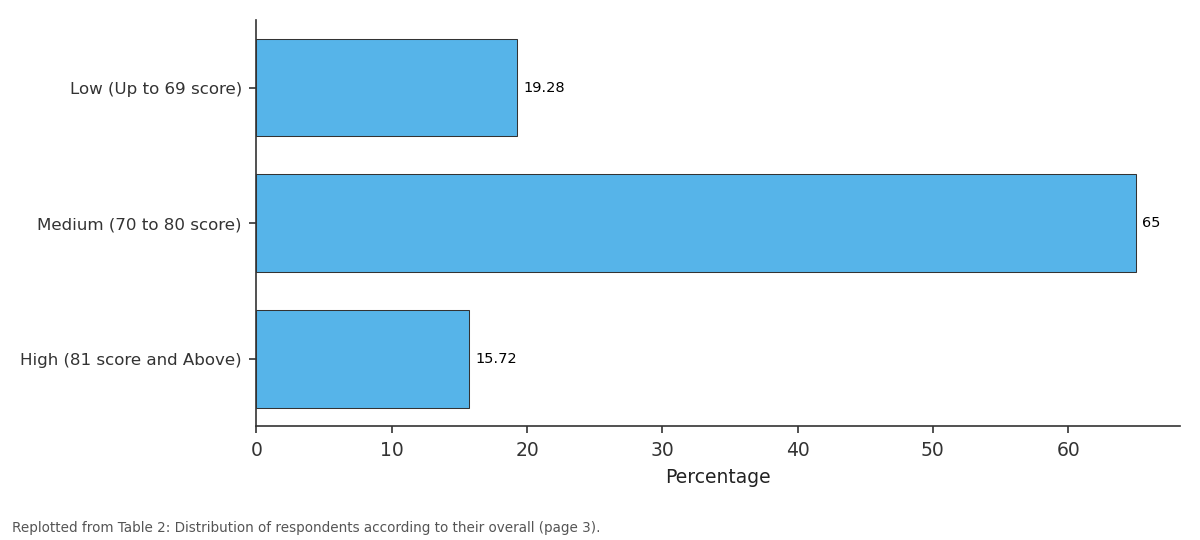
Percentage: Low (Up to 69 score) vs Medium (70 to 80 score) vs High (81 score and...
Replotted from Table 2 (page 3) of the original paper. Every bar is the paper's own table value.
View source evidence ↗Figures & tables
From the original paper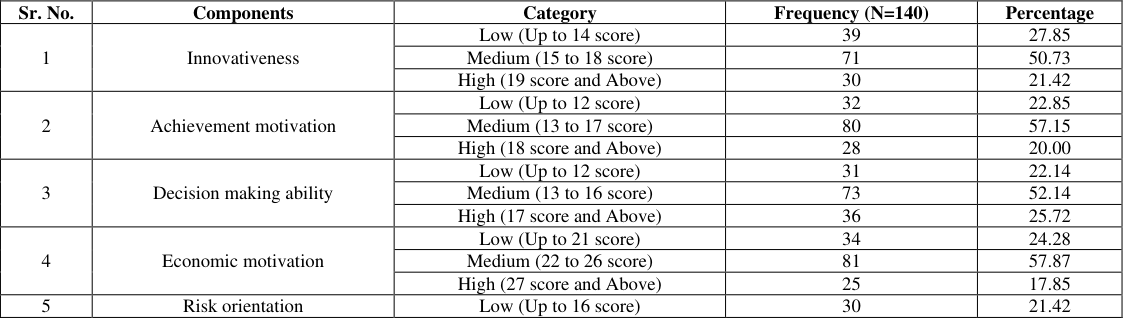 Table 1
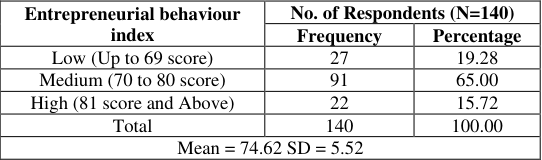 Table 2
Introduction
Grape, (Vitis vinifera) is one of the most important horticulture fruit crops in the world. It belongs to family Vitaceae and their origin in western Asia and Europe. In global landscape of grape production, several countries stand out as significant contributor among these nations India, USA, Turkey, China, Iran, Chile, South Africa and Netherland etc. these are the major grape growing countries in the world. India ranks seventh in the area and production of grape crop with area 163.42 thousand hectare resulting in the production of 8400.54 thousand metric tonnes with productivity of 21 Mt/ha. (Source-National Horticulture Board, Database 2022-23) In India, the major grape producing states are namely Maharashtra, Karnataka, Tamil Nadu, Andhra Pradesh and Mizoram. In which Maharashtra and Karnataka jointly contribute more than 90.00 percent of grape production. In terms of area and production Maharashtra leads among the states of the country during the year 2022-23. The grape cultivation in Maharashtra was 118.94 thousand hectare and production were 2477.36 thousand metric tonnes with productivity 21Mt/ha. (Source-Horticulture Statistics at Glance 2022-23). Grape serves as diverse range of commercial purposes, making them versatile fruit. They can be enjoyed fresh, used in the production of raisin, jam, jelly, juice, wine, vinegar, chocolates, tartaric acids, pickles, oil, cattle food, tannin and many more. Globally, approximately 71.00 percent of the grape production is embarked for wine making, 27.00 percent for fresh consumption and 02.00 percent for raisin production. However, in India, a substantial 78.00 percent of grape primarily use for table and fresh consumption roughly 20.00 percent grapes allocated for raisin production. While 1.50 percent utilized for juice manufacturing and 0.50 percent for wine production. The major grape growing region in Maharashtra is Nashik, Sangli, Solapur, Ahmednagar and Pune. The Nashik district is ranks first in terms of area and production followed by Sangli district. The total area under grape cultivation in Sangli district is 33799.95 hectare with production of 732.33 thousand metric tonnes with productivity 21.67 Mt/ha.
(Source-District Statistical Office, Sangli). In India, raisin mostly produced in Maharashtra state in which Sangli, Nashik, Solapur district of Maharashtra and Bijapur district of Karnataka state. In India, the estimated raisin production was 1,53,500 Mt in which exported 27,045 Mt in year 2021-22. India ranks 10th in global raisin production. And export. In Maharashtra estimated raisin production was 1,20,000 Mt out of that 85,000 Mt produced in Sangli district in year 2021-22. (Source-Agrowan, News Paper). The entrepreneurial behaviour was evaluated by using seven major components, including innovativeness, achievement motivation, decision making ability, economic motivation, risk orientation, leadership ability and management orientation.
Methodology
The present study was carried out in Sangli district of Maharashtra in 2022-23 purposively selected for the study as it had a maximum area under grape cultivation in the Sangli region. Ex-post facto research design was followed for the investigation. Out of 10 tehsils of Sangli district, two tehsils namely Tasgaon & Miraj were purposively selected on the basis of the maximum area under raisin production from each tehsil, seven villages and from each village 10 respondents were selected by using a random sampling method, which make 14 villages and 140 respondents respectively. The data were collected by personal interview method through structured interview schedule of analysed by employing suitable statistical tools like arithmetic mean, standard deviation, frequencies & percentage. The findings were meaningfully interpreted and relevant conclusion were drawn.
Results and Disscussion
The entrepreneurial behaviour was evaluated against seven major components, including innovativeness, achievement motivation, decision making ability, economic motivation, risk orientation, leadership ability and management orientation.
Innovativeness
The data observed in Table No.1 shows that a half of the raisin producers' (50.73 percent), had a medium level of innovativeness. Followed by high and low levels of innovativeness were represented by (21.42 percent and 27.85 percent), significantly. Thus, it was determined that the medium level of innovativeness of raisin producers might be due to their a less education, low land holdings, and lack of extension contacts, raisin producers may have a medium level of innovativeness and little exposure to new technology.
The results obtained in this study align with the research findings of Manjunath (2015) [7] , Shewale (2017) [10] .
Achievement motivation
The data presented in Table No.1 show that the more than half of raisin producers' (57.15 percent), had a medium level of achievement motivation, while (20.00 percent) of respondents had high levels of achievement motivation and (22.85 percent) had low levels of achievement motivation. This is made clear by the respondent's desire for preserving their social standing via achieving higher goals. It is believed that achievement motivation encourages the person to fulfil certain self-imposed targets. Higher an individual's motivation, greater their efforts. Because of their perceived ability to do more, respondents' social and economic position can be linked to this current medium motivation level. The findings are in line with the results of Ghube (2016) [15] , Jadhav (2014) [5] and Shewale (2017) [10] .
Decision making ability
The information in Table No.1 indicated that the more than half of raisin producers (52.14 percent) had a medium level of decision-making ability, followed by high and low levels of decision-making ability (25.72 percent and 22.14 percent), respectively. The possible reason for this might be due to the constantly changing agro-climatic conditions and lack of stabilized price policy make it extremely difficult for raisin producers to take decision in particular conditions and majority of respondents' middle-class status, which included a medium level of income, education and medium level of farming experience and management ability. The findings are in line with the findings of Manjunath (2015) [7] and Khawale (2020) [6] .
Economic motivation
Table No.1 revealed that more than half of raisin producers, (57.87 percent), had a medium level of economic motivation. Followed by High and low levels of economic motivation (17.85 percent and 24.28 percent), respectively. Thus, it is concluded that more than half of raisin producers had medium level of economic motivation. Raisin producers may have medium economic motivations because of irregular weather patterns, pricing policy swings, and a lack of support from family members. The results obtained corresponding with the results reported by Jadhav (2014) [5] , Wadekar (2016) [14] and Khawale (2020) [6] . The study made it clear that raisin producers who were willing to take risks in order to get high economic returns from a small unit area they were ready to take risks. Due to these reasons the raisin producers under investigation were thus categorized with a medium risk ability. It is dependent upon personal and socioeconomic factors. Individuals with higher incomes are more adept at taking risks. Due to market price fluctuations, the majority of them prefer a moderate level of risk. Similar findings were verified by Manjunath (2015) [7] , Shewale (2017) [10] and Shreekant (2017) [11] .
Leadership ability
Table No.1 data revealed that a half of raisin producers, (51.43 percent), had a medium level of leadership ability. High and low levels of leadership ability, (22.15 percent) and (26.42 percent), respectively.
The possible reason for the medium level of leadership ability might be due to that the raisin producers had a low level of education and low extension contacts, which led them to be followers rather than leaders, which may have contributed to their low leadership abilities.
The findings of the current study are consistent with the findings of Shreekant (2017) [11] , Shende (2019) [9] , and Khawale (2020) [6] .
Management orientation
Table No.1 data indicates that the majority of respondents (64.28 percent) showed a moderate level of management orientation, followed by high (20.72 percent) and low (15.00 percent) levels of management orientations respectively. This might have been because the majority of respondents were skilled at planning cultivation practices, such as sowing and planting time, intercultural operations, and general crop management, which increased production and provides grape quality and allowed them to sell their produce in market for a reasonable price. These findings are consistent with the research conducted by Uday (2019) and Khawale (2020) [6] .
Entrepreneurial Behaviour
The data presented in Table No.2 shows that the majority (65.00 percent) of the respondents exhibited a medium level of entrepreneurial behaviour. This was followed by (15.72 percent) with a high level and (19.28 percent) with a low level of entrepreneurial behaviour of raisin producers respectively. This might be due to the fact that majority of respondents had a positive attitude towards the development and adoption of new technologies. They also exhibited a medium level of decisionmaking ability, economic motivation, leadership ability, high school education, medium to high levels of innovativeness, medium management orientation, and risk-taking ability. The majority of respondents exhibited moderate levels of different entrepreneurial behaviour components; as a result, their overall level of entrepreneurial behaviour was also medium.
The results obtained in this study align with the research findings of Jadhav (2014) [5] , Mubeena (2017), Shewale (2017 [10] , Shreekant (2017) [11] , Shende (2019) [9] , and Uday (2019).
Conclusion
The majority of the raisin producers showed medium level of entrepreneurial behaviour in raisin production. The possible reason for that majority of the farmers were belonging to medium level of innovativeness, achievement motivation, decision making ability, economic motivation, risk orientation, leadership ability and management orientation. It is observed that majority of raisin producers showed medium levels of entrepreneurial behaviour, which is representative of the farmers' progressive nature. Therefore, it recommends policymakers to boost up the support for farmers through field extension personnel from development agencies, nongovernmental organizations (NGOs), private corporations, and state Agri-Horticulture educational institutions. This would help to make raisin producers more self-sufficient. The majority of raisin producers fall within the middle age group; targeted training initiatives should be implemented to empower this raisin producers to serve as catalysts in inspiring and facilitating communication networks among other producers. The results of the study may be helpful to the government, administrators, and policy makers in understanding the reasons behind farmer opting raisin production as entrepreneurial behaviour activity.
Figures and tables from the paper
| Sr. No. | Components | Category | Frequency (N=140) | Percentage |
|---|---|---|---|---|
| 1 | Innovativeness | Low (Up to 14 score) | 39 | 27.85 |
| Medium (15 to 18 score) | 71 | 50.73 | ||
| High (19 score and Above) | 30 | 21.42 | ||
| 2 | Achievement motivation | Low (Up to 12 score) | 32 | 22.85 |
| Medium (13 to 17 score) | 80 | 57.15 | ||
| High (18 score and Above) | 28 | 20.00 | ||
| 3 | Decision making ability | Low (Up to 12 score) | 31 | 22.14 |
| Medium (13 to 16 score) | 73 | 52.14 | ||
| High (17 score and Above) | 36 | 25.72 | ||
| 4 | Economic motivation | Low (Up to 21 score) | 34 | 24.28 |
| Medium (22 to 26 score) | 81 | 57.87 | ||
| High (27 score and Above) | 25 | 17.85 | ||
| 5 | Risk orientation | Low (Up to 16 score) | 30 | 21.42 |
Table text extracted from the original PDF; superscript letters are shown inline. The original table image is below.
View original table image
| Entrepreneurial behaviour index | No. of Respondents (N=140) | — |
|---|---|---|
| Frequency | Percentage | |
| Low (Up to 69 score) | 27 | 19.28 |
| Medium (70 to 80 score) | 91 | 65.00 |
| High (81 score and Above) | 22 | 15.72 |
| Total | 140 | 100.00 |
| Mean = 74.62 SD = 5.52 |
Table text extracted from the original PDF; superscript letters are shown inline. The original table image is below.
View original table image
References
1 in the original paper- Girahge RR, Charjan SU, Jadhav GN, Bhaskarwar AC, Ghube NN, Lambat AP, et al. Evaluation of different genotypes of gaillardia for growth, flowering and yield parameters. Int. J Agri. Sci. Res. 2016;6(6):301-306.