
Research article · 2024 · Full text
International Journal of Agriculture Extension and Social DevelopmentUtilization of marketing information by farm women in Telangana state
Volume 7(2) · Pages 38–41 · DOI: 10.33545/26180723.2024.v7.i2a.312 ↗
Research areasInnovation and Socioeconomic DevelopmentLivestock Management and Performance ImprovementBusiness Strategies and Innovation
Abstract
Author-writtenThe study ascertained the utilization of marketing information by farm women involved in horticulture in Telangana State. A purposive random sampling technique was adopted in the selection of 120 women farmers. Data were collected from the respondents with the structured interview schedule. Data analysis was carried out using frequency counts, percentages, mean, and standard deviation, and correlation was used to establish relationships between selected variables. Among the recognized sources of marketing data are family members, television, neighbors’ relatives, mobile, friends, and progressive farmers. revealed that majority (91.60 MPS) of the respondents were utilizing the market information to know market demands followed by crop selection (89.50 MPS), selection of variety (88.30 MPS), price fixing (87.00 MPS), place of selling the produce (85.40 MPS), type of strategy used to sell the produce (83.70 MPS), time of selling the produce (83.30 MPS), quantity of produce for selling in the market (82.50 MPS), packing techniques (78.30 MPS), increasing the shelf life of produce (76.60 MPS), storing techniques (21.30 MPS) and storage facilities available (17.90 MPS).Age, Education, Farming experience, Extension contact. Information-seeking behavior and the Source of marketing information available are significantly correlated with the utilization of marketing information by farm women.
Summary
Source-checkedPlain-language reading of the full paper, prepared with AI and checked against the text. Each point links to the authors' own words.
Why it matters
- Women constitute a significant part of the rural population and their involvement is closely linked to sustainable agricultural growth. View evidence ↗
- Despite their role, women's contributions to agriculture are often poorly understood, and their specific information needs are frequently ignored during development planning. View evidence ↗
- A prosperous agricultural economy relies on timely marketing information regarding transportation, new opportunities, and prices for inputs and outputs. View evidence ↗
The question
- The study aimed to determine how farm women involved in horticulture in Telangana State utilize marketing information. View evidence ↗
What they did
- The research was conducted in the randomly selected districts of Ranga Reddy and Medchal-Malkajgiri in Telangana State. View evidence ↗
- A purposive sample of 120 farm women who owned land and marketed horticultural produce (fruits, flowers, and vegetables) was selected. View evidence ↗
- Data was collected via a structured interview schedule using a three-point continuum (to a great extent, some extent, not at all). View evidence ↗
- The analysis employed frequency counts, percentages, mean, standard deviation, and correlation to identify relationships between variables. View evidence ↗
What they found
- Family members were the primary source of marketing information (MPS 85.50), followed by television (MPS 79.70) and neighbors (MPS 77.70). View evidence ↗
- The most common use of marketing information was to determine market demands (91.60 MPS), while the least common uses were storing techniques (21.30 MPS) and available storage facilities (17.90 MPS). View evidence ↗
- There is a positive and significant correlation (p < 0.05) between a woman's age and her extent of utilizing marketing information. View evidence ↗
- Higher education levels are positively and significantly correlated (p < 0.01) with the extent of marketing information utilization. View evidence ↗
- Farming experience shows a positive and significant relationship (p < 0.05) with the utilization of marketing information. View evidence ↗
- Increased contact with extension services is positively and significantly correlated (p < 0.05) with the utilization of marketing information. View evidence ↗
- Information-seeking behavior is positively and significantly correlated (p < 0.01) with the extent of marketing information utilization. View evidence ↗
- The availability of marketing information sources is positively and significantly correlated (p < 0.01) with the extent of its utilization. View evidence ↗
What it means
- The authors conclude that targeted educational programs and interventions are necessary to improve farm women's access to marketing information. View evidence ↗
- The authors note that effective utilization of information is hindered by barriers such as limited technology access, lack of awareness, and social or cultural constraints. View evidence ↗
Visual summary
3 visualsIllustrations explain the paper; charts are replotted from the paper's own table values.
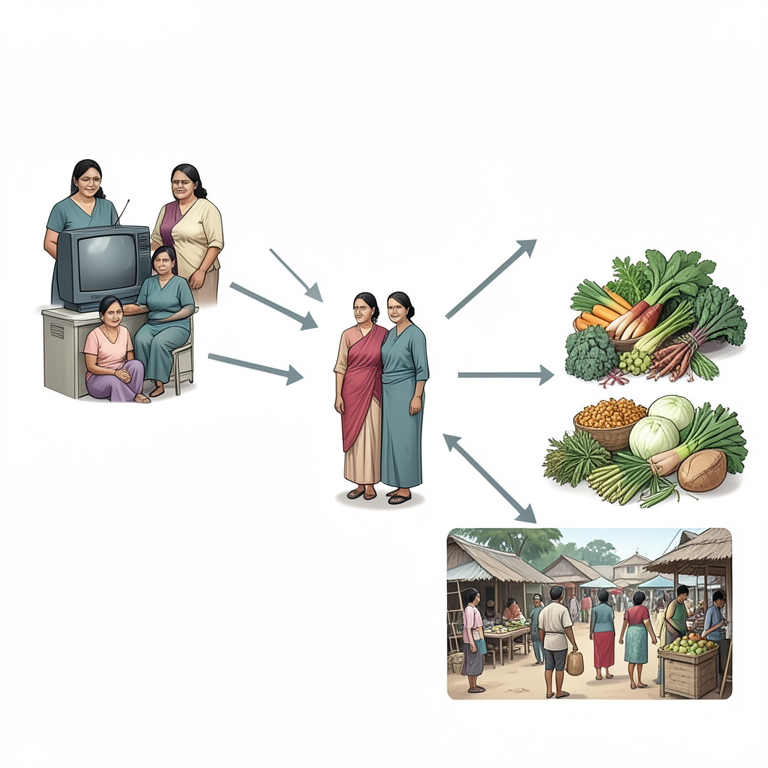
Information Flow and Application
AI-generated conceptual illustration (Indian farm women in Telangana state). It explains the idea and does not show study data.
View source evidence ↗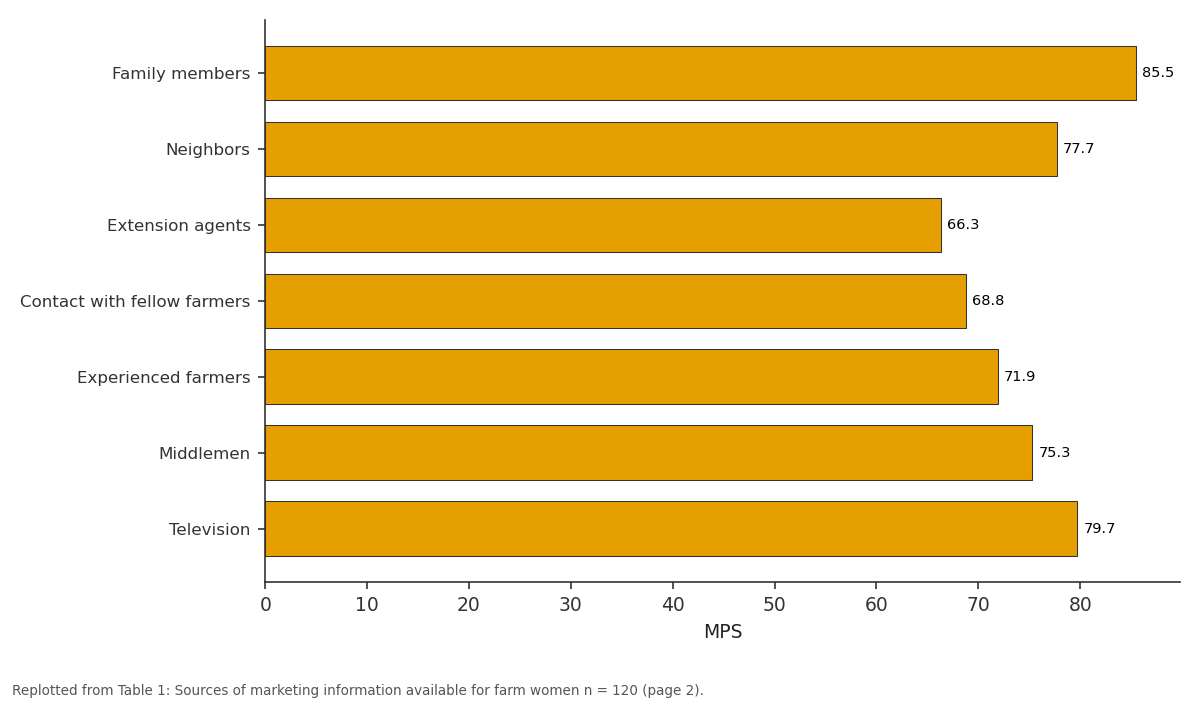
MPS: Family members vs Neighbors vs Extension agents vs Contact with fellow... vs Experienced farmers
Replotted from Table 1 (page 2) of the original paper. Every bar is the paper's own table value.
View source evidence ↗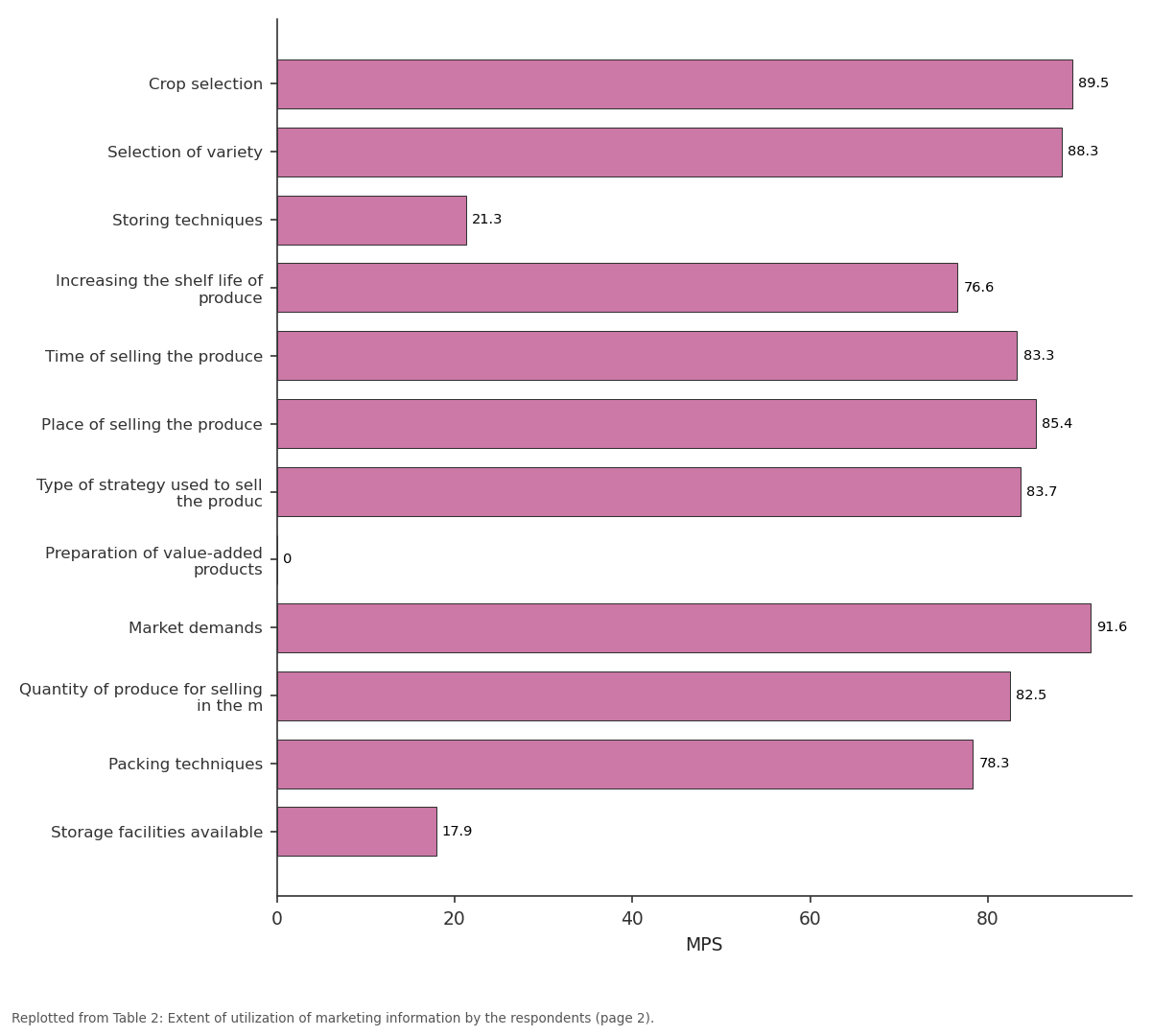
MPS: Crop selection vs Selection of variety vs Storing techniques vs Increasing the shelf... vs Time of selling the...
Replotted from Table 2 (page 2) of the original paper. Every bar is the paper's own table value.
View source evidence ↗Figures & tables
From the original paper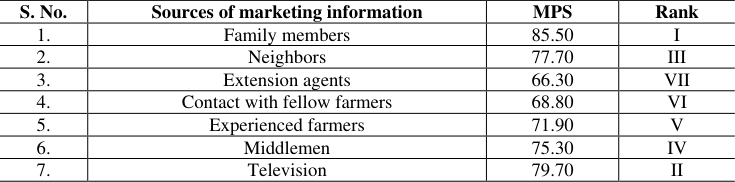 Table 1
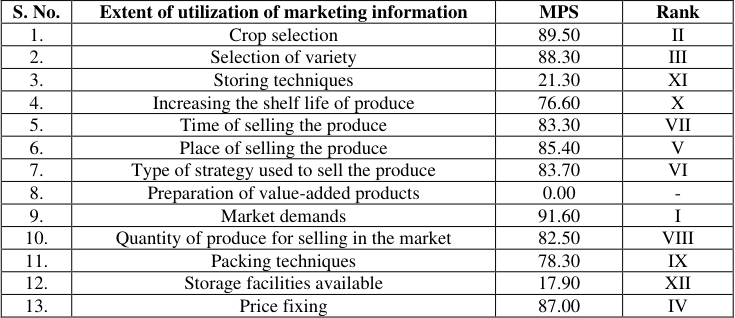 Table 2
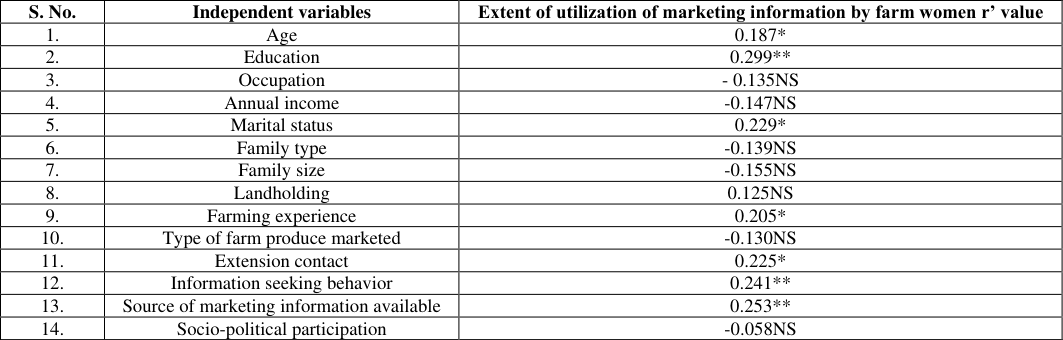 Table 3
Introduction
A significant and novel facet of agriculture in developing nations is agricultural marketing information. According to Oyeyinka and Bello (2013) [7] , this is acknowledged to have a lot of potential for promoting agricultural products both domestically and worldwide. Sustainable agricultural growth is closely linked to the involvement of women, who make up a significant portion of the rural populace, in agriculture. Therefore, encouraging the use and availability of diverse agricultural information categories that can aid in rural development and farmers' needs is crucial to a country's social and economic advancement (Mangual, 2010) [2] . Women's contributions to agriculture are underappreciated, and development planning ignores their unique information demands. In spite of this, women produce and distribute the majority of the world's food (Nosheen et al., 2008) [3] . In Nigeria, women have been observed to actively participate in agricultural production, particularly in areas like produce production, processing, and selling. Agricultural marketing information is an important and new aspect of agriculture in developing countries. This is known to have great potential for promoting agricultural products both locally and internationally (Oyeyinka and Bello, 2013) [7] . The participation of women as an important segment of the rural population in agriculture is germane to sustainable agricultural development. Hence, promoting access to and utilization of various categories of agricultural information that can support farmers and rural development therefore plays an important role in the social and economic development of a nation (Mangual, 2010) [2] . The contributions of women in agriculture are poorly understood and their specific information needs are ignored in the development planning. Despite that, women are the world's principal food producers and providers (Nosheen et al., 2008) [3] . Women have been found to play active roles in agricultural production in Nigeria, especially in activities such as production, processing, and marketing of produce. It's interesting to note that knowledge has emerged as one of the primary production variables, and this tendency is certain to continue. In the current information era, knowledge application and accumulation will spur development and open up previously unheard-of possibilities for both economic growth and the eradication www.extensionjournal.com of poverty. According to estimates, there will be a 2-3% increase in economic growth rates when information and communications technologies (ICTs) are effectively integrated into various economic sectors. An effective and prosperous agricultural economy depends on having timely and pertinent information, particularly marketing information on the availability of transportation, new marketing opportunities, and the market prices of farm inputs and outputs (Samuel, 2001; Adebo and Ewuola, 2005) [5,1] .
Methodology
The present study was conducted in two districts of Telangana State namely Ranga Reddy and Medchal-Malkajgiri were randomly selected for the study. A total of 120 farm women were selected as the sample of the study purposively for which the farm women who possessed agricultural land and were involved in growing and marketing horticulture produce such as vegetables, flowers, and fruits were considered for the study. The ex-post facto research design was adopted for the study. A structured interview schedule was developed to identify the problems faced by farm women in marketing horticulture produce. Statements were measured on a three-point continuum i.e., to a great extent, some extent, not at all. Primary data was collected from the respondents in two districts of Telangana. Mean Percentage Score was calculated to rank the statements. The respondents were inclined towards marketing towards demands because the respondents were purposively selected who were marketing the produce and so were interested in knowing the day-to-day market demands. Their utilization of marketing information was also high in selection and selection of variety may be due to the reason that marketing information may help them to know about the consumer demands and accordingly could take up farming activities and gain appropriate profits. The results were supported by Yusufu (2016) [6] conducted a study on the Use of Agricultural Information Sources and Services by Farmers to Improve Productivity revealed that information on market days/market distance was available and the most often utilized (WMS = 4.61) and ranked first, followed by the information on the best time for marketing harvested cassava tubers (81.8%) ranked 2nd and information on high yielding varieties for better market value (80.9%) ranked 3 rd . www.extensionjournal.com Socio-political participation -0.058NS * = Significant at 0.05 level of probability ** = Significant at 0.01 level of probability, NS = Non-significant
Results and Discussion
Results and Discussion
Correlation analysis of profile characteristics and extent of utilization of marketing information by farm women
Correlation analysis of profile characteristics and extent of utilization of marketing information by farm women
Age vs Extent of utilization of marketing information by farm women
It was quite evident from table 3 that there was a positive and significant relationship between the age and extent of utilization of marketing information by farm women at the 0.05 level of probability. It indicated that as the age of farm women increased their extent of utilization of market information also was increased. As their age was increased their experience on various method and key aspects in marketing were realized by them which enabled them to seek and utilize the available marketing information.
| S. No. | Independent variables | Extent of utilization of marketing information by farm women r’ value |
|---|---|---|
| 1. | Age | 0.187* |
| 2. | Education | 0.299** |
| 3. | Occupation | - 0.135NS |
| 4. | Annual income | -0.147NS |
| 5. | Marital status | 0.229* |
| 6. | Family type | -0.139NS |
| 7. | Family size | -0.155NS |
| 8. | Landholding | 0.125NS |
| 9. | Farming experience | 0.205* |
| 10. | Type of farm produce marketed | -0.130NS |
| 11. | Extension contact | 0.225* |
| 12. | Information seeking behavior | 0.241** |
| 13. | Source of marketing information available | 0.253** |
| 14. | Socio-political participation | -0.058NS |
Table text extracted from the original PDF; superscript letters are shown inline. The original table image is below.
View original table image
Education vs Extent of utilization of marketing information by farm women
From table 3 it could be observed that there was a positive and significant relationship between the education and extent of utilization of marketing information at the 0.01 level of probability. It stated that as the education of farm women increased their extent of utilization of marketing information also increased. This may be due to the reason that increase in the education level might have increased their mental horizon to access and utilize the information available regarding marketing activities.
Marital status vs Extent of utilization of marketing information by farm women
The table from table 3. Clearly stated that there was a positive and significant relationship between the marital status and extent of utilization of marketing information at the 0.01 level of probability. This might be due to the reason that majority of the farm women who were involved in marketing were middle aged and such age group generally married who wanted to find various ways available & means in which they can utilize the marketing information available to raise their income.
Farming experience vs Extent of utilization of marketing information by farm women
From the table 3 it could be concluded that there was a positive and significant relationship between the farming experience and extent of utilization of marketing information by farm women at the 0.05 level of probability. It implied that as the farming experience of farm women increased their utilization of marketing information also increased. This might be due to the reason that increasing farming experience had improved the farm women's awareness and skills regarding marketing activities which helped in making wise decisions in all the aspects of utilizing the marketing information.
Extension contact vs Extent of utilization of marketing information by farm women
It was obvious from the table 3 that there was a positive and significant relationship between the extension contact and extent of utilization of marketing information by farm women at the 0.05 level of probability. It implied that as the extension contact of farm women increased their utilization of marketing information also increased. This could be because increase in the extension contact of farm women gave them an exposure to find ways and means in the utilizing the available marketing information from the local extension personnel.
Information seeking behavior vs Extent of utilization of marketing information by farm women
From table 3 signified that there was a positive and significant relationship between the information seeking behavior and extent of utilization of marketing information by farm women at the 0.01 level of probability. As the information seeking behavior of farm women increased their utilization of marketing information also increased. This might be due to the reason that increasing in the information seeking behavior might have motivated to search and seek marketing information from different sources and made farm women to utilize the needed information.
Sources of marketing information available to farm women
From table 3 it could be observed that there was a positive and significant relationship between sources of the marketing information available to farm women and their extent of utilization of marketing information at 0.01 level www.extensionjournal.com of probability. Due to increase in the availability of sources of marketing information to farm women had facilitated them to acquire more and more information regarding marketing and which helped them to top more resources to improve their marketing strategies so as to gain more income to the families.
Conclusion
In conclusion, the study sheds light on the significant role of marketing information in empowering farm women. Farm women actively seek and utilize marketing information to make informed decisions about their agricultural activities. This information not only enhances their understanding of market dynamics but also enables them to negotiate better prices for their produce and effectively manage their resources. Furthermore, our findings underscore the importance of targeted educational programs and interventions aimed at improving access to marketing information among farm women. By providing training in areas such as market analysis, price forecasting, and value-added opportunities, policymakers and stakeholders can further empower farm women to maximize their agricultural productivity and income. However, it is crucial to acknowledge the existing challenges and barriers that hinder the effective utilization of marketing information by farm women, including limited access to technology, lack of awareness about available resources, and social and cultural constraints. Governmental agencies, non-governmental groups, and other pertinent parties must work together to address these issues and provide solutions that are specifically designed to meet the requirements and conditions of farm women. All things considered, our research emphasizes how critical it is to acknowledge farm women as engaged members of agricultural value chains and promotes laws and programs that facilitate their access to pertinent data and resources. Farm women can make a substantial contribution to the sustainable development of rural communities and the agricultural industry as a whole by utilizing the marketing information at their disposal.
Implications
Providing farm women with accessible and up-to-date market information can enhance their decision-making capabilities, allowing them to respond effectively to market demands and secure better prices for their produce. Policymakers should prioritize gender-sensitive policies that address the specific needs and challenges faced by farm women in accessing and utilizing marketing information. This may involve integrating gender perspectives into agricultural extension services, allocating resources for women-focused training programs, and promoting women's participation in decision-making forums related to agriculture and rural development
Figures and tables from the paper
| S. No. | Sources of marketing information | MPS | Rank |
|---|---|---|---|
| 1. | Family members | 85.50 | I |
| 2. | Neighbors | 77.70 | III |
| 3. | Extension agents | 66.30 | VII |
| 4. | Contact with fellow farmers | 68.80 | VI |
| 5. | Experienced farmers | 71.90 | V |
| 6. | Middlemen | 75.30 | IV |
| 7. | Television | 79.70 | II |
Table text extracted from the original PDF; superscript letters are shown inline. The original table image is below.
View original table image
| S. No. | Extent of utilization of marketing information | MPS | Rank |
|---|---|---|---|
| 1. | Crop selection | 89.50 | II |
| 2. | Selection of variety | 88.30 | III |
| 3. | Storing techniques | 21.30 | XI |
| 4. | Increasing the shelf life of produce | 76.60 | X |
| 5. | Time of selling the produce | 83.30 | VII |
| 6. | Place of selling the produce | 85.40 | V |
| 7. | Type of strategy used to sell the produce | 83.70 | VI |
| 8. | Preparation of value-added products | 0.00 | - |
| 9. | Market demands | 91.60 | I |
| 10. | Quantity of produce for selling in the market | 82.50 | VIII |
| 11. | Packing techniques | 78.30 | IX |
| 12. | Storage facilities available | 17.90 | XII |
| 13. | Price fixing | 87.00 | IV |
Table text extracted from the original PDF; superscript letters are shown inline. The original table image is below.
View original table image
References
5 in the original paper- Adebo GM, Ewuola SO. Impact of Micro Credit and Effective Communication System on Income of Women in Ondo and Ekiti State, Nigeria. Journal of Agricultural Extension. 2005;8:158.
- Mangual A. Access to Agricultural information. The Pacific Agricultural and Forestry Policy Network (PAFPNet), Land Resources Division News Article, Secretariat of The Pacific Community (SPC), 2010, 3.
- Nosheen F, Ali T, Ahmad M, Nawaz H. Exploring the Gender Involvement in Agricultural Decision Making: a case study of District Chawal Pakistan. Journal of Agricultural Science. 2008;45(3):101-106.
- Olaniyi OA, Adebayo OO, Akintola SO. Rural Youth's Perception and Utilization of Agricultural Information in Oyo State, Nigeria. Journal of Agriculture and Social Sciences (JASS). 2011;7(4):117-123.
- Oyeyinka RA, Bello RO. Farmers use of ICTs for marketing information outlets in Oyo State, Nigeria. Journal of Agricultural Science. 2013 Nov 1;5(11):150.