
Research article · 2024 · Full text
International Journal of Agriculture Extension and Social DevelopmentEconomic analysis of milk production for social development
Volume 7(1) · Pages 682–685 · DOI: 10.33545/26180723.2024.v7.i1i.297 ↗
Research areasAgricultural Economics and Policy
Abstract
Author-writtenIn the present study, 120 milk producers from eight from from four tahsils in Amravati district was purposively selected. Out of 120 milk producers, 32 milk producers who reared improved buffaloes were selected for study. 32 milk producers had 69 improved buffaloes of different breeds. In the analysis of cost and profit, it is reflected that, out of total returns from improved buffaloes, 81.08% returns received from sale of milk only, whereas, out of total returns, receipt from the sale of milk products, value of milk for home consumption, value of milk products at home consumption, value of manures, value of empty gunny bags & value of new born heifers were calculated as 2.42%, 1.37%, 0.53%, 7.14% 0.12% & 7.32% respectively. The details in respect of percentage share to total cost about interest paid on fixed capital, taxes on cattleshed, taxes on godown, depreciation on milch animals, depreciation on cattleshed & equipments was 3.13%, 0.040%, 0.043%, 5.64%, 3.61%. It was also reflected that, out of total cost, percentage share of total cost was 12.54%. Gross return from 69 improved buffaloes was Rs. 85,89, 314, out of total returns, net returns at the total cost was Rs. 47, 67,410.01, net returns at variable cost was Rs. 52,46, 870. It was found that, B:C ratio was 1:2.24. And this firm was found to be more profitable. There is an imperative need to reduce the cost of producing green fodder, dry fodder and concentrates feeds, thereby reducing cost of milk production. The gross income and net income is always higher in improved buffalo’s milk production. From economic and social development point of view, rearing of improved buffalo was more profitable.
Summary
Source-checkedPlain-language reading of the full paper, prepared with AI and checked against the text. Each point links to the authors' own words.
Why it matters
- Improved buffaloes are critical to the Indian dairy industry, producing over half of the country's total milk despite making up less than 40% of the bovine population. View evidence ↗
- Buffalo milk is considered superior to local cow milk due to higher production levels and a richer nutrient profile, including higher fat, protein, and calcium content. View evidence ↗
- Many of the millions of milk producers in India lack knowledge regarding the economic aspects of their production processes. View evidence ↗
The question
- The study aims to analyze the costs, returns, and profit margins associated with improved buffalo milk production. View evidence ↗
What they did
- The final study group consisted of 32 producers managing a total of 69 improved buffaloes of various breeds. View evidence ↗
- Data on variable costs, fixed costs, total costs, and returns were collected from the selected producers using a random sample technique and a structured questionnaire. View evidence ↗
What they found
- The total annual gross return from the 69 improved buffaloes was Rs 85,89,314. View evidence ↗
- The sale of milk was the primary source of income, accounting for 81.08% of the total returns. View evidence ↗
- Variable costs made up 87.45% of the total cost, while fixed costs (including depreciation and taxes) accounted for the remainder. View evidence ↗
- The Benefit-Cost (B:C) ratio was found to be 1:2.24, indicating the enterprise was profitable. View evidence ↗
- The cost to produce one litre of milk was Rs 9.42 based on variable costs and Rs 12.06 based on total costs. View evidence ↗
- Feeds and fodder represented the largest expense, accounting for 61% of the total production cost. View evidence ↗
What it means
- The authors conclude that rearing improved buffaloes is highly profitable and contributes to the social and economic prosperity of dairy farmers. View evidence ↗
- The authors recommend reducing the costs of producing green fodder, dry fodder, and concentrate feeds to further lower the overall cost of milk production. View evidence ↗
- Major constraints identified for producers include a lack of knowledge regarding management practices, labor shortages, and the high cost of feeds. View evidence ↗
Visual summary
1 visualsIllustrations explain the paper; they do not show study data.
Cost Distribution of Milk Production
AI-generated conceptual illustration (dairy cows in a farm setting). It explains the idea and does not show study data.
View source evidence ↗Figures & tables
From the original paper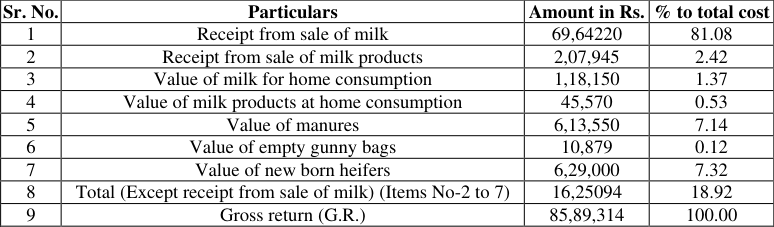 Table 1
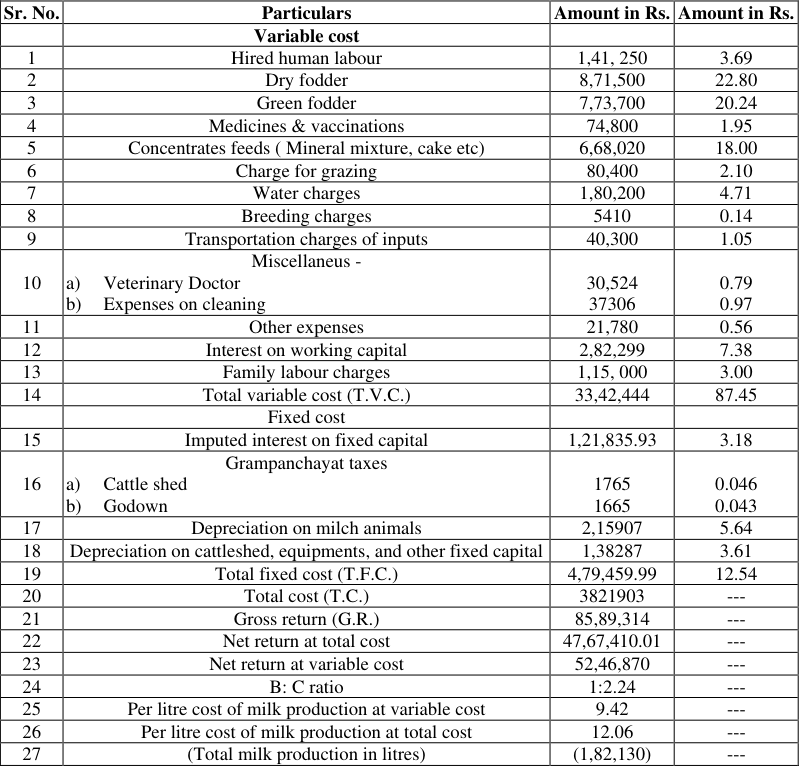 Table 2
Introduction
India is the world's largest producer and consumer of milk and has the world's largest dairy herd comprised of water buffalo and indigenous and crossbred cattle. The buffalo population in India was 105.3 million heads out of that 6.07 million heads were in Maharashtra. The superiority of buffalo over local cow milk in production has been proved beyond any doubt. Even the higher content of fat, protein and mineral especially calcium content of buffalo milk make it richer in nutrients vis -avis cow milk The buffalo produce on an average 1700-1900 kg of milk with 8% fat per lactation. As a subsidiary agro-based industry, dairy provide drought power and manures which augment the crop production. Milch animals are one of the solutions to solve the problems of uncertainty associated in family business. Dairy industry is one of the profitable agro-based industries which can effectively tackle the problem of unemployment in rural as well as in urban area. Dairy production can be adopted under a wide range of climatic condition and can generally be combined conveniently with other farm enterprises. The land and per capita requirement for this enterprise being not large, it ensures a regular flow of income through better production and marketing of milk and its products. India has the largest number of buffalo in the world. The buffalo, especially improved buffalo which is considered to be the backbone of Indian dairy industry, constitutes less than 40% of bovine population, but accounts for more than half of the total milk production of the country. In fact, small size milk producers produce bulk of the milk in India. India is home not only to the world famous 'Murrah" buffalo but also several others high milk producing buffalo breeds such as Jafrabadi, Nili-Ravi, Pandharpuri, Surti, and Mehsana with their unique characteristics. Milk production in India is in the hands of millions of such milk producers, who are ignorant about the economic aspect of milk production. Therefore, it is necessary to check cost, returns and profit margin in improved buffalo milk production. Hence this research study is selected to analyses the cost and profit in improved buffalo milk production to cope with the fallowing objectives as under -Objectives 1) To estimate the gross return from improved buffalo selected for study 2) To analyses the cost, per litre cost and profit in improved buffalo milk production. www.extensionjournal.com
Methodology
The detail methodology is given as under in fallowing headsa) Selection of area: For the present study, eight villages from four tahsils in Amravati district was purposively selected. b) Selection of sample: A sample of 120 milk producers (15 milk producers from eight villages) was selected.
Out of 120 milk producers, 32 milk producers who reared improved buffaloes were selected for study. 32 milk producers had 69 improved buffaloes of different breeds. c) Collection of data: For data collection, the comprehensive objectives wise questionnaire was prepared. The required information on variable cost, fixed cost, total cost, gross returns & net return was obtained by random sample technique from selected milk producers.
Results and Discussions
After the collection of data, it is tabulated as under - According to above calculations, it was clearly seen that, improved buffaloes milk production was more profitable as seen by B:C ratio 1:2.24. In an average & compared to all groups, per litre cost of milk production was found to low therefore, this business was found to be more viable.
Conclusions
This analysis is represented that, total annual gross returns made from 69 improved buffalo was Rs. 85,89,314 in which highest share was from sale of milk, it was 81.08% and remaining receipt was 11% which was made from sale of milk products, manures & new born calves etc. The total cost required for milk production from 69 improved buffaloes was as Rs. 38, 21,903 which included total variable cost and total fixed cost was respectively as 87.45% and 12.55% to the total cost. Net returns at total cost were Rs. 47, 67,410.01. Per litre cost of milk production at total cost was Rs. 12.06. And in this firm, B: C ratio was found 1:2.24. And this firm was found to be more profitable and it creates prosperity in social and economic condition of dairymen.
It is also concluded that, in respect of investment made by milk producers, highest investment was observed only in improved buffalo milk production. In case of improved buffalo milk production, B:C ratio was found 1:2.24. It was definitely higher than any other milch animals milk www.extensionjournal.com production. This study concluded that, the cost of feeds, fodder, and concentrates feeds was the most important items of the total maintenance cost of buffalo milk production.
There is an imperative need to reduce the cost of producing green fodder, dry fodder and concentrates feeds, thereby reducing cost of milk production. The gross income and net income is always higher in improved buffalo's milk production. From economic and social development point of view, rearing of improved buffalo was more profitable. The milk producers were mostly unknown about the different management practices of buffalo and non availability of labour and high cost of feeds and concentrates feeds were faced as major constraints to buffalo milk producers.
Figures and tables from the paper
| Sr. No. | Particulars | Amount in Rs. | % to total cost |
|---|---|---|---|
| 1 | Receipt from sale of milk | 69,64220 | 81.08 |
| 2 | Receipt from sale of milk products | 2,07,945 | 2.42 |
| 3 | Value of milk for home consumption | 1,18,150 | 1.37 |
| 4 | Value of milk products at home consumption | 45,570 | 0.53 |
| 5 | Value of manures | 6,13,550 | 7.14 |
| 6 | Value of empty gunny bags | 10,879 | 0.12 |
| 7 | Value of new born heifers | 6,29,000 | 7.32 |
| 8 | Total (Except receipt from sale of milk) (Items No-2 to 7) | 16,25094 | 18.92 |
| 9 | Gross return (G.R.) | 85,89,314 | 100.00 |
Table text extracted from the original PDF; superscript letters are shown inline. The original table image is below.
View original table image
| Sr. No. | Particulars | Amount in Rs. | Amount in Rs. |
|---|---|---|---|
| Variable cost | |||
| 1 | Hired human labour | 1,41, 250 | 3.69 |
| 2 | Dry fodder | 8,71,500 | 22.80 |
| 3 | Green fodder | 7,73,700 | 20.24 |
| 4 | Medicines & vaccinations | 74,800 | 1.95 |
| 5 | Concentrates feeds ( Mineral mixture, cake etc) | 6,68,020 | 18.00 |
| 6 | Charge for grazing | 80,400 | 2.10 |
| 7 | Water charges | 1,80,200 | 4.71 |
| 8 | Breeding charges | 5410 | 0.14 |
| 9 | Transportation charges of inputs | 40,300 | 1.05 |
| 10 | Miscellaneus - a) Veterinary Doctor b) Expenses on cleaning | 30,524 37306 | 0.79 0.97 |
| 11 | Other expenses | 21,780 | 0.56 |
| 12 | Interest on working capital | 2,82,299 | 7.38 |
| 13 | Family labour charges | 1,15, 000 | 3.00 |
| 14 | Total variable cost (T.V.C.) | 33,42,444 | 87.45 |
| Fixed cost | |||
| 15 | Imputed interest on fixed capital | 1,21,835.93 | 3.18 |
| 16 | Grampanchayat taxes a) Cattle shed b) Godown | 1765 1665 | 0.046 0.043 |
| 17 | Depreciation on milch animals | 2,15907 | 5.64 |
| 18 | Depreciation on cattleshed, equipments, and other fixed capital | 1,38287 | 3.61 |
| 19 | Total fixed cost (T.F.C.) | 4,79,459.99 | 12.54 |
| 20 | Total cost (T.C.) | 3821903 | --- |
| 21 | Gross return (G.R.) | 85,89,314 | --- |
| 22 | Net return at total cost | 47,67,410.01 | --- |
| 23 | Net return at variable cost | 52,46,870 | --- |
| 24 | B: C ratio | 1:2.24 | --- |
| 25 | Per litre cost of milk production at variable cost | 9.42 | --- |
| 26 | Per litre cost of milk production at total cost | 12.06 | --- |
| 27 | (Total milk production in litres) | (1,82,130) | --- |
Table text extracted from the original PDF; superscript letters are shown inline. The original table image is below.
View original table image
References
4 in the original paper- Chauhan AK, Kalra KK, Singh R, Raina BB. A study on the economics of milk production, processing in dairy plant in Haryana, Agril. Economics Research Review. 2006;9:399-406.
- Nagrale BG, Datta KK, Singh S. Cost of milk production in Vidarbha region of Maharashtra, Indian Journal of Dairy Science. 2011;64(6):514-519.
- Singh R, Chauhan AK, Sharma SP. Economic analysis of milk production in tribal area of Udaipur (Rajasthan), Indian Journal of Dairy Science. 2006;59(5):328-336.
- Choodamanbigai RS. Economic Profile of milk production in Coimbatore, International Journal of current research. 2011;3(7):260-263.