
Research article · 2024 · Full text
International Journal of Agriculture Extension and Social DevelopmentOutcomes of Mahatma Gandhi National Rural Employment Guarantee act project in the Jhalawar district Rajasthan
Volume 7(1) · Pages 686–687 · DOI: 10.33545/26180723.2024.v7.i1i.300 ↗
Research areasAgricultural risk and resilienceAgricultural Economics and Practices
Abstract
Author-writtenThe paper tries to critically analyze MGNREGA scheme in the Jhalawar district. It tries to identify the problems and challenges dealing with the scheme in the region and also coming up with suitable prospects as a solution. The paper tries to examine the implementation and effectiveness of MGNREGS in providing rural support in various forms, through the case study method it also deals with major findings from field study and observation. Followed by conclusion where it analyses the outcome of field study and also attempts to provide suggestion in the form of policy recommendation.
Summary
Source-checkedPlain-language reading of the full paper, prepared with AI and checked against the text. Each point links to the authors' own words.
Why it matters
- The Mahatma Gandhi National Rural Employment Guarantee Scheme (MGNREGS) is a social welfare program designed to improve livelihood security for rural populations by providing wage employment to unskilled workers. View evidence ↗
- The scheme aims to foster rural economic growth by regenerating natural resources through soil and water conservation activities to ensure sustainable livelihoods. View evidence ↗
- The study area in the Jhalawar district is characterized by poor economic conditions, with 21.92% of households belonging to SC/ST families. View evidence ↗
The question
- The research aims to critically analyze the MGNREGA scheme in the Jhalawar district to identify regional challenges and propose suitable solutions. View evidence ↗
- The specific goal of the project was to enhance agricultural production and upgrade rural livelihoods through a watershed development project. View evidence ↗
What they did
- The study employed a case study method, utilizing field studies and observations to examine the implementation and effectiveness of MGNREGS. View evidence ↗
- The project was implemented across 21 villages within 7 Gram Panchayats in the Jhalarpatan, Pirawa, and Bakani blocks of the Jhalawar District, Rajasthan. View evidence ↗
- The study area is characterized by a dry climate with an average annual rainfall of 1044.7 mm and temperatures ranging from 3 °C to 47 °C. View evidence ↗
What they found
- The project resulted in the construction of 25 farm ponds specifically for vulnerable families. View evidence ↗
- To prevent soil erosion, 20,000 bamboo plants were planted across 400 hectares of farmers' land. View evidence ↗
- The project facilitated the creation of 120 new Women Self Help Groups involving 1,211 women participants. View evidence ↗
- The project generated a total of 40,490 person-days of employment. View evidence ↗
- A total of 1,315 rural marginal to small farming families benefited from the project's activities. View evidence ↗
- Water harvesting and pasture development activities led to a rise in the local water table and increased fodder availability. View evidence ↗
What it means
- The authors conclude that further efforts are needed to optimize income for small land-holding farmers and provide employment for landless laborers. View evidence ↗
- The authors recommend shifting focus from simply increasing labor to implementing women's initiatives for skill employment and empowerment (WISEE) for comprehensive watershed development. View evidence ↗
Visual summary
1 visualsIllustrations explain the paper; they do not show study data.
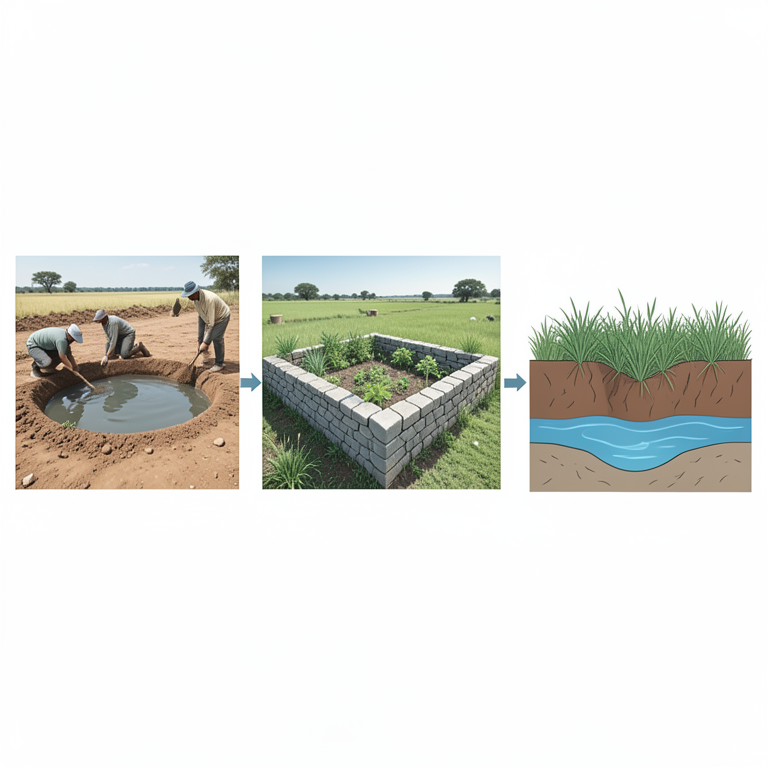
MGNREGS Cycle of Impact
AI-generated conceptual illustration (Rural landscape in Jhalawar district, Rajasthan, featuring arid soil, traditional water harvesting structures, and local). It explains the idea and does not show study data.
View source evidence ↗Introduction
The Mahatma Gandhi national rural employment guarantee scheme. The flagship program was implement programme by the govt. of India as the national rural employment guarantee act in September, 2005. This social welfare program in primarily intended to enhance the livelihood securities of the people in rural areas by supplementing wage employment opportunities to the unskilled labor force. The programme is in force with the intension that it would act as a strong safety net for the poor in the wake of lack of alternative employment opportunities.
IN AN attempt to ensure the rural economy to grow, the scheme is expected to regenerate the rural natural resources base for sustainable livelihood by carrying out soil and water conservation activities. What is considered most crucial is the empowerment of the poor through the provision of a right based law. The other key attribute of this schemes are time bound guarantee, labor intensive work, decentralize participatory planning, women empowerment, work site facilities and above all, transparency and accountability through bank and post office accounts is another innovative step that is likely to reduce fudging of the muster roles on the part of the implementing agencies since the actual payment are beyond their reach since the actual payment are beyond their reach. Project Objectives To achieve hundred percent work result through hard work To generate water conservation benefit to make work environment under this program To empower the rural level governance of natural resources by rural community, including involvement of panchayat in find out natural resources. 686 https://www.extensionjournal.com awareness, FFS Ugs including 691 total number of participants. 28 CRISIL Module trainings conducted for Ultra Poor Women Self Help Group members. A loan of Rs. 15 lac disbursed to 11 Women Self Help Groups of different villages. 1,315 rural marginal to small farming families benefitted by the project. 40,490 person days employment generate Confederation of Indian Industry (CII) visited to inspect the activities done under Watershed Management and awarded with best managed watershed award.
Conclusion
As Seventh year of the project is completed in the project, water harvesting, soil conservation and pasture land development activities are done. By doing such activities water table in the area is raised and some fodder availability increased though pasture development works. As MGNREGA is scheme for providing employment to rural residents. There is still need to work with small land holding farmers for optimum income per unit of the land and also need to provide livelihood/employment to land less labor.
Initially project aim was to provide employment to poor and unemployed labor now we realize instead of increasing labor we need to focus on women initiate for skill employment and empowerment (WISEE) for whole watershed development.
References
4 in the original paper- Indian Institute of Rural Development. Projects reports.
- Institute of Social Sciences. Status of Panchayati Raj in the States and Union Territories of India. New Delhi: Concept Publishing Company Pvt. Ltd.; c2013.
- Debnath S, Paramita S. Ensuring Rural Livelihood Security of Women through MGNREGA: A study of Tripura. J North East Stud Man Soc. 2013;10:119-143.
- Jadhav V. Elite Politics and Maharashtra’s Employment Guarantee Scheme. Econ Political Weekly. 2006;41(50):5157-5162. depending on the rain fall during that year. Farmers who have water sources and investment capacity are growing horticulture crops. Rational of the project: The Gram Panchayat has a pivotal role in the implementation of MGNREGS. It is responsible for planning of works, registering households, issuing job cards, allocating employment, executing 50 per cent of the works and monitoring the implementation of the Scheme at the village level. Therefore, it is imperative to build capacities of institutions responsible for local self- governance so that they can effectively and efficiently plan and execute the work without undermining quality. Certain enabling provisions in the Act call for the involvement of NGOs and mature community based organizations like SHGs in the implementation of the physical work under MGNREGS. Interested private sector companies can sponsor reputed NGOs/CBOs for the implementation of plans under NREGS. Such a strategic collaboration under NREGS will not only provide managerial support to the overall plans of government. Project goal: To upgrade livelihood of rural area through implementation of watershed development project and enhance agriculture production of the area Outcomes The project started with IIRD in June, 2010 during sixth year of the project following outcomes achieved 25 Farm ponds were constructed for vulnerable families. 5 Percolation Tanks constructed at Maroomkheri, Nayapura, Vajindpura, Semlikalan & Gadiya villages. Continuous Contour Trench dug on 44 Ha pasture land to protect area from erosion. 18 Ha field demos demonstrated in Kharif and Rabi season benefitting 525 farmers. 20,000 Bamboo plants were planted on 400 Ha farmers land to protect area from erosion. Land Leveling works done in 9 Individual Beneficiaries’ fields at Jhumki, Soyla & Parasali. 9 Vermi Compost Beds constructed at Jhumki, Soyla & Parasali. 15 Cattle Sheds constructed at Jhumki, Parasali & Soyla & 2 New Customer Hiring Centers commenced at Shyampura & Dubliya. 5 New Water User Groups created with 51 beneficiaries. 7 New women FFS formed at 7 villages with 175 female student farmers. 10 Animal health camps were organized benefitting 416 cattles of 10 villages. Farmer Field Day celebrated in to 5 villages & Savlon Hand Wash Day celebrated at 15 project area villages. Classmate Drawing Competition organized in 38 Primary and Middle School at all project villages around 3020 students participated. 120 new Women Self Help Groups made with 1,211 women participants in different villages. 20 capacity building training organized on institutional development, technical aspect, book keeping, 687