
Research article · 2024 · Full text
International Journal of Agriculture Extension and Social DevelopmentImpact of biogas flora some of the beneficiaries
Volume 7(2) · Pages 26–28 · DOI: 10.33545/26180723.2024.v7.i2a.298 ↗
Research areasRenewable energy and sustainable power systemsSustainable Development and Environmental ManagementEngine and Fuel Emissions
Abstract
Author-writtenThis survey was conducted in Mahasamund district of Chhattisgarh state to assess the level of impact of biogas plant on the respondents. In this study, 110 beneficiaries were considered as respondents. Respondents were interviewed through a personal interview. The collected data were analyzed using appropriate statistical methods. Analysis of the results showed that most of the respondents (75.00%) found the impact that using biogas slurry as manure can improve soil fertility, increase the overall productivity of various crops and it was found that the maximum productivity was recorded in Lathyrus crops, minimize the use of chemical fertilizers, reduce labor costs and weed populations. A significant impact on health care has been noticed among the beneficiaries and the beneficiaries can save valuable money by reducing the consumption of L.P.G.
Summary
Source-checkedPlain-language reading of the full paper, prepared with AI and checked against the text. Each point links to the authors' own words.
Why it matters
- Biogas serves as a clean, smokeless fuel source suitable for cooking, electricity, and mechanical power. View evidence ↗
- The depletion and rising cost of fossil fuels have created a global power crisis, making alternative energy sources necessary. View evidence ↗
- The rapid depletion of fossil fuels has made the adoption of renewable energy resources imperative. View evidence ↗
The question
- The study aimed to evaluate the impact of biogas plants on beneficiaries located in Chhattisgarh. View evidence ↗
What they did
- The research was conducted in the Mahasamund district of Chhattisgarh. View evidence ↗
- The study sample consisted of 110 randomly selected beneficiaries from eleven municipalities. View evidence ↗
- Data analysis was performed using statistical tools including frequency, percentage, mean, standard deviation, correlation, and regression. View evidence ↗
What they found
- The use of biogas slurry resulted in a 75% improvement in soil health. View evidence ↗
- Among specific crops, Lathyrus showed the highest productivity increase at 50%. View evidence ↗
- Beneficiaries experienced a 122.00% increase in savings on L.P.G. consumption. View evidence ↗
- The use of biogas plants led to a 212.50% increase in forest savings. View evidence ↗
- The most significant environmental impact was a 257.69% improvement in keeping kitchens smokeless. View evidence ↗
What it means
- The authors conclude that biogas slurry directly improves soil fertility and reduces weed populations. View evidence ↗
- The authors conclude that biogas plants lead to smokeless kitchens, improved sanitation, and reduced environmental pollution. View evidence ↗
Visual summary
3 visualsIllustrations explain the paper; charts are replotted from the paper's own table values.
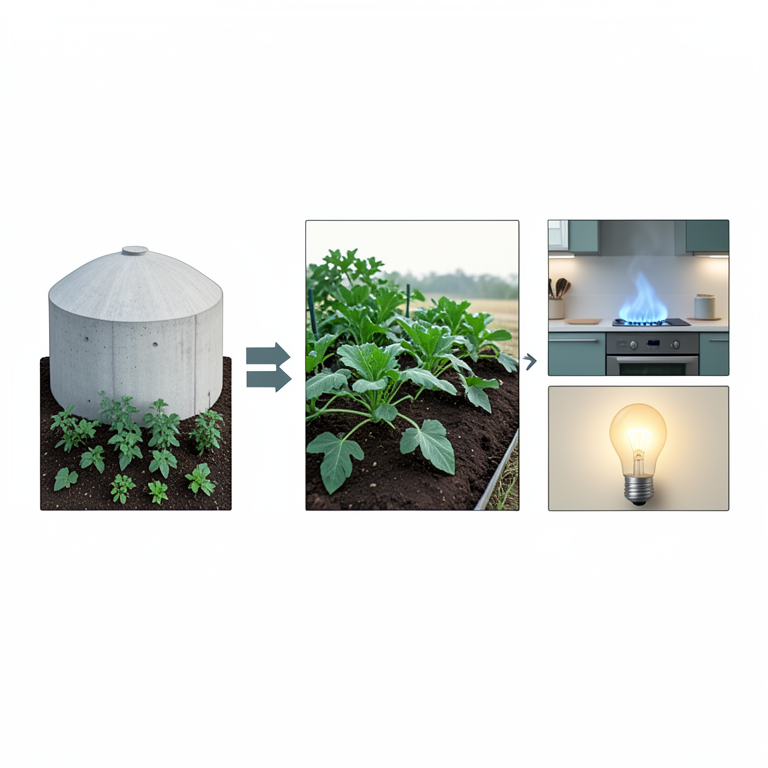
Multifaceted Benefits of Biogas
AI-generated conceptual illustration (A rural biogas digester system and its associated agricultural and domestic environment). It explains the idea and does not show study data.
View source evidence ↗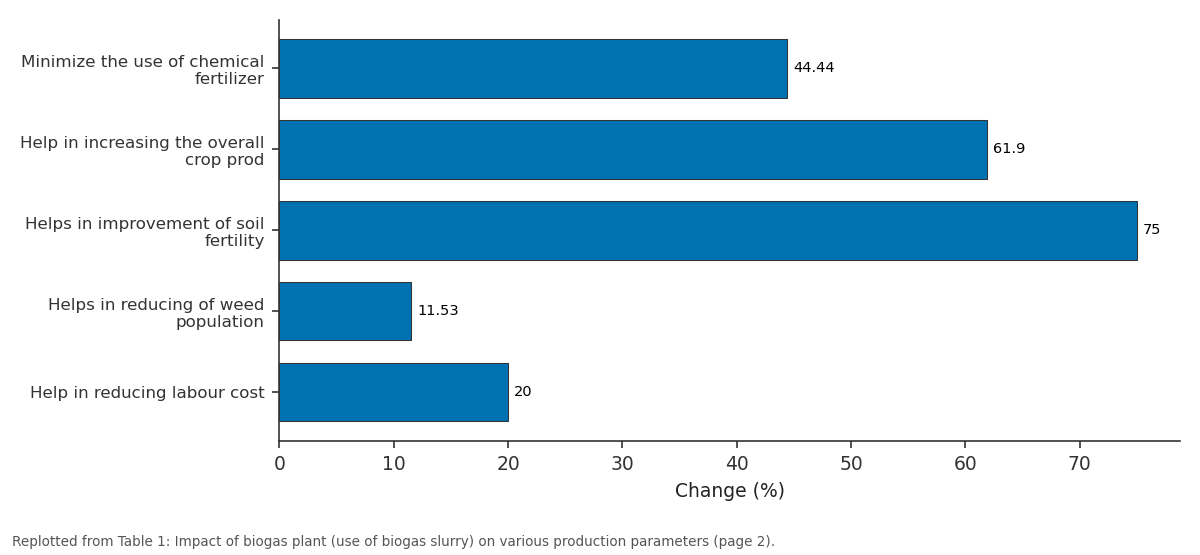
Change (%): Minimize the use of... vs Help in increasing the... vs Helps in improvement of... vs Helps in reducing of... vs Help in reducing labour...
Replotted from Table 1 (page 2) of the original paper. Every bar is the paper's own table value.
View source evidence ↗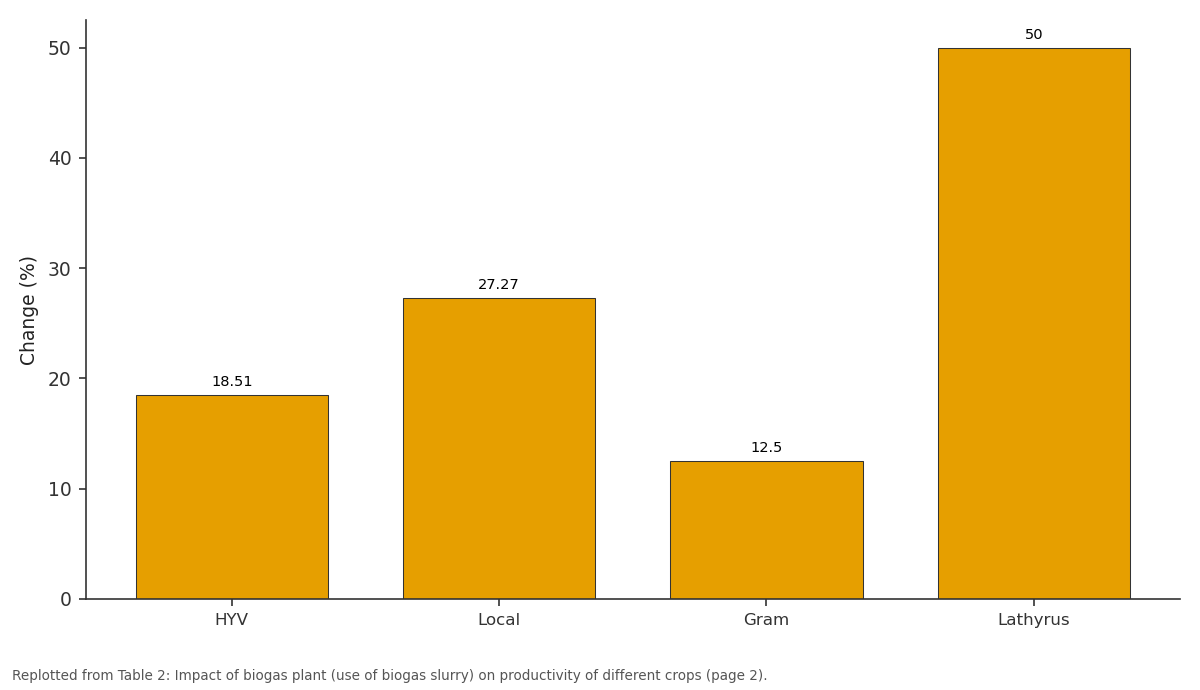
Change (%): HYV vs Local vs Gram vs Lathyrus
Replotted from Table 2 (page 2) of the original paper. Every bar is the paper's own table value.
View source evidence ↗Figures & tables
From the original paper Table 1
 Table 2
 Table 3
 Table 4
 Table 5
Introduction
Biogas is a mixture of methane and carbon dioxide and is produced beneath anaerobic situations (without the presence of oxygen) with the aid of breaking down natural matter in a "Biogas Station" typically referred to as a "Gobar gas Station" through a method known as digestion. Common organic materials which could produce sufficient biogas below anaerobic situations are animal dung, water hyacinth, human excrement, fowl droppings, and many others. Biogas is a smooth, unpolluted, smokeless and soot-free fuel that may be used for cooking meals, electrification, and producing mechanical strength. The usage of biogas inside the village will enhance the cleanliness of the village surroundings and will make a contribution to decreasing pollutants. Biogas is an efficient supply of energy that doesn't pollute the air. In comparison to the want and capacity, biogas stations are being implemented slowly in our United States of America (Agro-economic studies center 1983). Modern international is swiftly heading in the direction of a power crisis. Fossil fuels are being depleted in no time and their charges are growing daily. Any such source of energy cannot be relied upon in view of the everincreasing electricity crisis. Underneath those instances, it turns into essential to discover opportunity sources of energy. Scientists are pinning their hopes on biogas to make sure a enough, low-priced and cheap strength package deal to satisfy these desires. India's population is growing each day. It has an immediate impact on the ever-growing food, fertilizer and fuel troubles. Our U.S. has almost triumph over the trouble of meals grains information fertilizers and gas are still imported from different international locations at higher cost.
The greater the velocity of development, the greater the intake of power, and thus electricity has turn out to be a very severe hassle of today. The need for renewable energy assets has therefore emerge as imperative as current fossil fuel sources are rapidly depleting. This look at became conducted with precise objectives to evaluate the impact of biogas flora at the beneficiaries of Chhattisgarh.
Material and Methods
This have a look at was performed in Mahasamund district of Chhattisgarh nation. Mahasamund location become purposively selected for this take a look at as most wide variety of biogas vegetation have been set up there and this location has already been declared as biogas region in Chhattisgarh country. There are five blocks (Mahasamund, Pithora, Bagbahara, Basna and Saraipali). From these, three blocks specifically Mahasamund, Pithoura and Bagbahara had been randomly selected wherein blocks, three villages were randomly selected from Pithora and Bagbahara blocks and five villages had been randomly decided on from Mahasamund block due to the fact this block has greater biogas recipients than different blocks. A listing of respondents (beneficiaries) become prepared for all eleven municipalities. 10 respondents were randomly selected from each decided on municipality. Therefore, a complete of 110 respondents have been selected, who spoke back according to the interview plan designed for the look at. The gathered facts had been analyzed using diverse statistical equipment i.e. frequency, percent, imply, popular deviation, correlation and regression etc. in this observe, socio-communicative attributes suggest the social reputation www.extensionjournal.com or class of an character or organization. The scoring process was used as follows.
Impact of biogas
The dictionary which means of the term "effect" is a robust impression or out comes. Hence impact is consciousness and behavioural final results of folks. It refers to perfect adjustments in focused population. The effect of any technological development may be assessed in ways. viz direct and oblique. The direct effect is the direct effect of generation at the productivity, whilst indirect effect of the programme can be accessed via trade in socio-economic status of the programme most of the respondents. The direct and indirect impact of biogas was assessed with help of the following formula:
Where, I = Impact of biogas X 1 = Current position of biogas X 2 = Pre-position of biogas i.e. position before installation of biogas plant.
Result and Discussion
The result and discussion of the present study have been summarized on the basis of response of respondents regarding to impact of biogas among the respondents are represented in the following. The data presented in Table 1 show that the effect of the biogas plant, i.e., the use of biogas slurry, on various production parameters. It is clear that the maximum change (75%) was found in improving soil health by using biogas slurry. 61.90 percent change was recorded in increase in total crop productivity followed by 44.44 percent, 20.00 percent and 11.53 percent change revealed in reduction (minimization) of chemical fertilizer use and reduction in labor cost and reduction in weed population. The impact of biogas plant on various health parameters of the beneficiaries is presented in table 3. Current position of health parameters of beneficiaries was compared with the pre-position. There was an improvement in practically all the observed health parameters, maximum change of 53.33 percent i.e. decrease was observed in irritation in eyes and nose Similarly there was a 50.00 percent decrease in excitement, 40.00 percent decrease in nausea and unconsciousness, 22.05 percent decrease in headache and 14.28 percent decrease in breathing problems among the beneficiaries because of the use of biogas plant www.extensionjournal.com The data in Table 4 indicates that the impact of biogas plant was analyzed with respect to its use as electricity for the purpose of lighting and other such type of related uses, it was found that only 5 respondents were using biogas as electricity apart from its one as fuel while there were no respondents who used it for the purpose of electricity, prior to the installation of biogas plant. There was a change increased 122.00 percent in the saving of L.P.G. after the use of biogas among the beneficiaries. similarly there was an increase of 106.06 percent in the saving of fuel wood followed by 53.33 percent increase in saving of money and 212.50 percent increase in saving of forest .Maximum impact was observed (45.45%) in saving of time by the use of biogas plant in beneficiaries. The data in Table 5 indicates that the impact of biogas plant on various environmental parameters was studied and found that maximum (257.69%) change was expressed that by the use of biogas plant in keeping the kitchen smokeless, 150.00 percent change was observed in the reduction of environmental pollution due to the use biogas plant. Similarly 100.00 percent change was felt by the beneficiaries that the use of biogas plant helps in improving sanitation.
| S. No. | Characteristics | X2 | X1 | Mean difference | Change (%) |
|---|---|---|---|---|---|
| 1. | Helps in reducing environmental pollution. | 20 | 50 | 30 | 150.00 |
| 2. | Helps in improving sanitation | 20 | 40 | 20 | 100.00 |
| 3. | Helps for keeping smokeless kitchen | 26 | 93 | 67 | 257.69 |
Table text extracted from the original PDF; superscript letters are shown inline. The original table image is below.
View original table image
| S. No. | Characteristics | X2 | X1 | Mean difference | Change (%) |
|---|---|---|---|---|---|
| 1. | Use of lighting (electricity) | 0 | 5 | - | - |
| Saving | |||||
| 1. | L.P.G. | 9 | 20 | 11.0 | 122.00 |
| 2. | Fuel wood | 33 | 68 | 35 | 106.06 |
| 3. | Time | 00 | 50 | - | - |
| 4. | Money | 30 | 46 | 16 | 53.33 |
| 5. | Forest | 8 | 25 | 17 | 212.50 |
Table text extracted from the original PDF; superscript letters are shown inline. The original table image is below.
View original table image
| S. No. | Characteristics | X2 | X1 | Mean difference | Change |
|---|---|---|---|---|---|
| 1. | Headache | 68 | 53 | -15 | -22.05 |
| 2. | Breathing problems | 35 | 30 | -5 | -14.28 |
| 3. | Irritation in eyes & nose | 75 | 35 | -40 | -53.33 |
| 4. | Nausea | 10 | 6 | -4 | -40.00 |
| 5. | Unconsciousness | 25 | 15 | -10 | -40.00 |
| 6. | Excitement | 14 | 7 | -7 | -50.00 |
Table text extracted from the original PDF; superscript letters are shown inline. The original table image is below.
View original table image
| S. No. | Agriculture Activities | X2 | X1 | Mean difference | Change (%) |
|---|---|---|---|---|---|
| 1. | Minimize the use of chemical fertilizer | 45 | 65 | 20 | 44.44 |
| 2. | Help in increasing the overall crop productivity | 42 | 68 | 26 | 61.90 |
| 3 | Helps in improvement of soil fertility | 40 | 70 | 30 | 75.00 |
| 4. | Helps in reducing of weed population | 52 | 58 | 6 | 11.53 |
| 5. | Help in reducing labour cost | 50 | 60 | 10 | 20.00 |
Table text extracted from the original PDF; superscript letters are shown inline. The original table image is below.
View original table image
Conclusion
From the above studies findings it is able to be concluded that the direct impact of use of biogas i.e. use of biogas slurry as manure to improve soil fertility and discount of weed populace and different parameters. With regards in improvement in productivity of different crops, maximum development turned into recorded in Lathyrus, accompanied via paddy and gram plants. The massive impact become observed in irritation in eyes & nostril, nausea, headache, respiratory issues and many others and valuable cash can be saved by way of the beneficiaries via reduction in consumption of L.P.G., gas wooden and the depletion of forest can also be saved. The kitchen grow to be smokeless, sanitation turned into stepped forward and environmental pollutants became reduced.
Figures and tables from the paper
| S. No. | Crops | X2 | X1 | Mean difference | Change (%) |
|---|---|---|---|---|---|
| 1. | Paddy | ||||
| a. | HYV | 27 | 32 | 5 | 18.51 |
| b. | Local | 22 | 28 | 6 | 27.27 |
| 2. | Gram | 8 | 9 | 1 | 12.50 |
| 3. | Lathyrus | 4 | 6 | 2 | 50.00 |
Table text extracted from the original PDF; superscript letters are shown inline. The original table image is below.
View original table image
References
11 in the original paper- Chand AD, Murthy N. District level management system for biogas programme. Economic and Political Weekly. 1988;23(20):80-84.
- Chatterjee SN, Bhattacharya B, Das RP. Gobergas as an alternative source of energy: A case study. Khadi Gramodyog. 1991;39(12):476-483.
- Digraskar RK, Wangikar SD, Mairal VK. A study on the utility perception of biogas plant. Maha J Extn Edu. 1992;(11):239-244.
- Ghosal MK, Swair S. Relative advantage of biogas slurry in rice cultivation. J Res Orissa Univ Agric Tech. 2002;20(2):5-7.
- Karanjekar S. Biogas programme: Problems and solutions. Khadigramodyog. 2002:110-115.
- Nagpal A, Yadav L. Impact of biogas on rural women. Maha J Extn Edu. 1991;(10):343-345.
- Naidu AB. Growth and impact of biogas plant in selected mandals of Anantapur district, Andhra Pradesh. Ind Econo Panorama. 2002;11(4):51-53.
- Nimbal MK, Ansari MR. A study on knowledge of biogas technology users. Maha J Extn Edu. 1995;(14):117-120.
- Revelle R. Energy use in rural India. Science. 1976;(192):969-975.
- Shehrawat PS, Singh B, Hooda RS. Prospects of biogas technology in southwest Punjab. Ind Econ Panaramo. 2002;11:53-55.
- Sirohi AS, Singh I. Dairy farming biogas energy for cooking and irrigation. Urja. 1981;10:285.