
Research article · 2024 · Full text
International Journal of Research in AgronomyEffect of nutrient management practices on yield and economics of organic cotton (Gossypium hirsutum L.)
Volume 7(2) · Pages 11–15 · DOI: 10.33545/2618060x.2024.v7.i2a.272 ↗
Research areasResearch in Cotton CultivationCrop Yield and Soil FertilityAgricultural Science and Fertilization
Abstract
Author-writtenA field experiment was conducted in organic block of Main Agricultural Research Station, UAS, Raichur, during kharif 2018 to study the effect of nutrient management practices in organic cotton production under irrigated condition. The experiment was laid out in randomized complete block design with eleven treatments and three replications. The treatments consisted application of 50% RDN through compost (25%) + vermicompost (25%) and compost (25%) + poultry manure (25%) as basal dose along with vermicompost (50%) and poultry manure equivalent to 50% RDN as top dress in equal splits at 30 and 60 DAS alone and in combination with foliar spray of 3% panchagavya alternated with 10% vermiwash at 45, 60, 75 and 90 DAS and compost (100% RDN) as basal dose alone and in combination with vermicompost and poultry manure on equivalent basis (50:50). The results indicated that application of compost + vermicompost equivalent to 50% RDN as basal dose + vermicompost (50% RDN) as top dress + panchagavya spray alternated with vermiwash recorded significantly higher seed cotton yield (1323 kg ha-1) and was on par with compost + poultry manure equivalent to 50% RDN as basal dose + vermicompost (50% RDN) as top dress + panchagavya spray alternated with vermiwash (1252 kg ha-1), compost + vermicompost equivalent to 50% RDN as basal dose + poultry manure (50% RDN) as top dress + panchagavya spray alternated with vermiwash (1249 kg ha-1), compost + vermicompost equivalent to 50% RDN as basal dose + vermicompost (50% RDN) as top dress (1248 kg ha-1) and compost + poultry manure equivalent to 50% RDN as basal dose + poultry manure (50% RDN) as top dress + panchagavya spray alternated with vermiwash (1203 kg ha-1) over compost alone (1044 kg ha-1). Similar trend as that of seed cotton yield in respect of net returns and BC ratio was also seen.
Summary
Source-checkedPlain-language reading of the full paper, prepared with AI and checked against the text. Each point links to the authors' own words.
Why it matters
- Cotton is a globally significant commercial fiber crop, often referred to as 'the white gold' or 'the king of fibers'. View evidence ↗
- The use of chemical fertilizers has become increasingly expensive and subject to supply shortages due to energy crises. View evidence ↗
- In India, cotton production is highly dependent on chemicals, accounting for over 55% of total agro-chemical consumption. View evidence ↗
The question
- The study aimed to evaluate how different organic nutrient management practices affect the production of irrigated organic cotton. View evidence ↗
What they did
- The researchers used a randomized complete block design featuring eleven different treatments, each replicated three times. View evidence ↗
- The trial was conducted on deep black, slightly alkaline soil (pH 7.65) with medium organic carbon (0.54%) and specific available NPK levels. View evidence ↗
- The study used cotton variety SCS-1062, planted on June 28, 2018, with a spacing of 90 cm between rows and 30 cm between plants. View evidence ↗
- The organic inputs used had varying nutrient compositions: poultry manure had the highest nitrogen (2.10%) and phosphorus (1.80%), while vermicompost had the highest potassium (1.22%). View evidence ↗
What they found
- Treatment T10 produced the best yield parameters, including 22.6 harvested bolls per plant, a mean boll weight of 2.63 g, and a seed cotton weight of 58.9 g per plant. View evidence ↗
- The combination of compost, vermicompost, and liquid organic sprays (T10) provided the best economic results, with gross returns of Rs. 71,460 ha-1, net returns of Rs. 47,322 ha-1, and a B:C ratio of 2.96. View evidence ↗
- The most effective organic treatments increased net returns by 10% to 26% compared to using only basal compost. View evidence ↗
What it means
- The authors conclude that the highest economic yield and net returns are achieved by combining compost and vermicompost as basal and top dressings, supplemented with alternating foliar sprays of panchagavya and vermiwash. View evidence ↗
Visual summary
3 visualsIllustrations explain the paper; charts are replotted from the paper's own table values.
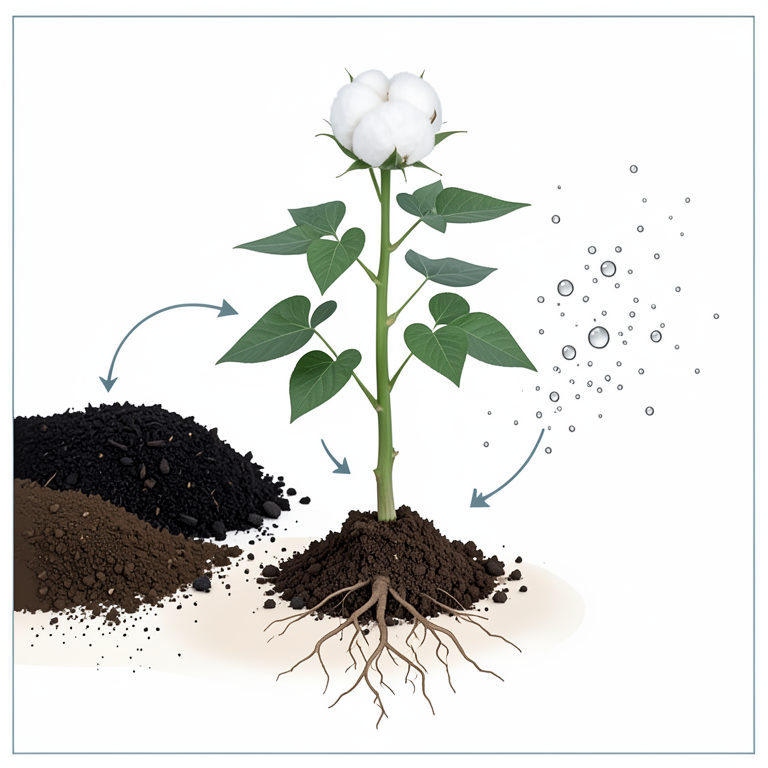
Organic Nutrient Application Cycle
AI-generated conceptual illustration (Organic cotton plants (Gossypium hirsutum L.)). It explains the idea and does not show study data.
View source evidence ↗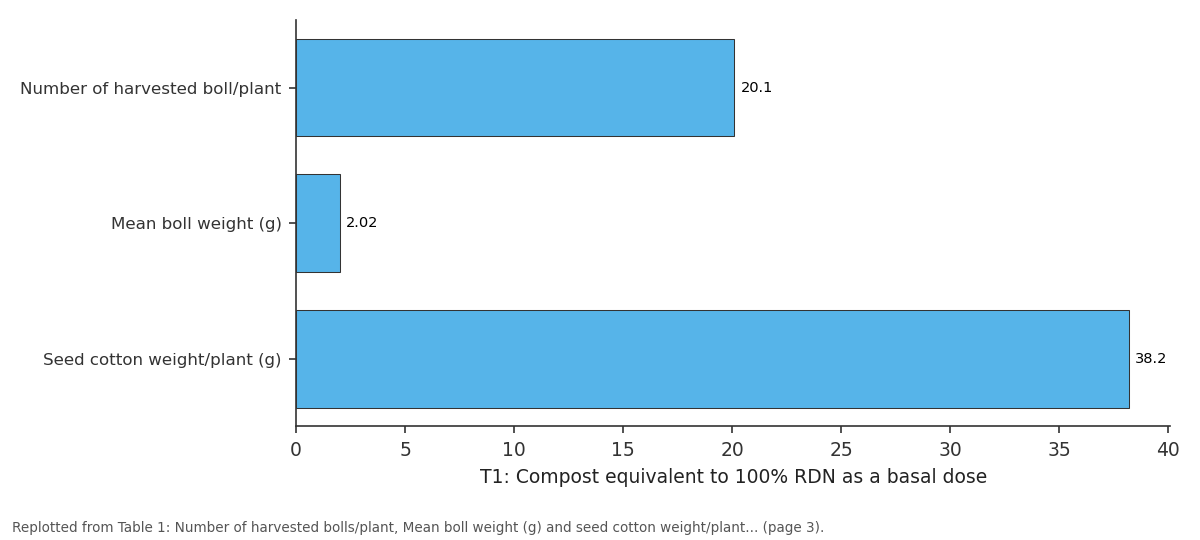
T1: Compost equivalent to 100% RDN as a...: Number of harvested... vs Mean boll weight (g) vs Seed cotton...
Replotted from Table 1 (page 3) of the original paper. Every bar is the paper's own table value.
View source evidence ↗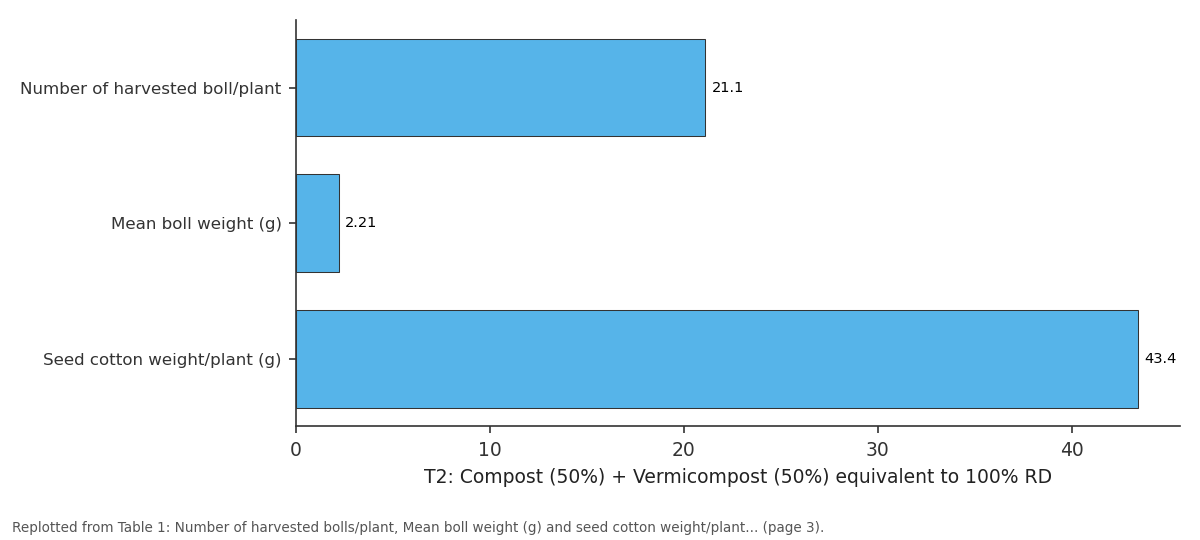
T2: Compost (50%) + Vermicompost (50%)...: Number of harvested... vs Mean boll weight (g) vs Seed cotton...
Replotted from Table 1 (page 3) of the original paper. Every bar is the paper's own table value.
View source evidence ↗Figures & tables
From the original paper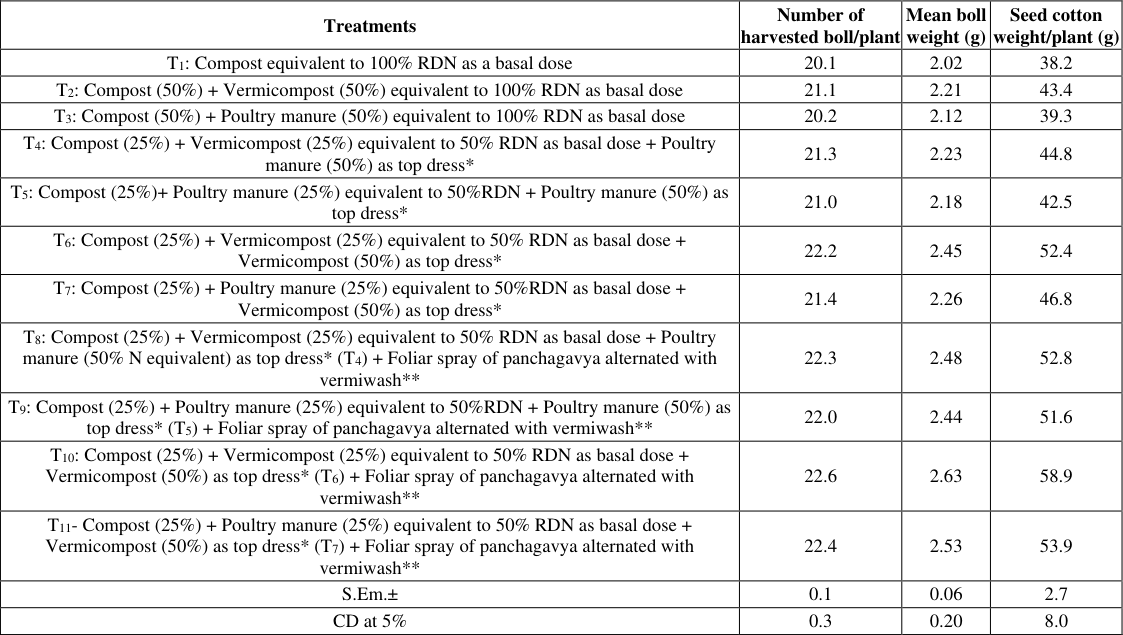 Table 1
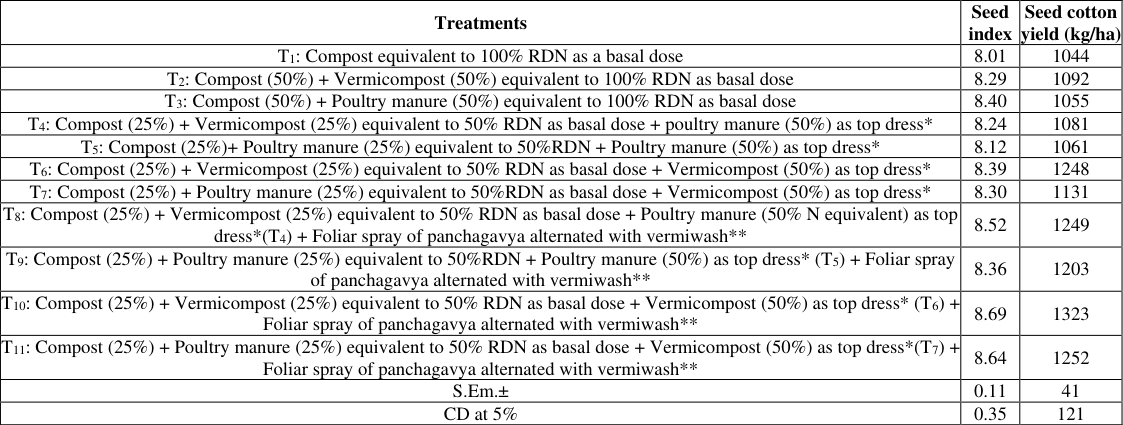 Table 2
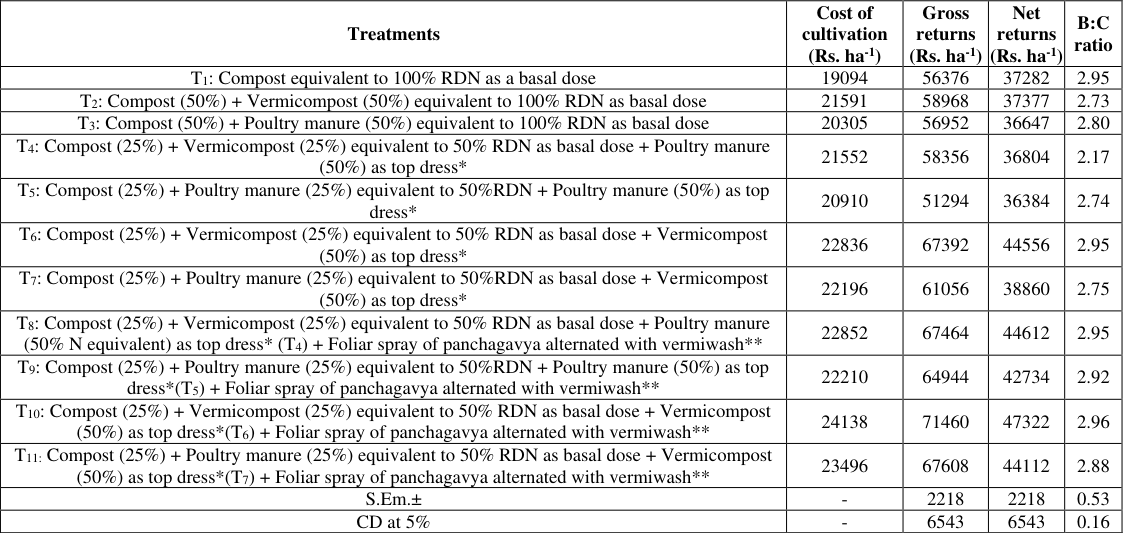 Table 3
Introduction
Cotton (Gossypium spp.) 'The king of fibers' also popularly known as "the white gold" is an important commercial fiber crop grown under diverse agro-climatic conditions around the world. It provides fiber, a raw material for the textile industry along with cotton seeds and quality animal feed and biomass in the form of cotton stalks and plays a vital role in economy of the country. Globally, cotton is cultivated in 70 countries with a total coverage of 31.8 million ha. In India, cotton is grown over an area of about 12.35 million ha with a total production of 36.5 million bales (Anon., 2019) [1] . India ranks fifth in area and third in production of cotton after USA and China. The productivity of cotton is 568 kg lint ha -1 which is much lower than the world average of 621 kg lint ha -1 . Among the cotton growing states, Karnataka ranks fifth with an area of 4.64 lakh ha and sixth in production with 20.0 lakh bales of lint with an average productivity of 537 kg of lint ha -1 . India has unique place among the cotton growing countries of the world as all the four species of Gossypium, recognized in the world are commercially cultivated in the country. Currently, the energy crises associated with hike in prices of N, P 2 O 5 , K 2 O fertilizers has made the use of chemical fertilizers in crop production not only costly but also in short supply. In modern agriculture application of high input intensive technologies have undoubtedly increased the production and labour efficiency, but there is a growing concern over their adverse effects on soil productivity and environmental quality. Cotton accounts for more than 55 percent of total agro-chemicals consumed in India.
But the consumption of non-renewable energy for the production of chemical fertilizers and pesticides will be a limiting factor in future. Cost of production is also increased due to escalation in cost of chemical fertilizers and pesticides. Further, indiscriminate use of chemical fertilizers and pesticides in intensive production system has deteriorated the soil fertility, productivity and environmental quality. The growing concern over the environmental problems in cotton production belt has increased the awareness regarding the search for use of organic cotton as an alternative to chemical based cotton system. In this context, it is worth noting that nutrient management through organics play a major role in maintaining soil health due to build up of soil organic matter, beneficial microbes, enzymes, besides improving soil physical and chemical properties. To achieve sustained soil fertility and crop productivity, organic cotton production involves use of various sources of organic manures viz., FYM, compost, vermicompost, poultry manures, crop residues etc including fermented liquid organics viz., panchagavya, cow urine, vermiwash, biodigester solution etc. In this context, to make the organic cotton production more sustained the field studies were carried to study the nutrient management practices for organic cotton production.
Materials and Methods
A field trial was conducted during Kharif 2018 in Organic block of Main Agricultural Research Station (MARS), University of Agricultural Sciences, Raichur, which is situated between 16 ₀ 12' North latitude and 77 ₀ 20' East longitude with an altitude of 389 meters above the mean sea level and it falls within the North Eastern Dry Zone (Zone 2) of Karnataka. The soil of the experimental site was deep black, slightly alkaline with a pH of 7.65, EC 0.23 d Sm -1 , medium organic carbon (0.54%) and available N, P 2 O 5 and K 2 O (202.5: 62.3: 290.3 NPK kg ha -1 respectively). The experiment was laid out in randomized complete block design with eleven treatments and three replications. The treatments are T 1 : Compost equivalent to 100% RDN as basal dose, T 2 : Compost (50%) + Vermicompost (50%) equivalent to 100% RDN as basal dose, T 3 : Compost (50%) + Poultry manure (50%) equivalent to 100% RDN as basal dose, T 4 : Compost (25%) + Vermicompost (25%) equivalent to 50% RDN as basal dose + Poultry manure (50% N equivalent) as top dress in equal splits at 30 and 60 DAS, T 5 : Compost (25%) + Poultry manure (25%) equivalent to 50% RDN + Poultry manure (50% RDN) as top dress in equal splits at 30 and 60 DAS, T 6 : Compost (25%) + Vermicompost (25%) equivalent to 50% RDN as basal dose + Vermicompost (50% RDN) as top dress in equal splits at 30 and 60 DAS, T 7 : Compost (25%) + Poultry manure (25%) equivalent to 50% RDN as basal dose + Vermicompost (50% RDN) as top dress in equal splits at 30 and 60 DAS, T 8 : Compost(25%) + Vermicompost (25%) equivalent to 50% RDN as basal dose + Poultry manure (50% RDN) as top dress in equal splits at 30 and 60 DAS (T 4 ) + Foliar spray of 3% Panchagavya and 10% Vermiwash alternatively at 45, 60, 75 and 90 DAS, T 9 : Compost (25%)+ Poultry manure(25%) equivalent to 50%RDN + Poultry manure (50% RDN) as top dress in equal splits at 30 and 60 DAS (T 5 ) + Foliar spray of 3% Panchagavya and 10% Vermiwash alternatively at 45, 60, 75 and 90 DAS, T 10 : Compost (25%) + Vermicompost (25%) equivalent to 50% RDN as basal dose + Vermicompost (50% RDN) as top dress in equal splits at 30 and 60 DAS (T 6 )+ Foliar spray of 3% Panchagavya and 10% Vermiwash alternatively at 45, 60, 75 and 90 DAS, T 11 : Compost (25%) + Poultry manure(25%) equivalent to 50% RDN as basal dose + Vermicompost (50% RDN) as top dress in equal splits at 30 and 60 DAS (T 7 )+ Foliar spray of 3% Panchagavya and 10% Vermiwash alternatively at 45, 60, 75 and 90 DAS. The nutrient composition of compost, vermicompost and poultry manure were 0.77, 1.57 and 2.10% nitrogen, 0.68, 0.79 and 1.80% phosphorus and 1.01, 1.22 and 1.39% potassium. The seeds were treated with Azospirillum and Phosphate Solubilizing Bacteria before sowing. The seeds of cotton variety, SCS-1062 were obtained from MARS, Raichur and were hand dibbled with two cotton seeds per hill at a spacing of 90 cm between rows and 30 cm between plants on 28 th June 2018. After seven days of germination thinning was done to retain only one seedling per hill.
Results and Discussion
Among the various factors affecting the growth and yield of cotton, nutrient management plays a vital role. Presently, the chemical fertilizers are the major source of nutrients but due to its escalating cost, coupled with increasing demand of chemical fertilizers and depleting soil health necessitates the safe and efficient use of organics in crop production. These practices gaining much popularity to enhance and maintain soil organic carbon status for obtaining sustainable crop yields.
Yield and yield parameters
Among the organic manurial treatments, application of compost (25%) + vermicompost (25%) equivalent to 50% RDN as basal dose + vermicompost (50% RDN) as top dress + foliar spray of panchagavya alternated with vermiwash (T 10 ) recorded significantly higher number of harvested bolls per plant (22.6), mean boll weight (2.63 g), seed cotton yield per plant (58.9g) in Table 1 and seed index (8.69) in Table 2. and was on par with compost (25%) + poultry manure (25%) equivalent to 50% RDN as basal dose + vermicompost (50% RDN) as top dress + foliar spray of panchagavya alternated with vermiwash which recorded 22.4, 2.53 g, 53.9 g and 8.64 respectively. The other treatments which found on par with T 10 were application of compost (25%) + vermicompost (25%) equivalent to 50% RDN as basal dose + poultry manure (50% RDN) as top dress + foliar spray of panchagavya alternated with vermiwash (22.3, 2.48 g, 52.8 g and 8.52 respectively ), compost (25%) + vermicompost (25%) equivalent to 50% RDN as basal dose + vermicompost (50% RDN) as top dress (22.2, 2.45 g, 52.4 g and 8.39 respectively) and compost (25%) + poultry manure (25%) equivalent to 50% RDN as basal dose + poultry manure (50% RDN) as top dress + foliar spray of panchagavya alternated with vermiwash (22.0, 2.44 g, 51.6 g and 8.36 respectively) over compost equivalent to 100% RDN as basal dose (20.1, 2.02 g, 38.2 g and 8.01 respectively). Significant improvement in number of harvested bolls per plant, boll weight and seed cotton yield per plant could be attributed to increase in number of monopodial and sympodial branches per plant and dry matter production in reproductive parts. The higher yield parameters with these treatments may also be attributed to steady supply of nutrients throughout the crop growth period due to basal application, top dressing and foliar nutrition of organics at different growth stages which enhanced the dry matter production. Increase in seed index values (100 seed weight) under these treatments received different organic sources might be due to 'N' induced enhancement in photosynthetic activity. These findings are in accordance with the work of Rajanna et al. (2011) [8] and Zalate and Padmani (2009) [12] in different crops. Sunil Kumar et al. (2017) [11] observed higher growth and yield parameters of scented rice with treatment of 100% N through poultry manure (50%) as basal and vermicompost (50%) as top dress at 30 days after transplanting. The seed cotton yield per hectare was significantly higher with the application of compost (25%) + vermicompost (25%) equivalent to 50% RDN as basal dose + vermicompost (50% RDN) as top dress + foliar spray of panchagavya alternated with vermiwash (1323 kg ha -1 ) and it was on par with compost (25%) + poultry manure (25%) equivalent to 50% RDN as basal dose + vermicompost (50% RDN) as top dress + foliar spray of panchagavya alternated with vermiwash (1252 kg ha -1 ), compost (25%) + vermicompost (25%) equivalent to 50% RDN as basal dose + poultry manure (50% RDN) as top dress + foliar spray of panchagavya alternated with vermiwash (1249 kg ha -1 ), compost (25%) + vermicompost (25%) equivalent to 50% RDN as basal dose + vermicompost (50% RDN) as top dress (1248 kg ha -1 ) and compost (25%) + poultry manure (25%) equivalent to 50% RDN as basal dose + poultry manure (50% RDN) as top dress + foliar spray of panchagavya alternated with vermiwash (1203 kg ha -1 ) which inturn were significantly superior over other remaining treatments except compost (25%) + poultry manure (25%) equivalent to 50% RDN as basal dose + vermicompost (50% RDN) as top dress (1131 kg ha -1 ). The increase in seed cotton yield may be due to better crop growth which might be reflected in yield parameters such as number of harvested bolls per plant, boll weight and seed cotton yield per plant and seed index. The extent of increase in seed cotton yield with these treatments varied from 9 to 26 percent compared to compost application alone (100% RDN) at basal dose. Further foliar spray of panchagavya alternated with vermiwash spray has increased the biological efficiency of crop plants creating greater sources to sink capacities in the plant and increasing the nutrient uptake. Panchagavya also contains naturally occurring beneficial micro-organisms predominantly lactic acid, bacteria, actinomycetes and beneficial and proven micro-organisms such as Acetobacter, Azospirillum and Phosphobacterium where as vermiwash is a rich source of vitamins, hormones, enzymes, macro and micro nutrients. Several workers also noticed increased crop yields with integrated use of organics. (Sharada, 2013; Divya, 2015; and Kiran et al. 2016) [9,4,5] . Similarly, Dada et al. (2012) [3] , Sujatha et al. (2014) [10] , Pradhan et al. (2016) [6] and Prakash et al. (2018) [7] whose findings are in accordance with results of the present investigation reported higher yield levels of various crops with various sources of organic manures application at different growth stages of the crops.
| Treatments | Seed index | Seed cotton yield (kg/ha) |
|---|---|---|
| T1: Compost equivalent to 100% RDN as a basal dose | 8.01 | 1044 |
| T2: Compost (50%) + Vermicompost (50%) equivalent to 100% RDN as basal dose | 8.29 | 1092 |
| T3: Compost (50%) + Poultry manure (50%) equivalent to 100% RDN as basal dose | 8.40 | 1055 |
| T4: Compost (25%) + Vermicompost (25%) equivalent to 50% RDN as basal dose + poultry manure (50%) as top dress* | 8.24 | 1081 |
| T5: Compost (25%)+ Poultry manure (25%) equivalent to 50%RDN + Poultry manure (50%) as top dress* | 8.12 | 1061 |
| T6: Compost (25%) + Vermicompost (25%) equivalent to 50% RDN as basal dose + Vermicompost (50%) as top dress* | 8.39 | 1248 |
| T7: Compost (25%) + Poultry manure (25%) equivalent to 50%RDN as basal dose + Vermicompost (50%) as top dress* | 8.30 | 1131 |
| T8: Compost (25%) + Vermicompost (25%) equivalent to 50% RDN as basal dose + Poultry manure (50% N equivalent) as top dress*(T4) + Foliar spray of panchagavya alternated with vermiwash** | 8.52 | 1249 |
| T9: Compost (25%) + Poultry manure (25%) equivalent to 50%RDN + Poultry manure (50%) as top dress* (T5) + Foliar spray of panchagavya alternated with vermiwash** | 8.36 | 1203 |
| T10: Compost (25%) + Vermicompost (25%) equivalent to 50% RDN as basal dose + Vermicompost (50%) as top dress* (T6) + Foliar spray of panchagavya alternated with vermiwash** | 8.69 | 1323 |
| T11: Compost (25%) + Poultry manure (25%) equivalent to 50% RDN as basal dose + Vermicompost (50%) as top dress*(T7) + Foliar spray of panchagavya alternated with vermiwash** | 8.64 | 1252 |
| S.Em.± | 0.11 | 41 |
| CD at 5% | 0.35 | 121 |
Table text extracted from the original PDF; superscript letters are shown inline. The original table image is below.
View original table image
| Treatments | Number of harvested boll/plant | Mean boll weight (g) | Seed cotton weight/plant (g) |
|---|---|---|---|
| T1: Compost equivalent to 100% RDN as a basal dose | 20.1 | 2.02 | 38.2 |
| T2: Compost (50%) + Vermicompost (50%) equivalent to 100% RDN as basal dose | 21.1 | 2.21 | 43.4 |
| T3: Compost (50%) + Poultry manure (50%) equivalent to 100% RDN as basal dose | 20.2 | 2.12 | 39.3 |
| T4: Compost (25%) + Vermicompost (25%) equivalent to 50% RDN as basal dose + Poultry manure (50%) as top dress* | 21.3 | 2.23 | 44.8 |
| T5: Compost (25%)+ Poultry manure (25%) equivalent to 50%RDN + Poultry manure (50%) as top dress* | 21.0 | 2.18 | 42.5 |
| T6: Compost (25%) + Vermicompost (25%) equivalent to 50% RDN as basal dose + Vermicompost (50%) as top dress* | 22.2 | 2.45 | 52.4 |
| T7: Compost (25%) + Poultry manure (25%) equivalent to 50%RDN as basal dose + Vermicompost (50%) as top dress* | 21.4 | 2.26 | 46.8 |
| T8: Compost (25%) + Vermicompost (25%) equivalent to 50% RDN as basal dose + Poultry manure (50% N equivalent) as top dress* (T4) + Foliar spray of panchagavya alternated with vermiwash** | 22.3 | 2.48 | 52.8 |
| T9: Compost (25%) + Poultry manure (25%) equivalent to 50%RDN + Poultry manure (50%) as top dress* (T5) + Foliar spray of panchagavya alternated with vermiwash** | 22.0 | 2.44 | 51.6 |
| T10: Compost (25%) + Vermicompost (25%) equivalent to 50% RDN as basal dose + Vermicompost (50%) as top dress* (T6) + Foliar spray of panchagavya alternated with vermiwash** | 22.6 | 2.63 | 58.9 |
| T11- Compost (25%) + Poultry manure (25%) equivalent to 50% RDN as basal dose + Vermicompost (50%) as top dress* (T7) + Foliar spray of panchagavya alternated with vermiwash** | 22.4 | 2.53 | 53.9 |
| S.Em.± | 0.1 | 0.06 | 2.7 |
| CD at 5% | 0.3 | 0.20 | 8.0 |
Table text extracted from the original PDF; superscript letters are shown inline. The original table image is below.
View original table image
Economics
Among the various treatments, application of compost (25%) + vermicompost (25%) equivalent to 50% RDN as basal dose + vermicompost (50% RDN) as top dress + foliar spray of panchagavya alternated with vermiwash recorded significantly higher gross returns (Table 3), net returns and BC ratio (Rs. 71460 ha -1 , Rs. 47322 ha -1 and 2.96) and was on par with compost (25%) + vermicompost (25%) equivalent to 50% RDN as basal dose + poultry manure (50%) as top dress + foliar spray of panchagavya alternated with vermiwash (Rs. 67464 ha -1 , Rs. 44612 ha -1 and 2.95), compost (25%) + vermicompost (25%) equivalent to 50% RDN as basal dose + vermicompost (50% RDN) as top dress (Rs. 67392 ha -1 , Rs. 44556 ha -1 and 2.95), compost (25%) + poultry manure (25%) equivalent to 50% RDN as basal dose + vermicompost (50% RDN) as top dress + foliar spray of panchagavya alternated with vermiwash (Rs. 67608 ha - 1, Rs. 44112 ha -1 and 2.88) and compost (25%) + poultry manure (25%) equivalent to 50% RDN as basal dose + poultry manure (50% RDN) as top dress + foliar spray of panchagavya alternated with vermiwash (Rs. 64944 ha -1 , Rs. 42734 ha -1 and 2.92 respectively) over other treatments. The extent of increase in net returns with these treatments was 10 to 26 percent over compost application alone as basal dose (T 1 ) and 10 to 30 percent with compost (25%) + poultry manure (25%) equivalent to 50% RDN as basal dose + poultry manure (50% RDN) as top dress. This might be due to higher kapas yield and low cost of cultivation with these treatments. These results are in conformity with the findings of Channagouda, et al. (2015a) [2] .
| Treatments | Cost of cultivation (Rs. ha-1) | Gross returns (Rs. ha-1) | Net returns (Rs. ha-1) | B:C ratio |
|---|---|---|---|---|
| T1: Compost equivalent to 100% RDN as a basal dose | 19094 | 56376 | 37282 | 2.95 |
| T2: Compost (50%) + Vermicompost (50%) equivalent to 100% RDN as basal dose | 21591 | 58968 | 37377 | 2.73 |
| T3: Compost (50%) + Poultry manure (50%) equivalent to 100% RDN as basal dose | 20305 | 56952 | 36647 | 2.80 |
| T4: Compost (25%) + Vermicompost (25%) equivalent to 50% RDN as basal dose + Poultry manure (50%) as top dress* | 21552 | 58356 | 36804 | 2.17 |
| T5: Compost (25%) + Poultry manure (25%) equivalent to 50%RDN + Poultry manure (50%) as top dress* | 20910 | 51294 | 36384 | 2.74 |
| T6: Compost (25%) + Vermicompost (25%) equivalent to 50% RDN as basal dose + Vermicompost (50%) as top dress* | 22836 | 67392 | 44556 | 2.95 |
| T7: Compost (25%) + Poultry manure (25%) equivalent to 50%RDN as basal dose + Vermicompost (50%) as top dress* | 22196 | 61056 | 38860 | 2.75 |
| T8: Compost (25%) + Vermicompost (25%) equivalent to 50% RDN as basal dose + Poultry manure (50% N equivalent) as top dress* (T4) + Foliar spray of panchagavya alternated with vermiwash** | 22852 | 67464 | 44612 | 2.95 |
| T9: Compost (25%) + Poultry manure (25%) equivalent to 50%RDN + Poultry manure (50%) as top dress*(T5) + Foliar spray of panchagavya alternated with vermiwash** | 22210 | 64944 | 42734 | 2.92 |
| T10: Compost (25%) + Vermicompost (25%) equivalent to 50% RDN as basal dose + Vermicompost (50%) as top dress*(T6) + Foliar spray of panchagavya alternated with vermiwash** | 24138 | 71460 | 47322 | 2.96 |
| T11: Compost (25%) + Poultry manure (25%) equivalent to 50% RDN as basal dose + Vermicompost (50%) as top dress*(T7) + Foliar spray of panchagavya alternated with vermiwash** | 23496 | 67608 | 44112 | 2.88 |
| S.Em.± | - | 2218 | 2218 | 0.53 |
| CD at 5% | - | 6543 | 6543 | 0.16 |
Table text extracted from the original PDF; superscript letters are shown inline. The original table image is below.
View original table image
B:C ratio
B:C ratio
Conclusion
In organic cotton production system under irrigated condition, higher economic yield and net returns from cotton cultivation could be obtained by combined application of compost (25%) + vermicompost (25%) equivalent to 50% RDN as basal dose + vermicompost (50% RDN) as top dress + foliar spray of 3% panchagavya alternated with 10% vermiwash at 45, 60, 75 and 90 DAS or compost (25%) + poultry manure (25%) equivalent to 50% RDN as basal dose + vermicompost (50% RDN) as top dress + foliar spray of 3% panchagavya alternated with 10% vermiwash at 45, 60, 75 and 90 DAS or compost (25%) + vermicompost (25%) equivalent to 50% RDN as basal dose + poultry manure (50% RDN) as top dress + foliar spray of 3% panchagavya alternated with 10% vermiwash at 45, 60, 75 and 90 DAS or of compost (25%) + vermicompost (25%) equivalent to 50% RDN as basal dose + vermicompost (50% RDN) as top dress or compost (25%) + poultry manure (25%) equivalent to 50% RDN as basal dose + poultry manure (50% RDN) as top dress + foliar spray of 3% panchagavya alternated with 10% vermiwash at 45, 60, 75 and 90 DAS.
References
9 in the original paper- Dada OA, Adigun SA, Thomas AS, Oworu OO. Response of Upland Rice (Oryza sativa L) Cultivars to Split Application of Compost on Highly Weathered Soil of Derived Savannah Agro-Ecology. Annales of West Univ. Timisoara. Series of Biology. 2012;15(2):167.
- Divya S. Impact of organic manures and liquid organic manures on growth, yield and quality of aerobic rice. Int. Quart. J Sci. 2015;9(2):563-567.
- Kiran, Rao S, Rameshkumar C. Effect of nutrient management practices through organics on growth, yield & economics of chickpea under rainfed condition. Green Fmg. 2016;7(4):880-883.
- Pradhan S, Mishra SK, Kar CS, Moharana S. Soil microbial health and crop yield under organically managed rice-rice sequence. J Crop and Weed. 2016;12(1):40-45.
- Prakash P, Nagaraju, Ramchandra C. Effect of establishment methods and sources of organic nutrient uptake of finger millet (Eleusine coracana L.). Int. J Pure App. Biosci. 2018;6(3):437-442.
- Rajanna G, Murali K, Nayak P, Lakshmipathy R, Gopakalli P, Paramesh V, et al. Effect of different sources and time of application of organic manures on yield attributes, yield and economics of aerobic rice (Oryza sativa L.). Int. J Agric. Sci. 2011:7(1):193-196
- Sujatha V, Mosha K, Subbaiah G, Rani PP. Residual soil fertility and productivity of rice (Oryza sativa L.) as influenced by different organic sources of nitrogen. Int. J plant, animal and environmental sci. 2014;4(1):266-269.
- Kumar S, Shrivastava GK, Navaz MO, Navrang S, Pali GP, Pandey N, et al. Impact of various organic sources of nitrogen on growth, yield attributes and yield of scented rice (Oryza sativa L.) under irrigated conditions of Chhattisgarh plains. J Pharmacognosy and Phytochemistry. 2017;6(6):1388-1391.
- Zalate PY, Padmani DR. Effect of organic manure and biofertilizer on growth and yield of attributing characters of Kharif groundnut (Arachis hypogea L.). Int. J Agric. Sci. 2009;5(2):343-345.
Cited by 2
From OpenAlex, OpenCitations and reference lists read by Scinovex
- Impact of different nutrient management strategies on growth, yield components and yield of coloured cotton (Gossypium hirsutum L.) cv. Vaidehi 1 ↗
Selvaraj Selvakumar, Thiruvengadam Ragavan, Arumugam Gurusamy, J Prabhaharan, Mahalingam Gunasekaran, Thangasamy Sivakumar et al. · Frontiers in Sustainable Food Systems · 2025
Cotton (Gossypium spp.), often referred to as “white gold” and “the king of fibers”, is a major commercial fiber crop cultivated across various agroclimatic conditions, primarily used in the textile industry to manufacture fabrics. However, conventional white cotton production is associated with several environmental challenges including excessive water consumption, reliance on synthetic chemicals and the use of synthetic dyes, which…
❝ 6PDF - Sustainable nutrient management in Cotton: Impact of nitrogen application through vermicompost on yield, growth attributes, and economic returns
C Mounika, PR Kadu, Peram Nagaseshi Reddy, NM Konde · International Journal of Research in Agronomy · 2025
A field investigation titled " Sustainable Nutrient Management in Cotton: Impact of Nitrogen Application through Vermicompost on Yield, Growth Attributes, and Economic Returns " was conducted during the Kharif season of 2021-22 at COART (Centre for Organic Agriculture Research and Training), Dr. PDKV, Akola to evaluate the effect of different nitrogen levels applied through vermicompost on the productivity, growth, and economics of rainfed organic cotton (Gossypium spp.).The experiment was laid out in a factorial randomized block design (FRBD) with eight treatments, each replicated three times