
Research article · 2024 · Full text
International Journal of Research in AgronomyGrowth and yield parameters of wheat (Triticum aestivum L.) as affected by different herbicides on different weeds in the field
Volume 7(2) · Pages 24–28 · DOI: 10.33545/2618060x.2024.v7.i2a.275 ↗
Research areasWeed Control and Herbicide ApplicationsAllelopathy and phytotoxic interactionsAgronomic Practices and Intercropping Systems
Abstract
Author-writtenA field experiment was carried out in the 2022–2023 rabi season by the School of Agricultural Sciences at Dr. K. N. Modi University in Newai. The study's objective was to investigate the effects of several herbicides on wheat's growth and yield characteristics. The trial employed six treatment combinations: control, manual weeding, 2-4 D spray at 25 and 50 DAS, tribuzing spray at 25 and 50 DAS, methylfuran spray at 25 and 50 DAS, and a combination of isoproturon 1.0 and 2-4 D at 0.5 kg/ha. Three replications and an RBD layout characterised the experiment. The experimental study's various weed control strategies had no discernible impact on either the starting or end plant populations. The pesticides used after emergence. T5 (Metsulfuron spray at 25 and 50 DAS), T2 (manual weeding), and T4 (Metribuzin spray at 25 and 50 DAS) were the other herbicidal treatments that showed the highest tiller count, which was found under T3 (2-4 D spray at 25 and 50 DAS). Dry matter buildup was highest in the T6 (Mixture of Isoproturon 1.0 + 2-4 D @ 0.5 kg/ha) plot. although T3 (2-4 D spray at 25 and 50 DAS) was significantly less than T5 (Metsulfuron spray at 25 and 50 DAS), T2 (manual weeding), and T4 (Metribuzin spray at 25 and 50 DAS). T6 (weed-free) had the largest spike length, statistically comparable to T3 (2-4 D spray at 25 and 50 DAS). T5 (Metsulfuron spray at 25 and 75 DAS) came in second. The highest grain count, earhead-1, was observed in T6 (1.0 + 2-4 D @ 0.5 kg/ha) is the isoproturon. In the T6 (Isoproturon 1.0 + 2-4 D @ 0.5 kg/ha) plot, the maximum test weight was noted. T3 showed the highest grain yield (Spray 2-4 D at 25 and 50 DAS). T3 showed the maximum yield of grains (2-4 D spray at 25 and 50 DAS). T1 (Control) recorded the largest amount of nutrients absorbed by the crop, followed by T3 (2-4 D spray at 25 and 50 DAS) and T5 (Metsulfuron spray at 25 and 50 DAS). T3 (Spray 2-4 D at 25 and 50 DAS) generated the greatest net returns, and T6 and T5 (Metsulfuron spray at 25 and 50 DAS) came in second and third, respectively. T3 (2-4 D spray at 25 and 50 DAS) plots had the highest benefit-cost ratio.
Summary
Source-checkedPlain-language reading of the full paper, prepared with AI and checked against the text. Each point links to the authors' own words.
Why it matters
- Wheat (Triticum aestivum L.) is a critical crop in India because it can grow in many different environments and agroclimatic conditions. View evidence ↗
- Weeds limit wheat production by competing with the crop for essential resources like space, sunlight, moisture, and nutrients. View evidence ↗
- Weed competition can lead to a significant reduction in wheat grain output in India, ranging from 28% to 53%. View evidence ↗
The question
- The researchers aimed to determine how different herbicides affect the growth and yield characteristics of wheat. View evidence ↗
What they did
- The field experiment was conducted during the 2022–2023 rabi season at Dr. K.N. Modi University in Newai, Rajasthan. View evidence ↗
- The study used an RBD layout with 18 plots across six treatments (control, hand weeding, 2,4-D, metribuzin, metsulfuron, and an isoproturon/2,4-D mixture) and three replications. View evidence ↗
- Wheat was sown on December 10, 2022, using a spacing of 20 cm by 10 cm. View evidence ↗
What they found
- The largest leaf area was observed with Metsulfuron spray at 25 and 50 DAS (T5), measuring 5.79 cm² at 25 DAS and 7.98 cm² at 50 DAS. View evidence ↗
- The maximum test weight was 49.22 g in the 2,4-D treatment (T3), while the control (T1) had the lowest at 42.31 g. View evidence ↗
What it means
- The authors conclude that herbicides such as 2,4-D and metsulfuron are effective for removing weeds from wheat fields. View evidence ↗
- The results suggest that these herbicide treatments are a viable, less costly, and less time-consuming alternative to manual hand weeding. View evidence ↗
Visual summary
3 visualsIllustrations explain the paper; charts are replotted from the paper's own table values.
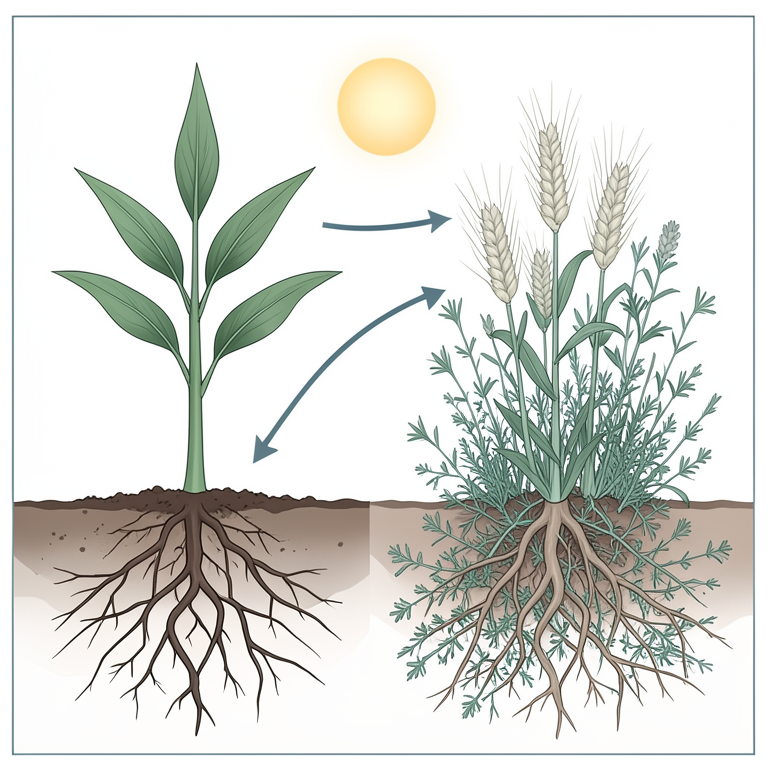
Weed Competition Mechanism
AI-generated conceptual illustration (wheat plants (Triticum aestivum L.) and common field weeds). It explains the idea and does not show study data.
View source evidence ↗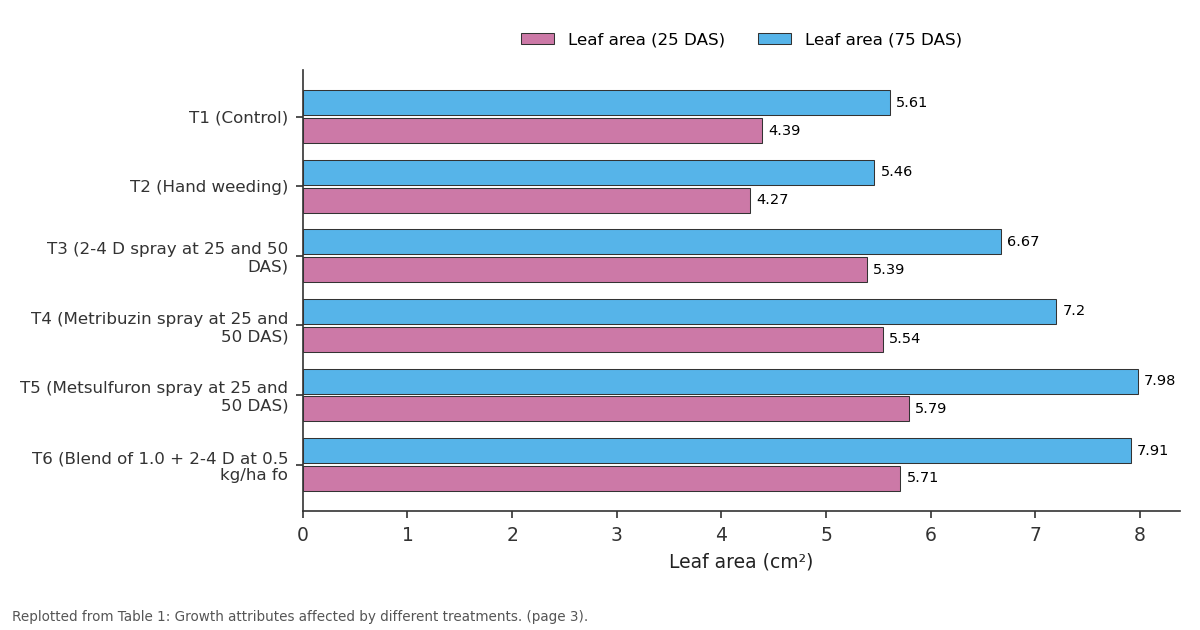
Leaf area (25 DAS) and Leaf area (75 DAS): T1 (Control) vs T2 (Hand weeding) vs T3 (2-4 D spray at 25... vs T4 (Metribuzin spray at... vs T5 (Metsulfuron spray...
Replotted from Table 1 (page 3) of the original paper. Every bar is the paper's own table value.
View source evidence ↗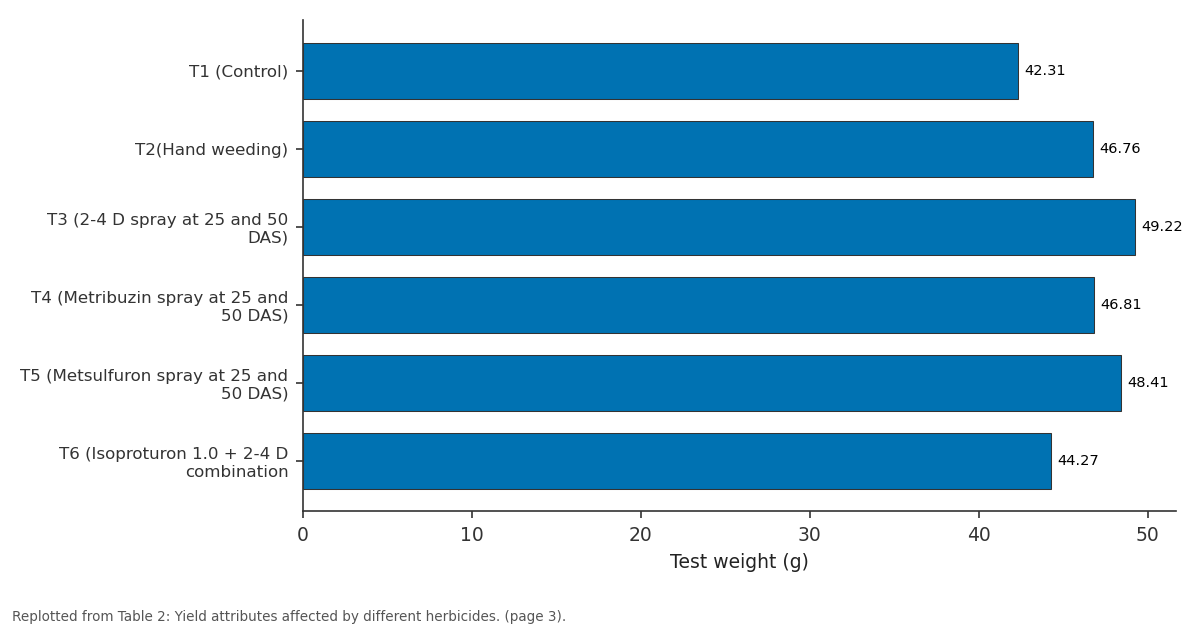
Test weight (g): T1 (Control) vs T2(Hand weeding) vs T3 (2-4 D spray at 25... vs T4 (Metribuzin spray at... vs T5 (Metsulfuron spray...
Replotted from Table 2 (page 3) of the original paper. Every bar is the paper's own table value.
View source evidence ↗Figures & tables
From the original paper Table 1
 Table 2
Introduction
Triticum aestivum L., or wheat, is one of India's most important crops. due to its vastness as well as its flexibility in a range of agroclimatic conditions and crop-growing environments. The world's second-largest producer of wheat is India. In India, wheat is a significant crop for rabi cereal. In the grass family, wheat belongs to the genus Triticum. or poaceae family. South Western Asia is where wheat originated. Although there are dozens of varieties of wheat, the three most significant Bread is made from common wheat (Triticum aestivum), and pasta is made from duram wheat (T. durum). Macaroni and spaghetti (alimentary pastes); club wheat (T. compactum), which is used to make cakes, crackers, cookies, etc and other baked goods because it is softer. breads and flours. Emmer wheat (Triticum diccocum) was used in ancient times; Einkorn wheat (Triticum monococcum) is domesticated from wild Einkorn. Furthermore, the industry uses a portion of wheat to make starch, paste, malt, dextrose, gluten, alcohol, and other products. Biscuits, cakes, flakes, bread, and other baked goods are also made with wheat. It is produced in many different geographic locations and meteorological conditions. India ranks second globally in terms of output (110 million tonnes) with a productivity per acre average of 3.05 metric tonnes, lagging behind China, while having the largest area under cultivation for wheat (29.8 million hectares).
India's wheat-growing states include Madhya Pradesh, Punjab, Rajasthan, Haryana, Gujarat, Maharashtra, Bihar, and Uttar Pradesh. Uttar Pradesh is the most productive state in terms of both area and output. however Punjab is ranked highest in terms of productivity. Various varieties of wheat, including hard wheat, pissi wheat, amber wheat, and soft wheat, are cultivated and utilised in the production of bread, pastries, chapaties, and bakery goods. To make Rawa, Suji, and Sewaiya, hard wheat is utilised. The primary purpose of wheat straw is to feed livestock. The crop yields 13.88 million metric tonnes annually on an area of 3.09 million hectares in Rajasthan, with an average productivity of 3971 kg ha-1. The area and production of wheat are extremely low in Rajasthan, a non-traditional wheat-growing province. to raise the output to a level comparable with other non-traditional wheat-growing regions in India in order to fulfil the significant demand for food. More attention must be paid to matching agronomic methods, weed, disease, and pest problems in wheat, as well as the use of new high-yielding cultivars in order to reach the desired production and productivity. Weeds are one of the main factors limiting wheat production; they compete with crops for nutrients, moisture, sun radiation, and space. Compared to other parts of India, Rajasthan's weed flora is completely unrelated to wheat. India experiences a 28-53% decrease in wheat grain output as a result of weed competition. Weed management with the conventional approach is laborintensive, time-consuming, and slow. Not only is labour growing more expensive, but it is also getting harder to find. Only feasible on a limited scale, hand weeding requires a lot of work, time, and energy, but it works well for annual weeds. The quest for alternatives, such as the use of herbicides either alone or in conjunction with hand weeding, was prompted by the rising costs of labour and their scarcity. Though less expensive, mechanical methods are limited to controlling weeds between rows rather than those within. The best, most sensible, most affordable, and most efficient way to lessen early weed competition and crop production losses in such circumstances is to use herbicides. However, continued usage of some herbicides has resulted in the development of resistant weeds, exacerbating weed issues. Phalaris minor, for example, has evolved isoproturon resistance in Punjab and Haryana's rice-wheat cropping systems. Mechanical solutions are less expensive, but they can only eradicate weeds between rows, not within them. Herbicide application is the best, most practical, most economical, and most effective approach to reduce crop output losses due to early weed competition. Nonetheless, continuous pesticide use has resulted in the proliferation of resistant weeds, exacerbating the weed problem. For instance, in Punjab and Haryana's rice-wheat cropping systems, Phalaris minor has developed isoproturon resistance. Herbicides account for only 8% of all pesticides used in India, where the average herbicide used is 35 grammes per year. Thus, a comparative analysis of various weed control strategies for wheat is necessary, as is India's wheat-growing states include Madhya Pradesh, Punjab, Rajasthan, Haryana, Gujarat, Maharashtra, Bihar, and Uttar Pradesh. While Punjab is ranked highest in terms of productivity, Uttar Pradesh is ranked first in terms of area and production. Various varieties of wheat, including hard wheat, pissi wheat, amber wheat, and soft wheat, are cultivated and utilised in the production of bread, pastries, chapaties, and bakery goods. Rawa, Suji, and Sewaiya are made from hard wheat. The primary use of wheat straw is as animal feed.
Materials and Methods
During the 2022-2023 rabi season, at the Dr. K.N. Modi University's agronomy farm in Newai, Rajasthan's School of Agricultural Sciences, the current study, titled "Effect of different herbicides on the growth and yield parameters of wheat (Triticum aestivum L.)," is being carried out. Within the trial plot, the available phosphorus was 29 kilogrammes per hour, the available potassium was 268 kilogrammes per hour, the available nitrogen was low (270.00 kg ha-1) and sandy loam made up the soil's texture. With a pH of 8.4, the soil reaction was slightly alkaline. The crop was able to grow normally in this soil. Over the course of 18 plots, six treatments and three replications were carried outT 1 was the control, T 2 was hand weeding, and T 3 was 2,4-D spraying at 25 The treatments were T 1 : control, T 2 : hand weeding, T 3 : 2,4-D spray at 25 and 50 DAS, T 4 : tributing spray at 25 and 50 DAS, T 5 : metsulfuron spray at 25 and 50 DAS, and T 6 : a mixture of isoproturon 1.0 similar 2,4-D at 0.5 kg/ha. 5.0 m x 2.8 m and 4 m x 2 m, respectively, were the gross and net plot sizes. Sowing was done on 10th December 2022 and spacing was 20 cm 10 centimetres. Applying urea, DAP, MOP, and gypsum in accordance with treatment protocols allowed for the recommended dosage of fertiliser to be administered. Measures for protecting plants and implementing recommended practices were followed. April 22, 2023, was the harvest date of the crop.
Results and Discussion
Grow that tributes Table 1 presents information on how different treatments affect growth attributes include the height of the plant, the quantity of green leaves, and the area of the leaves.
| S. No | Treatments | Plant height (25 DAS) | Plant height (75 DAS) | Leaf area (25 DAS) | Leaf area (75 DAS) |
|---|---|---|---|---|---|
| 1. | T1 (Control) | 18.46 | 73.44 | 4.39 | 5.61 |
| 2. | T2 (Hand weeding) | 19.90 | 94.02 | 4.27 | 5.46 |
| 3. | T3 (2-4 D spray at 25 and 50 DAS) | 21.14 | 95.12 | 5.39 | 6.67 |
| 4. | T4 (Metribuzin spray at 25 and 50 DAS) | 19.50 | 92.90 | 5.54 | 7.20 |
| 5. | T5 (Metsulfuron spray at 25 and 50 DAS) | 20.05 | 94.45 | 5.79 | 7.98 |
| 6. | T6 (Blend of 1.0 + 2-4 D at 0.5 kg/ha for isoproturon) | 22.05 | 88.55 | 5.71 | 7.91 |
| SE m± | 0.76 | 0.47 | 0.19 | 0.30 | |
| CD (at 5%) | 2.28 | 1.45 | 0.57 | 0.90 |
Table text extracted from the original PDF; superscript letters are shown inline. The original table image is below.
View original table image
Throughout the crop's many growth stages, data on the impact of different treatments on mean plant height (cm) was frequently recorded. It showed that, with the exception of 25 DAS, the weed control treatments significantly affected plant height at every stage of crop growth. The T 6 (combination of isoproturon 1.0 + 2-4 D @ 0.5 kg/ha) at 25 DAS had the tallest plants. T 3 (2-4 D) mist at 25 and 50DAS) among the different herbicides used, recorded the maximum plant height (21.14 and 95.12 cm at 25 and 75 DAS); this was comparable to T 5 (Metsulfuron spray at 25 and 50 DAS) and much greater than all other herbicidal treatments. T 1 (Control) had the smallest plant height measured.
Different treatments influenced the mean number of leaf areas at various growth stages of the crop. Different treatments significantly affected the leaf area. It indicated that leaf area increases although the plant's height increased, the largest leaf area was noticed in the T 5 (Metsulfuron 5.79 and 7.98 cm2 at 25 and 50 DAS, respectively). After that, T 6 combination of 2-4 D and isoproturon 1.0 @ 0.5 kg/ha recorded 5.71 and 7.91 cm2 of leaf area, followed by T 4 and T 3 . The lowest leaf area (cm2) was recorded in T 2 (handweeding)
Growth Analysis
The LAI (leaf area index) and other growth functions were determined using the information on growth characteristics, including leaf area, plant height, etc.
Attributes of yield
Data on the yield and features contributing to the yield were recorded after the observations. such as spike length (cm), grain Test weight (g), grain yield (kg/ha), straw yield (kg/ha), ear head (g), and so on.
Spike length
Every weed control technique was discovered to have a substantial effect on spike length. The T 6 treatment (blended at 0.5 kg/ha of isoproturon 1.0 + 2-4 D) recorded the longest spike length (12.56), which was statistically comparable to the T 3 therapy (12.46) and significantly superior to all other treatments (2-4 D spray at 50 DAS).
Grains earhead-1
According to the findings, the T 6 treatment (Mixture of Isoproturon 1.0 + 2-4 D @ 0.5 kg/ha) generated the greatest amount of grains per head-1 (45.80) followed by T 5 (Metsulfuron spray at 25 and 50 DAS).
Test weight
The highest test weight was observed in T 3 (2,4D spray at 25 and 50 DAS) (49.22 g) and lowest in T 1 (Control) (42.31 g). Among the different herbicidal treatments, T 5 (Metsulfuron spray at 25 and 50 DAS) (48.41 g) was discovered to be noticeably better than the rest of the therapies.
Grain yield
The T 6 treatment (0.5 kg/ha of isoproturon 1.0 + 2-4 D combined) produced the highest grain yield because the weeds that significantly reduced the yield in the T 1 control were frequently eliminated.
The herbicidal treatment T 6 (isoproturon 1.0 + 2-4 D combined at a rate of 0.5 kg/ha) likewise yielded the most of all the treatments; it was comparable to T 1 (control) and far greater than any other. Due to a severe weed infestation, which decreased wheat output, T 1 (Control) had the lowest grain yield recorded.
Straw yield T 6
The mixture of isoproturon 1.0 + 2-4 D @ 0.5 kg/ha yielded the most amount of straw (5578.89 kg/ha). shown to be considerably greater than the yields of the other treatments. T 1 (Control) yielded the least amount of straw.
Harvest index
The T 6 (mixture of 2-4 D at 0.5 kg/ha and isoproturon 1.0) as well T 1 (control) (39.80) had the highest and lowest harvest indices, respectively. The herbicidal treatment T 3 (2-4 D spray at 25 and 50 DAS) was shown to be much better than the other herbicidal treatments, as seen by the maximum harvest index it recorded.
Conclusion
The application of herbicides such metsulfuron and 2,4-D is effective in removing the weeds that have taken over the crop field, according toward the findings of the current experiment. Following T 5 (Metsulfuron spray at 25 and 50 DAS), T 6 (2,4D 0.5 kg/ha + isoproturon 1.0 kg/ha) application) produced yield attributes that were found to be equivalent with T 3 (2,4-D at 25 and 50 DAS), with considerably better growth. The outcomes are comparable to a crop free of weeds and serve as a suitable substitute for the time-consuming and costly hand weeding method. Furthermore, because metsulfuron breaks down more quickly in soil than other herbicides, it is safe to use in agricultural fields, according to bioassay studies conducted on indicator plants to test the persistence of herbicides.
Figures and tables from the paper
| S. No | Treatments | Spike length (cm) | Grain ear head (g) | Test weight (g) | Grain yield (kg) | Straw yield (kg) |
|---|---|---|---|---|---|---|
| 1. | T1 (Control) | 11.10 | 36.68 | 42.31 | 3026.96 | 4576.96 |
| 2. | T2(Hand weeding) | 11.86 | 42.07 | 46.76 | 3626.76 | 5276.79 |
| 3. | T3 (2-4 D spray at 25 and 50 DAS) | 12.46 | 43.69 | 49.22 | 3924.92 | 9451.66 |
| 4. | T4 (Metribuzin spray at 25 and 50 DAS) | 11.24 | 39.08 | 46.81 | 3107.53 | 7767.52 |
| 5. | T5 (Metsulfuron spray at 25 and 50 DAS) | 12.33 | 44.90 | 48.41 | 3717.76 | 9016.52 |
| 6. | T6 (Isoproturon 1.0 + 2-4 D combination at 0.5 kg/ha) | 12.56 | 45.80 | 44.27 | 4011.52 | 9590.42 |
| SE m± | 0.25 | 0.30 | 0.28 | 43.70 | 104.20 | |
| CD (at 5%) | 0.76 | 0.92 | 0.86 | 134.63 | 321.02 |
Table text extracted from the original PDF; superscript letters are shown inline. The original table image is below.
View original table image
References
45 in the original paper- Bharat R, Kachroo D. Bio-efficacy of various herbicides and their mixtures on weeds and yield of wheat (Triticum aestivum) under subtropical agro-ecosystem. India Journal of Agronomy. 2007;52(1):53-59.
- Bhullar MS, Walia US. Effect of seed rate row spacing and herbicides on uptake of nutrient by Phalaris minor and wheat. Journal of Research, Punjab Agriculture University. 2004;40(3&4).
- Chandra S, Kumar S, Acharya S, Kumar P, Tyagi S. Effect of Different Weed Management Practices on Growth and Yield of wheat and Associated weeds. International Journal of Current Microbiology and Applied Sciences. 2018;7:3859-3865.
- Chaudhary S, Ali M, Iqbal J. Effect of weed competition period on yield and yield components of wheat. Journal of Agricultural Research. 2008;46(1):47-53.
- Chhokar R, Sharma R, Sharma I. Weed Management strategies in wheat -A review. Journal of Wheat Research. 2012;4:1-21.
- Chopra NK, Chopra N, Singh H. Bio-efficacy of herbicide mixtures against complex weed flora in wheat (Triticum aestivum). Indian Journal of Agronomy. 2019;53(23):62-65.
- Chopra NK, Chopra N. Bio-efficacy of herbicides mixtures against complex weed in wheat (Triticum aestivum). Indian Journal of Agronomy. 2008;53(1):62-65.
- Dev D, Singh A, Pal S, Kumar R. Weed management studies in wheat (Triticum aestivum). Indian Journal of Agronomy. 2019;58(2):215-219.
- Dev D, Singh PS, Kumar R. Efficacy of herbicide mixtures and sequential applications against different weeds in wheat (Triticum aestivum L.). Indian Journal of Weed Science. 2019;39(1&2):132-134.
- Dowler C. A Cucumber Bioassay test for the soil residues of certain herbicides. Weed Science. 1969;17(3):309-310.
- Gaffer MA, Khan EA, Alam MS, Adhikary SKM. Influence of planting density and time of weeding on weed infestation and yield performance in wheat. Bangladesh Journal of Science. 2008;38(3):480-483.
- Gill GS, Kumar V. Weed index: a new method for reporting weed control trials. Indian Journal of Agronomy. 1969;16(2):96-98.
- Govindra RP, Singh CG, Kumar SQ. Effect of herbicide on Phalaris minor and wheat yield. Indian Journal of Weed Sciesnce. 2002;23(4):21-24.
- Han H, Ning T, Li Z. Effects of soil tillage and weed control on weed species composition and winter wheat yield in North China. Journal of Food Agriculture and Environment. 2014;12(1):266-271.
- Hooda VS, Dhukia RS, Malik RK, Yadav A, Kumari R, Singh S. Influence of irrigation and Metsulfuron-methyl on growth, yield attributes and yield of wheat (Triticum aestivum L.). Indian Journal of Weed Science. 2007;39(1&2):123-125.
- Jabran K, Mahmood K, Melander B, Bajwa A, Kudsk P. Weed Dynamics and Management in wheat. Advances in Agronomy. 2017;145:97-166.
- Jat RK, Punia SS, Malik RK. Efficacy of herbicide mixtures and sequential applications against different weeds in wheat (Triticum aestivum L.). Indian Journal of Weed Science. 2009;39(1&2):132-134.
- Kanojia Y, Nepalia V. Effect of chemical weed control on nutrient uptake by wheat and associated weeds. Agricultural Science Digest. 2006;26(2):141-143.
- Kaur M, Walia US, Sindhu VK. Bioefficacy of herbicides for the control of isoproturon resistant Phalaris minor Retz. and their residual effects on succeeding crops. Indian Journal of Weed Science. 2007;39(1):126-128.
- Khairkar AK, Kumar S, Gawali K, Kalmegh J, Sarda A, Nagmote A. Effect of pre and post emergence herbicides on growth, yield and economics of wheat. International Journal of Chemical Studies. 2020;8(5):2649:2652.
- Kolb LN, Gallandt ER. Weed management in organic cereals: advances and opportunities. Organic Agriculture. 2012;2:23-42.
- Kurchania SP, Bhalla CS, Paradkar NR. Bio efficacy of Metsulfuron-methyl and 2, 4-D combination for broadleaf Weed control in Wheat. Indian Journal of Weed Science. 2000;32(1/2):67-69.
- Malik RS, Yadav A, Malik RK. Evaluation of different herbicides against broadleaf weeds in wheat and their residual effects on sorghum. Indian Journal of Weed Science. 2008;40(1):37-40.
- Mani VS, Malla ML, Gautam KC. Weed-killing chemicals in potato cultivation. Indian farming. 1973;23(8):17-18.
- Meena SR, Singh MK. Weed management in late sowing zero-till wheat (Triticum aestivum L.) with varying seed rate. Indian Journal of Agronomy. 2011;56(2):127-132.
- Mishra JS, Singh VP, Yaduaraju NP. Effect of tillage and weed control methods on weeds and wheat in vertisols. Indian Journal of Weed Science. 2005;37(2):522-523.
- Mustari S, Bari MN, Islam MR, Karim AJMS. Evaluation of selected herbicides on Weed Control Efficiency and yield of wheat. Journal of Science Foundation. 2014;12(2):27-33.
- Nadeem AM, Tanveer A, Ali A, Ayub M, Tahir M. Effect of weed-control practice and irrigation levels on weeds and yield of wheat (Triticum aestivum). Indian Journal of Agronomy. 2007;52(1):60-63.
- Oerke EC. Crop Losses to Pests. Journal of Agricultural Science. 2006;144:31-43.
- Pandey IB, Dwivedi DK. Effect of planning pattern and weed control methods on weed growth and performance of wheat (Triticum aestivum L.). Indian Journal of Agronomy. 2007;523(3):235-238.
- Paul R, Sharma R, Kulshrestha G, Singh SB. Analysis of Metsulfuron-methyl residues in wheat field soil a comparison of HPLC and bioassay technique. Pest Management Science. 2009;65(9):963-968.
- Punia SS, Varma AK. Effect of isoproturon tank mix with metsulfuron and 2, 4-D on weeds and yield on wheat. Indian Journal of Agronomy. 2005;49(2):114-115.
- Ram H, Kaur M. Efficacy of herbicides for broadleaf weeds management in wheat (Triticum aestivum L.). Plant Archives. 2020;20(2):5830-5834.
- Reisinger P, Lehoczky E, Komives T. Competitiveness and precision management of the noxious weed Cannabis sativa L. in winter wheat. Communications in Soil Science and Plant Analysis. 2005;36:629-634.
- Sharma R, Ahuja SS. Bio-efficacy of Chlorsulfuron, Metsulfuron and Metribuzin alone and in combinations for weed control in Wheat (Triticum aestivum L.). Indian Journal of Weed Science. 2001;33(3/4):112-115.
- Sharma SN, Singh RK. Productivity and economics of wheat (Triticum aestivum L.) as influenced by weed management and seed rate. Progressive Agriculture. 2011;11(3):242-250.
- Singh G, Singh M, Singh VP. Effect of Metsulfuron-methyl alone and in combination with 2,4-D and surfactant on nongrassy weeds and wheat yield, Indian Journal of Weed Science. 2002;34 (3&4):175-177.
- Shivran AC, et al. Effect of Different Herbicides on Growth and Yield of Wheat (Triticum aestivum L.). Int. J Curr. Microbiol. App. Sci. 2020;9(04):438-448.
- Singh RK, Ali MA. Effect of weed competition period on yield and yield components of wheat. Journal Agricultural Research. 2004;46(3):47-49.
- Surin SS, Singh MK, Upasani RR, Thakur R, Pal SK. Weed management in rice (Oryza sativa)-Wheat (Triticum aestivum) cropping system under conservation tillage. Indian Journal of Agronomy. 2013;58(3):288-229.
- Van der Meulen A, Chauhan B. A review of weed management in wheat using crop competition. Crop Protection. 2017;95:38-44.
- Watson DJ. Comparative physiological studies on growth of field crops Bot. 1947;II:41-48..
- Watson DJ. The physiological basis of variation in yield. Advances in Agronomy. 1952;4:101-104.
- Yadav A, Malik RK. Persistence of sulfosulfuron applied in wheat on succeeding crop of sorghum. Indian Journal. Weed Science. 2009;39(2):40-43.
- Yadav DB, Singh S, Malik RK, Yadav A. Persistence of Metsulfuron-methyl in soil. Indian Journal of Weed Science. 1997;29(3&4):138-141.