
Research article · 2024 · Full text
International Journal of Research in AgronomyIn vitro compatibility of entomopathogenic fungi with insect growth regulators
Volume 7(2) · Pages 29–33 · DOI: 10.33545/2618060x.2024.v7.i2a.276 ↗
Research areasEntomopathogenic Microorganisms in Pest ControlInsect Resistance and GeneticsInsect Pest Control Strategies
Abstract
Author-writtenThe present investigation, was carried out to test the compatibility of two entomopathogenic fungi viz., M. anisopliae and B. bassiana with three insect growth regulators viz., novaluron 10EC, chlorfluazuron 5.4 EC and buprofezin 25 SC. The results obtained on the radial growth, percent inhibition of mycelial growth and spore production confirmed that buprofezin 25 SC at its 50 percent of field recommended dose was found compatible with both the fungi. Amongst the treatments, comprised of the maximum mycelial growth at 6 days after inoculation was observed in M. anisopliae grown on the media containing buprofezin 25 SC at its 50 percent field recommended dose (69.00 mm) and was followed by the treatment of M. anisopliae with buprofezin 25 SC at its 100 percent of field recommended dose (68.00 mm). In case of percent inhibition of mycelia growth of fungi, the lowest percent inhibition (0.96 percent) was observed when M. anisopliae was grown on media incorporated with buprofezin 25 SC at its 50 percent field recommended dose followed by the treatment of B. bassiana grown on media incorporated with buprofezin 25 SC at its 50 percent field recommended dose (3.87 percent). Mean conidia production of fungi was found maximum in M. anisopliae (7.23 × 10⁷) and B. bassiana (6.76 × 10⁷) grown on media without incorporation of insect growth regulators. However, when these fungi grown on media incorporated with insect growth regulators, highest mean conidia production was observed in B. bassiana grown on media incorporated with buprofezin 25 SC at its 50 percent field recommended dose.
Summary
Source-checkedPlain-language reading of the full paper, prepared with AI and checked against the text. Each point links to the authors' own words.
Why it matters
- Entomopathogenic fungi (EPF) are microorganisms that can cause infections in insects upon contact with spores. View evidence ↗
- Insect growth regulators (IGRs), specifically chitin synthesis inhibitors, work by blocking the enzyme activity required for chitin synthesis in insects. View evidence ↗
- Combining EPF with chemical pesticides can reduce the time needed to kill pests and create synergistic effects, provided the two are compatible. View evidence ↗
The question
- The study aimed to test the compatibility of two fungi, Metarhizium anisopliae and Beauveria bassiana, with three IGRs: novaluron 10EC, chlorfluazuron 5.4 EC, and buprofezin 25 SC. View evidence ↗
What they did
- The researchers used the poisoned food technique to evaluate the in vitro compatibility, measuring both vegetative and reproductive growth. View evidence ↗
- The experiment used potato dextrose agar (PDA) medium incorporated with either the full field recommended dose or half of the recommended dose of each IGR, with three replications per treatment. View evidence ↗
- Mycelial growth was measured in millimeters daily for six days, and spore production was counted 15 days after inoculation. View evidence ↗
What they found
- For M. anisopliae, the highest mycelial growth at 6 days was seen with buprofezin 25 SC at 50% recommended dose (69.00 mm), followed by the 100% dose (68.00 mm). View evidence ↗
- The lowest fungal diameter was recorded for B. bassiana treated with chlorfluazuron 5.4 EC at 100% recommended dose (32.00 mm). View evidence ↗
- M. anisopliae showed the least mycelial growth inhibition when treated with buprofezin at 50% recommended dose (0.96%) and 100% recommended dose (2.39%). View evidence ↗
- B. bassiana experienced the lowest growth inhibition with buprofezin at 50% recommended dose (3.87%) and 100% recommended dose (10.33%). View evidence ↗
What it means
- The authors concluded that buprofezin 25 SC is the most compatible IGR for both fungi, followed by Novaluron 10 EC, while chlorfluazuron 5.4 EC is the least compatible. View evidence ↗
- The study found that half the recommended dose of an IGR is generally more compatible with the fungi than the full dose. View evidence ↗
Visual summary
3 visualsIllustrations explain the paper; charts are replotted from the paper's own table values.
Compatibility Hierarchy of IGRs
AI-generated conceptual illustration (entomopathogenic fungi spores and insect growth regulator chemical droplets). It explains the idea and does not show study data.
View source evidence ↗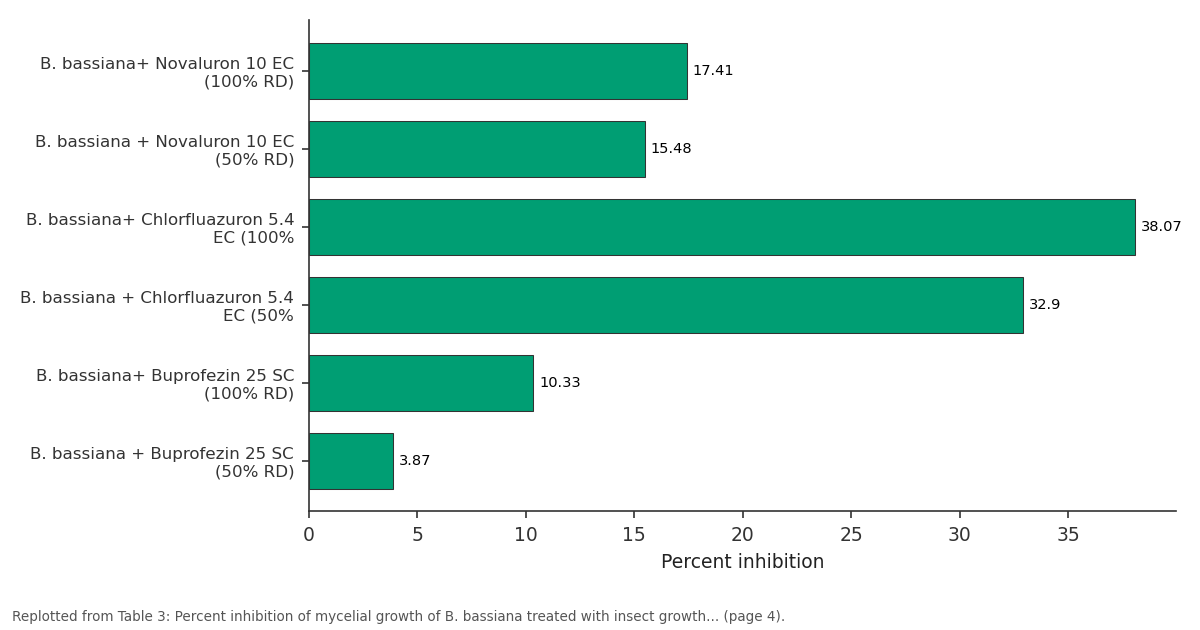
Percent inhibition: B. bassiana+ Novaluron... vs B. bassiana + Novaluron... vs B. bassiana+... vs B. bassiana +... vs B. bassiana+ Buprofezin...
Replotted from Table 3 (page 4) of the original paper. Every bar is the paper's own table value.
View source evidence ↗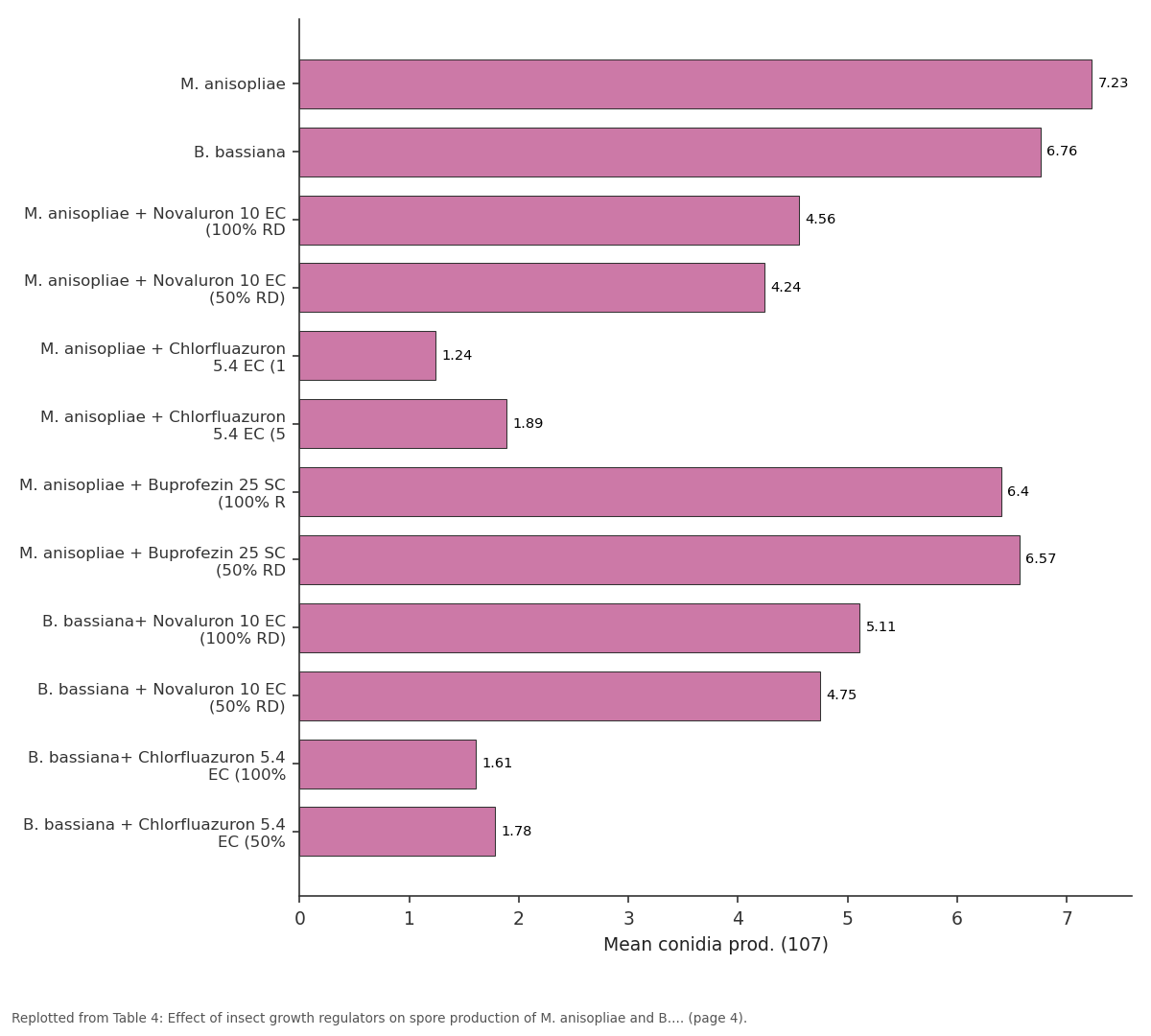
Mean conidia prod. (107): M. anisopliae vs B. bassiana vs M. anisopliae +... vs M. anisopliae +... vs M. anisopliae +...
Replotted from Table 4 (page 4) of the original paper. Every bar is the paper's own table value.
View source evidence ↗Figures & tables
From the original paper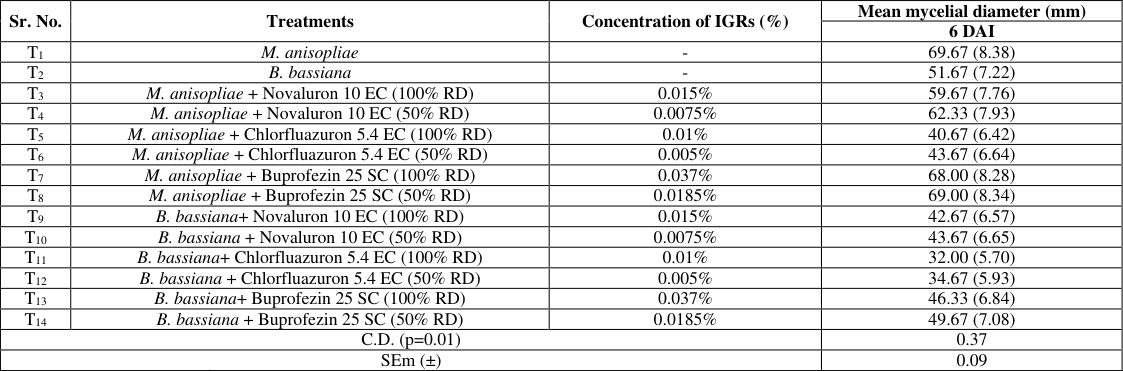 Table 1
 Table 2
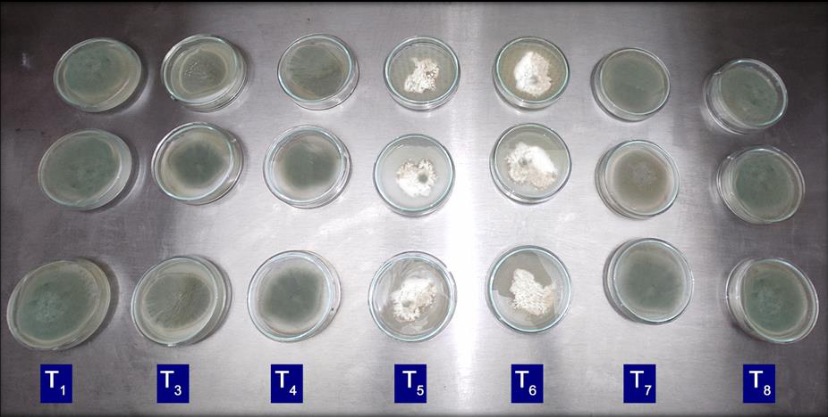 Figure 1
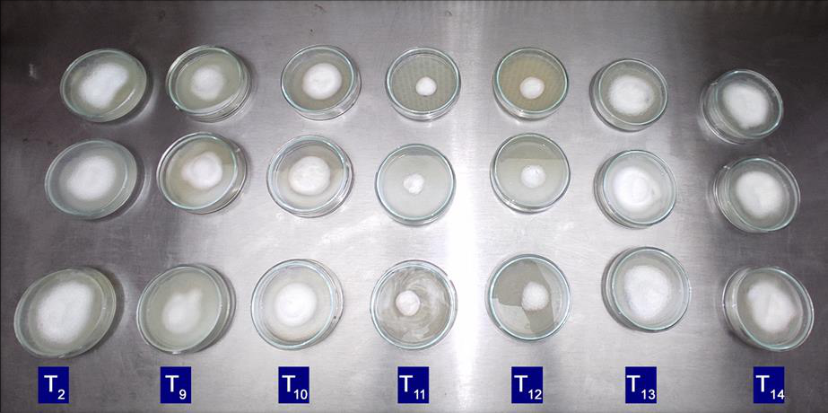 Figure 2
 Table 3
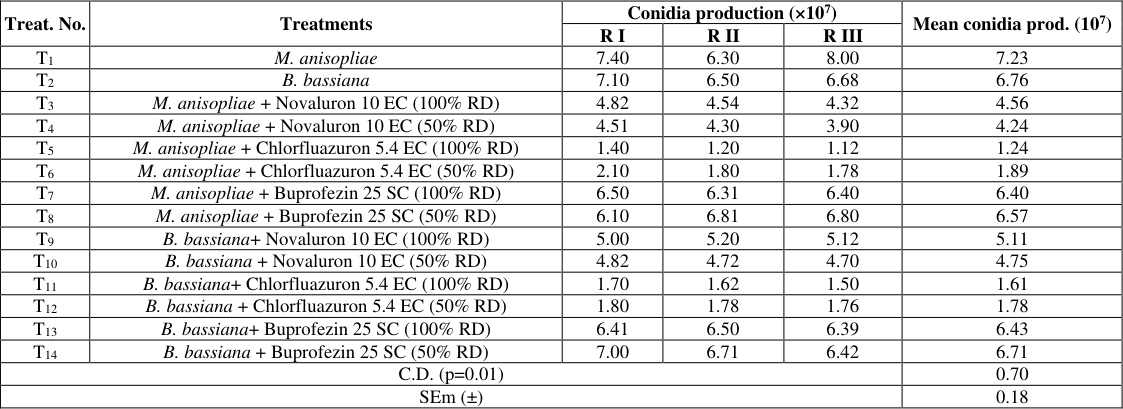 Table 4
Introduction
Entomopathogenic fungi (EPF) are the microorganisms that are pathogenic to insects. They typically cause the infection when particular insect comes in the contact with spores of the fungal species. Russian zoologist Elie Metchnikoff found Metarhizium anisopliae (previously Entomophthora anisopliae) in the late nineteenth century Similarly, Agostino Bassi in 1835 was established Beauveria bassiana (formerly Botrytis bassiana). Chitin synthesis inhibitors is one of the groups of insect growth regulators found to be effective in inhibiting chitin synthesis in vivo by blocking the chitin synthetase enzyme activity. Novaluron acts by both ingestion and contact (Ishaaya et al., 2003) [4] . Chlorfluazuron acts by inhibiting biosynthesis of chitin in the cuticle of insects which leads to cause the loss of cuticle elasticity and firmness, and it is also acts as anti-moulting agent results in abortive moulting. Buprofezin is one of the first IGRs which mainly against sucking pests. It expresses its activity at the time of moulting due to which insects are not able to shed their cuticle and die during this process (De Cock and Degheele, 1998) [2] . Combination of EPF with chemical pesticides not only reduce time to kill the target pests but also produce additive or synergistic effects provided they should be compatible with each other. Generally, factors responsible for determining compatibility of EPF with insecticides or pesticides are spore production and toxicity index of EPF. On the basis of compatibility, we can use compatible EPF and chemical pesticide combinations for control of target pests (Sain et al., 2022) [7] . This study will help to understand compatible IGR and EPF combinations so that they can be used in management of different pests.
Material and Methods
Material and Methods
Effect of insect growth regulators on mycelial diameter of M. anisopliae and B. bassiana
The in vitro compatibility of entomopathogenic fungi with insect growth regulators was tested using poisoned food technique and recorded vegetative and reproductive growth of fungus. Accordingly, quantity of each insect growth regulator as per their field recommended and half of the field recommended dose of each insect growth regulator were calculated (for 60 ml potato dextrose agar medium). It was added separately in 250 ml conical flask containing molten potato dextrose agar which was dispense in three petriplates (7 cm diameter) in order to maintain three replications. After solidification of PDA 5 mm disc of either Metarhizium anisopliae or Beauveria bassiana was placed in the centre of each petri plate. They were incubated at ambient room temperature in laminar air flow and observations of mycelial growth of fungal colony in millimetre (mm) on 1 st , 2 nd , 3 rd , 4 th , 5 th and 6 th day/days after inoculation on PDA were measured. Similarly, reproductive growth of fungus was calculated by counting spores produce by fungi in each treatment after 15 days of inoculation.
Percent inhibition of entomopathogenic fungi treated with insect growth regulators
Percent inhibition of both entomopathogenic fungi viz., M. anisopliae and B. bassiana was calculated separately by considering the treatments of M. anisopliae and B. bassiana alone as control. It was calculated by using the formula given by Vincent (1947) [9] and recorded data of mycelial growth of fungi.
Where, I= Percent inhibition (%) C= Growth of fungus in control plate (mm) T= Growth of fungus in treatment plate (mm)
Effect of insect growth regulators on spore production of M. anisopliae and B. bassiana
To study the effect of IGR on spore production of entomopathogenic fungi, 5 mm disc of 10 days old culture of M. anisopliae and B. bassiana grown on PDA plates, containing desired concentrations of an IGRs were put in test tubes containing 10 ml sterilized distilled water and 0.01% Tween 80. Mixed thoroughly using vortex mixer, strained from double layer sterilized muslin cloth and after that conidia were counted by using haemocytometer. Number of conidia per ml was calculated using following formula; [8] . Similarly, Reddy et al. (2020) [6] reported more radial growth of Metarhizium anisopliae and Beauveria bassiana in the treatments comprised of half the recommended dose of Buprofezin than the treatments comprised of full recommended dose of Buprofezin. Joshi et al. (2018) [5] tested the compatibility of Beauveria bassiana and Metarhizium anisopliae with novaluron 10 EC and found Novaluron at recommended dose was compatible with both the fungi.
Percent inhibition of entomopathogenic fungi treated with insect growth regulators
As data shown in the table 2, percent inhibition of mycelial growth of M. anisopliae was least when it was grown on media incorporated with buprofezin 50% RD i.e., 0.96 percent followed by buprofezin 100% RD (2.39percent), novaluron 50% RD (10.53 percent) and novaluron100% RD (14.35 percent). Percent inhibition of mycelia growth of M. anisopliae was higher when it was grown on media incorporated with Chlorfluazuron 50% RD and 100% RD i.e., 37.31 percent and 41.62 percent, respectively. 3 revealed that all the insect growth regulators evaluated were caused some inhibitory actions on the mycelial growth of fungus B. bassiana. Least percent inhibition of mycelial growth of B. bassiana (3.87 percent) was recorded by the action of buprofezin at its 50% RD. Buprofezin at its 100% RD stood next in terms of less inhibition of mycelial growth (10.33 percent). Next treatment in order of exhibiting less inhibition of mycelial growth of B. bassiana was novaluron at its 50% RD (15.48percent) followed by novaluron at its 100% RD (17.41percent). However, maximum percent inhibition of mycelial growth of B. bassiana were recorded in the treatments comprised of chlorfluazuron 50% RD (32.90 percent) and 100% RD (38.07 percent). [6] reported 5.53% and 6.52% inhibition in mycelial growth of Metarhizium anisopliae and Beauveria bassiana due to 50% RD and 15.71% and 19.96% at 100% RD of buprofezin, respectively. Joshi et al. (2018) [5] reported 24.32% and 23.45% inhibition in mycelial growth of Metarhizium anisopliae and Beauveria bassiana in the treatment of recommended dose of novaluron 10 EC which is in accordance with the present findings.
| Sr. No. | Treatments | Conc. (%) | Mean mycelial growth (mm) | Percent inhibition |
|---|---|---|---|---|
| 1. | M. anisopliae + Novaluron 10 EC (100% RD) | 0.015 | 59.67 | 14.35 |
| 2. | M. anisopliae + Novaluron 10 EC (50% RD) | 0.0075 | 62.33 | 10.53 |
| 3. | M. anisopliae + Chlorfluazuron 5.4 EC (100% RD) | 0.01 | 40.67 | 41.62 |
| 4. | M. anisopliae + Chlorfluazuron 5.4 EC (50% RD) | 0.005 | 43.67 | 37.31 |
| 5. | M. anisopliae + Buprofezin 25 SC (100% RD) | 0.037 | 68.00 | 2.39 |
| 6. | M. anisopliae + Buprofezin 25 SC (50% RD) | 0.0185 | 69.00 | 0.96 |
| 7. | Control (M. anisopliae) | - | 69.67 | - |
Table text extracted from the original PDF; superscript letters are shown inline. The original table image is below.
View original table image
Effect of insect growth regulators on spore production of M. anisopliae and B. bassiana
Table 4 indicates that all treatments showed reductions in conidia production than that of T 1-M. anisopliae (7.23×10 7 spores per ml) and T 2 -B. bassiana (6.76×10 7 spores per ml). Amongst different treatments wherein PDA is incorporated with insect growth regulator, treatment T 8 -M. anisopliae + Buprofezin 25 SC (50% RD) and T 14 -B. bassiana+ Buprofezin 25 SC (50% RD) recorded statistically equal conidial production i.e., 6.71×10 7 spores per ml and 6.57 ×10 7 spores per ml, respectively. It was followed by T 13 -B. bassiana+ Buprofezin 25 SC (100% RD) with 6.43 ×10 7 spores per ml and was at par with T 7 -M. anisopliae + Buprofezin 25 SC (100% RD) with 6.40 ×10 7 spores per ml. The next effective treatment in order of spore production was T 9 -B. bassiana+ Novaluron 10 EC (100% RD) with 5.11 ×10 7 spores per ml and was at par with T 10 -B. bassiana+ Novaluron 10 EC (50% RD) with 4.75 ×10 7 spores per ml andT 3 -M. anisopliae + Novaluron 10 EC (100% RD) with 4.56 ×10 7 spores per ml. The latter two treatments were also at par with T 4 -M. anisopliae + Novaluron 10 EC (50% RD) with 4.24 ×10 7 spores per ml. The treatment T 6 -M. anisopliae + Chlorfluazuron 5.4 EC (50% RD) recorded comparatively less spores i.e., 1.89×10 7 per ml and was at par with T 12 -B. bassiana+ Chlorfluazuron 5.4 EC (50% RD) with 1.78×10 7 spores per ml and T 11 -B. bassiana+ Chlorfluazuron 5.4 EC (100% RD) with 1.61×10 7 spores per ml. The latter two treatments were also at par with T 5 -M. anisopliae + Chlorfluazuron 5.4 EC (100% RD) which recorded lowest spores i.e., 1.24×10 7 per ml. Present findings got strong support from the findings of Cuthbertson et al. (2005) [1] who revealed that exposure of spores of entomopathogenic fungi Lecanicellium lecanii to buprofezin provided an acceptable level of spore germination. Hassan et al. (1994) [3] also found that buprofezin was relatively harmless to Lecanicellium muscarium.
| Treat. No. | Treatments | Conidia production (×107) | — | — | Mean conidia prod. (107) |
|---|---|---|---|---|---|
| R I | R II | R III | |||
| T1 | M. anisopliae | 7.40 | 6.30 | 8.00 | 7.23 |
| T2 | B. bassiana | 7.10 | 6.50 | 6.68 | 6.76 |
| T3 | M. anisopliae + Novaluron 10 EC (100% RD) | 4.82 | 4.54 | 4.32 | 4.56 |
| T4 | M. anisopliae + Novaluron 10 EC (50% RD) | 4.51 | 4.30 | 3.90 | 4.24 |
| T5 | M. anisopliae + Chlorfluazuron 5.4 EC (100% RD) | 1.40 | 1.20 | 1.12 | 1.24 |
| T6 | M. anisopliae + Chlorfluazuron 5.4 EC (50% RD) | 2.10 | 1.80 | 1.78 | 1.89 |
| T7 | M. anisopliae + Buprofezin 25 SC (100% RD) | 6.50 | 6.31 | 6.40 | 6.40 |
| T8 | M. anisopliae + Buprofezin 25 SC (50% RD) | 6.10 | 6.81 | 6.80 | 6.57 |
| T9 | B. bassiana+ Novaluron 10 EC (100% RD) | 5.00 | 5.20 | 5.12 | 5.11 |
| T10 | B. bassiana + Novaluron 10 EC (50% RD) | 4.82 | 4.72 | 4.70 | 4.75 |
| T11 | B. bassiana+ Chlorfluazuron 5.4 EC (100% RD) | 1.70 | 1.62 | 1.50 | 1.61 |
| T12 | B. bassiana + Chlorfluazuron 5.4 EC (50% RD) | 1.80 | 1.78 | 1.76 | 1.78 |
| T13 | B. bassiana+ Buprofezin 25 SC (100% RD) | 6.41 | 6.50 | 6.39 | 6.43 |
| T14 | B. bassiana + Buprofezin 25 SC (50% RD) | 7.00 | 6.71 | 6.42 | 6.71 |
| C.D. (p=0.01) | 0.70 | ||||
| SEm (±) | 0.18 |
Table text extracted from the original PDF; superscript letters are shown inline. The original table image is below.
View original table image
Conclusion
Results revealed that the entomopathogenic fungus M. anisopliae grows more rapidly than B. bassiana on PDA media. The growth of both these fungi is adversely affected when PDA media is incorporated with either half or full dose of any of the three insect growth regulators tested. However, amongst the three insect growth regulators buprofezin 25 SC was found most compatible with both the fungi followed by Novaluron 10 EC while chlorfluazuron 5.4 EC was less compatible as it recorded least fungal growth of both entomopathogenic fungi. Similarly, half recommended dose of an insect growth regulator was found more compatible than its full dose. The highest number of spores were recorded in M. anisopliae grown on media without incorporation of IGR and was followed by B. bassiana grown on media without incorporation of IGR. When both the fungi were grown on the PDA media incorporated either with half or full dose of IGRs, maximum spore production by the fungi were recorded when they were grown on media incorporated with buprofezin 25 SC at its half of field recommended dose.
Figures and tables from the paper
| Sr. No. | Treatments | Concentration of IGRs (%) | Mean mycelial diameter (mm) |
|---|---|---|---|
| 6 DAI | |||
| T1 | M. anisopliae | - | 69.67 (8.38) |
| T2 | B. bassiana | - | 51.67 (7.22) |
| T3 | M. anisopliae + Novaluron 10 EC (100% RD) | 0.015% | 59.67 (7.76) |
| T4 | M. anisopliae + Novaluron 10 EC (50% RD) | 0.0075% | 62.33 (7.93) |
| T5 | M. anisopliae + Chlorfluazuron 5.4 EC (100% RD) | 0.01% | 40.67 (6.42) |
| T6 | M. anisopliae + Chlorfluazuron 5.4 EC (50% RD) | 0.005% | 43.67 (6.64) |
| T7 | M. anisopliae + Buprofezin 25 SC (100% RD) | 0.037% | 68.00 (8.28) |
| T8 | M. anisopliae + Buprofezin 25 SC (50% RD) | 0.0185% | 69.00 (8.34) |
| T9 | B. bassiana+ Novaluron 10 EC (100% RD) | 0.015% | 42.67 (6.57) |
| T10 | B. bassiana + Novaluron 10 EC (50% RD) | 0.0075% | 43.67 (6.65) |
| T11 | B. bassiana+ Chlorfluazuron 5.4 EC (100% RD) | 0.01% | 32.00 (5.70) |
| T12 | B. bassiana + Chlorfluazuron 5.4 EC (50% RD) | 0.005% | 34.67 (5.93) |
| T13 | B. bassiana+ Buprofezin 25 SC (100% RD) | 0.037% | 46.33 (6.84) |
| T14 | B. bassiana + Buprofezin 25 SC (50% RD) | 0.0185% | 49.67 (7.08) |
| C.D. (p=0.01) | 0.37 | ||
| SEm (±) | 0.09 |
Table text extracted from the original PDF; superscript letters are shown inline. The original table image is below.
View original table image
| Sr. No. | Treatments | Conc. (%) | Mean mycelial growth (mm) | Percent inhibition |
|---|---|---|---|---|
| 1. | B. bassiana+ Novaluron 10 EC (100% RD) | 0.015 | 42.67 | 17.41 |
| 2. | B. bassiana + Novaluron 10 EC (50% RD) | 0.0075 | 43.67 | 15.48 |
| 3. | B. bassiana+ Chlorfluazuron 5.4 EC (100% RD) | 0.01 | 32.00 | 38.07 |
| 4. | B. bassiana + Chlorfluazuron 5.4 EC (50% RD) | 0.005 | 34.67 | 32.90 |
| 5. | B. bassiana+ Buprofezin 25 SC (100% RD) | 0.037 | 46.33 | 10.33 |
| 6. | B. bassiana + Buprofezin 25 SC (50% RD) | 0.0185 | 49.67 | 3.87 |
| 7. | Control (B. bassiana) | - | 51.67 | - |
Table text extracted from the original PDF; superscript letters are shown inline. The original table image is below.
View original table image
References
9 in the original paper- Cuthbertson AG, Walters KF, Deppe C. Compatibility of the entomopathogenic fungus Lecanicillium muscarium and insecticides for eradication of sweet potato whitefly, Bemisia tabaci. Mycopathologia. 2005;160:35-41.
- De Cock A, Degheele D. Buprofezin: a novel chitin synthesis inhibitor affecting specifically planthoppers, whiteflies and scale insects. Insecticides with Novel Modes of Action: Mechanisms and Application. 1998;74-91.
- Hassan SA, Bigler F, Bogenschu tz H, Boller E, Brun J, Calis JNM, et al. Results of the sixth joint pesticide testing programme of the IOBC/WPRS-working group ''Pesticides and Beneficial Organisms''. Entomophaga. 1994;39:107119.
- Ishaaya I, Kontsedalov S, Horowitz AR. Novaluron (Rimon), a novel IGR: potency and cross-resistance. Archives of Insect Biochemistry and Physiology: Published in Collaboration with the Entomological Society of America. 2003;54(4):157-164.
- Joshi M, Gaur N, Pandey R. Compatibility of entomopathogenic fungi Beauveria bassiana and Metarhizium anisopliae with selective pesticides. Journal of Entomology and Zoology Studies. 2018;6(4):867-872.
- Reddy BN, Lakshmi VJ, Laha GS, Maheswari TU. Compatibility of entomopathogenic fungi with buprofezin for management of brown planthopper, Nilaparvata lugens Stal (Delphacidae: Hemiptera) in rice. Journal of Plant Development Sciences. 2020;12(1):35-38.
- Sain SK, Monga D, Kranthi S, Hiremani NS, Nagrale DT, Kumar R, et al. Evaluation of the bioefficacy and insecticide compatibility of entomopathogens for management of whitefly (Hemiptera: Aleyrodidae) on upland cotton under laboratory and polyhouse conditions. Neotropical Entomology. 2022;51(4):600-612.
- Sain SK, Monga D, Kumar R, Nagrale DT, Hiremani NS, Kranthi S. Compatibility of entomopathogenic fungi with insecticides and their efficacy for IPM of Bemisia tabaci in cotton. Journal of Pesticide Science. 2019;44(2):97-105.
- Vincent JM. Distortion of fungal hyphae in the presence of certain inhibitors. Nature. 1947 Jun 21;159(4051):850.
Cited by 1
From OpenAlex, OpenCitations and reference lists read by Scinovex
- Compatibility of insect growth regulators from natural and synthetic origins with mycoinsecticides used in the corn leafhopper management ↗
Matheus Rakes, Maíra Chagas Morais, Michele Trombin de Souza, Mireli Trombin de Souza, Daniel Bernardi, Anderson Dionei Grützmacher et al. · Crop Protection · 2025
❝ 0